The CHURCH has LEFT the building AGAIN…
A Summer of Serving: Bringing Hope and the Gospel to Appalachian Communities
by Cup&Cross Ministries, Intl.
Growing up in the Appalachian Mountains has made ministry to this region deeply personal. The people and the challenges faced by rural families are not distant realities to us as humble messengers of the Gospel. Because of our commitment to honoring the dignity of every individual, we have never been a ministry that uses images of poverty or vulnerable children to raise support. For ethical reasons and out of respect for the families we serve, this report will be presented through words rather than photographs.
This summer, we have been blessed with numerous opportunities to minister throughout the rural communities from Tennessee to North Carolina. Each opportunity has been a reminder that ministry is often found in simple acts of compassion and being open to the tug on your heart to act where and how He commands. Our summer outreach began with an invitation to participate in a community event held at the county courthouse, where we helped provide shoes, school supplies, and food for more than 150 children. This initial partnership opened the door for further ministry involvement, including helping prepare and pack more than 300 ministry bags filled with Bible devotions, crafts, and resources designed to encourage children spiritually.
Following, we partnered with a local Baptist church to distribute vitamins we donated to children participating in their summer program. This was an unplanned event that from start to finish literally happened within 24 hours. For many families, basic health resources that we often overlook are difficult to afford. These moments remind us of the many blessings we experience each day and the importance of sharing those blessings with others.
Through the Cup & Cross Homeschool Network, we were also able to provide homeschool curriculum and educational resources to families within our community. Supporting parents who are committed to educating their children while strengthening their faith continues to be an important part of our mission. And during this election season, we have had the opportunity to engage with several candidates and community leaders to raise awareness about the importance of homeschool independence, parental rights, and educational freedom. Building upon these conversations, we continued advocating for families and strengthening relationships with local leaders which is apparent by Cup & Cross successfully working with the county commissioners to adopt our county as the first homeschool sanctuary in the Nation. We also are continuing to serve in the Summer Serve Project of the First Lady of our State as well.
Throughout the summer, we have also had the privilege of volunteering with several local churches during their Vacation Bible School programs and three week-long summer camps one of which was personally hosted to teach the Eastern European community in our area. These opportunities have allowed us to invest directly into the next generation by teaching children the Word of God and building relationships within our community which is so important to us. Jesus did ministry by “walking around” and it is one that should not be overlooked.
Our passion for reaching children with Biblical truth throughout the summer led to a unique divine connection beyond our local area. We traveled to North Carolina to minister to children within the Cherokee community of the Eastern Band of Cherokee Indians, the only federally recognized Native American tribe in North Carolina. This opportunity allowed us to share the love of Christ with our actions while learning from this historic community.
As we look ahead, we ask for prayer that God will continue to open doors and provide favor so that this relationship may grow and develop over the coming months. We are grateful for every opportunity to serve, knowing that even the smallest acts of kindness can become powerful expressions of God’s love.
“And let us not grow weary of doing good, for in due season we will reap, if we do not give up.” – Galatians 6:9
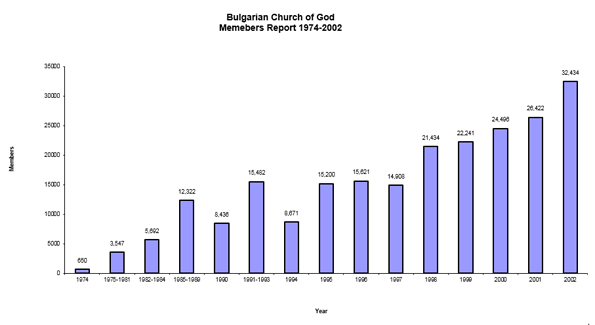
Another denomination splits from the Bulgarian Church of God
One more denomination has split from the Bulgarian Church of God. After a year of struggles and dilemmas, the annual report indexing the state of the church shows a new denomination registered with the municipality court in the capital Sofia. The new Philadelphia church has emerged from an association of Romani pastors with a similar name that has existed and operated for almost 15 years. This is the 11th officially registered fraction leaving the denomination since the split of 2005. Two more churches, Mostar and Rebirth, too seem to have ceased meetings within the last year after the sale of the Bulgarian Ministry Center in the capital Sofia. The Center which broke ground in 2001 and was dedicated in 2011, hosted a number of strategic Church of God congregations during its decade of operation. Since 2005, most older Romani congregations exist with dual registration alongside the national alliance of Church of God-United (unitarian). With the current split, the total number of fractions separating from the original denomination now exceeds 13 (if not 14):
- Bulgarian Church of God (27.12.1990)
- Church of God in Bulgaria (23.01.2006)
- God’s Church (13938/2006: 07.02.2007)
- Church of God-12 (Sofia, Rodostono)
- New Generation Church of God (05.04.2000)
- Bethesda Church of God (27.12.2010)
- BulLiv Church of God (15.01.2000)
- New Life Church of God (06.11.2000)
- Bulgarian Church of God – Sofia (4996/2003 Sredetz, E.Georgiev Bul. 2, apt. 4)
- Bridge Church of God (50/2013)
Aftermath of the April Uprising, 1876
Following the suppression of the April Uprising, horrific massacres were carried out in Batak, Perushtitsa, and other places in southern Bulgaria. In northern Bulgaria, the uprising in the Tarnovo district was also suppressed and its principal leaders executed. All of this adversely affected the evangelical work of both missions north and south of the Balkan range. Evangelical preachers were forced to limit their movements and make do with greatly reduced gatherings. Despite this, Bishop Andrews concluded his report to the Board in New York with the following recommendation:
“As soon as a more favorable opportunity presents itself for the Bulgarian mission, brethren from America must be sent in accordance with the purpose adopted when the work received its new impetus. This must be done because, in the event of death, transfer of missionaries to America, or proven incapacity on the part of the brethren now here, their number will not be sufficient.”
The Year 1877: A dark cloud hung over the mission. Yet the missionaries maintained unwavering faith in God. As often happens, light began to appear in the darkness. In Svishtov, Pastor Challis noticed encouraging signs early in the year. Church members, almost without exception, attended the prayer and class meetings. Two were received into full membership, and six on trial, in one of the villages within the Svishtov circuit. The Sunday school was well attended, and Pastor Challis translated into Bulgarian the questions for the Sunday lessons. Pastor Lounsbury likewise began his work in Tarnovo under encouraging conditions. Initially the meetings were well attended, but threats soon caused a significant decline in participation. Gavrail Iliev spent most of his time outside Ruse, in towns and villages where the massacres had occurred. Aid was distributed to 1,620 families. The Bulgarian preachers did everything they could in the afflicted areas of northern Bulgaria.
Lovech, 1877: Pastor and Eight Members Killed
During the Russo–Turkish War of 1877, when Russian forces captured Lovech and later withdrew temporarily, bashi-bazouk bands re-entered the town and slaughtered many people. According to some accounts, a massacre occurred at the place where the evangelicals gathered. Eight people were killed, including the preacher Nikola Voynov. It is unclear why this is omitted in the manuscripts of Pastor St. Tomov, though the event is confirmed.
Yordan Ikonomov then completing his theological course at the seminary in Drew, USA, was sent that same year to work in Bulgaria. The superintendent appointed him to teach the young men preparing for the ministry.
The Death of Mrs. Challis: In April 1877 Russia declared war on Turkey with the aim of liberating Bulgaria from Ottoman rule. Mrs. Flocken fell ill, and Mrs. Challis was holding a small child in her arms. Pastor Flocken believed it best to take the women to Germany and then return to Bulgaria. Just as he was preparing to carry out this plan, Pastor Challis contracted smallpox, and his devoted wife refused to leave him. The disease spread to the child, making separation impossible. Flocken departed with his wife, but upon arriving in Budapest, Mrs. Flocken was unable to continue the journey. He placed her in a Christian hospital, where the next day she gave birth to a daughter. Eager to return to Ruse, he soon learned the sorrowful news of the death of Mrs. Challis, who had died of smallpox.
Meanwhile Russian troops were advancing toward Svishtov, and the superintendent advised Pastor Challis to take his child to the United States, as he would be unable to care for it in Bulgaria. Following this counsel, Pastor Challis left for America accompanied by Miss Siika Dimitrova, daughter of Grandfather Dimitar – one of the first evangelicals in Svishtov – who agreed to care for the child. They arrived in New York in June 1877. Upon the advice of the mission secretaries and the bishop, he took up work in his Annual Conference until the end of the war in Bulgaria. Flocken received word from Budapest that his wife and newborn child were not expected to live long. He summoned Lounsbury to Ruse and left for Budapest. The child died, but by God’s mercy his wife survived.
The Russians crossed the Danube, and the missionaries were forced to withdraw. The mission was divided by the warring armies. Under these circumstances the Board advised Flocken and Lounsbury to return to the United States, and they departed. Pastor Flocken arrived in New York on 1 February 1878, and Lounsbury several weeks earlier.
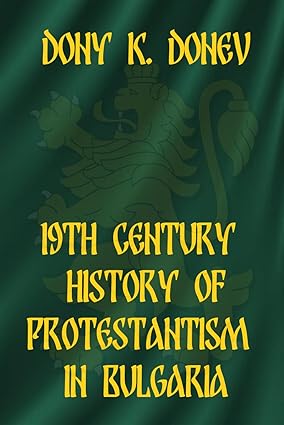 Dony K. Donev, D.Min., is a prominent researcher and author specializing in Bulgarian Protestant, Evangelical, and Pentecostal history, with over three decades of study. His work, including 19th Century History of Protestantism in Bulgaria and The Unforgotten: Historical and Theological Roots of Pentecostalism in Bulgaria, documents the development of these movements, their suppression under Communism, and the subsequent post-1989 revival. Key aspects of Donev’s research on Bulgarian Protestant history include:
Origins (19th Century): Protestant work began in the 1800s, with denominations like Congregationalists (1856), Methodists (1857), and Baptists (1865) establishing missions, culminating in the first Bulgarian Protestant Church in 1871. Donev also highlights the 1871 publication of the Protestant Bulgarian Bible translation. His research, often in collaboration with the Institute of Bulgarian Protestant History, has focused on preserving, digitizing, and recovering documents, including church diaries, photographs, and, in some cases, saving records from destruction during the communist era.
Lucy F. Farrow: The Forgotten Apostle of Azusa
Lucy F. Farrow was born in Portsmouth, VA. Unfortunately, her origins there have not been yet fully traced. Her involvement appeared around the summer of 1905 while working as governess in Parham’s home in Houston.
While in Houston, Farrow met Charles Parham, who came there from Baxter Springs, Kansas, in October 1905 and held meetings in Bryan Hall. Parham was preaching about the earlier outpouring of the Holy Spirit that had occurred in his Bethel Bible College in Topeka, Kansas, in January 1901.
Other sources claim, Lucy F. Farrow received the Holy Ghost a little bit earlier on September 6, 1905 after Parham opened up a month-long meeting in Columbus, Kansas. Along with Parham she witnessed events unfold in Zion, Illinois, where John Alexander Dowie was faltering.
Lucy Farrow was the niece of renowned black abolitionist Frederick Douglass. She was serving as pastor of a holiness church in Houston in 1905 when Charles Parham engaged her to work as a governess in his home. Farrow carried the Pentecostal embers back to Texas, on to her home state Virginia and later to Liberia. Her aptitude for igniting the supernatural gifts among others was evident at a 1906 camp meeting near Houston when some 25 seekers stood lined up in a row in front of her. When Farrow “laid hands upon them…many began to speak in tongues at once.”
Although William J. Seymour is acknowledged as the leader of the Azusa Street Revival, it was a black woman, Lucy Farrow, who provided the initial spark that ignited that revival. About the time when Seymour departed to Los Angeles in January of 1906, Lucy Farrow and J. A. Warren also arrived there independently. Other sources claim, they had been sent by Parham to help Seymour with his meetings.
Seymour began his meetings at the Santa Fe Mission on February 24, 1906 but was quickly shut down by the pastor Julia W. Hutchins on March 4, 1906 after a consultation with the South Californian Holiness Association.
The meetings then moved to 214 Bonnie Brae St., home of Richard and Ruth Asberry. As a result, Edward S. Lee was the first one was baptized in the Spirit and spoke in other tongues in the late afternoon when William J. Seymour and Lucy F. Farrow laid hands on him for healing at his house. At 7:30 p.m., the group went back to Bonnie Brae for the evening meeting and before the night was over, Jennie Evans Moore and several others joined him.
It has been said that no one associated with the prayer meeting led by Seymour had spoken in tongues until Farrow, at Seymour’s request, arrived on the scene and began laying her hands on people and seeing God fill them with the Holy Spirit as in the book of Acts. She also ministered with power across the southern United States and in Liberia in West Africa. She lived out her final years in Los Angeles, where there were reported healings and remarkable answers to prayer through her ministry.
Were Molokans the first to Speak in Tongues at Azusa?
Adopted from Andrei Conovaloff
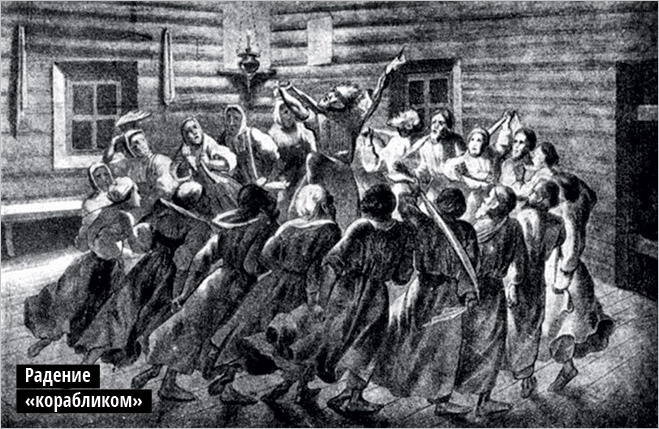
American Molokan Dukh-i-zhiznik (lit. living in the Spirit) oral history (documented in the Book of the Sun: Spirit and Life, Dukh i zhizn’) reports that Molokani and Pryguny received the “outpouring of the Holy Spirit” in the Milky Waters region (now in Ukraine) in 1833. The diary of Vassili V. Verestchagin documents that Pryguny (lit. leapers) in the Caucasus in the early 1860s spoke in tongues, jumped to exhaustion, and held hands up in the air for more than an hour. These charismatic practices continue among Dukh-i-zhizniki in the U.S. and Australia.
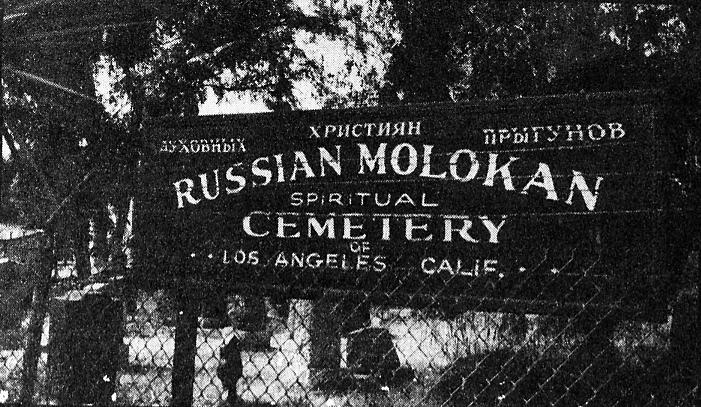
From 1906 to 1909, the Apostolic Faith Mission conducted three services a day, seven days a week, for over three years or 1000+ services! Thousands of seekers received the “tongues” baptism, including many Molokani and Pryguny. Also many public Pentecostal revivals were conducted in tent meetings on Oake’s lot and other locations around the Flats area slums were Russian settled. English speaking Pryguny and other Russians immigrants often translated at the services. Oake’s lot later became Pecan Playground, at First and Pecan Streets.
In Molokans in America (pages 101-102, ch. 5), John K. Berokoff reports about the connection between Prygun leader Philip Mikhailovich Shubin and the early Pentecosts:
“During his 27 years in America he was the outstanding speaker and orator of the brotherhood with a wide acquaintance among non-Molokans , not infrequently taking a choir of singers to Pentecostal church meetings where he preached and explained the Molokan reasons for their migration. It was his wisdom, his profound knowledge of the scriptures plus his wide knowledge of Russian literature that enabled him to repel the periodic attempts by leaders of neighboring denominations—Baptists, Pentecostals, etc.—to proselytize the Molokan people …”
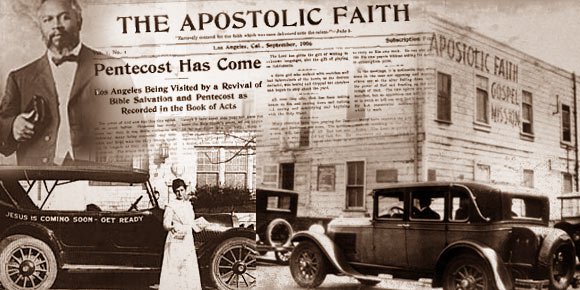
More evidence of connections between the Azusa Street Revival and the Pryguny is reported in the newspaper The Apostolic Faith, which was distribute free to 50,000 subscribers, when the population of Los Angeles was 250,000. Many Russian sectarians in Flats knew about this church and saw this free paper, especially since it reported about them in the first issue, the church was within walking distance, and elders exchanged visits.
1906 September — The Apostolic Faith (Volume 1 Number 1) — The first edition of the newspaper reports that Apostolic Faith Mission members spoke at a Prygun prayer meeting. In 1906, Pryguny held Sunday services at the Bethlehem Institutional Church and the Stimson-Lafayette Industrial School, and welcomed guests at both locations which were 1/2 block from each other and about 1/4 mile east of the Apostolic Faith Mission. The Pentecosts invited the Pryguny to attend their meetings, which many did with a translator:
RUSSIANS HEAR IN THEIR OWN TONGUE
“Different nationalities are now hearing the Gospel in their own “tongue wherein they were born.” Sister Anna Hall spoke to the Russians in their church in Los Angeles, in their own language as the Spirit gave utterance. They were so glad to hear the truth that they wept and even kissed her hands [showing respect]. They are a very simple, pure, and hungry people for the full Gospel. The other night, as a company of Russians were present in the meeting, Bro. Lee, a converted Catholic, was permitted to speak [translate] their [Russian] language. As he spoke and sang, one of the Russians came up and embraced him. It was a holy sight, and the Spirit fell upon the Russians, as well as on others, and they glorified God.”
1907 April — The Apostolic Faith (Volume 1 Number 7) — The 7th edition reports about the Russian and Armenian Pryguny in the Flats:
“Russians and Armenians in Los Angeles are seeking the baptism. The Armenians have a Pentecostal cottage meeting on Victor street, between 4th and 5th [Now under the I-5 Freeway]. Some have been baptized with the Holy Ghost.”
In his 2006 book, The Azusa Street Mission and Revival: The Birth of the Global Pentecostal Movement, Cecil Robeck reports that in 1906 Los Angeles had a population of 238,000 and was growing at the rate of 3,000 (1.3%) per month, as ~ 4,000 Russian sectarians migrated to the U.S. He mentions the Russian and Armenian Pryguny at least 5 times in his book:
[Page 57] Finally, between 1903 and 1912 several thousand Russians and Armenians arrived in the city, refugees from Russia’s increasingly repressive government. Unlike most Russians, they did not belong to the Orthodox church. They were [Spiritual Christian ethnic] Molokans, literally “milk drinkers,” a name they received because they refused to fast from dairy products during traditional fast days. More importantly, they could be described as a “proto-Protestant'” group, since they had been influenced by some of the sixteenth-century Reformers. They also had a special appreciation for the Holy Spirit. Many of them claimed that they had been directed to leave southern Russia through the gift of prophecy. They engaged in what was often described as ecstatic behavior, jumping and dancing; falling on the floor when they believed that they were possessed of the Holy Spirit to do so; and singing chant-like songs that strongly paralleled the “singing in the Spirit” (a multi-layered, harmony-rich singing in tongues that are unknown to the singers and are believed to be inspired by the Holy Spirit) at the Azusa Street Mission.
[Page 94] As the revival grew … Seymour celebrated the spread of the revival to other congregations … the Russian Molikan [sic] community, … He viewed them as fellow-workers.
[Page 138] While the mission was led by an African American pastor, dominated by and African American membership, and heavily influenced by African American worship patterns, it quickly developed into a multi-ethnic and multiracial congregation. … non-African-Americans did bring their own gifts and experiences. … Recent Russian and Armenian Molokan [Spiritual Christian] immigrants already practiced the unusual jumping and chanting also found at the mission. … This was a revival unlike any other the city of Los Angeles had ever seen … African Americans, Latinos, Armenians, Russians, Swedes, Germans, Italians, Chinese, Japanese, Native Americans, and other ethnic groups … bountiful expressions of ecstatic manifestation such as speaking in tongues, prophesying, claims of dreams and visions, trances, healings, exorcism, and falling “in the Spirit.”
[Page 153] “Singing in the Spirit” accomplished more than an expression of worship, however. It also provided a bridge that brought Russian and Armenian Molokans [Spiritual Christian Jumpers] into the mission — among them the Shakarian and Mushegian families. These families arrived in Los Angeles in the 1905 emigration. The Molokans commonly practiced a king of “sing-song” prayer, a form of vocal prayer and praise that resembled singing in Spirit.” Walking down San Pedro Street in 1905, Demos Shakarian, grandfather of the Demos Shakarian who would later found the Full Gospel Businessman’s Association, and his brother-in-law, Magardich Muchegian, passed the Azusa Street Mission. As they drew near, they heard sounds of praying, singing, and speaking in tongues coming from the mission — expressions that they identified as similar to their own. The single phenomenon of “singing in tongues” convinced Demos to embrace the mission as a place his family could worship. From the moment he heard it, he concluded that God was also beginning to move to America just as He had in their homeland of America and in Russia.”(27)
[Pages 189-190] At the same time a group of Armenians and Russians [Spiritual Christian Pryguny], who had come to Los Angeles in the Molokans immigration, opened cottage prayer meetings on Victoria Street between West Fourth and Fifth Streets that would quickly develop into an Armenians-language Pentecostal church.
American-born Armenian-Prygun historian Joyce Bivin comments: We have a similar story in our community about the Azusa Street Revival. The story goes like this — quoted from a letter by M. Mushagian:
“Our people came to Los Angeles right after the Azusa Street Revival. They used to attend the meetings even though they didn’t understand the American language. They saw that the Holy Spirit was moving there like it did in the Old Country. So they accepted Pentecostal because they believed in Acts 2:4.”
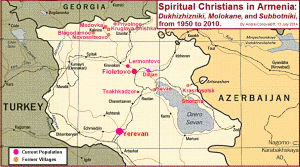 The Armenians apparently were worshiping in this manner, including dancing in the Spirit, (jumping, which my grandmother did at one of the Paskha meetings and the next day mother told me she was healed of whatever affliction she had at the time), prophesying, speaking in tongues, etc. before they came to America. I wasn’t aware the Molokans responded to the Azusa Street meetings. After the Armenians visited the Azusa Street meetings, they eventually changed their identity from Armenian Molokans to Armenian Pentecostals. Though they kept the Molokan traditions in their worship, their theology shifted from focusing on Jesus and M.G. Rudometkin (whose book was next to the Bible on the table) to Jesus’s teachings as defined by Pentecostal/Protestant doctrine.
The first place our people gathered to worship was on Boston Street. The next place was on 431 S. Pecan Terrace, in a large room where my great grandfather eventually turned into a bath house. Then they moved to Gless Street [all in the Flats] and next to Goodrich Blvd before moving to Hacienda Heights. The church today is located in Hacienda Heights, off Hacienda Blvd. on West. It’s the first entrance on the right after you turn on West.
The FORGOTTEN ROOTS OF THE AZUSA STREET REVIVAL
 by HAROLD HUNTER, PH.D.
Writing during the glow of the Azusa Street revival, V.P. Simmons claimed to have 42 years of personal exposure to those who spoke in tongues. Published in 1907 by Bridegroom’s Messenger and circulated as a tract, Simmons chronicled the history of Spirit baptism from Irenaeus (2nd century) up to and including a group from New England whom he personally observed manifesting tongues-speech as they continually partook of a spiritual baptism.1 Identified as Gift People or Gift Adventists, they were widely known for their involvement with spectacular charisms.Early Pentecostal periodicals reported that tongues-speech was known among these groups since the latter part of the 19th century. Some groups were said to number in the thousands.
William H. Doughty, who, by 1855, had spoken in tongues while in Maine, was counted among that number. Elder Doughty moved to Providence, Rhode Island, in 1873 and assumed leadership among those exercising the gifts of the Spirit.3 Doughty’s mantle was passed on to Elder R.B. Swan who, reacting to the Azusa Street revival, wrote a letter explaining that the Gift People in Rhode Island had experienced speaking in tongues as early as 1874–75. (See “The Work of the Spirit in Rhode Island.”) B.F. Lawrence followed Swan’s letter describing an independent account of a woman who spoke in tongues in New York, perhaps prior to 1874, a result of her contact with the Gift People.4 (See “A Wonderful Healing Among The Gift People.”)
Stanley H. Frodsham quotes Pastor Swan’s claim to having spoken in tongues in 1875. Swan speaks of great crowds drawn from five states and specifically mentions his wife — along with Amanda Doughty and an invalid hunchback who was instantly healed — among those who spoke in tongues during this time.
Simmons said that Swan’s group adopted the name “The Latter Rain” after the advent of the Pentecostal movement. Their activities extended throughout New England states, especially Rhode Island, New Hampshire, Massachusetts, Vermont, and Connecticut, with the 1910 Latter Rain Convention held October 14–16 in Quakertown, Connecticut. Frank Bartleman frequently referred to joint speaking engagements with Swan, specifically recounting a 1907 tour that included a convention in Providence, Rhode Island, where he spoke 18 times.
Previously overlooked in related investigations is whether the Doughty family counted among the Gift People overlap with the Doughty who traveled with Frank Sandford. Lawrence attests that Swan’s circle included William H. Doughty’s daughter-in-law, Amanda Doughty, and her unnamed husband, an elder in the Providence congregation.8 Simmons says that William H. Doughty had two sons, the oldest, Frank, who was ordained. Could the unnamed brother of Frank be Edward Doughty, who at the end of the 19th century was part of Sandford’s entourage? So it seems.
Most of the groups named here have similar stories. For example, among the Fire-Baptized Holiness ranks was Daniel Awrey who had spoken in tongues in 1890 in Ohio. His residence was in Beniah, Tennessee, where an outbreak of speaking in tongues was reported in 1899. F.M. Britton wrote about people speaking in tongues in his Fire-Baptized revivals that predated the Azusa Street revival. Also, a revival in Cherokee County, North Carolina, in 1896, that gave the Church of God (Cleveland, Tennessee) many of its early leaders reported an outburst of speaking in tongues among several of the adherents. Given the above accounts, there is some debate as to whether Parham first heard speaking in tongues while at Sandford’s Shiloh in Maine or while he was among Fire-Baptized enthusiasts.
THE FOLLOWING ARE THE CATHOLIC LEADERSHIP OR GROUPS RECORDED TO HAVE SPOKEN IN TONGUES:
• ST. HILDEGARD (1098-1179)
• ANTHONY OF PADUA (1195-1231)
• FRANCISCANS (1200S)
• ANGE CLARENUS (1300)
• VINCENT FERRER (1350-1419)
• STEPHEN, MISSIONARY TO GEORGIA (1400S)
• ST. COLETTE (1447)
• LOUIS BERTRAND (1526-1581)
• THE JANSENISTS (1600)
• JEANNE OF THE CROSS (1450S)
• FRANCIS XAVIER (1506-1552)
SHERRILL’S BOOK ALSO LISTS SOME INDIVIDUALS FROM THE 19TH CENTURY WHO REPORT TONGUES-SPEAKING OCCURRING:
- 1855 V.P. SIMMONS
- ROBERT BOYD (DURING MOODY’S MEETINGS)
- 1875 R.B. SWAN
- 1979 W. JETHRO WALTHALL
- MARIA GERBER
MORE BOOKS to STUDY:
- “THEY SPEAK WITH OTHER TONGUES” BY JOHN L. SHERRILL
- “GLOSSOLALIA: TONGUE SPEAKING IN BIBLICAL, HISTORICAL, AND “PSYCHOLOGICAL PERSPECTIVE” BY FRANK E. STAGG
- “SPEAKING IN TONGUES: A GUIDE” BY MILLS
- “SPEAKING WITH TONGUES: HISTORICALLY AND PSYCHOLOGICALLY CONSIDERED” BY GEORGE CUTTEN.
Ivan Voronaev: Back in the USSR

This book is a Journey!
A journey that has stretched over three continents and a century of time. And a journey that may not be yet over…
This book is Ivan Voronaev’s journey in search of Truth, Spirit and Power. A search for a new name, a new life and a new reality. A journey that redefined his life and the lives of thousands around him. A journey of life that sentenced him to death! And essentially, a journey that became his life as a martyr and reaching into The Life Himself.
This book is my own journey of searching, uncovering, and at times even leaving alone sensitive documents from church denominations, secret government organizations and long-kept personal archives. A journey to discover that instead of being celebrated has mostly met with a push to be silenced and in the case of governments even sealed as top secret.
And finally, this book is our journey as Pentecostals. For a life of self-sacrifice defines us all as a movement. Or at least it should, as it did once upon a time at the start of Modern Day Pentecost. And a journey we all still need to take…
Over the years the research on the life and ministry of Ivan Voronaev faced strong opposition from both Balkan chauvinism and Slavic imperialism. It was constantly challenged for being both misunderstanding and misunderstood. But as a 5th generation Bulgarian Pentecostal, who grew under Communism with family roots traced to the original Pentecostal revival that shook the country in 1920, I do understand. A great-great-granduncle and great-great-grandaunt of mine were taken from the Thracian fields into slavery by the Turks. Two of my great-great-granduncles were hanged on the historic Oak of 100 Rebels, where 1876 uprising leaders were killed by the Ottomans. My great grandmother was heavily persecuted by Bulgarian Orthodoxy for accepting Pentecost in 1928, after my grandmother was miraculously healed on her deathbed of tuberculosis at age four. Both of my grandfathers were prosecuted by the secret Communist police, one for being a Pentecostal preacher and the other for having a successful businessman and landowner during the Communist nationalization of 1958. Neither of my parents was ever allowed to study pass high school or hold a job of any importance, because they came from families of believers and Protestants, treated as “enemy of the state.” My sister and I were saved as teenagers at the fall of the Berlin Wall, but not late enough not to be mocked for calling publicly professing the Lord. For this reason alone, I’ve strived to tell this story with distinct self-realization and personal passion – to understand and be understood.
Protestant Participation in the April Uprising (1876)
A considerable number of Protestants took part in the prematurely erupted April Uprising. Many of them were in the immediate circle of Benkovski, Vasil Volóv, and the other revolutionary apostles. Some Protestants joined during the uprising itself. According to Dimitar Strashimirov, about sixty men from the village of Tserovo, in the Pazardzhik region, joined Benkovski’s detachment under the leadership of Tsvyatko Brŭshkov. At that time Tserovo had 120 households, fifteen of which belonged to Bulgarian Protestants. Two roster protocols were compiled – one larger list for the Orthodox, and a smaller one for the Protestants. The leaders of the Protestant group were K. Teliyski and Nikola Kochov. From the same village came Ivan Cheshírov, one of the “tens-men” (leaders of groups of ten) in the Flying Column. Collective memory has preserved the names of two well-known Protestants from Panagyurishte as active participants in the uprising: Stefan Balabanov, who organized the sewing of clothing for the rebels, and Rad Minev, one of the most experienced arms-bearers of the insurgent town.
Protestants were also involved in the activities of nearly all revolutionary districts. Particularly dramatic was the fate of the evangelist Stoil Findzhikov, the master craftsman of the “cherry-wood cannons,” who became a symbol of the uprising. As a youth, Stoil had worked in a military workshop in Constantinople, where he learned details of firearms manufacture. On the eve of the uprising and during its course, prompted by Volov and Benkovski, he crafted and refined several of these primitive cannons. He fired his last “cherry-wood cannon” at the advancing Ottoman forces beneath Mount Kamenitsa. Under the pressure of the attacking bashi-bozouk irregulars, the defenders fled one by one, and some fell in battle.
The evangelist Petar Donchev from Panagyurishte also took an active part in the April Uprising. During the height of the revolt, he served as a trusted courier between the surrounding towns and villages, employed by both Benkovski and Volov. “Petraki,” as the insurgents called him, displayed remarkable resourcefulness, courage, and self-sacrifice. After the uprising he departed for the United States, where he studied theology, later returning to Bulgaria as pastor in Chirpan. Yet he remained throughout his life a passionate patriot and tireless public figure. He declined every offer of praise or reward after the Liberation with the simple words that “whatever he had done, he had done for God and for the Fatherland.”
In the early summer days of 1876, there existed a real danger that the bloody sacrifice of the Bulgarian people would be silenced. Had this occurred, the central idea of the revolutionary movement – and the sacrifice of tens of thousands – would have faded ingloriously into obscurity. At precisely this moment, Bulgarians from Pazardzhik and Plovdiv succeeded in secretly sending the first accurate and detailed descriptions of the events in the rebellious regions to the Protestant missionaries in Constantinople. A decisive man – Father Tilev of Pazardzhik – was the first to describe the massacres, the fires, the hangings, the mass slaughter of defenseless people, and the full horror experienced by the population in the affected districts. He entrusted the packet of writings to the Croat Ilitch, director of the Austrian post in Plovdiv, asking him to forward it to a friend in Constantinople who would deliver it personally to Dr. Albert Long. The first description was soon followed by a second and a third. Reports and accounts began to appear from other sources as well. Ivan Ev. Geshov of Plovdiv also sent a letter through Andrei Tsanov to Dr. Long, writing, among other things: “Many villages in the Pazardzhik region are in flames and the people are being exterminated. Is there no help or protection for them from somewhere?”
With the help of Andrei Tsanov, Dr. Long translated the letters into English and consulted Dr. George Washburn, director of Robert College. The two agreed that Dr. Long would systematize the shocking materials arriving in Constantinople, while Dr. Washburn would bring them to the attention of influential English and American figures in the Ottoman capital. Thus, the information reached Edwin Pears, an English barrister and correspondent for the Daily News, who sent the first alarming reports. The London editorial office initially refused to believe the atrocious descriptions and demanded telegraphic confirmation from Pears himself. Only then, on 23 June 1876, did the Daily News publish the first horrifying accounts of the tragedy of the Bulgarian people.
Dr. Long and Dr. Washburn presented the matter to the British ambassador Henry Elliot and the American minister Horace Maynard. Elliot stated that the matter had to be investigated and verified before being taken “seriously.” Undeterred, the two missionaries sent a second, even more detailed report to the Daily News, insisting that Britain intervene on behalf of the suffering Christian population. Gradually, the Disraeli–Beaconsfield government was cornered, and the prime minister attempted to deflect the issue by declaring in Parliament that “all this commotion is nothing but coffeehouse gossip.” This statement, however, marked the beginning of the crisis’ most intense phase.
More and more dispatches appeared in the Daily News and in a growing number of British and European newspapers. The Daily Mail sent the well-known American journalist Januarius MacGahan – then in London – to visit the sites of the atrocities and report his findings. Disraeli, for his part, ordered an “urgent inquiry” by the British Embassy in Constantinople. The ambassador entrusted the task to the youngest member of the mission, Walter Baring, along with his father-in-law, Fr. Gauracino, a Levantine, retired British consul, and significant debtor to the Ottoman state.
To the American missionaries it was clear that this move sought to obscure the truth about the massacre of an entire people. They immediately visited Minister Maynard again, insisting that the newly arrived first secretary and U.S. consul general in Constantinople, Eugene Schuyler, depart for the burned and blood-soaked regions of Bulgaria. This was also necessary because they feared that the Ottoman government would refuse permission for Baring to carry out his mission.
Minister Maynard expressed his profound sympathy for the Bulgarian people but explained that his duties in Constantinople did not include intervention in the political affairs of the empire, being limited exclusively to the promotion of “commercial relations.” In his view, only one Great Power – Britain – could exert real influence over Turkey. Dr. Washburn, exasperated, rose from his chair and firmly declared: “I am going directly to the telegraph office to inform the President of the United States that his representative in Turkey refuses to lift a finger to save an entire nation of suffering Christians. And I shall report the same to the American press.” The minister was compelled to ask Washburn to return to his office. With the assistance of Dr. Long, they devised a “skillful maneuver”: Eugene Schuyler would travel to Adrianople and the province “to identify and appoint a suitable correspondent for commercial matters.” Thus, the ground was prepared. Upon MacGahan’s arrival, the two Americans, both fluent in Russian, together with Petar Dimitrov, a graduate of Robert College and secretary of the newspaper Zornitsa, set out for the devastated regions of Bulgaria. They were later joined by the Russian consul in Adrianople, Prince Tsertelev.
Meanwhile, Dr. Jacob Clarke of Plovdiv was the first foreigner to visit Batak immediately after the massacre, accompanied by Pastor Nikola Boyadzhiev of Panagyurishte. Amid the ghastly scene and overwhelming stench, they placed in their suitcase several heads of children and women – still with their hair braided – and carried them back to Plovdiv. These were physical proofs intended to confront certain foreign skeptics, influenced by Ottoman officials, who claimed that the victims had been “rebels” whom the Turks were obliged to eliminate “to preserve order.” Dr. Clarke visited several consuls in Plovdiv and began taking out the severed heads one by one, asking: “Is this a rebel? And is this a rebel?” Britain, and soon all of Europe, recoiled in horror at the slaughter. One of the most renowned British war correspondents, Archibald Forbes, wrote:
“MacGahan accomplished brilliantly his mission of exposing the Turkish atrocities in Bulgaria in 1876. I know of nothing in journalism that surpasses, in language, pathos, and flaming indignation, writing that passed so spontaneously from heart to heart. His call stirred William Gladstone to a convulsive paroxysm of revulsion at the barbarities. It stirred England to the depths of her national soul. You could see people traveling on the railways reading those reports with burning faces and tears in their eyes.”
Throughout this entire dramatic period Dr. Albert Long, though remaining in Constantinople, continued – literally day and night – his efforts on behalf of the Bulgarian people. Even when, at the end of 1876 and the beginning of 1877, certain forces sabotaged the work of the Constantinople Conference of the Great Powers, which had agreed on autonomy for Bulgaria across its full ethnic territory, Dr. Long did not lose composure. He continued to seek solutions by every means available. Washburn wrote of him:
“It is a fundamental fact that, although Dr. Long kept modestly in the background, he was the center of everything that was done in Constantinople for Bulgaria during the massacres and the severe trials endured by the Bulgarians in their struggle for freedom.”
Finally, in early May 1876, just days after the outbreak of the April Uprising, a Bulgarian girl in Thessaloniki – Stefana Lanskova – was rescued from abduction intended to force her conversion to Islam. She was hidden in the home of the American consul in Thessaloniki, Hadzhi Lazarov (a Bulgarian Evangelical Christian from Voden who had taken American citizenship and service). This provoked violent unrest among fanatical Turks around Robert College in Constantinople. On May 6, 1876, Muslim extremists murdered the French and German consuls in Thessaloniki (Moulin and Abbott). The American consul, who was their primary target, survived. As unrest at Robert College intensified, ambassador Maynard appealed to President Grant for assistance who did not hesitate to dispatch an American naval squadron led by the USS Trenton to the Sea of Marmara to deter both the fanatical mobs threatening Robert College and the British naval squadron positioned at the Bosporus. It was in precisely this atmosphere that the large-scale efforts of American missionaries, journalists, and diplomats unfolded during the summer of 1876.
In s similar fashion Januarius MacGahan received assignments from the London Daily News and others to report from war zones, particularly the 1876 Bulgarian Uprising against the Ottoman Empire, where his vivid reports on atrocities. With special attention to the Batak Massacre that had shocked Europe and galvanized support for Bulgarian independence, leading to his posthumous title, “Liberator of Bulgaria.” His “orders” were to report the truth, which he did fearlessly, even following Russian armies without permission. His dispatches became crucial historical records of the conflict and Ottoman brutality over Bulgarian civilian population.
Dony K. Donev, D.Min., is a prominent researcher and author specializing in Bulgarian Protestant, Evangelical, and Pentecostal history, with over three decades of study. His work, including 19th Century History of Protestantism in Bulgaria and The Unforgotten: Historical and Theological Roots of Pentecostalism in Bulgaria, documents the development of these movements, their suppression under Communism, and the subsequent post-1989 revival. Key aspects of Donev’s research on Bulgarian Protestant history include:
Origins (19th Century): Protestant work began in the 1800s, with denominations like Congregationalists (1856), Methodists (1857), and Baptists (1865) establishing missions, culminating in the first Bulgarian Protestant Church in 1871. Donev also highlights the 1871 publication of the Protestant Bulgarian Bible translation. His research, often in collaboration with the Institute of Bulgarian Protestant History, has focused on preserving, digitizing, and recovering documents, including church diaries, photographs, and, in some cases, saving records from destruction during the communist era.
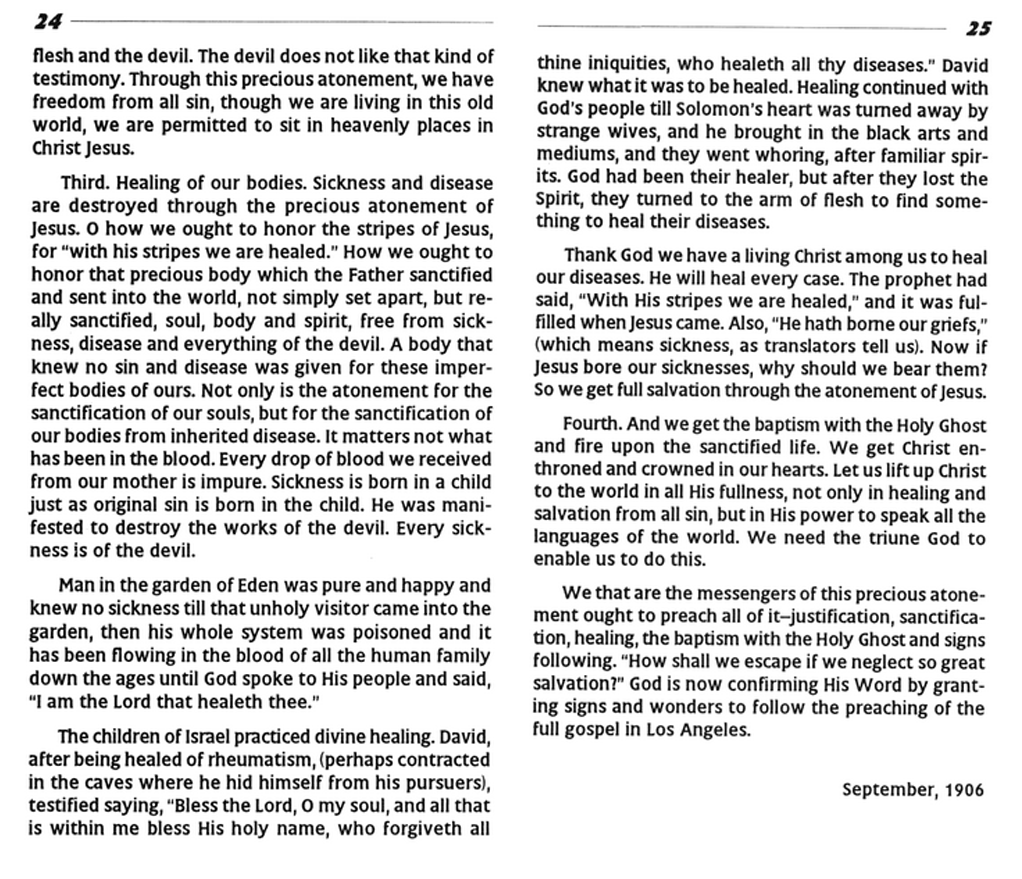
Azusa Street Sermons: The Precious Atonement