

March 4, 1906: William Seymour is expelled from the Santa Fe Mission
March 5, 2026 by Cup&Cross
Filed under Featured, Missions, News, Publication
On March 4, 1906, Seymour preached during the morning service at the Santa Fe Mission that speaking in tongues is the biblical evidence of baptism in the Holy Spirit. When he returned for the evening service, he found the church doors locked by Julia Hutchins. After consulting the leadership of the Southern California Holiness Association, to which the Santa Fe Mission belonged, Hutchins informed Seymour that she did not accept speaking in tongues (glossolalia) as part of the doctrine of holiness. One of the elders’ arguments was that Seymour himself had not been baptized in the Holy Spirit and had not experienced what he preached.
However, Seymour was not the first to make the connection between speaking in tongues and baptism in the Holy Spirit. Even his teacher, Charles Parham, who systematized the theological link between biblical sanctification and Spirit baptism, was an heir to a rich tradition of preachers and churches that accepted speaking in tongues as the sign of the baptism in the Holy Spirit within the holiness doctrine.
1905 – Lucy Farrow, who introduced Seymour to Parham and later helped him receive the invitation to pastor the Santa Fe Mission in Los Angeles, was baptized in the Holy Spirit and spoke in tongues. She was the niece of Frederick Douglass and pastor of a Holiness church in Houston. Lucy Farrow received the baptism in the Holy Spirit while working in the home of Charles Parham. At a prayer meeting in Houston in early 1906, she prayed for 25 people, all of whom were baptized in the Holy Spirit and spoke in tongues simultaneously. Shortly afterward, she traveled to Los Angeles, and when Seymour was expelled, it was Lucy Farrow who prayed for the first believers to receive Spirit baptism during the home prayer meetings that began on Bonnie Brae Street in April 1906.
1896 – During the revival meetings known as the “Shearer Schoolhouse Revival,” more than 100 men, women, and children were baptized in the Holy Spirit. They were part of a mountain community in North Carolina called the “Christian Union,” from which the Church of God (Cleveland, Tennessee) would later emerge.
1887 – In the revival meetings of Maria Etter, under the power of the Holy Spirit, believers (mainly Quakers and Methodists) fell into trances and spoke in unknown tongues, leading the secular press to call her a “voodoo priestess.”
1880 – The “Pentecostal Holiness Church Movement” documented Holy Spirit baptisms among its members.
1889 – Jethro Walthall of Arkansas was baptized in the Holy Spirit along with many others during a prayer meeting.
1875 – E. B. Swan testified that the so-called “Gift People” in Rhode Island practiced speaking in tongues.
1874 – Similar testimonies came from healing meetings in New York State, where many were baptized in the Spirit and spoke in tongues.
1855 – William Dowie spoke in unknown tongues during meetings of Frank W. Sandford in Shiloh, Maine. Later, Dowie founded the “Gift People” movement, and Sandford started a Bible school called “The Holy Spirit and Us” as part of his church. Ambrose J. Tomlinson, who in 1907 would organize the Church of God, also visited Shiloh in October 1901. Even Charles Parham stayed at the school for six weeks during the summer of 1900 to listen to Sandford’s lectures. It was there that Parham first heard speaking in tongues among the students in the school’s old prayer towers.
In 1906, the participants in the Azusa Street Revival sought the same experience of speaking in tongues that had occurred in the early hours of January 1, 1901, at Charles Parham’s school in Topeka, Kansas. Interestingly, a publication from January 6, 1900, reported that at Sandford’s school in Shiloh, many had been baptized in the Holy Spirit and spoke in unknown tongues following a prayer meeting that began on New Year’s Eve and lasted about ten days.
1854 – W. P. Simons and Robert Boyd separately testified about speaking in unknown tongues during evangelistic meetings led by D. L. Moody, attended by followers of the Scottish preacher Edward Irving.
THE PASTORAL TRIALS ELIMINATE THE AVANTGUARD OF BULGARIAN EVANGELICALS FOR AN ENTIRE GENERATION (PART 3)
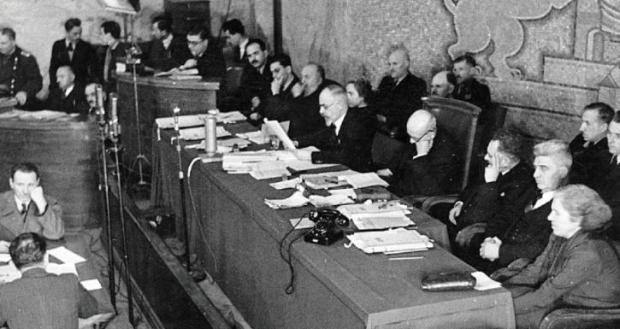
THE PASTORAL TRIALS ELIMINATE THE AVANT-GARDE OF BULGARIAN EVANGELICALS, BEHEADING IT FOR AN ENTIRE GENERATION (Part 3)
[Editorial note: The following text is translated from the Bulgarian original. The documents contain memorandums, archival records, State Security (Darzhavna Sigurnost / DS) interrogation files, survivor testimonies, and secondary scholarly sources. Bracketed insertions in the original are the author’s. Handwritten portions of the source document are noted where applicable. Archival reference: pp. 155–177.]
Yanko Nikolov Ivanov
Completed his studies in Frankfurt (1925). He had earlier withdrawn from the Faculty of Law at Sofia University and redirected his path towards commerce. He successfully completed the Commercial and Industrial Chamber in Ruse. His father, Nikola Ivanov, financed his studies and sent him to study theology at the Methodist Church seminary in Frankfurt. Immediately upon returning from Frankfurt, he was appointed to Gorna Mitropolia at the 28th Annual Conference in Sofia (1925). The following year Yanko Ivanov was elected assistant secretary of the Conference and appointed to the Evangelical Methodist Church (EMC) in Vidin for a period of four years. During this period he was elected secretary of the Annual Conference and treasurer of the Church Charitable Society. In 1930 he was sent to Lom for three years, where he subsequently served as pastor. During his stay in Lom the newly constructed Methodist church building was sold. From 1933 to 1940 he served in Pleven, and was then, with the approval of Alphonse Prache, transferred to the EPC Sofia as secretary of the Annual Methodist Conference. From 1944 he held the position of supreme superintendent of the EMC and deputy religious representative of the Evangelicals within the United Evangelical Churches (OETs), until the commencement of the Pastoral Trials.
From the State Security interrogation file: ‘His arrest for anti-people and espionage activities was met by him with arrogance. At the outset of the investigation he maintained an arrogant manner and with marked irony attempted to answer the questions. He relied on foreign intervention and on his high ecclesiastical rank. He denied everything without reservation… By this stance he greatly impeded the investigation. He displayed a strong will, a firm character, and steadfastness. He possesses a sound logical faculty.’
Despite being subjected to torture both ‘behind the curtain’ and in the ‘devil’s cell’ during pre-trial detention, he endeavoured to protect his colleagues from dangerous deviations in the political sphere. He attempted to warn the others that two of the accused pastors were assisting the investigation with their testimony, but his effort was thwarted. According to his testimony, at the OETs assembly of 1944, a hostile line towards the Fatherland Front was discussed, at which ‘Zyapkov reported that he had made contact with the American and British Legations in Sofia and received assurances of protection should the authorities take measures against them as a result of their conduct (according to the testimony of N. Mikhailov, Georgi Chernev, Yanko Ivanov, and others, in part)… That in 1945 Yanko Ivanov, in his capacity as deputy religious representative, met with a certain Tobias — who had entered the country under cover as a delegate of the British youth delegation and was an American intelligence operative — who came to Ivanov in strict secrecy and presented himself as an emissary of Methodist Bishop Garber, to whom Ivanov provided written information on the situation in the country and on the conditions under which the sects operated; which information he had gathered from all four sects in written form; and that he received directives for agitation and slander against the people’s authority from Tobias, which directives Ivanov subsequently transmitted at one of the sessions of the Supreme Council of the OETs (according to the testimonies of Ya. Ivanov, G. Chernev, and N. Mikhailov).’
In his own defence he stated: ‘I am proud to declare that the honourable Ministry of Foreign Affairs has never experienced any difficulties owing to violations committed by members or employees of the Methodist Church. In all circumstances, the Methodist Church as a community and I as its representative have acted straightforwardly, honestly, and loyally towards the authorities, as any good Bulgarian would. Never and under no circumstance have I sought the intervention of foreigners, not even that of our bishop Dr. Garber, in order to achieve a proper resolution of disputed matters with the authorities. In such cases I have always sought the assistance of the authorities and the laws of the country, but not the interference of any foreigners whatsoever.’
He was found guilty of participating in ‘a reconnaissance network in favour of a foreign intelligence service’ and transmitting ‘numerous items of information of a military, economic, and political character constituting state secrets’; receiving ‘remuneration from a foreign state and representatives of a foreign intelligence service’; disseminating ‘abroad false and grossly distorted accounts, substantially damaging the dignity of the Bulgarian people and state,’ as well as ‘false rumours, reports, and assertions,’ and ‘verbally within the country, offensive, defamatory, and false assertions’ with the aim of harming ‘our good relations with a friendly state or its authorities,’ diminishing ‘the prestige of such a state or its authorities,’ all of this serving ‘another state in a hostile act against the Bulgarian state.’ He was sentenced to life imprisonment with hard labour, a fine of one million leva in favour of the state, deprivation of pastoral rights, and confiscation of all his property. He was released after thirteen and a half years of imprisonment — only a few months before his death, which came on Christmas Day, 1962.
Note on his son: Nikolai Yankov Ivanov, residing at 86 ‘Rakovski’ Street, served as secretary of the Methodist Church youth section. He was expelled from the Shumen Aviation School on charges of fascist activity. He had made attempts to leave the country with no intention of returning. He had also escorted and arranged meetings with persons suspected of espionage for one Lord Shier, who arrived in Bulgaria in 1948.
Vasil Marinov Popov
Completed his studies in Brussels and theology in Cremona, Switzerland (1920). Detained and sent to a labour camp without sentence together with the Methodists Kiril Yotov, Marin Gluharov, and Nikola Pulev. The Pastoral Trials found him serving as pastor of the EMC in Varna. The investigation unearthed his earlier case from Lovech, where he had served as pastor (1940–1945) and had been acquitted. He maintained close ties with the American household at the boarding house in the city of Lovech, and demonstrated Germanophile tendencies, being a member of the Bulgarian-German Society in the city. He attended the OETs assembly held at the end of September and beginning of October 1945 in Burgas, at a special gathering of pastors convened at Zyapkov’s request; and also the conference of 1938 in Pleven, attended by Dr. John L. Newlson, Dr. Ralph Diffendorfer, and Alphonse Prache (according to the testimony of Yanko Ivanov and Mitko Mateyev).
Simeon Dimitrov Popov — Age 43
Completed his studies in Frankfurt; married to a Swiss national (Elza Walter Gisler). After completing secondary school in 1922, he was sent on a pastoral internship in Popovo, and the following year became assistant to Pastor Iv. Todorov in Veliko Tarnovo. At the Annual Conference in the autumn of 1924 he was sent to study theology at the seminary in Frankfurt am Main, Germany (1924–1927). After his return he served five years in Svishtov, and in 1932 was appointed senior pastor of the EMC in Lovech for a further five years. In 1937 he succeeded Vasil as pastor in the Czech village of Voyvodovo, remaining there until the moment of his arrest in 1949, when he was charged with espionage. He was sentenced to seven years and six months’ imprisonment, of which he served five years and four months in the prisons of Sofia, Varna, and Belene. He was released in 1955, and in 1958 assumed the pastorate of the EMC ‘Dr. Long’ in Sofia. His success was such that the authorities compelled him to relocate to Svoge, from where he commuted to services, until he was ultimately banned even from entering Sofia. In 1960 he assumed leadership of the EMC in Shumen, where he devoted himself to the meticulous collection and preservation of the Methodist archive.
In a letter from Zyapkov to the Methodist Church historian Samuil Vasilev, dated 25 March 1971, we read: ‘Is the bishop not interested in your work? Could Simeon Popov not help you in gathering materials? In my view he is the best worker in the Methodist Church today!’
Despite his advanced age, in Shumen Pastor Popov participated in a network for the clandestine distribution of Bibles. During one of the searches of his home, the State Security Service confiscated 4,000 Bibles, and he himself was arrested. During Johnnie Noer’s visit in 1989, Shumen was placed under blockade, and Pastor Simeon Popov — despite his advanced years — spent the day at the local militia headquarters in order to prevent the expulsion of the foreign visitors to Romania. Pastor Popov was known among the faithful of that era for his letter ministry, dispatching messages to over 1,200 believers throughout the country. Initially these were typed on a typewriter and later reproduced on a Roneograph. The Ministry of the Interior confiscated all the machines, but workers at the BCP party bookshop in Svoge secretly printed the messages at night. His book Why I Believe in God, begun in 1940, was printed in the Netherlands in 1982. In 1992 it received official approval and a recommendation from the Ministry of Education and Culture as a teaching aid for the optional study of religious instruction.
Gavril Tsvetanov Tsvetanov — Age 47
Completed his studies in Constantinople and at the episcopal seminary in Rome; residing in Sofia, 28 ‘Skobelev’ Street. His father, Pastor Tsvetan Tsvetanov, officiated at the wedding of Georgi Dimitrov and Lyuba Ivoshevich in Pleven on 20 October 1906. Gavril was born the same year in Sevlievo. He served as an associate professor at the Faculty of Economic and Social Sciences, and as secretary of the Supreme Council of the OETs and personal English-language correspondent of Yanko Ivanov. In 1920 he was sent on a scholarship to a theological school in Manchester. In 1923 he was sent to Italy to study theology, and contributed to the fascist newspaper Popolo d’Italia. In 1925 he was transferred again to study in Manchester. He attended the Methodist conference of 1938 in Pleven, together with Dr. John L. Newlson, chief secretary of the Board in America, Dr. Ralph Diffendorfer, and Alphonse Prache.
Before 9 September 1944, he was head of the ‘Cultural Section’ of the Bulgarian Workers’ Union (BRS). From August 1943 until 9 September 1944 he was mobilised at the Army Staff ‘Reconnaissance Company’ under Captain Armyanov. He organised a clandestine radio transmitter which, at Tsvetanov’s insistence, broadcast fascist content for a year and several months. He was a contributor to the newspaper Vecher, with records indicating that he served British intelligence. Detained for his fascist activities and sent to a corrective labour camp from 20 March to 20 October 1945. After 9 September he accompanied Yanko Ivanov to the American Mission, where Captain Andrénond received them, and served as interpreter for the conversation between the two. They also visited Strong, Reiminkel, and Cyril Black. During the visits of Bishop Dr. Paul Garber, Tsvetanov served as interpreter and transmitted informational data about Bulgaria, which were subsequently published in the foreign press, thereby exposing Bulgaria to the outside world. At the end of 1947 the chairman of the World Council of Churches, Cockburn, organised a conference with the pastors at the Hotel Bulgaria, with Gavril Tsvetanov serving as interpreter. For maintaining contacts with legionaries after 9 September, Tsvetanov was detained at the beginning of 1948 but released on 29 March 1948 owing to insufficient evidence. The foregoing is attested to by the testimonies of Yanko Ivanov and Haralan Popov, as well as by the data contained in file No. 155382.
Tsvetan Alexandrov Litov
Completed his studies in Frankfurt; currently specialising in America. He served as pastor of the ‘Dr. Long’ church in Sofia, which during his tenure numbered over 280 members. In 1934 he was one of only thirteen pastors in Bulgaria to receive a written certificate from the Ministry. As secretary of the OETs he participated in the Union of Youth Evangelical Organisations in Bulgaria. According to the confessions from the Pastoral Trials, he was among the first to whom Cyril Black’s petition was transmitted. He was then compelled to gather detailed information about the Sofia garrison and the Pernik–Voluyak railway line. The information was transmitted in 1945 in two tranches — to Black and to Melony Turner. He was the only one to escape conviction, being in the United States at the time and not returning to Bulgaria. Upon his departure he was replaced by Pastor Zdravko Bezlov.
Iliya Yakov Iliev — Age 38
Born in 1907 in Kalugerovo (near Pravets, above the Borovets fortress). He attended the ecclesiastical school of the Cherepish Monastery but could not sing. He completed secondary school in Botevgrad and established contact with the pastor of the EMC in Botevgrad, Spas Miloshev. He was appointed as a trainee pastor in 1929 under Pastor Alexander Georgiev in Pleven. The following year, at the Annual Conference of 1930, he was sent to the seminary in Frankfurt, where he studied alongside Popov, Iliev, Yotov, Litov, Kishishyan, Yanko Ivanov, and Georgi Sivriev. The rector, Dr. Mele, personally covered half of the tuition fee. He served with the Missionary Tent throughout Germany. At the 37th Annual Conference of the EMEC in Varna he was appointed by Bishop Nilsen to Hotantsa, where he worked for eleven years until the end of the Second World War.
His wife, Marta Müller — a German national — was to have been sent together with other Germans to a camp in the USSR, but the entire village interceded on her behalf, and the family relocated to the EMC in Lovech. At the end of August 1948 the American Girls’ School in Lovech was closed, and Pastor Iliev was charged and convicted at the second closed Pastoral Trial to three years’ imprisonment. He served his sentence in the Sofia Central Prison, while during the same period his son developed pulmonary complications. In August 1951 Pastor Iliev was released, but the church hall had been taken over as a warehouse by the Pharmaceutical Directorate — Lovech. From 1953 he conducted Sunday services simultaneously in the Methodist and Baptist churches in Ruse. Two years later the entire family settled in that riverside city, where he remained until his death in 1997.
Marin Dobrev Gluharov
Completed his studies at the theological seminary in Frankfurt. Born in Yablanitsa (1909). He graduated from the Theological Seminary in Sofia, and subsequently continued his studies in ‘Finance and Accounting’ at the Free University. In 1932 he received a scholarship for theological education in Germany. Upon his graduation in 1935 he assumed leadership of the Evangelical Methodist Church (EMC) in Vidin, and the following year was transferred to Sevlievo, where he served for four years. During the Second World War he fulfilled his pastoral duties in Ihtiman. During the Pastoral Trials he was sentenced to six years’ imprisonment, which he served in the labour camps at Belene and Bobov Dol. Because of his refusal to give testimony he could not be definitively convicted, but as a result of the inquisitions during interrogation and the brutal beatings inflicted upon him, he sustained severe physical injuries, including a fractured spine.
Stefan Bochev describes the condition of Pastor Gluharov, whom he encountered in the camp, in the following terms: ‘He could not stand upright. He dragged himself on his stomach, having fitted his palms with hand-clogs so as not to injure them. He would raise himself slightly on his hands in order to move forward. Yes, they had succeeded in reducing him to the condition of a reptile… crawling with his hand-clogs through the mud of Persin, yet with the gaze of a human being and a spirit worthy of the heights.’
Zdravko Stefanov Bezlov
At the age of twenty-eight, he graduated with distinction from Frankfurt (1943) and was awarded a scholarship for doctoral studies in the United States. Nevertheless, he returned to Bulgaria during the war and, after several months of work in Ruse, assumed leadership of the ‘Dr. Long’ church in Sofia. With the advent of the Communist regime, Pastor Bezlov was removed from the pulpit and began his path of martyrdom — passing through the cells of the State Security Service, labour camps, coal mines, and stone quarries. He was sentenced to fifteen years’ hard imprisonment, a fine of 250,000 leva, and deprivation of civil rights for fifteen years.
Despite all of this, he remained one of the few who refused to plead guilty — alongside Ivan Angelov, Hristo Neychev, Dimitar Hristov, and Zdravko Bezlov himself. He once confided: ‘I am in the camp, and do you know — when you fail to meet the quota, apart from being beaten with a cudgel, what it feels like to sleep in a pit full of mud.’ After thirteen and a half years Pastor Bezlov was released, but the authorities continued to persecute him as a former political prisoner. After 1989, already half-paralysed, he organised the restoration of the Methodist Church in Bulgaria and the ‘Dr. Long’ church. In 1992 the World Methodist Council awarded him its Peace Prize. The entire sum of the award he donated to the Organ Fund of the ‘Dr. Long’ church.
Nikola Mikhailov Naumov
Completed his studies in Hamburg, Germany. From 1922 a member of the editorial committee of the quarterly publication of the Evangelical Baptist Churches of Bulgaria (SEBC), together with Vidolov and Zashev. According to the confessions: ‘Mikhailov [i.e., the defendant Pastor Nikola M. Naumov — ed.] was also interested in the course of the war. I would communicate all information to him. Mikhailov would pass it on to the Americans… Mikhailov travelled throughout the provinces on church business.’
According to the indictment: ‘In 1938, the Baptist pastor Carl Filbrand — a long-standing major agent of American and German intelligence with several years’ experience in subversive work in the USSR, of German origin from Russia, residing in Vienna — convened a conference with Baptist pastors in Bulgaria at which he assigned them the very concrete task of propagating German influence in the country and gathering information of a political, economic, and military character. He organised an extensive agent network from all Baptist pastors, appointing as residents the pastors: Ivan Angelov, Georgi Vasov, and Nikola Mikhailov. This apparatus began to function immediately, with information being transmitted to Filbrand and Mikhailov (according to the testimony of N. Mikhailov, G. Chernev, and G. Vasov).’
Ivan Petrov Igov
Completed his studies in Hamburg, Germany. Born in Berkovitsa (1905); Baptist pastor residing in Sofia, 17 ’20 April’ Street. Sentenced and sent to Belene on account of his faith, where he spent six long years. His family was interned in Golintsi, without the right to return to Sofia. After his release, Igov served as pastor in Lom, and later in Varna and Plovdiv.
According to the indictment: ‘In 1925 he was recruited by Filbrand. He completed his studies at a theological seminary in Hamburg, Germany, a classmate of Georgi Vasov. In 1938 he participated in the re-recruitment of all Baptist pastors by Loishner, at which point he was designated as one of four individuals to establish the intelligence apparatus among pastors of the Baptist denomination. Until the war he received his support directly from America. In 1938 he returned to Sofia with Pavlov Schmidt, who was in Bulgaria at that time together with Filbrand. After 9 September, he attended all gatherings of the pastors, congresses, and so forth. He also attended the unofficial gatherings of the pastors, at which decisions were taken against the Fatherland Front authority. At the Baptist church congress of September 1947, Igov stood as a candidate for chairman of the Baptist Union. Mikhailov opposed him. Igov then rose and declared before everyone that he was leaving the Baptist Union congress and going to report Mikhailov to the authorities and reveal who Mikhailov was and what he was doing. Engineer Milan Kostov intervened and compelled them to reconcile. He received money from the illegally exchanged dollars. Igov was a collaborator of Georgi Vasov, to whom he transmitted his information. He was a travelling pastor among the Baptist churches. From 1931 to 1939 he visited Hungary, twice Germany, four times Switzerland, and Sweden (according to the testimony of Mikhailov, Zahari Raychev, Dimitar Mateyev, and G. Vasov).’
Vasil Georgiev Angelov
Completed his studies in America. Born in Stob (1909). On the recommendation of Pastor Pavel Mishkov, he completed his studies at Wheaton College in Chicago and the Theological Seminary in Dallas. He did not return to Bulgaria until 1938, where for a brief period he served as pastor in Yambol, Haskovo, and Samokov. From 1946 to 1948 he published the magazine Good News (Dobri Vesti).
According to the indictment: ‘[The pastors] gathered and transmitted to their foreign missions numerous items of information of a military, political, and economic character — such as the production of the military factories in Kazanlak and the aircraft factory and their output; the production of Koralovag; the production of the Mülhaupt factory in Ruse; the production of the Pirin mines; the mobilisation of conscripts; the movement of military units; traffic on the Danube and at Danubian ports; the mood of the popular masses; etc. (according to the testimony of N. Mikhailov, Georgi Vasov, Dimitar Mateyev, Zahari Raychev, Georgi Chernev, and Haralan Popov).’
Atanas Andonov Georgiev — Age 52
Completed his studies in Hamburg. Born in Sumitsa (1897); residing in Ruse, 35 ‘G. Dimitrov’ Street. Baptist pastor, recruited in 1925.
According to the indictment: ‘In 1937 re-recruited by Filbrand, and in 1938 recruited by Loishner. He supplied information of an economic, political, and military character to N. Mikhailov. After 9 September he continued his intelligence activities, again transmitting information to Mikhailov. According to the old and new construction of the intelligence apparatus, he was required to transmit his information to Nikola Mikhailov. From the information sent to us from Ruse regarding him, it is evident that he was hostile in his disposition towards the Fatherland Front authority. This is most clearly apparent from the sermons he delivered. He received from abroad for the year 1947 six parcels — 42 kg; for 1948 — one parcel of 8.5 kg; and for the period 1947–48 received from Mikhailov from the illegally exchanged dollars the sum of 324,000 leva.’
Mitko Mateyev Dimitrov — Age 39
Completed his studies in Germany.
According to the indictment: ‘Every Evangelical pastor who receives his support from abroad (and all of them do) was obliged to send reports to his foreign mission on his work and the conditions under which he operated — reports in which he was required to provide as extensive information as possible on the mood of the people among whom he worked, on economic life, on the political mood of the masses, etc. — reports constituting in essence intelligence despatches on the political and economic life of the country (according to the testimony of N. Mikhailov, Yanko Ivanov, Georgi Chernev, Georgi Vasov, Dimitar Mateyev, Haralan Popov, and others).’
Exiled to Varna, Persin, and Belene. After Belene he worked at Elhima. He was denounced by someone close to him for planning to emigrate. He was sentenced to a further seven years of hard imprisonment. He subsequently emigrated to Canada, where he published a book about the years spent in prison, entitled Upon Thy Word I Have Placed My Trust.
Translated from the list with pastors from the document above:
LIST OF BULGARIAN EVANGELICAL PASTORS WHO COMPLETED THEIR EDUCATION ABROAD
State Security Service Memorandum, 1948
Archival Reference: 155/3/177
Editorial note: The following is a complete transcription and translation of the archival document photographed at pastir.org. Text underlined in the original manuscript is rendered with underline formatting below. A handwritten annotation reading ‘до тук’ (‘to here’) appears at the foot of the original page, indicating the end of the handwritten portion of the document. Checkmarks (✓) visible in the original against certain entries are noted in brackets. The preamble and closing summary are translated verbatim from the Bulgarian.
Preamble (verbatim translation): ‘In order not to speak in generalities and to substantiate the foregoing, I find it necessary to append a list of the names of the pastors who completed their education in America or in some other foreign country, who, in addition to their religious fanaticism, have unquestionably acquired the character and mentality of the “secular” Western democracies. For example:’
THE LIST
- Vasil Georgiev Zyapkov — age 47. Completed advanced theological studies in Manchester and New York.
- Lambri Marinov Mishkov — age 40. Completed his studies at the theological seminary in Princeton, USA.
- Simeon Petrov Iliev — age 37. Completed his studies at a theological seminary in Switzerland.
- Konstantin Stoyanov Marvakov — age 55. Completed his studies at a seminary in Austria.
- Kiril Yotov Vladov — age 43. Completed his studies in Frankfurt am Main.
- Kostadin Spasov Bozovayski — age 35. Completed his studies in London — Seminary.
- Krum Georgiev Bumbakov — age 43. Completed his studies at a seminary in Austria.
- Sarkis Bedros Manukyan. Completed his studies in Kingston, Canada.
- Pavel Hristov Nikolov — age 49. Completed advanced theological education in Oxford, England.
- Nikola Borisov Dimitrov — age 42. Completed his studies at a seminary in Bangor, USA.
- Yosif Isakov Danailov — age 49. Completed his studies in Austria and England.
- Atanas Angelov Kremenliev — age 37. Completed his studies at a seminary in the USA.
- Georgi Nikolov Chernev — age 45. Completed his studies in Danzig and London.
- Emanuil Stoyanov Manolov — age 49. Completed his studies in Danzig and London.
- Boris Ivanov Kuzmanov. Completed his studies in Krichona — Switzerland.
- Yoncho Nikolov Dryanov — age 42. Completed his studies in Danzig — Germany.
- Haralan Ivanov Popov — age 47. Completed his studies in Danzig and London.
- Gruy Iliev Kuzmanov — age 54. Completed his studies in Danzig.
- Ivan Zerev Angelinov — age 37. Completed his studies in Danzig.
- Diko Dimitrov Mavrudaev — age 42. Completed his studies in Danzig.
- Yosif Georgiev Kokonchev — age 38. Completed his studies in Danzig.
- Enyu Iliev Tsonev — age 39. Completed his studies in Danzig.
- Nikola Stefanov Stoyanov — age 40. Completed his studies in Danzig.
- Eduard Agop Kuriyan — age 34. Completed his studies in Danzig and London.
- Todor Stoykov Godjorov — age 41. Completed his studies in Danzig.
- Ivan Stoychev Ivanov — age 40. Completed his studies in Danzig.
- Ladin Ivanov Popov — age 34. Completed his studies in Danzig and London.
- Ivan Mitev Yalamov — age 36. Completed his studies in Danzig.
- Stoicho Dimitrov Kupenov — age 38. Completed his studies in Danzig.
- Nikola Harlamiev Tsenkov — age 41. Completed his studies in Danzig.
- Yanko Nikolov Ivanov — age 47. Completed his studies in Frankfurt am Main.
- Vasil Marinov Popov — age 45. Completed his studies in Krichona, Switzerland.
- Simeon Dimitrov Popov — age 43. Completed his studies in Frankfurt am Main.
- Gavril Tsvetanov Tsvetanov — age 41. Completed his studies in Manchester and at the episcopal academy in Rome.
- Tsvetan Alexandrov Litov. Completed his studies in Frankfurt; currently specialising in America.
- Iliya Yakov Iliev — age 38. Completed his studies in Frankfurt am Main.
- Marin Dobrev Gluharov. Completed his studies at the theological seminary in Frankfurt am Main.
- Zdravko Stefanov Bezlov — age 28. Completed his studies in Frankfurt am Main.
- Nikola Mikhailov Naumov — age 49. Completed his studies in Hamburg — Germany.
- Ivan Petrov Igov — age 48. Completed his studies in Hamburg — Germany.
- Vasil Georgiev Angelov — age 39. Completed his studies in northern America.
- Atanas Andonov Georgiev — age 52. Completed his studies in Hamburg — Germany.
- Mitko Mateyev Dimitrov — age 39. Completed his studies in Wilenest — Germany.
Closing Summary (verbatim translation):
‘In addition to the above-mentioned, a further 7 individuals completed their studies in various countries. Thus, of a total of 115 pastors throughout the entire country, half completed their education abroad — who are accordingly first-class and qualified foreign agents.’
Handwritten annotation at foot of document: ‘до тук’ (‘to here’) — indicating the end of the handwritten portion of the memorandum.
Translator’s Notes
- Entries marked with ✓ in the original document are reproduced here with that symbol. The significance of the checkmarks is not explained in the source; they may denote individuals already arrested, already under surveillance, or prioritised for prosecution at the time of the document’s compilation.
- Underlined text in the original (indicating institutions and cities) is preserved with underline formatting.
- ‘Danzig’ refers to the Free Theological Academy (Freie Theologische Akademie) in the Free City of Danzig (present-day Gdańsk, Poland), which served as the principal training institution for Bulgarian Pentecostal pastors throughout the 1930s.
- ‘Krichona’ refers to the St. Chrischona Pilgrim Mission (Pilgermission St. Chrischona) near Basel, a pietist missionary training institution.
- ‘Wilenest — Germany’ in entry 43 is likely a transcription error or phonetic rendering in the original Bulgarian; the precise institution has not been identified.
- The document bears the archival reference 155/3/177 and is reproduced at pastir.org. The preamble and closing summary are in typewritten Bulgarian; the annotation ‘до тук’ (‘to here’) is handwritten.
- The assertion that foreign-educated pastors are ‘first-class and qualified foreign agents’ represents the operative ideological premise of the 1948–1949 Pastoral Trials — that Western theological education was itself evidence of intelligence recruitment.
THE PASTORAL TRIALS ELIMINATE THE AVANTGUARD OF BULGARIAN EVANGELICALS FOR AN ENTIRE GENERATION (PART 2)
THE PASTORAL TRIALS ELIMINATE THE AVANT-GARDE OF BULGARIAN EVANGELICALS, BEHEADING IT FOR AN ENTIRE GENERATION (Part 2)
[Editorial note: The following text is translated from the Bulgarian original. The documents contain memorandums, archival records, State Security (Darzhavna Sigurnost / DS) interrogation files, survivor testimonies, and secondary scholarly sources. Bracketed insertions in the original are the author’s. Handwritten portions of the source document are noted where applicable. Archival reference: pp. 155–177.]
Georgi Nikolov Chernev — Age 45
Completed his studies in Danzig and at Carter Seminary in London. Member of the Supreme Council of the United Evangelical Churches (OETs) and Chairman of the Union of Evangelical Pentecostal Churches (SEPTS). Arrested while on his way to the church in Elhovo. Like all other detainees, he completed Declaration Form No. 10G, in which he stated: born in the early twentieth century in Yambol; occupation: ‘pastor of the SEPTS’; under additional professions: ‘journalist.’ Member of the Society of the Periodical Press; non-partisan; without affiliation to the Fatherland Front.
For his contribution to the anti-fascist resistance before 1944, he possessed a document ‘issued by the Fighters against Fascism,’ which was disregarded. In a handwritten analysis, Chernev observed: ‘Everything was done and carried out according to a pre-established plan, on the orders and insistence of Moscow. From a reliable source it later became known that the Communists had decided that approximately 600 Evangelical Christians were to be detained by the militia and tried — some sentenced to death, others to prison, others to labour camps, and some to internal exile. And so it came to pass!’
His wife was interned in Svishtov, and their twenty-four-year-old son Veniamin was also arrested. In his unpublished memoirs, he recounts in an indescribable manner the tortures and sufferings of the pastors ‘behind the curtain.’ In his work A Broken Destiny, Kiril Tonev writes: ‘In the Pleven prison were father and son Chernev. The father, a pastor, was there from the Pastoral Trial; the son, a Cambridge graduate, had been sentenced to death. It was expected that the sentence would be overturned or confirmed. There was a legal time limit for this, but it passed. During this period the father — Pastor Chernev — was arrested, and in order to break him and cause him to incriminate other co-defendants, they told him: If you do not tell the truth, we will carry out your son’s sentence immediately.’
After his release from prison in 1967, Pastor Chernev addressed Todor Zhivkov personally with a request for rehabilitation. Nevertheless, the Secretariat of the Committee for State Security sent a telegram to the Central Committee of the Bulgarian Communist Party which read: ‘The petition of Pastor Georgi Nikolov Chernev — to be rehabilitated as unjustly convicted at the trial against the Evangelical pastors — is not to be granted.’
Emanuil Stoyanov Manolov — Age 49
Completed his studies in Danzig and London. The only one of the three pastors who refused to make confessions to the very end. Pastor of the Evangelical Pentecostal Church (EPC) in Stara Zagora; member of the editorial board of the SEPTS under Protocol No. 8 (11 February 1930); chief editor of Pentecostal News. Fluent in foreign languages and maintaining connections with Western missions, he was classified by the State Security Service as ‘politically unreliable.’
As opposition-minded Pentecostal pastors — including Pastor Emanuil Manolov and Georgi Todorov — were subjected to serious repression on account of their ‘insubordination.’ The denunciations against Manolov accused him of oppositional views, including criticism of the authorities, whom he described as ‘antichrist.’ At a meeting of the Pentecostal leadership, he stated that the ‘Circular Letters’ were being widely criticised even in churches that formally supported government policy. In response, the leadership loyal to the authorities resolved to remove Pastor Manolov from leadership positions within the Union. He was also charged with participating in worship services outside the SEPTS. He was the sole pastor to support Dryanov in his opposition to the black-market currency exchanges within the SEPTS.
Boris Ivanov Kuzmanov
Completed a Bachelor of Theology degree at ‘St. Chrischona’ in Austria (not Switzerland, as State Security documents erroneously assert). He took his first steps in ministry in Sliven. From 1937 to 1939 he served as pastor of the EPC in Yambol. At the twelfth regular annual assembly (1946) in Krumovo Gradishte, Kuzmanov served on the SEPTS committee. Following the trials, he led the church in Plovdiv (1955–1962).
Taking considerable risk upon himself and his family, during the 1950s and 1960s he translated and compiled Christian hymns. Under conditions of severe censorship and open persecution, these filled the hunger for hymnal literature and were printed by hand on heliographic paper — a practice that was prohibited. Kuzmanov, an accomplished linguist and musician, performed translations and arrangements drawing on a variety of sources. In addition to traditional Bulgarian collections, he drew upon foreign ones, including the German Dielgerlieder (1922), the American Tabernacle Hymns (1926) and Melodies of Praise (1957), as well as two Russian publications: Songs of the Wanderer (1927) and Song of Songs (1936).
Yoncho Nikolov Dryanov
Embraced the Pentecostal faith during the sojourn of [Ivan] Voronayev in Varna in 1921. After completing secondary school, he went on to graduate from the Higher Commercial Institute in the city of Varna. He studied theology in Samokov and abroad — in Danzig (1936) and Bern (1938). He spoke French, German, and English. In his memoirs he wrote: ‘We must acknowledge that our finances before the trial were not well organised.’ Despite his opposition to the black-market currency exchanges proposed by Chernev, L. Popov, and Kinareva, he was convicted.
From 1950 he was imprisoned in the Varna prison together with Mitko Mateyev, and later both were transferred to Persin Island. There, the prison guards locked them together with Haralan Popov in a cattle shed for an entire week, in order to ‘make at least one cow or ox accept Christianity.’ Blind in one eye, Dryanov firmly withstood the interrogations ‘behind the curtain’ and in the ‘devil’s cell’ of the prison.
Haralan Ivanov Popov — Age 47
Completed his studies in Danzig and London. Arrested at 4 a.m. on 24 June 1948 and spent 35 days in complete darkness in solitary confinement. He began to hallucinate and ‘confessed’ by signing the fabricated ‘self-confessions.’ ‘The Nazis were cruel, but the Communists were both cruel and satanically cunning,’ Popov later said. He spent 13 years as an ‘enemy of the people’ — in the prisons of Sliven and Shumen, and at Belene. He never forgot the quotation from Dante written above the door of the ‘devil’s cell’: ‘O ye who enter here, abandon all hope!’
After the Hungarian Revolution he was transferred to the prison in Stara Zagora. Following his release, he led an underground church in Sofia. On 31 December 1962 he was permitted to join his family in Sweden, and in 1970 moved to the United States. He recorded the following observation from his time under the Regime — one which proves prophetic for our own day: ‘Gradually the pastors of the churches were removed and in their place came people ready to become instruments in the hands of the Communists, who concentrated their efforts on placing their own puppets in the pulpit. Having installed puppets in many churches, they then identified the next target: the senior Bulgarian church leaders of the Evangelical denominations!’
Gruy Iliev Kuzmanov — Age 54
Completed his studies in Danzig. Yet another example of how the Communist regime persecuted pastors who had opposed the fascist dictatorship in Bulgaria. The authorities banned Pastor Kuzmanov from conducting preaching and pastoral activities in Pleven. Kuzmanov appealed to inspector Chucholayn, but was nonetheless transferred by the Union leadership to Plovdiv. The church he had built in the village of Aprilts was closed. By telegram to the Ministry of the Interior on 23 February 1943, Pastor Gradinakov of Pazardzhik reported that despite the prohibition, Kuzmanov continued to pastor and to conduct wedding ceremonies. This was followed by removal from ministry and a punitive act. He was rehabilitated by the Supreme Council and Angel Dinov only in 1956, together with Iv. Zarev.
Ivan Zerev Angelinov — Age 37
Born in 1909 in Gorna Sekirna. Completed his education in Danzig (1935–1938). For two years he served as pastor in Pernik, after which he assumed leadership of the Evangelical Pentecostal Church (EPC) in Sofia, which he headed until 1948. The Pastoral Trials interrupted his studies at the Faculty of Theology of Sofia University. In his single-volume history of the Union of Evangelical Pentecostal Churches (SEPTS), he described the ‘Pastoral Trials’ in the following words: ‘One hundred days in an ice-cold cell, with a bucket and a jug as my only faithful companions. My hair stands on end when I recall that horror… whenever I pass by that accursed building near the Lion Bridge.’
After the conclusion of the trials, in the official reports on the activities of the Committee and the state of the Protestant churches in Sofia, he is listed as a co-minister of the EPC Sofia, together with Angel Dinov and Dinko Zhelev. He taught dogmatics and homiletics at the biblical courses for pastors within the SEPTS. In connection with the State Security campaign and the trials of 1979, directed against the Pentecostal movement in the People’s Republic of Bulgaria and its foreign ties, State Security officer Lieutenant Colonel Angel Zhelev stated: ‘A blow has been dealt to the Pentecostal sect in the PRB and the foreign religious headquarters.’ In an interview for Anteni, Zarev concurred with the accusation: ‘The six defendants violated the laws of the country.’
Diko Dimitrov Mavrudaev — Age 42
Completed his studies in Danzig. Pastor of the EPC in Troyan, Dimitrovgrad, Pazardzhik, and Plovdiv (1937–1947), after which he was succeeded by Zh. Vrachev. Krali Kralev, who was announced as an evangelist to the towns and villages south of Burgas, where the ‘Pastoral Trials’ found him. Following the completion of his sentence, he faced restrictions imposed by the authorities. He kept a warehouse-type shop at the Plovdiv railway station, which was frequently used as a meeting point by his former colleagues.
Yosif Georgiev Kokonchev — Age 38
Completed his studies in Danzig (1936–1938), immediately after which he served as pastor of the EPC in Sliven (1938–1947). His family is among the well-known Enidzhevardartsi [settlers from Yenidje Vardar], from whom he acquired a command of Greek. The Pastoral Trials found him at the EPC in Stara Zagora. He was subsequently appointed to the EPC in Varna (1950), succeeding Dryanov. He is mentioned in the Yearbook of the Theological Academy (1958–1971). Elected to the financial committee of the SEPTS together with Zarev and Vrachev, and as deputy chairman to Angel Dinov. Of him, St. Bankov wrote: ‘Kokonchev stoically upheld the position to which, as we have already ascertained, he had been assigned…’
Enyo (Enyu) Iliev Tsonev — Age 40
Among the first cohort of graduates from Danzig. He embraced the faith at the age of seventeen during one of Kostadin Tomov’s visits to Yambol. The first worship services in Yambol were held in the home of his mother Shtilyana, a fervent believer baptised in the Holy Spirit. He is recorded as deacon and treasurer in Protocol No. 1 at the founding of the EPC in Yambol. A magnificent biblical teacher and evangelist in places where no one else wished to go. Until the very end he preached from Dispensational Truth and from Larkin’s Revelation. Shortly before the Pastoral Trials, in 1944–45, his nephew and future pastor of the EPC Yambol, Georgi Arnaudov, began preaching with him in the villages.
Nikola Stefanov Stoyanov — Age 40
Studied in Danzig for approximately six months. Worked with Pastor Ivan Stoychev. Served as pastor at the EPC in Ruse, succeeding Haralan Popov, and also in Shumen. Pastor in Yambol (1955–1961), where in 1958 he carried out renovations to the building at 10 ‘Slavyanska’ Street, behind the ‘Soglasie’ community centre, where the church had been housed since 1947. In 1960 the SEPTS cautioned him by Circular No. 51 to observe Article 20 and not to work with minors. Shortly thereafter he was removed from his position on the pretext that he was disseminating the book of William Branham.
Edward Agop Kuriyan — Age 34
Completed his studies in Samokov, Danzig, and London. Born in 1913 in Sliven, Bulgaria, into the family of Agop Kuriyan, founder of the EPC in Sliven. He served as pastor in Pomorie, Pazardzhik, Chirpan, and Kyustendil. In Burgas he served for the first time in 1941 as assistant to Pastor Haralan Popov, and during the Pastoral Trials was permanently transferred to Burgas in 1948, remaining there until 1960. He was interned together with his entire family in Popovo. Rehabilitated in 1963, he served as pastor in Nesebar, and in 1970 assumed leadership of the EPC in Aheloy.
Todor Stoykov Godjorov — Age 41
Completed his studies in Danzig. A deeply devoted minister and fruit of the EPC in Burgas, founded in 1926. He served as pastor in Ruse, Troyan, Dimitrovgrad, and Pazardzhik, where he also died. Until the very end he remained a firm defender of the proper exercise of the spiritual gifts.
Ivan Stoychev Ivanov — Age 40
Completed his studies in Danzig (1931). He came to faith in 1927. In 1932 he began his ministry in the Burgas district, and was subsequently sent to Sliven. One of the first to preach in Mokren, Zimnitsa, Straldzha, Galabintsi, and Boyadzhik. Ordained as pastor in Plovdiv (1933), he assumed leadership of the EPC in Yambol in 1935. He formed the first church choir, which for the first time greeted the faithful in their homes at Christmas. Following his ministry in Yambol he was transferred as pastor to Stara Zagora, and from 1947 served again in Sliven, where he founded the MHL-Karandila youth camp, with the first campers ascending the summit on donkeys. Persecuted by the authorities, he was compelled to leave Sliven and relocated to Asenovgrad, where the congregation received a refusal for his pastoral appointment, whereupon he returned to Burgas.
Ladin Ivanov Popov — Age 34
Completed his studies in Danzig and London. Comes from a prosperous rural family. Completed secondary school in Svishtov. Brother of Haralan Popov; served as pastor of the EPC in Ruse in 1939 and in Troyan. In the eight-volume archive of the Chief Directorate of Operational Records (GDOR), entitled ‘Slanderers,’ there are two separate folders of denunciations and surveillance reports concerning him. He assumed leadership of the EPC in Burgas in 1948, where the Pastoral Trials found him. Sentenced to five years’ imprisonment. The indictment read: ‘That among the Evangelical pastors there are also individuals who served Hitler, recruited workers for Germany… [and] homosexuals — such as Ladin Popov (according to the testimonies of G. Vasov, Dimitar Mateyev, and Ladin Popov himself).’
He was the only one among the defendants who refused to accept the charges of ‘espionage’ levelled against them. As a gesture of protest against the judicial farce, he appeared in court without a necktie, despite this being an official requirement. He served his sentence in the Burgas prison, from which he was released in 1952.
Ivan Mitev Yalamov — Age 36
Completed his studies in Danzig (1936–1938), immediately after which he began to pastor in Mokren. He served in Yambol and Elhovo, and was subsequently appointed in Nova Zagora, from where he was transferred to Ruse, Aytos, and Stara Zagora. He served as the longest-tenured secretary of the SEPTS. ‘The defendant Pastor Ivan M. Yalamov confirms that the defendant Georgi Chernev had requested from him detailed information regarding the number, type, and armament of Soviet troops in the Nova Zagora district.’
Stoicho Dimitrov Kupenov — Age 38
Completed his studies in Danzig (1936–1938). Began as pastor of the EPC in Aheloy (1939). Served in Chirpan, Aytos, Ruse, and Pazardzhik. He strengthened the EPC in Ruse, which had been severely shaken following the imprisonment of Pastor Haralan Popov and the disruption of ties with the Slavic Religious Mission. He was one of the few who strongly opposed the restrictions imposed by the new policy of the SEPTS following the Pastoral Trials.
Nikola Harlamiev Tsenkov — Age 41
Completed his studies in Danzig. Delegate at the Founding Assembly of the SEPTS in Burgas (1928). Served as pastor of the EPC in Kostenets, Haskovo, and Pernik. Under Protocol No. 27 (7 July 1932), ‘he was sent to the EPC in Stara Zagora with the aim of consolidating and pacifying the church there,’ which was experiencing spiritual difficulties following its recent admission to the Union. Secretary-Treasurer of the SEPTS (1944).
Translated from the list with pastors from the document above:
LIST OF BULGARIAN EVANGELICAL PASTORS WHO COMPLETED THEIR EDUCATION ABROAD
State Security Service Memorandum, 1948
Archival Reference: 155/3/177
Editorial note: The following is a complete transcription and translation of the archival document photographed at pastir.org. Text underlined in the original manuscript is rendered with underline formatting below. A handwritten annotation reading ‘до тук’ (‘to here’) appears at the foot of the original page, indicating the end of the handwritten portion of the document. Checkmarks (✓) visible in the original against certain entries are noted in brackets. The preamble and closing summary are translated verbatim from the Bulgarian.
Preamble (verbatim translation): ‘In order not to speak in generalities and to substantiate the foregoing, I find it necessary to append a list of the names of the pastors who completed their education in America or in some other foreign country, who, in addition to their religious fanaticism, have unquestionably acquired the character and mentality of the “secular” Western democracies. For example:’
THE LIST
- Vasil Georgiev Zyapkov — age 47. Completed advanced theological studies in Manchester and New York.
- Lambri Marinov Mishkov — age 40. Completed his studies at the theological seminary in Princeton, USA.
- Simeon Petrov Iliev — age 37. Completed his studies at a theological seminary in Switzerland.
- Konstantin Stoyanov Marvakov — age 55. Completed his studies at a seminary in Austria.
- Kiril Yotov Vladov — age 43. Completed his studies in Frankfurt am Main.
- Kostadin Spasov Bozovayski — age 35. Completed his studies in London — Seminary.
- Krum Georgiev Bumbakov — age 43. Completed his studies at a seminary in Austria.
- Sarkis Bedros Manukyan. Completed his studies in Kingston, Canada.
- Pavel Hristov Nikolov — age 49. Completed advanced theological education in Oxford, England.
- Nikola Borisov Dimitrov — age 42. Completed his studies at a seminary in Bangor, USA.
- Yosif Isakov Danailov — age 49. Completed his studies in Austria and England.
- Atanas Angelov Kremenliev — age 37. Completed his studies at a seminary in the USA.
- Georgi Nikolov Chernev — age 45. Completed his studies in Danzig and London.
- Emanuil Stoyanov Manolov — age 49. Completed his studies in Danzig and London.
- Boris Ivanov Kuzmanov. Completed his studies in Krichona — Switzerland.
- Yoncho Nikolov Dryanov — age 42. Completed his studies in Danzig — Germany.
- Haralan Ivanov Popov — age 47. Completed his studies in Danzig and London.
- Gruy Iliev Kuzmanov — age 54. Completed his studies in Danzig.
- Ivan Zerev Angelinov — age 37. Completed his studies in Danzig.
- Diko Dimitrov Mavrudaev — age 42. Completed his studies in Danzig.
- Yosif Georgiev Kokonchev — age 38. Completed his studies in Danzig.
- Enyu Iliev Tsonev — age 39. Completed his studies in Danzig.
- Nikola Stefanov Stoyanov — age 40. Completed his studies in Danzig.
- Eduard Agop Kuriyan — age 34. Completed his studies in Danzig and London.
- Todor Stoykov Godjorov — age 41. Completed his studies in Danzig.
- Ivan Stoychev Ivanov — age 40. Completed his studies in Danzig.
- Ladin Ivanov Popov — age 34. Completed his studies in Danzig and London.
- Ivan Mitev Yalamov — age 36. Completed his studies in Danzig.
- Stoicho Dimitrov Kupenov — age 38. Completed his studies in Danzig.
- Nikola Harlamiev Tsenkov — age 41. Completed his studies in Danzig.
- Yanko Nikolov Ivanov — age 47. Completed his studies in Frankfurt am Main.
- Vasil Marinov Popov — age 45. Completed his studies in Krichona, Switzerland.
- Simeon Dimitrov Popov — age 43. Completed his studies in Frankfurt am Main.
- Gavril Tsvetanov Tsvetanov — age 41. Completed his studies in Manchester and at the episcopal academy in Rome.
- Tsvetan Alexandrov Litov. Completed his studies in Frankfurt; currently specialising in America.
- Iliya Yakov Iliev — age 38. Completed his studies in Frankfurt am Main.
- Marin Dobrev Gluharov. Completed his studies at the theological seminary in Frankfurt am Main.
- Zdravko Stefanov Bezlov — age 28. Completed his studies in Frankfurt am Main.
- Nikola Mikhailov Naumov — age 49. Completed his studies in Hamburg — Germany.
- Ivan Petrov Igov — age 48. Completed his studies in Hamburg — Germany.
- Vasil Georgiev Angelov — age 39. Completed his studies in northern America.
- Atanas Andonov Georgiev — age 52. Completed his studies in Hamburg — Germany.
- Mitko Mateyev Dimitrov — age 39. Completed his studies in Wilenest — Germany.
Closing Summary (verbatim translation):
‘In addition to the above-mentioned, a further 7 individuals completed their studies in various countries. Thus, of a total of 115 pastors throughout the entire country, half completed their education abroad — who are accordingly first-class and qualified foreign agents.’
Handwritten annotation at foot of document: ‘до тук’ (‘to here’) — indicating the end of the handwritten portion of the memorandum.
Translator’s Notes
- Entries marked with ✓ in the original document are reproduced here with that symbol. The significance of the checkmarks is not explained in the source; they may denote individuals already arrested, already under surveillance, or prioritised for prosecution at the time of the document’s compilation.
- Underlined text in the original (indicating institutions and cities) is preserved with underline formatting.
- ‘Danzig’ refers to the Free Theological Academy (Freie Theologische Akademie) in the Free City of Danzig (present-day Gdańsk, Poland), which served as the principal training institution for Bulgarian Pentecostal pastors throughout the 1930s.
- ‘Krichona’ refers to the St. Chrischona Pilgrim Mission (Pilgermission St. Chrischona) near Basel, a pietist missionary training institution.
- ‘Wilenest — Germany’ in entry 43 is likely a transcription error or phonetic rendering in the original Bulgarian; the precise institution has not been identified.
- The document bears the archival reference 155/3/177 and is reproduced at pastir.org. The preamble and closing summary are in typewritten Bulgarian; the annotation ‘до тук’ (‘to here’) is handwritten.
- The assertion that foreign-educated pastors are ‘first-class and qualified foreign agents’ represents the operative ideological premise of the 1948–1949 Pastoral Trials — that Western theological education was itself evidence of intelligence recruitment.
THE PASTORAL TRIALS ELIMINATE THE AVANTGUARD OF BULGARIAN EVANGELICALS FOR AN ENTIRE GENERATION (PART 1)
THE PASTORAL TRIALS ELIMINATE THE AVANT-GARDE OF BULGARIAN EVANGELICALS, BEHEADING IT FOR AN ENTIRE GENERATION (Part 1)
[Editorial note: The following text is translated from the Bulgarian original. The documents contain memorandums, archival records, State Security (Darzhavna Sigurnost / DS) interrogation files, survivor testimonies, and secondary scholarly sources. Bracketed insertions in the original are the author’s. Handwritten portions of the source document are noted where applicable. Archival reference: pp. 155–177.]
Archival Preamble
To Comrade [name illegible in manuscript]. Here! … (p. 1), 155–3pp–177
Comrade Director — in order not to speak in generalities [regarding the arrest warrants and the public punitive proceedings against them as enemies of the Party and the people] and to substantiate my claim, I shall append a list of the names of pastors who completed their education in America or in another foreign country. In addition to their religious fanaticism, they have unquestionably acquired the character and mentality of the ‘secular’ Western democracies. For example…
Vasil Georgiev Zyapkov — Age 47
Completed advanced theological studies in Manchester and New York. Interrogated by the State Security Service and driven nearly to madness before he ‘confessed’ to the creation of a spy network that had sabotaged the ‘people’s authority’ and harmed ‘fraternal relations with the Soviet Union,’ thereby becoming a ‘servant and assistant of the interests of England and the United States.’ According to the scenario written in Sofia and Moscow along the model of [Andrei] Vyshinsky, it was Zyapkov who was cast as the ‘sinister mastermind’ of the entire conspiracy (the so-called ‘espionage centre’). He was initially isolated and subjected to pressure to renounce his beliefs, subsequently blackmailed, and finally arrested in early November 1948. For nearly three months he was interrogated in the cells of the State Security Service together with the other pastors, all of whom were compelled to confess to everything imputed to them.
Zyapkov completed his studies in literature (not theology, as was erroneously believed) in Manchester. He maintained an extensive network of friends in England and America, including family ties, which the State Security Service deemed dangerous and potentially harmful to Bulgaria. At the insistence of Dimitar Furnadzhiev (1867–1944), he succeeded the latter as religious representative of the United Evangelical Churches (OETs). Zyapkov served as pastor of the central Methodist church ‘Dr. Long.’ He was sent by the Congregationalists to their Union Theological Seminary, where he most likely completed his master’s degree in 1932. His participation in the Bulgarian delegation to the Paris Peace Conference in the summer of 1946 was subsequently used as an argument at trial that he had established espionage contacts.
Zyapkov’s testimony (under the code name “ЧЕРВЕЙ” / “WORM”) reveals the interrogation techniques employed. Reading the document — written in 1951 and entitled My Confession Regarding the Trial, ostensibly submitted as a letter to the Prime Minister requesting a review of the case — one discovers numerous parallels with the memoirs of Haralan Popov (another of the convicted clergymen). The account of the tortures (more psychological than physical in nature) and the manner in which false confessions were ultimately extracted is replicated in both cases.
Zyapkov wrote that he was rarely beaten (‘only once was my head smashed against the concrete wall’), but that the most tormenting aspects were the ceaseless threats of a death sentence and the blackmailing carried out through his family (e.g., ‘your daughter will become a prostitute’). For weeks he was compelled to write confessions until 11:00 p.m., and was then woken shortly after midnight for lengthy nocturnal interrogations. He was threatened that the sentence would be carried out by execution in the cell. Towards the end of these exhausting interrogations, the prisoners began to experience hallucinations. A new narrative was fabricated in which Floyd Black, the director of the American College in Sofia, and his son Cyril Black were presented as the chief conspirators. The strategic intelligence that Zyapkov had allegedly gathered and transmitted to his purported handlers consisted of the numbers and names of Soviet ships docked in the port of Varna — information he had memorised in order not to compromise his confessions during the trial.
Note: Spas Ivanov Asenov, from the village of Malko Belovo, was sentenced to death in the trial of the ‘Free Warriors’ (anarchists). He shared a cell with Pastor Vasil Zyapkov and stated that he was a non-believer. However, when they led him out to be executed, he said: ‘Farewell! We shall meet above, before God’s gates!’
Together with Zyapkov, all of the more influential spiritual leaders were arrested. The agonising investigation was conducted by interrogators who had honed their inquisitorial cruelty through the interrogations of opposition figures. After months of physical and psychological torment, entirely innocent church workers were reduced to clay figures who, in the satanic tradition of the State Security Service, made their ‘confessions’ to having committed ‘espionage, slander against the people’s authority, and preparations for subversive activities.’ For a full three years after his sentencing, Zyapkov barely managed to return to normal behaviour.
Lambri Marinov Mishkov — Age 40
Completed his studies at the Princeton Theological Seminary. According to K. Grozev, he also studied chemistry at the University of Chicago and subsequently theology at Harvard, and worked towards a doctorate at Cambridge during the 1930s, at which point he was obliged to return to Bulgaria to be at his mother’s bedside in her final days. It is improbable, though not impossible, that the young Mishkov managed to complete so many disparate and numerous programmes of study within the span of approximately twenty years. It is equally possible that his name has been confused with that of his namesake Pavel Mishkov, who did indeed graduate from Chicago. The investigative file records only that he received his theological education at Princeton.
Despite being a clergyman, in 1946 he was invited to serve as an adjunct associate professor of philosophy at the newly founded University of Plovdiv. It was at this time that he published his book
Philosophy of Faith — one of the finest philosophical studies of the philosophy of religion ever written in the Bulgarian language.
- Grozev describes him as an ‘old uncle’ — a close friend of his grandfather. He spoke excellent English, would recount stories of Lincoln, and explained the meaning of the expression ‘monkey business,’ as well as one of the proposed etymologies of the well-known acronym ‘OK.’ Mishkov underwent the same interrogations and tortures as the others, but never confessed to having contacted the American Embassy or received money — an accusation that was ultimately dropped, resulting in a reduced sentence. Under duress, he ‘confessed’ to having transmitted information about the quantity of nails produced (in kilograms) at a factory in Plovdiv, as well as the road map from Plovdiv to Peshtera — a map that could in fact have been purchased at any bookshop. It was precisely this map, the subject of interrogations, that had allegedly been passed by Zyapkov to Cyrus Black, who was also considered part of the supposed spy network.
As with all those convicted, his children were barred from universities, forced to take low-paid manual work, and were permitted to visit their father only once every six months or even less frequently. The elder Grozev repeatedly took Mishkov’s children to prison visits when their mother was ill and the next permitted meeting was still months away.
Simeon Petrov Iliev — Age 37
Completed his studies at the American Scientific Theological School as well as a theological seminary in Switzerland. Following the departure of Kr. Stoyanov, at the initiative of the youth fellowship of the church, he was invited to assume the pastoral ministry in Asenovgrad (then known as Stanimaka). During his pastoral tenure, the church experienced a period of growth. He succeeded in uniting several other Evangelical fellowships, which led to a significant expansion of the church community. Despite the hardships of the post-war years, the new (modern) church building was constructed during this period. Furthermore, the headquarters of the Women’s Missionary Union of the Southern Evangelical Churches was established in Asenovgrad, further strengthening the organisational structure of the Protestant community in the region. Simeon Iliev served as pastor until 1949, when he was arrested and tried on charges of espionage.
Konstantin Stoyanov Marvakov — Age 55
Completed his studies at a theological seminary in Austria. Served as pastor of the church in Yakoruda. He was subjected to repression during the Communist campaign against religious communities in Bulgaria. Accused of espionage, the specific charges including the transmission of information concerning the annual harvest in the Chirpan region, as well as the production capacity of the oil-press in the village of Marichleri. These charges were formulated within the same framework as the case against Lambri Mishkov, with all alleged evidence reduced to a single page in the investigative file. This underscores the characteristic method of fabricating accusations in this period, whereby insignificant or publicly available information was interpreted as a threat to state security, in order to justify politically motivated repression.
Kiril Yotov Vladov — Age 43
Completed his studies in Frankfurt. Attended the men’s gymnasium in Pleven, and was subsequently recruited as an assistant pastor at the Sofia Methodist church ‘Dr. Long,’ where he worked and developed under the guidance of Pastor Vasil Zyapkov. He completed his theological education alongside future pastors Litov and Sivriev at the Methodist Seminary in Frankfurt, where he met his future wife, Maria Schmeissner, whom he married in 1931. In 1939 he was transferred to the Pleven Methodist church, replacing Pastor Yanko Ivanov.
As early as 10 September 1944, Soviet soldiers were quartered in the pastor’s residence. Two days later, a group of armed civilians burst into the house and conducted a search, their leader declaring: ‘You are under arrest! Take only the barest essentials — a little food and clothing — for we are taking you to Pleven prison.’ Pastor Yotov asked: ‘May we pray before you take us to prison?’ After the brief prayer, it was as though everything had changed. The leader of the arresting party began to calm those under arrest. The children were taken in by Miss Mara Gaytandzhieva and later sent to the village of Burkach to their grandmother. Before long, Maria returned, but completely changed — the time spent in prison remained with her for the rest of her life. Kiril Yotov spent eight months behind bars, enduring brutal torture and beatings.
In 1948 Kiril Yotov was arrested again in connection with the already-commenced Pastoral Trials. As a local prisoner, he was transferred from the Ministry of the Interior in Pazardzhik to Plovdiv, and ultimately to the investigative detention facility in Sofia. He was accused of supplying information concerning the annual harvest in Aprilsko and Tserov, the annual yield of winter crops, and the grape harvest. Beaten with leather belts and whips that tore entire strips of flesh from his back, in order to compel a confession — yet he did not lose his faith or his optimism. The Communists failed to break him and did not include him in the trial, as he was unpredictable and liable to disrupt their pre-arranged scenario. He was ultimately transferred to the ‘Bobov Dol’ labour camp and subsequently sent to Belene. His home was confiscated by the local authorities and his family was forced to relocate to Sofia. His wife Maria Yotova made extraordinary efforts to support the family, but the children were deemed politically unreliable and expelled from all youth organisations.
As no one could send him money from the outside, he acquired a razor, soap, and a rusty blade with which he shaved and cut the hair of his fellow camp inmates at Belene. In the summer of 1953, after five years in camps and prisons, Pastor Kiril Yotov was released. His family scarcely recognised him. At the time of his arrest he had been a healthy man weighing 85 kilograms; after five years he emerged emaciated, barely 48 kilograms — a frail body, but an unbroken spirit and a smile on his face. He recalled with pain the countless worthy individuals who had been oppressed, tortured, and humiliated.
Kostadin Spasov Bozovayski — Age 35
Theologian. Completed his seminary studies in Kassel and London, England. Born on 11 February 1912 in the village of Stob, Dupnitsa region. He served as pastor in Haskovo, following Vatralski, Furnadzhiev, and Gradinakov, and from 1956 served for three years as pastor in Asenovgrad. Until 1959 he was one of the few pastors not yet affected by the regime’s repression. When the Pastoral Trials commenced, Bozovayski was serving as treasurer at the ‘Pirin’ factories in Kardzhali whilst simultaneously serving as pastor of the Congregational church in the city. Upon his arrest, the charge was raised that he was a committed Germanophile, associating exclusively with reactionaries and the German specialists working in Kardzhali. He received various sums from different parts of Bulgaria, as well as numerous parcels from America, where his two brothers resided, with whom he maintained uninterrupted contact. In 1945 he attended the pastoral gathering of the United Evangelical Churches (OETs) in Burgas. He allegedly supplied ‘information regarding the annual production of the Pirin mine, the warehouses in Kardzhali, and tobacco production.’ The information was said to have been written on a typewriter.
Following the trials, already retired, Bozovayski served as chairman of the Congregational Church in Bulgaria and pastor of the mother church at 49 ‘V. Kolarov’ Street. He was repeatedly summoned before the [State] Committee, where Virchev, Totev, and Timotei Mikhailov were proposed to him as deputies. He refused, as they did not belong to the congregational churches, and Mikhailov was not even an ordained pastor. ‘You will ordain him,’ the director Tsvetkov ordered.
The authorities sought a financial audit with the aim of removing the Kulichev brothers on charges of hooliganism, including breaking down the church door with an axe. The Committee attempted to replace Pastor Bozovayski, but the congregation rejected the new appointment. ‘This question will be resolved definitively this year,’ the Party functionaries warned. ‘The leadership and ordinary membership is considerably aged… the church’s capacity for religious influence is rather weak,’ the Committee’s report noted.
Krum Georgiev Bumbanov — Age 43
Completed his studies at a seminary in Austria. Born in the village of Ognyanov (also known as Banya), he served as pastor of the church in Haskovo, following Vatralski, Furnadzhiev, Gradinakov, and Bozovayski. While serving in Yakoruda, he preached together with Angel Kremenliev in Bansko, Eleshnitsa, and Razlog. Brought as a defendant on the charge that he supplied information regarding the annual production of the dairies and the harvest in the Razlog region, as well as the summer crops in the area. His son, Danail Bumbanov, was arrested together with him in the course of the Pastoral Trials.
Sarkis Bedros Manukyan
Completed his studies in Kingston, Canada. His name appeared on the masthead of every issue of the Evangelical newspaper Zornitsa [Dawn].
Pavel Hristov Nikolov — Age 49
Completed advanced theological education at Oxford. Served as pastor of the church in Plovdiv before Zyapkov.
Nikola Borisov Dimitrov — Age 42
Completed his studies at a theological seminary in Bangor (USA — not the University of Bangor in England).
Yosif Isakov Danailov — Age 49
Completed his studies in Austria and England. A widely published Bulgarian man of letters. In 1952 he was the subject of a notice from the Presidium of the National Assembly: ‘Yosif Isakov Danailov, former resident of the city of Sofia, now of unknown address. I hereby notify you that under Enforcement Order No. 2132/1951, issued by the Sofia District Court, you have been sentenced to pay…’
Atanas Angelov Kremenliev — Age 37
Completed his studies at a seminary in the USA. Maintained close ties with Zyapkov and Pastor Isakov. He is mentioned in an explicit directive of the State Security Service: ‘Demonstrate that the defendants will be held accountable solely for their espionage [activities].’ Immediately following the exile of Pastor Trifon Ivanov, sentenced to eight years, Pastor Kremenliev was sent to the camp near Yakoruda with a rather unusual annotation regarding the conversion of Jews to Christianity.
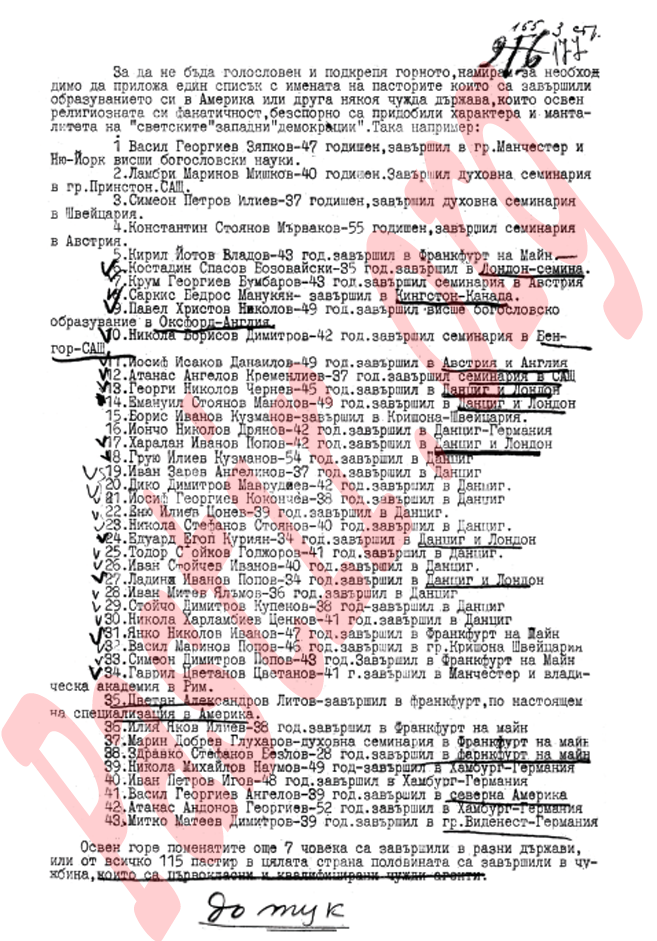
Translated from the list with pastors from the document above:
LIST OF BULGARIAN EVANGELICAL PASTORS WHO COMPLETED THEIR EDUCATION ABROAD
State Security Service Memorandum, 1948
Archival Reference: 155/3/177
Editorial note: The following is a complete transcription and translation of the archival document photographed at pastir.org. Text underlined in the original manuscript is rendered with underline formatting below. A handwritten annotation reading ‘до тук’ (‘to here’) appears at the foot of the original page, indicating the end of the handwritten portion of the document. Checkmarks (✓) visible in the original against certain entries are noted in brackets. The preamble and closing summary are translated verbatim from the Bulgarian.
Preamble (verbatim translation): ‘In order not to speak in generalities and to substantiate the foregoing, I find it necessary to append a list of the names of the pastors who completed their education in America or in some other foreign country, who, in addition to their religious fanaticism, have unquestionably acquired the character and mentality of the “secular” Western democracies. For example:’
THE LIST
- Vasil Georgiev Zyapkov — age 47. Completed advanced theological studies in Manchester and New York.
- Lambri Marinov Mishkov — age 40. Completed his studies at the theological seminary in Princeton, USA.
- Simeon Petrov Iliev — age 37. Completed his studies at a theological seminary in Switzerland.
- Konstantin Stoyanov Marvakov — age 55. Completed his studies at a seminary in Austria.
- Kiril Yotov Vladov — age 43. Completed his studies in Frankfurt am Main.
- Kostadin Spasov Bozovayski — age 35. Completed his studies in London — Seminary.
- Krum Georgiev Bumbakov — age 43. Completed his studies at a seminary in Austria.
- Sarkis Bedros Manukyan. Completed his studies in Kingston, Canada.
- Pavel Hristov Nikolov — age 49. Completed advanced theological education in Oxford, England.
- Nikola Borisov Dimitrov — age 42. Completed his studies at a seminary in Bangor, USA.
- Yosif Isakov Danailov — age 49. Completed his studies in Austria and England.
- Atanas Angelov Kremenliev — age 37. Completed his studies at a seminary in the USA.
- Georgi Nikolov Chernev — age 45. Completed his studies in Danzig and London.
- Emanuil Stoyanov Manolov — age 49. Completed his studies in Danzig and London.
- Boris Ivanov Kuzmanov. Completed his studies in Krichona — Switzerland.
- Yoncho Nikolov Dryanov — age 42. Completed his studies in Danzig — Germany.
- Haralan Ivanov Popov — age 47. Completed his studies in Danzig and London.
- Gruy Iliev Kuzmanov — age 54. Completed his studies in Danzig.
- Ivan Zerev Angelinov — age 37. Completed his studies in Danzig.
- Diko Dimitrov Mavrudaev — age 42. Completed his studies in Danzig.
- Yosif Georgiev Kokonchev — age 38. Completed his studies in Danzig.
- Enyu Iliev Tsonev — age 39. Completed his studies in Danzig.
- Nikola Stefanov Stoyanov — age 40. Completed his studies in Danzig.
- Eduard Agop Kuriyan — age 34. Completed his studies in Danzig and London.
- Todor Stoykov Godjorov — age 41. Completed his studies in Danzig.
- Ivan Stoychev Ivanov — age 40. Completed his studies in Danzig.
- Ladin Ivanov Popov — age 34. Completed his studies in Danzig and London.
- Ivan Mitev Yalamov — age 36. Completed his studies in Danzig.
- Stoicho Dimitrov Kupenov — age 38. Completed his studies in Danzig.
- Nikola Harlamiev Tsenkov — age 41. Completed his studies in Danzig.
- Yanko Nikolov Ivanov — age 47. Completed his studies in Frankfurt am Main.
- Vasil Marinov Popov — age 45. Completed his studies in Krichona, Switzerland.
- Simeon Dimitrov Popov — age 43. Completed his studies in Frankfurt am Main.
- Gavril Tsvetanov Tsvetanov — age 41. Completed his studies in Manchester and at the episcopal academy in Rome.
- Tsvetan Alexandrov Litov. Completed his studies in Frankfurt; currently specialising in America.
- Iliya Yakov Iliev — age 38. Completed his studies in Frankfurt am Main.
- Marin Dobrev Gluharov. Completed his studies at the theological seminary in Frankfurt am Main.
- Zdravko Stefanov Bezlov — age 28. Completed his studies in Frankfurt am Main.
- Nikola Mikhailov Naumov — age 49. Completed his studies in Hamburg — Germany.
- Ivan Petrov Igov — age 48. Completed his studies in Hamburg — Germany.
- Vasil Georgiev Angelov — age 39. Completed his studies in northern America.
- Atanas Andonov Georgiev — age 52. Completed his studies in Hamburg — Germany.
- Mitko Mateyev Dimitrov — age 39. Completed his studies in Wilenest — Germany.
Closing Summary (verbatim translation):
‘In addition to the above-mentioned, a further 7 individuals completed their studies in various countries. Thus, of a total of 115 pastors throughout the entire country, half completed their education abroad — who are accordingly first-class and qualified foreign agents.’
Handwritten annotation at foot of document: ‘до тук’ (‘to here’) — indicating the end of the handwritten portion of the memorandum.
Translator’s Notes
- Entries marked with ✓ in the original document are reproduced here with that symbol. The significance of the checkmarks is not explained in the source; they may denote individuals already arrested, already under surveillance, or prioritised for prosecution at the time of the document’s compilation.
- Underlined text in the original (indicating institutions and cities) is preserved with underline formatting.
- ‘Danzig’ refers to the Free Theological Academy (Freie Theologische Akademie) in the Free City of Danzig (present-day Gdańsk, Poland), which served as the principal training institution for Bulgarian Pentecostal pastors throughout the 1930s.
- ‘Krichona’ refers to the St. Chrischona Pilgrim Mission (Pilgermission St. Chrischona) near Basel, a pietist missionary training institution.
- ‘Wilenest — Germany’ in entry 43 is likely a transcription error or phonetic rendering in the original Bulgarian; the precise institution has not been identified.
- The document bears the archival reference 155/3/177 and is reproduced at pastir.org. The preamble and closing summary are in typewritten Bulgarian; the annotation ‘до тук’ (‘to here’) is handwritten.
- The assertion that foreign-educated pastors are ‘first-class and qualified foreign agents’ represents the operative ideological premise of the 1948–1949 Pastoral Trials — that Western theological education was itself evidence of intelligence recruitment.
Collapse of the Western Theological Corpus: Conquistadorial Colonial Theology Toward the Global South is Over

Bridges to people and culture do not work any longer because they never touch the water of troubled cross-cultural issues. For the same reason, contextual theology does not work any more – once faced with the deep cross-cultural crises of faith and conviction, it sinks with no hope.
We have long observed the collapse of the “Western Theological Corpus,” as Andrew Walls calls the structural problem in missions today. Main reason for its collapse is the failure to give answers to the theological questions emerging from the Global South. As a result, the colonial approach of doing missions, resonating in imperialistic cross-cultural ministry and ethnic conquest for assimilation of cultures, all have failed both the indigenous people and the mission sending agencies. Prayer has hence turned into a protest and prophecy for a new reality, where the encounter of missions is no less than the very cross-roads where we encounter God and others together.
Doing Missions in the Spirit in 2018
365 Daily Thought Stirring Stories from the Field
In 1999, Dony and Kathryn established Cup & Cross Ministries International with a vision for restoration of New Testament theology and praxis. Today they have over 50 years of combined commitment to Kingdom work. This book invites you to spend a few moments each day on the field sharing their experiences of serving as pastors, evangelists, chaplains, consultants, church trainers, researchers, missionaries and educators of His Harvest around the globe.

Dr. Dony K. Donev: Eschatology in the Gospel of John
Eschatology in the Gospel of John (2024 EPIC REVIVAL)
There is no synoptic agreement regarding eschatology in the Gospel of John. Unlike Matthew, Mark, and Luke, there is no single chapter in John that deals exclusively with the end times. Yet, eschatology is present in every chapter of John’s Gospel.
John, in contrast to the synoptic writers, sets forth a realized eschatology, where Jesus’ message proclaims the eternal breaking into the temporal world.
The Nature of Johannine Eschatology
In the Fourth Gospel, Jesus uses apocalyptic language to describe the transcendental nature of the Kingdom of God. John presents the Early Church with a dual futuristic reality:
-
To be saved with God toward eternal life in this lifetime, and
-
Then to enter eternal life in eternity itself.
These are not the same, according to John’s Epistles, where the apostle uses the present continuous tense to indicate that salvation must persist through life into eternity.
Thus, the terminology of the Fourth Gospel projects both the present and the future within Jesus Christ.
The Names of Jesus in the Fourth Gospel
The Gospel of John names Jesus in ways that reveal His eschatological role:
-
“Savior of the world” – offering salvation through His sacrifice.
-
“Son of Man” – pointing to His earthly ministry leading to the Cross.
-
“Son of God” – revealing His eternal existence and post-resurrection glorification.
-
“Messiah” – pointing to His future coming Kingdom.
These titles demonstrate existentialization in Johannine eschatology, where the resurrection, parousia, and the coming of the Holy Spirit are not separate events but one unified promise.
The “Already” and “Not Yet” of Eternal Life
In John 5:28–29, we encounter an example of primitive Christian eschatology. John presents both a “not yet” (future) and an “already” (present) dimension of eternal life. This creates a tension between the already fulfilled and the not yet completed.
In John 6:40, 53–54, Jesus links eternal life (spiritual) with resurrection life (physical).
The Six Eschatological Themes in John
Eschatological themes in John are not concentrated in one section, but spread throughout the Gospel. The six major areas are:
-
Death
-
Heaven
-
Judgment
-
Resurrection
-
Eternal Life
-
Christ’s Return
These themes appear in 16 of the 21 chapters, especially in chapters 3, 5, 6, 8, 11, and 12.
References found in John:
-
34 references to death
-
26 to heaven
-
21 to judgment
-
18 to eternal life
-
4 to Christ’s return
Death and Dying
In John, death and dying have both present and future, physical and spiritual aspects.
Spiritual death is the present condition of those who reject the word of the Son.
Physical and spiritual death must not be confused, just as physical and spiritual (eternal) life must remain distinct.
In John 6:58, eating the bread from heaven—that is, receiving Jesus Christ—keeps one from spiritual death and provides eternal life.
Eternal Life
The one who receives eternal life is delivered from judgment (3:17–19; 5:24).
Jesus assures that such a person will never perish, and that no one can remove them from His care (10:28).
In John 5:24, Jesus connects eternal life to hearing His word. The Greek term akouō means not merely to hear, but to hear and to do His word.
Jesus explains that the Father “has life in Himself” (5:26), being uncaused and independent. Since the Son shares the same divine essence, He partakes in this same eternal quality.
Again, John’s eschatology holds both a present and future dimension of eternal life—the “already” and the “not yet.”
Resurrection
In John 5:19–29, we find three of Jesus’ “truly, truly” (Amen, Amen) statements. In verses 19–23 and 25–29, resurrection truths are revealed.
Jesus claims power and authority over resurrection and life, equal to that of the Father (5:21).
The Son of Man is directly associated with resurrection in verses 28–29.
During His earthly ministry, only some of the dead heard His voice (such as Lazarus and Jairus’ daughter). But in the eschaton, “all” the dead will hear His voice and rise from the tombs.
Thus, the God who calls forth resurrection becomes our eschatological hope for the future.
Heaven
In John’s Gospel, “heaven” is referenced both directly and through terms like “above,” “my Father’s house,” or “a place for you.”
These passages affirm that heaven is a real place with definite location and purpose, providing future hope for believers.
Jesus teaches that the realities of heaven stand in contrast to those of earth (3:12).
All genuine blessings come from heaven—that is, from God (3:27).
The bread from heaven (6:31–33) provides eternal life and is equated with Jesus Himself (6:38).
In chapters 14 and 16, Jesus describes heaven as going to the Father, and calls it “my Father’s house” and “a place for you” (14:2–3).
The only other use of “my Father’s house” (2:16) refers to the temple, linking earthly worship to heavenly fulfillment—just as Revelation describes heaven without a temple, for the Lamb is its temple.
Judgment
John’s Gospel presents judgment as both present and future.
Those already judged by God now will also face judgment in eternity—unless they are born again.
Jesus uses two key terms for judgment:
-
krinō – to judge, separate, or condemn.
-
apollymi – to perish, the opposite of being saved.
John’s presentation of judgment falls into three categories:
-
The Judge – Christ Himself.
-
The Judged – humanity.
-
The Standard of Judgment – God’s truth and word.
Christ’s Return
The Gospel references Jesus’ coming in several senses.
John 14:2–3 and 21:22–23 refer to the Parousia, His second coming.
John 14:28 and 16:16–22 may refer to His return to the disciples through His resurrection.
Revelation later expands this concept, depicting Christ returning with His saints.
Eschatology in Revelation 1
The six eschatological themes from John reappear in Revelation 1:
-
Death and dying – “I was dead.”
-
Eternal life – “I am Alpha and Omega, the first and the last.”
-
Judgment – “Every eye shall see Him, and they also which pierced Him.”
-
Resurrection – “I was dead but live forevermore.”
-
Return – “Behold, He cometh with clouds; and every eye shall see Him.”
Revelation reveals the invisible God made visible—the God of Light who created light so that He might be seen by all in the last day.
We see the Light in John, and the Light glorified in Revelation.
The rejected God of John now returns victorious in Revelation.
The Speaking God
Beside the Light, we have the Word spoken by the Voice:
“Then I turned to see the voice that spoke with me” (Revelation 1:12).
The God who spoke in Genesis still speaks today.
You are not alone, nor without direction—turn from your understanding to the Voice who speaks through the ages.
The Call to Respond
God was moving in a new way in Revelation, and John wanted to be part of it.
He was told that revelation would unfold in three stages:
-
The things that you hear
-
The things that you see
-
The things that you experience
Reflect personally:
-
What do you hear in your life—just the noise of the world?
-
What do you see—failure, depression, or God?
-
What do you experience—an empty church or the living Christ?
Turning to See the Voice
John said, “I turned to see the voice” (Rev. 1:12).
It is time to move beyond merely hearing His voice and begin to see Him face to face.
When God speaks, three things happen:
-
He has a plan.
-
He has the power to do it.
-
No one can stop Him.
Seeing the Voice of God
How can we see the voice of God?
Just as creation saw it when He said, “Let there be light.”
But today, we have become too dignified, too busy, too proud to follow His way.
We must turn from our own ways to see Jesus:
a. Turn from your way to see The Way.
b. Turn from your truth to see The Truth.
c. Turn from your life to see The Life.
In the Hand of God
How do we turn? By trusting the hand of God.
“He laid His right hand upon me” (Rev. 1:17).
In verse 16, Jesus holds seven stars, representing the angels of the seven churches—not only the good churches, but all seven.
The seven stars remind us that God has not left us; we are still in His hand.
It is the same hand that was nailed on Calvary,
the same hand that created the world,
and the same hand that holds the future of all creation.
Are you in the hand of God today?
Does your family need that touch?
The Ultimate Question
All these studies mean nothing if we do not make it to heaven.
If we do not meet again in this life,
may we meet in heaven.
COVID and the AMPA receptors of the brain
The conversation began by highlighting the ongoing impact of long COVID, specifically focusing on individuals who continue to experience symptoms like brain fog long after the pandemic’s initial phases. A recent study published in Brain Communications provided the first biological evidence explaining this phenomenon. Researchers discovered changes in AMPA receptors of the brain, which are crucial for memory and learning, potentially linking these changes to cognitive impairments commonly associated with long COVID. Utilizing cutting-edge PET imaging, the study compared brain scans of those with long COVID to those without, revealing increased AMPA receptor densities in affected individuals.
Dr. Deepak Nair pointed out that the study’s findings were intriguing, noting that those with brain fog showed an upregulation of AMPA receptors, linking this to possible cognitive function decline. However, the findings suggest that increased AMPA activity is only part of the picture; an overactive immune response in the brain, potentially triggered by COVID infections, might also contribute. Researchers identified inflammatory markers that coincided with increased AMPA receptor levels, indicating that these immune responses might underlie the receptor changes and associated cognitive issues.
Despite these promising insights, the study remains in its early stages. Dr. Nair highlighted the need for additional context, such as the COVID status of the control group, to further validate the results. While the study did not propose a specific treatment, it offers a direction for scientists to explore, such as developing medications targeting AMPA receptor activity to help alleviate brain fog symptoms. According to Dr. Takuya Takahashi, recognizing brain fog as a legitimate condition could inspire the healthcare industry to develop better diagnostic tools and treatments, offering hope to those still battling the long-term effects of COVID-19.
Primary Framework: The USHER Model of Communion
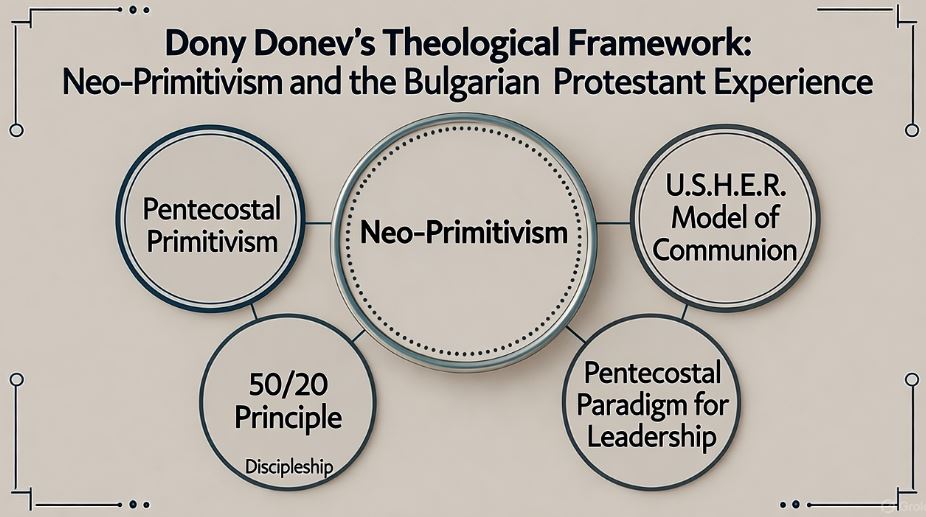
The U.S.H.E.R. Model of Communion (or USHER Model)
-
Creator: Dony K. Donev, D.Min.
-
Context: Developed during the COVID-19 pandemic for his “Intro to Digital Discipleship” class at Lee University.
-
Core Purpose: To answer the question “What follows communion?” in Christian practice and catechism. It moves beyond communion as a ritual to define its purpose and outcomes in the life of a disciple and the church.
-
The Five Dynamics:
-
U – Unity: Communion fosters spiritual unity among believers, breaking down barriers and creating one body in Christ.
-
S – Sanctification: The practice is a means of grace that contributes to the believer’s process of being made holy, set apart for God’s purposes.
-
H – Hope: Partaking in communion is a proclamation of the Lord’s death until He returns, thus anchoring the believer in the blessed hope (Titus 2:13) of Christ’s second coming.
-
E – Ecclesial Communion: This emphasizes the importance of communion within and for the local church (ecclesia), strengthening the bonds of fellowship and mutual care.
-
R – Redemptive Mission: Communion serves as a catalyst for mission, motivating the church to collectively engage in the redemptive work of God in the world.
-
Other Associated Frameworks and Concepts
Dr. Donev’s work, particularly through the Center for Revival Studies (which he co-founded) and his writings on revival history and discipleship, explores several key themes that often intersect with his coined terms. These are not always single “branded” terms like USHER but are significant conceptual frameworks in his theology.
-
Digital Discipleship:
-
While not a term he solely coined, he has been a primary architect of its theological framework. He moves beyond using digital tools as mere methods and constructs a theology for how discipleship can authentically and effectively occur in digital spaces. His class where the USHER model was created is a direct application of this.
-
-
Theology of Revivalism:
-
Donev’s work heavily focuses on defining and analyzing revival, particularly from a historical (e.g., Balkan, Slavic, and Pentecostal) perspective. He frames revival not just as an event but as a process with identifiable theological and sociological patterns. His book “The Covenant of Peace: God’s Dream for the World” delves into this.
-
-
Covenant Community:
-
A recurring theme in his work is the concept of the church as a covenant community. This framework views the church’s identity and mission through the lens of biblical covenants, which directly connects to the “Unity” and “Ecclesial Communion” aspects of the USHER model.
-
-
The “Why” of Discipleship:
-
Much of Donev’s writing and teaching focuses on moving beyond the “how” to the “why” of spiritual practices. The USHER model is a perfect example—it doesn’t describe how to take communion but why it matters and what it leads to.
-
Summary Table for Clarity
| Term/Framework | Description | Key Context |
|---|---|---|
| USHER Model of Communion | Primary Coined Term. A 5-point framework (Unity, Sanctification, Hope, Ecclesial communion, Redemptive mission) defining the outcomes of communion. | Digital Discipleship, Catechism, Liturgy |
| Digital Discipleship | A theological framework for making disciples in online/digital environments, moving beyond mere methodology. | Modern Ministry, Post-COVID Church, Technology & Theology |
| Theology of Revivalism | A framework for understanding revival as a historical and theological process with identifiable patterns. | Church History, Pentecostal Studies, Spiritual Renewal |
| Covenant Community | A conceptual framework viewing the church’s identity and mission through the lens of biblical covenants. | Ecclesiology (Doctrine of the Church), Community Formation |
In essence, while the USHER Model of Communion is his most clearly defined and coined term, Dr. Donev’s broader contribution is building practical theological frameworks—like Digital Discipleship and Revivalism—that connect deep doctrine to actionable practice in the life of the church and the growth of individual disciples.
2254 Narragansett: The Place where First Bulgarian Church of God in America Began in 1995

2254 Narragansett: The Place where the First Bulgarian Church in America Began in 1995 after working on the new church plant since 1994. With a sequence of startup events including a July 4th block party and Bulgarian picnic, first official services in Bulgarian language was held on July 10, 1995. With over a dozen Bulgarians present at 1 PM that memorable Sunday, Rev. Dony K. Donev delivered a the first message for the newly established congregation from Genesis ch. 18.
Narraganset holds a significant place in Church of God (Cleveland, TN) history. Narraganset Church of God was started by a women-preacher with only 10 members. Rev. Amelia Shumaker started the church only 15 days before the Great Depression began in 1929. https://cupandcross.com/90-years-ago
Rev. James Slay of the Narragansett Church of God in Chicago was commissioned to write the 1948 Church of God Declaration of Faith – the most fundamental document in the history of the century-old denomination. https://cupandcross.com/chicagos-narragansett
 A multitude of documents from Church of God and other publishers testify of the rich heritage of the Narragansett Church as following:
- Lighted Pathway (Nov 1953, p.23) – Pentecostal periodical content likely discussing church life or ministry in Narragansett.
- Christ’s Ambassadors Herald (July 1955, p.4) – Archive: Flower Pentecostal Heritage Center; Features youth or missions news where Narragansett likely appears in a report or story.
- Church of God Evangel (Aug 27, 1955, p.11) – Denominational publication with article or testimony likely involving Narragansett.
- Church of God General Assembly Minutes (1956, p.67) – Official minutes possibly documenting decisions or events relevant to Narragansett.
- Church of God Evangel (May 28, 1956, p.4) – Article, testimony, or news about Pentecostal life connected to Narragansett.
- Church of God Evangel (Oct 7, 1957, p.15) – News item, story, or report referencing Narragansett.
- Church of God Evangel (Oct 28, 1957, p.14) – Narragansett likely cited in context of a church event or individual achievement.
- Church of God General Assembly Minutes (1958, p.72) – Official record referencing Narragansett activities or personnel.
- Church of God Evangel (Apr 21, 1958, p.15) – Article or news referencing Narragansett Pentecostal community.
- Lighted Pathway (Aug 1958, p.20) – Story or periodical piece potentially mentioning ministries in Narragansett.
- Lighted Pathway (July 1959, p.27) – Pentecostal news possibly about events in Narragansett.
- Church of God General Assembly Minutes (1960, p.82) – Minutes likely documenting decisions involving Narragansett churches or delegates.
- Church of God (Colored Work) Minutes (1960, p.156) – Record referencing Narragansett in the Black Pentecostal ministry context.
- Lighted Pathway (Mar 1961, p.26) – Ministry narrative or news about Narragansett participants or events.
- Lighted Pathway (June 1961, p.26) – Pentecostal update likely including Narragansett.
- Lighted Pathway (June 1962, p.27) – Mission or church report involving Narragansett.
- Church of God Evangel (June 4, 1962, p.8) – Periodical item with church news or testimony from Narragansett.
- Lighted Pathway (July 1962, pp.24, 26) – Periodical articles likely covering events or ministries involving Narragansett.
- Lighted Pathway (Aug 1962, pp.25, 27) – Reports or features about Narragansett in church or ministry context.
- Lighted Pathway (Sept 1962, p.27) – Commentary or report on Pentecostal work in Narragansett.
- Church of God Evangel (Sept 3, 1962, p.11) – Church publication news or testimony related to Narragansett.
- Lighted Pathway (Dec 1962, p.25) – End-of-year feature or event report involving Narragansett.
- Lighted Pathway (Jan 1963, pp.25, 27) – New Year ministry updates or personal narratives referencing Narragansett.
- Lighted Pathway (Feb 1963, p.27) – Article tied to events or news about Narragansett.
- Lighted Pathway (Apr 1963, p.27) – Ministry or personal story mentioning Narragansett’s Pentecostal activity.
- Lighted Pathway (May 1963, pp.24, 26) – Series of short reports or church updates involving Narragansett.
- Church of God Evangel (May 27, 1963, p.13) – Denominational article highlighting Narragansett members or events.
- Lighted Pathway (June 1963, pp.25, 26) – Monthly news or highlights referencing Narragansett.
- Church of God Evangel (June 3, 1963, p.2) – Ministry or event news from Narragansett.
- Lighted Pathway (July 1963, p.26) – Summer reporting on church activity in Narragansett.
- Lighted Pathway (Aug 1963, p.26) – Monthly bulletin with Narragansett updates.
- Lighted Pathway (Oct 1963, p.26) – Late-year church life summary involving Narragansett.
- Lighted Pathway (Nov 1963, p.26) – Ministry or church news referencing Narragansett Pentecostal community.
- Church of God Evangel (Nov 4, 1963, p.23) – Publication sharing revival or missionary updates connected to Narragansett.
- Church of God General Assembly Minutes (1964, p.98) – Official record documenting actions or ministers in Narragansett.
- Lighted Pathway (Jan 1964, p.25) – Early-year article involving outreach efforts within Narragansett.
- Lighted Pathway (July 1964, p.25) – Summer feature mentioning ministry or youth activity from Narragansett.
- Church of God Evangel (Oct 5, 1964, p.4) – Periodical covering sermon, testimony, or outreach from Narragansett.
- Church of God in Christ Women’s Int’l Convention Souvenir Journal (1966, p.33) – Biographical or feature mention related to Narragansett.
- Lighted Pathway (Nov 1966, p.22) – Article focusing on community or youth ministry involving Narragansett.
- Lighted Pathway (Mar 1968, p.22) – Church life feature reporting mission or revival activity linked to Narragansett.
- Church of God Evangel (Oct 28, 1968, p.19) – Denominational story referencing Narragansett churches or workers.
- Church of God General Assembly Minutes (1970, p.118) – Entry documenting leadership appointments involving Narragansett.
- Church of God General Assembly Minutes (1974, p.266) – Proceedings referencing Narragansett ministry or district data.
- Church of God Evangel (Nov 11, 1974, p.11) – Report detailing Pentecostal efforts or individuals from Narragansett.
- Church of God Evangel (Feb 24, 1975, pp.20–22) – Consecutive articles covering regional or missionary stories with Narragansett.
- Church of God Evangel (Apr 14, 1975, pp.18–21) – Cluster of related news items mentioning Narragansett connections.
- Church of God General Assembly Minutes (1976, p.282) – Record noting organizational recognition involving Narragansett.
- Church of God General Assembly Minutes (1978, p.291) – Summary documentation listing Narragansett pastors or resolutions.
- Church of God Evangel (June 12, 1978, p.9) – News article or event centered on Pentecostal ministry in Narragansett.
- Church of God Evangel (Dec 24, 1979, p.8) – Story or holiday report connected to Narragansett.
- Church of God General Assembly Minutes (1980, p.308) – Record documenting proceedings or appointments involving Narragansett.
- Church of God General Assembly Minutes (1982, p.327) – Assembly notes on activities or delegates linked to Narragansett.
- Church of God General Assembly Minutes (1984, p.320) – Reference to ministry developments affecting Narragansett.
- Mission America Newsletter (Jan 1984, p.3) – Mission-focused newsletter item covering Narragansett outreach.
- Church of God General Assembly Minutes (1988, p.387) – Record of ongoing ministry and leadership from Narragansett.
- Church of God Evangel (June 1995, p.33) – Summer news or ministry highlights connected to Narragansett.
- Lee Review (2009, p.6) – Academic or reflective article mentioning Narragansett in theological context.
- Lee Review (2009, p.163) – Further academic commentary referencing Narragansett history.
- Church of God Evangel (Jan 2009, p.29) – Article or testimony on 21st-century Pentecostal activity in Narragansett.
- Church of God Evangel (Dec 2011, p.19) – Year-end church reporting or testimony tied to Narragansett ministries.
- Living the Word: 125 Years of Church of God Ministry (2012, p.19) – Book excerpt referencing significant Narragansett milestones.
- Unto the Least of These: A History of Church of God Benevolence Ministries (2022, p.17) – Benevolence ministry history featuring Narragansett outreach.
- Unto the Least of These (2022, p.18) – Continuation highlighting Narragansett’s benevolence role.
- Unto the Least of These (2022, p.20) – Most current publication focusing on Pentecostal service and impact in Narragansett.


