

Aftermath of the April Uprising, 1876
Following the suppression of the April Uprising, horrific massacres were carried out in Batak, Perushtitsa, and other places in southern Bulgaria. In northern Bulgaria, the uprising in the Tarnovo district was also suppressed and its principal leaders executed. All of this adversely affected the evangelical work of both missions north and south of the Balkan range. Evangelical preachers were forced to limit their movements and make do with greatly reduced gatherings. Despite this, Bishop Andrews concluded his report to the Board in New York with the following recommendation:
“As soon as a more favorable opportunity presents itself for the Bulgarian mission, brethren from America must be sent in accordance with the purpose adopted when the work received its new impetus. This must be done because, in the event of death, transfer of missionaries to America, or proven incapacity on the part of the brethren now here, their number will not be sufficient.”
The Year 1877: A dark cloud hung over the mission. Yet the missionaries maintained unwavering faith in God. As often happens, light began to appear in the darkness. In Svishtov, Pastor Challis noticed encouraging signs early in the year. Church members, almost without exception, attended the prayer and class meetings. Two were received into full membership, and six on trial, in one of the villages within the Svishtov circuit. The Sunday school was well attended, and Pastor Challis translated into Bulgarian the questions for the Sunday lessons. Pastor Lounsbury likewise began his work in Tarnovo under encouraging conditions. Initially the meetings were well attended, but threats soon caused a significant decline in participation. Gavrail Iliev spent most of his time outside Ruse, in towns and villages where the massacres had occurred. Aid was distributed to 1,620 families. The Bulgarian preachers did everything they could in the afflicted areas of northern Bulgaria.
Lovech, 1877: Pastor and Eight Members Killed
During the Russo–Turkish War of 1877, when Russian forces captured Lovech and later withdrew temporarily, bashi-bazouk bands re-entered the town and slaughtered many people. According to some accounts, a massacre occurred at the place where the evangelicals gathered. Eight people were killed, including the preacher Nikola Voynov. It is unclear why this is omitted in the manuscripts of Pastor St. Tomov, though the event is confirmed.
Yordan Ikonomov then completing his theological course at the seminary in Drew, USA, was sent that same year to work in Bulgaria. The superintendent appointed him to teach the young men preparing for the ministry.
The Death of Mrs. Challis: In April 1877 Russia declared war on Turkey with the aim of liberating Bulgaria from Ottoman rule. Mrs. Flocken fell ill, and Mrs. Challis was holding a small child in her arms. Pastor Flocken believed it best to take the women to Germany and then return to Bulgaria. Just as he was preparing to carry out this plan, Pastor Challis contracted smallpox, and his devoted wife refused to leave him. The disease spread to the child, making separation impossible. Flocken departed with his wife, but upon arriving in Budapest, Mrs. Flocken was unable to continue the journey. He placed her in a Christian hospital, where the next day she gave birth to a daughter. Eager to return to Ruse, he soon learned the sorrowful news of the death of Mrs. Challis, who had died of smallpox.
Meanwhile Russian troops were advancing toward Svishtov, and the superintendent advised Pastor Challis to take his child to the United States, as he would be unable to care for it in Bulgaria. Following this counsel, Pastor Challis left for America accompanied by Miss Siika Dimitrova, daughter of Grandfather Dimitar – one of the first evangelicals in Svishtov – who agreed to care for the child. They arrived in New York in June 1877. Upon the advice of the mission secretaries and the bishop, he took up work in his Annual Conference until the end of the war in Bulgaria. Flocken received word from Budapest that his wife and newborn child were not expected to live long. He summoned Lounsbury to Ruse and left for Budapest. The child died, but by God’s mercy his wife survived.
The Russians crossed the Danube, and the missionaries were forced to withdraw. The mission was divided by the warring armies. Under these circumstances the Board advised Flocken and Lounsbury to return to the United States, and they departed. Pastor Flocken arrived in New York on 1 February 1878, and Lounsbury several weeks earlier.
 Dony K. Donev, D.Min., is a prominent researcher and author specializing in Bulgarian Protestant, Evangelical, and Pentecostal history, with over three decades of study. His work, including 19th Century History of Protestantism in Bulgaria and The Unforgotten: Historical and Theological Roots of Pentecostalism in Bulgaria, documents the development of these movements, their suppression under Communism, and the subsequent post-1989 revival. Key aspects of Donev’s research on Bulgarian Protestant history include:
Origins (19th Century): Protestant work began in the 1800s, with denominations like Congregationalists (1856), Methodists (1857), and Baptists (1865) establishing missions, culminating in the first Bulgarian Protestant Church in 1871. Donev also highlights the 1871 publication of the Protestant Bulgarian Bible translation. His research, often in collaboration with the Institute of Bulgarian Protestant History, has focused on preserving, digitizing, and recovering documents, including church diaries, photographs, and, in some cases, saving records from destruction during the communist era.
VBS for Adults

For reasons obvious to most of our readers, I was able to attend no less than 10 (ten) VBS/Kids crusades this summer. Seven Baptist, several Pentecostals and a Methodist one.
The themes ranged from jungle journey and the Lion King to giddy up cowboys and cowgirls and world/planet/time travelling. All cool themes with lots of props and much careful preparation all in the name of bringing the Good News to the little ones. A noble cause truly worthy of any expense and labor for any church out there.
Time and length ranged from one whole day or one evening service to three nights and even several week long ones. For most of it, the ones held in most Baptist churches were designed by LifeWay and were well structured with kids constantly moving from station to station. The rest were somewhat free style, but still designed with the expectation of lots of children attending. In between each module there was candy, snacks or even a full blown supper.
The location of each VBS and the way it was designed for the crowd flow made the initial impression important. Signs welcoming and directing newcomers were grate, but the friendliness of the people made up for less signage and more human touch. Registration was a must and parents’ preferences were not taken lightly. The decorations of each room helped the children adjust to the new setting and work through the set curriculum. And yes, lots of kids made lots of mess so cleanness in class rooms, play areas and bathrooms were tended to. Some churches had a designated team that made sure the facilities were clean for the next group. And where cleanness was not intentional, it was observed that many parents did not return with their children.
Most VBS programs were designed around age groups. Some included even classes for toddlers and several had adult classes too. The ones that did not, included a family night toward the end of the week for parents to attend. A family night was a great feature for parents who did not attend but dropped their kids every night and picked them up afterwards. They were addressed with materials and opportunities for a spiritual renewal.
The thematic VBSs progressed with learning daily and build up on the previous day. The groups of children toggled between Bible lesson, crafts, games and lots of music. Kids were greatly encouraged to participate and learn the songs and dancing, recite Bible verses and answer questions from the covered material. Some parents participated too.
Prayer was made a central focal point for most of the VBSs observed. The Baptists ones, especially, had pledges of allegiance at the start of the service and assembly with prayer toward the end. A memorable experience for all children who enjoy social setting, making new friends and learn the Bible.
Here are several take ways to observe for a VBS in your church:
- Prepare for lots of children – if you have it they will come
- Train your workers. Form teams for each task. Assign measurable goals to ensure smooth moving through the program
- Self designed VBS programs work as good as the paid ones, as long as designed with the children and families in mind
- Chose the length of the event carefully with regard of your constitutions. For the most of it, less is really more.
- Do not underestimate friendliness, cleanness and the safety of the children.
- Don’t miss a family day. Everyone likes hot dogs and water slides on a hot summer day.
This goes without saying, but focus on God – it is easy to lose track and purposes in the larger design of such events.
Januarius MacGahan: Turkish Atrocities in Bulgaria (Part 2)
At the next house a man stopped us to show where a blinded little brother had been burned alive, and the spot where he had found his calcined bones, and the rough, hard-vizaged man sat down and sobbed like a child…. On the other side of the way were the skeletons of two children lying side by side, partly covered with stones, and with frightful, sabre cuts in their little skulls. The number of children killed in these massacres is something enormous. They were often spitted on bayonets, and we have several stories from eye-witnesses who saw the little babes carried about the streets, both here and at Olluk-Kui, on the points of bayonets. The reason is simple. When a Mohammedan has killed a certain number of infidels, he is sure of Paradise, no matter what his sins may be. Mahomet probably intended that only armed men should count, but the ordinary Mussulman takes the precept in its broader acceptation, and counts women and children as well. The advantage of killing children is that it can be done without danger, and that a child counts for as much as an armed man. Here in Batak the Bashi-Bazouks, in order to swell the count, ripped open pregnant women, and killed the unborn infants. As we approached the middle of the town, bones, skeletons, and skulls became more numerous. There was not a house beneath the ruins of which we did not perceive human remains, and the street besides was strewn with them.
Before many of the doorways women were walking up and down wailing their funeral chant. One of them caught me by the arm and led me inside of the walls, and there in one corner, half covered with stones and mortar, were the remains of another young girl, with her long hair flowing wildly about among the stones and dust. And the mother fairly shrieked with agony, and beat her head madly against the wall. I could only turn round and walk out sick at heart, leaving her alone with her skeleton. A few steps further on sat a woman on a doorstep, rocking herself to and fro, and uttering moans heartrending beyond anything I could have imagined. Her head was buried in her hands, while her fingers were unconsciously twisting and tearing her hair as she gazed into her lap, where lay three little skulls with the hair still clinging to them.…
And now we begin to approach the church and the schoolhouse. The ground is covered here with skeletons, to which are clinging articles of clothing and bits of putrid flesh; the air is heavy with a faint sickening odour, that grows stronger as we advance. It is beginning to be horrible.
The school is on one side of the road, the church on the other. The schoolhouse, to judge by the walls that are in part standing, was a fine large building, capable of accommodating two or three hundred children. Beneath the stones and rubbish that cover the floor to the height of several feet, are the bones and ashes of two hundred women and children burnt alive between those four walls. Just beside the school house is a broad shallow pit. Here were buried a hundred bodies two weeks after the massacre. But the dogs uncovered them in part.
The water flowed in, and now it lies there a horrid cesspool, with human remains floating about or lying half exposed in the mud. Nearby, on the bunks of the little stream that runs through the village, is a sawmill. The wheel-pit beneath is full of dead bodies floating in the water.
The banks of this stream were at one time literally covered with corpses of men and women, young girls and children, that lay there festering in the sun, and eaten by dogs. But the pitiful sky rained down a torrent upon them, and the little stream swelled and rose up and carried the bodies away, and strewed them far down its grassy banks, through its narrow gorges and dark defiles beneath the thick underbrush and the shady woods as far as Pestera, and even Tatar Buzardjik, forty miles distant.
We entered the churchyard, but the odour here became so bad that it was almost impossible to proceed. We take a handful of tobacco, and hold it to our noses while we continue our investigation. The church was not a very large one, and it was surrounded by a low stone wall, enclosing a small churchyard about fifty yards wide by seventy-five long. At first we perceive nothing in particular, and the stench was so great that we scarcely care to look about us, but we see that the place is heaped up with stones and rubbish to the height of five or six feet above the level of the street, and upon inspection we discover that what appeared to be a mass of stones and rubbish is in reality an immense heap of human bodies covered over with a thin layer of stones. The whole of the little churchyard is heaped up with them to the depth of three or four feet, and it is from here that the fearful odour comes….
We were told there were three thousand people lying here in this little churchyard alone, and we could well believe it. It was a fearful sight – a sight to haunt one through life. There were little curly heads there in that festering mass, crushed down by heavy stones; little feet not as long as your finger on which the flesh was dried hard, by the ardent heat before it had time to decompose; little baby hands stretched out as if for help; babes that had died wondering at the bright gleam of sabres and the red hands of the fierce-eyed men who wielded them; children who had died shrinking with fright and terror; young girls who had died weeping and sobbing and begging for mercy; mothers who died trying to shield their little ones with their own weak bodies, all lying there together, festering in one horrid mass. They are silent enough now. There are no tears nor cries, no weeping, no shrieks of terror, nor prayers for mercy. The harvests are rotting in the fields, and the reapers are rotting here in the churchyard.
We looked into the church which had been blackened by the burning of the woodwork, but not destroyed, nor even much injured. It was a low building with a low roof, supported by heavy irregular arches, that as we looked in seemed scarcely high enough for a tall man to stand under. What we saw there was too frightful for more than a hasty glance. An immense number of bodies had been partly burnt there and the charred and blackened remains, that seemed to fill it half way up to the low dark arches and make them lower and darker still, were lying in a state of putrefaction too frightful to look upon.
I had never imagined anything so horrible.
We all turned away sick and faint, and staggered out of the fearful pest house glad to get into the street again. We walked about the place and saw the same things repeated over and over a hundred times. Skeletons of men with the clothing and flesh still hanging to and rotting together; skulls of women, with the hair dragging in the dust, bones of children and of infants everywhere. Here they show us a house where twenty people were burned alive; there another where a dozen girls had taken refuge, and been slaughtered to the last one, as their bones amply testified. Everywhere horrors upon horrors.
….Some of those who have been able to identify the bones of friends have made weak attempts at burying them. But they have no spades to dig graves with, and they are weak and starving. Besides, many of the survivors are women, who have
made fruitless efforts to keep the bodies of loved ones covered with a little earth. We had ample proof that wherever bones could be identified, they were tenderly cared for. We saw many well-kept graves decorated with flowers. We saw others that had been uncovered by the rain or the dogs, leaving parts of the skeleton exposed, that were still decorated with flowers. We even saw skulls lying on the ground, within a doorway or a garden wall, with a bouquet of flowers lying upon them, as though some one was caring for them, and was yet loth to bury them away out of sight. I saw one half buried, with the face upward, and its hollow eyes gazing reproachfully up at the sunny sky, with a bouquet carefully placed in its mouth; but most of these skeletons and bones have nobody to look after them.
Of the eight or nine thousand people who made up the population of the place, there are only twelve or fifteen hundred left, and they have neither tools to dig graves with nor strength to use spades if they had them. But why have the Turkish authorities not buried them out of sight? The Turkish authorities will tell you they have buried them, and that there were very few to bury. Of all the cruel, brutal, ferocious things the Turks ever did, the massacre of Batak is among the worst! Of all the mad, foolish things they ever did, leaving these bodies to lie here rotting for three months un-buried is probably the maddest and most foolish! But this village was in an isolated, out-of-the way place, difficult of access, and they never thought Europeans would go poking their noses here, so they cynically said, “These Christians are not even worth burial, let the dogs eat them.”
We talked to many of the people, but we had not the heart to listen to many of their stories in detail, and we restricted ourselves to simply asking them the number lost in each family. No other method would probably give a better idea of the fearful character of the massacre, and the way in which whole families were swept out of existence. “How many ware in your family?” we would ask. “Ten,” the answer would be, perhaps. “How many remain?” “Two.” “How many in yours?” “Eight.” How many remain?” “Three.” “How many in yours?” “Fifteen.” “How many remain?” “Five.” And so on in families numbering from five to twenty, in which only remained from one to five persons.
One old woman came to us, wringing her hands, and crying in that hard tearless manner of which I have already spoken, and when we could get her sufficiently calmed to tell us her story, she said she had three tall handsome sons, Ghiorghy, Ivantehu, und Stoyan, and they were all married to good and dutiful wives, Reika, Stoyanka, and Anka, and they had between them twelve beautiful children, Anghel and Tragan and Ghiorghy and Ivantchu, Letko, Assen, Boydan, Stoyan, Tonka, Gingka, Marika, and Reika, so that the family counted all told nineteen persons living under the same roof. Of all this large flourishing family, the tall handsome sons, the dutiful wives, and the twelve beautiful children, there remained only this poor old grandmother. They were all brutally slaughtered to the last one. Of this nourishing family tree there remained only this lifeless withered trunk, and the poor old woman sat down and beat her head against the ground, and fairly screamed out her despair…. We were told that any number of children and young girls had been carried off; that it was known in what Turkish villages they were kept, and that the Turks simply refused to restore them to their parents. Mr. Schuyler afterwards obtained a list, with the names and ages of eighty-seven girls and boys that had been carried off, with the name of the village in which each was kept…. We asked about the skulls and bones we had seen up on the hill upon first arriving in the village where the dogs had barked at us. These we were told were the bones of about two hundred young girls, who had first been captured and particularly reserved for a worse fate than death. They had been kept till the last; they had been in the hands of their captors for several days – for the burning and the pillaging had not all been accomplished in a single day – and during this time they had suffered all it was possible that poor weak trembling girls could suffer at the hands of brutal savages. Then, when the town had been pillaged and burnt, when all their friends had been slaughtered, these poor young things, whose very wrongs should have insured them safety, whose very outrages should have insured them protection, were taken, in the broad light of day, beneath the smiling canopy of heaven, coolly beheaded, then thrown in a heap there, and left to rot.”
~ J. A. MacGahan (The Daily News, August 22, 1876)
Dony K. Donev, D.Min., is a prominent researcher and author specializing in Bulgarian Protestant, Evangelical, and Pentecostal history, with over three decades of study. His work, including 19th Century History of Protestantism in Bulgaria and The Unforgotten: Historical and Theological Roots of Pentecostalism in Bulgaria, documents the development of these movements, their suppression under Communism, and the subsequent post-1989 revival. Key aspects of Donev’s research on Bulgarian Protestant history include:
Origins (19th Century): Protestant work began in the 1800s, with denominations like Congregationalists (1856), Methodists (1857), and Baptists (1865) establishing missions, culminating in the first Bulgarian Protestant Church in 1871. Donev also highlights the 1871 publication of the Protestant Bulgarian Bible translation. His research, often in collaboration with the Institute of Bulgarian Protestant History, has focused on preserving, digitizing, and recovering documents, including church diaries, photographs, and, in some cases, saving records from destruction during the communist era.
Januarius MacGahan: Turkish Atrocities in Bulgaria (Part 1)
“A pilgrim from the ends of earth I come
To kneel devoutly at your lowly tomb
To own our debt, we can never repay
To sigh with gratitude, thank God and pray
To bless your name and bless your name
For this I came.” ~Stoyan Vatralsky
“Since my letter of yesterday I have supped full of horrors. Nothing has as yet been said of the Turks that I do not now believe; nothing could be said of them that I should not think probable and likely. There is, it seems, a point in atrocity beyond which discrimination is impossible, when mere comparison, calculation, measurement are out of the question, and this point the Turks have already passed. You can follow them no further.…
But let me tell you what we saw in Batak: We had some difficulty in getting away from Pes[h]tera. The authorities were offended because Mr. Schuyler refused to take any Turkish official with him, and they ordered the inhabitants to tell us that there were no horses, for we had to leave our carriages and take to the saddle. But the people were so anxious that we should go that they furnished horses in spite of the prohibition, only bringing them at first without saddles, by way of showing how reluctantly they did it. We asked them if they could not bring us saddles, also, and this they did with much alacrity and some chuckling at the way in which the Mudir’s orders were walked over. Finally, we mounted and got off. We had been besieged all the morning by the same people who had blockaded us the night before, or who appeared to be the same, their stories were so much alike. We could do nothing but listen in pity to a few of them – it would have taken all day to hear each separate tale of misery and suffering – gave vague promises that we would do all in our power to relieve their misery upon our return to Constantinople. But diplomatic help is, alas! very slow. While ambassadors are exchanging notes and compliments inviting each other to dinner, discussing the matter over their coffee and cigars, making representations to the Porte, and obtaining promises which nobody believes in, these poor people are starving and dying. Many of them decided to seize this opportunity and accompany us to Batak, to visit their ruined homes, and others caught our bridle reins, determined to make us listen to their stories before we should start. One woman caught my horse, and held it until she could show me where a bullet had traversed her arm, completely disabling her from work, and this was only the least of her woes. Husband killed, and little children depending on that broken arm for bread; all of this told in a language so much like Russian that I could understand a great deal of it; so like Russian that I could easily have fancied myself amongst peasants of the Volga, or the denizens of the Gostinoidvor, Moscow. The resemblance is striking, and it is no wonder the Russians sympathise with these people….
Batak is situated about thirty miles south of Tatar Bazardjik as the crow flies, high up in a spur of the Balkans that here sweeps around to the south from the main range. The road was only a steep mountain path that in places might have tried the agility of a goat. There was a better one, as we learned upon our return, but with that perversity which distinguishes the Oriental mind, our guide took this one instead….
After three hours’ climbing by paths so steep that we were obliged to dismount and walk half the time without then seeming quite safe from rolling down into some abyss, mounting higher and higher until we seemed to have got among the clouds, we at last emerged from a thick wood into a delightful little valley that spread out a rich carpet of verdure before our eyes…. The mill-wheels are silent now. This little valley with its rich grassy slopes ought to have been covered with herds of sheep and cattle. Not one was to be seen. The pretty little place was as lonely as a graveyard, or as though no living thing had trod its rich greensward for years…. This was the village of Batak, which we were in search of.
…. We turned aside from the road, and passing over the debris of two or three walls and through several gardens, urged our horses up the ascent toward the dogs. They barked at us in an angry manner, and then ran off into the adjoining fields. I observed nothing peculiar as we mounted until my horse stumbled, when looking down I perceived he had stepped on a human skull partly hid among the grass. It was quite hard and dry, and might, to all appearances, have been there two or three years, so well had the dogs done their work. A few steps further there was another and part of a skeleton, likewise, white and dry. As we ascended, bones, skulls, and skeletons became more frequent, but here they had not been picked so clean, for there were fragments of half dry, half putrid flesh attached to them. At last, we came to a little plateau or shelf on the hillside, where the ground was nearly level, with the exception of a little indentation, where the head of a hollow broke through. We rode toward this with the intention of crossing it, but all suddenly drew reign with an exclamation of horror, for right before us, almost beneath our horses’ feet, was a sight that made us shudder. It was a heap of skulls, intermingled with bones from all parts of the human body, skeletons nearly entire and rotting, clothing, human hair and putrid flesh lying there in one foul heap, around which the grass was growing luxuriantly. It emitted a sickening odour, like that of a dead horse, and it was here that the dogs had been seeking a hasty repast when our untimely approach interrupted them.
In the midst of this heap, I could distinguish the slight skeleton form, still enclosed in a chemise, the skull wrapped about with a coloured handkerchief, and the bony ankles encased in the embroidered footless stockings worn by Bulgarian girls. We looked about us. The ground was strewed with bones in every direction, where the dogs had carried them off to gnaw them at their leisure.
At the distance of a hundred yards beneath us lay the town. As seen from our standpoint, it reminded one somewhat of the ruins of Herculaneum and Pompeii. There was not a roof left, not a whole wall standing; all was a mass of ruins, from which arose as we listened a low plaintive wail, like the “keening” of the Irish over their dead, that filled the little valley and gave it voice. We had the explanation of thin curious sound when we afterwards descended into the village. We looked again at the heap of skulls and skeletons before us, and we observed that they were all small and that the articles of clothing intermingled with them and lying about were all women’s apparel. These, then, were all women and girls. From my saddle I counted about a hundred skulls, not including those that were hidden beneath the others in the ghastly heap nor those that were scattered far and wide through the fields. The skulls were nearly all separated from the rest of the bones – the skeletons were nearly all headless. These women had all been beheaded.
We descended into the town. Within the shattered walls of the first house we came to was a woman sitting upon a heap of rubbish rocking herself to and fro, wailing a kind of monotonous chant, half sung, half sobbed, that was not without a wild discordant melody. In her lap she held a babe, and another child sat beside her patiently and silently, and looked at us as we passed with wondering eyes. She paid no attention to us, but we bent our ear to hear what she was saying, and our interpreter said it was as follows: “My home, my home, my poor home, my sweet home; my husband, my husband, my dear husband, my poor husband; my home, my sweet home,” and so on, repeating the same words over again a thousand times. In the next house were two engaged in a similar way; one old, the other young, repeating words nearly identical: “I had a home, now I have none; I had a husband, now I am a widow; I had a son, and now I have none; I had five children, and now I have one,” while rocking themselves to and fro, beating their heads and wringing their hands. These were women who had escaped from the massacre, and had only just returned for the first time, having taken advantage of our visit or that of Mr. Baring to do so. They might hare returned long ago, but their terror was so great that they had not dared without the presence and protection of a foreigner, and now they would go on for hours in this way, “keening” this kind of funeral dirge over their ruined homes. This was the explanation of the curious sound we had heard when up on the hill.
As we advanced there were more and more; some sitting on the heaps of stones that covered the floors of their houses; others walking up and down before their doors, wringing their hands and repeating the same despairing wail. There were few tears in this universal mourning. It was dry, hard, and despairing. The fountain of tears had been dried up weeks before, but the tide of sorrow and misery was as great as ever, and had to find vent without their aid. As we proceeded most of them fell into line behind us, and they finally formed a procession of four or five hundred people, mostly women and children, who followed us about wherever we went with their mournful cries. Such a sound as their united voices sent up to heaven I hope never to hear again.
….A little further on we came to an object that filled us with pity and horror. It was the skeleton of a young girl not more than fifteen lying by the roadside, and partly covered with the debris of a fallen wall. It was still clothed in a chemise; the ankles were enclosed in footless stockings, but the little feet, from which the shoes had been taken, were naked, and owing to the fact that the flesh had dried instead of decomposing were nearly perfect. There was a large gash in the skull, to which a mass of rich brown hair, nearly a yard long, still clung, trailing in the dust. It is to be remarked that all the skeletons found here were dressed in a chemise only, and this poor child had evidently been stripped to her chemise, partly in the search for money and jewels, partly out of mere brutality, and afterwards killed. We have tallied with many women who had passed through all parts of the ordeal but the last, and the procedure seems to have been, as follows: They would seize a woman, strip her carefully to her chemise, laying aside articles of clothing that wore valuable, with any ornaments and jewels she might have about her. Then as many of them as cared would violate her, and the last man would kill her or not as the humour took him.
Dony K. Donev, D.Min., is a prominent researcher and author specializing in Bulgarian Protestant, Evangelical, and Pentecostal history, with over three decades of study. His work, including 19th Century History of Protestantism in Bulgaria and The Unforgotten: Historical and Theological Roots of Pentecostalism in Bulgaria, documents the development of these movements, their suppression under Communism, and the subsequent post-1989 revival. Key aspects of Donev’s research on Bulgarian Protestant history include:
Origins (19th Century): Protestant work began in the 1800s, with denominations like Congregationalists (1856), Methodists (1857), and Baptists (1865) establishing missions, culminating in the first Bulgarian Protestant Church in 1871. Donev also highlights the 1871 publication of the Protestant Bulgarian Bible translation. His research, often in collaboration with the Institute of Bulgarian Protestant History, has focused on preserving, digitizing, and recovering documents, including church diaries, photographs, and, in some cases, saving records from destruction during the communist era.
AZUSA STREET AND FRANK BARTLEMAN
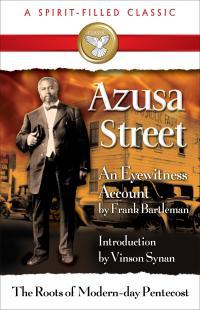 An Eyewitness to Azusa Street
INTRODUCTION by Vinson Synan
Few events have affected modern church history as greatly as the famous Azusa Street revival of 1900-1909, which ushered into being the worldwide twentieth-century Pentecostal renewal. From this single revival has issued a movement which by 1980 numbers over 50,000,000 classical Pentecostals in uncounted churches and missions in practically every nation of the world. In addition to these Pentecostals, there are untold numbers of charismatics in every denomination who can trace at least part of their spiritual heritage to the Azusa Street meeting.
WILLIAM J. SEYMOUR
It was in Houston that a Southern black holiness preacher by the name of William J. Seymour joined Parham’s Bible school. Despite the Jim Crow segregation laws of the South, Seymour joined in the classes taught by Parham. Originally a Baptist, Seymour had entered the ranks of the holiness movement before 1905 and freely accepted Parham’s cardinal teachings which now included five points: justification, sanctification, baptism in the Holy Spirit with the “initial evidence” of speaking in other tongues, divine healing and the premillennial second coming of Christ.
Although Seymour accepted Parham’s teaching on tongue: (glossolalia), he did not receive the experience in Houston. The mantle of leadership in the fledgling pentecostal movement was soon to be transferred from Parham to Seymour, and the “place of blessing” from Houston to Los Angeles.
In 1906 Seymour received an invitation to preach in a black Nazarene church in Los Angeles pastored by a woman preacher, Reverend Mrs. Huchinson. When he arrived in Los Angeles in the spring of 1906, Seymour found a city of some 228,000 which was growing at a rate of 15 percent a year. Many strange religions and a multiplicity of denominations occupied the religious attentions of the city. Los Angeles was a melting-pot metropolis! with large numbers of Mexicans, Chinese, Russians, Greeks Japanese, Koreans, and Anglo-American inhabitants.
The religious life of the city was dominated by Joseph Smale, whose large First Baptist Church had been transformed into the, “New Testament Church” due to the effects of the Welsh revival which were being felt in Los Angeles at the time. Another important religious influence in the city was Phineas Bresee, who had founded the Pentecostal Church of the Nazarene in 1895 in an attempt to preserve the teaching of holiness which he felt was dying out in the Methodist Church, a denomination in which h had served as a leading minister for some thirty years.
Starting his work at the Peniel Mission in the very poorest section of the city, Bresee was repeating Wesley’s work of a earlier century in England by ministering to the disinherited of Los Angeles society. His Nazarene followers were rapidly becoming the largest holiness church in America.
In the black community, a rich social and religious life had developed during the last years of the century with numbers of Methodist, Baptist, and holiness churches located in the black community that centered around Bonnie Brae Street.
Without question, William J. Seymour was the central figure of the Azusa street revival and will always be remembered as the vessel chosen of the Lord to spark the worldwide Pentecost revival. Yet, little that he wrote has been preserved for posterity.
This fact is not to be despised, however, when one reflects that neither Socrates nor Jesus left a body of written works for future generations to read. Socrates had his Plato to record his dialogue while Jesus had the four evangelists, Matthew, Mark, Luke, and John, to leave a written record of His teachings. Seymour had his Frank Bartleman.
It was Bartleman’s diary and reports in the holiness press that constituted the most complete and reliable record of what occurred at Azusa Street. In later years, Bartleman gathered together his diary entries and articles written to various periodicals and published them in book form.
In this book, entitled “How Pentecost Came to Los Angeles,” one feels the excitement of the events at the old Azusa mission. From the beginning, Bartleman seemed to sense the historic significance of the Los Angeles Pentecost. From the first meeting he attended in April 1906, he felt that a “world wide revival” would be the result.
In many ways, Bartleman’s entire life had been spent in preparation for reporting the Azusa Street meeting. It is probable that without his reporting, the Pentecostal movement would not have spread so quickly and so far as it did. His journalism not only informed the world about the Pentecostal movement, but in a large measure also helped to form it.
Born in Rucks County, Pennsylvania, in 1871 to a German-born Roman Catholic father and an English-born Quaker mother, Bartleman grew up on a farm where his first job was that of following a plow. While he feared his stern father, he enjoyed a tender relationship with his mother. From his earliest days, he suffered from frail health. In his own words he was a “life-long semi-invalid” who “always lived with death looking over my shoulder.”
His conversion took place in October 1893 in the Baptist Temple in Philadelphia, pastored by the famous preacher Russell Conwell, author of the gospel of wealth classic, “Acres of Diamonds. After Conwell baptized the twenty-two-year-old Bartleman, he offered to pay the young man’s way through college. Bartleman refused, explaining that “I made my choice between a popular, paying pulpit and a humble walk of poverty and suffering. . . I choose the streets and slums for my pulpit.”
At the time he licensed to preach, by the Temple Baptist Church, he decided to “trust God” for his body. A lifelong devotion to the doctrine of divine healing followed. The desire to preach was overwhelming. “The Gospel was a fire in my bones that roared all the day,” wrote the young minister.
In 1897 Bartleman left the Baptist ministry and cast his lot with the holiness movement. Joining the Salvation Army, he spent a short time in Johnstown, Pennsylvania, as a captain before disillusionment led him to leave the army. He later traveled to Chicago to attend the Moody Bible Institute.
Bartleman did not study long in Chicago, however. He had wandering feet. Soon he was on a “gospel wagon” making his first tour of the South. Here he befriended the blacks to the consternation of white Southerners. The wandering life occasionally depressed him. On a second tour of the South in 1899 he became so despondent that he once actually contemplated suicide. Later, though, he felt well enough to contemplate matrimony.
In 1900 he married a Miss Ladd, matron of a school for fallen girls in Pittsburgh, Pennsylvania. He also experienced his first spiritual manifestation of “shouting and jumping,” although before this he had led a life of a “rather monkish tendency.”
Soon after marriage, Bartleman was ordained in Philadelphia “in pentecostal connection,” a term which he fails to further explain. This group was probably one of the small holiness groups of the day, who found it popular to use the word “pentecostal” in their name in reference to the second blessing of sanctification through the baptism in the Holy Ghost (without any reference to glossolalia).
Near the time of his marriage he joined the Wesleyan Methodist Church and was assigned a pastorate in Corry, Pennsylvania. This pastorate was an unhappy experience for Bartleman, since he found the church to be “not even spiritual” and, in his judgment, a “backslidden holiness charge.”
In this period, Bartleman was subject to several more mystic experiences in addition to his shouting and jumping of a few months earlier. In a camp meeting he felt “electric shocks” to the point that he fell unconscious. Later after his horse was healed in answer to prayer, Satan attacked him in his room at night “to destroy me.” The name of Jesus put Satan to flight. Also, after miraculous healing, he was “slain in the Spirit” for one-half hour before a congregation where he had been preaching.
When his father-in-law invited him to join the Methodist Episcopal Conference in New York Bartleman refused. While the Methodist Church was moving away from emotional and expressive holiness religion in this period, Bartleman was moving in the opposite direction. He branded the Methodist Church as being “dead and compromised.”
After leaving the Wesleyan Methodist Church in Pennsylvania, Bartleman set his sights on the West. Working at odd jobs, he led his wife and newly born daughter, Esther, on a trip to Colorado, with California as his eventual goal.
In Denver, he went to work with Alma White, head of the Pillar of Fire church, a small holiness group that specialized in the “holy dance.” It was here that Bartleman was “cured of ever worshipping a religious zeal or creed.”
While in Colorado, Bartleman continued the ministry that became his lifetime mission–work in slum areas among alcoholic and fallen girls. Most of this work was done in the holiness rescue missions that were located in the central areas of the nation’s larger cities.
He also felt compelled to print and distribute tracts as part of his ministry. In addition to tracts, Bartleman often painted Scriptures on bridges, rocks beside the highways, or other public places. Because of these activities he occasionally ran afoul of the law. In 1902 he was arrested in Boulder, Colorado, for painting Scriptures on canyon walls near the city. Beyond these activities the indefatigable evangelist felt led to preach in every saloon and house of prostitution in every city he visited. In Denver that included over a hundred saloons.
It was in 1904 that Bartleman finally reached his goal, California, where he exclaimed, “Here we reached paradise.” His first stop was in Sacramento, where he was immediately placed in charge of the Peniel Mission, a holiness rescue mission in the heart of the city. His work at Peniel failed “because of incompetent workers” and the aggressive proselyting of the rival Burning Bush and Pillar of Fire missions.
After leaving the Peniel Mission, Bartleman frantically tried to reenter the pastoral ministry. An attempt to gain an appointment in the Wesleyan Methodist Church failed, as did an application to Phineas Bresee for a Nazarene pastorate. “None available” was the word from Bresee.
The desperate Bartleman turned to whatever odd jobs he could obtain-painting, picking apples, cutting wood, etc. Things got so bad that their second baby was born in a rescue home. The leaders of the home refused to let the hapless evangelist stay with his wife and baby. Later his wife was reduced to scrounging for food in garbage cans. They could not afford proper clothing, their feet wearing through the soles of their shoes.
By December 1904, Bartleman left Sacramento for Los Angeles, where he was destined to record some of the most stirring events in the history of the church. “The Spirit had led us to Los Angeles for the ‘Latter Rain’ outpouring,” he later wrote in the end of his autobiographical book, “From Plough to Pulpit–From Maine to California.
In Los Angeles, Bartleman went immediately to the Peniel Mission on South Main Street, which was founded and operated by Mrs. Manie Ferguson, author of the hymn “Blessed Quietness.” (P.F. Bresee worked on the Peniel staff before founding the Church of the Nazarene in 1895).
For Bartleman, hardship and tragedy awaited him in Los Angeles. Poverty, sickness, and the death of his oldest child, “Queen Esther,” in January, 1905, left the hapless preacher and his wife grief-stricken but more determined than ever to fulfill their ministry in the “city of the angels.”
Throughout 1905 Bartleman worked with the various holiness churches and missions in the Los Angeles area. But many of the holiness churches had become rigid and negative to any new winds of revival that might begin to blow. In a warning to them, Bartleman confided in his diary “some holiness churches [foremost at that time are going to be surprised to find God passing them by. He will work in channels where they will yield to Him. They must humble themselves for Him to come.”
Indeed the greatest signs of revival in Los Angeles in 1905 were in Methodist and Baptist churches, in particular the Lake Avenue Methodist Church in Pasadena and Los Angeles’s First Baptist Church, pastored by Frank Smale.
The revival in Smale’s church was sparked by news of the great Welsh revival of 1904-05 led by Evan Roberts. A trip to Wales by Smale and an exchange of letters between Bartleman and Evan Roberts demonstrate a direct spiritual link between the move of God in Wales and the Pentecostal outpouring in Los Angeles in 1906.
At this time also, Bartleman began to write articles for the holiness press. His reports from Los Angeles were printed primarily in the “Way of Faith” in Columbia, South Carolina, and “God’s Revivalist” published in Cincinnati, Ohio. From these influential periodicals Bartleman’s stories were republished for other holiness papers around the nation. By 1906 Bartleman had built a reputation in holiness circles as a reliable reporter whose articles emphasized the need of spiritual renewal among all Christians, but among holiness partisans in particular. He was thus in a strategic position to describe the spiritual climate of Los Angeles before the Azusa Street revival and to report the historic events after the Azusa Street meeting began in 1906.
The reports of the Azusa Street revival are contained in a book Bartleman published in 1925 entitled “How Pentecost Came to Los Angeles–As It Was in the Beginning.” This book was written several years after the events of 1906-1909 and was pieced together from the author’s diary and clippings from articles he had written for the holiness press.
In this book, Bartleman injects himself into the story as one of the prime movers of the Azusa Street events. While it is true that Bartleman helped establish the spiritual climate in which the pentecostal movement could flourish in Los Angeles, the crucial role was played by William J. Seymour, pastor of the Azusa Street Mission.
In 1906 Seymour had been invited to preach in a black Nazarene church in Los Angeles pastored by a “Mrs. Hutchinson.” When Seymour preached his first sermon, proclaiming the “initial evidence” theory of the baptism in the Holy Spirit, he was locked out of the Nazarene church. The stranded preacher was then invited to stay in the home of Richard Asbury on Bonnie Brae Street until he could arrange his return to Houston. But Seymour was destined to spend the rest of his life in Los Angeles due to the tremendous revival that began shortly thereafter.
The theory that forced Seymour out of the Nazarene church was new to holiness circles in Los Angeles in 1906. Simply stated, it is that one cannot say that he has been “baptized in the Holy Spirit” without the “initial evidence” of speaking in tongues (as the church had done on the Day of Pentecost). This was an offensive and revolutionary teaching, since practically all Christians claimed to be baptized in the Spirit–evangelicals at the time of conversion and holiness people at the time of their “second blessing” or “entire sanctification.” The teaching of a glossolalia-attested Spirit baptism became the centerpiece of Pentecostal teaching, with Seymour as the apostle of the movement.
Although he had not yet spoken in tongues at the time he was locked out of the Nazarene church, Seymour did soon thereafter in the Asbury home. Home prayer meetings soon gave way to front-porch street meetings which drew hundreds of eager listeners to hear Seymour and his tongue-speaking followers. Soon the crowds became so large that larger quarters were needed for the fast-growing group.
A search of the downtown Los Angeles area turned up an abandoned old building on Azusa Street that had been used variously as a Methodist church, a stable, and a warehouse. In 1906 it was a shambles, but adequate for the band of Pentecostals who began holding services there in April of 1906.
Bartleman first attended services while the group was on Bonnie Brae Street and then followed Seymour to the premises on Azusa Street. The “Los Angeles Times” first reported the Azusa story in April of 1906. Calling tongues a “weird babel” and Seymour’s followers a “sect of fanatics,” the front-page Time’s article created curiosity and bigger crowds for the meeting. The “press wrote us up shamefully” declared Bartleman, “but that only drew more crowds. “The following is part of the Times report of April 18, 1906 (see Appendix A for the complete article).
Breathing strange utterances and mouthing a creed which it would seem no sane mortal could understand, the newest religious sect has started in Los Angeles. Meetings are held in a tumble-down shack on Azusa Street, near San Pedro Street, and devotees of the weird doctrine practice the most fanatical rites, preach the wildest theories and work themselves into a state of mad excitement in their peculiar zeal.
Colored people and a sprinkling of whites compose the congregation, and night is made hideous in the neighborhood by the howlings of the worshippers who spend hours swaying forth and back in a nerve-racking [sic] attitude of prayer and supplication. They claim to have the “gift of tongues,” and to be able to comprehend the babel.
As the revival continued for three and one-half years at Azusa, services were held three times a day-morning, afternoon, and night. Tongues-speaking was the central attraction, but healing of the sick was not far behind. The walls were soon covered with the crutches and canes or those who were miraculously healed. The gift of tongues was soon followed by the gift of interpretation. As time passed Seymour and his followers claimed that all the gifts of the Spirit had been restored to the church.
It soon became apparent that Seymour was the leading personality in the Los Angeles Pentecost. He became pastor of the church and remained so until his death in 1923. Despite the fact that Seymour was black, many of his followers were white. Although at the beginning of the revival blacks predominated, at the height of the meetings whites constituted a majority. The mission later became predominantly black after the whites began organizing their own assemblies in the Los Angeles area after 1906. In regard to the racial situation, Bartleman exulted, “the color line has been washed away in the Blood.”
As the revival continued, it became apparent that Bartleman’s role would be that of reporter to the religious world about the Los Angeles Pentecost. His articles gained a wide audience across America and in other lands. Stories about Azusa Street in “Way of Faith, God’s Revivalist, and Christian Harvester” were passed from hand to hand.
In addition to Bartleman’s reports and the negative comments of the Los Angeles press, Seymour and his Azusa Street leaders began publication of their own paper, entitled “The Apostolic Faith.” It was sent free across the United States to any who desired it. The editor was a white woman who worked in the mission, Florence Crawford. The name was taken from Charles Parham’s Apostolic Faith movement.
The connection between Seymour and Parham was broken, however, in October 1906. Seymour had invited Parham, his “father in the gospel,” to preach in Azusa Street, but Parham’s negative messages and attempts to correct what he saw as abuses led to his expulsion from the church. From that time onward there was a complete rupture between Seymour and Parham that never was healed.
Nothing was able to stop the inexorable momentum of the renewal that issued forth from Azusa Street, however. “Pilgrims to Azusa” came from all parts of the United States, Canada and Europe. They in turn spread the fire in other places. From North Carolina came Gaston Sarnabus Cashwell of the Pentecostal Holiness Church. After a “crucifixion” over his racial attitudes, he asked the Azusa Street blacks to pray for him. According to his testimony, Cashwell received his baptism and “was soon speaking in the German tongue.” A few months afterward in a meeting in Dunn, North Carolina, and a preaching tour of the South, Cashwell led several southern holiness denominations into the Pentecostal fold (the Pentecostal Holiness Church, the Fire-Baptized Holiness Church, The Church of God, the United Holy Church of America, and The Pentecostal Free Will Baptist Church).
C.H. Mason, head of The Church of God in Christ of Memphis, Tennessee, came to Azusa in November 1906 and received the Pentecostal experience. After returning to his church, the majority of the Church of God in Christ was Pentecostalized. In Birmingham, Alabama, M.M. Pinson and H.G. Rodgers, future pillars in the Assemblies of God (organized in 1914), were baptized in the Holy Spirit under Cashwell’s ministry. When Florence Crawford moved to Portland, Oregon, she took the Azusa paper, “Apostolic Faith,” and made that the name for her new Pentecostal denomination.
From Azusa Street, the Pentecostal flame spread to Canada under R.E. McAlistier and A.H. Argue. The “Apostle of Pentecost” to Europe, T.B. Barratt, cancelled a planned trip to Azusa Street after receiving his Pentecost in New York City. Returning to Oslo, Norway, in 1906 he opened the first Pentecostal work in Europe. From his ministry the torch was passed to Sweden, Denmark, England, Germany, and France. Less directly the fire spread to Chile under the ministry of the American Methodist missionary Dr. W.C. Hooevr; to Brazil under the ministries of Daniel Berg and Gunnar Vingren; and to Russia and other Slavic nations under lvan Voronaeff, a Russian Baptist from New York City.
Thus within a short time the Azusa Street Pentecost became a worldwide move of the Holy Spirit. The five major teachings of Azusa Street served as a standard for this first wave of Pentecostals. They were: (1) justification by faith; (2) sanctification as a definite work of grace; (3) the baptism in the Holy Spirit evidenced by speaking in other tongues; (4) divine healing “as in the atonement”; and (5) the personal premillennial rapture of the saints at the second coming of Christ. Though many “winds of doctrine” blew at Azusa Street, Seymour and his followers continued to stress the above teachings throughout the years of the mission’s ministry.
In time, opinion in the religious world became bitterly divided over the Azusa Street revival. Although a significant proportion of the holiness movement accepted the Azusa revival as signaling the long-prayed-for Pentecost, the majority rejected Pentecostalism. The Fundamentalists rejected Pentecostalism and by 1928 had disfellowshiped all Pentecostals from their ranks. The vast majority of mainline Christians either knew little or nothing of the movement, or dismissed it as another heresy among the “holy rollers.”
After seventy-five years it is now possible to gain a better historical perspective concerning the Azusa Street revival. In the years from 1906 to 1909, during the height of the excitement, it was impossible for anyone to be objective about the events and the teachings at the mission. For those who were baptized in the Spirit and spoke in tongues, the meeting was a foretaste of a worldwide revival. For others who rejected Seymour’s teaching, the “winds of perdition” were blowing at the Azusa Street “slum” mission.
The storm of charges and countercharges that swirled around the controversial revival mission made little impression on Seymour and Bartleman. Though they recognized excesses and the occasional intrusion of spiritualists and mediums into the midst, they continued to see the revival as the beginning of a historic awakening. A prime feature of the services was the reading of reports from other cities, states, and nations where the revival was spreading. It was Bartleman’s opinion that the revival unleashed at Azusa Street would be “a world-wide one without doubt.”
While Bartleman extolled the historic dimensions of the new movement, there were others in Los Angeles who were not so sure. By December 1906, Dr. Phineas Bresee, founder of the Church of the Nazarene (known at that time as the Pentecostal Church of the Nazarene) felt compelled to write an editorial in the Nazarene Messenger about the Azusa services. While Bresee lived in Los Angeles near the mission, there is no evidence that he ever attended services on Azusa Street.
In the article, entitled “The Gift of Tongues” (see Appendix C), he referred obliquely to the articles that Bartleman had already sent to the editors of eastern holiness periodicals:
But some parties who had the confidence of editors in the East sufficiently to secure the publication of what they have written, have given such marvelous statements of things as occurring in connection with this thing, that. . . we deem it wise to say a simple word.
Playing down the importance of the Azusa Street phenomenon in Los Angeles, Bresee stated:
Locally it is of small account, being insignificant both in numbers and influence. Instead of being the greatest movement of the times, as represented–in Los Angeles, at least–it is of small moment. It has had, and has now upon the religious life of the city, about as much influence as a pebble thrown into the sea. . .
In the end, Bresee felt that the Azusa Street Pentecostal bordered on fanaticism and heresy by teaching that
Christians are sanctified before they receive the baptism with the Holy Ghost, this baptism being a gift of power upon the sanctified life, and that the essential and necessary evidence of the baptism is the gift of speaking with new tongues, [which he called] a jargon, a senseless mumble. . . a poor mess.
As to the Azusa Street worshipers, the Nazarene leader stated:
There are more or less people whose experience is unsatisfactory, who have never been sanctified wholly, or have lost the precious work out of their hearts, who will run after the hope of exceptional or marvelous things, to their own further undoing.
It is obvious that the “marvelous statements” to which Bresee referred were those that Bartleman was circulating in the holiness press. His view that the movement had as much influence in Los Angeles as “a pebble thrown into the sea” was contradicted by the burgeoning growth of Pentecostal assemblies in the Los Angeles area and the explosive growth of Pentecostalism across the United States. In the end, Bartleman turned out to be a better prophet than Bresee.
Perhaps Bartleman’s prescience came as a result of his life and career prior to 1906. An acute observer, he wrote vividly about everything he saw, and was not averse at judging everything and everyone he saw. His life spanned many important events and turning points of American religious history.
When he joined the “new order of priests” as a Pentecostal, he had no theological problem in accepting the tongues-attested baptism in the Holy Spirit. When the “finished work” view of sanctification was preached by William Durham of Chicago, Bartleman stood at his side and gladly accepted his teachings. A few years later when the “oneness” movement appeared, Bartleman joined with Glenn Cook and Frank Ewart and was rebaptized “in Jesus’ name.”
After joining what the Trinitarian Pentecostals dubbed the “Jesus only” Pentecostal movement, Bartleman lost many friends and former contacts. No longer able to write for holiness or Pentecost periodicals, he lost influence in the movement and became largely isolated except for his “oneness” colleagues.
After the Azusa Street years, Bartleman continued his travels and wrote other books, notably “Two Years Mission Work in Europe. . .1912-1914. This book described his experiences during a round-the-world trip that was interrupted by World War I. His descriptions of Europe at the outbreak of the war and attempts to get home “through the war zone” make exciting reading indeed. But nothing he did during the rest of his life could rival the importance of his report on “how it was in the beginning” at Azusa Street.
In poor health to the end, the erstwhile evangelist spent his years in Los Angeles engaged in his first love-mission work. At the last, Bartleman refused to join any of the established Pentecostal denominations. He died as he had lived–an independent. Death came in September 1935 in his beloved Los Angeles.
In the years after 1906-1909, Seymour remained as pastor at Azusa Street. After his death, Seymour’s wife carried on services for a few more years until the mission was torn down in 1929. The hallowed old building was offered to the Assemblies of God in case they wished to maintain it as a Pentecostal shrine. The leaders of the church refused because they “were not interested in relics.”
As the seventy-fifth anniversary of the Azusa Street revival is commemorated in 1981, it is possible to reflect on the importance of this watershed event in Christian history. By this year, there are estimates of the number of Pentecostals and Charismatics in the world that approach the 75,000,000 mark. That would mean that roughly 1,000,000 persons per year have accepted the premises of the Los Angeles Pentecost in the years since 1906.
Indeed, in 1981 Pentecost has come to Rome itself as millions of Catholic Pentecostals rejoiced in the baptism in the Holy Spirit. In 1975 over 10,000 Catholics gathered in St. Peter’s Cathedral in Rome to celebrate the Pentecost season. In a memorable service, these charismatics rejoiced as Pope Paul VI gave his endorsement to the movement. At the climax of that service thousands spoke and sang in other tongues.
In 1978 a similar Pentecostal service was conducted in Canterbury Cathedral in England. About 2,000 Spirit-filled Anglicans and Episcopalians rejoiced in the Spirit as tongues and prophecies came forth in the venerable seat of the World Anglican Communion. Archbishop Coggin addressed the Conference and spoke in glowing terms of the renewal in England.
It is a long way from Azusa Street to St. Peters and Canterbury, but in 1981 it is apparent that Pentecost has come not only to Los Angeles, but to all the cities and nations of the world.
The last chapter of this book, entitled “A Plea For Unity,” sounds strangely relevant to those who are active in the present Pentecostal/Charismatic renewal movements. After experiencing a lifetime of sectarian strife and division, the more mature Bartleman concluded his book on Azusa Street with an ecumenical call for the unity of believers today,
for the “one body” that the prayer of Jesus may be answered, “that they all may be one, that the world may believe” . . . we belong to the whole body of Christ, both in heaven and in earth.
“We belong to the whole body of Christ” is a phrase that might well be applied to the band of worshipers who gathered together in the Azusa Street Mission in April of 1906. They never belonged to an organized denominational group. None of the larger Pentecostal denominations of today, such as the Assemblies of God or The Church of God in Christ, can lay an exclusive claim to the mission. It belongs to the whole body of Christ. Seymour cannot be claimed only by the blacks, or the Pentecostals; he belongs to the whole body of Christ–of all nations, races, and peoples. And the baptism in the Holy Spirit, with the accompanying gifts and graces does not belong only to the Pentecostals, but to the whole body of Christ–indeed unto “as many as the Lord our God shall call” (Acts 2:39).
THE END
This introduction is reprinted from the book AZUSA STREET by Frank Bartleman, first published in 1925 (reprinted 1980). This book is still in print ISBN 0882704397.
Lucy F. Farrow: The Forgotten Apostle of Azusa
Lucy F. Farrow was born in Portsmouth, VA. Unfortunately, her origins there have not been yet fully traced. Her involvement appeared around the summer of 1905 while working as governess in Parham’s home in Houston.
While in Houston, Farrow met Charles Parham, who came there from Baxter Springs, Kansas, in October 1905 and held meetings in Bryan Hall. Parham was preaching about the earlier outpouring of the Holy Spirit that had occurred in his Bethel Bible College in Topeka, Kansas, in January 1901.
Other sources claim, Lucy F. Farrow received the Holy Ghost a little bit earlier on September 6, 1905 after Parham opened up a month-long meeting in Columbus, Kansas. Along with Parham she witnessed events unfold in Zion, Illinois, where John Alexander Dowie was faltering.
Lucy Farrow was the niece of renowned black abolitionist Frederick Douglass. She was serving as pastor of a holiness church in Houston in 1905 when Charles Parham engaged her to work as a governess in his home. Farrow carried the Pentecostal embers back to Texas, on to her home state Virginia and later to Liberia. Her aptitude for igniting the supernatural gifts among others was evident at a 1906 camp meeting near Houston when some 25 seekers stood lined up in a row in front of her. When Farrow “laid hands upon them…many began to speak in tongues at once.”
Although William J. Seymour is acknowledged as the leader of the Azusa Street Revival, it was a black woman, Lucy Farrow, who provided the initial spark that ignited that revival. About the time when Seymour departed to Los Angeles in January of 1906, Lucy Farrow and J. A. Warren also arrived there independently. Other sources claim, they had been sent by Parham to help Seymour with his meetings.
Seymour began his meetings at the Santa Fe Mission on February 24, 1906 but was quickly shut down by the pastor Julia W. Hutchins on March 4, 1906 after a consultation with the South Californian Holiness Association.
The meetings then moved to 214 Bonnie Brae St., home of Richard and Ruth Asberry. As a result, Edward S. Lee was the first one was baptized in the Spirit and spoke in other tongues in the late afternoon when William J. Seymour and Lucy F. Farrow laid hands on him for healing at his house. At 7:30 p.m., the group went back to Bonnie Brae for the evening meeting and before the night was over, Jennie Evans Moore and several others joined him.
It has been said that no one associated with the prayer meeting led by Seymour had spoken in tongues until Farrow, at Seymour’s request, arrived on the scene and began laying her hands on people and seeing God fill them with the Holy Spirit as in the book of Acts. She also ministered with power across the southern United States and in Liberia in West Africa. She lived out her final years in Los Angeles, where there were reported healings and remarkable answers to prayer through her ministry.
Were Molokans the first to Speak in Tongues at Azusa?
Adopted from Andrei Conovaloff
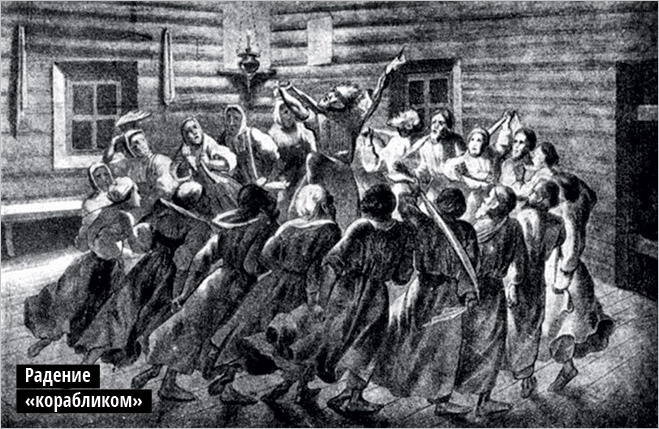
American Molokan Dukh-i-zhiznik (lit. living in the Spirit) oral history (documented in the Book of the Sun: Spirit and Life, Dukh i zhizn’) reports that Molokani and Pryguny received the “outpouring of the Holy Spirit” in the Milky Waters region (now in Ukraine) in 1833. The diary of Vassili V. Verestchagin documents that Pryguny (lit. leapers) in the Caucasus in the early 1860s spoke in tongues, jumped to exhaustion, and held hands up in the air for more than an hour. These charismatic practices continue among Dukh-i-zhizniki in the U.S. and Australia.
From 1906 to 1909, the Apostolic Faith Mission conducted three services a day, seven days a week, for over three years or 1000+ services! Thousands of seekers received the “tongues” baptism, including many Molokani and Pryguny. Also many public Pentecostal revivals were conducted in tent meetings on Oake’s lot and other locations around the Flats area slums were Russian settled. English speaking Pryguny and other Russians immigrants often translated at the services. Oake’s lot later became Pecan Playground, at First and Pecan Streets.
In Molokans in America (pages 101-102, ch. 5), John K. Berokoff reports about the connection between Prygun leader Philip Mikhailovich Shubin and the early Pentecosts:
“During his 27 years in America he was the outstanding speaker and orator of the brotherhood with a wide acquaintance among non-Molokans , not infrequently taking a choir of singers to Pentecostal church meetings where he preached and explained the Molokan reasons for their migration. It was his wisdom, his profound knowledge of the scriptures plus his wide knowledge of Russian literature that enabled him to repel the periodic attempts by leaders of neighboring denominations—Baptists, Pentecostals, etc.—to proselytize the Molokan people …”
More evidence of connections between the Azusa Street Revival and the Pryguny is reported in the newspaper The Apostolic Faith, which was distribute free to 50,000 subscribers, when the population of Los Angeles was 250,000. Many Russian sectarians in Flats knew about this church and saw this free paper, especially since it reported about them in the first issue, the church was within walking distance, and elders exchanged visits.
1906 September — The Apostolic Faith (Volume 1 Number 1) — The first edition of the newspaper reports that Apostolic Faith Mission members spoke at a Prygun prayer meeting. In 1906, Pryguny held Sunday services at the Bethlehem Institutional Church and the Stimson-Lafayette Industrial School, and welcomed guests at both locations which were 1/2 block from each other and about 1/4 mile east of the Apostolic Faith Mission. The Pentecosts invited the Pryguny to attend their meetings, which many did with a translator:
RUSSIANS HEAR IN THEIR OWN TONGUE
“Different nationalities are now hearing the Gospel in their own “tongue wherein they were born.” Sister Anna Hall spoke to the Russians in their church in Los Angeles, in their own language as the Spirit gave utterance. They were so glad to hear the truth that they wept and even kissed her hands [showing respect]. They are a very simple, pure, and hungry people for the full Gospel. The other night, as a company of Russians were present in the meeting, Bro. Lee, a converted Catholic, was permitted to speak [translate] their [Russian] language. As he spoke and sang, one of the Russians came up and embraced him. It was a holy sight, and the Spirit fell upon the Russians, as well as on others, and they glorified God.”
1907 April — The Apostolic Faith (Volume 1 Number 7) — The 7th edition reports about the Russian and Armenian Pryguny in the Flats:
“Russians and Armenians in Los Angeles are seeking the baptism. The Armenians have a Pentecostal cottage meeting on Victor street, between 4th and 5th [Now under the I-5 Freeway]. Some have been baptized with the Holy Ghost.”
In his 2006 book, The Azusa Street Mission and Revival: The Birth of the Global Pentecostal Movement, Cecil Robeck reports that in 1906 Los Angeles had a population of 238,000 and was growing at the rate of 3,000 (1.3%) per month, as ~ 4,000 Russian sectarians migrated to the U.S. He mentions the Russian and Armenian Pryguny at least 5 times in his book:
[Page 57] Finally, between 1903 and 1912 several thousand Russians and Armenians arrived in the city, refugees from Russia’s increasingly repressive government. Unlike most Russians, they did not belong to the Orthodox church. They were [Spiritual Christian ethnic] Molokans, literally “milk drinkers,” a name they received because they refused to fast from dairy products during traditional fast days. More importantly, they could be described as a “proto-Protestant'” group, since they had been influenced by some of the sixteenth-century Reformers. They also had a special appreciation for the Holy Spirit. Many of them claimed that they had been directed to leave southern Russia through the gift of prophecy. They engaged in what was often described as ecstatic behavior, jumping and dancing; falling on the floor when they believed that they were possessed of the Holy Spirit to do so; and singing chant-like songs that strongly paralleled the “singing in the Spirit” (a multi-layered, harmony-rich singing in tongues that are unknown to the singers and are believed to be inspired by the Holy Spirit) at the Azusa Street Mission.
[Page 94] As the revival grew … Seymour celebrated the spread of the revival to other congregations … the Russian Molikan [sic] community, … He viewed them as fellow-workers.
[Page 138] While the mission was led by an African American pastor, dominated by and African American membership, and heavily influenced by African American worship patterns, it quickly developed into a multi-ethnic and multiracial congregation. … non-African-Americans did bring their own gifts and experiences. … Recent Russian and Armenian Molokan [Spiritual Christian] immigrants already practiced the unusual jumping and chanting also found at the mission. … This was a revival unlike any other the city of Los Angeles had ever seen … African Americans, Latinos, Armenians, Russians, Swedes, Germans, Italians, Chinese, Japanese, Native Americans, and other ethnic groups … bountiful expressions of ecstatic manifestation such as speaking in tongues, prophesying, claims of dreams and visions, trances, healings, exorcism, and falling “in the Spirit.”
[Page 153] “Singing in the Spirit” accomplished more than an expression of worship, however. It also provided a bridge that brought Russian and Armenian Molokans [Spiritual Christian Jumpers] into the mission — among them the Shakarian and Mushegian families. These families arrived in Los Angeles in the 1905 emigration. The Molokans commonly practiced a king of “sing-song” prayer, a form of vocal prayer and praise that resembled singing in Spirit.” Walking down San Pedro Street in 1905, Demos Shakarian, grandfather of the Demos Shakarian who would later found the Full Gospel Businessman’s Association, and his brother-in-law, Magardich Muchegian, passed the Azusa Street Mission. As they drew near, they heard sounds of praying, singing, and speaking in tongues coming from the mission — expressions that they identified as similar to their own. The single phenomenon of “singing in tongues” convinced Demos to embrace the mission as a place his family could worship. From the moment he heard it, he concluded that God was also beginning to move to America just as He had in their homeland of America and in Russia.”(27)
[Pages 189-190] At the same time a group of Armenians and Russians [Spiritual Christian Pryguny], who had come to Los Angeles in the Molokans immigration, opened cottage prayer meetings on Victoria Street between West Fourth and Fifth Streets that would quickly develop into an Armenians-language Pentecostal church.
American-born Armenian-Prygun historian Joyce Bivin comments: We have a similar story in our community about the Azusa Street Revival. The story goes like this — quoted from a letter by M. Mushagian:
“Our people came to Los Angeles right after the Azusa Street Revival. They used to attend the meetings even though they didn’t understand the American language. They saw that the Holy Spirit was moving there like it did in the Old Country. So they accepted Pentecostal because they believed in Acts 2:4.”
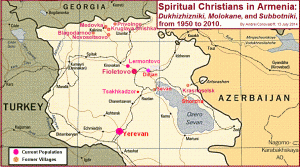 The Armenians apparently were worshiping in this manner, including dancing in the Spirit, (jumping, which my grandmother did at one of the Paskha meetings and the next day mother told me she was healed of whatever affliction she had at the time), prophesying, speaking in tongues, etc. before they came to America. I wasn’t aware the Molokans responded to the Azusa Street meetings. After the Armenians visited the Azusa Street meetings, they eventually changed their identity from Armenian Molokans to Armenian Pentecostals. Though they kept the Molokan traditions in their worship, their theology shifted from focusing on Jesus and M.G. Rudometkin (whose book was next to the Bible on the table) to Jesus’s teachings as defined by Pentecostal/Protestant doctrine.
The first place our people gathered to worship was on Boston Street. The next place was on 431 S. Pecan Terrace, in a large room where my great grandfather eventually turned into a bath house. Then they moved to Gless Street [all in the Flats] and next to Goodrich Blvd before moving to Hacienda Heights. The church today is located in Hacienda Heights, off Hacienda Blvd. on West. It’s the first entrance on the right after you turn on West.
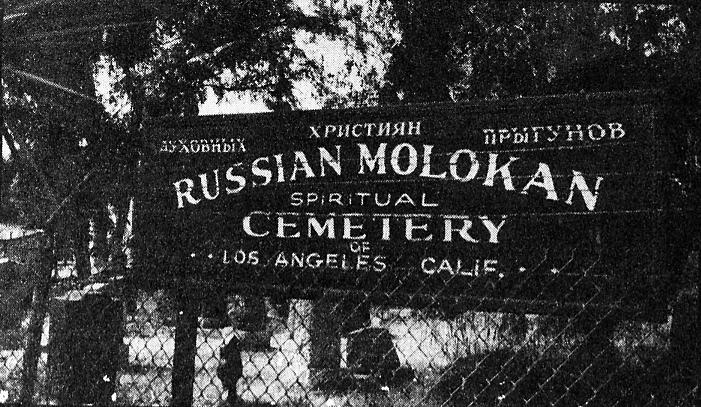
The FORGOTTEN ROOTS OF THE AZUSA STREET REVIVAL
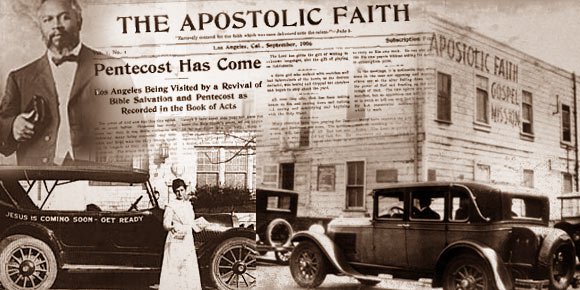 by HAROLD HUNTER, PH.D.
Writing during the glow of the Azusa Street revival, V.P. Simmons claimed to have 42 years of personal exposure to those who spoke in tongues. Published in 1907 by Bridegroom’s Messenger and circulated as a tract, Simmons chronicled the history of Spirit baptism from Irenaeus (2nd century) up to and including a group from New England whom he personally observed manifesting tongues-speech as they continually partook of a spiritual baptism.1 Identified as Gift People or Gift Adventists, they were widely known for their involvement with spectacular charisms.Early Pentecostal periodicals reported that tongues-speech was known among these groups since the latter part of the 19th century. Some groups were said to number in the thousands.
William H. Doughty, who, by 1855, had spoken in tongues while in Maine, was counted among that number. Elder Doughty moved to Providence, Rhode Island, in 1873 and assumed leadership among those exercising the gifts of the Spirit.3 Doughty’s mantle was passed on to Elder R.B. Swan who, reacting to the Azusa Street revival, wrote a letter explaining that the Gift People in Rhode Island had experienced speaking in tongues as early as 1874–75. (See “The Work of the Spirit in Rhode Island.”) B.F. Lawrence followed Swan’s letter describing an independent account of a woman who spoke in tongues in New York, perhaps prior to 1874, a result of her contact with the Gift People.4 (See “A Wonderful Healing Among The Gift People.”)
Stanley H. Frodsham quotes Pastor Swan’s claim to having spoken in tongues in 1875. Swan speaks of great crowds drawn from five states and specifically mentions his wife — along with Amanda Doughty and an invalid hunchback who was instantly healed — among those who spoke in tongues during this time.
Simmons said that Swan’s group adopted the name “The Latter Rain” after the advent of the Pentecostal movement. Their activities extended throughout New England states, especially Rhode Island, New Hampshire, Massachusetts, Vermont, and Connecticut, with the 1910 Latter Rain Convention held October 14–16 in Quakertown, Connecticut. Frank Bartleman frequently referred to joint speaking engagements with Swan, specifically recounting a 1907 tour that included a convention in Providence, Rhode Island, where he spoke 18 times.
Previously overlooked in related investigations is whether the Doughty family counted among the Gift People overlap with the Doughty who traveled with Frank Sandford. Lawrence attests that Swan’s circle included William H. Doughty’s daughter-in-law, Amanda Doughty, and her unnamed husband, an elder in the Providence congregation.8 Simmons says that William H. Doughty had two sons, the oldest, Frank, who was ordained. Could the unnamed brother of Frank be Edward Doughty, who at the end of the 19th century was part of Sandford’s entourage? So it seems.
Most of the groups named here have similar stories. For example, among the Fire-Baptized Holiness ranks was Daniel Awrey who had spoken in tongues in 1890 in Ohio. His residence was in Beniah, Tennessee, where an outbreak of speaking in tongues was reported in 1899. F.M. Britton wrote about people speaking in tongues in his Fire-Baptized revivals that predated the Azusa Street revival. Also, a revival in Cherokee County, North Carolina, in 1896, that gave the Church of God (Cleveland, Tennessee) many of its early leaders reported an outburst of speaking in tongues among several of the adherents. Given the above accounts, there is some debate as to whether Parham first heard speaking in tongues while at Sandford’s Shiloh in Maine or while he was among Fire-Baptized enthusiasts.
THE FOLLOWING ARE THE CATHOLIC LEADERSHIP OR GROUPS RECORDED TO HAVE SPOKEN IN TONGUES:
• ST. HILDEGARD (1098-1179)
• ANTHONY OF PADUA (1195-1231)
• FRANCISCANS (1200S)
• ANGE CLARENUS (1300)
• VINCENT FERRER (1350-1419)
• STEPHEN, MISSIONARY TO GEORGIA (1400S)
• ST. COLETTE (1447)
• LOUIS BERTRAND (1526-1581)
• THE JANSENISTS (1600)
• JEANNE OF THE CROSS (1450S)
• FRANCIS XAVIER (1506-1552)
SHERRILL’S BOOK ALSO LISTS SOME INDIVIDUALS FROM THE 19TH CENTURY WHO REPORT TONGUES-SPEAKING OCCURRING:
- 1855 V.P. SIMMONS
- ROBERT BOYD (DURING MOODY’S MEETINGS)
- 1875 R.B. SWAN
- 1979 W. JETHRO WALTHALL
- MARIA GERBER
MORE BOOKS to STUDY:
- “THEY SPEAK WITH OTHER TONGUES” BY JOHN L. SHERRILL
- “GLOSSOLALIA: TONGUE SPEAKING IN BIBLICAL, HISTORICAL, AND “PSYCHOLOGICAL PERSPECTIVE” BY FRANK E. STAGG
- “SPEAKING IN TONGUES: A GUIDE” BY MILLS
- “SPEAKING WITH TONGUES: HISTORICALLY AND PSYCHOLOGICALLY CONSIDERED” BY GEORGE CUTTEN.
Ivan Voronaev: Back in the USSR

This book is a Journey!
A journey that has stretched over three continents and a century of time. And a journey that may not be yet over…
This book is Ivan Voronaev’s journey in search of Truth, Spirit and Power. A search for a new name, a new life and a new reality. A journey that redefined his life and the lives of thousands around him. A journey of life that sentenced him to death! And essentially, a journey that became his life as a martyr and reaching into The Life Himself.
This book is my own journey of searching, uncovering, and at times even leaving alone sensitive documents from church denominations, secret government organizations and long-kept personal archives. A journey to discover that instead of being celebrated has mostly met with a push to be silenced and in the case of governments even sealed as top secret.
And finally, this book is our journey as Pentecostals. For a life of self-sacrifice defines us all as a movement. Or at least it should, as it did once upon a time at the start of Modern Day Pentecost. And a journey we all still need to take…
Over the years the research on the life and ministry of Ivan Voronaev faced strong opposition from both Balkan chauvinism and Slavic imperialism. It was constantly challenged for being both misunderstanding and misunderstood. But as a 5th generation Bulgarian Pentecostal, who grew under Communism with family roots traced to the original Pentecostal revival that shook the country in 1920, I do understand. A great-great-granduncle and great-great-grandaunt of mine were taken from the Thracian fields into slavery by the Turks. Two of my great-great-granduncles were hanged on the historic Oak of 100 Rebels, where 1876 uprising leaders were killed by the Ottomans. My great grandmother was heavily persecuted by Bulgarian Orthodoxy for accepting Pentecost in 1928, after my grandmother was miraculously healed on her deathbed of tuberculosis at age four. Both of my grandfathers were prosecuted by the secret Communist police, one for being a Pentecostal preacher and the other for having a successful businessman and landowner during the Communist nationalization of 1958. Neither of my parents was ever allowed to study pass high school or hold a job of any importance, because they came from families of believers and Protestants, treated as “enemy of the state.” My sister and I were saved as teenagers at the fall of the Berlin Wall, but not late enough not to be mocked for calling publicly professing the Lord. For this reason alone, I’ve strived to tell this story with distinct self-realization and personal passion – to understand and be understood.
Protestant Participation in the April Uprising (1876)
A considerable number of Protestants took part in the prematurely erupted April Uprising. Many of them were in the immediate circle of Benkovski, Vasil Volóv, and the other revolutionary apostles. Some Protestants joined during the uprising itself. According to Dimitar Strashimirov, about sixty men from the village of Tserovo, in the Pazardzhik region, joined Benkovski’s detachment under the leadership of Tsvyatko Brŭshkov. At that time Tserovo had 120 households, fifteen of which belonged to Bulgarian Protestants. Two roster protocols were compiled – one larger list for the Orthodox, and a smaller one for the Protestants. The leaders of the Protestant group were K. Teliyski and Nikola Kochov. From the same village came Ivan Cheshírov, one of the “tens-men” (leaders of groups of ten) in the Flying Column. Collective memory has preserved the names of two well-known Protestants from Panagyurishte as active participants in the uprising: Stefan Balabanov, who organized the sewing of clothing for the rebels, and Rad Minev, one of the most experienced arms-bearers of the insurgent town.
Protestants were also involved in the activities of nearly all revolutionary districts. Particularly dramatic was the fate of the evangelist Stoil Findzhikov, the master craftsman of the “cherry-wood cannons,” who became a symbol of the uprising. As a youth, Stoil had worked in a military workshop in Constantinople, where he learned details of firearms manufacture. On the eve of the uprising and during its course, prompted by Volov and Benkovski, he crafted and refined several of these primitive cannons. He fired his last “cherry-wood cannon” at the advancing Ottoman forces beneath Mount Kamenitsa. Under the pressure of the attacking bashi-bozouk irregulars, the defenders fled one by one, and some fell in battle.
The evangelist Petar Donchev from Panagyurishte also took an active part in the April Uprising. During the height of the revolt, he served as a trusted courier between the surrounding towns and villages, employed by both Benkovski and Volov. “Petraki,” as the insurgents called him, displayed remarkable resourcefulness, courage, and self-sacrifice. After the uprising he departed for the United States, where he studied theology, later returning to Bulgaria as pastor in Chirpan. Yet he remained throughout his life a passionate patriot and tireless public figure. He declined every offer of praise or reward after the Liberation with the simple words that “whatever he had done, he had done for God and for the Fatherland.”
In the early summer days of 1876, there existed a real danger that the bloody sacrifice of the Bulgarian people would be silenced. Had this occurred, the central idea of the revolutionary movement – and the sacrifice of tens of thousands – would have faded ingloriously into obscurity. At precisely this moment, Bulgarians from Pazardzhik and Plovdiv succeeded in secretly sending the first accurate and detailed descriptions of the events in the rebellious regions to the Protestant missionaries in Constantinople. A decisive man – Father Tilev of Pazardzhik – was the first to describe the massacres, the fires, the hangings, the mass slaughter of defenseless people, and the full horror experienced by the population in the affected districts. He entrusted the packet of writings to the Croat Ilitch, director of the Austrian post in Plovdiv, asking him to forward it to a friend in Constantinople who would deliver it personally to Dr. Albert Long. The first description was soon followed by a second and a third. Reports and accounts began to appear from other sources as well. Ivan Ev. Geshov of Plovdiv also sent a letter through Andrei Tsanov to Dr. Long, writing, among other things: “Many villages in the Pazardzhik region are in flames and the people are being exterminated. Is there no help or protection for them from somewhere?”
With the help of Andrei Tsanov, Dr. Long translated the letters into English and consulted Dr. George Washburn, director of Robert College. The two agreed that Dr. Long would systematize the shocking materials arriving in Constantinople, while Dr. Washburn would bring them to the attention of influential English and American figures in the Ottoman capital. Thus, the information reached Edwin Pears, an English barrister and correspondent for the Daily News, who sent the first alarming reports. The London editorial office initially refused to believe the atrocious descriptions and demanded telegraphic confirmation from Pears himself. Only then, on 23 June 1876, did the Daily News publish the first horrifying accounts of the tragedy of the Bulgarian people.
Dr. Long and Dr. Washburn presented the matter to the British ambassador Henry Elliot and the American minister Horace Maynard. Elliot stated that the matter had to be investigated and verified before being taken “seriously.” Undeterred, the two missionaries sent a second, even more detailed report to the Daily News, insisting that Britain intervene on behalf of the suffering Christian population. Gradually, the Disraeli–Beaconsfield government was cornered, and the prime minister attempted to deflect the issue by declaring in Parliament that “all this commotion is nothing but coffeehouse gossip.” This statement, however, marked the beginning of the crisis’ most intense phase.
More and more dispatches appeared in the Daily News and in a growing number of British and European newspapers. The Daily Mail sent the well-known American journalist Januarius MacGahan – then in London – to visit the sites of the atrocities and report his findings. Disraeli, for his part, ordered an “urgent inquiry” by the British Embassy in Constantinople. The ambassador entrusted the task to the youngest member of the mission, Walter Baring, along with his father-in-law, Fr. Gauracino, a Levantine, retired British consul, and significant debtor to the Ottoman state.
To the American missionaries it was clear that this move sought to obscure the truth about the massacre of an entire people. They immediately visited Minister Maynard again, insisting that the newly arrived first secretary and U.S. consul general in Constantinople, Eugene Schuyler, depart for the burned and blood-soaked regions of Bulgaria. This was also necessary because they feared that the Ottoman government would refuse permission for Baring to carry out his mission.
Minister Maynard expressed his profound sympathy for the Bulgarian people but explained that his duties in Constantinople did not include intervention in the political affairs of the empire, being limited exclusively to the promotion of “commercial relations.” In his view, only one Great Power – Britain – could exert real influence over Turkey. Dr. Washburn, exasperated, rose from his chair and firmly declared: “I am going directly to the telegraph office to inform the President of the United States that his representative in Turkey refuses to lift a finger to save an entire nation of suffering Christians. And I shall report the same to the American press.” The minister was compelled to ask Washburn to return to his office. With the assistance of Dr. Long, they devised a “skillful maneuver”: Eugene Schuyler would travel to Adrianople and the province “to identify and appoint a suitable correspondent for commercial matters.” Thus, the ground was prepared. Upon MacGahan’s arrival, the two Americans, both fluent in Russian, together with Petar Dimitrov, a graduate of Robert College and secretary of the newspaper Zornitsa, set out for the devastated regions of Bulgaria. They were later joined by the Russian consul in Adrianople, Prince Tsertelev.
Meanwhile, Dr. Jacob Clarke of Plovdiv was the first foreigner to visit Batak immediately after the massacre, accompanied by Pastor Nikola Boyadzhiev of Panagyurishte. Amid the ghastly scene and overwhelming stench, they placed in their suitcase several heads of children and women – still with their hair braided – and carried them back to Plovdiv. These were physical proofs intended to confront certain foreign skeptics, influenced by Ottoman officials, who claimed that the victims had been “rebels” whom the Turks were obliged to eliminate “to preserve order.” Dr. Clarke visited several consuls in Plovdiv and began taking out the severed heads one by one, asking: “Is this a rebel? And is this a rebel?” Britain, and soon all of Europe, recoiled in horror at the slaughter. One of the most renowned British war correspondents, Archibald Forbes, wrote:
“MacGahan accomplished brilliantly his mission of exposing the Turkish atrocities in Bulgaria in 1876. I know of nothing in journalism that surpasses, in language, pathos, and flaming indignation, writing that passed so spontaneously from heart to heart. His call stirred William Gladstone to a convulsive paroxysm of revulsion at the barbarities. It stirred England to the depths of her national soul. You could see people traveling on the railways reading those reports with burning faces and tears in their eyes.”
Throughout this entire dramatic period Dr. Albert Long, though remaining in Constantinople, continued – literally day and night – his efforts on behalf of the Bulgarian people. Even when, at the end of 1876 and the beginning of 1877, certain forces sabotaged the work of the Constantinople Conference of the Great Powers, which had agreed on autonomy for Bulgaria across its full ethnic territory, Dr. Long did not lose composure. He continued to seek solutions by every means available. Washburn wrote of him:
“It is a fundamental fact that, although Dr. Long kept modestly in the background, he was the center of everything that was done in Constantinople for Bulgaria during the massacres and the severe trials endured by the Bulgarians in their struggle for freedom.”
Finally, in early May 1876, just days after the outbreak of the April Uprising, a Bulgarian girl in Thessaloniki – Stefana Lanskova – was rescued from abduction intended to force her conversion to Islam. She was hidden in the home of the American consul in Thessaloniki, Hadzhi Lazarov (a Bulgarian Evangelical Christian from Voden who had taken American citizenship and service). This provoked violent unrest among fanatical Turks around Robert College in Constantinople. On May 6, 1876, Muslim extremists murdered the French and German consuls in Thessaloniki (Moulin and Abbott). The American consul, who was their primary target, survived. As unrest at Robert College intensified, ambassador Maynard appealed to President Grant for assistance who did not hesitate to dispatch an American naval squadron led by the USS Trenton to the Sea of Marmara to deter both the fanatical mobs threatening Robert College and the British naval squadron positioned at the Bosporus. It was in precisely this atmosphere that the large-scale efforts of American missionaries, journalists, and diplomats unfolded during the summer of 1876.
In s similar fashion Januarius MacGahan received assignments from the London Daily News and others to report from war zones, particularly the 1876 Bulgarian Uprising against the Ottoman Empire, where his vivid reports on atrocities. With special attention to the Batak Massacre that had shocked Europe and galvanized support for Bulgarian independence, leading to his posthumous title, “Liberator of Bulgaria.” His “orders” were to report the truth, which he did fearlessly, even following Russian armies without permission. His dispatches became crucial historical records of the conflict and Ottoman brutality over Bulgarian civilian population.
Dony K. Donev, D.Min., is a prominent researcher and author specializing in Bulgarian Protestant, Evangelical, and Pentecostal history, with over three decades of study. His work, including 19th Century History of Protestantism in Bulgaria and The Unforgotten: Historical and Theological Roots of Pentecostalism in Bulgaria, documents the development of these movements, their suppression under Communism, and the subsequent post-1989 revival. Key aspects of Donev’s research on Bulgarian Protestant history include:
Origins (19th Century): Protestant work began in the 1800s, with denominations like Congregationalists (1856), Methodists (1857), and Baptists (1865) establishing missions, culminating in the first Bulgarian Protestant Church in 1871. Donev also highlights the 1871 publication of the Protestant Bulgarian Bible translation. His research, often in collaboration with the Institute of Bulgarian Protestant History, has focused on preserving, digitizing, and recovering documents, including church diaries, photographs, and, in some cases, saving records from destruction during the communist era.


