

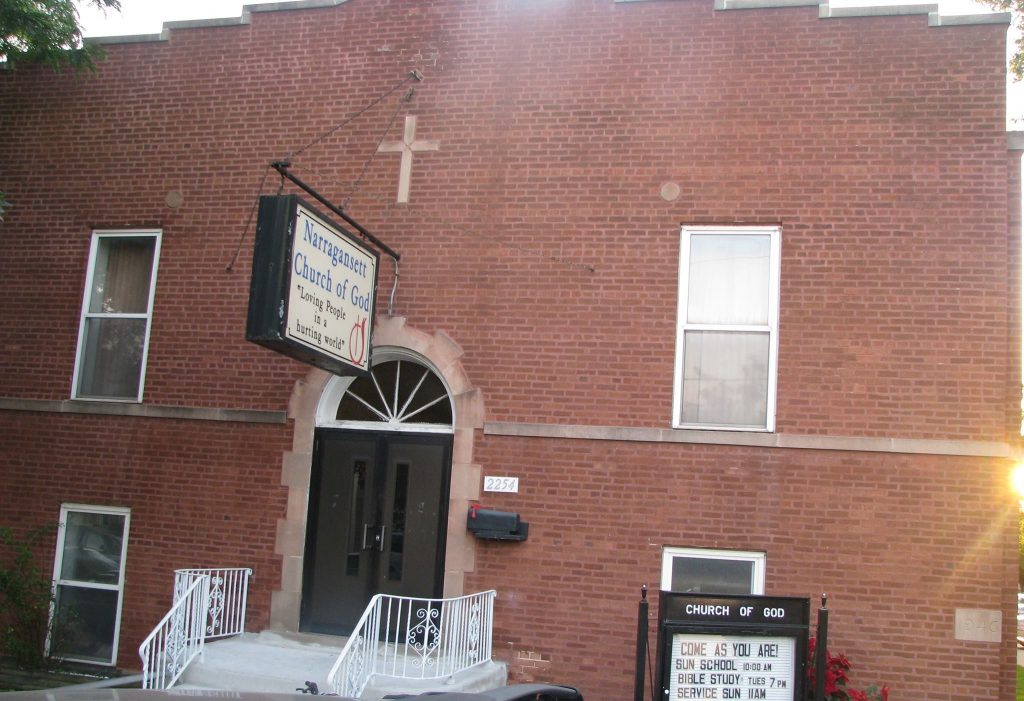
30 years ago in Chicago

30 Years of the Bulgarian Church of God in Chicago
I left Chicago on this day 30 years ago (July 30, 1995). The Bulgarian church that day held service at 1 PM with 64 Bulgarians and many other internationals in attendance. Bulgarian students from the neighboring Indiana and Wisconsin attended as well. There was even a Bulgarian family from Alaska.
It was a Sunday. I left Chicago to preach in Beloit, WI that night and then left for Washington, D.C. the following morning. While driving north with quite the speed my Carolina blue Grand National began filling with white smoke. At first, I thought the air conditioner was on its last leg in the hot Chicago summer of 1995, but the air remained strong and cold. The cloud proceeded and it was so sensible that I had to slow down and basically stop on the side of the road. In my 35 years of ministry, I have only seen this one more time – in 2011 when the Glory of God descended over a youth camp we were preaching in the Bulgarian mountains. I did finally preach in Beloit and made it to D.C. the next day, but the vision of the cloud remained with me for the next 30 years.
Meanwhile, the word of mouth had spread and the Bulgarian church in Chicago was growing among the Bulgarian diaspora. On October 7, 1995, I was able to visit the church in Chicago again and present it to the National Overseer of the Bulgarian Church of God, Pastor Pavel Ignatov who visited the Bulgarian congregation in Chicago for the first time. By that time, it has become evident that the initial structuring for growth was giving more than expected results. The church became not only the first officially registered Bulgarian Pentecostal congregation in the United States, but also an important social and educational center able to minister to the 100,000 Bulgarians that live in the Great Lake region today.
Called to another mission, I left Chicago on July 30, 1995. The church bulletin upon my departure under Farewell and Appreciation read: “Today we are saying thank you to Dony for a job well done this past summer. He has served our church faithfully, and has been a tremendous blessing to Narragansett Ministries. Immediately following worship this morning, there is a dinner in Dony’s honor in the fellowship hall. And everyone is invited to attend.” Quiescently, while writing this next book for the 30th anniversary of the Bulgarian Church in Chicago, I was able to find this last bulletin in a box with several dozen letters I had sent weekly to my parents in Bulgaria. Surprising even to myself, those letters contain pictures, documents, dates, growth charts and progression predictions that are surprising even to me today. I remember spending countless nights in prayer, contemplating and strategizing over the new Bulgarian church plant, but I had forgotten all this was carefully documented as a case study.
The church congregation presented me with a plaque that represented my efforts and work in Chicago, which I have also kept until now. Because this plaque represents the prayers and the vision of many who are continuing the work today, establishing and leading Bulgarian churches around the world to providing pastoral care for many who have left the homeland in search for a better life. To these ministers goes my personal token of appreciation and thanks, “Well done thou good and faithful!” For me personally today a quarter of a century later, this plaque represents one very simply thing – I never betrayed my dreams. And in my book, this is well done…
Viscountess Emily Anne Eliza Strangford
“I have looked upon nothing with such satisfaction as upon the six hospitals which I have built. Where there were most afflicted by the insurrection, old men, children, and mothers, nothing that was strange, because of typhus and dysentery. Sofia, one of my sisters, was only 18 years old – she died here, in the village of Radilovo, again from typhus, but before she died, she fed the hungry and treated the sick.” ~Lady Emily Strangford
Emily Ann Beaufort was born in 1826 as the youngest child in the family of the renowned geographer and oceanographer Admiral Sir Francis Beaufort, of French origin. The intellectual atmosphere of the Beaufort household actively encouraged her interests in travel, the natural sciences, and writing. From an early age, Emily accompanied her father on extensive journeys, which profoundly shaped her scientific curiosity and cosmopolitan outlook. Between 1843 and 1845, during travels along the coasts of the Orkney Islands in northern Scotland and Ireland, she collected marine algae and systematically preserved them in a two-volume herbarium.
Around the same time, Emily Ann Beaufort, now known as Lady Emily Strangford appeared in Bulgaria as the widow of the noble friend of the Bulgarian people and former president of the Royal Asiatic Society, Lord Strangford. As early as the beginning of the summer of 1876, Lady Strangford issued and circulated in England an appeal for the collection of relief funds for the victims of the April Uprising. Within the first weeks of the campaign alone, £29,000 were raised, a sum that continued to increase thereafter. The death of Lord Stranford in 1869 was a turning point in her life. The widow devoted herself to philanthropy and to voluntary work. After her curiosity for the exotic worlds, which was further developed under the influence of her husband into a stable interest and devotion, she changed her life and dedicated her efforts to help solve the issues of poverty, sufferings and social injustice.
On 15 August 1876, Viscountess Emily Anne Eliza Strangford publicly announced the establishment of the Bulgarian Peasant Relief Fund. Addressing the British public, she appealed for a total of £10,000 to assist Bulgarians left homeless and destitute in the aftermath of violence and devastation. At the same time, she volunteered her personal services, committing herself not merely as a donor but as an active organizer of relief on the ground. Upon her arrival in Bulgaria, Lady Strangford continued the work of the first hospital founded by the American missionary James Clarke, and soon expanded these efforts substantially. She organized and financed the construction of five additional hospitals in Karlovo, Panagyurishte, Perushtitsa, Petrich, and Radilovo. From Plovdiv, where she was primarily based, she personally supervised the organization, staffing, and operation of these institutions, either directly or through trusted collaborators. The Ottoman authorities permitted her voluntary activities and assigned a police officer in Plovdiv both to accompany her as a bodyguard and to monitor her work. Convinced of the transformative role of education, Lady Strangford deliberately located her shelter for homeless families in Plovdiv near a school, ensuring that children could attend classes regularly. Her vision of relief thus extended beyond immediate survival toward long-term social recovery. Drawing on reports by James Clarke, she structured her humanitarian activities across six rural districts identified as being in particularly deplorable condition. Material assistance was distributed on an unprecedented scale: clothing, bedding, cooking utensils, medicines, and other necessities reached tens of thousands of people. In addition, one hundred wooden huts were provided to homeless families. The total value of distributed aid reached £24,874, a sum remarkable both for its scale and for the speed with which it was deployed. From the very beginning of her stay, Lady Strangford provided extensive clothing assistance, including over 12,000 women’s traditional garments (sukmani), 10,000 pairs of men’s trousers (poturi), an equal number of men’s cloaks and coats, more than 5,000 rain cloaks (yamurluks), and nearly 1,500 blankets. In total, clothing was supplied to more than 20,000 individuals. Beyond emergency relief, she also funded the construction of dwellings, a mill, 110 distillation cauldrons for rose-oil production in Klisura and surrounding villages, five sawmills in the Rhodope Mountains, and large quantities of essential foodstuffs.
A public dining hall in Koprivshtitsa was likewise established, reinforcing local networks of support. Until that time, Bulgarian society under Ottoman rule had not witnessed a charitable initiative of comparable scope carried out within so brief a period. Lady Strangford’s philanthropy was distinctly personal and participatory. She worked in close contact with the local population, assisted by several young Bulgarian men who served as collaborators and translators. She entrusted reliable local figures with the direct management of relief activities. Nevertheless, the establishment of new institutions was not without difficulties. As a British woman operating independently, she was sometimes suspected of being a Protestant missionary or a foreign spy. In Karlovo, rumors circulated that the newly founded hospital might be a psychiatric institution or even a brothel, reflecting the climate of suspicion and uncertainty that accompanied her efforts. Several months after the establishment of these hospitals, Pastor Ivan Tondjorov founded another hospital in Plovdiv, which functioned for many years. During its early period, this institution provided medical care and refuge to members of Bulgarian revolutionary committees. Remarkably, the hospital continued to operate even after Tondjorov himself was arrested and imprisoned as a revolutionary in Yedi Kule in Thessaloniki, while other Bulgarian evangelicals were exiled to Diyarbakir for similar activities.
Before departing Bulgaria, Lady Strangford expressed her intention that the hospital buildings she had founded be converted into schools, thereby ensuring their continued service to Bulgarian society. She also facilitated the education of several young Bulgarian men who had worked with her, sending them to pursue studies at British universities. After her return to Great Britain, Lady Strangford remained energetically engaged in philanthropic and educational initiatives. She organized the Female Emigrant Society in Dorset Street, contributed to the establishment of a Medical School in Beirut, founded a geographical award in memory of her husband at Harrow School, and supported the creation of another hospital in Cairo, Egypt. When Emily Strangford died in 1887, she left behind extensive documentation, correspondence, and scholarly materials. In accordance with her will, she bequeathed a copy of a highly valuable Bible and her herbarium to her Bulgarian collaborator Valko Shopov, a gesture symbolizing the enduring personal and intellectual bonds she had formed during her humanitarian mission in Bulgaria.
 Dony K. Donev, D.Min., is a prominent researcher and author specializing in Bulgarian Protestant, Evangelical, and Pentecostal history, with over three decades of study. His work, including 19th Century History of Protestantism in Bulgaria and The Unforgotten: Historical and Theological Roots of Pentecostalism in Bulgaria, documents the development of these movements, their suppression under Communism, and the subsequent post-1989 revival. Key aspects of Donev’s research on Bulgarian Protestant history include:
Origins (19th Century): Protestant work began in the 1800s, with denominations like Congregationalists (1856), Methodists (1857), and Baptists (1865) establishing missions, culminating in the first Bulgarian Protestant Church in 1871. Donev also highlights the 1871 publication of the Protestant Bulgarian Bible translation. His research, often in collaboration with the Institute of Bulgarian Protestant History, has focused on preserving, digitizing, and recovering documents, including church diaries, photographs, and, in some cases, saving records from destruction during the communist era.
Januarius MacGahan: Turkish Atrocities in Bulgaria (Part 1)
“A pilgrim from the ends of earth I come
To kneel devoutly at your lowly tomb
To own our debt, we can never repay
To sigh with gratitude, thank God and pray
To bless your name and bless your name
For this I came.” ~Stoyan Vatralsky
“Since my letter of yesterday I have supped full of horrors. Nothing has as yet been said of the Turks that I do not now believe; nothing could be said of them that I should not think probable and likely. There is, it seems, a point in atrocity beyond which discrimination is impossible, when mere comparison, calculation, measurement are out of the question, and this point the Turks have already passed. You can follow them no further.…
But let me tell you what we saw in Batak: We had some difficulty in getting away from Pes[h]tera. The authorities were offended because Mr. Schuyler refused to take any Turkish official with him, and they ordered the inhabitants to tell us that there were no horses, for we had to leave our carriages and take to the saddle. But the people were so anxious that we should go that they furnished horses in spite of the prohibition, only bringing them at first without saddles, by way of showing how reluctantly they did it. We asked them if they could not bring us saddles, also, and this they did with much alacrity and some chuckling at the way in which the Mudir’s orders were walked over. Finally, we mounted and got off. We had been besieged all the morning by the same people who had blockaded us the night before, or who appeared to be the same, their stories were so much alike. We could do nothing but listen in pity to a few of them – it would have taken all day to hear each separate tale of misery and suffering – gave vague promises that we would do all in our power to relieve their misery upon our return to Constantinople. But diplomatic help is, alas! very slow. While ambassadors are exchanging notes and compliments inviting each other to dinner, discussing the matter over their coffee and cigars, making representations to the Porte, and obtaining promises which nobody believes in, these poor people are starving and dying. Many of them decided to seize this opportunity and accompany us to Batak, to visit their ruined homes, and others caught our bridle reins, determined to make us listen to their stories before we should start. One woman caught my horse, and held it until she could show me where a bullet had traversed her arm, completely disabling her from work, and this was only the least of her woes. Husband killed, and little children depending on that broken arm for bread; all of this told in a language so much like Russian that I could understand a great deal of it; so like Russian that I could easily have fancied myself amongst peasants of the Volga, or the denizens of the Gostinoidvor, Moscow. The resemblance is striking, and it is no wonder the Russians sympathise with these people….
Batak is situated about thirty miles south of Tatar Bazardjik as the crow flies, high up in a spur of the Balkans that here sweeps around to the south from the main range. The road was only a steep mountain path that in places might have tried the agility of a goat. There was a better one, as we learned upon our return, but with that perversity which distinguishes the Oriental mind, our guide took this one instead….
After three hours’ climbing by paths so steep that we were obliged to dismount and walk half the time without then seeming quite safe from rolling down into some abyss, mounting higher and higher until we seemed to have got among the clouds, we at last emerged from a thick wood into a delightful little valley that spread out a rich carpet of verdure before our eyes…. The mill-wheels are silent now. This little valley with its rich grassy slopes ought to have been covered with herds of sheep and cattle. Not one was to be seen. The pretty little place was as lonely as a graveyard, or as though no living thing had trod its rich greensward for years…. This was the village of Batak, which we were in search of.
…. We turned aside from the road, and passing over the debris of two or three walls and through several gardens, urged our horses up the ascent toward the dogs. They barked at us in an angry manner, and then ran off into the adjoining fields. I observed nothing peculiar as we mounted until my horse stumbled, when looking down I perceived he had stepped on a human skull partly hid among the grass. It was quite hard and dry, and might, to all appearances, have been there two or three years, so well had the dogs done their work. A few steps further there was another and part of a skeleton, likewise, white and dry. As we ascended, bones, skulls, and skeletons became more frequent, but here they had not been picked so clean, for there were fragments of half dry, half putrid flesh attached to them. At last, we came to a little plateau or shelf on the hillside, where the ground was nearly level, with the exception of a little indentation, where the head of a hollow broke through. We rode toward this with the intention of crossing it, but all suddenly drew reign with an exclamation of horror, for right before us, almost beneath our horses’ feet, was a sight that made us shudder. It was a heap of skulls, intermingled with bones from all parts of the human body, skeletons nearly entire and rotting, clothing, human hair and putrid flesh lying there in one foul heap, around which the grass was growing luxuriantly. It emitted a sickening odour, like that of a dead horse, and it was here that the dogs had been seeking a hasty repast when our untimely approach interrupted them.
In the midst of this heap, I could distinguish the slight skeleton form, still enclosed in a chemise, the skull wrapped about with a coloured handkerchief, and the bony ankles encased in the embroidered footless stockings worn by Bulgarian girls. We looked about us. The ground was strewed with bones in every direction, where the dogs had carried them off to gnaw them at their leisure.
At the distance of a hundred yards beneath us lay the town. As seen from our standpoint, it reminded one somewhat of the ruins of Herculaneum and Pompeii. There was not a roof left, not a whole wall standing; all was a mass of ruins, from which arose as we listened a low plaintive wail, like the “keening” of the Irish over their dead, that filled the little valley and gave it voice. We had the explanation of thin curious sound when we afterwards descended into the village. We looked again at the heap of skulls and skeletons before us, and we observed that they were all small and that the articles of clothing intermingled with them and lying about were all women’s apparel. These, then, were all women and girls. From my saddle I counted about a hundred skulls, not including those that were hidden beneath the others in the ghastly heap nor those that were scattered far and wide through the fields. The skulls were nearly all separated from the rest of the bones – the skeletons were nearly all headless. These women had all been beheaded.
We descended into the town. Within the shattered walls of the first house we came to was a woman sitting upon a heap of rubbish rocking herself to and fro, wailing a kind of monotonous chant, half sung, half sobbed, that was not without a wild discordant melody. In her lap she held a babe, and another child sat beside her patiently and silently, and looked at us as we passed with wondering eyes. She paid no attention to us, but we bent our ear to hear what she was saying, and our interpreter said it was as follows: “My home, my home, my poor home, my sweet home; my husband, my husband, my dear husband, my poor husband; my home, my sweet home,” and so on, repeating the same words over again a thousand times. In the next house were two engaged in a similar way; one old, the other young, repeating words nearly identical: “I had a home, now I have none; I had a husband, now I am a widow; I had a son, and now I have none; I had five children, and now I have one,” while rocking themselves to and fro, beating their heads and wringing their hands. These were women who had escaped from the massacre, and had only just returned for the first time, having taken advantage of our visit or that of Mr. Baring to do so. They might hare returned long ago, but their terror was so great that they had not dared without the presence and protection of a foreigner, and now they would go on for hours in this way, “keening” this kind of funeral dirge over their ruined homes. This was the explanation of the curious sound we had heard when up on the hill.
As we advanced there were more and more; some sitting on the heaps of stones that covered the floors of their houses; others walking up and down before their doors, wringing their hands and repeating the same despairing wail. There were few tears in this universal mourning. It was dry, hard, and despairing. The fountain of tears had been dried up weeks before, but the tide of sorrow and misery was as great as ever, and had to find vent without their aid. As we proceeded most of them fell into line behind us, and they finally formed a procession of four or five hundred people, mostly women and children, who followed us about wherever we went with their mournful cries. Such a sound as their united voices sent up to heaven I hope never to hear again.
….A little further on we came to an object that filled us with pity and horror. It was the skeleton of a young girl not more than fifteen lying by the roadside, and partly covered with the debris of a fallen wall. It was still clothed in a chemise; the ankles were enclosed in footless stockings, but the little feet, from which the shoes had been taken, were naked, and owing to the fact that the flesh had dried instead of decomposing were nearly perfect. There was a large gash in the skull, to which a mass of rich brown hair, nearly a yard long, still clung, trailing in the dust. It is to be remarked that all the skeletons found here were dressed in a chemise only, and this poor child had evidently been stripped to her chemise, partly in the search for money and jewels, partly out of mere brutality, and afterwards killed. We have tallied with many women who had passed through all parts of the ordeal but the last, and the procedure seems to have been, as follows: They would seize a woman, strip her carefully to her chemise, laying aside articles of clothing that wore valuable, with any ornaments and jewels she might have about her. Then as many of them as cared would violate her, and the last man would kill her or not as the humour took him.
Dony K. Donev, D.Min., is a prominent researcher and author specializing in Bulgarian Protestant, Evangelical, and Pentecostal history, with over three decades of study. His work, including 19th Century History of Protestantism in Bulgaria and The Unforgotten: Historical and Theological Roots of Pentecostalism in Bulgaria, documents the development of these movements, their suppression under Communism, and the subsequent post-1989 revival. Key aspects of Donev’s research on Bulgarian Protestant history include:
Origins (19th Century): Protestant work began in the 1800s, with denominations like Congregationalists (1856), Methodists (1857), and Baptists (1865) establishing missions, culminating in the first Bulgarian Protestant Church in 1871. Donev also highlights the 1871 publication of the Protestant Bulgarian Bible translation. His research, often in collaboration with the Institute of Bulgarian Protestant History, has focused on preserving, digitizing, and recovering documents, including church diaries, photographs, and, in some cases, saving records from destruction during the communist era.
Protestant Participation in the April Uprising (1876)
A considerable number of Protestants took part in the prematurely erupted April Uprising. Many of them were in the immediate circle of Benkovski, Vasil Volóv, and the other revolutionary apostles. Some Protestants joined during the uprising itself. According to Dimitar Strashimirov, about sixty men from the village of Tserovo, in the Pazardzhik region, joined Benkovski’s detachment under the leadership of Tsvyatko Brŭshkov. At that time Tserovo had 120 households, fifteen of which belonged to Bulgarian Protestants. Two roster protocols were compiled – one larger list for the Orthodox, and a smaller one for the Protestants. The leaders of the Protestant group were K. Teliyski and Nikola Kochov. From the same village came Ivan Cheshírov, one of the “tens-men” (leaders of groups of ten) in the Flying Column. Collective memory has preserved the names of two well-known Protestants from Panagyurishte as active participants in the uprising: Stefan Balabanov, who organized the sewing of clothing for the rebels, and Rad Minev, one of the most experienced arms-bearers of the insurgent town.
Protestants were also involved in the activities of nearly all revolutionary districts. Particularly dramatic was the fate of the evangelist Stoil Findzhikov, the master craftsman of the “cherry-wood cannons,” who became a symbol of the uprising. As a youth, Stoil had worked in a military workshop in Constantinople, where he learned details of firearms manufacture. On the eve of the uprising and during its course, prompted by Volov and Benkovski, he crafted and refined several of these primitive cannons. He fired his last “cherry-wood cannon” at the advancing Ottoman forces beneath Mount Kamenitsa. Under the pressure of the attacking bashi-bozouk irregulars, the defenders fled one by one, and some fell in battle.
The evangelist Petar Donchev from Panagyurishte also took an active part in the April Uprising. During the height of the revolt, he served as a trusted courier between the surrounding towns and villages, employed by both Benkovski and Volov. “Petraki,” as the insurgents called him, displayed remarkable resourcefulness, courage, and self-sacrifice. After the uprising he departed for the United States, where he studied theology, later returning to Bulgaria as pastor in Chirpan. Yet he remained throughout his life a passionate patriot and tireless public figure. He declined every offer of praise or reward after the Liberation with the simple words that “whatever he had done, he had done for God and for the Fatherland.”
In the early summer days of 1876, there existed a real danger that the bloody sacrifice of the Bulgarian people would be silenced. Had this occurred, the central idea of the revolutionary movement – and the sacrifice of tens of thousands – would have faded ingloriously into obscurity. At precisely this moment, Bulgarians from Pazardzhik and Plovdiv succeeded in secretly sending the first accurate and detailed descriptions of the events in the rebellious regions to the Protestant missionaries in Constantinople. A decisive man – Father Tilev of Pazardzhik – was the first to describe the massacres, the fires, the hangings, the mass slaughter of defenseless people, and the full horror experienced by the population in the affected districts. He entrusted the packet of writings to the Croat Ilitch, director of the Austrian post in Plovdiv, asking him to forward it to a friend in Constantinople who would deliver it personally to Dr. Albert Long. The first description was soon followed by a second and a third. Reports and accounts began to appear from other sources as well. Ivan Ev. Geshov of Plovdiv also sent a letter through Andrei Tsanov to Dr. Long, writing, among other things: “Many villages in the Pazardzhik region are in flames and the people are being exterminated. Is there no help or protection for them from somewhere?”
With the help of Andrei Tsanov, Dr. Long translated the letters into English and consulted Dr. George Washburn, director of Robert College. The two agreed that Dr. Long would systematize the shocking materials arriving in Constantinople, while Dr. Washburn would bring them to the attention of influential English and American figures in the Ottoman capital. Thus, the information reached Edwin Pears, an English barrister and correspondent for the Daily News, who sent the first alarming reports. The London editorial office initially refused to believe the atrocious descriptions and demanded telegraphic confirmation from Pears himself. Only then, on 23 June 1876, did the Daily News publish the first horrifying accounts of the tragedy of the Bulgarian people.
Dr. Long and Dr. Washburn presented the matter to the British ambassador Henry Elliot and the American minister Horace Maynard. Elliot stated that the matter had to be investigated and verified before being taken “seriously.” Undeterred, the two missionaries sent a second, even more detailed report to the Daily News, insisting that Britain intervene on behalf of the suffering Christian population. Gradually, the Disraeli–Beaconsfield government was cornered, and the prime minister attempted to deflect the issue by declaring in Parliament that “all this commotion is nothing but coffeehouse gossip.” This statement, however, marked the beginning of the crisis’ most intense phase.
More and more dispatches appeared in the Daily News and in a growing number of British and European newspapers. The Daily Mail sent the well-known American journalist Januarius MacGahan – then in London – to visit the sites of the atrocities and report his findings. Disraeli, for his part, ordered an “urgent inquiry” by the British Embassy in Constantinople. The ambassador entrusted the task to the youngest member of the mission, Walter Baring, along with his father-in-law, Fr. Gauracino, a Levantine, retired British consul, and significant debtor to the Ottoman state.
To the American missionaries it was clear that this move sought to obscure the truth about the massacre of an entire people. They immediately visited Minister Maynard again, insisting that the newly arrived first secretary and U.S. consul general in Constantinople, Eugene Schuyler, depart for the burned and blood-soaked regions of Bulgaria. This was also necessary because they feared that the Ottoman government would refuse permission for Baring to carry out his mission.
Minister Maynard expressed his profound sympathy for the Bulgarian people but explained that his duties in Constantinople did not include intervention in the political affairs of the empire, being limited exclusively to the promotion of “commercial relations.” In his view, only one Great Power – Britain – could exert real influence over Turkey. Dr. Washburn, exasperated, rose from his chair and firmly declared: “I am going directly to the telegraph office to inform the President of the United States that his representative in Turkey refuses to lift a finger to save an entire nation of suffering Christians. And I shall report the same to the American press.” The minister was compelled to ask Washburn to return to his office. With the assistance of Dr. Long, they devised a “skillful maneuver”: Eugene Schuyler would travel to Adrianople and the province “to identify and appoint a suitable correspondent for commercial matters.” Thus, the ground was prepared. Upon MacGahan’s arrival, the two Americans, both fluent in Russian, together with Petar Dimitrov, a graduate of Robert College and secretary of the newspaper Zornitsa, set out for the devastated regions of Bulgaria. They were later joined by the Russian consul in Adrianople, Prince Tsertelev.
Meanwhile, Dr. Jacob Clarke of Plovdiv was the first foreigner to visit Batak immediately after the massacre, accompanied by Pastor Nikola Boyadzhiev of Panagyurishte. Amid the ghastly scene and overwhelming stench, they placed in their suitcase several heads of children and women – still with their hair braided – and carried them back to Plovdiv. These were physical proofs intended to confront certain foreign skeptics, influenced by Ottoman officials, who claimed that the victims had been “rebels” whom the Turks were obliged to eliminate “to preserve order.” Dr. Clarke visited several consuls in Plovdiv and began taking out the severed heads one by one, asking: “Is this a rebel? And is this a rebel?” Britain, and soon all of Europe, recoiled in horror at the slaughter. One of the most renowned British war correspondents, Archibald Forbes, wrote:
“MacGahan accomplished brilliantly his mission of exposing the Turkish atrocities in Bulgaria in 1876. I know of nothing in journalism that surpasses, in language, pathos, and flaming indignation, writing that passed so spontaneously from heart to heart. His call stirred William Gladstone to a convulsive paroxysm of revulsion at the barbarities. It stirred England to the depths of her national soul. You could see people traveling on the railways reading those reports with burning faces and tears in their eyes.”
Throughout this entire dramatic period Dr. Albert Long, though remaining in Constantinople, continued – literally day and night – his efforts on behalf of the Bulgarian people. Even when, at the end of 1876 and the beginning of 1877, certain forces sabotaged the work of the Constantinople Conference of the Great Powers, which had agreed on autonomy for Bulgaria across its full ethnic territory, Dr. Long did not lose composure. He continued to seek solutions by every means available. Washburn wrote of him:
“It is a fundamental fact that, although Dr. Long kept modestly in the background, he was the center of everything that was done in Constantinople for Bulgaria during the massacres and the severe trials endured by the Bulgarians in their struggle for freedom.”
Finally, in early May 1876, just days after the outbreak of the April Uprising, a Bulgarian girl in Thessaloniki – Stefana Lanskova – was rescued from abduction intended to force her conversion to Islam. She was hidden in the home of the American consul in Thessaloniki, Hadzhi Lazarov (a Bulgarian Evangelical Christian from Voden who had taken American citizenship and service). This provoked violent unrest among fanatical Turks around Robert College in Constantinople. On May 6, 1876, Muslim extremists murdered the French and German consuls in Thessaloniki (Moulin and Abbott). The American consul, who was their primary target, survived. As unrest at Robert College intensified, ambassador Maynard appealed to President Grant for assistance who did not hesitate to dispatch an American naval squadron led by the USS Trenton to the Sea of Marmara to deter both the fanatical mobs threatening Robert College and the British naval squadron positioned at the Bosporus. It was in precisely this atmosphere that the large-scale efforts of American missionaries, journalists, and diplomats unfolded during the summer of 1876.
In s similar fashion Januarius MacGahan received assignments from the London Daily News and others to report from war zones, particularly the 1876 Bulgarian Uprising against the Ottoman Empire, where his vivid reports on atrocities. With special attention to the Batak Massacre that had shocked Europe and galvanized support for Bulgarian independence, leading to his posthumous title, “Liberator of Bulgaria.” His “orders” were to report the truth, which he did fearlessly, even following Russian armies without permission. His dispatches became crucial historical records of the conflict and Ottoman brutality over Bulgarian civilian population.
Dony K. Donev, D.Min., is a prominent researcher and author specializing in Bulgarian Protestant, Evangelical, and Pentecostal history, with over three decades of study. His work, including 19th Century History of Protestantism in Bulgaria and The Unforgotten: Historical and Theological Roots of Pentecostalism in Bulgaria, documents the development of these movements, their suppression under Communism, and the subsequent post-1989 revival. Key aspects of Donev’s research on Bulgarian Protestant history include:
Origins (19th Century): Protestant work began in the 1800s, with denominations like Congregationalists (1856), Methodists (1857), and Baptists (1865) establishing missions, culminating in the first Bulgarian Protestant Church in 1871. Donev also highlights the 1871 publication of the Protestant Bulgarian Bible translation. His research, often in collaboration with the Institute of Bulgarian Protestant History, has focused on preserving, digitizing, and recovering documents, including church diaries, photographs, and, in some cases, saving records from destruction during the communist era.
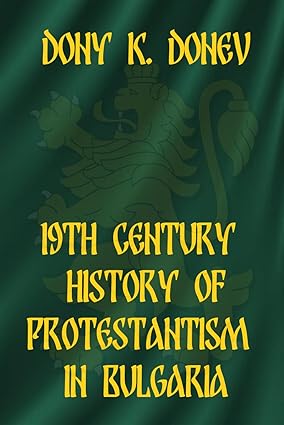
19th Century History of Protestantism in Bulgaria
Dony K. Donev, D.Min., is a prominent researcher and author specializing in Bulgarian Protestant, Evangelical, and Pentecostal history, with over three decades of study. His work, including 19th Century History of Protestantism in Bulgaria and The Unforgotten: Historical and Theological Roots of Pentecostalism in Bulgaria, documents the development of these movements, their suppression under Communism, and the subsequent post-1989 revival.
Key aspects of Donev’s research on Bulgarian Protestant history include:
Origins (19th Century): Protestant work began in the 1800s, with denominations like Congregationalists (1856), Methodists (1857), and Baptists (1865) establishing missions, culminating in the first Bulgarian Protestant Church in 1871. Donev also highlights the 1871 publication of the Protestant Bulgarian Bible translation. His research, often in collaboration with the Institute of Bulgarian Protestant History, has focused on preserving, digitizing, and recovering documents, including church diaries, photographs, and, in some cases, saving records from destruction during the communist era.
Pentecostalism and Growth: The Unforgotten documents the arrival of the Pentecostal movement in Bulgaria, particularly through the influence of the Azusa Street Revival, tracing the roots of early Bulgarian Pentecostal families.
Post-Communist Revival: Donev has documented the rapid growth of the Protestant movement after 1989, noting a significant increase in membership from approximately 13,000 to over 100,000. Dr. Donev has published his dissertation on on Bulgarian Churches in North America.
30 years ago in Chicago
30 Years of the Bulgarian Church of God in Chicago
I left Chicago on this day 30 years ago (July 30, 1995). The Bulgarian church that day held service at 1 PM with 64 Bulgarians and many other internationals in attendance. Bulgarian students from the neighboring Indiana and Wisconsin attended as well. There was even a Bulgarian family from Alaska.
It was a Sunday. I left Chicago to preach in Beloit, WI that night and then left for Washington, D.C. the following morning. While driving north with quite the speed my Carolina blue Grand National began filling with white smoke. At first, I thought the air conditioner was on its last leg in the hot Chicago summer of 1995, but the air remained strong and cold. The cloud proceeded and it was so sensible that I had to slow down and basically stop on the side of the road. In my 35 years of ministry, I have only seen this one more time – in 2011 when the Glory of God descended over a youth camp we were preaching in the Bulgarian mountains. I did finally preach in Beloit and made it to D.C. the next day, but the vision of the cloud remained with me for the next 30 years.
Meanwhile, the word of mouth had spread and the Bulgarian church in Chicago was growing among the Bulgarian diaspora. On October 7, 1995, I was able to visit the church in Chicago again and present it to the National Overseer of the Bulgarian Church of God, Pastor Pavel Ignatov who visited the Bulgarian congregation in Chicago for the first time. By that time, it has become evident that the initial structuring for growth was giving more than expected results. The church became not only the first officially registered Bulgarian Pentecostal congregation in the United States, but also an important social and educational center able to minister to the 100,000 Bulgarians that live in the Great Lake region today.
Called to another mission, I left Chicago on July 30, 1995. The church bulletin upon my departure under Farewell and Appreciation read: “Today we are saying thank you to Dony for a job well done this past summer. He has served our church faithfully, and has been a tremendous blessing to Narragansett Ministries. Immediately following worship this morning, there is a dinner in Dony’s honor in the fellowship hall. And everyone is invited to attend.” Quiescently, while writing this next book for the 30th anniversary of the Bulgarian Church in Chicago, I was able to find this last bulletin in a box with several dozen letters I had sent weekly to my parents in Bulgaria. Surprising even to myself, those letters contain pictures, documents, dates, growth charts and progression predictions that are surprising even to me today. I remember spending countless nights in prayer, contemplating and strategizing over the new Bulgarian church plant, but I had forgotten all this was carefully documented as a case study.
The church congregation presented me with a plaque that represented my efforts and work in Chicago, which I have also kept until now. Because this plaque represents the prayers and the vision of many who are continuing the work today, establishing and leading Bulgarian churches around the world to providing pastoral care for many who have left the homeland in search for a better life. To these ministers goes my personal token of appreciation and thanks, “Well done thou good and faithful!” For me personally today a quarter of a century later, this plaque represents one very simply thing – I never betrayed my dreams. And in my book, this is well done…
A Great Century of Pentecostal Charismatic Renewal
A “Great Century” 81 of Pentecostal/Charismatic Renewal and Missions Edward Keith Pousson Pentecostals and Charismatics missionary-minded segment of dynamics Charismatic to produce a worldwide The following make up what is probably the most world Christianity today. What are the of this century-long movement of both Pentecostal and Renewal that have converged missionary thrust? And on what grounds can we speak of the twentieth century as a “great century” of Pentecostal/Charismatic missions? two questions launch and guide our discussion. will also be addressed: What kind of missionary has emerged from the Charismatic Renewal in particular? has Pentecostal missions impacted Charismatic missions, and what lessons can Charismatic missions learn from Pentecostal missions? What is the emerging Charismatic contribution to mission theology? between renewal and missions is the theme that unites These related questions movement How The relationship this entire article. An End-Time Movement in the nineteenth and twentieth centuries. Missions Scott Latourette Christian missions. worldwide religion. century as a comparably “great renewal and missions? What common to Renewal and Missionary This section explores the relationship between renewal and missions against the backdrop of developments Professor Stephen Neill and Yale Historian Kenneth called the nineteenth century the “Great Century” of It was that century that made Christianity a On what grounds may we speak of the twentieth century” are some of the dynamics of renewal both of these centuries that have birthed massive missionary movements around the world? Renewal Results in Mission First, and of primary significance movements every Christian Orthodox, renewed of Pentecostal/Charismatic for this article, spiritual renewal to global missionary in both of these periods gave birth expansion. By the end of the eighteenth century, for example, virtually denomination throughout the Western world, including Catholic and Protestant churches, had been recently in one way or another. Renewal movements in Protestantism included Pietism, Puritanism, Moravianism, England and the related Wesleyan revival, and the Great Awakenings the American Colonies. Though unevenly distributed and timed, it was this church-wide awakening that provided the spiritual impetus for that the Evangelical Revival in in 1 82 which is now called the “Great I Century” of Christian missions, Similarly, renewal pervasive missionary expansion and global country where rapid church Pentecostal/Charismatic decadal growth rates.2 In 1992, Wagner penned this hypothesis: non-militaristic, beginning 1792 and ending 1914.’ in the twentieth century, impacted virtually every renewal has likewise brought church growth. Pentecostal and Charismatic Christian denomination. This about unprecedented In nearly every multiplication is occurring, are leading the way in terms of C. Peter movement has over the past congregations church growth professor “In all of human history not another non-political voluntary human movement has grown as dramatically as the Pentecostal/charismatic 25 years.”3 Without question, as Wagner suggests, Pentecostalism in all its forms is the fastest growing segment of Christianity in the twentieth century. It grew from 16 million worldwide adherents in 1945 to 4.3 billion in 1993.4 Renewal about dramatic changes of that both periods of renewal Protestant institutions, new missionary structures. Protestant the nineteenth century minds of Neill and Latourette Changes Christian Institutions A second comparison from the nineteenth and twentieth centuries is brought in including and especially a vast proliferation The birth and multiplication of these missionary societies is perhaps the leading factor that makes the Great Century of Christian missions in the Once freed from church and state launched more than 21,000 control, these voluntary societies focused exclusively on missions and Protestant missionaries by 1910.6 Thanks to Harper History of ‘ See Kenneth Scott Latourette, A History of Christianity, Vol. 2 (New York, NY: . & Row Publishers, Inc., 1953), 1013-1035; Gary B. McGee, This Shall Be Preached. A Gospel to 1959 History and Theology of Assemblies of God Foreign Missions (Springfield, MO: Gospel Publishing House, 1986), 24; Stephen Neill, A Christian Missions (Second edition revised by Owen Chadwick; London and New York: Penguin Books, 1986), 204, 213-215, 240-245, 286-287, 332-334. 2 C. Peter “Church Growth,” in Pentecostal and Charismatic Wagner, Dictionary of Movements, eds. Stanley M. Burgess and Gary B. McGee (Grand MI: Zondervan Publishing House, 1988), 185-188. [Hereafter cited as Rapids, A1issions, 214; Sydney (New 6 McGee, missionary DPCM.] I ‘ C. Peter Wagner, Warfare Prayer (Ventura, CA: Regal Books, 1992), 48. 4 ‘David J. Hesselgrave, Today’s Choices for Tomorrow’s Mission (Grand Rapids, MI: Zondervan Publishing House, 1988), 119; David B. Barrett, “Annual Statistical Table on Global Mission: 1993,” International Bulletin of Missionary Research 17 (January 1993): 22-23. ‘Latourette, A History of Christianity, 1013-1033ff.; Neill, A History of Christian E. Ahlstrom, A Religious History of the American People Haven and London: Yale University Press, 1972), 422-423. This Gospel Shall Be Preached, I, 21. Examples of early Protestant societies include William Carey’s Baptist Missionary Society (1792), the London Missionary Society (1795), and the American Board of Commissioners for Missions (incorporated 1812). Foreign 2 during Through the twentieth movement has likewise given sending agencies, including 83 living in Asia, the Pentecostal/Charismatic and the world’s largest with some 25,000 of recent their efforts, the percentage of the world’s Protestants Africa and Latin America increased from one percent to ten percent the nineteenth century.’ 7 century, birth to hundreds of new missionary the Assemblies of God Foreign Missions Division with more than 1,500 missionaries, Christian mission, Youth With a Mission (YWAM), missionaries reaching out to nearly every country of the world.’ But the the movement is not its number of missionaries, on the mission field. Eighty percent to Christianity have been the result of according Today at least 66% of the world’s Pentecostals/Charismatics Latin America, and Oceania, including 88% of Assemblies church members and 75% of Church of God (Cleveland, TN) believers, two of the largest Pentecostal denominations worldwide.’° crowning success of but its growth conversions from paganism Pentecostal/Charismatic efforts, Asia, Africa, of God Patterns of Piety fueled the nineteenth produced striking changes piety. Moravian pietism to several researchers.’ live in movement, for instance, of Protestant Renewal Changes A third common feature of the nineteenth and twentieth centuries is that both periods of renewal unleashed new forms of spirituality that aided fresh missionary expansion. The various renewal movements that century missionary in the forms and expressions centered on Christ and him crucified. Wesleyanism called for personal conversion, The Great Awakenings in the Colonies/States stressed the unchurched, preaching. “evangelical” preaching for the need for individual “decisions” holy living, and zeal in resulting responsibility for witness, in the “new birth,” and a prayer for enabled the Protestant strong desire for individual and corporate prayer, including concerts of world missions. These new expressions of spirituality faith to adapt itself and reach out to the ends of History 8 Gary for (Grand Rapids, ‘Paul E. Pierson, “Why Did the 1800s Explode with Missions?,” Christian 11/4 (1992): 20. B. McGee, “Overseas Missions (North American),” DPCM, 614-624; David B. Barrett, “Global Statistics,” DPCM, 814-815, 830; Choices Tomorrow’s Mission, 120, 255n; Edward K. Hesselgrave, Today’s Pousson, Spreading the Flame MI: Zondervan Publishing House, 1992), 88-89; John A. Siewert and John A. Kenyon, eds., Mission Handbook 1993-95 (15th Edition; Monrovia, CA: MARC, 1993), 243, 248, 255-256. 9 Vinson Synan, “Global Consultation on AD 2000 3 Evangelization: AD 2000 the Target,” Together (Spring 1989): 7; Larry Pate, From Every People (Monrovia, CA: MARC, 1989), 129; C. Peter Wagner, Spiritual Power and Church Growth (Altamonte Springs, FL: Strang Communications 1986), 12; C. Peter How to Have a Healing Ministry Without Company, Making Your Church Sick (Ventura, CA: Regal Books, 1988), 68-89. ‘°L. Grant McClung, “The Pentecostal ‘Trunk’ must Learn from its ‘Branches’,” Missions Quarterly 29 (January 1993): 35. Wagner, Evangelical 3 84 our changing movements.” world through many new and unprecedented renewal has produced new and material. Comparing needs-spiritual, Pentecostal Comparatively, Pentecostal/Charismatic and varied expressions of worship and spirituality which have reached to the ends of the earth. One major factor behind the astonishing success of the movement is its appeal to a broader range of human physical to ministry with the Interdenominational Foreign Missions Association (IFMA), missionary theologian Arthur F. Glasser of Fuller Theological Seminary’s School of World Mission emotional, approaches writes, challenge evangelicals… … Pentecostals were willing to tackle the “dark side of the soul” and the growing phenomenon of occultism, Satan worship and demon possession. Whereas IFMA people and other non-charismatic had found it relatively easy to the occasional expose the extravagance of charlatan, they were silenced in the presence of the Pentecostal’s serious confrontation of the hard realities of the spirit world. Here was a spirituality which could not be ignored. 12 Charismatic spiritual guidance, together ministry, dynamic praying movement world. such as exorcisms, worship, healings and spontaneous secularizing “power-encounters,” with expressive and a lively oral tradition make this especially appealing to many peoples of the non-Western Through these and other viable spiritual dynamics, PentecostaUCharismatic missions has curtailed trends of earlier missions that offered people “soul-salvation” but left miracles, healings to the early church.’3 Pentecostal/Charismatic missionaries offer healing, not to “disembodied exorcism and physical souls,” but to whole persons. Renewal expansion global of Changes Leadership Patterns A fourth renewal dynamism giving rise to unprecedented in nineteenth century was the creation of new patterns of leadership, including the service of women, increased participation lay people and of less formally trained clergy, and the unprecedented mobilization of 180,000 student volunteers for missions.14 Similarly, Pentecostals/Charismatics have advanced in missions through hands-on, leadership training models, and the sending of many women evangelists and missionaries. ‘ decentralized training, semiformal Bible institute 11 Latourette, A History ojChristianity, 959-960, 1019-1029, 1043-1047; Neill, A History of Christian A1issions, 202-204, 214, 275. 12 Arthur F. Glasser and Donald A. McGavran, Contemporary Theologies of Mission (Grand Rapids, MI: Baker Book House, 1983), 119-120. “See Paul G. Hiebert, “The Flaw of the Excluded Middle,” Missiology: An International Review 10 A (January 1982): 35ff. 14 Latourette, History ojChristianity, 960, 1020, 1027; McGee, This Gospel Shall Be Preached, I, 24; Neill, A History of Christian Missions, 217-218. “L. Grant McClung, ed., Azusa Street and Beyond: Pentecostal ivissions and 4 example, undesirable, proven growth provided people respond. They “experience” 85 modified Calvinism by making Strong reliance on the laity and multiple routes to ordination have accelerated leadership emergence in areas of rapid church growth. For most Assemblies of God pastors around the world are without so much as a Bible school education. `6 Higher education is not but imposing educational requirements for ordination is a restriction in some cases. And the lack of educational requirements for ordination has not stopped the Assemblies of God from becoming the largest Pentecostal denomination. Renewal Alters Theological Traditions Consider one final comparison between these two “great centuries” of renewal and missions. In both cases, renewed theological reflection motivations for a new thrust in world evangelization. Of great significance for the nineteenth century missions movement was this one fact: renewal reshaped traditional Calvinism with respect to election and predestination. The Puritan fathers, for example, believed that all would hear the gospel and that some from every nation would launched missions to the Indians in all Thirteen Colonies. The Great Awakening in the Colonies broached Arminian-ish ideas, establishing the need for an individual “decision” and a personal of salvation for the elect. And Jonathan Edwards, a leading theologian of the Awakening, for the sinner’s response in accepting God’s forgiveness.” in England, the Evangelical Awakening with its stress breaking up hyper-Calvinism. Even among the Particular Baptists, William Carey’s there was a “slow awakening,” Stutd1fse, Carey, and others planted seeds of a mission theology into In these and many other ways, revival . of traditional theology, providing fundamental convictions and motivations for the nineteenth century missions more room Simultaneously on evangelism was also denomination, the English religious scene.” altered the landscape movement. Topeka, America. the fallow ground of as Andrew Fuller, John in Pentecostalism. The revival in of Pentecostalism in North reflection to Los Angeles, We observe the same pattern Kansas marks the beginning This revival was triggered by fresh theological concerning sanctification, the baptism in the Holy Spirit and speaking in tongues. From Topeka the revival spread to Houston, Texas, and then where the Azusa Street Revival broke out and 76-77; Rapids, Church Growth in the Twentieth Century (South Plainfield, NJ: Bridge, 1986), McGee, This Gospel Shall Be Preached, I, 91-93. 16 J. Herbert Kane, The Christian World Mission: Today and Tomorrow (Grand MI: Baker Book House, 1981), 105. “These and many other theological developments linked to the Great and Awakenings providing missionary motivations are discussed in Latourette, A History of 958-961, 1019, 1043-45. ‘eTim Dowley, ed., A Lion Handbook: The History of Christianity (Oxford: Lion 406-409. Christianity, Publishing, 1990), 5 86 innovations in early motivations and convictions movements. Consider One, Pentecostals Spirit Testament experience. impacted various parts of the world. Theological and mature Pentecostalism have provided powerful that could not help but produce explosive missionary the following three theological innovations. claimed that the personalized power of the Holy is readily available now to every believer just as it was in New Pentecostals discovered that they can receive the sacraments and experience the Spirit, not through the mediation of and the clergy (as in Catholicism), and not only through the ministry of the Word (as in mainstream Protestantism), but through direct and personal access to the Father and to Jesus, the Baptizer in the Holy Spirit.19 Two, Pentecostals emphasized Pentecost expect the supernatural ministering that the purpose of this personal for missions. This claim of the biblical experience of the Holy Spirit is empowerment is a rediscovery by experience of the true purpose (Acts 1:8). Being “baptized” in the Spirit, Pentecostals manifestations or charismata of the Spirit to be there for them in evangelistic and missionary outreach. Three, Pentecostals see themselves as living in the last days and in the same salvation history context as that of the New Testament.2° They have, therefore, recovered the New Testament hope of the soon return of Jesus. This view of things has generated powerful motivation which is characterized by expectancy, urgency, how renewal alters missionary and intensity. These three innovations theological traditions movements. Theological serve to illustrate in such a way as to stimulate fresh missionary reflection concerning the mission of the church has played a vital role across the last two great centuries of renewal and missions. century” above parallels between these of a professional of the School of World Mission Pasadena, California. 21 Although my analysis may lack the nuances historian, I believe that the twentieth century can be called the “great of Pentecostal/Charismatic renewal and missions in that it bears comparison to the nineteenth-century missionary movement. The two periods of renewal and expansion are not only striking but also instructive. They illustrate the following key missionary principles taught by missions historian Paul E. Pierson at Fuller Theological Seminary in First, renewal and missions are interlinked. Missionary expansion is both the natural and the supernatural result of the outpouring of the Spirit of God upon the church (Acts 1:8). Any renewal that is truly Missions “Dowley, ed., A Lion Handbook, 646; Paul A. Pomerville, The Third Force in (Peabody, MA: Hendrickson Publishers, 1985), 65. 2°Pomerville, 21 The Third Force in Missions, 57-58. While Pierson is to be credited for these principles, I do not claim his authority for the ways in which I have adapted and applied them in this article. 6 87 eschatological will eventually turn its focus outward and cross social and cultural barriers to reach the lost, as the biblical Pentecost did. Second, renewal changes the way we do church and missions, creating new structures and patterns for both. Specifically, missions is most effective when local churches and extra-local mission structures cooperate together in a semi-autonomous, mutually interdependent fashion, as seen in both the nineteenth and twentieth century missionary movements mentioned above, as well as throughout church and missions history. Third, renewal creates new and viable forms of spirituality that spur fresh missionary outreach and appeal more effectively to the unchurched peoples of the day. Fourth, renewal creates new patterns of leadership that unleash fresh missionary outreach. And fifth, renewal alters older theological traditions and ushers in new theological insights that provide fresh motivation for evangelistic and missionary outreach. Observing Pentecostal/Charismatic renewal and missions in a general way, we have thus far identified key dynamics or characteristics of renewal that lead almost inevitably to a missions thrust. This analysis provides the foundation, perspectives and presuppositions for all that follows. From here on, however, the emphasis falls more specifically on Charismatic missions of the latter half of this century. The Charismatic Renewal: Creating New Patterns for Church and Missions That the Pentecostal revival has produced a major missionary movement is a well documented fact. By 1990 there were 320,000 classical Pentecostal churches around the world with a total membership of over 45 million. 22 But what kind of missionary movement has the Charismatic Renewal produced? How are the dynamics and principles observed above also working in the Charismatic Renewal? . The Emergence of a “Charismatic” Ecclesia Renewal, we have observed, changes the way we do church. The healing revival of the 1950s formed the bridge between the Pentecostal Movement and the Charismatic Renewal. William Branham, Oral Roberts, T. L. Osborn, Jack Coe, A. A. Allen, R. W. Schambach and hundreds of other healing revival leaders caught the attention of the masses in mainline churches who had more or less ignored classical Pentecostalism. This was the real beginning of the Charismatic Renewal. Dennis Bennett’s public announcement in 1960 of his “nine o’clock in the morning” experience was merely the cutting of the ribbon. After the media publicized Bennett’s announcement, many others in mainline churches admitted their own Charismatic experiences. Many z2 Barrett, “Global Statistics,” DPCM, 812-815. 7 88 Charismatic leaders were able to stay in their traditional churches and cultivate renewal. But hundreds of others were forced out. New wine skins were needed for the new wine. As a result, tens of thousands of independent Charismatic churches were eventually formed across the United States and around the world. For the sake of definition, “independent Charismatic” denotes churches or ministries that have embraced the Charismatic Renewal and, because of their Charismatic experiences and innovations, are not institutionally linked to classical Pentecostalism or any denomination. Although these churches only began to form in the early 1970s, they represent 14% of all Charismatics and now make up the fastest growing segment of Christianity in the United States as well as in many Third World countries.23 There are between 60,000 and 100,000 independent Charismatic congregations in the USA alone. Consistent with observations made in the beginning of this article, independent Charismatic churches are bom out of renewal and have certain characteristics which promote effective missionary outreach. What are these characteristics? First, despite the apparent “babel” of diversity, there is an underlying spiritual unity among these churches. Nowadays old rifts are being forgotten and Charismatic churches and ministers are coming together in “networks”-loose, overlapping ministerial associations without the legal or bureaucratic encumbrances. Well known examples include Charismatic Bible Ministries (1,500 ministers), Christ for the Nations (600 churches), Rhema Ministerial Association (500 churches) and the large, umbrella type Network of Christian Ministries, which brings together leaders of other networks. Second, independent Charismatic churches, like new wine skins, help preserve the witness and the heritage of the Charismatic Renewal. The practical value of this is best seen in light of the fact that most mainline Charismatics become “postcharismatics” after two or three years of involvement in the renewal. 24 Third, independent Charismatic churches have unleashed their laity. They have recruited, apprenticed, and released into ministry and missions thousands of people with little or no formal theological training. Not that professional training is of no value. But Christian history teaches us that God often calls and uses people on the periphery of our religious institutions. “Can . anything good come out of Nazareth?” “Peter D. Hocken, “Charismatic Movement,” DPCM, 144; Wagner, “Church Growth,” DPCM, 181-182; Paul G. Chappell, “Healing Movements,” DPCIU 374; Stephen Strang, “Nondenominational Pentecostal and Charismatic Churches,” DPCM, 640; Barrett, “Global Statistics,” DPCM, 811-813. “For definition and statistics on “postcharismatics” in mainline churches, see Wagner, “Church Growth,” DPCM, 183; Barrett, “Global Statistics,” DPCM, 811-813, 826. 8 Fourth, Charismatic The by leaders, Jesus, people Renewal, powerful strongest and most consistent For an exception the movement’s missions. Many movement. 89 and missionaries are “practical” or mission fields. But some of these love the Lord Missions thrust of the Charismatic Charismatic churches and a major missionary pastors theologians. frame of reference for their theology is provided, not the seminary, but by the context of their ministry and by the hurts, needs and questions of their congregations The lack of theological foundations is sometimes problematic. who are often the subject of a media-inquisition, love their congregations and have led hundreds and thousands of into a liberating experience of the kingdom of God. These and other spiritual and institutional dynamics make the Charismatic and in particular, the independent Charismatic church, a force for world evangelism. The “Slow” Emergence of Charismatic If renewal and missions are linked, then what kind of missionary movement has come out of the Charismatic Renewal, and what kinds of structures and strategies are being used to muster missions activity? While denominational Charismatic missionaries have excelled, the missionary Renewal has come from the independent ministries.’ To this exciting story we now turn. a while, it looked as though the Charismatic Renewal would be to the rule that revival results in mission. Some still question missionary track record. Three things need to be noted. First, not all Charismatic churches are equally interested in are still “bless-me” communities, not yet realizing missions as the reason for revival. Second, the Protestant Reformation was nearly two centuries old before it produced And third, most of what is now being done by Charismatics in missions remains undocumented. But there are indicators of a ground swell of effective missionary activity among Charismatics. the beginnings of a distinctively Charismatic missionary thrust have been relatively slow for the following reasons.26 within the churches. rightly spent much time and energy bringing their own churches and denominations. Structure limitations. Thousands of independent have no connections with organized missions agencies. Many have espoused the ideal of being a “sending church” apart from the expertise and assistance of agencies that specialize in if any, have really succeeded over the long haul. Related to this problem is the spirit of independence that obstructs practical, functional unity and cooperation however, Renewal ministry Charismatic leaders renewal to bear upon churches training and sending missionaries. efforts. Admittedly, Many of the early Charismatic sending Few, in missions 2S 26 Hocken, “Charismatic Movement,” DPCM, 157. Pousson, Spreading the Flame, 79-82. 9 90 Strategy limitations. The emphasis on the Holy Spirit and subjective guidance sometimes preempts practical goal-setting and informed strategy planning. Once a Charismatic minister “felt led” to evangelize a certain Caribbean island. He resigned from his pastorate, raised funds and went to the island, finding nothing but coconut trees. No people. Limited theology of mission. Charismatic anti-intellectualism coupled with the idea of learning by “revelation” apart from theological discipline has taken a toll. Too many churches are built around faith for prosperity, healing and spiritual gifts, often to the exclusion of the biblical basis of missions and the New Testament revelation of the Holy Spirit as empowerment for worldwide, cross-cultural witness to the Risen Lord. Limited missions exposure. Many independent Charismatics have little awareness of recent global mission trends even in their own movement. What is an unreached people group? What is the 10/40 Window? What is the AD 2000 & Beyond movement? What is a career missionary, and how does a person become one? Sad to say, surveys have shown that vast numbers of Charismatics all across the United States are simply unacquainted with these and other mission dynamics. Related to this lack of exposure is the lack of real missionary vision and leadership. These and other bottlenecks account for what some would consider a sluggish start for Charismatic missions. But that is not the whole picture. There are signs that Charismatics, particularly the independents, are seizing a global missions vision and making a global contribution. Charismatics, for example, outnumbered Pentecostals in the number of worldwide annual converts in 1988, according to David Banrett.2′ From the very beginning of the Charismatic movement there were notable missionary pioneers. And through the decades of movement we have seen the emergence of Charismatic sending churches, sending agencies, and a premier association of Charismatic mission agencies and churches called the Association of International Missions Services (AIMS). Charismatic Missionary Pioneers Oral Roberts, T. L. Osborn, Gordon Lindsay, Kenneth Hagin, Sr., and Lester Sumrall are among the few leaders from the Post-World War II healing revival (1947-1958) who also became significant leaders in the subsequent Charismatic Renewal. They have blazed a trail for Charismatic missions. Oral Roberts founded the university named after him which trains Charismatics from all over the world. From 1976 to 1990, Oral Roberts University sent several thousand students into more than 30 countries on “Summer Missions” assignments. T. L. Osborn has played a leading role in Charismatic renewal and missions. By the early 1970s he had already evangelized in over 50 27Barrett,. “Global Statistics,” DPCM, 811. 10 91 countries where his ministry was producing more than 400 self-supporting churches annually. 21 In 1970 Gordon Lindsay founded Christ for the Nations Institute (CFNI) which continues to train and send out Charismatic missionaries to many parts of the world. Kenneth Hagin, Sr. and Lester Sumrall have also founded and led major Charismatic ministries which have launched missionaries and missions efforts in every continent. Pentecostal/Charismatic pioneer Daniel Ost founded Charismatic Ministerial Institute (CMI) in El Carmen, Mexico in 1955. Since then, CMI has trained and launched more than 1,000 ministers throughout Mexico and in ten other countries, including India and France. CMI graduates have founded 120 churches called “Centers of Faith, Hope and Love” which are transforming major cities across Mexico. The school is now challenging its students to go as missionaries to the “10/40 Window,” the least evangelized region of the world, stretching from West Africa to East Asia, 10 degrees and 40 degrees north of the equator. Mexico is no longer just a mission field, but also a missionary force.29 Charismatic Sending Churches Bethany World Prayer Center in Baker, Louisiana is an independent Charismatic church of four to five thousand members. A million dollars annually from their budget supports various projects and over 100 missionaries in 25 countries. One-third of these missionaries were recruited and sent out from Bethany World Prayer Center. The pastor, Larry Stockstill, a graduate of Oral Roberts University, has adopted a strategy which combines crusade evangelism with church planting techniques. With this strategy, several large and growing churches have recently been planted in Russia, Nicaragua, Uganda and India. In 1991, for example, a Bethany team held an evangelistic church planting crusade in Moscow. The result was 5,000 decisions for Christ and 1,000 new believers in attendance at the first service of the Moscow Christian Center. . Another Charismatic church with a serious missionary vision is John Osteen’s Lakewood Church in Houston, Texas. Since its founding in 1961, Lakewood Church has launched effective missions outreaches to more than a hundred countries.3° Tulsa Christian Fellowship, the oldest independent Charismatic church in Tulsa, Oklahoma numbers about 500 and gives $150,000 a year to missions. They have sent out at least 28 David Edwin Harrell, Jr., All Things Are Possible: The Healing and Charismatic Revivals in Modern America (Bloomington, IN: Indiana University Press, 1975), 171. z9 Lee Anderson and Christina Tumey, “Mexican Churches Charisma & Growing Christian Rapidly,” Life 19 (October 1993): 68-73. ” Stephen Strang, “Osteen, John Pentecostal Explosion (Altamonte Springs, FL: Creation House, Hillery,” DPCM, 656; Vinson Synan, The Twentieth-Century 1987), 25-29. 11 92 40 of their own people as missionaries involved in just about everything from Bible translation to pioneer evangelism among unreached people groups. Still another example, the 8,000-member Victory Christian Center, also in Tulsa, supports 125 missionaries to 20 different countries. A closer look at a few successful sending churches, including some of those mentioned above, has revealed certain keys to their success. 1) They have a consistently missions-minded pastor and a missions director or a missions committee to steer the church’s missionary involvement. 2) They commit a substantially large percentage, typically from 20% to 30%, of their annual budget to missions. 3) They strongly emphasize the role of the local church in missions, providing consistent missions exposure through literature, preaching and mission conventions. 4) They provide their missionary candidates with both informal apprentice training as well as structured Bible school training. 5) They have loose but functional ties with mission organizations that provide various types of training, helps and services to their missionaries. For example, they may send a missionary through Youth With a Mission or Wycliffe Bible Translators. Some churches relate to Charismatic service agencies that handle the missionaries’ financial matters and newsletters. 6) Sending churches usually have relationships with senior missionaries and/or indigenous Christian leaders in or near to the countries where their missionaries serve. These leaders in the host countries serve as mentors and field directors, especially for new missionaries. 7) Successful sending churches provide pastoral care for their missionaries away from home. This caring support involves correspondence, phone calls, cassette recordings of the pastor’s sermons, and, if necessary, a personal visit from the missions director. These seven factors make up a fairly simple and reproducible methodology, regardless of the size of the church. The Charismatic sending church model has much to offer. It bring their members back to the New Testament conviction that Charismatic experiences are given to the church for the purpose of mission. It emphasizes the centrality of the local church in missions. It produces missionaries that have the local church at heart and believe in church planting. And it helps ease church-missions tensions that exist in many Christian traditions. Despite a highly vocalized ideal of “sending direct” without the aid of so-called “para-church” organizations, I have found that the really successful sending churches usually rely on extra-local entities for help in training, mobilizing, serving and supervising their missionaries. When, however, the church tries to act like a self-contained mission agency, certain weaknesses crop up. Missionaries often become like lone rangers on the frontier without proper supervision or accountability. To the other extreme, some sending churches only get 12 93 involved with persons and projects that they can somehow control from the home front. Furthermore, many churches that try to be the mission agency act more like travel agencies. Short term mission trips to places where churches already exist becomes a substitute for real pioneer missions work. Other weaknesses include the sending of inadequately trained missionaries, haphazard field selection, and duplication or lack of cooperation between missionaries in the same location. The greatest problem with churches that try to become the mission agency is the historically repeating pattern whereby the apostolic function becomes absorbed by churchly concerns. A sudden or gradual shift in missions philosophy or priorities on the part of the sending church can leave missionaries in the lurch. In 1990, for example, a large Charismatic sending church changed its focus from foreign missions to home missions and expeditiously withdrew financial support from 35 overseas missionaries. Many of these had to come home because all their eggs were in one basket. Charismatic Sending Agencies Consistent with the pattern of the Great (nineteenth) Century, whereby awakening resulted in the proliferation of new mission agencies, the Charismatic Renewal has also produced a multitude of new mission structures. Many of the Charismatic networks described earlier in this article have formed creative missionary sending and service agencies which contribute in various ways to the recruiting, training, and mobilizing of cross-cultural missionaries. Other Charismatic mission structures have emerged independently of networks. In the late 1980s, one hundred new agencies surfaced in the Western world, and over three hundred in the Third World.3′ At least ten of the agencies listed as “Charismatic” in the 1993-95 edition of the Mission Handbook are independent Charismatic and represent a total of 646 USA personnel overseas.32 There are many other agencies of various types which represent thousands of Charismatic missionaries. Listed in the Mission Handbook as transdenominational, Youth With A Mission has thousands of missionaries who come from independent Charismatic churches. Not listed in the Handbook, the Oklahoma-based “Teen Mania” has sent hundreds of high school students on summer missions outreaches since 1987. In the summer of 1993, for example, Teen Mania took 1,750 teens to 14 countries, including Mongolia, Egypt and Albania.33 A Charismatic Missions Association In 1985, Charismatic leader Howard Foltz saw that the groundswell Charismatic missionary activity would warrant some kind of 31 32 Barrett, “Global Statistics,” DPCM 830. Siewert and Kenyon, Mission Handbook, 248, 255-256. “1. Lee Grady, “Radically Saved,” Charisma & Christian Life 19 (September 1993): 38-40. 13 94 overarching fellowship or association. So he founded and now leads the Association of International Missions Services (AIMS), a consortium of some 150 Charismatic sending churches, sending agencies and training institutions. Based in Virginia Beach, Virginia, AIMS is devoted to catalyzing the resources of the Charismatic Renewal for world evangelization. It provides a framework for unity, cooperation and the sharing of information between its member organizations. These kinds of developments suggest that the Charismatic Renewal is producing a major missionary thrust, and that the independent Charismatic church is the heartbeat of this thrust. With this in view, we now take up questions raised in the introduction about the relationship between Pentecostal missions and Charismatic missions. The Charismatic Contribution in Relation to Pentecostal Missions Several observers of Pentecostalism agree that the various Pentecostal and Charismatic expressions in the twentieth century all stem from one eschatological renewal movement. The spiritual foundations and impulses for Charismatic missions are traced to the same Holy Spirit revival that began at the start of this century. For all their innovations, Charismatic missions stand in strong continuity with the Pentecostal movement in certain important respects. How Pentecostal Missions Impacts Charismatic Missions First, most of the early pioneers in Charismatic missions, including those mentioned above, either had Pentecostal roots or were influenced by Pentecostalism. Gordon Lindsay, for example, in the late 1960s transformed his revivalistic “Voice of Healing” organization into a Charismatic missionary society devoted to world evangelization. By 1973, Lindsay’s ministry, Christ for the Nations, had helped finance 3,000 church buildings in 83 nations and had distributed 15 million books in 46 languages. 31 Second, Charismatics have also followed many of the strategies of Pentecostal missions. For example, the supernatural calling and recruitment of missionaries, apprenticeship training of missionaries, the use of women in missions, the dependence on the Spirit’s intervention in evangelism, the use of evangelistic crusades to plant churches and the application of indigenous church principles are common strategies in both Pentecostal and Charismatic missions. And third, Pentecostalism’s theological motivation for mission has significantly impacted the Charismatic movement. The Pentecostal emphasis on the Holy Spirit as empowerment for mission is basic to Charismatic missions. Charismatics have inherited from Pentecostals a “Gary B. McGee, “Association of International Mission Services,” DPCM, 30; Pousson, Spreading the Flame, 25-26, 52, 70, 88, 127-128. 35Harrell,A// Things Are Possible, 166-168. 14 95 strong commitment to the literal and plain meanings of Scripture, a Christ-centered approach to worship, preaching, and ministry, a sense of urgency for mission as people living in the last days and a sense of divine destiny.36 Although “Charismatic theology” is still in its formative stages, many Charismatic leaders intuitively know that their Charismatic experiences should lead to evangelism and missions. Emerging Charismatic Contributions to Theology of Mission The Charismatic movement is consistent with historic Evangelical theology with respect to the Trinity, the Incarnation, Christ’s atonement, resurrection, regeneration by the Spirit and other basic doctrines.” Also, as noted above, Charismatics are basically in the same theological orbit as Pentecostals. The Charismatic movement, however, is yet to develop an adequate theology of mission as such. A solid theology of mission would, in fact, be an effective antidote to many of the abuses in Charismatic circles. Nevertheless, there are several tenets of Charismatic “theology-on-the-way” that can or do contribute positively to mission and mission theology. Faith teachings. Despite its many abuses, the so-called “faith movement” honors God and serves mission inasmuch as it cultivates in people a deeply personal, corporate and biblical trust in the Person and power of Jesus Christ. Charismatic faith teaching stresses physical healing, material well-being, positive thinking and confession, divine guidance and the believer’s authority and victory over Satan, principalities and powers. Criticisms and reactions against these teachings abound. Some criticisms are valid. But the spiritual dynamics related to the faith teachings positively account for much of the success in Charismatic evangelism and missions today. Rightly focused faith is central and essential to all successful missions. Howard Foltz of AIMS writes, Faith teaching has elevated the expectations of many believers today to for God and “attempt great things expect great things from God.” When dynamic rhema faith is released in reaching the nations, and not on selfish or material wants, great things can happen. Numerous missionaries from the faith movement have gone to the mission field and believed God for far more than the “average” missionary. 38 Kingdom now. There is another stream of Charismatic thought known as “Kingdom Now.” Leading centers of this emphasis include Earl Paulk’s 10,000-member Chapel Hill Harvester Church in Atlanta, Georgia, and Tommy Reid’s Full Gospel Tabernacle of Orchard Park, New York. These, and others in the “kingdom now” circle, model and 36 McClung, Azusa Street and Beyond, 48-52. “J. I. Packer, “Piety on Fire,” Christianity Today, 12 May 1989, 20. 38Howard Foltz, “Moving Toward a Charismatic Theology of Missions,” paper presented at the 17th Annual Meeting of the Society for Pentecostal Studies (Virginia Beach, VA: November 12-14, 1987), 76-77. 15 96 visible expression of God’s concern on change social conscience Covenant theology. into secular society for the sake of The church is to be a of urge active Christian penetration social service and structural transformation. dominion in the world. Kingdom now theology represents at least a small step towards a theology of social the part of Charismatics. Since internal and external cultural is part of the biblical missionary mandate, the emergence of a in Charismatic circles is praiseworthy. This wing of the Charismatic movement emerged from the controversial discipleship-shepherding teachings the 1970s. Some of these principles continue to find expression in many Charismatic churches today, such as the Fellowship of Covenant Churches and Ministers founded by Charles Simpson and based in Mobile, Alabama. Covenant teachings emphasize self denial, obedience to the commands of Jesus and the need for growth to maturity in the between believers and between spiritual and mentorees. Notwithstanding abuses in discipleship circles, their basic principles are at the heart of the Great Commission and can contribute positively to a theology of mission. context of strong relationships mentors Restorationism. Restorationist Charismatic Carolina based National emphasize the recovery paradigms, teachings are emphasized in several and the Montreat, North groupings, including a nation-wide network of churches known as the People of Destiny International, Leadership Conference. Their teachings of the nine spiritual gifts of 1 Corinthians 12, and the “five-fold ministry” of Ephesians 4:11, especially the apostolic and prophetic dimensions of church authority. Driven by these the People of Destiny movement has developed a creative model of ministry based on Paul’s apostolic team in the book of Acts. The movement is led by a mobile team of four to six “apostolic” team” provides direction for church planting, church nurturing and leadership training, but the relationship between churches is spiritual, leaders. This “apostolic the team and the non-bureaucratic.39 This approach Paul’s missionary band. This semi-autonomous and and its theological convictions display principles and dynamics consistent with those of the apostle “restoration” of apostolic teams is a positive contribution to world evangelism movements. One of the most significant Prayer theological and power developments in the Pentecostal/Charismatic movement 1986): Quoted Prince,” People of Destiny Lfagazine 39Hocken, “Charismatic Movement,” DPCM, 141f; Larry Tomczak, “The World Mission of Every Christian,” People of Destiny Magazine 4 (September/October 15; Larry Tomczak, “Relationship With the Sending Church,” in The Church Planters Handbook, ed. Jim Durkin, et. ai. (South Lake Tahoe, CA: Christian Equippers International, 1988), 105. 40 in 1986 Charismatic leader Derek Prince said, “I’ve also begun to see that in a certain sense the major outreach arm of the Church should be apostolic teams.” from Larry Tomczak, ed., “Unfinished Business, An Interview with Derek 4 (September/October 1986): 23. 16 97 comes under the rubric of “signs and wonders” and “spiritual warfare.” The present proliferation of power literature by Pentecostals/ Charismatics and “third-wavers,” such as Peter Wagner and Charles Kraft,. is making an immense contribution toward our understanding of how effectively to resist and neutralize demonic powers that hinder evangelism and missions. Without these and other spiritual dynamics, missiological techniques and methodologies are like state-of-the-art computer hardware without the software to run it. The current global prayer and power movement which is sweeping into all six continents is introducing new spiritual dynamics for evangelism and missions with documented results in terms of countable disciples of the kingdom. Much of the above may indeed represent formative Charismatic contributions to mission theology and the science of missiology. Most of the hermeneutical problems in Charismatic teachings could be ironed out by the integration of a solid evangelical theology of the kingdom with an understanding of the mission of God. However, theological formulation always lags behind revival and missionary movements. We must remain patient but hopeful. I agree with missions professor, L. Grant McClung’s statement that, . In this “Decade of Definition” there will be a rapid growth in the science of pentecostal/charismatic studies and enough missiological literature to support what I feel is the emergence of a definitive pentecostal/charismatic missiology.” Consistent with precedent patterns of renewal and missions, fresh theological reflection has created fresh missionary motivation among Charismatic believers. What Charismatic Missions Can Learn from Pentecostals If Charismatic churches, especially those of the independent movement, are to maximize their potential for world evangelism, there are several areas where Charismatics need to catch up with their Pentecostal friends. First, Charismatics need to tackle the disciplines of theology and missiology. Charismatics must learn from Pentecostals to overcome their own anti-intellectualism and engage in high-level theological reflection as Pentecostals are now doing. J. Rodman Williams of Regent University in Virginia has made forward strides with Renewal Theology, a three-volume work which takes a fresh look at theology from a Charismatic perspective. But much remains to be done, especially in the area of mission theology. Many Charismatics are yet to learn and embrace what classical Pentecostalism really stands for-that, as a part of salvation history, renewal is essentially missionary in nature and cannot be complete without expansion to the unchurched and the unreached. 41 L. Grant McClung, ” Mission in the 1990s,” International Bulletin Research 14 ofMissionary (October 1990): 153. 17 98 Second, Charismatics must overcome their own aversion to organization. It was not until the forebearers of the Pentecostal movement struck the right balance between Spirit-led spontaneity and strategic organization that their movement became an effective worldwide missionary force. The Assemblies of God denomination, for example, was formed in 1914 as an agency for world evangelization. This organizational move helped provide sorely needed cooperation among pastors and churches, and helped achieve a more effective missionary outreach. Before that time, Pentecostal missions was notorious for a number of fiascoes due to the lack of organization. Charismatics have needlessly repeated virtually every early Pentecostal fiasco: duplication, competition, inadequate training and financial backing for missionaries, lack of structure and the omission of long-term strategy planning. Many are yet to learn the lesson from Pentecostalism that a certain amount of organization is necessary if Charismatics are to fulfill their own missionary calling.” Third, Charismatics need to create, recognize, and unchain more mission structures. Espousing ideals of a “sending church,” some Charismatics all around the world are trying to turn local churches into missionary sending agencies. A related problem is the practice of subjecting mission agencies to the control of sending churches. These practices are contrary to the New Testament pattern and deaf to the voice and verdict of missions history, which teaches us that the authority for mission is not tied to any ecclesiastical institution. The authority- for mission stems directly from the word of the Spirit and from a revelation of Christ in the calling of the missionary. Paul’s apostolic team was not in any way under the direction of the Antioch church. Both church and mission team were under the headship of Christ and the spontaneous leading of the Spirit of God. Where this pattern has been recovered through history, missions has prospered. But where the local church has tried to control missions, it has generally stifled rather than stimulated effective cross-cultural evangelism. Research has confirmed this outcome among Charismatics as well. For Charismatics to unleash a more effective missionary force, they will need to multiply and release more mission structures and provide more and more missionary candidates with a clearly defined career path to missions. Conclusion: “Nine O’Clock in the Evening” The century-old Pentecostal movement, and the one-half-century-old Charismatic movement, and the younger expression known as the “third wave” all represent twentieth-century expressions of the eschatological outpouring of the Holy Spirit which began in the first 42 Howard Foltz, “Bottlenecks Hindering Mission Mobilization,” Ministries 4 (Summer 1986): 42; Pomerville, The Third Force in Missions, 57. 18 engage 99 century A.D. The essential purpose of this and all other renewals is to the church in God’s redemptive mission to the nations. What will it take to make the twentieth century the greatest century of all in even if this achievement takes factors, the history Christian missions, Pentecostals, twenty-first century? theological breakthroughs, needed? Charismatics and other Christians a few decades into the What new institutional and what new spiritual dynamics institutionalization. happens, God always sparks what new are that First, with respect to the above suggestions about organization, both Pentecostals and Charismatics must avoid the trap of over Renewal creates new patterns and structures for ministry and missions. But eventually, these become organizations quench the Spirit. As movements become mature institutions, they tend to “domesticate” the Spirit and the kingdom of God. When this a renewal somewhere on the periphery of the ecclesiastical structures of the day. Then, old wine skins often burst rather than stretch to accommodate the new things God is doing. The and Charismatics is this: how can they the necessary and church spontaneous institutions are increasingly ineffective for cross-cultural Third World models and strategies are multiplying question for Pentecostals continue to provide evangelism, missions spiritual dynamics? informal becoming increasingly effective. 43 overlooked. are Calvinistic thinking think Charismatics reflection structures and strategies for growth without quenching Traditional centralized, hierarchical missions, while and if they to critical Second, the necessity of ongoing theological reflection must not be We have noted that new missionary movements have often been fueled by fresh theological thinking. What theological alterations now needed in Pentecostal/Charismatic communities in order for there to be a fresh outburst of missionary zeal and action? Extreme was a theological barrier in the days of William Carey. Pentecostals and Charismatics are kidding themselves there are no theological barriers today. What are these barriers? How can they be identified and challenged? Are Pentecostals and willing to subject their favorite theologies and scrutiny in order to identify their own blind spots that hinder world missions? And third, what kinds of new spiritual dynamics are needed to launch new and greater missionary movements from Pentecostal/Charismatic communities? Reporting on the 45th General Council of the Assemblies in Minneapolis in August 1993, Peter Johnson asked the question, “Can the world’s largest Pentecostal the revival fires of Azusa Street and go on to greater spiritual heights? of God held denomination reignite Handbook “Bryant L. Myers, “The Changing Shape of World Mission,” in A4ission 1993-95, eds. John A. Siewert and John A. Kenyon (15th Edition; Monrovia, CA: MARC, 1993), 35. 19 100 Or will it degenerate into a bureaucratic dinosaur nourished chiefly by programs, building projects, and committees?”44 Johnson’s question represents the kinds of questions being asked by many Pentecostals and Charismatic leaders today. But my response is, do Pentecostals and Charismatics really want to relight Azusa Street? Some Pentecostal and Charismatics are looking back to what God has done in the past with a kind of “do-it-again-God” nostalgia. But God never quite does it again; his work is often new, surprising, incredible. But a recurring problem with every generation that experiences renewal is the tendency to cling to and perpetuate the forms and expressions of their particular brand of spirituality. When God begins doing new things, they look back to the old ways. My point is this: God is already lighting new fires of renewal and missionary zeal around the world. Many Pentecostals and Charismatics are in the center of it, but some either do not see it or they are standing aloof and looking askance. I am referring to the many multifaceted movements, especially in the Third World, that are now converging under the banner of the AD 2000 & Beyond movement. In all six continents there are the stirrings of an unprecedented transdenominational prayer and power movement which has its focus on the unfinished task of world evangelization. Through this global prayer movement, new spiritual dynamics are being introduced for the “pulling down of strongholds” that hinder evangelism and missions. Prayer concerts, prayer walks, marches for Jesus, spiritual mapping, repentance and reconciliation between pastors and leaders from different denominations and ethnic groups, and a renewed compassion for the lost, especially the peoples of the 10/40 window are some of the new patterns of spirituality that God is using to turn resistant populations into people who are receptive to the gospel.” One of the greatest challenges for the heirs of Pentecostalism will be to recognize the new ways in which the kingdom of God is now advancing and to remain on the crest of that wave until his glorious return. The way home is through harvest. “Peter K. Johnson, “AG Leaders Call for New Pentecost,” Charisma & Christian Life 19 (October 1993): 84. resources for the United Prayer Network of the AD 2000 Movement include: John Dawson, Taking Our Cities for God (Lake the the Mary, FL: Creation House, 1989); Cindy Jacobs, Possessing Gates of Enemy (Grand Rapids, MI: Chosen Books, 1991); C. Peter Wagner, ed., Engaging the Enemy (Ventura, CA: Regal Books, 1991); C. Peter Wagner, Warfare Prayer (Ventura, CA: Regal Books, 1992); C. Peter Wagner, ed., Breaking Strongholds in Your City (Ventura, CA: C. Peter Wagner, Churches that Pray Regal Books, 1993); (Ventura, CA: Regal Books, 1993); George Otis, Jr., The Last of the Giants (Grand Rapids, MI: Chosen Books, 1991). Information is available from: Mobilization of United Prayer Resource Network, 215 N. Marengo Ave., Suite 151, Pasadena, CA 91109. 20
A quarter of a century ago in Chicago
I left Chicago on this day 25 years ago (July 30, 1995). The Bulgarian church that day held service at 1 PM with 64 Bulgarians and many other internationals in attendance. Bulgarian students from the neighboring Indiana and Wisconsin attended as well. There was even a Bulgarian family from Alaska.
It was a Sunday. I left Chicago to preach in Beloit, WI that night and then left for Washington, D.C. the following morning. While driving north with quite the speed my Carolina blue Grand National began filling with white smoke. At first, I thought the air conditioner was on its last leg in the hot Chicago summer of 1995, but the air remained strong and cold. The cloud proceeded and it was so sensible that I had to slow down and basically stop on the side of the road. In my 30 years of ministry, I have only seen this one more time – in 2011 when the Glory of God descended over a youth camp we were preaching in the Bulgarian mountains. I did finally preach in Beloit and made it to D.C. the next day, but the vision of the cloud remained with me for the next 25 years.
Meanwhile, the word of mouth had spread and the Bulgarian church in Chicago was growing among the Bulgarian diaspora. On October 7, 1995, I was able to visit the church in Chicago again and present it to the National Overseer of the Bulgarian Church of God, Pastor Pavel Ignatov who visited the Bulgarian congregation in Chicago for the first time. By that time, it has become evident that the initial structuring for growth was giving more than expected results. The church became not only the first officially registered Bulgarian Pentecostal congregation in the United States, but also an important social and educational center able to minister to the 100,000 Bulgarians that live in the Great Lake region today.
Called to another mission, I left Chicago on July 30, 1995. The church bulletin upon my departure under Farewell and Appreciation read: “Today we are saying thank you to Dony for a job well done this past summer. He has served our church faithfully, and has been a tremendous blessing to Narragansett Ministries. Immediately following worship this morning, there is a dinner in Dony’s honor in the fellowship hall. And everyone is invited to attend.” Quiescently, while writing this next book for the quarter century anniversary of the Bulgarian Church in Chicago, I was able to find this last bulletin in a box with several dozen letters I had sent weekly to my parents in Bulgaria. Surprising even to myself, those letters contain pictures, documents, dates, growth charts and progression predictions that are surprising even to me today. I remember spending countless nights in prayer, contemplating and strategizing over the new Bulgarian church plant, but I had forgotten all this was carefully documented as a case study.
The church congregation presented me with a plaque that represented my efforts and work in Chicago, which I have also kept until now. Because this plaque represents the prayers and the vision of many who are continuing the work today, establishing and leading Bulgarian churches around the world to providing pastoral care for many who have left the homeland in search for a better life. To these ministers goes my personal token of appreciation and thanks, “Well done thou good and faithful!” For me personally today a quarter of a century later, this plaque represents one very simply thing – I never betrayed my dreams. And in my book, this is well done…
Protestant Strategies in Bulgaria during the 19th Century
April 20, 2015 by Cup&Cross
Filed under Featured, News, Publication
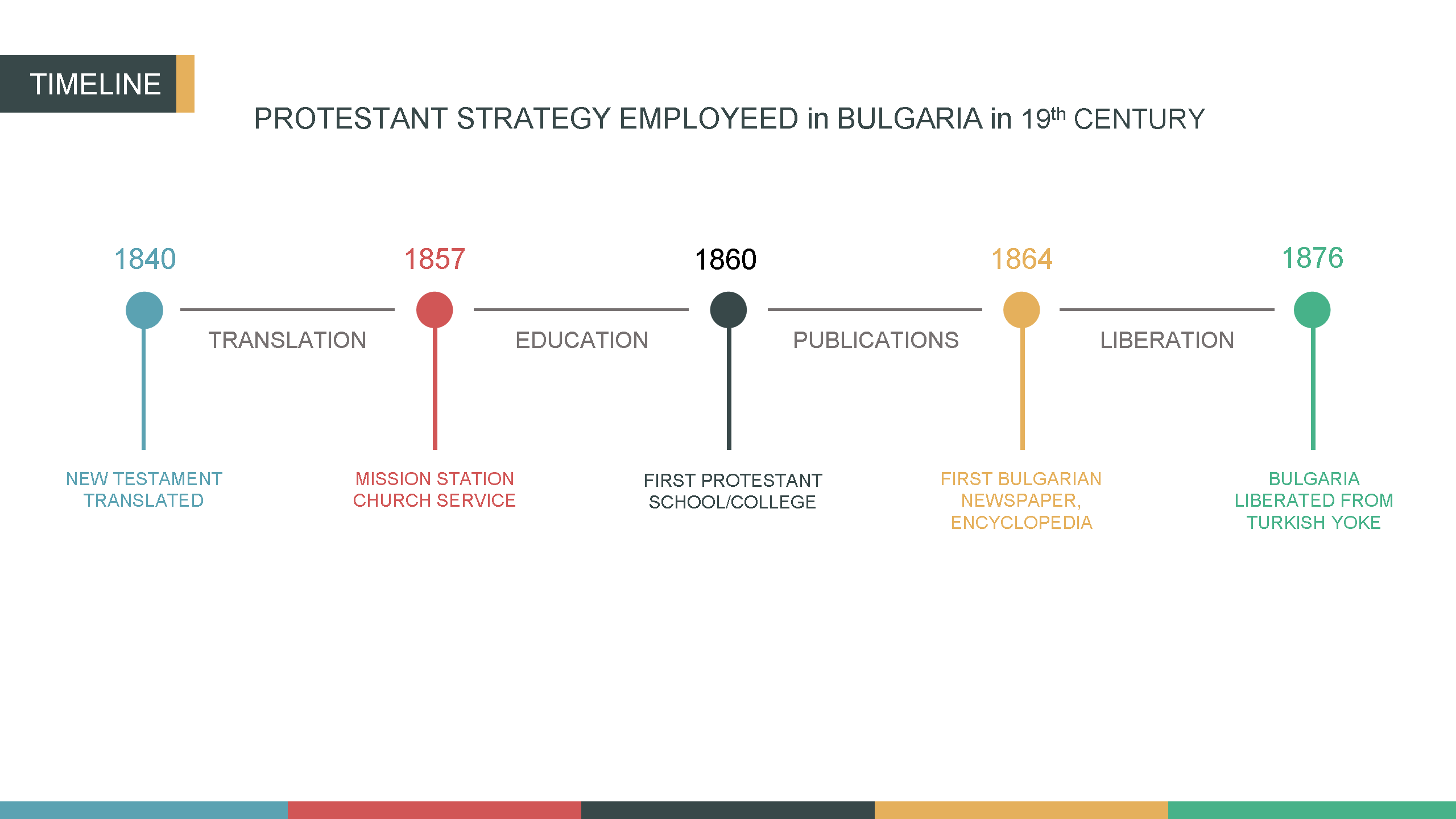 by Dony K. Donev, D.Min.
Historical and Doctrinal Formation of Holiness Teachings and Praxis among Bulgarian Pentecostals (Research presentation prepared for the Society of Pentecostal Studies, Seattle, 2013 – Lakeland, 2015, thesis in partial fulfillment of the degree of D. Phil., Trinity College)
The early Bulgarian protestants were mainly Methodists and Congregational. They followed the strategy of the American and British missionaries, which began with a translation of the Bible in the 1840s, followed by the first mission stations and protestant services in the 1850s.
In the following decade, Protestant schools were established in over a dozen Bulgarian cities. A broad stream of educational publications were translated and provided to schools, churches and the open public. The final goal of the missionary strategy was the establishing of churches, which began in the 1870s and continued onward.
The main sources of influence were the American Board of Commissioners for Foreign Missions (setup in Boston) with its local centers in Turkey and then Bulgaria; as well as from the British and Foreign Bible Society which also had centers in Constantinople and its main Slavic arm through the Russian Bible Society based in St. Petersburg.
Additionally, Baptists entered Bulgaria with their own mission work in 1875 and the Adventists in 1891. Although there were no Presbyterians churches in Bulgaria at that time, many of the agents sent by American Board of Commissioners for Foreign Missions were in fact Presbyterian and were educated at Princeton and Drew along with many Bulgarian protestants who studied abroad.
With all these key players present, Bulgaria was eventually introduced to the rise of Higher Criticism (1880–93) and consecutively to the movement to revise the Westminster Confession of Faith (1900–1910). It was met with great resistance among Bulgarian churches. In this context, the search for holiness among Bulgarian evangelicals began at turn of the 20th country not only as an alternative to the liberal theological thought and praxis, but as a move toward a renewed spiritual identity, which ultimately became the channel for introducing Pentecostal-Holiness teachings.
21st Century Revival of Study Bibles
June 20, 2012 by Cup&Cross
Filed under Featured, News, Publication
 We are undertaking the task of comparing and reviewing a growing number of Study Bibles appearing on the book market recently in what appear to be a 21st century Revival of Study Bibles. We will be including some classical titles as well, but overall this study will have three parts dealing with three distinct types of Study Bibles namely: (1) Non-Pentecostal, (2) Pentecostal and (3) Prophecy Related. The following titles are among the ones we have chosen to review in the course of the study:
I. Non-Pentecostal
- Orthodox Study Bible – in relations to Eastern mysticism and its historical effect on the Pentecostal experience
- Reformation Study Bible – within the scope of formation of evangelical identity among Pentecostals
- Wesley Study Bible – with the purpose of studying the relations between Wesleyan-Holiness tradition and Pentecostal theology
- C.S. Lewis Bible – in the scope of its relation to Pentecostal and Charismatic ethics and religious praxis
- Maxwell Leadership Bible – as per its relations to the leadership paradigms involving and affecting Pentecostal and Charismatic communities
- NetBible and its relations to general formations within Pentecostal Theology
II. Pentecostal
- Spirit Filled Study Bible – written by leading Pentecostal scholars
- Full Life Study Bible – classic Pentecostal and foundation for the youth oriented Fire Bible and the Life In The Spirit Study Bible
- Word Study Bible – including selected teachings from Hagin, Copeland, Sumrall, Savelle, Hayes, Osborn, Wigglesworth, Kuhlman and McPherson
- Kenneth Copeland Study Bible – considered as a fundamentalist Pentecostal teaching
- Jimmy Swaggart’s Expositor’s Study Bible – as an introduction of Pentecostal ethics and praxis
- Dake Study Bible – as a classic example on Pentecostalism and Last Days Prophecy coming together
III. Prophecy Related
- Scofield Study Bible and its dispensational effect on early Pentecostals
- John Hagee Prophecy Bible combining understanding of prophetic themes with doctrines of salvation, covenants, and questions about the Christian faith.
- Jeffrey Prophecy Study Bible regarded as the most comprehensive prophecy study Bible
- Tim LaHaye Prophecy Study Bible combining the knowledge of 48 leading Bible experts of prophecy
- Jack Van Impe Prophecy Bible as a valuable source with a wealth of information on Bible prophecy
- Perry Stone Hebraic/Prophetic Study Bible gleaning from 44,000 hours of Bible Study and produced within 34 years of ministry
F. Sanders (a.k.a. Theologue) has further compiled a comprehensive list of study Bibles, which we truly recommend.


