

THE PASTORAL TRIALS ELIMINATE THE AVANTGUARD OF BULGARIAN EVANGELICALS FOR AN ENTIRE GENERATION (PART 1)
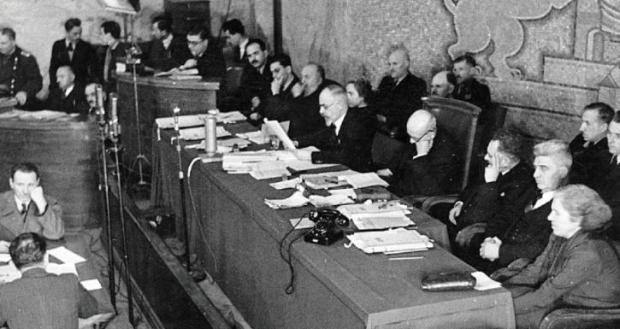
THE PASTORAL TRIALS ELIMINATE THE AVANT-GARDE OF BULGARIAN EVANGELICALS, BEHEADING IT FOR AN ENTIRE GENERATION (Part 1)
[Editorial note: The following text is translated from the Bulgarian original. The documents contain memorandums, archival records, State Security (Darzhavna Sigurnost / DS) interrogation files, survivor testimonies, and secondary scholarly sources. Bracketed insertions in the original are the author’s. Handwritten portions of the source document are noted where applicable. Archival reference: pp. 155–177.]
Archival Preamble
To Comrade [name illegible in manuscript]. Here! … (p. 1), 155–3pp–177
Comrade Director — in order not to speak in generalities [regarding the arrest warrants and the public punitive proceedings against them as enemies of the Party and the people] and to substantiate my claim, I shall append a list of the names of pastors who completed their education in America or in another foreign country. In addition to their religious fanaticism, they have unquestionably acquired the character and mentality of the ‘secular’ Western democracies. For example…
Vasil Georgiev Zyapkov — Age 47
Completed advanced theological studies in Manchester and New York. Interrogated by the State Security Service and driven nearly to madness before he ‘confessed’ to the creation of a spy network that had sabotaged the ‘people’s authority’ and harmed ‘fraternal relations with the Soviet Union,’ thereby becoming a ‘servant and assistant of the interests of England and the United States.’ According to the scenario written in Sofia and Moscow along the model of [Andrei] Vyshinsky, it was Zyapkov who was cast as the ‘sinister mastermind’ of the entire conspiracy (the so-called ‘espionage centre’). He was initially isolated and subjected to pressure to renounce his beliefs, subsequently blackmailed, and finally arrested in early November 1948. For nearly three months he was interrogated in the cells of the State Security Service together with the other pastors, all of whom were compelled to confess to everything imputed to them.
Zyapkov completed his studies in literature (not theology, as was erroneously believed) in Manchester. He maintained an extensive network of friends in England and America, including family ties, which the State Security Service deemed dangerous and potentially harmful to Bulgaria. At the insistence of Dimitar Furnadzhiev (1867–1944), he succeeded the latter as religious representative of the United Evangelical Churches (OETs). Zyapkov served as pastor of the central Methodist church ‘Dr. Long.’ He was sent by the Congregationalists to their Union Theological Seminary, where he most likely completed his master’s degree in 1932. His participation in the Bulgarian delegation to the Paris Peace Conference in the summer of 1946 was subsequently used as an argument at trial that he had established espionage contacts.
Zyapkov’s testimony (under the code name “ЧЕРВЕЙ” / “WORM”) reveals the interrogation techniques employed. Reading the document — written in 1951 and entitled My Confession Regarding the Trial, ostensibly submitted as a letter to the Prime Minister requesting a review of the case — one discovers numerous parallels with the memoirs of Haralan Popov (another of the convicted clergymen). The account of the tortures (more psychological than physical in nature) and the manner in which false confessions were ultimately extracted is replicated in both cases.
Zyapkov wrote that he was rarely beaten (‘only once was my head smashed against the concrete wall’), but that the most tormenting aspects were the ceaseless threats of a death sentence and the blackmailing carried out through his family (e.g., ‘your daughter will become a prostitute’). For weeks he was compelled to write confessions until 11:00 p.m., and was then woken shortly after midnight for lengthy nocturnal interrogations. He was threatened that the sentence would be carried out by execution in the cell. Towards the end of these exhausting interrogations, the prisoners began to experience hallucinations. A new narrative was fabricated in which Floyd Black, the director of the American College in Sofia, and his son Cyril Black were presented as the chief conspirators. The strategic intelligence that Zyapkov had allegedly gathered and transmitted to his purported handlers consisted of the numbers and names of Soviet ships docked in the port of Varna — information he had memorised in order not to compromise his confessions during the trial.
Note: Spas Ivanov Asenov, from the village of Malko Belovo, was sentenced to death in the trial of the ‘Free Warriors’ (anarchists). He shared a cell with Pastor Vasil Zyapkov and stated that he was a non-believer. However, when they led him out to be executed, he said: ‘Farewell! We shall meet above, before God’s gates!’
Together with Zyapkov, all of the more influential spiritual leaders were arrested. The agonising investigation was conducted by interrogators who had honed their inquisitorial cruelty through the interrogations of opposition figures. After months of physical and psychological torment, entirely innocent church workers were reduced to clay figures who, in the satanic tradition of the State Security Service, made their ‘confessions’ to having committed ‘espionage, slander against the people’s authority, and preparations for subversive activities.’ For a full three years after his sentencing, Zyapkov barely managed to return to normal behaviour.
Lambri Marinov Mishkov — Age 40
Completed his studies at the Princeton Theological Seminary. According to K. Grozev, he also studied chemistry at the University of Chicago and subsequently theology at Harvard, and worked towards a doctorate at Cambridge during the 1930s, at which point he was obliged to return to Bulgaria to be at his mother’s bedside in her final days. It is improbable, though not impossible, that the young Mishkov managed to complete so many disparate and numerous programmes of study within the span of approximately twenty years. It is equally possible that his name has been confused with that of his namesake Pavel Mishkov, who did indeed graduate from Chicago. The investigative file records only that he received his theological education at Princeton.
Despite being a clergyman, in 1946 he was invited to serve as an adjunct associate professor of philosophy at the newly founded University of Plovdiv. It was at this time that he published his book
Philosophy of Faith — one of the finest philosophical studies of the philosophy of religion ever written in the Bulgarian language.
- Grozev describes him as an ‘old uncle’ — a close friend of his grandfather. He spoke excellent English, would recount stories of Lincoln, and explained the meaning of the expression ‘monkey business,’ as well as one of the proposed etymologies of the well-known acronym ‘OK.’ Mishkov underwent the same interrogations and tortures as the others, but never confessed to having contacted the American Embassy or received money — an accusation that was ultimately dropped, resulting in a reduced sentence. Under duress, he ‘confessed’ to having transmitted information about the quantity of nails produced (in kilograms) at a factory in Plovdiv, as well as the road map from Plovdiv to Peshtera — a map that could in fact have been purchased at any bookshop. It was precisely this map, the subject of interrogations, that had allegedly been passed by Zyapkov to Cyrus Black, who was also considered part of the supposed spy network.
As with all those convicted, his children were barred from universities, forced to take low-paid manual work, and were permitted to visit their father only once every six months or even less frequently. The elder Grozev repeatedly took Mishkov’s children to prison visits when their mother was ill and the next permitted meeting was still months away.
Simeon Petrov Iliev — Age 37
Completed his studies at the American Scientific Theological School as well as a theological seminary in Switzerland. Following the departure of Kr. Stoyanov, at the initiative of the youth fellowship of the church, he was invited to assume the pastoral ministry in Asenovgrad (then known as Stanimaka). During his pastoral tenure, the church experienced a period of growth. He succeeded in uniting several other Evangelical fellowships, which led to a significant expansion of the church community. Despite the hardships of the post-war years, the new (modern) church building was constructed during this period. Furthermore, the headquarters of the Women’s Missionary Union of the Southern Evangelical Churches was established in Asenovgrad, further strengthening the organisational structure of the Protestant community in the region. Simeon Iliev served as pastor until 1949, when he was arrested and tried on charges of espionage.
Konstantin Stoyanov Marvakov — Age 55
Completed his studies at a theological seminary in Austria. Served as pastor of the church in Yakoruda. He was subjected to repression during the Communist campaign against religious communities in Bulgaria. Accused of espionage, the specific charges including the transmission of information concerning the annual harvest in the Chirpan region, as well as the production capacity of the oil-press in the village of Marichleri. These charges were formulated within the same framework as the case against Lambri Mishkov, with all alleged evidence reduced to a single page in the investigative file. This underscores the characteristic method of fabricating accusations in this period, whereby insignificant or publicly available information was interpreted as a threat to state security, in order to justify politically motivated repression.
Kiril Yotov Vladov — Age 43
Completed his studies in Frankfurt. Attended the men’s gymnasium in Pleven, and was subsequently recruited as an assistant pastor at the Sofia Methodist church ‘Dr. Long,’ where he worked and developed under the guidance of Pastor Vasil Zyapkov. He completed his theological education alongside future pastors Litov and Sivriev at the Methodist Seminary in Frankfurt, where he met his future wife, Maria Schmeissner, whom he married in 1931. In 1939 he was transferred to the Pleven Methodist church, replacing Pastor Yanko Ivanov.
As early as 10 September 1944, Soviet soldiers were quartered in the pastor’s residence. Two days later, a group of armed civilians burst into the house and conducted a search, their leader declaring: ‘You are under arrest! Take only the barest essentials — a little food and clothing — for we are taking you to Pleven prison.’ Pastor Yotov asked: ‘May we pray before you take us to prison?’ After the brief prayer, it was as though everything had changed. The leader of the arresting party began to calm those under arrest. The children were taken in by Miss Mara Gaytandzhieva and later sent to the village of Burkach to their grandmother. Before long, Maria returned, but completely changed — the time spent in prison remained with her for the rest of her life. Kiril Yotov spent eight months behind bars, enduring brutal torture and beatings.
In 1948 Kiril Yotov was arrested again in connection with the already-commenced Pastoral Trials. As a local prisoner, he was transferred from the Ministry of the Interior in Pazardzhik to Plovdiv, and ultimately to the investigative detention facility in Sofia. He was accused of supplying information concerning the annual harvest in Aprilsko and Tserov, the annual yield of winter crops, and the grape harvest. Beaten with leather belts and whips that tore entire strips of flesh from his back, in order to compel a confession — yet he did not lose his faith or his optimism. The Communists failed to break him and did not include him in the trial, as he was unpredictable and liable to disrupt their pre-arranged scenario. He was ultimately transferred to the ‘Bobov Dol’ labour camp and subsequently sent to Belene. His home was confiscated by the local authorities and his family was forced to relocate to Sofia. His wife Maria Yotova made extraordinary efforts to support the family, but the children were deemed politically unreliable and expelled from all youth organisations.
As no one could send him money from the outside, he acquired a razor, soap, and a rusty blade with which he shaved and cut the hair of his fellow camp inmates at Belene. In the summer of 1953, after five years in camps and prisons, Pastor Kiril Yotov was released. His family scarcely recognised him. At the time of his arrest he had been a healthy man weighing 85 kilograms; after five years he emerged emaciated, barely 48 kilograms — a frail body, but an unbroken spirit and a smile on his face. He recalled with pain the countless worthy individuals who had been oppressed, tortured, and humiliated.
Kostadin Spasov Bozovayski — Age 35
Theologian. Completed his seminary studies in Kassel and London, England. Born on 11 February 1912 in the village of Stob, Dupnitsa region. He served as pastor in Haskovo, following Vatralski, Furnadzhiev, and Gradinakov, and from 1956 served for three years as pastor in Asenovgrad. Until 1959 he was one of the few pastors not yet affected by the regime’s repression. When the Pastoral Trials commenced, Bozovayski was serving as treasurer at the ‘Pirin’ factories in Kardzhali whilst simultaneously serving as pastor of the Congregational church in the city. Upon his arrest, the charge was raised that he was a committed Germanophile, associating exclusively with reactionaries and the German specialists working in Kardzhali. He received various sums from different parts of Bulgaria, as well as numerous parcels from America, where his two brothers resided, with whom he maintained uninterrupted contact. In 1945 he attended the pastoral gathering of the United Evangelical Churches (OETs) in Burgas. He allegedly supplied ‘information regarding the annual production of the Pirin mine, the warehouses in Kardzhali, and tobacco production.’ The information was said to have been written on a typewriter.
Following the trials, already retired, Bozovayski served as chairman of the Congregational Church in Bulgaria and pastor of the mother church at 49 ‘V. Kolarov’ Street. He was repeatedly summoned before the [State] Committee, where Virchev, Totev, and Timotei Mikhailov were proposed to him as deputies. He refused, as they did not belong to the congregational churches, and Mikhailov was not even an ordained pastor. ‘You will ordain him,’ the director Tsvetkov ordered.
The authorities sought a financial audit with the aim of removing the Kulichev brothers on charges of hooliganism, including breaking down the church door with an axe. The Committee attempted to replace Pastor Bozovayski, but the congregation rejected the new appointment. ‘This question will be resolved definitively this year,’ the Party functionaries warned. ‘The leadership and ordinary membership is considerably aged… the church’s capacity for religious influence is rather weak,’ the Committee’s report noted.
Krum Georgiev Bumbanov — Age 43
Completed his studies at a seminary in Austria. Born in the village of Ognyanov (also known as Banya), he served as pastor of the church in Haskovo, following Vatralski, Furnadzhiev, Gradinakov, and Bozovayski. While serving in Yakoruda, he preached together with Angel Kremenliev in Bansko, Eleshnitsa, and Razlog. Brought as a defendant on the charge that he supplied information regarding the annual production of the dairies and the harvest in the Razlog region, as well as the summer crops in the area. His son, Danail Bumbanov, was arrested together with him in the course of the Pastoral Trials.
Sarkis Bedros Manukyan
Completed his studies in Kingston, Canada. His name appeared on the masthead of every issue of the Evangelical newspaper Zornitsa [Dawn].
Pavel Hristov Nikolov — Age 49
Completed advanced theological education at Oxford. Served as pastor of the church in Plovdiv before Zyapkov.
Nikola Borisov Dimitrov — Age 42
Completed his studies at a theological seminary in Bangor (USA — not the University of Bangor in England).
Yosif Isakov Danailov — Age 49
Completed his studies in Austria and England. A widely published Bulgarian man of letters. In 1952 he was the subject of a notice from the Presidium of the National Assembly: ‘Yosif Isakov Danailov, former resident of the city of Sofia, now of unknown address. I hereby notify you that under Enforcement Order No. 2132/1951, issued by the Sofia District Court, you have been sentenced to pay…’
Atanas Angelov Kremenliev — Age 37
Completed his studies at a seminary in the USA. Maintained close ties with Zyapkov and Pastor Isakov. He is mentioned in an explicit directive of the State Security Service: ‘Demonstrate that the defendants will be held accountable solely for their espionage [activities].’ Immediately following the exile of Pastor Trifon Ivanov, sentenced to eight years, Pastor Kremenliev was sent to the camp near Yakoruda with a rather unusual annotation regarding the conversion of Jews to Christianity.
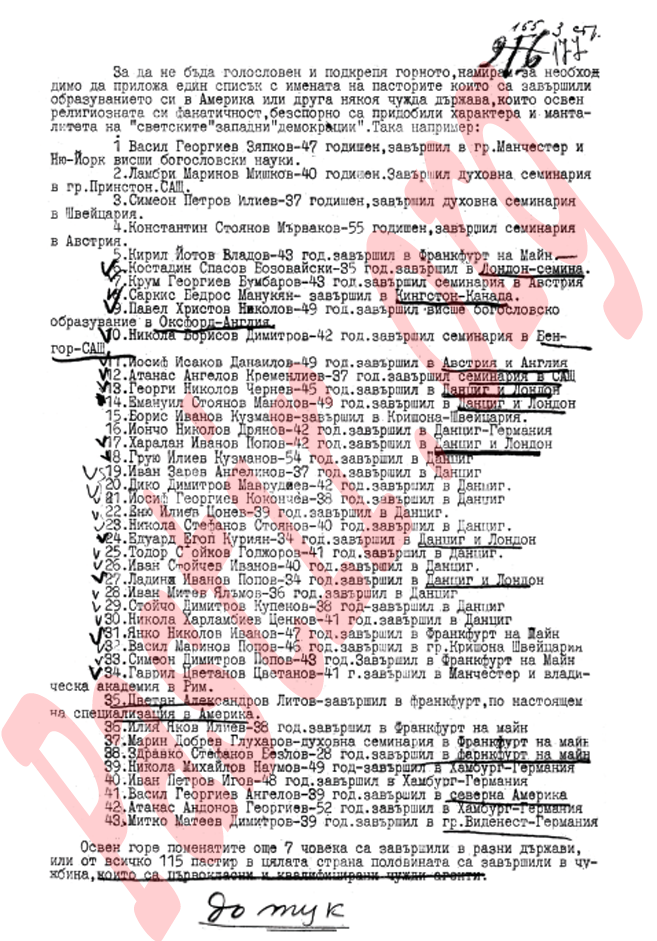
Translated from the list with pastors from the document above:
LIST OF BULGARIAN EVANGELICAL PASTORS WHO COMPLETED THEIR EDUCATION ABROAD
State Security Service Memorandum, 1948
Archival Reference: 155/3/177
Editorial note: The following is a complete transcription and translation of the archival document photographed at pastir.org. Text underlined in the original manuscript is rendered with underline formatting below. A handwritten annotation reading ‘до тук’ (‘to here’) appears at the foot of the original page, indicating the end of the handwritten portion of the document. Checkmarks (✓) visible in the original against certain entries are noted in brackets. The preamble and closing summary are translated verbatim from the Bulgarian.
Preamble (verbatim translation): ‘In order not to speak in generalities and to substantiate the foregoing, I find it necessary to append a list of the names of the pastors who completed their education in America or in some other foreign country, who, in addition to their religious fanaticism, have unquestionably acquired the character and mentality of the “secular” Western democracies. For example:’
THE LIST
- Vasil Georgiev Zyapkov — age 47. Completed advanced theological studies in Manchester and New York.
- Lambri Marinov Mishkov — age 40. Completed his studies at the theological seminary in Princeton, USA.
- Simeon Petrov Iliev — age 37. Completed his studies at a theological seminary in Switzerland.
- Konstantin Stoyanov Marvakov — age 55. Completed his studies at a seminary in Austria.
- Kiril Yotov Vladov — age 43. Completed his studies in Frankfurt am Main.
- Kostadin Spasov Bozovayski — age 35. Completed his studies in London — Seminary.
- Krum Georgiev Bumbakov — age 43. Completed his studies at a seminary in Austria.
- Sarkis Bedros Manukyan. Completed his studies in Kingston, Canada.
- Pavel Hristov Nikolov — age 49. Completed advanced theological education in Oxford, England.
- Nikola Borisov Dimitrov — age 42. Completed his studies at a seminary in Bangor, USA.
- Yosif Isakov Danailov — age 49. Completed his studies in Austria and England.
- Atanas Angelov Kremenliev — age 37. Completed his studies at a seminary in the USA.
- Georgi Nikolov Chernev — age 45. Completed his studies in Danzig and London.
- Emanuil Stoyanov Manolov — age 49. Completed his studies in Danzig and London.
- Boris Ivanov Kuzmanov. Completed his studies in Krichona — Switzerland.
- Yoncho Nikolov Dryanov — age 42. Completed his studies in Danzig — Germany.
- Haralan Ivanov Popov — age 47. Completed his studies in Danzig and London.
- Gruy Iliev Kuzmanov — age 54. Completed his studies in Danzig.
- Ivan Zerev Angelinov — age 37. Completed his studies in Danzig.
- Diko Dimitrov Mavrudaev — age 42. Completed his studies in Danzig.
- Yosif Georgiev Kokonchev — age 38. Completed his studies in Danzig.
- Enyu Iliev Tsonev — age 39. Completed his studies in Danzig.
- Nikola Stefanov Stoyanov — age 40. Completed his studies in Danzig.
- Eduard Agop Kuriyan — age 34. Completed his studies in Danzig and London.
- Todor Stoykov Godjorov — age 41. Completed his studies in Danzig.
- Ivan Stoychev Ivanov — age 40. Completed his studies in Danzig.
- Ladin Ivanov Popov — age 34. Completed his studies in Danzig and London.
- Ivan Mitev Yalamov — age 36. Completed his studies in Danzig.
- Stoicho Dimitrov Kupenov — age 38. Completed his studies in Danzig.
- Nikola Harlamiev Tsenkov — age 41. Completed his studies in Danzig.
- Yanko Nikolov Ivanov — age 47. Completed his studies in Frankfurt am Main.
- Vasil Marinov Popov — age 45. Completed his studies in Krichona, Switzerland.
- Simeon Dimitrov Popov — age 43. Completed his studies in Frankfurt am Main.
- Gavril Tsvetanov Tsvetanov — age 41. Completed his studies in Manchester and at the episcopal academy in Rome.
- Tsvetan Alexandrov Litov. Completed his studies in Frankfurt; currently specialising in America.
- Iliya Yakov Iliev — age 38. Completed his studies in Frankfurt am Main.
- Marin Dobrev Gluharov. Completed his studies at the theological seminary in Frankfurt am Main.
- Zdravko Stefanov Bezlov — age 28. Completed his studies in Frankfurt am Main.
- Nikola Mikhailov Naumov — age 49. Completed his studies in Hamburg — Germany.
- Ivan Petrov Igov — age 48. Completed his studies in Hamburg — Germany.
- Vasil Georgiev Angelov — age 39. Completed his studies in northern America.
- Atanas Andonov Georgiev — age 52. Completed his studies in Hamburg — Germany.
- Mitko Mateyev Dimitrov — age 39. Completed his studies in Wilenest — Germany.
Closing Summary (verbatim translation):
‘In addition to the above-mentioned, a further 7 individuals completed their studies in various countries. Thus, of a total of 115 pastors throughout the entire country, half completed their education abroad — who are accordingly first-class and qualified foreign agents.’
Handwritten annotation at foot of document: ‘до тук’ (‘to here’) — indicating the end of the handwritten portion of the memorandum.
Translator’s Notes
- Entries marked with ✓ in the original document are reproduced here with that symbol. The significance of the checkmarks is not explained in the source; they may denote individuals already arrested, already under surveillance, or prioritised for prosecution at the time of the document’s compilation.
- Underlined text in the original (indicating institutions and cities) is preserved with underline formatting.
- ‘Danzig’ refers to the Free Theological Academy (Freie Theologische Akademie) in the Free City of Danzig (present-day Gdańsk, Poland), which served as the principal training institution for Bulgarian Pentecostal pastors throughout the 1930s.
- ‘Krichona’ refers to the St. Chrischona Pilgrim Mission (Pilgermission St. Chrischona) near Basel, a pietist missionary training institution.
- ‘Wilenest — Germany’ in entry 43 is likely a transcription error or phonetic rendering in the original Bulgarian; the precise institution has not been identified.
- The document bears the archival reference 155/3/177 and is reproduced at pastir.org. The preamble and closing summary are in typewritten Bulgarian; the annotation ‘до тук’ (‘to here’) is handwritten.
- The assertion that foreign-educated pastors are ‘first-class and qualified foreign agents’ represents the operative ideological premise of the 1948–1949 Pastoral Trials — that Western theological education was itself evidence of intelligence recruitment.
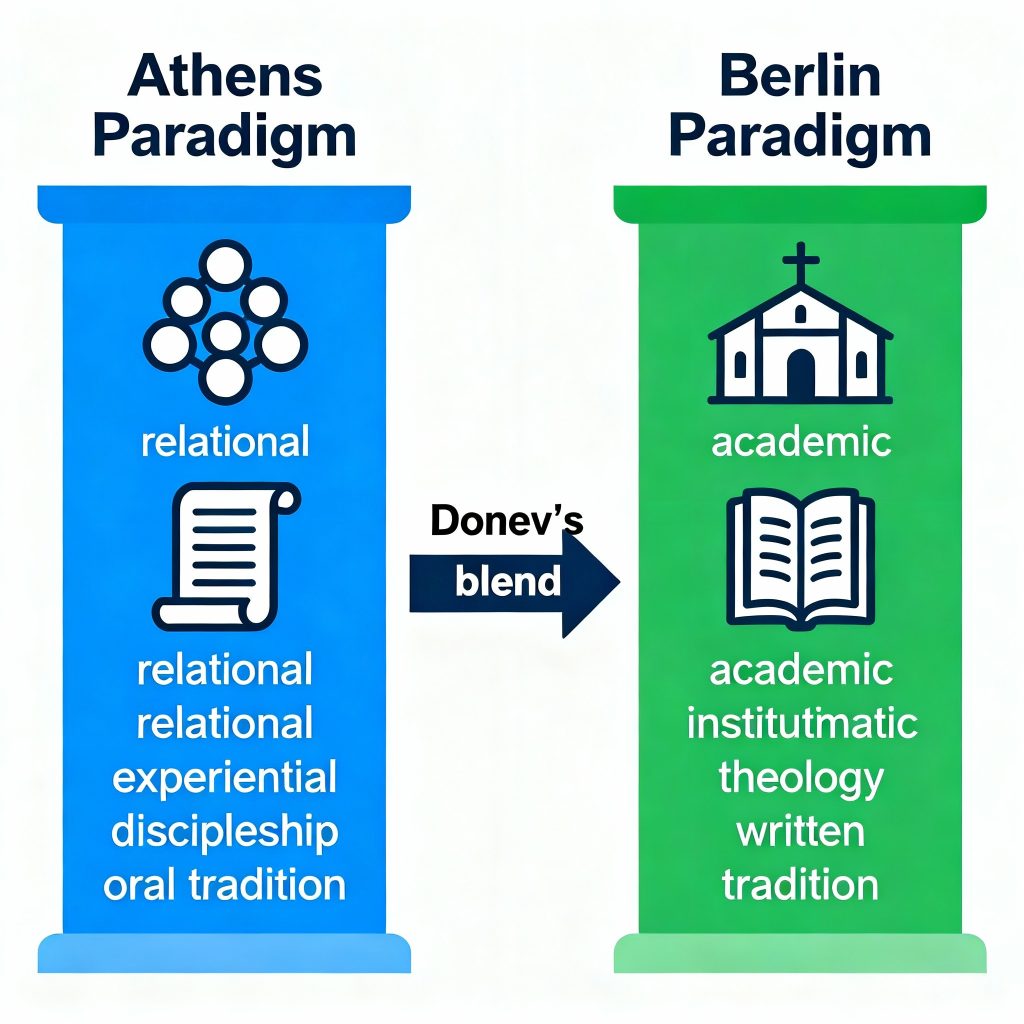
Frameworks and Key Terms by Dr. Dony Donev: Athens vs Berlin Paradigm Shift
Core Theological Frameworks
U.S.H.E.R. Model of Communion
A theological framework coined during the Covid-19 Pandemic in Donev’s Intro to Digital Discipleship course at Lee University. It defines what follows Communion in Christian catechism, identifying five foundational dynamics for disciple growth: Unity, Sanctification, Hope, Ecclesial communion, and Redemptive mission.
Freedom Theology (Theology of Freedom)
Developed through Donev’s research on postcommunist Eastern Europe and the Bulgarian Protestant experience, this framework explores biblical concepts of freedom, liberation from both sin and socio-political oppression, and the church’s transformative mission as a liberator in history. It often appears in his writings as “Feast of Freedom,” drawing connections between national liberation and spiritual renewal.
Primitive Church Restorationist Model
Based in his historical research, Donev advocates for returning to the original practices and structure of the Early (Primitive) Church. This model emphasizes rediscovering authentic spiritual identity, intergenerational faith transmission, and revivalist community rooted in biblical precedent.
These frameworks have had meaningful impact on global Pentecostal studies, digital discipleship, and liberation theology, addressing contemporary challenges in theology, worship, and ecclesial practice.
Effect on Donev’s Models
-
U.S.H.E.R. Model: By anchoring his post-Communion framework in the “Athens” paradigm, Donev prioritizes unity, lived discipleship, and communal mission over purely doctrinal or institutional forms. This perspective shapes the model to valorize shared spiritual experience and relational growth, not just catechetical instruction.
-
Freedom Theology: “Athens” influences Donev’s liberation emphasis by grounding freedom in communal lived reality, while “Berlin” marks the shift toward codifying and structurally analyzing liberation.
-
Primitive Church Restoration: Donev navigates between Athens’ restorationist, dialogical church identity and Berlin’s historical-critical, analytical methodology, advocating an integration that revitalizes spiritual community while acknowledging scholarly insights.
In sum, Donev’s “Athens vs Berlin” usage intentionally blends experiential, relational Christian practice (“Athens”) with disciplined, systematic theology (“Berlin”). This dynamic underlies his frameworks, ensuring they are both deeply incarnational and critically constructive.
2026 Proclamation
Judgment has come to this region!
We were given six years to repent and to change our ways, yet we did not heed the call. We did not hear because we were distracted listening to false reports, following false gods, and walking false paths. Because of this, hardship has come upon us, and greater trials still lie ahead.
What we experienced since the Pandemic has been difficult, but what is coming will resemble the trials of Job. Only those who possess the faith of Job, those who remain steadfast and faithful, will emerge victorious on the other side. Only those who stop complaining and start moving toward conquering the promise will take the land. Only those who believe in the report of the One who brought you out of bondage will receive the blessing of milk and honey.
It does not matter that the enemy is bigger. It does not matter that their army is greater. It does not matter that there is no water or food. He is our provision and will not forsake us even though we feel as if we have been striped down to nothingness.
Stand your ground. Stand tall against demonic works in this region to which we have foolishly opened the door in our weakness. Find your backbone.
Claim your babies, claim your family, claim your promise.
Do not yield to the enemy. Not even one centimeter. Don’t even flinch in fear.
The anxiety and fear you are encountering is a lie from the pits of hell. Rebuke them in the name of Jesus.
BUT if we continue to look the other way, if we continue to welcome sin into our homes and into our sanctuaries, refusing to call sin what it is, then there will be NO hope. There will be no promise of protection. Hypocrisy will not be excused. Grace is not a license for rebellion.
Turning the house of worship into a smoke-and-mirrors spectacle is shameful. The sanctuary must remain holy. It should be a place so sacred, so charged with the presence of God, that one feels conviction even standing upon its floor. A place where no one would dare treat it casually by sipping on their starbucks. No distractions, no performances, no self-promotion.
The church can no longer function as a social club designed to entertain or accommodate the sinful, New Age practices that have crept into our region. Idolatry is wrong. Overlooking that gods have been drowned in our rivers is not acceptable. Bowing in a yoga stance to the gods is wrong.
Playing with magic is wrong. Communicating with the dead is not a game. It is wrong, even if it is your blood dabbling with it. We are to hate the sin, but love the sinner, but this does not mean to turn a blind eye to the manipulation of witchcraft and homosexuality.
Holiness is not optional! It is the standard. Period. Judgment has come to this region. Repent, repent, repent.
ENTER 2026…

A Message from Dr. David Griffis
These are very dark days in America, dear reader, and indeed this infection of evil is spreading throughout the globe. As a Christian and student of God’s Holy Word, I have been awakened to speak to you, for I hear in my spirit, the distant thunder of tribulation, deception, and evil increasing.
I am appalled at much of the silence in the world of denominational Christendom, about all that is taking place. I understand and weep at the deliberate soft stepping in this hour by religious leadership, afraid to offend, fearing how their needed words might affect their own future, but if ever an hour needed the voice of God’s true prophets it is now.
Believe me when I speak now, I speak broken and humbly, for I feel unworthy to carry His message…but God will not let truth be silent.
This whole thing, exploding in America , is a spiritual warfare issue. Remember how the Prophet Daniel was told by the Angel Gabriel, that his answer to prayer was delayed by a demonic power known as the “Prince of Persia” (Daniel10:13) and Michael the Archangel had to come and defeat this demon before Daniel’s answer from God came.
And the Apostle Paul’s Ephesians declaration in Ephesians 6 warns us of “principalities and powers”, which are satanic rulers who have taken influence over areas of earth that have given themselves to evil.
What is going on, in not only Minneapolis, but in large cities throughout America, and indeed many cities of the world, is a satanically inspired spiritual warfare, with hatred spewing like molten volcanic lava, with fear rolling like a deep earthquake caused tsunami, and violence erupting, as demonic forces from the deepest pits of hell, where demon spirits writhe and rule, filling hearts opening to receive such dominion.
But we Christians should sing the song dear reader, to the entire world in the midst of all this chaos, the song that has the answer….the answer is true, and O, so needed….
“What can wash away my sin?
Nothing but the blood of Jesus.
What can make me whole again?
Nothing but the blood of Jesus.
O, Precious is the flow,
That makes me white as snow.
No other fount I know,
Nothing but the blood of Jesus!”
We sing the song extolling the power of Jesus’s blood, and His redemptive power. God has a work in progress, that the enemies control of the news media does not want you to hear.
There is a satanic attempt to stop the last day spread of the Gospel out of the United States, as a “New Christian Conservatism” is developing in this country that could be the impetus for the final Joel 2:28 fulfillment. Charlie Kirk was in the forefront of this movement, when an assassin, with a transgender lover, goaded by hell itself, put a bullet through Charlie’s neck.
But God’s work is never dependent on just one person, and though Charlie’s life was taken, God’s work through many different channels, but especially in local churches anointed by God, with anointed shepherds leading them, remains. The last day harvest is coming in, I see it everywhere I go.
The devil is doing everything in his power to try and stop this move of God among our young people. So “principalities and powers” create the chaos in major cities like Minneapolis, and lure young people seeking for answers into the fray of hatred.
Violence and mayhem, do not come from The Good Shepherd. Hatred of authority does not come from God. Something evil is amiss when “law and order” is hated as an enemy. If lawmen do wrong, their own judgement will come. All, and I mean all, must live with their deeds.
So what must happen?
God will, as the Prophet declared, “pour His Spirit out upon all flesh”, while at the same time there is, as Saint Paul warns us, “a great falling away”.(II Thessalonians 2:3)
What Christians must do to combat this onslaught of calculated evil…
Voice the truth and flee the posture of silence embraced by so many “Leading Christians”. But declare the word of the Lord only as the Spirit leads you, for God alone knows the time of His speaking
Find your “Closet of Intercession”. That closet is of utmost importance .
Seek guidance from the Word of God, for this is vital to spiritual survival, and for some strange reason I have been led in my awakening from the wee hours of the morning to commend to you for your reading and meditation, the books of Proverbs, Habakkuk, John, Ephesians, both First and Second Timothy, and the Book of Jude, and any others God may lay upon your heart.
Find people of like precious faith and form bonds of prayer and sharing of testimonies. We must be united as Christians.
Look not to “Christian flamboyant, celebrity personalities” as your source….they are falling one by one…Nor should you trust in the carnality that is found in “professional denominational political leaders” in these dangerous times.
But rather, listen to the humble voice of the true shepherds of God’s flock, the “apostles, prophets, evangelists, pastors and teachers” that Ephesians 4:11 refers to, who will lead you not toward themselves, but toward Christ. For God has placed them here for His purposes. And remember, no true messenger from God, will ever say anything that contradicts God’s Holy Word.
I have finished now and have delivered what He has given me dear reader…please take heed.
ENTER 2026…
37 Years after Communism…
The Fall of the Berlin Wall was on the evening of November 9, 1989

37 years in 60 seconds at the red-light…
I’m driving slowly in the dark and raining streets of my home town passing through clouds of car smoke. The gypsy ghetto in the outskirts of town is covered with the fog of fires made out of old tires burning in the yards. And the loud music adds that grotesque and gothic nuance to the whole picture with poorly clothed children dancing around the burnings.
The first red light stops me at the entrance to the “more civilized” part of the city. The bright counter right next to it slowly moves through the long 60 seconds while tiredly walking people pass through the intersection to go home and escape the cold rain. The street ahead of me is already covered with dirt and thickening layer of sleet.
This is how I remember Bulgaria of my youth and it seems like nothing has changed in the past 30 years.
The newly elected government just announced its coalition cabinet – next to a dozen like it that had failed in the past two decades. The gas price is holding firmly at $6/gal. and the price of electricity just increased by 10%, while the harsh winter is already knocking at the doors of poor Bulgarian households. A major bank is in collapse threatening to take down the national banking system and create a new crisis much like in Greece. These are the same factors that caused Bulgaria’s major inflation in 1993 and then hyperinflation in 1996-97.
What’s next? Another winter and again a hard one!
Ex-secret police agents are in all three of the coalition parties forming the current government. The ultra nationalistic party called “ATTACK” and the Muslim ethnic minorities party DPS are out for now, but awaiting their move as opposition in the future parliament. At the same time, the new-old prime minister (now in his second term) is already calling for yet another early parliamentarian election in the summer. This is only months after the previous elections in October, 2014 and two years after the ones before them on May 2013.
Every Bulgarian government in the past 30 years has focused on two rather mechanical goals: cardinal socio-economical reforms and battle against communism. The latter is simply unachievable without deep reformative change within the Bulgarian post-communist mentality. The purpose of any reform should be to do exactly that. Instead, what is always changing is the outwardness of the country. The change is only mechanical, but never organic within the country’s heart.
Bulgaria’s mechanical reforms in the past quarter of a century have proven to be only conditional, but never improving the conditions of living. The wellbeing of the individual and the pursuit of happiness, thou much spoken about, are never reached for they never start with the desire to change within the person. For this reason, millions of Bulgarians and their children today work abroad, pursuing another life for another generation.
The stop light in front of me turns green bidding the question where to go next. Every Bulgarian today must make a choice! Or we’ll be still here at the red light in another 37 years from now…
ENTER 2026…
Yotova Becomes Bulgaria’s First Female President
The Constitutional Court of Bulgaria has formally accepted President Rumen Radev’s resignation, paving the way for Vice President Iliana Yotova to assume the presidency. Pavlina Panova, president of the Constitutional Court, served as rapporteur on the case. With the court’s unanimous decision, effective January 23, 2026, Yotova becomes Bulgaria’s first female head of state. Twelve constitutional judges participated in the session, which confirmed that Radev’s resignation was made voluntarily and without external pressure. As this is not an impeachment case, no additional hearings or investigations were required.
Following the court ruling, Radev’s presidential powers are officially transferred to Yotova. She will not need to retake the oath before the National Assembly, having already sworn in as vice president in 2021. Later today, at 4 p.m., Radev will leave the presidential building through the ceremonial entrance, accompanied by Yotova, marking the conclusion of his nine-year tenure. Social media initiatives have already begun commemorating his departure. Expectations are high that Radev will soon announce his own political project ahead of the upcoming early elections.
Rumen Radev, a Major General in the Air Force and former Commander of the Air Force, was first elected president in November 2016. He took office on January 22, 2017, alongside Iliana Yotova as vice president. The pair were re-elected in November 2021 for a second term. Notably, Radev is the first president in Bulgaria’s democratic history to resign before completing a term, leaving Yotova to finish their second term alone.
Peace Council: only Bulgaria & Hungary from EU
The US president is currently announcing the ‘Peace Council.’ This involves the creation of a new international body called the ‘Board/Peace Council’ (in public discourse it has become known as the ‘Peace Council’ or ‘Board of Peace’), which is presented as a tool for peacemaking—initially focusing on Gaza—but will gradually expand as a ‘crisis management’ forum for other conflicts as well.
What the ‘Peace Council’ is – and why it raises suspicion
According to Reuters, Trump has sent invitations to around 60 countries, aiming for a body that ‘starts with Gaza’ and ‘expands’ to other fronts, while the same report mentions that permanent participation is expected for those who pay $1 billion and that Trump will be chairman for life.
The existence of a ‘ticket’ for a permanent seat (and at an amount that functions as a power filter rather than an equal contribution) is the first major source of European distrust: it turns the body into a closed club, favoring the ‘willing’ and the financially powerful, rather than a process of legitimacy through international treaties.
The second source of distrust is the political structure: in a Reuters report about Italy, it is mentioned that Rome considers participation in an organization ‘led solely by the U.S. president’ to be in conflict with the Italian constitutional principle requiring equal participation in international organizations. Italy’s argument encapsulates European concern: the ‘Council’ does not resemble a multilateral institution but rather a mechanism of American hegemony, where access, duration, and renewal of tenure (according to what has leaked about the draft charter) are directly linked to the central will of the U.S. president.
The third problem is institutional overlap. In a television excerpt/transcript from CNN (Situation Room), the ‘peace council’ already appears as a point of tension between Trump and Macron, with Trump escalating rhetoric and using trade threats in a domain that would ‘normally’ belong to diplomacy and collective security. This combination of ‘hard power’ (tariffs) with ‘peacemaking architecture’ (board) is the main warning sign for Brussels: it turns peacemaking into a tool of coercion.
Greece absent, as is the rest of the EU, except Hungary and Bulgaria
In Greek reporting, Athens appears aligned with general European reluctance. This is a strategic choice: due to geography and sovereignty issues, Greece has historically invested in strict adherence to International Law and the UN institutional framework.
This logic also underpins the statement by government spokesperson Pavlos Marinakis regarding Greenland—that ‘we cannot play with issues of International Law.’
At the same time, Prime Minister Kyriakos Mitsotakis ultimately misses Davos because his flight to Zurich was canceled due to severe weather, resulting in a cut program since he had to immediately travel to Brussels for the EU emergency summit.
2026

In 2019, the Spirit nudged me to the understanding that by 2026, the idea of pandemic will be exhausted. The mentality of those who endure the crises will be permanently changed. Artificial Intelligence will form a new subculture for those open to be influenced.
For those who have remained outside of the system, off the grid, as sovereign citizens or similar, it will be difficult to participate in society. There is no hiding from the star of one’s “true identity” with constant biometric monitoring virtually everywhere. Christians are the minority now.
By 2027, if the Lord terries, our world as we knew it will be nonexistent if we do not firmly stand against the demonic warfare that is so ever present. We are battling a force which is so great it influenced angels to fall from Heaven and caused God’s chosen people to turn from His protection.
The Good News is that God always some way sends a warning to his people if they will only
take heed and listen. He is a loving God full of kindness, but there is no room for demonic works in His Kingdom.
I will not stand by quietly and allow any born or unborn child to be sacrificed. Our sons and daughters will not pass through any fire. They will not be offered as any burnt offering. I declare that my children will be the ones to prophesy and to see beyond worldly understandings.
Will you accept the call and take a stand against evil; to declare that you will not tolerate sorcery or magic or divination or witchcraft or any demonic confusion in any way?
Read more here: A CALL
Pentecostal Triangle of Primitive Faith: A Framework of Experience and Restoration
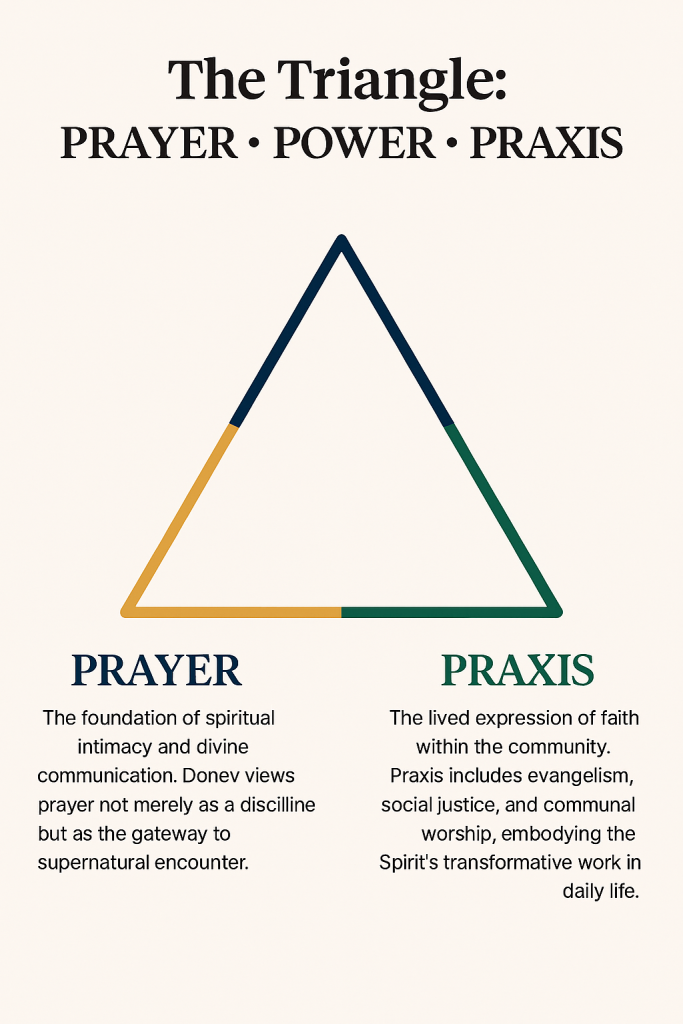
Pentecostal Triangle of Primitive Faith
This is one of Donev’s most recognized frameworks. It emphasizes three core elements of Pentecostal spirituality:
- Prayer: Seen as the starting point of spiritual communication and personal experience with God.
- Power: The manifestation of divine presence through spiritual gifts and supernatural experiences.
- Praxis: The lived expression of faith within the community, reflecting both personal and collective identity.
This triangle encapsulates the holistic nature of Pentecostalism, where theology is deeply rooted in experience rather than abstract doctrine.
Restorationist Theology
Donev builds on the idea of primitivism—a return to the faith and practices of the early church. He critiques Wesleyan frameworks like the quadrilateral (Scripture, tradition, reason, experience) as insufficient for Pentecostal identity, arguing that Pentecostalism goes beyond Wesley to reclaim the apostolic era.
Historical-Theological Contributions
In his book The Unforgotten, Donev explores the theological roots of Pentecostalism in Bulgaria, tracing its development through key figures like Ivan Voronaev and the influence of Azusa Street missionaries. His research highlights:
- Trinitarian theology among early Bulgarian Pentecostals, shaped by Eastern Orthodox pneumatology and Western Pentecostal doctrine.
- Free will theology, emphasizing Armenian views over Calvinist predestination, due to Bulgaria’s Orthodox heritage and missionary influences.
Other Notable Works
- The Life and Ministry of Rev. Ivan Voronaev: A historical-theological study of one of the pioneers of Slavic Pentecostalism.
- Doctrine of the Trinity among Early Bulgarian Pentecostals: Explores how the Trinity was experienced and understood in early Eastern European Pentecostal context
The Pentecostal Triangle of Primitive Faith: A Framework of Experience and Restoration
Introduction
Pentecostal theology has long emphasized the experiential dimension of faith—where divine encounter, spiritual gifts, and communal expression converge. Among the contemporary voices shaping this discourse, Dony K. Donev offers a compelling framework known as the Pentecostal Triangle of Primitive Faith, which seeks to restore the apostolic essence of early Christianity. This essay explores the theological contours of Donev’s model and compares it with other influential Pentecostal and charismatic paradigms.
The Triangle: Prayer, Power, Praxis
At the heart of Donev’s framework lies a triadic structure:
- Prayer: The foundation of spiritual intimacy and divine communication. Donev views prayer not merely as a discipline but as the gateway to supernatural encounter.
- Power: Manifested through the gifts of the Spirit—healing, prophecy, tongues, and miracles. This element reflects the Pentecostal emphasis on dunamis, the Greek term for divine power.
- Praxis: The lived expression of faith within the community. Praxis includes evangelism, social justice, and communal worship, embodying the Spirit’s transformative work in daily life.
This triangle is not hierarchical but interdependent. Prayer leads to power, power fuels praxis, and praxis deepens prayer. Donev’s model thus reflects a restorationist impulse, aiming to recover the vibrancy of the early church as seen in Acts.
Comparison with Wesleyan Quadrilateral
The Wesleyan Quadrilateral—Scripture, tradition, reason, and experience—has historically shaped Methodist and Holiness theology. Pentecostals have often adopted this model, emphasizing experience as a key source of theological reflection.
However, Donev critiques this framework as insufficient for Pentecostal identity. He argues that Pentecostalism is not merely an extension of Wesleyanism but a distinct restoration movement. While Wesley’s model is epistemological, Donev’s triangle is ontological and missional, rooted in being and doing rather than knowing.
Comparison with Classical Pentecostal Theology
Classical Pentecostalism, as shaped by early 20th-century leaders like Charles Parham and William Seymour, emphasized:
- Initial evidence doctrine: Speaking in tongues as proof of Spirit baptism.
- Dispensational eschatology: A belief in imminent rapture and end-times urgency.
- Holiness ethics: A call to moral purity and separation from the world.
Donev’s framework diverges by focusing less on doctrinal distinctives and more on spiritual vitality and historical continuity. His emphasis on praxis aligns with newer Pentecostal movements that prioritize social engagement and global mission.
Comparison with Charismatic Theology
Charismatic theology, especially within mainline and evangelical churches, often emphasizes:
- Renewal within existing traditions
- Broad acceptance of spiritual gifts
- Less emphasis on tongues as initial evidence
Donev’s triangle shares the Charismatic focus on spiritual gifts but retains a Pentecostal distinctiveness through its restorationist lens. He seeks not just renewal but recovery of primitive faith, making his model more radical in its ecclesiological implications.
Eastern European Context and Trinitarian Theology
Donev’s work is also shaped by his Bulgarian heritage. He highlights how early Bulgarian Pentecostals embraced a Trinitarian theology informed by Eastern Orthodox pneumatology. This contrasts with Western Pentecostalism’s often fragmented view of the Spirit.
His emphasis on free will theology—influenced by Arminianism and Orthodox thought—also sets his framework apart from Calvinist-leaning Charismatic circles.
Conclusion
Dony K. Donev’s Pentecostal Triangle of Primitive Faith offers a rich, experiential, and historically grounded model for understanding Pentecostal spirituality. By centering prayer, power, and praxis, Donev reclaims the apostolic fervor of the early church while challenging existing theological paradigms. His framework stands as a bridge between classical Pentecostalism, Charismatic renewal, and Eastern Christian traditions—inviting believers into a deeper, more dynamic walk with the Spirit.
Comparative Insights from Leading Pentecostal Scholars
Gordon Fee: Scripture-Centered Pneumatology
Fee’s scholarship emphasizes the Spirit’s role in New Testament theology, particularly in Pauline writings. While he critiques traditional Pentecostal doctrines like initial evidence, he affirms the Spirit’s transformative presence. Compared to Donev, Fee’s approach is exegetical and text-driven, whereas Donev’s triangle is experiential and restorationist, prioritizing lived encounter over doctrinal precision.
Stanley M. Horton: Doctrinal Clarity and Holiness
Horton’s work, especially in Bible Doctrines, provides a systematic articulation of Pentecostal beliefs, including Spirit baptism and sanctification. His theology is deeply rooted in Assemblies of God tradition. Donev diverges by de-emphasizing denominational boundaries, focusing instead on the primitive church’s egalitarian and Spirit-led ethos.
Craig Keener: Charismatic Experience and Historical Context
Keener bridges academic rigor with charismatic openness, especially in his work on miracles and Acts. His emphasis on historical plausibility and global charismatic phenomena aligns with Donev’s praxis-driven model. However, Keener’s scholarship is more apologetic and evidential, while Donev’s triangle is formational and communal.
Frank Macchia: Spirit Baptism and Trinitarian Theology
Macchia’s theology centers on Spirit baptism as a metaphor for inclusion and transformation, often framed within Trinitarian and sacramental lenses. Donev shares Macchia’s Trinitarian depth, especially in Eastern European contexts, but leans more toward neo-primitivism and ecclesial simplicity.
Vinson Synan: Historical Continuity and Global Pentecostalism
Synan’s historical work traces Pentecostalism’s roots and global expansion. Donev builds on this by reclaiming Eastern European Pentecostal narratives, such as those of Ivan Voronaev. Both emphasize restoration, but Donev’s triangle is more prescriptive, offering a model for future church practice.
Robert Menzies: Missional and Contextual Theology
Menzies focuses on Pentecostal mission and theology in Asian contexts, often challenging Western assumptions. His emphasis on Spirit empowerment for mission resonates with Donev’s praxis element. Yet, Donev’s model is more liturgical and communal, drawing from Orthodox and Puritan influences.
Cecil M. “Mel” Robeck: Ecumenism and Pentecostal Identity
Robeck’s work on Pentecostal ecumenism and global dialogue complements Donev’s inclusive vision. Both advocate for Pentecostal distinctiveness without isolation, though Donev’s triangle is more grassroots and revivalist, aimed at local church transformation.
Implications for Church Practice
Donev’s triangle offers a practical blueprint for churches seeking renewal:
- Prayer ministries that foster intimacy and prophetic intercession.
- Power encounters through healing services and spiritual gift activation.
- Praxis initiatives like community outreach, justice advocacy, and discipleship.
Compared to other scholars, Donev’s model is less academic and more actionable, designed to reignite the apostolic fire in everyday church life.
Bulgarian government resigns amid protests
SOFIA, Dec 11 (Reuters) – Bulgaria’s government resigned on Thursday after less than a year in power, following weeks of street protests over its economic policies and its perceived failure to tackle corruption.
Prime Minister Rosen Zhelyazkov announced the decision in a televised address just minutes before parliament was due to vote on a no-confidence motion. The resignation comes less than three weeks before Bulgaria is due to join the euro zone on January 1.
“Our coalition met, we discussed the current situation, the challenges we face and the decisions we must responsibly make,” Zhelyazkov said, confirming that the government would step down.
Thousands of Bulgarians rallied on Wednesday evening in Sofia and dozens of other towns and cities, the latest in a wave of demonstrations highlighting public anger over endemic graft and successive governments’ inability to root it out.
“We realise that the protest was against arrogance and conceit, this is not a social protest, but a protest for values,” Zhelyazkov said. “It was not a meeting of political opponents over policies but over attitudes, and therefore it unites different components of Bulgarian society.”


