

Argentine Cardinal Jorge Mario Bergoglio Named New POPE
 Argentine Cardinal Jorge Mario Bergoglio has been elected by his peers as the new pope, becoming the first pontiff from the Americas. He has chosen to be known as Pope Francis I.
The 76-year-old has spent nearly his entire career at home in Argentina, overseeing churches and shoe-leather priests.
Francis, the archbishop of Buenos Aires, reportedly got the second-most votes from the 115 cardinals after Joseph Ratzinger in the 2005 papal election, and he has long specialized in the kind of pastoral work that some say is an essential skill for the next pope.
In a lifetime of teaching and leading priests in Latin America, which has the largest share of the world’s Catholics, Francis has shown a keen political sensibility as well as the kind of self-effacing humility that fellow cardinals value highly.
He is also known for modernizing an Argentine church that had been among the most conservative in Latin America. Like other Jesuit intellectuals, Bergoglio has focused on social outreach. Catholics are still buzzing over his speech last year accusing fellow church officials of hypocrisy for forgetting that Jesus Christ bathed lepers and ate with prostitutes. Bergoglio has slowed a bit with age and is feeling the effects of having a lung removed due to infection when he was a teenager.
In taking the name Francis, he drew connections to the 13th century St. Francis of Assisi, who saw his calling as trying to rebuild the church in a time of turmoil. It also evokes images of Francis Xavier, one of the 16th century founders of the Jesuit order that is known for its scholarship and outreach. Francis, the son of middle-class Italian immigrants, is known as a humble man who denied himself the luxuries that previous Buenos Aires cardinals enjoyed. Bergoglio often rode the bus to work, cooked his own meals and regularly visited the slums that ring Argentina’s capital. He came close to becoming pope last time, reportedly gaining the second-highest vote total in several rounds of voting before he bowed out of the running in the conclave that elected Pope Benedict XVI. Groups of supporters waved Argentine flags in St. Peter’s Square as Francis, wearing simple white robes, made his first public appearance as pope.
Chants of “Long live the pope!” arose from the throngs of faithful, many with tears in their eyes. Crowds went wild as the Vatican and Italian military bands marched through the square and up the steps of the basilica, followed by Swiss Guards in silver helmets and full regalia. Francis appeared on the balcony of St. Peter’s Basilica after the vote. Earlier in the same place, a church official announced “Habemus Papum” — “We have a pope” — and gave Bergoglio’s name in Latin.
“Ladies and Gentlemen, good evening,” he said before making a reference to his roots in Latin America, which accounts for about 40 percent of the world’s Roman Catholics.
Francis asked for prayers for himself, and for retired Pope Benedict XVI, whose surprising resignation paved the way for the conclave that brought the first Jesuit to the papacy.
“Brothers and sisters, good evening,” Francis said to wild cheers in his first public remarks as pontiff. “You know that the work of the conclave is to give a bishop to Rome. It seems as if my brother cardinals went to find him from the end of the earth. Thank you for the welcome.”
Bergoglio has shown a keen political sensibility as well as the kind of self-effacing humility that fellow cardinals value highly, according to his official biographer, Sergio Rubin. He showed that humility on Wednesday, saying that before he blessed the crowd he wanted their prayers for him and bowed his head.
“Good night, and have a good rest,” he said before going back into the palace.
White smoke billowed from the Vatican’s Sistine Chapel earlier Wednesday, indicating the cardinals selected Francis after two days of voting after Benedict XVI stunned the Catholic world last month by becoming the first pope in 600 years to resign. Crowds packing St. Peter’s Square were seen waving flags and were cheering the announcement as bells were ringing. Prior to being announced as the new pope by French Cardinal Protodeacon Jean-Louis Pierre Tauran, Francis would have been asked inside St. Peter’s Basilica “Do you accept your canonical election as Supreme Pontiff?”
After giving his approval, Francis was then asked which name he would like to be called, and other cardinals would have approached him to make acts of homage and obedience. Francis also had to be fitted into new robes, and all the cardinals took time for prayer and reflection. Elected on the fifth ballot, Francis was chosen in one of the fastest conclaves in years, remarkable given there was no clear front-runner going into the vote and that the church had been in turmoil following the upheaval unleashed by Pope Benedict XVI’s surprise resignation.
The conclave also played out against revelations of mismanagement, petty bickering, infighting and corruption in the Holy See bureaucracy. Those revelations, exposed by the leaks of papal documents last year, had divided the College of Cardinals into camps seeking a radical reform of the Holy See’s governance and those defending the status quo.
The Vatican spokesman, the Rev. Federico Lombardi said it was a “good hypothesis” that Francis would be installed next Tuesday, on the feast of St. Joseph, patron saint of the universal church. The installation Mass is attended by heads of state from around the world, requiring at least a few days’ notice. Benedict XVI would not attend, he said.
In Washington, President Barack Obama offered warm wishes to newly elected Pope Francis I. Obama said the selection of the first pope from the Americas speaks to the strength and vitality of the region. He said millions of Hispanic Americans join him in praying for the new pope. The Vatican earlier on Wednesday divulged the secret recipe used: potassium perchlorate, anthracene, which is a derivative of coal tar, and sulfur for the black smoke; potassium chlorate, lactose and a pine resin for the white smoke.
Thousands of people braved a chilly rain on Wednesday morning to watch the 6-foot-high copper chimney on the chapel roof for the smoke signals telling them whether the cardinals had settled on a choice. Nuns recited the rosary, while children splashed in puddles. The chemicals were contained in five units of a cartridge that is placed inside the stove of the Sistine Chapel. When activated, the five blocks ignite one after another for about a minute apiece, creating the steady stream of smoke that accompanies the natural smoke from the burned ballot papers. Despite the great plumes of white and black smoke that poured out of the chimney, neither the Sistine frescoes nor the cardinals inside the chapel suffered any smoke damage, Lombardi said.

Presenting at the Society for Pentecostal Studies in Seattle Pacific University on “Historical and Doctrinal Formation of Holiness Teachings and Praxis among Bulgarian Pentecostals” (Part 1)
March 10, 2013 by Cup&Cross
Filed under News, Publication, Research
Presenting at the Society for Pentecostal Studies in Seattle on “Historical and Doctrinal Formation of Holiness Teachings and Praxis among Bulgarian Pentecostals” (Part 1)
Leadership Crisis in Bulgaria
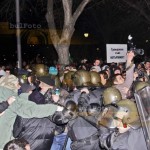
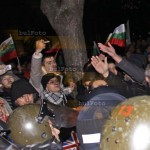
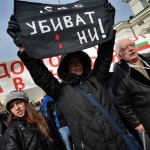
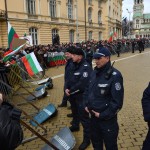
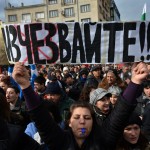
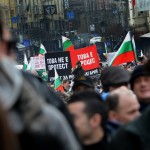
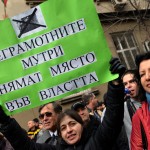
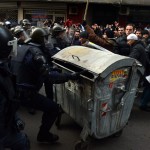
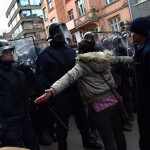
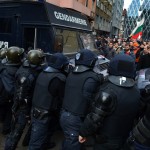
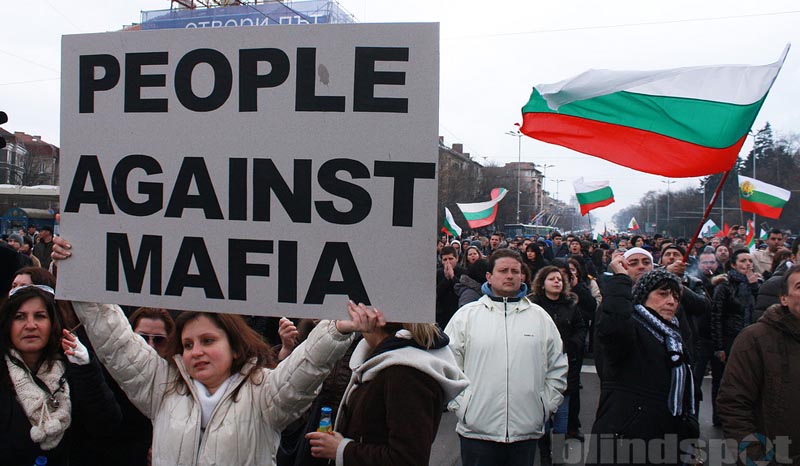 As Bulgaria is celebrating its Liberation Day on March 3rd, protests are still going on in most major Bulgarian cities. Neither the resignation of the Prime Minister and the leading party from the government amidst deepening economics crises, nor the appointment of a new patriarch to the Orthodox Church was able to calm the crowds who have been out in the streets for weeks now. General government elections are scheduled for May 12, 2013 while the President is working with parliament on forming an interim government.
After the last election some four years ago, political analysts working closely with our ministerial team warned that if newly elected government continues to use the same local level (city, municipality) political paradigms to run the country as a member of the European Union, crises will be inevitable. This was obvious even to the social concern grassroots including our chaplaincy program and para-church ministries.
Two years later, as half of the parliamentarian term has passed, we further advised in “Election’s Perspectives for Bulgaria” that as Bulgaria’s Prime Minister elect did not take the much expected place as a presidential candidate, his political strategy has been strongly criticized by his opponents as inadequate and insufficient to answer Bulgaria’s current crises. Amidst the global economic collapse, it was reasonable to suggest that similar socioeconomic shifts will not be long before appearing in Bulgaria.
The year 2013 began with a political distress in one of Bulgaria’s ethnic parties through a “backstage” attack against their soon to resign leader. The opposition responded immediately releasing a secret dossier code named “Buddha” revealing the Prime Minister working as a secret agent for the communist government police. His resignation, along with the resignation of the whole Cabinet, followed less than two weeks later as protests swept the streets of Bulgaria in the month with lowest temperatures, highest electric bills and of course highest rate of the government disapproval.
Meanwhile, after almost entering Bulgaria’s parliament in 1997, the Bulgarian Christian Coalition, traditionally representing the Protestants in the country, remains on the borderline of any political existence. Bulgarian evangelicals were never able to reach their political legacy again, although the new Bulgarian census showed over 25% increase of evangelical population in Bulgaria to some 65,000 people strong. The alternative party, Christian Democratic Forum has showed no political activity since it was established a decade later and quickly defeated by having less than 1,000 votes nationwide. The Bulgarian Christian Coalition has also chosen not to run in the upcoming elections.
Repost: Ministry NOT for Sale
 My son, if sinners entice thee, consent thou not (Proverbs 1:10)
Several years ago, while employed with a certain organization, we faced the dilemma to choose between what was morally right and what was financially secure. Regardless of the jeopardy of this predicament, we were able to make the right decision, preserving our integrity and disallowing financial pressure to dictate our moral choices. Soon thereafter, we initiated a healing process which dealt with the internal wounds, restored the lost trust and attempted to recover the invested time and resources. Years past, we forgot the pain, but never forgot the lesson we learned …
Recently, while involved in a global ministry campaign, we were faced with a similar situation. This time, however, it did not involve business partners, but a multitude of Pentecostal ministers. The larger size of the context did not change the problem at hand, but rather intensified and multiplied its harmful effects. We regretfully witnessed how hundreds of men and women involved in ministry were manipulatively forced to face the same dilemma. They had to make a mandatory choice between the financial security of their families and their own moral integrity. The results were accordingly. Read more
Bulgaria’s Orthodox Church Elects New Patriarch
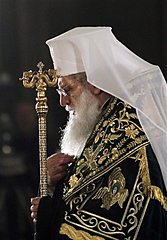 Metropolitan Neofit of Ruse was elected Sunday as the new spiritual leader of Bulgaria’s Orthodox Christians amid social unrest threatening to throw the Balkan country in a serious political crisis. The 67-year-old Neofit was picked among three candidates shortlisted in a secret ballot by the 14 bishops that make up the Holy Synod of the church.
The enthronement ceremony for Patriarch Neofit was held at Sofia with ongoing nationwide protests against high energy bills, poverty and corruption, and demands for radical political reforms, which forced the government to resign. Speaking at the ceremony, President Rosen Plevneliev voiced hope the new patriarch will contribute to Orthodox unity and the strengthening of the faith, and will preserve the integrity of the church.
The main challenges Neofit will face at home are addressing church unity, the church’s isolation from current public concerns, financial troubles and the dwindling number of priests and monks. Last year, a panel investigating communist-era secret services announced that 11 of the 15 metropolitans had ties to those services. Among those named was also Neofit. Over 20 Pentecostal and charismatic denominational leaders were also revealed to have been a part of a nationwide network of secret agents and handlers organized by the communist secret police. Yet, only two have resigned form their leadership positions. Alike many evangelical leaders in Bulgaria, the patriarch of the Orthodox church is elected for life.
Bulgaria Axes Finance Minister
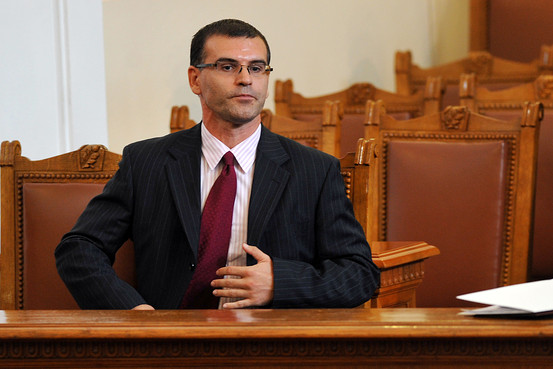 JOE PARKINSON, The Wall Street Journal
SOFIA—Bulgaria sacked its finance minister on Monday after a weekend of demonstrations over electricity prices brought tens of thousands onto the streets, raising pressure on a government that had until recently defied political gravity by retaining popularity in the teeth of an austerity drive.
Simeon Djankov, a former World Bank official who won the respect of financial markets for undertaking painful reforms but courted controversy in Bulgaria as a fiscal hawk, was relieved from his duties as finance minister by Prime Minister Boyko Borisov on Monday, the government said in a statement. The prime minister proposed Tomislav Donchev, the minister responsible for European Union funds, for the post, the statement said.
The news, which took analysts by surprise, comes as Mr. Borisov’s ruling center-right Citizens for European Development of Bulgaria party, or GERB, is facing mounting pressure after a series of antiausterity protests and corruption scandals have dramatically eroded popular support for its policies.
Sunday saw Bulgaria’s largest demonstration for more than a decade as tens of thousands of protesters gathered in more than a dozen regions, paralyzing city centers and blocking highways. Venting their anger against high electricity bills, the protesters demanded the resignation of the cabinet and the re-nationalization of power distributors. Electricity prices are politically sensitive in the EU’s poorest member state, where power bills bite off a large chunk of monthly incomes, especially during the winter.
Hewing to a tight fiscal policy and navigating the financial crisis without taking a foreign bailout, Bulgaria has stood as one of the EU’s fiscal brightspots, comparing favorably to regional economies Hungary and Romania, which have been plagued by steeper recessions and political turmoil.
But analysts warned that the removal of Mr. Djankov, the government’s most high-profile technocrat, would likely foreshadow a shift toward more populist economic policies ahead of national elections tabled for July.
“Djankov was the figure who symbolized fiscal and financial discipline. The whole economic policy was based on these priorities,” said Daniel Smilov, program director at the Center for Liberal Strategies, a Sofia-based think tank. “Now there is an expectation that some change in economic course is imminent and that may make some people nervous.”
There were signs that Czech power company CEZ AS, BAACEZ.PR -0.44% which has been the focus of popular anger at rising energy prices, could be in the cross hairs of a more populist policy. Bulgaria’s Energy Economy and Tourism Ministry said on its website on Sunday that the national energy regulator was considering whether to revoke CEZ’s license due to allegations the company violated public-procurement rules. CEZ, which insists it hasn’t breached regulations, had 9.9 % of its 2011 revenue from Bulgaria, making it the company’s second-largest market after the Czech Republic.
Bulgaria’s opposition leaders on Monday sought to build pressure on Mr. Borisov, stressing that the removal of Mr. Djankov would not alleviate public anger.
“This move means Borisov is panicking…The change is not enough, we need a new government and new rules,” said Ivan Kostov, former Prime Minister and leader of the rightist Democrats for Strong Bulgaria party was quoted as saying by Bulgarian state media.
On the periphery of the euro zone, but overwhelmingly dependent on the bloc’s larger economies for growth, Bulgaria won admiration from Brussels by reducing its budget deficit to 0.5% of gross domestic product last year from 2% in 2011. The economy managed a 0.5% expansion in the fourth quarter from a year earlier, marking its 10th successive quarter of growth
But opinion polls in recent months showed a precipitous decline in the ruling party’s ratings after three years of austerity policies, corruption scandals snaring cabinet ministers and a lack of significant results in fighting crime and graft.
A lead of 15 percentage points last year has evaporated in recent months, placing GERB level with the Bulgarian Socialist Party, according to recent polling. Analysts say that electoral arithmetic would make it very difficult for Mr. Borisov to form a single-party government at national elections and could prompt the Prime Minister to call a snap poll in the Spring. On the streets of Sofia on Monday, residents appeared polarized about the news.
Boiana Stoyanov, a 34-year old hotel manager said Mr. Djankov had been made a “scapegoat” and his ouster showed the coming election campaign “will be dirty.” Tsvetan Tcherneva, a pensioner who demonstrated in Sofia on Sunday said he was surprised Mr. Djankov lasted so long. “He brought American ideas and took an ax to pensions and to state wages. The government is in serious trouble now,” he said.
Pope Benedict Resigns
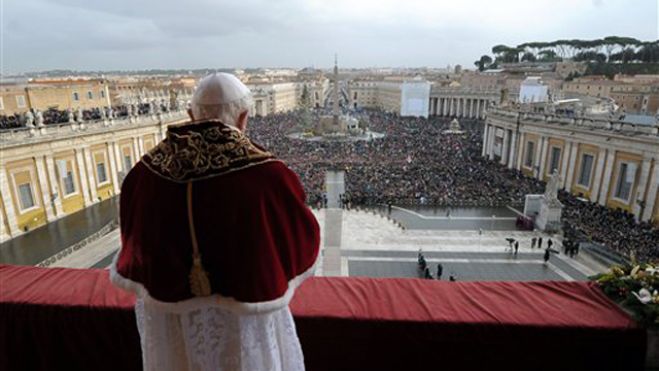 (VATICAN CITY) — Pope Benedict XVI announced Monday that he would resign on Feb. 28 because he was simply too infirm to carry on — the first pontiff to do so in nearly 600 years. The decision sets the stage for a conclave to elect a new pope before the end of March. The 85-year-old pope announced his decision in Latin during a meeting of Vatican cardinals on Monday morning. He emphasized that carrying out the duties of being pope — the leader of more than a billion Roman Catholics worldwide — requires “both strength of mind and body.”
“After having repeatedly examined my conscience before God, I have come to the certainty that my strengths due to an advanced age are no longer suited to an adequate exercise of the Petrine ministry,” he told the cardinals. “I am well aware that this ministry, due to its essential spiritual nature, must be carried out not only by words and deeds but no less with prayer and suffering.
“However, in today’s world, subject to so many rapid changes and shaken by questions of deep relevance for the life of faith, in order to govern the barque of St. Peter and proclaim the Gospel, both strength of mind and body are necessary — strengths which in the last few months, has deteriorated in me to the extent that I have had to recognize my incapacity to adequately fulfill the ministry entrusted to me.”
The last pope to resign was Pope Gregory XII, who stepped down in 1415 in a deal to end the Great Western Schism among competing papal claimants. Benedict called his choice “a decision of great importance for the life of the church.”
The pope’s brother, Georg Ratzinger, says the pontiff had been advised by his doctor not to take any more transatlantic trips and had been considering stepping down for months. Pope Benedict XVI announced Monday that he would resign Feb. 28. Talking from his home in Regensburg to the news agency dpa, Georg Ratzinger said his brother was having increasing difficulty walking and that his resignation was part of a “natural process.” “His age is weighing on him,” the 89-year-old said of his 85-year-old brother. “At this age my brother wants more rest.” Georg Ratzinger did not answer his telephone for calls seeking further comment.
The move sets the stage for the Vatican to hold a conclave to elect a new pope by mid-March, since the traditional mourning time that would follow the death of a pope doesn’t have to be observed. There are several papal contenders in the wings, but no obvious front-runner — the same situation when Benedict was elected pontiff in 2005 after the death of Pope John Paul II. When Benedict was elected pope at age 78 — already the oldest pope elected in nearly 300 years — he had been already planning to retire as the Vatican’s chief orthodoxy watchdog to spend his final years writing in the “peace and quiet” of his native Bavaria.
Contenders to be his successor include Cardinal Angelo Scola, archbishop of Milan, Cardinal Christoph Schoenborn, the archbishop of Vienna, and Cardinal Marc Ouellet, the Canadian head of the Vatican’s office for bishops. Longshots include Cardinal Timothy Dolan of New York. Although Dolan is popular and backs the pope’s conservative line, the general thinking is that the Catholic Church doesn’t need a pope from a “superpower.”
All cardinals under age 80 are allowed to vote in the conclave, the secret meeting held in the Sistine Chapel where cardinals cast ballots to elect a new pope. As per tradition, the ballots are burned after each voting round; black smoke that snakes out of the chimney means no pope has been chosen, while white smoke means a pope has been elected.
Popes are allowed to resign; church law specifies only that the resignation be “freely made and properly manifested.” Only a handful have done so, however and there’s good reason why it hasn’t become commonplace: Might the existence of two popes — even when one has stepped down — lead to divisions and instability in the church? Might a new resignation precedent lead to pressures on future popes to quit at the slightest hint of infirmity?
Benedict himself raised the possibility of resigning if he were simply too old or sick to continue on in 2010, when he was interviewed for the book “Light of the World.” “If a pope clearly realizes that he is no longer physically, psychologically and spiritually capable of handling the duties of his office, then he has a right, and under some circumstances, also an obligation to resign,” Benedict said. The former Cardinal Joseph Ratzinger had an intimate view as Pope John Paul II, with whom he had worked closely for nearly a quarter-century, suffered through the debilitating end of his papacy.
GOD is DOING a NEW THING in 2013

The Holy Ghost within us cries for holiness and we shall not be oppressed, depressed, repressed, regressed, transgressed by this dead and dying world. For there’s a standard of heaven and a judgment of God; a rule of holiness and a road of righteousness which must begin nowhere else but with the household of God; where God is doing a NEW thing in 2013 speaking a SEASON of:
– Re-covery
– Re-claiming
– Re-versal
– Re-juvenation
– Re-imbursement
– Re-cuperation
– Re-organization
– Re-volution
– Re-envisioning
– Re-freshing
and re-telling the old, old story that a King has left His glory and died on cross on Calvary to save a wretch like me…
A Psychological Exploration of Communist and Post Communist Bulgaria
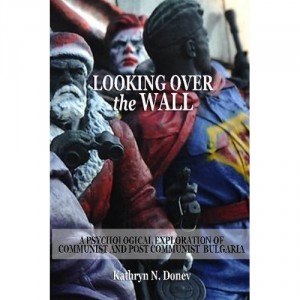 From an environment of uncertainty and hopelessness, the Bulgarian Evangelical believer turns to the continuity of faith in the Almighty Redeemer. Pentecostalism as practical Christianity gives a sense of internal motivation to the discouraged. In a society that is limited in conduciveness for progression of thought or self actualization, one finds refuge in the promises of Christianity. It becomes a certainty which can be relied upon. Historically, having undergone severe persecution, the Bulgarian Evangelical believer is one who possesses great devotion to his or her belief. Having to defend the faith fosters a deep sense of appreciation and in an impoverished country, faith becomes all some have. Christ becomes the only one to whom to turn for provision. In the midst of this complete dependence is where miracles occur. Furthermore, it is in the midst of miracles where the skepticism which is prominent in post communist Bulgaria is broken. When those who believe are healed from cancer and even raised from the dead, there is no room for disbelief or low self-esteem.
The Immature Mind and the Effects of Information Processing Associated with Indoctrination
 by Kathryn N. Donev, M.S., L.P.C.
The following is a response to the most recent developments within Bulgarian laws dealing with Educational Reform making it mandatory that children begin attending public school at the age of four years old.
The mind of a child is an extremely fragile organism that is malleable with the potential to be molded into whatever a caregiver chooses. It is a great responsibility to raise children and much love and guidance has to be given in order for a child to become a healthy functioning part of any society.
Before age six, give or take a year or so, is when a child is most impressionable and is most influenced by learning information and forming realities and constructs. It is before age six that a child’s mind has most neuroplasticity, although our minds are always capable of change. It is during this period when reorganization of neural pathways and long lasting functional changes in the brain occurs as we take in new information.
When the immature brain first begins to process sensory information is when it is most malleable. Indoctrination can occur at great rates and if accomplished before the age of six, then these teachings are so deeply ingrained within that it becomes nearly impossible to change or re-wire the neural pathways which have been formed. Accordingly to neuroscientists, by the time an infant is two or three years old, the number of synapses in their brain is approximately 15,000 per neuron, which is twice the amount of an average adult. This gives insight into how absorbent and thirsty the brain is for knowledge. At the same time, a child’s brain is very impressionable without yet having the ability to rationally sensor the intake of information. Meaning, they will believe whatever a caregiver tells them because they have no other reason but to innocently trust at this early age.
Since a young child’s memory has not yet fully developed, learning takes place by being told and retold what to do. They have to be indoctrinated. And it is the greatest responsibility of a caregiver to choose the most appropriate principles and values to teach a child. By age three or four, the parent or primary caregiver still is their “external conscience,” reinforcing their memory of what they’re supposed to do.
According to Erikson’s stages of child development, it is around two-four years when a child enters into the “Will: Autonomy vs. Shame and Doubt” stage in which they encounter life and ask the question if it is okay to be themselves. This question is answered with how the world around them responds to their actions. This period of time is when a child, in gaining control over eliminative functions and motor abilities, will begin to explore their surroundings. If a parent is patience and encouraging, autonomy will be fostered within a child. A caregiver must encourage self-sufficient behavior in hope to develop a sense of autonomy in order to being competent to face life challenges independently. But if caregivers are too demanding, refusing to let children perform tasks of which they are capable, or ridicule early attempts at self-sufficiency, children may instead develop shame and doubt about their ability to handle problems. Now if it is the intent to diminish this fostering of self sufficiency, then it is right at the age of 4 when a child can be influenced to be dependent and self-doubting.
It is during the next developmental stage, “Purpose: Initiative vs. Guilt” that a child asks, “Is it okay for me to be proactive?” in attempts to master the world around them and learn basic skills. At this stage, the child wants to begin and complete their own actions for a purpose. The development of courage and independence are what set preschoolers, ages three to six years of age, apart from other age groups. During this stage, the child learns to take initiative and prepare for leadership and goal achievement roles. However, if a child is striped away from this ability to take initiative, then their purpose is stripped away.
A child has to be given times of self-taught or self-thinking in order to form within a sense of identity; personal and not corporative identity or knowing their true self. If this is not allowed, then confusion sets in and results in midlife crises. After for years having lived exactly how you have been instructed and after having believed all of what you have been told to believe, an awakening takes place that this perceived reality does not meet up with your real internal being and destined reality.
If a child is not allowed to think for themselves and explore on their own at this young age outside of systematic education, then they will never reach the stage of development which is known as “Competence: Industry vs. Inferiority”. The consequences are self-explanatory. Inferiority and doubt set in and this child becomes a product of the system and is void of internal motivation, will and desire to make a change for the betterment of the society. They become cogs in a wheel and the result of a communistic effort.
If we give over our children to a state school system at early and early ages, the parents’ rights are being stripped away. The choice to teach morals of right and wrong or beliefs is only available for a limited time and shared with an organization with limits. A child has no one to speak for themselves at such a young age and they will believe that the sky is green if they are told it is so. It is by around age six that normal children are developing an internal conscience. By age six, they have formed this conscience based on what they have been taught is truth, is right and is wrong. These first six years of development are the most crucial and should not be trusted to anyone else or any other organization that may have hidden agendas. If a child is asking if it is okay to be themselves and they are told it is not, but rather they have to be what a government or a society insists, then confusion arises.
Let children be children and the children that they are intended to become naturally and innocently void of any motive. Let us foster a society of thinkers with independent minds free to make choices. Democratic principles should be applied on all levels of society. We always hear of child rights including stopping physical and emotional abuse, but we rarely are faced with having to protect our children’s minds. Awareness is the first step in prevention and we have to at all cost, protect the rights of our children. Our children only have our mouthpiece to protect them…


