

The Missional Church
 The nature of the church is missional, through the fact that its existence is powered by the Great Commission. The book summarizes the culture of today’s American spirituality and its relation to the apostolic church. The main question is, “What would a theology of the church look like that took seriously the fact that North America is now itself a mission field?”
Five Key Insights
1. The missional nature of the church – The place which the church takes in the surrounding world/society defines its nature as missional. How it interacts with the surrounding worlds identifies the church’s response to the needs of individuals and groups of people and results in its success/failure to fulfill its original mission. A valid point was the statement that the witness of the missional church is characterized by its integrity.
2. Recovering missional identity – Recovering the church’s original New Testament identity has been a subject of discussion for many various ages in church history. The volume of works written about it has indeed increased in the latter part of the 20th century. The discussion in the book claims that as truth, self, and society are rediscovered in postmodernism, the churches of North America will recover its missional identity. Thus, the individual search of identity will reflect on the corporate search of the church as a community and as the Body of Christ. Chapter four further claims that the churches missional identity is shaped by the gospel of the reign of God which Jesus preached.
3. The Holy Spirit and the community of the missional churches – The Chapter on the Holy Spirit, although very informative, did not integrate the connection between the Spirit and Missional outreach to a practical paradigm, but it was mostly a theoretic and philosophical proposition.
4. On spiritual leadership – the discussion on spiritual leadership is based on the axiom that leadership is focused on the reign of God. Only then the church assumes its mission. Solving problems and creating unity within the church is reached through the same focus on the reign of God.
5. The secular surroundings – the vision of the church may not align with the secular surrounds. Actually, it may often completely contradict them fulfilling its role as a prophetic utterance. At the same time, social, political and economical factors may oppose the message and the mission of the church, thus creating an atmosphere in which the church grows against the grain.
The Fire Bible Review

Several months ago, our team undertook the task of comparing and reviewing a growing number of Study Bibles appearing on the book market recently in what we called a 21st century Revival of Study Bibles. This article is part of our Study Bibles review series as outlined here: https://cupandcross.com/bible-revival/
Fire Bible Review
Dony K. Donev, D.Min.
I’ve been personally following and using the Fire Bible since it was called the Full Life Study Bible. And not mainly because it is Pentecostal (much like Dake’s and Spirit Filled Life Bibles), but more so because a good portion of the commentaries were written by one of my favorite professors in seminary, Dr. French Arrington. Therefore, I was very truly blessed when our ministry was able to participate in the translation and promoting this great work in Bulgaria.
Beginning with our usual control passages from the Old Testament, Number 6 contains a great detail of explanation on the vow and practice of the Nazarite law. Furthermore, there is a special note on “Wine in the Old Testament” in the Fire Bible, and the Aaronic benediction at the end of the chapter is specifically marked, outlined and discussed as two articles are cited in connection with “Faith and Grace” and “The Peace of God.”
Our second control passage in Jeremiah 18 is also not left without discussion. Actually, the commentary in v.8 makes two powerful points on God taking account spiritual changes in our lives and not forcing our decision despite knowing the final outcome; thus presenting a typical Pentecostal approach on free will, God’s sovereignty and foreknowledge, which is further discussed in the article on “Election and Predestination.”
The doctrine of the Rapture is not only mentioned in Revelation 4, but preceded with a special article from 1 Thessalonians and a detailed chart of Last Day Events in the forward of Revelation in both the early and the Fire editions. The Tribulation is also clearly explained as a post-Rapture event, divided in two parts and well documented with Scripture references. Additionally, in a very balanced Pentecostal manner, the dispensations, although noted by some, are not explicitly defended in the pre-Millennial system. The significance of the phrase “in the Spirit” is dully noted, which brings us to Pneumatology.
In regards to Pentecostal theology, the doctrine of Trinity is presented in an indictable orthodox way after the Athanasius Confession. Perhaps, the only criticism could be that there’s no mention of the fact that some early Pentecostal groups indeed taught Jesus-only doctrine. The Holy Ghost baptism is both theoretically and practically explained in the forward to Acts, while there’s an additional article on Speaking in Tongues after Acts ch.2. This is further mentioned in a comment after Mark ch. 16 followed by an article on Spiritual Gifts in 1 Corinthians 12.
There’s also a detail discussion the doctrine of Sanctification in 1 Peter after the foreknowledge of God is additionally explained. Sanctification is viewed as immediate, not “giving up sin little by little,” yet “do not suggest an absolute perfection.” The work of God and man is defined, and most importantly God is viewed as one who desires to sanctify His people. There’s no specific comparison to a second work of grace, yet the general approach toward the doctrine and practice of sanctification presents a typical, historically accurate, Pentecostal point of view toward the teaching.
The Four Gospels of the New Bulgarian Translation Published
August 15, 2013 by Cup&Cross
Filed under Featured, News, Publication, Research
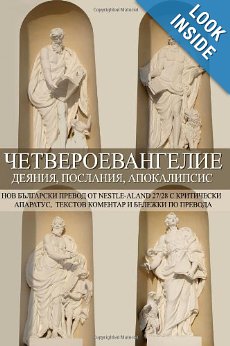
We are both happy and humbled to announce the publication of the Tetraevangelion of of the New Bulgarian Translation including:
- Matthew (2011)
- Mark (2010)
- Luke: Gospel and Acts (2013)
- John: Gospel, Epistles and Apocalypse (2007)
This final volume has been almost ten years in the making as it combines all four previously published volumes. It is new literal translation in the Bulgarian vernacular directly from the Nestle Aland Novum Testamentum (27/28 editions).
We thank friends and foes for the internal motivation without which this work would have never been completed.
We are currently working on another similar project, namely the publication of a Study New Testament in Bulgarian, which will be ready for print by the end of this summer.


Christ and Culture
Richard Niebuhr is one of the most influential modern reformed theologians. He is considered an authority on ethics and church in the Western culture and writes that the authenticity of the Christian faith is based on its realization in a counterpart world setting.
Christ and Culture presents an observation of the ways the church realizes its place in the surrounding world. The central idea of the book is that the church wrestles with both its Lord and with the cultural society with which it lives. In such context, the relevancy of the church’s message to the opposing party remains the central as well. Four models of how the Christian and contemporary realities can interact to seek the answer to how Christian life should be lived are discussed.
Niebuhr approaches culture in general, from a reformed point of view with a definite accent on the present (now) covenant and not so much with apprehension of the eschatological future of the church. His views are based on a mid-twentieth century church operating in a modern Western context. His discussion of the relationship of church and contemporary culture, however, give an opinion much beyond this time making this research valid today.
Niebuhr, believed that the life which Christ commanded from his followers contain values that are essential for the formation of culture and are much needed by the secular world. Christian faith, however, needs to be brought beyond self-separation in order to engage culture with the values of the Christian life. Faith then acts more as a social presence and action which become a transforming factor for society. In a typical reformed manner, the text proposes the church’s involvement in bringing the Kingdom on earth.
The author then uses the four models to examine the variations of the place in culture given to Christ and examines the different effects on society and the church. These models are: (1) Christ against, (2) Christ of, (3) Christ above and (4) Christ transforming culture. They form a literal gradation in the book and serves as the author’s supporting evidence. Christ against culture is a rather “postmodern” approach through which the church rejects modern culture. Such process is in parallel with the life of Christ who not only taught the values of faith but also lived them. Thus, as the church opposes the world, Christian values must become personal acts rather than theoretical descriptive qualifications.
Niebuhr explains that Christ’s rejection of culture was not a result of eschatological expectations, but a result of Him being the Son of God. The realization of Christ’s sonship, then is also the way through which the church should minister in the world. In other words, the church and the life of the Christian must demonstrate Christ’s sonship.
Niebuhr outlines several theological problems in the Christ against culture model as follows (1) reason and revelation, (2) nature and prevalence of sin, (3) relationship of law and grace and (4) the relationship of Jesus Christ to the Creator of nature and Governor of history.
Christ of culture is the second approach which Niebuhr observes. This is another historical overview which speaks much of the Enlightenment. The text discusses several of the thinkers of the day, who attempt to identify Christ with culture. This model shifts the focus from revelation and reason to Christ and culture, as shown in the discussion about Rischl.
The difficulty with cultural Christianity is that it has always been widely rejected. As far as discipleship is concerned, such approach is not more effective than Christian radicalism. The reason for this is that Gnostics and cultural Protestants which Niebuhr describes as lead representatives of this approach create a new mystical image of Christ. When paralleled with the actual Christian story, such images cannot bear the witness of true Christianity and are rejected by both the Scripture and Church.
Christ above culture is the next model which Niebuhr examines, treating medieval representations of a practical synthesis. This synthesis was full of tensions as both sides of the church were corrupt. Regardless of the damages, they both served as means for each other transformation, thus reforming each other. Such synthesis could not be a present day paradigm except if its prerequisites, protesting Christianity and religious institutions, are present in the context of a cultural church able to accommodate such relationship.
The final proposal is the one of the culture-transforming Christ. Unfortunately, this chapter is not as comprehensive as the rest of the observations, perhaps leaving some space for new research and answers. The author spends a great deal of time examining the conversion motif from the fourth Gospel as a model for this culture-transferring Christianity. He then relates it to the theology of Augustine and Maurice and their views of culture transformed by Christ.
In conclusion of this reflection, it must be pointed out that while precise in a great deal of historical facts, Niebuhr is not accurate in the description of the Mennonite Church (Christ Against Culture), perhaps he meant Amish. Also, the definition of culture seems to change through the presentation of different models. Finally, he approaches the relationship of culture and Christianity from a Calvinistic point of view, leaving very little expression of other paradigms outside reformed theology.
Mission Applications
The Fall of the Berlin Wall opened the door toward Eastern Europe and the Soviet republics. Since millions of Eastern Europeans coming out of the Communist Regime could relate to the Pentecostal faith, the numbers of saved and baptized with the Holy Spirit grew by the millions. The result was a multitude of revival fires from the Prague to Vladivostok which unavoidably began changing the local culture.
In the midst of the Pentecostal Eastern European revival, the underground and semi-underground Pentecostal churches coming out of the communist persecution quickly found themselves insufficient to accommodate the need of the new converts for a Pentecostal community. Having had minimal opportunities for education and training under Communism, the only hope was in the supernatural. I In such times, lack of spiritual dependency was replaced by human leadership, self-confidence and wrongful ambitions. Ministers, churches and whole denominations made mistakes which resulted in thousands of new converts being lost for the harvest. Adding clearly Western theological views, church practices and management models were only temporary patches. Like its context of origin, they lasted only enough for the problems to grow and come back in a hunt to destroy human lives. Intense opposition from the schismatic Eastern Orthodox Church, severe economical crises, the lack of political direction, rapidly changing governments and laws were only a few details present as we entered Postmodernity. All of a sudden theologies brought from he west made no sense in the Eastern European context and a sudden need for a new, contextualized Pentecostal paradigm for ministry emerged.
The main question which such paradigm must answer is how a post-persecuted and post-communist church ministers to a postmodern world. In Chrsit-cultural terms, this same question may sound like, “How does a church which has been rejected by Community culture for decades now overcome this rejection and minister to the post-Communist culture.” The answers are many, but the right one must emerge form the identity of the church through a realization that even before there ever was a post-Communist culture in Bulgaria, through rejection of the Communist culture, the church itself was operating within a post-Communist reality. Such paradigm is not strange to the Bible, as the Early Church rejected the Roman reality and operated, similar to a post-Roman reality. The problem with the Bulgarian Protestant church, however, is a very oxymoronic one. This comes from the fact that while outsiders would consider Bulgarian post-Communist culture as a postmodern one, in fact the present Bulgarian culture is pre-modern or at best modern. Since the relationship between postcommunist and postmodern culture is still a new issue, the correct paradigm within such culture must make a decision if the post-Communist culture is pre-modern, modern or postmodern. Such paradigm for ministry will act as a paradigm of cultural transformation.
Spirit, Pathos and Liberation
 The research presents Hispanic Pentecostalism as “the voice of the voiceless.” Solivan prepares the reader for the cultural and religious context in which orthodoxy has failed for various cultural, historical and theological reasons. He further proposes that the new term of “orthopathos” should be used. Orthopathos is the combination of orthodoxy (what we believe) and orthopraxis (what we do). As such, it introduces an interlocutor between God and humanity and between beliefs and works. God is the God who suffers for creation and with creation. The act of repentance is then the human response to the passion of God for humanity and joining with His sorrow in the death and alienation of mankind. Such appeal is against the dehumanization of revelation. It reduces the salvific experience to a simple claim of Biblical truths based on a logical choice.
Several reasons are given to prove that such intercalative paradigm is necessary for the Hispanic Pentecostal communities. Among them are not only Biblical, theological and mission requirements, but also sociopolitical, ecumenical and identity ones. These necessities expand the orthopathic approach beyond the church-religious context into the area of social transformation, thus proposing it as a larger paradigm for Christian mission to the world. Solovan claims that pathos denotes the idea of goodness and passion, which were very often missed by the ecclesial formations which followed the early church and was never properly restored by the Reformation. The discussion addresses the imago Dei and the pointed by Tertullian’s argument that God’s expression of passion is not a reflection of ours, but rather a reflection of His image.
Having established the pathos idea, Solivan goes further with showing how orthopathos can become a means of human liberation even through suffering. Three theological principles of orthopathos are presented as follows:
1. In connection with the Biblical principle of identification.
2. In connection with the Biblical principle of location.
3. In connection with the Biblical principle of transformation.
Through the Biblical foundation, the starting point of orthopathos is identified with the suffering and its relations to the category of poverty within the socioeconomic matrix. The author continues with a parallel between suffering and the work of the Holy Spirit and His work among the poor.
Once, the pneumatological factor is introduced, Solivan goes a step further to discuss Pentecostal glossolalia. He sees it as an affirmation of the work of the Spirit among the poor. This gives a Pentecostal conclusion of the orthopathos topic and allows the author to explore its practical implementation within the Hispanic Pentecostal community.
The book further introduces three critical questions concerning the topic of orthopathos. The first one is concerned with the imago Dei in reference to the emerging identity of Hispanic Americans and more specific Hispanic American Pentecostals.
The first concern is continued by the second question about the common experiences and culture in the context of North American immigration dynamics. This factor has a rather unicultural and ecumenical approach, but brings several interesting possibility for communality within the Holy Spirit. The third concern deals with the transformation of practice into praxis in a Pentecostal context and is connected with the last question which calls against passivity toward suffering and poverty. The book concludes with a call for social transformation which is addressed by Pentecostal theology and praxis.
Practical Implementation
In the background context of the treated problems and issues, the book inevitably stands against passivism toward social injustice and touches on the role of the church in the social transformation dynamics. Although, the book is dedicated to a Hispanic Pentecostals, the principles of social transformation are applicable also in my area of ministry in postcommunist Bulgaria. The similarities are many.
First, just like South America, Eastern Europe after the Fall of the Berlin wall in 1989 is struggling economically. Along with the social and political instabilities in the region, the economical crises have separated the Bulgarian community into a small percentage of extremely rich, and a majority of extremely poor with minimal or no middle class separation between them.
Second, while South America’s religion is monopolized by the Catholic Church, this role in Bulgaria has been occupied by the Eastern Orthodox Church. The last has been credited as the protector of the Bulgarian culture during the Turkish Yoke and the Communist Regime. However, in both cases, the Eastern Orthodox Church has participated in historical dynamics which have created environments for the rich and powerful minorities, thus oppressing the poor and the underprivileged majorities.
Thirdly, through the Protestant missions Pentecostalism was introduced to the Bulgarian culture in the 1920s. Today it is the fastest growing religious movement in Eastern Europe. Protestantism has rightly and faithfully fulfilled its role as a sociological factor in the formation of the Bulgarian culture exactly in the historical moments when the Eastern Orthodox Church has been or had chosen to become socio-culturally inactive.
Fourth, cross-cultural problems which Hispanic communities in North Amerca face are similar to the problems which Bulgarian immigrant communities face. The cross-cultural processes, struggle with identity, loss of heritage, as well as their recovery and reclaiming through the Biblical salvific experience, are dynamics which essential for the Bulgarian immigrant communities and the Bulgarian immigrant individually.
Finally, Pentecostalism has drawn a paradigm for personal and social transformation which has created an environment for liberation of the oppressed by postcommunist reality Bulgarians both in Bulgaria and internationally. It has further effectively addressed theological and practical issues through Pentecostal identity, experience and community becoming a factor within the social transformation and the postcommunist mentality as well. As such Pentecostalism, in a larger scale, has become an answer for many through providing answers to existential questions in the midst of crises, transitions and insecurity as its call for orthopathos has integrating the sacrifice of God with the present search and suffering of the Bulgarian nation.
20churches.com: Official Release
Comments Off on 20churches.com: Official Release
![logo-copy-600x238[1]](http://ourcog.org/wp-content/uploads/2013/07/logo-copy-600x2381.jpg)
We are honored and humbled to introduce an innovative ministry instrument, which can increase your church influence in the community.
20churches.com is a FREE web tool that networks pastors with leading ministry experts to helping churches grow and prosper by increasing:
- Leadership reach and effectiveness
- Volunteer team building strategy
- Communicational and conflict resolution
- Mobile strategy as a church
- Web presence on the social networks
- Overall ministry’s vision and mission
The website’s algorithm analyzes church influence and reach within the community based on: (1) your survey results, (2) your local demographics and (3) leading ministry expertise combined with national church trends.
- Go to 20churches.com to see your current church influence
- Fill out the online survey to receive an instant free report
- Choose among leading experts to increase your church influence
Please leave your feedback as it will help us improve our methodology and assist others. You can also check the current national church trends at:http://20churches.com/trends/
This service is free. Your information is confidential and will not be used for offers or reselling. Click here to begin now: 20churches.com
#ourCOG Dev.Team
Mission of God Study Bible Review
Comments Off on Mission of God Study Bible Review
![MissionOfGodSB_post[1]](https://cupandcross.com/wp-content/uploads/2013/07/MissionOfGodSB_post1.jpg)
Several months ago, our team undertook the task of comparing and reviewing a growing number of Study Bibles appearing on the book market recently in what we called a 21st century Revival of Study Bibles. This article is part of our Study Bibles review series as outlined here: https://cupandcross.com/bible-revival/
The Mission of God Study Bible is edited by Ed Stetzer and Philip Nation containing essays and commentaries by over 50 contributors among whom Billy Graham and Jack Hayford. Significant place is given to quotes from Francis Dubose’s 1983 book, God Who Sends. The primary purpose is to introduce a Missional Manifesto to the church of the 21st century. Beside book introductions, essays and cross-reference annotations, it promotes ideas from the Bible as QR Codes, Text Messages and Notes from God using the Holman Christian Standard Bible text as a foundation.
The initial commentary introduces God’s mission in creating the world and the divine plan to reconnect with His creation into a promise of an eternal land. The passages of our usual consideration (Numbers ch.6 and Jeremiah ch.18) are not particularly commented; however, the introduction to Numbers begins with a beautiful analogy of how serious God takes His mission leading the Israelites for 40 years in the wilderness. The notes on Jeremiah also contain Glenn Barth’s Dwelling and Working for God in the City.
Although not written by primarily Pentecostal authors, the commentary on Acts includes a very charismatic key to revival through making disciples using: (1) empowerment, (2) education and (3) evolving. This process is described as inclusive and hospitable to all in two articles on the Gentile conversion in Acts 10. The mission of the Christian ministry is enriched by the Gifts of the Spirit annotated personally by Ed Stetzer in 1 Corinthians 14 through the source, search and sovereignty of spirituality. But it is also inseparable from the marketplace as described in connection with the Corinthian church Acts ch.18.
The Pneumatological and ministry related commentaries connect well with the urgency of musicological eschatology starting with the phrase “In the Spirit” (Revelation 4:2). The notes conclude with another article with an urban theme on the Heavenly City. The eschatological mission in Revelation is explained as “Refocusing and Renewing the Church.” An article about missionary to China, Hudson Taylor is placed next to the story of the two witnesses, expressing the eschatological urgency to reach the whole world with the Gospel. This coincides with two commentaries on the Great Commission in Matthew 28, “The Mission of God and the Mission in the Church” and “Go Therefore.”
Overall a great missional tool with over 150 commentary notes and articles begins with the Missional Manifesto and concluding with the “Letters to the Church” from elder statesmen like Billy Graham, Jack Hayford, R. T. Kendall, Erwin Lutzer, Calvin Miller, and R.C. Sproul.
After 40 days of protests police removes protesters from Parliament square in Sofia, Bulgaria
Comments Off on After 40 days of protests police removes protesters from Parliament square in Sofia, Bulgaria
Anti-government protests in Bulgaria’s capital have been going on for 40 days, and escalated Tuesday evening as several hundred demonstrators trapped the officials inside Parliament in a bid to oust the left-leaning government.
 (Reuters) – Hundreds of protesters built barricades around Bulgaria’s parliament, effectively trapping over 100 lawmakers, ministers, and journalists in the building for more than seven hours on Tuesday following a brief scuffle with police. Protesters pulled out sidewalk tiles and piled garbage bins to cut off roads to Bulgaria’s parliament, shouting “Mafia!” and “Resign!” and “Red Garbage!”, to keep the deputies under blockade until the Socialist-led government steps down. An earlier attempt to get deputies out of the parliament with a bus led to a scuffle with police. It was aborted after protesters threw bottles and other objects at the bus, while others sat in front of it.
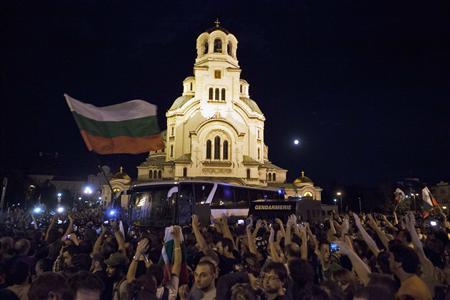 Thousands of Bulgarians have been protesting almost daily in Sofia since last month following a government decision to name a powerful media magnate as security chief, which many see as an example of private interests controlling state institutions. The government’s withdrawal of the appointment failed to quell public discontent in the European Union’s poorest country, which also is one of the bloc’s most corrupt. Seven protesters were treated for head injuries, the national radio said. Two police officers were also wounded.
Growing in the Life of Faith
 Having evolved from Wesleyan-holiness movement and having received great formational impact from many of the 20th century denominations, Pentecostalism inherits numerous church practices. Yet, several practices are historically, culturally and ecclesiastically distinctive from the Pentecostal churches. Among them are:
1. Baptism with the Holy Spirit accompanied by the initial evidence of speaking in tongues (glossolalia).
2. Practicing of the gifts of the Spirit, with the gifts of speaking and interpreting of tongues being predominant.
3. Foot washing services, as a part of the communion service.
4. Enthusiastic and emotional worship involving the whole congregation.
5. Altar services accompanied with shouting, running and trances.
6. Prayer clothes as a part of prayer for the sick.
7. Life of holiness, not only as a personal lifestyle, but as a discipleship model as well.
8. Inspiring the process of uniting and unifying people from different social, educational, economical and cultural backgrounds forming a movement without borders.
The absence of the above practices in Pentecostal discipleship will result in the following negative implications:
1. Discontinuity with Pentecostal heritage.
2. Discontinuity with Pentecostal theology.
3. Mutilation of Pentecostal Practices.
4. Discontinuity with Pentecostal identity and transformation into a new identity distinct from the Pentecostal one.
5. Failure to fulfill the divine calling for the Pentecostal mission.
Indeed, discipleship can exist without the above listed practices and actions, in the same way it exists in other Christian denominations and movements. However, discipleship of this type will not carry a Pentecostal distinctiveness. Therefore, it is clear that Pentecostal discipleship can exist and be productive only when modeled after distinct Pentecostal practices. Only then will Pentecostal discipleship be a cross-cultural and a cross-denominational movement.
It is unfortunate that Pentecostal practices, even within the global Pentecostal community, are disappearing. It is even more troubling that in many congregations and movements they are mutating to create a new identity much different from the Pentecost of the Bible. For example, in the beginning of the 21st century:
1. Baptism with the Holy Spirit accompanied by the initial evidence of speaking in tongues (glossolalia) is often replaced by the modern and postmodern religious experiences like “holy laughter,” “holy rain,” etc.
2. Practicing of the gifts of the Spirit, is a rare appearance often replaced by “prophetic” utterance and leadership of types quite distanced from the Biblical prophetic operation.
3. Foot washing services are not a part of our worship any longer.
4. Enthusiastic and emotional worship involving the whole congregation is more often faked and imitated than genuinely inspired by the Holy Spirit. The reason: great desire for the results without much discipline to go through the process.
5. Altar services accompanied with shouting, running and trances may still occur, yet they often do not fulfill their original purpose: to reconcile both Christians and sinners with their Creator.
6. Prayer clothes as a part of prayer for the sick are practiced as ministry, yet the results of healing are often not there.
7. A life of holiness has been rejected as impossible, impractical and foolish. The few who still press forth for practicing it have been classified as social outcasts by both the world and the global Christian community.
8. The idea of uniting and unifying people from different social, educational, economical and cultural backgrounds forming a movement without borders has been implemented by the world into the idea of a “global community,” yet it has very little presence and practice in the Pentecostal churches.
Leading and Managing a Growing Church
According to George Hunt the three main roles of each pastor of an effective and growing church are:
- Leader communicating the church vision, purpose, and direction
- Manager utilizing people and resources, assigning specific roles, jobs, and tasks, in order to achieve the mission’s purpose.
- Administrator facilitating the flow of the organization and makes sure it is efficient. (p. 26).
The following paper is a basic list of my actions in my present context of ministry grouped according to the above categories.
Leadership
- Creating, providing and consciously supporting a spiritual environment of prayer for leadership decision-making.
- Vision: Receiving the vision for the department and communicating a vision through all existing structures to all people in the department without any exception.
- Purpose: presenting a purpose of the vision – what would be the results of fulfilling the vision.
- Mission: how does the vision compliment the overall mission of the congregation?
- Relationships: relating to people s needs, spiritual growth and transformation.
- Message: in the church context providing a message related to the vision empowering the gifts of the people, encouraging with a hope for the future and at the same time ministering to their present situation personally, in their families as a basic church structure, and in the corporate presence of the church congregation as a community.
- Interacting with existing systems, structures and hierarchy in the church through providing an adequate leadership model in the assignment department.
Management
- Creating, providing and consciously supporting a spiritual environment of prayer for management decision-making.
- Creating an environment for adequate and timely problem solving in relationship to relationships between people and resources or both.
- Forming and continuously developing a dynamical financial strategy in accordance with the overall financial strategy of the congregation that provides for the ministry needs.
- Budget planning as a part of the annual church budget presented by the senior pastor and approved by the pastoral/church council.
- Creating relationships with long and short term sponsors.
- Providing and implementing long and short term fundraiser strategies.
- Finding, creating and building resources providing and adequate model for their purposeful usage.
- Creating annual and/or five-year projections for the further development of the ministry department in accordance with the available resources and the adequately provided leadership plans.
Administration
- Creating, providing and consciously supporting a spiritual environment of prayer for administration decision-making.
- Establishing communication with leaders and members through a variety of mail outs, websites, weekly bulletins, monthly newsletters and presentations.
- Cataloging member profiles in an information database to create a holistic church communication structure, and available for planning an extended church strategy.
- Forming basic structures and systems to aid the youth ministry:
- Volunteer leaders
- Student leaders
- Small groups
- Small group leaders
- Weekly meetings
- Wednesday night leaders
- Sunday school teen program, etc.
- Providing training, feedback and communication with the department structures aiming better results and relationships.
- Participating in church boards, interacting with directors, establishing and executing the proper chain of command.
- Creating and publishing reports and statistics inclusive of results.
- Analyzing the available data, structuring the results with proper feedback and providing a strategic plan for further development of the ministry.


