

Pentecostal Neo-Primitivism: The Theological Framework
Dony K. Donev, D.Min., is a Pentecostal theologian, historian, and minister associated with institutions like the Pentecostal Theological Seminary and Lee University, where he has taught classes such as Intro to Digital Discipleship. His work focuses on Pentecostal history, leadership, primitivism, and practical theology, often drawing from Bulgarian Protestant contexts and global Pentecostalism. Below, I outline the key theological frameworks and terms he has coined or developed, based on his publications, articles, and teachings. These emphasize spiritual renewal, community, and missional application within Pentecostal traditions.1. U.S.H.E.R. Model of Communion
- Description: This is a theological framework for understanding the dynamics of Communion (the Lord’s Supper) as foundational to disciple growth in Christian catechism. It identifies five key elements: Unity (fostering communal bonds), Sanctification (personal holiness through the Spirit), Hope (eschatological assurance), Ecclesial communion (church fellowship), and Redemptive mission (outward evangelistic calling). The model positions Communion not as an isolated ritual but as a catalyst for ongoing spiritual formation and mission.
- Coined: During the Covid-19 pandemic (circa 2020–2021) as part of his “Intro to Digital Discipleship” class at Lee University.
- Key Ideas and Evidence: It builds on biblical Communion texts (e.g., 1 Corinthians 11:23–26) and Pentecostal emphases on experiential faith, adapting traditional catechism for digital and crisis contexts. No specific case studies are detailed in public sources, but it addresses post-pandemic disciple-making challenges.
- Contributions: Emphasizes Communion’s role in digital discipleship, linking ritual to practical growth.
2. Pentecostal Paradigm for Leadership
- Description: A leadership model redefining ministry in Pentecostal contexts through three core factors: (1) Leadership of the Spirit (divine calling and vision via the Holy Spirit), (2) Holiness Lifestyle (integrity and sanctification as ethical foundations), and (3) Emphasis on Community (team-based, accountable servant-leadership). It contrasts with secular or hierarchical models, promoting a “servant-church” ethos.
- Coined: In his paper “Pentecostal Paradigm for Leadership” (published on Cup & Cross Ministries).
- Key Ideas and Evidence: Draws from biblical servant leadership (e.g., Christ as the “suffering servant” in Isaiah 53 and Philippians 2), historical Pentecostal examples (e.g., early church community in Acts and Bulgarian Pentecostals under Communist persecution), and contextual analysis (e.g., Bulgaria’s post-1989 crises with ethnic diversity in churches like Samokov and Razlog). Proof includes axioms: leadership solves problems in people-groups, proven by church growth data (e.g., 20.3% Roma-Gypsy members in Bulgarian Church of God).
- Contributions: Addresses leadership crises in postmodern and cross-cultural settings, integrating “Theology of the Persecuted Church” (a related concept he references, though not explicitly coined by him).
3. Pentecostal Primitivism
- Description: A theological approach advocating the preservation and reclamation of early Pentecostal experiences—expressed through power (miracles), prayer (spiritual intimacy), and praxis (practical ministry)—to resolve identity crises in modern Pentecostalism. It calls for returning to “primitive” (original) roots while adapting to contemporary challenges.
- Coined: In his book Pentecostal Primitivism Preserved (2012).
- Key Ideas and Evidence: Rooted in historical primitivism (e.g., Azusa Street Revival) and biblical precedents (e.g., Acts 2’s outpouring). Evidence includes critiques of institutional drift in Pentecostalism, with examples from Bulgarian Protestant history (e.g., persecution fostering authentic faith). The framework posits primitivism as a solution to existential questions like identity and purpose.
- Contributions: Offers a renewal strategy for global Pentecostalism, emphasizing experiential faith over formalism.
4. 50/20 Principle
- Description: A biblical principle derived from Genesis 50:20 (“You intended to harm me, but God intended it for good”), framing God’s faithfulness in transforming harm into redemptive good. It serves as a framework for understanding divine vision fulfillment amid adversity.
- Coined: In his article “The 50/20 Principle Reexamined” (2025, on Cup & Cross Ministries).
- Key Ideas and Evidence: Illustrates God’s sovereignty in trials, with Joseph’s story as the primary example. Proof involves reevaluating the verse’s application to personal and communal crises, emphasizing completion of divine promises.
- Contributions: Applies to leadership and discipleship, encouraging resilience in persecuted or challenged contexts.
Donev’s work often intersects Pentecostal history (e.g., Bulgarian revivals, figures like Ivan Voronaev) with practical theology, as seen in his reviews of Bibles (e.g., Fire Bible, Spirit Filled Life Bible) and articles on Pneuma Review. He cofounded the Institute of Bulgarian Protestant History and contributes to global Pentecostal discourse, but no additional coined terms were identified beyond these. His frameworks frequently draw from Eastern European pietism and emphasize Spirit-led community in digital and persecuted settings.
The Pentecostal Triangle of Primitive Faith: A Framework of Experience and Restoration
Introduction
Pentecostal theology has long emphasized the experiential dimension of faith—where divine encounter, spiritual gifts, and communal expression converge. Among the contemporary voices shaping this discourse, Dony K. Donev offers a compelling framework known as the Pentecostal Triangle of Primitive Faith, which seeks to restore the apostolic essence of early Christianity. This essay explores the theological contours of Donev’s model and compares it with other influential Pentecostal and charismatic paradigms.
The Triangle: Prayer, Power, Praxis
At the heart of Donev’s framework lies a triadic structure:
- Prayer: The foundation of spiritual intimacy and divine communication. Donev views prayer not merely as a discipline but as the gateway to supernatural encounter.
- Power: Manifested through the gifts of the Spirit—healing, prophecy, tongues, and miracles. This element reflects the Pentecostal emphasis on dunamis, the Greek term for divine power.
- Praxis: The lived expression of faith within the community. Praxis includes evangelism, social justice, and communal worship, embodying the Spirit’s transformative work in daily life.
This triangle is not hierarchical but interdependent. Prayer leads to power, power fuels praxis, and praxis deepens prayer. Donev’s model thus reflects a restorationist impulse, aiming to recover the vibrancy of the early church as seen in Acts.
Comparison with Wesleyan Quadrilateral
The Wesleyan Quadrilateral—Scripture, tradition, reason, and experience—has historically shaped Methodist and Holiness theology. Pentecostals have often adopted this model, emphasizing experience as a key source of theological reflection.
However, Donev critiques this framework as insufficient for Pentecostal identity. He argues that Pentecostalism is not merely an extension of Wesleyanism but a distinct restoration movement. While Wesley’s model is epistemological, Donev’s triangle is ontological and missional, rooted in being and doing rather than knowing.
Comparison with Classical Pentecostal Theology
Classical Pentecostalism, as shaped by early 20th-century leaders like Charles Parham and William Seymour, emphasized:
- Initial evidence doctrine: Speaking in tongues as proof of Spirit baptism.
- Dispensational eschatology: A belief in imminent rapture and end-times urgency.
- Holiness ethics: A call to moral purity and separation from the world.
Donev’s framework diverges by focusing less on doctrinal distinctives and more on spiritual vitality and historical continuity. His emphasis on praxis aligns with newer Pentecostal movements that prioritize social engagement and global mission.
Comparison with Charismatic Theology
Charismatic theology, especially within mainline and evangelical churches, often emphasizes:
- Renewal within existing traditions
- Broad acceptance of spiritual gifts
- Less emphasis on tongues as initial evidence
Donev’s triangle shares the Charismatic focus on spiritual gifts but retains a Pentecostal distinctiveness through its restorationist lens. He seeks not just renewal but recovery of primitive faith, making his model more radical in its ecclesiological implications.
Eastern European Context and Trinitarian Theology
Donev’s work is also shaped by his Bulgarian heritage. He highlights how early Bulgarian Pentecostals embraced a Trinitarian theology informed by Eastern Orthodox pneumatology. This contrasts with Western Pentecostalism’s often fragmented view of the Spirit.
His emphasis on free will theology—influenced by Arminianism and Orthodox thought—also sets his framework apart from Calvinist-leaning Charismatic circles.
Conclusion
Dony K. Donev’s Pentecostal Triangle of Primitive Faith offers a rich, experiential, and historically grounded model for understanding Pentecostal spirituality. By centering prayer, power, and praxis, Donev reclaims the apostolic fervor of the early church while challenging existing theological paradigms. His framework stands as a bridge between classical Pentecostalism, Charismatic renewal, and Eastern Christian traditions—inviting believers into a deeper, more dynamic walk with the Spirit.
Bulgarian parliamentary election are in a month
Parliamentary elections are scheduled to be held in Bulgaria on 19 April 2026 following the resignation of the Zhelyazkov government on 11 December 2025 caused by a series of protests. This will be the country’s seventh snap election since 2021 as a result of the political crisis affecting the country.
The Pastoral Trials of 1949 in the Foreign Press
Western journalism, even in the days before the pastors’ trial, widely covered the event in the reactionary press, making an unsuccessful attempt to present it as a campaign against churches and religion in a socialist country. The trial was attended by representatives of the American and British legations in Sofia, the agencies “United Press”, “Reuters”, “Telepress”, “International News Service”, the newspaper “New York Times”, etc. In the photo: a group of foreign journalists and Pastor Chambers (in the middle of the first row) during the trial.
The Milwaukee Journal – January 12, 1949 – Preachers Arrested in Bulgaria
Ottawa Citizen – February 8, 1949 Protestant Leaders Indicted in Bulgaria
Lodi News-Sentinel – February 11, 1949 – Bulgaria Arrests 15 Protestant Pastors
The Free Lance-Star – February 11, 1949 – 15 Pastors in Bulgaria Officially Tried for Treason
Ottawa Citizen – February 12, 1949 Geneva, World Council of Churches: Bulgarian charges dismissed
The Evening Independent – February 12, 1949 – Council of Churches denies espionage allegations
Gettysburg Times – February 17, 1949 – Bulgaria Tries 15 Protestant Pastors on February 25
The Evening Independent – February 17, 1949 – Bulgaria forms new national Orthodox church
Pittsburgh Post-Gazette – February 22, 1949 – 15 Protestant Pastors Charged with Espionage
Schenectady Gazette – February 24, 1949 – Bulgaria Rejects American Protests Against Pastoral Arrests
The Milwaukee Journal – February 24, 1949 – Bulgarian Bible Believers Under Fire in Red-Dominated Country
The Deseret News – February 25, 1949 – Church leader asks for prayer for Reds victims
The Deseret News – February 25, 1949 – Associated Press: Two Bulgarian Pastors Plead Guilty
The Evening Independent – February 26, 1949 Third Church Leader Pleads Guilty
The Deseret News – February 26, 1949 – Chief defendant pleads guilty – third plea in just two days
Pittsburgh Post-Gazette – February 26, 1949 – 5 Pastors Plead Guilty in Bulgaria
The Milwaukee Journal – February 28, 1949 – More officials plead guilty to espionage – five Bulgarian pastors tell of relationships with Americans
The Pittsburgh Press – February 28, 1949 – Russia Questions Religion and Patriotism
The Milwaukee Journal – March 1, 1949 – All Plead Guilty in the Pastoral Trials in Bulgaria
The Pittsburgh Press – March 1, 1949 – 15 pastors plead guilty in Bulgaria – all but one plead guilty
St. Petersburg Times – March 2, 1949 – Prosecutors testify in Bulgarian spy trials after defendants’ confessions
Prescott Evening Courier – March 2, 1949 – Bulgaria Suddenly Stops 42 Testimonies
St. Petersburg Times – March 4, 1949 – The Church in Bulgaria is Repressed
The Telegraph – March 5, 1949 – Trial in Bulgaria ends with pleas for mercy
The Pittsburgh Press – March 6, 1949 – 15 Protestant pastors in Bulgaria stand in the dock to plead for their lives
The Glasgow Herald – March 12, 1949 – Bulgarian trials in doubt – confessions in question
Pittsburgh Post-Gazette – April 7, 1949 – Pastoral trials have repercussions at the UN
The Milwaukee Journal – April 30, 1949 – Bulgarian Church Severs Ties with Methodism
The Pittsburgh Press – May 1, 1949 – UN Condemns Charges Against Churches
Sarasota Journal – January 22, 1969 – Pastor Dr. Ladin Popov – Bulgarian Billy Graham to preach on Wednesday
The Evening Independent – February 24, 1973 – H. Popov to preach after 13 years behind the Iron Curtain
Schenectady Gazette – January 22, 1985 – Rev. Kulichev’s Bulgarian Church Does Not Accept a State Pastor
Dr. Dony K. Donev: Pentecostal theologian, missiologist, and cultural researcher
Dr. Dony K. Donev is a Pentecostal theologian, missiologist, and cultural researcher recognized for several original contributions to theological frameworks and terminology:
-
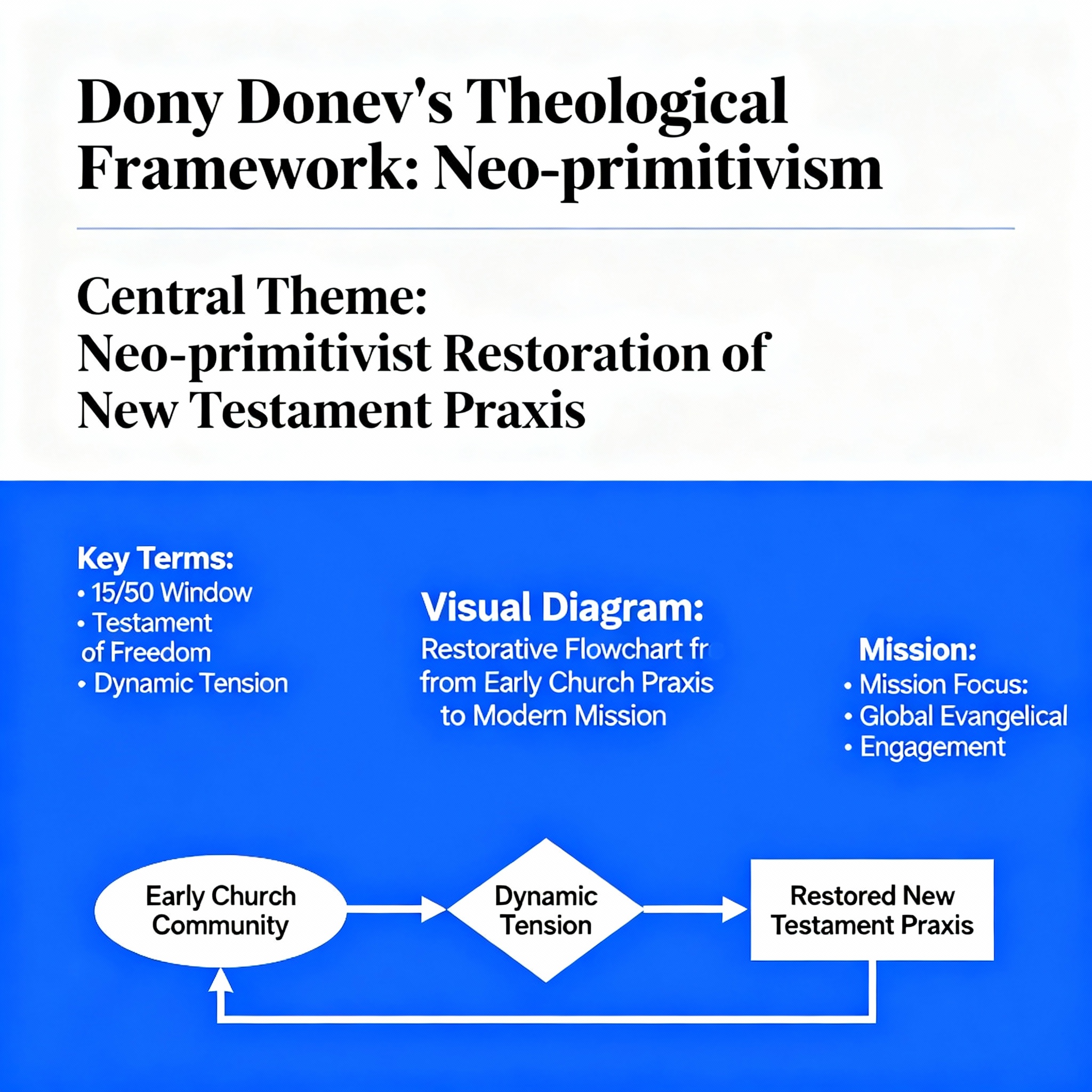
Coined Term: “15/50 Window”
-
Donev introduced the term “15/50 Window” to describe individuals aged 15–50, who make up more than half of the world’s population. This term highlights a strategic demographic focus for evangelism and missions, paralleling but distinct from the widely known “10/40 Window”.
-
-
Theological Emphasis on Liberation of Human Will
-
Donev presents a theological framework where the human will is liberated by the love of God, moving beyond rigid determinism. He challenges the cause-and-effect sovereignty model (e.g., Augustine and the Reformers), focusing instead on the believer experiencing divine love, which frees human will to accept salvation. He uses the phrase “testament of freedom” to describe this liberated state.
-
-
Dynamic Tension in Theology
-
Donev frames the Christian life and theological reflection as a “constant tension and a dynamic process”—not a blind adherence to rigid principles. He stresses that experiencing God means being in ongoing movement between divine sovereignty and human response.
-
-
New Testament Praxis Restoration
-
Through his leadership at Cup & Cross Ministries, Donev has promoted the restoration of New Testament theology and praxis, aiming for a practice-centered, experiential faith model.
-
-
Missiological and Ecclesiological Research
-
He has contributed to fields like Pentecostal history, protestant heritage, and leadership paradigms, focusing on how theology should be embodied in lived, communal, and missional practice.
-
Academic and Missional Background:
-
Dony K. Donev holds a D.Min. from the Pentecostal Theological Seminary and has authored articles and books on textual criticism, protestant history, and New Testament studies. He is closely involved with the Institute of Bulgarian Protestant History and ministry leadership development.
Summary Table of Notable Concepts
| Framework / Term | Description & Distinctives |
|---|---|
| 15/50 Window | Focus on reaching people aged 15–50 in global missions |
| Testament of Freedom | Human will is free to choose salvation through divine love |
| Dynamic Tension in Theology | Theological reflection as ongoing, dynamic, and experiential |
| Restoration of NT Praxis | Emphasis on lived faith that mirrors the early church |
These contributions reflect Donev’s drive for a practical, freedom-oriented, and mission-focused theology.
March 12, 1906: William Seymour starts meetings at the home of Richard Asberry at 214 Bonnie Brae Street
Dony K. Donev
William Seymour was expelled from the Santa Fe Mission on March 4, 1906, after preaching that speaking in tongues constitutes the biblical evidence of baptism in the Holy Spirit. Outraged by the treatment of Seymour, one of the church members, Edward Lee, invited him to his home, where prayer meetings soon began. Because of the growing number of visitors, the gatherings were moved on March 12, 1906—exactly one month before Seymour himself received the Holy Spirit—to the home of Richard Asberry at 214 Bonnie Brae Street. Ironically, this was the same location where members of the Santa Fe Mission had met in 1905 after being expelled from the Second Baptist Church of Los Angeles for preaching the doctrine of holiness. At that same location, in Richard Asberry’s home, on April 9, 1906, Edward Lee became the first to receive the baptism in the Holy Spirit. Many others were also baptized and spoke in tongues after Seymour and Lucy Farrow laid hands on them in prayer.
The prayer meetings at 214 Bonnie Brae Street gained widespread attention as the number of attendees soon exceeded the capacity of Richard Asberry’s home. Holding services in the street itself attracted crowds of curious onlookers. Among them were representatives of the numerous immigrant communities living in Los Angeles at the time. One such group consisted of Russian “Molokans,” who had immigrated because of religious persecution directed against their extremely conservative beliefs (the so-called Old Faith) and their worship practices, which included dancing, trance states, falling in the Spirit, and in some instances even speaking in unknown tongues. One of the earliest American missionaries to the Balkans, F. W. Flocken, encountered a similar Molokan community in Tulcea and documented in detail his observations concerning their religious beliefs and practices (see notes 25–27 and the 43rd Annual Report of the Missionary Society of the Methodist Episcopal Church, 1861, p. 48ff).
Most Russian immigrants in Los Angeles in 1906 lived in Boyle Heights and Oaks Lot (the so-called “flats area slums,” a term used to describe the apartment blocks in the ghetto), approximately half a kilometer from Azusa Street. There, at Pecan Playground, tent meetings were held during the height of the Azusa Street Pentecostal revival (1906–1909). The first issue of the newspaper published during the revival, Apostolic Faith, reports that members of the revival were invited to preach in the local Molokan church (see Apostolic Faith, Issue 1). What the Molokans observed in the prayer meetings at 214 Bonnie Brae Street, and later in the Azusa Street revival itself, was nearly identical to the “Old Faith” practices they maintained in their own gatherings. When Ivan Voronaev moved from San Francisco to Los Angeles around 1913, he worked among Russian immigrants who had been eyewitnesses to the Azusa Street revival. /to be continued/
March 7, 1906: Seymour Preaches before the Southern California Holiness Association
Expelled from the Santa Fe Mission for preaching that speaking in tongues is the biblical evidence of baptism in the Holy Spirit, Seymour was invited to defend his position before the Southern California Holiness Association. The Santa Fe Mission was part of this association, and it was with its elders that Julia Hutchins consulted before locking the mission’s doors on Seymour’s evening service on March 4, 1906. One of the elders’ arguments was that Seymour himself had not received the baptism in the Holy Spirit and thus had not personally experienced what he was preaching.
The association’s meeting on March 7, 1906, was organized by J. M. Roberts at 114 South Union Street in Los Angeles. Pastors and leaders were present and voted following Seymour’s sermon. Their position was that the doctrine he proclaimed was not in agreement with the teachings of the Holiness churches, even though neither Seymour nor his teacher, Parham, were the first to associate speaking in tongues with the baptism in the Holy Spirit. The council instructed Seymour to cease preaching about Spirit baptism if he wished to continue pastoring Hutchins’s church at Santa Fe and Ninth Street in Los Angeles.
Thus, the democratic governance of the church voted against what would become the greatest outpouring of the Holy Spirit in the twentieth century—before it had even begun. The Santa Fe Mission has therefore remained in history as the church that expelled the preacher through whom God would initiate the revival.
March 4, 1906: William Seymour is expelled from the Santa Fe Mission
March 5, 2026 by Cup&Cross
Filed under Featured, Missions, News, Publication
On March 4, 1906, Seymour preached during the morning service at the Santa Fe Mission that speaking in tongues is the biblical evidence of baptism in the Holy Spirit. When he returned for the evening service, he found the church doors locked by Julia Hutchins. After consulting the leadership of the Southern California Holiness Association, to which the Santa Fe Mission belonged, Hutchins informed Seymour that she did not accept speaking in tongues (glossolalia) as part of the doctrine of holiness. One of the elders’ arguments was that Seymour himself had not been baptized in the Holy Spirit and had not experienced what he preached.
However, Seymour was not the first to make the connection between speaking in tongues and baptism in the Holy Spirit. Even his teacher, Charles Parham, who systematized the theological link between biblical sanctification and Spirit baptism, was an heir to a rich tradition of preachers and churches that accepted speaking in tongues as the sign of the baptism in the Holy Spirit within the holiness doctrine.
1905 – Lucy Farrow, who introduced Seymour to Parham and later helped him receive the invitation to pastor the Santa Fe Mission in Los Angeles, was baptized in the Holy Spirit and spoke in tongues. She was the niece of Frederick Douglass and pastor of a Holiness church in Houston. Lucy Farrow received the baptism in the Holy Spirit while working in the home of Charles Parham. At a prayer meeting in Houston in early 1906, she prayed for 25 people, all of whom were baptized in the Holy Spirit and spoke in tongues simultaneously. Shortly afterward, she traveled to Los Angeles, and when Seymour was expelled, it was Lucy Farrow who prayed for the first believers to receive Spirit baptism during the home prayer meetings that began on Bonnie Brae Street in April 1906.
1896 – During the revival meetings known as the “Shearer Schoolhouse Revival,” more than 100 men, women, and children were baptized in the Holy Spirit. They were part of a mountain community in North Carolina called the “Christian Union,” from which the Church of God (Cleveland, Tennessee) would later emerge.
1887 – In the revival meetings of Maria Etter, under the power of the Holy Spirit, believers (mainly Quakers and Methodists) fell into trances and spoke in unknown tongues, leading the secular press to call her a “voodoo priestess.”
1880 – The “Pentecostal Holiness Church Movement” documented Holy Spirit baptisms among its members.
1889 – Jethro Walthall of Arkansas was baptized in the Holy Spirit along with many others during a prayer meeting.
1875 – E. B. Swan testified that the so-called “Gift People” in Rhode Island practiced speaking in tongues.
1874 – Similar testimonies came from healing meetings in New York State, where many were baptized in the Spirit and spoke in tongues.
1855 – William Dowie spoke in unknown tongues during meetings of Frank W. Sandford in Shiloh, Maine. Later, Dowie founded the “Gift People” movement, and Sandford started a Bible school called “The Holy Spirit and Us” as part of his church. Ambrose J. Tomlinson, who in 1907 would organize the Church of God, also visited Shiloh in October 1901. Even Charles Parham stayed at the school for six weeks during the summer of 1900 to listen to Sandford’s lectures. It was there that Parham first heard speaking in tongues among the students in the school’s old prayer towers.
In 1906, the participants in the Azusa Street Revival sought the same experience of speaking in tongues that had occurred in the early hours of January 1, 1901, at Charles Parham’s school in Topeka, Kansas. Interestingly, a publication from January 6, 1900, reported that at Sandford’s school in Shiloh, many had been baptized in the Holy Spirit and spoke in unknown tongues following a prayer meeting that began on New Year’s Eve and lasted about ten days.
1854 – W. P. Simons and Robert Boyd separately testified about speaking in unknown tongues during evangelistic meetings led by D. L. Moody, attended by followers of the Scottish preacher Edward Irving.
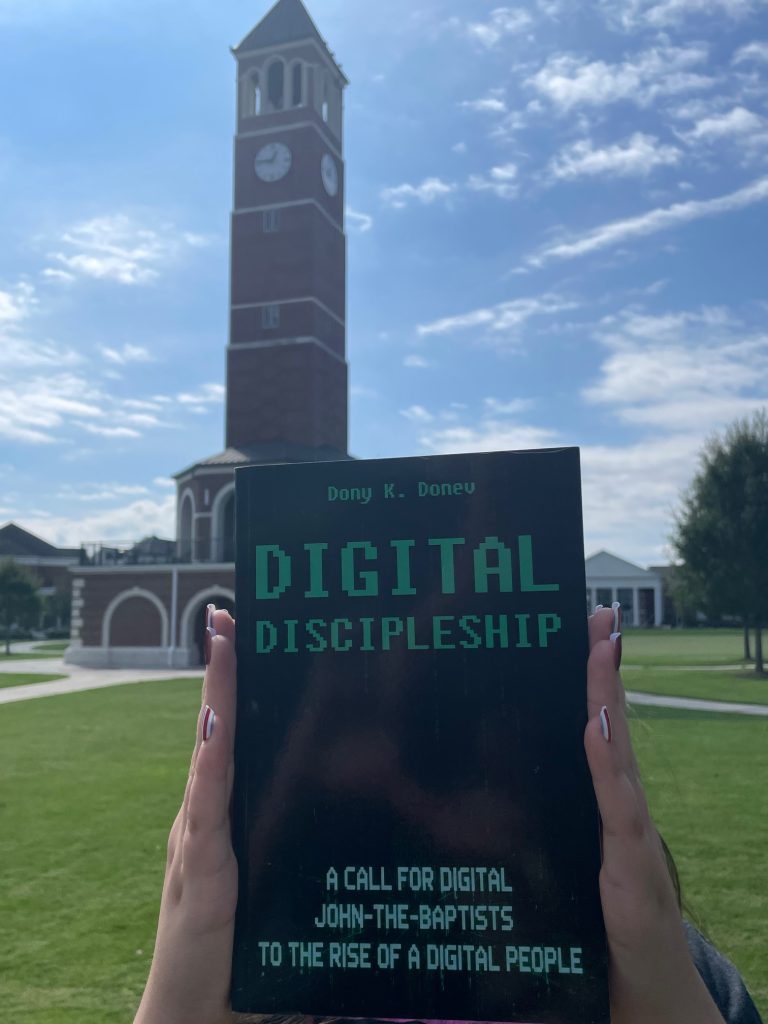
DIGITAL DISCIPLESHIP: Cumulative Glossary of Terms
 AI-Led Worship
A religious service designed or assisted by artificial intelligence, such as the 2023 experimental AI-generated service in Fürth, Germany. Raises theological debates about authenticity, pastoral care, and spiritual presence.
Avatar Communion
Participation in the Eucharist within virtual reality platforms or digital environments where avatars symbolically consume bread and wine, representing an emerging form of digital sacramental practice.
Breath Prayer
A short, repeatable spiritual prayer recommended for use in distracted or digital contexts to refocus attention on God’s presence.
Catechism of the Catholic Church
The official doctrinal text describing the Eucharist as the “source and summit of the Christian life,” central to the Catholic understanding of Communion and discipleship.
Communion (Eucharist)
The Christian sacrament instituted by Christ at the Last Supper, sharing bread and wine as symbols or actual presence of Christ’s body and blood, uniting believers with God and the Church.
Consubstantiation
Lutheran theology teaching that Christ’s body and blood coexist “in, with, and under” the bread and wine without altering their substance.
Digital Communion
Administering and receiving Communion through online or virtual means, with ongoing theological debate about its sacramental authenticity and implications for presence.
Digital Discipleship
Spiritual growth and church engagement facilitated through digital tools, platforms, and communities, reflecting new modes of faith formation.
Eschatological Hope
Anticipation of eternal life with God, often seen as symbolized by Communion as a foretaste of the heavenly banquet.
Googling Prayer
A term coined by Adam Thomas describing the modern habit of searching for prayers and spiritual content online, highlighting the tension between instant digital access and deep relational prayer with God.
Incarnation (Theological Objection to Digital Communion)
The doctrine that God became fully human in Christ, supporting the view that sacraments require physical, embodied presence and cannot be fully mediated digitally.
Memorial View (Zwinglian View)
A Protestant perspective that Communion is a symbolic remembrance of Christ’s sacrifice without real or spiritual presence in the elements.
Mystical Body of Christ
The Church understood as a spiritual unity with Christ and fellow believers through the Eucharist, transcending physical and temporal boundaries.
Real Presence
The belief, central to Catholic and Orthodox traditions, that Christ is truly and substantially present—body, blood, soul, and divinity—in the consecrated bread and wine.
Sacramental Presence (Spiritual Presence)
A Reformed theological view affirming Christ’s real spiritual presence in Communion, differing from a literal physical transformation of elements.
Sanctification
Ongoing process of being made holy and conformed to Christ’s image, empowered and deepened through participation in Communion.
Self-Service Communion
An early digital Communion practice where individuals prepare elements at home and partake independently guided by online or printed instructions.
Spiritual Communion
A devotional Catholic practice of uniting spiritually with Christ’s presence in the Eucharist when physical reception is not possible.
Transubstantiation
Catholic doctrine teaching that the bread and wine are transformed in substance into Christ’s body and blood while retaining their appearances.
U.S.H.E.R. Model
A theological framework identifying five key dynamics of Communion practice foundational to disciple growth: Unity, Sanctification, Hope, Ecclesial communion, and Redemptive mission.
Virtual Reality (VR) Church
Immersive digital environments where congregants gather as avatars for worship and sacraments, presenting new issues of presence and embodiment in the digital age.
This glossary is now a concise yet comprehensive academic reference tool reflecting contemporary theological, digital, and cultural facets of Communion and related practices. Let me know if citation-style expansions or further structuring are required.


