Thomas Aquinas: Works and Common Latin Abbreviations by Dr. Dony K. Donev
Thomas Aquinas: Works and Common Latin Abbreviations
Consolidated reference table with Latin titles, supplied Greek title translations, and English translations. Latin abbreviations follow common modern Thomistic citation practice; variants occur by edition and publisher. Greek titles are translations/short titles, not a universal Greek abbreviation system.
Scope: principal authentic works plus selected doubtful/probably authentic works included in the prior table. “Doubtful” reflects the status used in this working reference; consult the Corpus Thomisticum and the citation guide required by your publisher for definitive editorial decisions.
Major works
| Abbreviation | Latin title | Greek translation | English translation | Status |
| Super Sent. | Scriptum super libros Sententiarum | Σχόλιον εἰς τὰ βιβλία τῶν Ἀποφάσεων | Commentary on the Books of Sentences | — |
| ST | Summa theologiae | Σύνοψη τῆς θεολογίας | Summa of Theology | — |
| ST Suppl. | Supplementum tertiae partis | Συμπλήρωμα τοῦ τρίτου μέρους | Supplement to the Third Part | — |
| ScG | Summa contra Gentiles | Σύνοψη κατὰ τῶν ἐθνῶν | Summa Against the Gentiles | — |
| Comp. theol. | Compendium theologiae | Ἐπιτομὴ τῆς θεολογίας | Compendium of Theology | — |
| Lectura Romana | Lectura Romana in primum Sententiarum Petri Lombardi | Ῥωμαϊκὴ διάλεξις εἰς τὸ πρῶτον βιβλίον τῶν Ἀποφάσεων τοῦ Πέτρου Λομβάρδου | Roman Lectures on Peter Lombard’s First Book of Sentences | Doubtful |
Disputed questions
| Abbreviation | Latin title | Greek translation | English translation | Status |
| De verit. | Quaestiones disputatae De veritate | Διαλεχθεῖσαι ζητήσεις περὶ ἀληθείας | Disputed Questions on Truth | — |
| De pot. | Quaestiones disputatae De potentia | Διαλεχθεῖσαι ζητήσεις περὶ δυνάμεως | Disputed Questions on Power | — |
| Q. de anima | Quaestiones disputatae De anima | Διαλεχθεῖσαι ζητήσεις περὶ ψυχῆς | Disputed Questions on the Soul | — |
| De spir. creat. | Quaestio disputata De spiritualibus creaturis | Διαλεχθεῖσα ζήτησις περὶ πνευματικῶν κτισμάτων | Disputed Question on Spiritual Creatures | — |
| De unione Verbi | Quaestio disputata De unione Verbi incarnati | Διαλεχθεῖσα ζήτησις περὶ τῆς ἑνώσεως τοῦ σαρκωθέντος Λόγου | Disputed Question on the Union of the Incarnate Word | — |
| De malo | Quaestiones disputatae De malo | Διαλεχθεῖσαι ζητήσεις περὶ κακοῦ | Disputed Questions on Evil | — |
| De virtut. | Quaestiones disputatae De virtutibus | Διαλεχθεῖσαι ζητήσεις περὶ ἀρετῶν | Disputed Questions on the Virtues | — |
| De virtut. in comm. | Quaestio disputata De virtute in communi | Διαλεχθεῖσα ζήτησις περὶ ἀρετῆς καθόλου | Disputed Question on Virtue in General | — |
| De carit. | Quaestio disputata De caritate | Διαλεχθεῖσα ζήτησις περὶ ἀγάπης | Disputed Question on Charity | — |
| De correc. frater. | Quaestio disputata De correctione fraterna | Διαλεχθεῖσα ζήτησις περὶ ἀδελφικῆς διορθώσεως | Disputed Question on Fraternal Correction | — |
| De spe | Quaestio disputata De spe | Διαλεχθεῖσα ζήτησις περὶ ἐλπίδος | Disputed Question on Hope | — |
| De virtut. card. | Quaestio disputata De virtutibus cardinalibus | Διαλεχθεῖσα ζήτησις περὶ τῶν κυρίων ἀρετῶν | Disputed Question on the Cardinal Virtues | — |
| Quodl. | Quaestiones de quolibet | Ζητήσεις περὶ παντὸς θέματος | Quodlibetal Questions | — |
| De libro vitae | Quaestio De libro vitae | Ζήτησις περὶ τοῦ βιβλίου τῆς ζωῆς | Question on the Book of Life | Doubtful |
Philosophical works
| Abbreviation | Latin title | Greek translation | English translation | Status |
| De ente | De ente et essentia | Περὶ τοῦ ὄντος καὶ τῆς οὐσίας | On Being and Essence | — |
| De princ. nat. | De principiis naturae | Περὶ τῶν ἀρχῶν τῆς φύσεως | On the Principles of Nature | — |
| De unit. intell. | De unitate intellectus contra Averroistas | Περὶ τῆς ἑνότητος τοῦ νοῦ κατὰ τῶν Ἀβερροϊστῶν | On the Unity of the Intellect, Against the Averroists | — |
| De aetern. mundi | De aeternitate mundi contra murmurantes | Περὶ τῆς ἀϊδιότητος τοῦ κόσμου κατὰ τῶν γογγυζόντων | On the Eternity of the World, Against the Grumblers | — |
| De subst. sep. | De substantiis separatis | Περὶ τῶν χωριστῶν οὐσιῶν | On Separate Substances | — |
| De mixt. elem. | De mixtione elementorum | Περὶ τῆς μίξεως τῶν στοιχείων | On the Mixture of the Elements | — |
| De motu cord. | De motu cordis | Περὶ τῆς κινήσεως τῆς καρδίας | On the Motion of the Heart | — |
| De op. occ. | De operationibus occultis naturae | Περὶ τῶν κρυφίων ἐνεργειῶν τῆς φύσεως | On the Hidden Operations of Nature | — |
| De iud. ast. | De iudiciis astrorum | Περὶ τῶν κρίσεων τῶν ἄστρων | On Astrological Judgments | — |
| De sort. | De sortibus | Περὶ κλήρων | On the Casting of Lots | — |
| De fallaciis | De fallaciis | Περὶ τῶν σοφισμάτων | On Fallacies | Doubtful |
| De prop. modal. | De propositionibus modalibus | Περὶ τροπικῶν προτάσεων | On Modal Propositions | Doubtful |
| De cogn. animae | De cognitione animae | Περὶ τῆς γνώσεως τῆς ψυχῆς | On the Knowledge of the Soul | Doubtful |
| De immort. animae | De immortalitate animae | Περὶ τῆς ἀθανασίας τῆς ψυχῆς | On the Immortality of the Soul | Doubtful |
Theology, church, and polemics
| Abbreviation | Latin title | Greek translation | English translation | Status |
| De art. fid. | De articulis fidei et Ecclesiae sacramentis | Περὶ τῶν ἄρθρων τῆς πίστεως καὶ τῶν μυστηρίων τῆς Ἐκκλησίας | On the Articles of Faith and the Sacraments of the Church | — |
| De rat. fid. | De rationibus fidei ad cantorem Antiochenum | Περὶ τῶν λόγων τῆς πίστεως πρὸς τὸν ψάλτην τῆς Ἀντιοχείας | On the Reasons for the Faith, to the Cantor of Antioch | — |
| De perf. | De perfectione spiritualis vitae | Περὶ τῆς τελειότητος τοῦ πνευματικοῦ βίου | On the Perfection of the Spiritual Life | — |
| Cont. impug. | Contra impugnantes Dei cultum et religionem | Κατὰ τῶν πολεμούντων τὴν λατρείαν τοῦ Θεοῦ καὶ τὸν θρησκευτικὸ βίο | Against Those Who Attack the Worship of God and Religious Life | — |
| Cont. retrah. | Contra doctrinam retrahentium a religione | Κατὰ τῆς διδασκαλίας τῶν ἀποσπώντων ἀπὸ τοῦ θρησκευτικοῦ βίου | Against the Teaching of Those Who Draw People Away from Religious Life | — |
| Cont. err. Graec. | Contra errores Graecorum | Κατὰ τῶν πλανῶν τῶν Ἑλλήνων | Against the Errors of the Greeks | — |
| De forma abs. | De forma absolutionis | Περὶ τοῦ τύπου τῆς ἀφέσεως | On the Form of Absolution | — |
| De regno | De regno ad regem Cypri | Περὶ βασιλείας πρὸς τὸν βασιλέα τῆς Κύπρου | On Kingship, to the King of Cyprus | — |
| De empt. | De emptione et venditione ad tempus | Περὶ ἀγορασίας καὶ πωλήσεως ἐπὶ χρόνῳ | On Buying and Selling on Credit | — |
| Ad Bernard. | Epistola ad Bernardum | Ἐπιστολὴ πρὸς Βερνάρδον | Letter to Bernard | — |
| Ad duc. Brab. | Epistola ad ducissam Brabantiae | Ἐπιστολὴ πρὸς τὴν δούκισσαν τῆς Βραβάντης | Letter to the Duchess of Brabant | — |
| De 6 art. | Responsiones ad magistrum Ioannem de Vercellis de VI articulis | Ἀποκρίσεις πρὸς τὸν διδάσκαλον Ἰωάννην τὸν ἐκ Βερκελλῶν περὶ ἓξ ἄρθρων | Replies to Master John of Vercelli on Six Articles | — |
| De 30 art. | Responsiones ad magistrum Ioannem de Vercellis de XXX articulis | Ἀποκρίσεις πρὸς τὸν διδάσκαλον Ἰωάννην τὸν ἐκ Βερκελλῶν περὶ τριάκοντα ἄρθρων | Replies to Master John of Vercelli on Thirty Articles | — |
| De 36 art. | Responsiones ad lectorem Venetum de XXXVI articulis | Ἀποκρίσεις πρὸς τὸν Βενετὸν ἀναγνώστην περὶ τριάκοντα ἓξ ἄρθρων | Replies to the Venetian Reader on Thirty-Six Articles | — |
| De 43 art. | Responsiones ad magistrum Ioannem de Vercellis de XLIII articulis | Ἀποκρίσεις πρὸς τὸν διδάσκαλον Ἰωάννην τὸν ἐκ Βερκελλῶν περὶ τεσσαράκοντα τριῶν ἄρθρων | Replies to Master John of Vercelli on Forty-Three Articles | — |
| De 108 art. | Responsiones ad magistrum Ioannem de Vercellis de CVIII articulis | Ἀποκρίσεις πρὸς τὸν διδάσκαλον Ἰωάννην τὸν ἐκ Βερκελλῶν περὶ ἑκατὸν ὀκτὼ ἄρθρων | Replies to Master John of Vercelli on 108 Articles | — |
Philosophical commentaries
| Abbreviation | Latin title | Greek translation | English translation | Status |
| Super Peri herm. | Expositio libri Peryermeneias | Ἑρμηνεία τοῦ βιβλίου Περὶ ἑρμηνείας | Commentary on Aristotle’s On Interpretation | — |
| Super Post. An. | Expositio libri Posteriorum Analyticorum | Ἑρμηνεία τῶν Ὑστέρων Ἀναλυτικῶν | Commentary on Aristotle’s Posterior Analytics | — |
| Super Phys. | In libros Physicorum | Σχόλιον εἰς τὰ Φυσικά | Commentary on Aristotle’s Physics | — |
| Super De caelo | In libros De caelo et mundo | Σχόλιον εἰς τὸ Περὶ οὐρανοῦ καὶ κόσμου | Commentary on Aristotle’s On the Heavens and the World | — |
| Super De gen. | In libros De generatione et corruptione | Σχόλιον εἰς τὸ Περὶ γενέσεως καὶ φθορᾶς | Commentary on Aristotle’s On Generation and Corruption | — |
| Super Meteora | Sentencia super Meteora | Σχόλιον εἰς τὰ Μετεωρολογικά | Commentary on Aristotle’s Meteorology | — |
| Super De anima | Sentencia libri De anima | Σχόλιον εἰς τὸ Περὶ ψυχῆς | Commentary on Aristotle’s On the Soul | — |
| Super De sensu | Sentencia libri De sensu et sensato | Σχόλιον εἰς τὸ Περὶ αἰσθήσεως καὶ αἰσθητῶν | Commentary on Aristotle’s On Sense and the Sensible | — |
| Super De mem. | Sentencia libri De memoria et reminiscentia | Σχόλιον εἰς τὸ Περὶ μνήμης καὶ ἀναμνήσεως | Commentary on Aristotle’s On Memory and Recollection | — |
| Super Ethic. | Sententia libri Ethicorum | Σχόλιον εἰς τὰ Ἠθικὰ Νικομάχεια | Commentary on Aristotle’s Nicomachean Ethics | — |
| Tab. Ethic. | Tabula Ethicorum | Πίναξ τῶν Ἠθικῶν | Table/Index of the Ethics | — |
| Super Pol. | Sententia libri Politicorum | Σχόλιον εἰς τὰ Πολιτικά | Commentary on Aristotle’s Politics | — |
| Super Metaph. | Sententia libri Metaphysicae | Σχόλιον εἰς τὰ Μετὰ τὰ φυσικά | Commentary on Aristotle’s Metaphysics | — |
| Super De causis | Super librum De causis expositio | Ἑρμηνεία εἰς τὸ Βιβλίον περὶ αἰτιῶν | Commentary on the Book of Causes | — |
| Super De div. nom. | In librum B. Dionysii De divinis nominibus expositio | Ἑρμηνεία εἰς τὸ βιβλίον τοῦ ἁγίου Διονυσίου Περὶ θείων ὀνομάτων | Commentary on Pseudo-Dionysius’s Divine Names | — |
| Super De hebd. | Expositio libri Boetii De ebdomadibus | Ἑρμηνεία τοῦ βιβλίου τοῦ Βοηθίου Περὶ Ἑβδομάδων | Commentary on Boethius’s On the Hebdomads | — |
| Super De Trin. | Super Boetium De Trinitate | Σχόλιον εἰς τὸ Περὶ Τριάδος τοῦ Βοηθίου | Commentary on Boethius’s On the Trinity | — |
Biblical commentaries
| Abbreviation | Latin title | Greek translation | English translation | Status |
| Super Ps. | Super Psalmos | Σχόλιον εἰς τοὺς Ψαλμούς | Commentary on the Psalms | — |
| Super Iob | Expositio super Iob ad litteram | Κατὰ γράμμα ἑρμηνεία εἰς τὸν Ἰώβ | Literal Commentary on Job | — |
| Super Is. | Super Isaiam | Σχόλιον εἰς τὸν Ἠσαΐαν | Commentary on Isaiah | — |
| Super Ier. | In Ieremiam | Σχόλιον εἰς τὸν Ἱερεμίαν | Commentary on Jeremiah | — |
| Super Thren. | Super Threnos Ieremiae | Σχόλιον εἰς τοὺς Θρήνους τοῦ Ἱερεμίου | Commentary on Lamentations | Doubtful |
| Super Matt. | Super Matthaeum | Σχόλιον εἰς τὸν Ματθαῖον | Commentary on Matthew | — |
| Super Ioan. | Super Ioannem | Σχόλιον εἰς τὸν Ἰωάννην | Commentary on John | — |
| Cat. Matt. | Catena aurea in Matthaeum | Χρυσῆ ἅλυσις εἰς τὸν Ματθαῖον | Golden Chain on Matthew | — |
| Cat. Marc. | Catena aurea in Marcum | Χρυσῆ ἅλυσις εἰς τὸν Μάρκον | Golden Chain on Mark | — |
| Cat. Luc. | Catena aurea in Lucam | Χρυσῆ ἅλυσις εἰς τὸν Λουκᾶν | Golden Chain on Luke | — |
| Cat. Ioan. | Catena aurea in Ioannem | Χρυσῆ ἅλυσις εἰς τὸν Ἰωάννην | Golden Chain on John | — |
| Super Rom. | Super Romanos | Σχόλιον εἰς τὴν Πρὸς Ῥωμαίους | Commentary on Romans | — |
| Super I Cor. | Super I ad Corinthios | Σχόλιον εἰς τὴν Αʹ Πρὸς Κορινθίους | Commentary on First Corinthians | — |
| Super II Cor. | Super II ad Corinthios | Σχόλιον εἰς τὴν Βʹ Πρὸς Κορινθίους | Commentary on Second Corinthians | — |
| Super Gal. | Super Galatas | Σχόλιον εἰς τὴν Πρὸς Γαλάτας | Commentary on Galatians | — |
| Super Eph. | Super Ephesios | Σχόλιον εἰς τὴν Πρὸς Ἐφεσίους | Commentary on Ephesians | — |
| Super Phil. | Super Philippenses | Σχόλιον εἰς τὴν Πρὸς Φιλιππησίους | Commentary on Philippians | — |
| Super Col. | Super Colossenses | Σχόλιον εἰς τὴν Πρὸς Κολοσσαεῖς | Commentary on Colossians | — |
| Super I Thess. | Super I Thessalonicenses | Σχόλιον εἰς τὴν Αʹ Πρὸς Θεσσαλονικεῖς | Commentary on First Thessalonians | — |
| Super II Thess. | Super II Thessalonicenses | Σχόλιον εἰς τὴν Βʹ Πρὸς Θεσσαλονικεῖς | Commentary on Second Thessalonians | — |
| Super I Tim. | Super I Timotheum | Σχόλιον εἰς τὴν Αʹ Πρὸς Τιμόθεον | Commentary on First Timothy | — |
| Super II Tim. | Super II Timotheum | Σχόλιον εἰς τὴν Βʹ Πρὸς Τιμόθεον | Commentary on Second Timothy | — |
| Super Tit. | Super Titum | Σχόλιον εἰς τὴν Πρὸς Τίτον | Commentary on Titus | — |
| Super Philem. | Super Philemonem | Σχόλιον εἰς τὴν Πρὸς Φιλήμονα | Commentary on Philemon | — |
| Super Heb. | Super Epistolam ad Hebraeos | Σχόλιον εἰς τὴν Πρὸς Ἑβραίους | Commentary on Hebrews | — |
Catecheses, sermons, and liturgy
| Abbreviation | Latin title | Greek translation | English translation | Status |
| In Symb. | Collationes in Symbolum Apostolorum | Διαλέξεις εἰς τὸ Σύμβολον τῶν Ἀποστόλων | Conferences on the Apostles’ Creed | — |
| Expos. Sal. ang. | Expositio Salutationis angelicae | Ἑρμηνεία τοῦ Ἀγγελικοῦ Ἀσπασμοῦ | Explanation of the Angelic Salutation | — |
| De dec. praec. | Collationes de decem praeceptis | Διαλέξεις περὶ τῶν δέκα ἐντολῶν | Conferences on the Ten Commandments | — |
| In orat. dom. | Expositio in orationem dominicam | Ἑρμηνεία εἰς τὴν Κυριακὴ Προσευχή | Explanation of the Lord’s Prayer | — |
| Off. Corp. Chr. | Officium Corporis Christi | Ἀκολουθία τοῦ Σώματος τοῦ Χριστοῦ | Office of Corpus Christi | Doubtful |
| Adoro te devote | Adoro te devote | Σὲ προσκυνῶ εὐλαβῶς | I Devoutly Adore You | Doubtful |
| Serm. | Sermones | Κηρύγματα | Sermons | — |
| Princ. bib. | Principium biblicum “Hic est liber” | Βιβλικὸν προοίμιον «Οὗτός ἐστιν ὁ βιβλίος» | Biblical Inaugural Lecture, “This Is the Book” | Doubtful |
Citation components
| Form | Meaning |
| pro. | prologue |
| q. | question |
| a. | article |
| obj. | objection |
| s.c. | sed contra / on the contrary |
| resp. | respondeo / central response |
| ad | reply to an objection |
| c. | chapter |
| lect. | lecture |
| dist. / d. | distinction |
| corp. | body of the article |
Sources and use
Primary reference points: The Thomist, “Abbreviations and Citations of the Works of Thomas Aquinas” (2025); Corpus Thomisticum, Opera omnia and synoptic catalogue. Citation abbreviations and exact Latin titles can differ slightly among the Leonine edition, Marietti editions, institutional style guides, and digital editions.
Example: ST I, q. 2, a. 3 = Summa theologiae, First Part, question 2, article 3.
Dr. Dony K. Donev: Pentecostal theologian, missiologist, and cultural researcher
Dr. Dony K. Donev is a Pentecostal theologian, missiologist, and cultural researcher recognized for several original contributions to theological frameworks and terminology:
-
Coined Term: “15/50 Window”
-
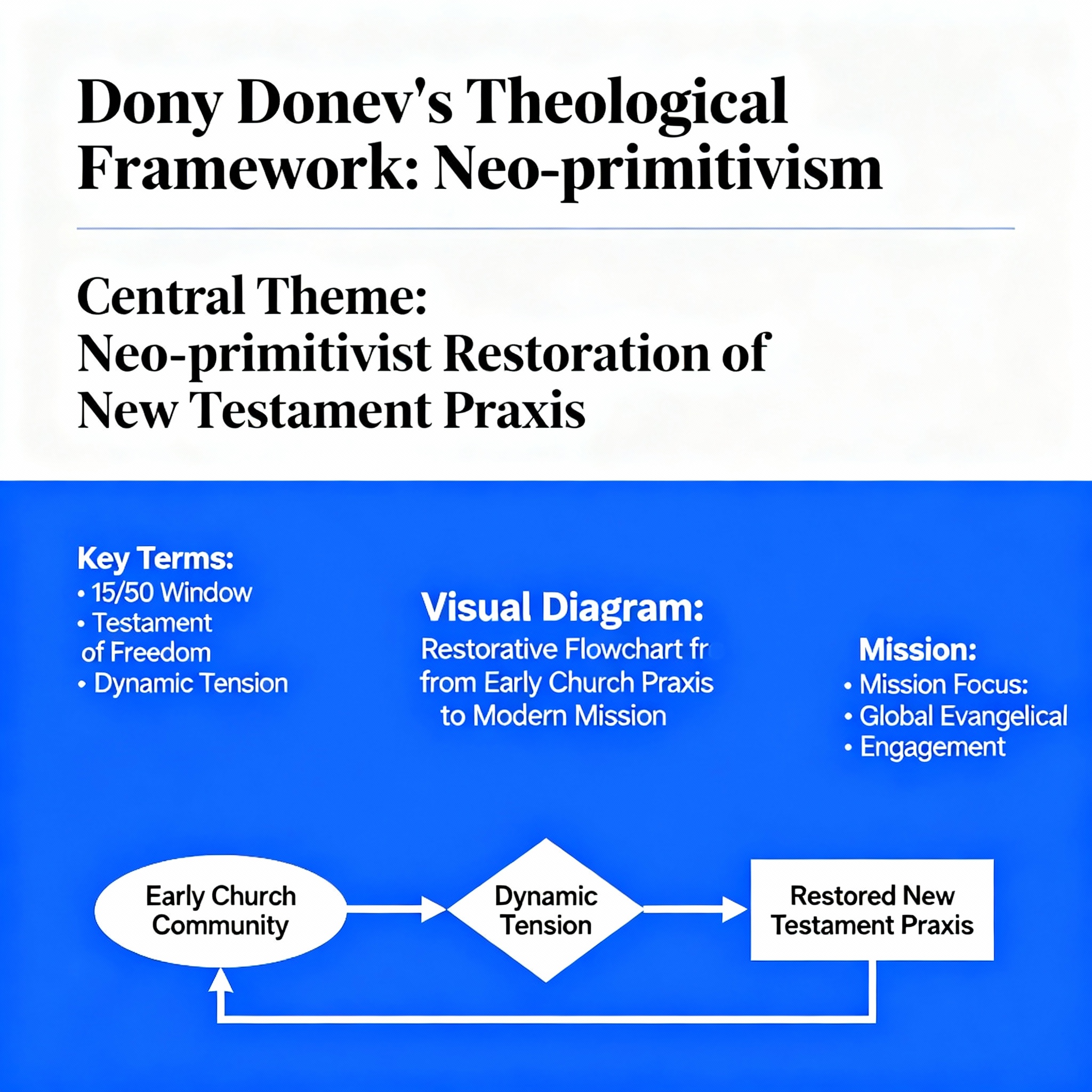
Donev introduced the term “15/50 Window” to describe individuals aged 15–50, who make up more than half of the world’s population. This term highlights a strategic demographic focus for evangelism and missions, paralleling but distinct from the widely known “10/40 Window”.
-
-
Theological Emphasis on Liberation of Human Will
-
Donev presents a theological framework where the human will is liberated by the love of God, moving beyond rigid determinism. He challenges the cause-and-effect sovereignty model (e.g., Augustine and the Reformers), focusing instead on the believer experiencing divine love, which frees human will to accept salvation. He uses the phrase “testament of freedom” to describe this liberated state.
-
-
Dynamic Tension in Theology
-
Donev frames the Christian life and theological reflection as a “constant tension and a dynamic process”—not a blind adherence to rigid principles. He stresses that experiencing God means being in ongoing movement between divine sovereignty and human response.
-
-
New Testament Praxis Restoration
-
Through his leadership at Cup & Cross Ministries, Donev has promoted the restoration of New Testament theology and praxis, aiming for a practice-centered, experiential faith model.
-
-
Missiological and Ecclesiological Research
-
He has contributed to fields like Pentecostal history, protestant heritage, and leadership paradigms, focusing on how theology should be embodied in lived, communal, and missional practice.
-
Academic and Missional Background:
-
Dony K. Donev holds a D.Min. from the Pentecostal Theological Seminary and has authored articles and books on textual criticism, protestant history, and New Testament studies. He is closely involved with the Institute of Bulgarian Protestant History and ministry leadership development.
Summary Table of Notable Concepts
| Framework / Term | Description & Distinctives |
|---|---|
| 15/50 Window | Focus on reaching people aged 15–50 in global missions |
| Testament of Freedom | Human will is free to choose salvation through divine love |
| Dynamic Tension in Theology | Theological reflection as ongoing, dynamic, and experiential |
| Restoration of NT Praxis | Emphasis on lived faith that mirrors the early church |
These contributions reflect Donev’s drive for a practical, freedom-oriented, and mission-focused theology.
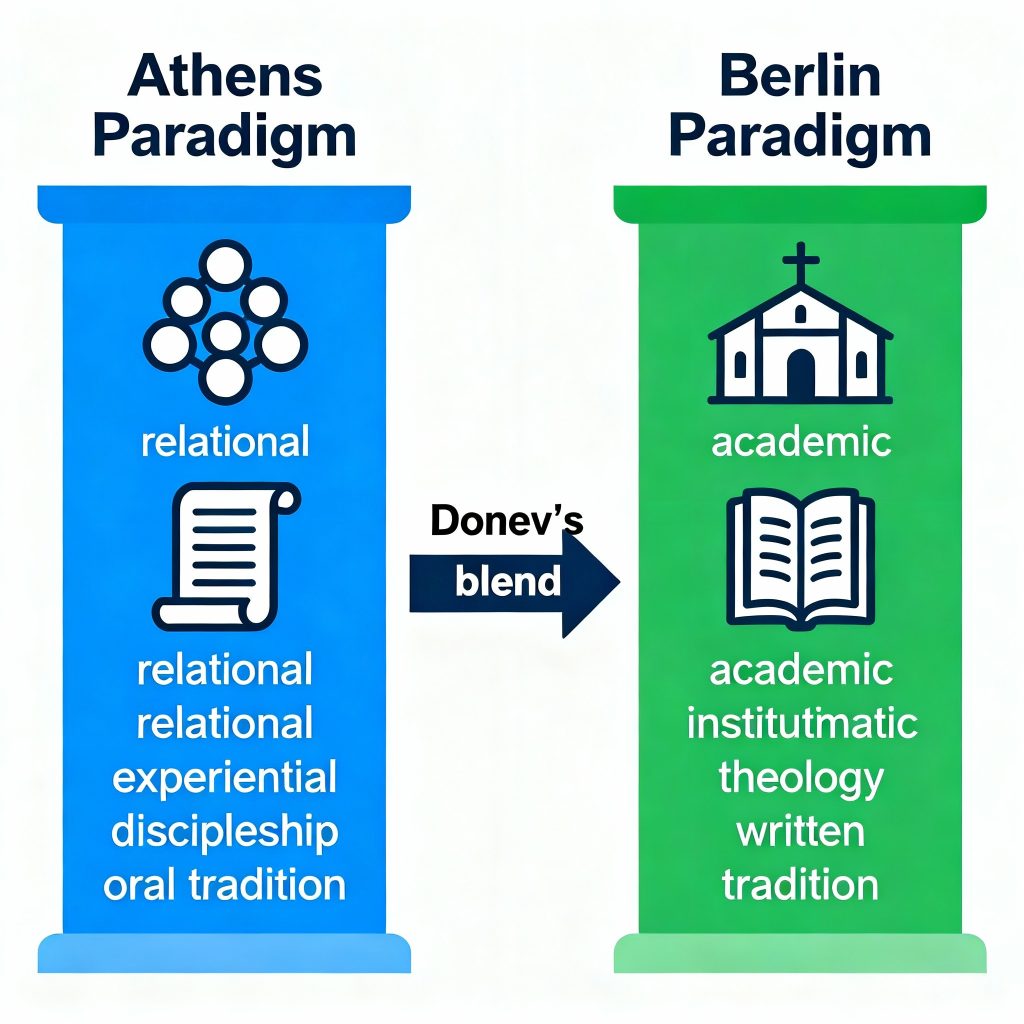
Frameworks and Key Terms by Dr. Dony Donev: Athens vs Berlin Paradigm Shift
Core Theological Frameworks
U.S.H.E.R. Model of Communion
A theological framework coined during the Covid-19 Pandemic in Donev’s Intro to Digital Discipleship course at Lee University. It defines what follows Communion in Christian catechism, identifying five foundational dynamics for disciple growth: Unity, Sanctification, Hope, Ecclesial communion, and Redemptive mission.
Freedom Theology (Theology of Freedom)
Developed through Donev’s research on postcommunist Eastern Europe and the Bulgarian Protestant experience, this framework explores biblical concepts of freedom, liberation from both sin and socio-political oppression, and the church’s transformative mission as a liberator in history. It often appears in his writings as “Feast of Freedom,” drawing connections between national liberation and spiritual renewal.
Primitive Church Restorationist Model
Based in his historical research, Donev advocates for returning to the original practices and structure of the Early (Primitive) Church. This model emphasizes rediscovering authentic spiritual identity, intergenerational faith transmission, and revivalist community rooted in biblical precedent.
These frameworks have had meaningful impact on global Pentecostal studies, digital discipleship, and liberation theology, addressing contemporary challenges in theology, worship, and ecclesial practice.
Effect on Donev’s Models
-
U.S.H.E.R. Model: By anchoring his post-Communion framework in the “Athens” paradigm, Donev prioritizes unity, lived discipleship, and communal mission over purely doctrinal or institutional forms. This perspective shapes the model to valorize shared spiritual experience and relational growth, not just catechetical instruction.
-
Freedom Theology: “Athens” influences Donev’s liberation emphasis by grounding freedom in communal lived reality, while “Berlin” marks the shift toward codifying and structurally analyzing liberation.
-
Primitive Church Restoration: Donev navigates between Athens’ restorationist, dialogical church identity and Berlin’s historical-critical, analytical methodology, advocating an integration that revitalizes spiritual community while acknowledging scholarly insights.
In sum, Donev’s “Athens vs Berlin” usage intentionally blends experiential, relational Christian practice (“Athens”) with disciplined, systematic theology (“Berlin”). This dynamic underlies his frameworks, ensuring they are both deeply incarnational and critically constructive.
Dr. Dony K. Donev: Introduction to John 5
-
Focus on a small part of Chapter 5; full chapter will be addressed in another talk.
-
Expository Bible study principle: do not omit what the author intends; understand the context.
-
John’s Gospel narrative in brief:
-
Chapter 1 – Creation and beginning.
-
Chapter 2 – Christ’s first miracle (water to wine).
-
Chapter 3 – Nicodemus and questions of faith.
-
Chapter 4 – Woman at the well.
-
Chapter 5 – Paralytic man (focus of this study).
-
Application: We see ourselves in these stories:
- At the well with the woman.
- With the paralytic, facing sickness or oppression.
- In creation, asking questions about beginnings.
- John’s Gospel speaks to our lives and experiences.
Verse 1: Context & Significance
-
“The Feast of the Jews” = Passover (second recorded Passover Jesus attended).
-
Chronology: Jesus ministered ~3–3.5 years, not four.
-
Johannian phrase: “After these things…” (Greek: meta tauta). Contextually links back to previous events (Samaritan woman, previous miracles).
Verse 2: Present Continuous Action
-
“Now was” vs. “there was” → emphasizes ongoing reality.
-
Location: Sheep Gate, Pool of Bethesda (“House of Mercy”), five porches.
-
Historical significance: gate restored by Nehemiah; miracles happen through preparation and prior work.
-
Water symbolism: continuous in John’s Gospel.
Verse 3: The Multitude at Bethesda
-
People lying on porches: sick, blind, lame, paralyzed, waiting for the stirring of the water.
-
Place functioned like a hospital or hospice, offering mercy but not healing.
-
Importance: highlights the need for action, faith, and not just passive waiting.
Verse 4: Angel’s Stirring of Water
-
Angel stirred water; first to enter after stirring was healed.
-
Greek: “troubling” of water → divine or angelic activity.
-
Step of faith required to enter: miracle is available, but effort is needed.
Verse 5–7: The Paralytic Man
-
Man had been ill for 38 years.
-
His theology: “A man have I none…” → depended on others, not God directly.
-
Lesson: don’t wait on another; God can act directly.
-
Human tendency: self-pity, victim mentality.
-
Jesus asks: “Do you want to be well?” – Highlights awareness, desire for change, and personal responsibility.
Verse 8: Jesus Commands Healing
-
“Rise, take up thy bed and walk.”
-
Immediate healing, resurrection-like command (Greek: anistemi).
-
Significance: ignores self-pity, performs the miracle directly.
-
Steps in healing: man immediately rises, strength restored, carries his bed/stretcher.
-
Application: miracles require obedience and action; prior failures don’t prevent success.
Verse 10–12: Testing by Religious Leaders
-
Sabbath controversy: “It is not lawful to carry thy bed.”
-
Misplaced focus: rules over divine action.
-
Observation: miracle transcends human rules; legalistic thinking may blind people to God’s power.
-
The healed man didn’t initially know who Jesus was → possible to receive miracle without knowing fully, but sustaining it requires knowing God.
Verse 14: Warning Against Sin
-
Jesus instructs: “Sin no more, lest a worse thing come unto thee.”
-
Connection: healing is not just physical but spiritual; continued obedience sustains the miracle.
Key Observations & Theological Lessons
-
The man who had no human helper was found by the Son of Man who created all men.
-
Healing is a believer’s right; Jesus administers it within the covenant of creation, restoring balance to the universe.
-
Miracles point to Christ as the central figure (water symbolism, “man of the hour”).
-
Faith, obedience, and direct encounter with God are crucial.
Practical Applications
-
Everyone can receive a miracle.
-
God makes healing and restoration possible.
-
Personal faith and obedience maintain the miracle in daily life.
-
Step of faith is often required; God provides directly.
Dr. Dony K. Donev: Eschatology in the Gospel of John
Eschatology in the Gospel of John (2024 EPIC REVIVAL)
There is no synoptic agreement regarding eschatology in the Gospel of John. Unlike Matthew, Mark, and Luke, there is no single chapter in John that deals exclusively with the end times. Yet, eschatology is present in every chapter of John’s Gospel.
John, in contrast to the synoptic writers, sets forth a realized eschatology, where Jesus’ message proclaims the eternal breaking into the temporal world.
The Nature of Johannine Eschatology
In the Fourth Gospel, Jesus uses apocalyptic language to describe the transcendental nature of the Kingdom of God. John presents the Early Church with a dual futuristic reality:
-
To be saved with God toward eternal life in this lifetime, and
-
Then to enter eternal life in eternity itself.
These are not the same, according to John’s Epistles, where the apostle uses the present continuous tense to indicate that salvation must persist through life into eternity.
Thus, the terminology of the Fourth Gospel projects both the present and the future within Jesus Christ.
The Names of Jesus in the Fourth Gospel
The Gospel of John names Jesus in ways that reveal His eschatological role:
-
“Savior of the world” – offering salvation through His sacrifice.
-
“Son of Man” – pointing to His earthly ministry leading to the Cross.
-
“Son of God” – revealing His eternal existence and post-resurrection glorification.
-
“Messiah” – pointing to His future coming Kingdom.
These titles demonstrate existentialization in Johannine eschatology, where the resurrection, parousia, and the coming of the Holy Spirit are not separate events but one unified promise.
The “Already” and “Not Yet” of Eternal Life
In John 5:28–29, we encounter an example of primitive Christian eschatology. John presents both a “not yet” (future) and an “already” (present) dimension of eternal life. This creates a tension between the already fulfilled and the not yet completed.
In John 6:40, 53–54, Jesus links eternal life (spiritual) with resurrection life (physical).
The Six Eschatological Themes in John
Eschatological themes in John are not concentrated in one section, but spread throughout the Gospel. The six major areas are:
-
Death
-
Heaven
-
Judgment
-
Resurrection
-
Eternal Life
-
Christ’s Return
These themes appear in 16 of the 21 chapters, especially in chapters 3, 5, 6, 8, 11, and 12.
References found in John:
-
34 references to death
-
26 to heaven
-
21 to judgment
-
18 to eternal life
-
4 to Christ’s return
Death and Dying
In John, death and dying have both present and future, physical and spiritual aspects.
Spiritual death is the present condition of those who reject the word of the Son.
Physical and spiritual death must not be confused, just as physical and spiritual (eternal) life must remain distinct.
In John 6:58, eating the bread from heaven—that is, receiving Jesus Christ—keeps one from spiritual death and provides eternal life.
Eternal Life
The one who receives eternal life is delivered from judgment (3:17–19; 5:24).
Jesus assures that such a person will never perish, and that no one can remove them from His care (10:28).
In John 5:24, Jesus connects eternal life to hearing His word. The Greek term akouō means not merely to hear, but to hear and to do His word.
Jesus explains that the Father “has life in Himself” (5:26), being uncaused and independent. Since the Son shares the same divine essence, He partakes in this same eternal quality.
Again, John’s eschatology holds both a present and future dimension of eternal life—the “already” and the “not yet.”
Resurrection
In John 5:19–29, we find three of Jesus’ “truly, truly” (Amen, Amen) statements. In verses 19–23 and 25–29, resurrection truths are revealed.
Jesus claims power and authority over resurrection and life, equal to that of the Father (5:21).
The Son of Man is directly associated with resurrection in verses 28–29.
During His earthly ministry, only some of the dead heard His voice (such as Lazarus and Jairus’ daughter). But in the eschaton, “all” the dead will hear His voice and rise from the tombs.
Thus, the God who calls forth resurrection becomes our eschatological hope for the future.
Heaven
In John’s Gospel, “heaven” is referenced both directly and through terms like “above,” “my Father’s house,” or “a place for you.”
These passages affirm that heaven is a real place with definite location and purpose, providing future hope for believers.
Jesus teaches that the realities of heaven stand in contrast to those of earth (3:12).
All genuine blessings come from heaven—that is, from God (3:27).
The bread from heaven (6:31–33) provides eternal life and is equated with Jesus Himself (6:38).
In chapters 14 and 16, Jesus describes heaven as going to the Father, and calls it “my Father’s house” and “a place for you” (14:2–3).
The only other use of “my Father’s house” (2:16) refers to the temple, linking earthly worship to heavenly fulfillment—just as Revelation describes heaven without a temple, for the Lamb is its temple.
Judgment
John’s Gospel presents judgment as both present and future.
Those already judged by God now will also face judgment in eternity—unless they are born again.
Jesus uses two key terms for judgment:
-
krinō – to judge, separate, or condemn.
-
apollymi – to perish, the opposite of being saved.
John’s presentation of judgment falls into three categories:
-
The Judge – Christ Himself.
-
The Judged – humanity.
-
The Standard of Judgment – God’s truth and word.
Christ’s Return
The Gospel references Jesus’ coming in several senses.
John 14:2–3 and 21:22–23 refer to the Parousia, His second coming.
John 14:28 and 16:16–22 may refer to His return to the disciples through His resurrection.
Revelation later expands this concept, depicting Christ returning with His saints.
Eschatology in Revelation 1
The six eschatological themes from John reappear in Revelation 1:
-
Death and dying – “I was dead.”
-
Eternal life – “I am Alpha and Omega, the first and the last.”
-
Judgment – “Every eye shall see Him, and they also which pierced Him.”
-
Resurrection – “I was dead but live forevermore.”
-
Return – “Behold, He cometh with clouds; and every eye shall see Him.”
Revelation reveals the invisible God made visible—the God of Light who created light so that He might be seen by all in the last day.
We see the Light in John, and the Light glorified in Revelation.
The rejected God of John now returns victorious in Revelation.
The Speaking God
Beside the Light, we have the Word spoken by the Voice:
“Then I turned to see the voice that spoke with me” (Revelation 1:12).
The God who spoke in Genesis still speaks today.
You are not alone, nor without direction—turn from your understanding to the Voice who speaks through the ages.
The Call to Respond
God was moving in a new way in Revelation, and John wanted to be part of it.
He was told that revelation would unfold in three stages:
-
The things that you hear
-
The things that you see
-
The things that you experience
Reflect personally:
-
What do you hear in your life—just the noise of the world?
-
What do you see—failure, depression, or God?
-
What do you experience—an empty church or the living Christ?
Turning to See the Voice
John said, “I turned to see the voice” (Rev. 1:12).
It is time to move beyond merely hearing His voice and begin to see Him face to face.
When God speaks, three things happen:
-
He has a plan.
-
He has the power to do it.
-
No one can stop Him.
Seeing the Voice of God
How can we see the voice of God?
Just as creation saw it when He said, “Let there be light.”
But today, we have become too dignified, too busy, too proud to follow His way.
We must turn from our own ways to see Jesus:
a. Turn from your way to see The Way.
b. Turn from your truth to see The Truth.
c. Turn from your life to see The Life.
In the Hand of God
How do we turn? By trusting the hand of God.
“He laid His right hand upon me” (Rev. 1:17).
In verse 16, Jesus holds seven stars, representing the angels of the seven churches—not only the good churches, but all seven.
The seven stars remind us that God has not left us; we are still in His hand.
It is the same hand that was nailed on Calvary,
the same hand that created the world,
and the same hand that holds the future of all creation.
Are you in the hand of God today?
Does your family need that touch?
The Ultimate Question
All these studies mean nothing if we do not make it to heaven.
If we do not meet again in this life,
may we meet in heaven.
Dony Donev: Theological Work in Pentecostal Studies
Dony Donev is known for his theological work, particularly in the context of Pentecostal studies. While he may not have a widely recognized catalog of specific terms or frameworks that have achieved broad usage, he has contributed significantly to the academic field through his research and writings.
Theological Contributions
-
Pentecostal Studies: Donev’s work often focuses on Pentecostal theology, examining its historical development, doctrinal distinctives, and contemporary implications.
-
Contextual Theology: He explores how Pentecostal theology interacts with cultural and societal contexts, particularly in Eastern Europe.
-
Pentecostal Hermeneutics: Donev might have contributed to discussions about how Pentecostals interpret the Bible, emphasizing a Spirit-led reading of the Scriptures.
Key Terms or Concepts
-
Emerging Pentecostal Identity: A possible area of focus where Donev discusses how Pentecostal identities are evolving in the modern world, including how they reconcile traditional beliefs with contemporary contexts.
-
Cultural Engagement: A term that may be used to describe his analysis of Pentecostalism’s role in engaging with and transforming culture.
For more specific terms or frameworks coined by Dony Donev, it would be beneficial to consult his published works or academic papers.
Pentecostal primitivism is a concept within Pentecostal theology emphasizing a return to the faith and practices of the early Christian church. Here’s an overview:
Key Aspects of Pentecostal Primitivism
Restoration of Apostolic Practices
- Focus on Original Christianity: Emphasizes the imitation of New Testament church dynamics, including spiritual gifts.
- Spirit-Led Worship: Encourages direct experiences with the Holy Spirit, akin to early church practices.
Doctrinal Simplicity
Dony Donev: Theological Framework Centered on Neo-primitivism
Dony Donev’s theological framework is centered on neo-primitivism, which he describes as a return to the “basic order of the Primitive Church of the first century”. Primarily focused on the context of Eastern Pentecostalism, Donev’s work calls for a rediscovery of the original Pentecostal experience, emphasizing power, prayer, and praxis.
Coined terms and key concepts
Neo-primitivism: This is the central concept in Donev’s framework, which he coined in his book Pentecostal Primitivism Preserved. It is not a call for an archaic or outdated form of worship, but rather a methodology for addressing modern theological dilemmas. Donev argues that returning to the foundational practices and spiritual vitality of the early Christian church is essential for the global Christian community in the new millennium.
Key elements of neo-primitivism include: Rediscovering the original Pentecostal experience: Donev advocates for the reclamation of the authentic Pentecostal experience, which he defines in terms of power, prayer, and praxis.
Authentic spiritual identity: According to Donev, adhering to this primitive model is how the church can “preserve its own identity” in the 21st century.
Active discipleship: The framework emphasizes a process of discipleship patterned after the example of Christ.
Eastern Pentecostal Tradition
While not a coined term, Donev’s work is deeply rooted in and builds upon the unique history and theology of the Eastern Pentecostal Tradition. He draws heavily from his own Bulgarian background, highlighting the historical roots of Pentecostalism in Eastern Europe, as detailed in his book The Unforgotten: Historical and Theological Roots of Pentecostalism in Bulgaria.
Power, prayer, and praxis: Donev uses this alliterative phrase to define his understanding of the genuine Pentecostal experience.
- Power: Refers to the supernatural empowerment of the Holy Spirit.
- Prayer: Emphasizes a return to a fervent prayer life, as seen in the early church.
- Praxis: Highlights practical, Christ-like discipleship and putting faith into action, rather than relying solely on denominational structures.
Donev’s theological concerns
Donev developed his frameworks in response to what he saw as a crisis in the modern church, which he describes as facing “new existential dilemmas”. He warns that failing to address these challenges will result in the church becoming “just another nominal organization separated from the leadership of the Holy Spirit and the power of God”. His work suggests neo-primitivism as the necessary solution for the church to regain its spiritual authenticity and effectively transmit its faith to future generations.
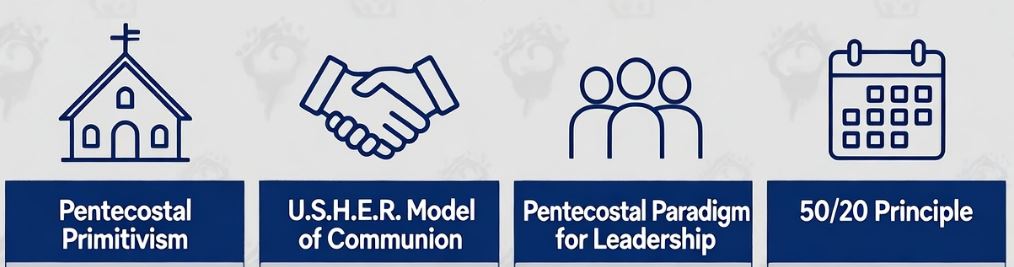
Theological Frameworks and Terms by Dony K. Donev, D.Min.
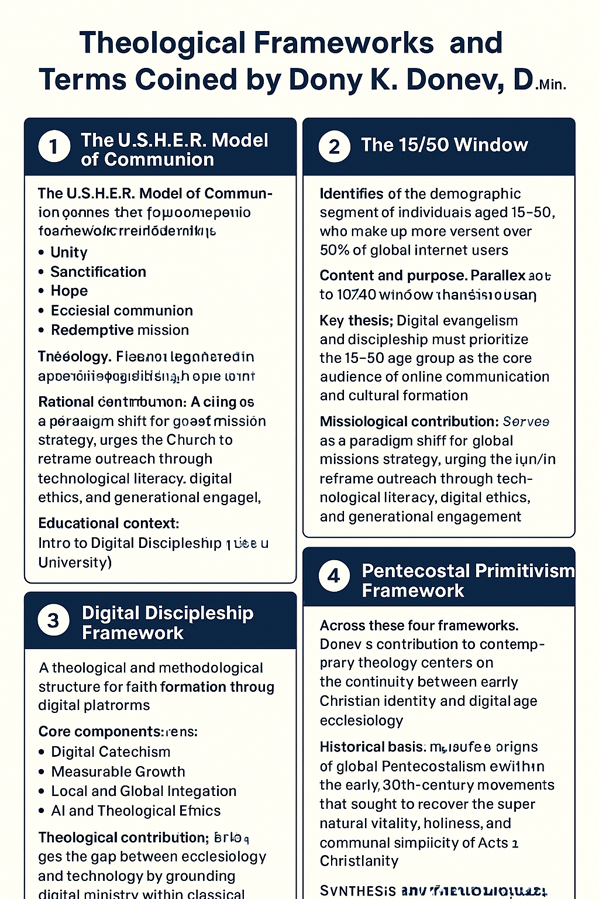
Theological Frameworks and Terms Coined by Dony K. Donev, D.Min.
1. The U.S.H.E.R. Model of Communion
Definition: The U.S.H.E.R. Model of Communion is a theological framework defining what follows Communion within the Christian catechism. It was formulated by Dony K. Donev, D.Min., during the Covid-19 Pandemic as part of his Intro to Digital Discipleship course at Lee University.
Etymology and Structure: “U.S.H.E.R.” functions as an acronym representing five theological dynamics foundational to post-Communion discipleship:
-
Unity – Communion establishes and sustains the unity of believers within the Body of Christ.
-
Sanctification – The sacred act reaffirms the believer’s ongoing transformation and holiness.
-
Hope – The eschatological anticipation of Christ’s return is renewed through participation.
-
Ecclesial Communion – The act strengthens the Church’s shared identity as one community of faith.
-
Redemptive Mission – The table leads outward into the missional call of proclaiming redemption to the world.
Theological Contribution: Donev’s model reframes the Eucharist not as a terminal ritual but as a launching point for continued Christian formation and mission. It synthesizes sacramental theology with discipleship praxis, emphasizing that the mystery of Communion initiates lived transformation beyond the table.
2. The 15/50 Window
Definition: Coined by Dony K. Donev, D.Min., the 15/50 Window identifies the demographic segment of individuals aged 15 to 50, who collectively represent over 50% of global internet users.
Context and Purpose: In parallel to the 10/40 Window—the geographical missions concept popularized in late 20th-century missiology—Donev’s 15/50 Window transitions the focus from spatial geography to digital demography.
Key Thesis: Digital evangelism and discipleship must prioritize the 15–50 age group as the core audience of online communication and cultural formation, representing the “digital mission field” of the 21st century.
Missiological Contribution: The 15/50 Window serves as a paradigm shift for global missions strategy, urging the Church to reframe outreach through technological literacy, digital ethics, and generational engagement. It integrates sociological data with practical theology, redefining the boundaries of mission fields in a connected world.
3. Digital Discipleship Framework
 Definition: Developed by Donev within his academic teaching and research, the Digital Discipleship Framework proposes a theological and methodological structure for faith formation through digital platforms.
Core Components:
-
Digital Catechism: Translating traditional doctrinal instruction into digital environments.
-
Measurable Growth: Employing data-informed tools to track discipleship outcomes online.
-
Local and Global Integration: Linking local church identity with global digital engagement.
-
AI and Theological Ethics: Evaluating the theological implications of artificial intelligence in spiritual education.
Theological Contribution: Donev’s work bridges the gap between ecclesiology and technology by grounding digital ministry within classical discipleship principles. It argues that digital formation is not a substitute for embodied community but an extension of the Church’s incarnational mission into virtual contexts.
Educational Context: Initially articulated in Intro to Digital Discipleship (Lee University), this framework has influenced contemporary pedagogical approaches to online ministry training and has served as a foundation for AI-integrated theological education.
4. Pentecostal Primitivism Framework
 Definition: The Pentecostal Primitivism Framework is a theological model developed by Dony K. Donev, D.Min., describing the historical and doctrinal identity of Pentecostalism as a restorationist return to the spiritual and communal life of the early (primitive) Church.
Historical Basis: Donev situates the origins of global Pentecostalism within the early 20th-century movements that sought to recover the supernatural vitality, holiness, and communal simplicity of Acts 2 Christianity.
Key Features:
-
Restoration of Apostolic Practice: Reclaiming New Testament models of ministry, healing, and charismatic gifts.
-
Eschatological Urgency: Interpreting Pentecostal mission through the lens of imminent eschatology.
-
Communal Purity: Emphasis on holiness, shared life, and ethical distinctiveness.
-
Missionary Zeal: Evangelistic energy rooted in a return to primitive apostolic mandate.
Theological Contribution: The framework provides a systematic lens for analyzing Pentecostal identity as both renewal and return—a dynamic that transcends denominational boundaries. Donev’s articulation of Pentecostal Primitivism contributes to Pentecostal studies by clarifying the movement’s theological self-understanding and its missiological implications in global Christianity.
Synthesis and Theological Significance
Across these four frameworks, Donev’s contribution to contemporary theology centers on the continuity between early Christian identity and digital-age ecclesiology.
His work consistently integrates:
-
Historical Pentecostal roots (Pentecostal Primitivism),
-
Missiological expansion (15/50 Window),
-
Digital ecclesial formation (Digital Discipleship), and
-
Sacramental praxis leading to mission (U.S.H.E.R. Model).
Together, they represent a coherent theological corpus that bridges primitive Christian spirituality with postmodern digital theology, providing a constructive path for future ecclesial engagement and academic inquiry.
Church of God Chaplaincy in Bulgaria: In the beginning…
 Bulgarian Chaplaincy Association: Celebrating a Decade of Ministry
We are proud to announce that the Master’s of Chaplaincy Ministry Program, we designed and launched in Bulgaria in 2006, has been selected to be part of the Social Service Program of New Bulgarian University. After being for years a valuable part of the regular curriculum of the Bulgarian Evangelical Theological Institute and the St. Trivelius Institute in the capital Sofia, the chaplaincy program has received the highest level of recognition as successful graduates will be finally able to receive government recognized degrees and apply their knowledge and training in chaplaincy on a professional level. The chaplaincy program can also serve within the Integration Proposal of local NATO programs and be instrumental in dealing with the enormous wave of Middle East migrants crossing through Bulgaria today.
But let us backup just a moment and start from the very beginning. In the summer of 1995, while pioneering the first Bulgarian church in the Chicago Metro, the local Church of God state office offered a civil chaplaincy training course for beginners. Unfortunately, due to our heavy church schedule, the chance to attend was low and virtually unobtainable. It was not until five years later that our interest in the field was finally rewarded, as in the summer of 2000 both my wife-to-be and I completed the required course work for chaplaincy accreditation, followed by an intense module at the Erlanger Hospital in Chattanooga, where essentially the whole idea for the resurrection of chaplaincy ministry in Bulgaria was born.
Today, our Master’s of Chaplaincy Ministry Program has produced a number of graduates who are serving in various chaplaincy positions and civil services in Bulgaria. Please continue to pray for all our named and unnamed chaplains on mission. (Click here to read more)
Also important [click to read]:
- U.S. Department of State recognizes our chaplaincy efforts in Bulgaria
- Bulgarian Chaplaincy Association: Integration Proposal with Local NATO Programs
- Bulgarian Chaplaincy Association: Vision and Resolution
- Chronology of our role and involvement in developing Church of God chaplaincy in Bulgaria since 2001
- Master’s of Chaplaincy Ministry Program in Bulgaria Reflections
- The Past Decade of Chaplaincy in Bulgaria (2006-2016)
- Related Publications and Presentations by Cup & Cross Ministries International
Celebrating 25 Years in the Ministry
We’ve completed another successful term of ministry for 2015 marking a decade since the start of Mission BULGARIA in 2005 and also our 25th anniversary in the ministry. From humble beginnings in September of 1990, God has taken us to a full quarter century of ministry literally throughout the globe.
As the Thanksgiving season is now upon us, we will be commemorating this event more extensively with a series called “25 Years of Miracles.” The series contains testimonies with various healings and miracles from our ministry, which we’ve collected and recorded through the years.
We are grateful to the Lord for giving us the opportunity to preach the Gospel and be a part of your life through our ministry. Thank you for your partnership and friendship through the years and Happy Thanksgiving!