

VBS for Adults

For reasons obvious to most of our readers, I was able to attend no less than 10 (ten) VBS/Kids crusades this summer. Seven Baptist, several Pentecostals and a Methodist one.
The themes ranged from jungle journey and the Lion King to giddy up cowboys and cowgirls and world/planet/time travelling. All cool themes with lots of props and much careful preparation all in the name of bringing the Good News to the little ones. A noble cause truly worthy of any expense and labor for any church out there.
Time and length ranged from one whole day or one evening service to three nights and even several week long ones. For most of it, the ones held in most Baptist churches were designed by LifeWay and were well structured with kids constantly moving from station to station. The rest were somewhat free style, but still designed with the expectation of lots of children attending. In between each module there was candy, snacks or even a full blown supper.
The location of each VBS and the way it was designed for the crowd flow made the initial impression important. Signs welcoming and directing newcomers were grate, but the friendliness of the people made up for less signage and more human touch. Registration was a must and parents’ preferences were not taken lightly. The decorations of each room helped the children adjust to the new setting and work through the set curriculum. And yes, lots of kids made lots of mess so cleanness in class rooms, play areas and bathrooms were tended to. Some churches had a designated team that made sure the facilities were clean for the next group. And where cleanness was not intentional, it was observed that many parents did not return with their children.
Most VBS programs were designed around age groups. Some included even classes for toddlers and several had adult classes too. The ones that did not, included a family night toward the end of the week for parents to attend. A family night was a great feature for parents who did not attend but dropped their kids every night and picked them up afterwards. They were addressed with materials and opportunities for a spiritual renewal.
The thematic VBSs progressed with learning daily and build up on the previous day. The groups of children toggled between Bible lesson, crafts, games and lots of music. Kids were greatly encouraged to participate and learn the songs and dancing, recite Bible verses and answer questions from the covered material. Some parents participated too.
Prayer was made a central focal point for most of the VBSs observed. The Baptists ones, especially, had pledges of allegiance at the start of the service and assembly with prayer toward the end. A memorable experience for all children who enjoy social setting, making new friends and learn the Bible.
Here are several take ways to observe for a VBS in your church:
- Prepare for lots of children – if you have it they will come
- Train your workers. Form teams for each task. Assign measurable goals to ensure smooth moving through the program
- Self designed VBS programs work as good as the paid ones, as long as designed with the children and families in mind
- Chose the length of the event carefully with regard of your constitutions. For the most of it, less is really more.
- Do not underestimate friendliness, cleanness and the safety of the children.
- Don’t miss a family day. Everyone likes hot dogs and water slides on a hot summer day.
This goes without saying, but focus on God – it is easy to lose track and purposes in the larger design of such events.
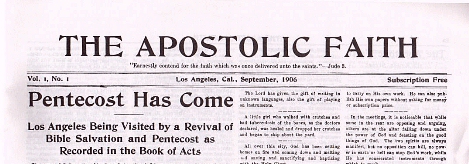
PENTECOST has COME
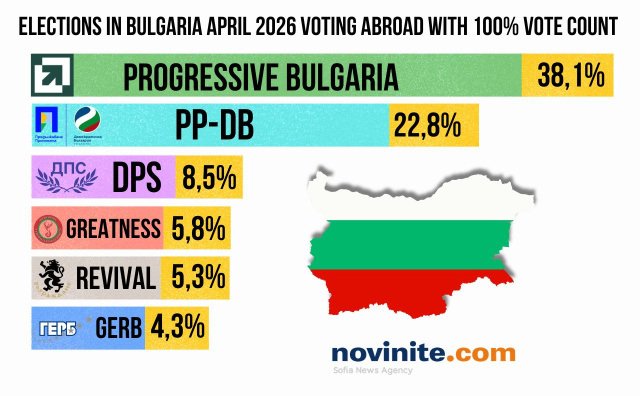
BULGARIA after 2026 Elections: Putin’s Trojan Horse in EU…
Bulgaria’s President Rumen Radev, a military general and pilot, is now Bulgaria’s new Prime Minister. He has served two presidential terms, and in January 2026 he resigned from office and entered the early parliamentary elections. Radev’s decisive victory in the parliamentary elections is a guarantee of absolute Parliamentarian majority for the first time since 1997.
A former member of the Communist Party, he has often taken ambiguous positions regarding Russia, considering Crimea to be ‘Russian’ and criticizing the European sanctions imposed in response to the war.” Given Radev’s attitude toward Putin and Russia, there is a risk of a pro-Kremlin government at a critical moment — he would be Putin’s Trojan horse in Europe.
DW: ‘A Trojan Horse for Putin’: Foreign media on the elections in Bulgaria
France-Presse recalls that during his campaign, Radev called for “practical relations with Russia, based on mutual respect and equal treatment.”
POLITICO: Pro-Russian candidate Rumen Radev emerges as the winner of the elections in Bulgaria
CNN: Bulgaria’s Kremlin-friendly ex-president wins election in landslide
BBC: The election was called after the previous government tried to push through a controversial budget in December, prompting mass protests which Radev, as president, supported.
FoxNews: Tired of political turmoil, Bulgarians give ex-president a convincing mandate for change
ALIVE!
 Rev. Dony K. Donev, D. Min.
“When I call to remembrance the unfeigned faith that is in thee, which dwelt first in thy grandmother Lois, and thy mother Eunice; and I am persuaded that in thee also.”
2 Timothy 1:5
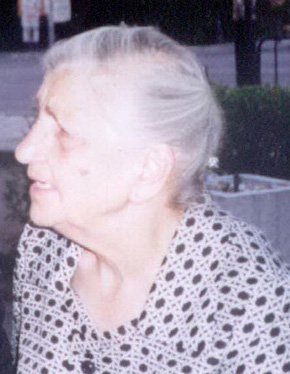
My Grandma, Todorka Mindova, was one of the first Sunday school teachers in the Bulgarian Pentecostal Union. After successfully graduating from a training course in the city of Sliven led by Donka Kinareva and personally organized by Dr. Nicolas Nikolov, she was allowed to minister in the denomination. But for grandma, the faith was more than teaching or a sermon. It was life. Many Bulgarian Pentecostal ministers can testify to the effectiveness of her ministry. And for her constant fasting and thousands of answered prayers I could write a book.
But far more interesting for me as a child was the fact that being a Sunday school teacher, Grandma never tried to preach to me. In the hardest moments of life she would only confess these words, which I have remembered from my childhood: “We serve a living God.” More was not needed. For Grandma preached with her life. Read more
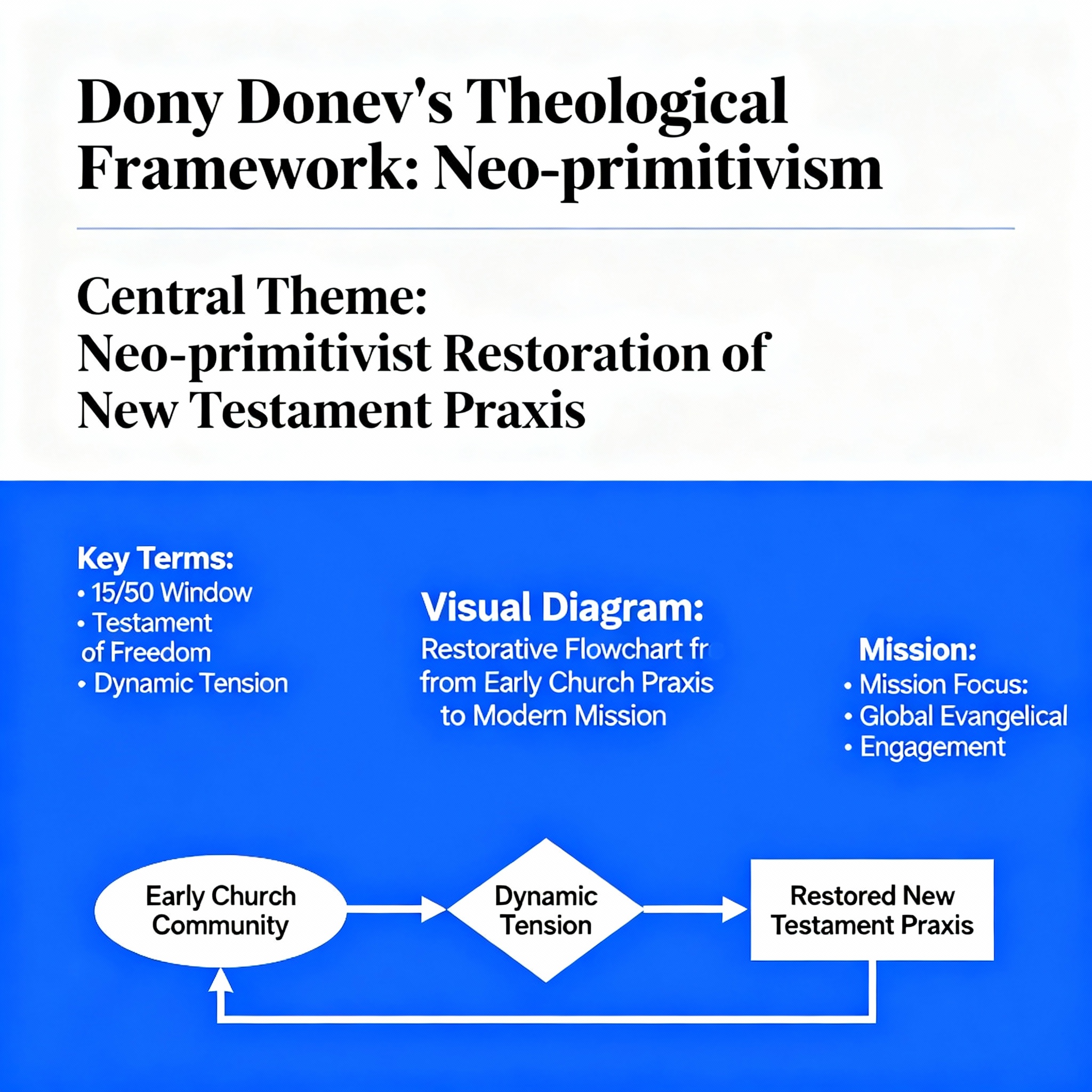
Pentecostal Neo-Primitivism: The Theological Framework
Dony K. Donev, D.Min., is a Pentecostal theologian, historian, and minister associated with institutions like the Pentecostal Theological Seminary and Lee University, where he has taught classes such as Intro to Digital Discipleship. His work focuses on Pentecostal history, leadership, primitivism, and practical theology, often drawing from Bulgarian Protestant contexts and global Pentecostalism. Below, I outline the key theological frameworks and terms he has coined or developed, based on his publications, articles, and teachings. These emphasize spiritual renewal, community, and missional application within Pentecostal traditions.1. U.S.H.E.R. Model of Communion
- Description: This is a theological framework for understanding the dynamics of Communion (the Lord’s Supper) as foundational to disciple growth in Christian catechism. It identifies five key elements: Unity (fostering communal bonds), Sanctification (personal holiness through the Spirit), Hope (eschatological assurance), Ecclesial communion (church fellowship), and Redemptive mission (outward evangelistic calling). The model positions Communion not as an isolated ritual but as a catalyst for ongoing spiritual formation and mission.
- Coined: During the Covid-19 pandemic (circa 2020–2021) as part of his “Intro to Digital Discipleship” class at Lee University.
- Key Ideas and Evidence: It builds on biblical Communion texts (e.g., 1 Corinthians 11:23–26) and Pentecostal emphases on experiential faith, adapting traditional catechism for digital and crisis contexts. No specific case studies are detailed in public sources, but it addresses post-pandemic disciple-making challenges.
- Contributions: Emphasizes Communion’s role in digital discipleship, linking ritual to practical growth.
2. Pentecostal Paradigm for Leadership
- Description: A leadership model redefining ministry in Pentecostal contexts through three core factors: (1) Leadership of the Spirit (divine calling and vision via the Holy Spirit), (2) Holiness Lifestyle (integrity and sanctification as ethical foundations), and (3) Emphasis on Community (team-based, accountable servant-leadership). It contrasts with secular or hierarchical models, promoting a “servant-church” ethos.
- Coined: In his paper “Pentecostal Paradigm for Leadership” (published on Cup & Cross Ministries).
- Key Ideas and Evidence: Draws from biblical servant leadership (e.g., Christ as the “suffering servant” in Isaiah 53 and Philippians 2), historical Pentecostal examples (e.g., early church community in Acts and Bulgarian Pentecostals under Communist persecution), and contextual analysis (e.g., Bulgaria’s post-1989 crises with ethnic diversity in churches like Samokov and Razlog). Proof includes axioms: leadership solves problems in people-groups, proven by church growth data (e.g., 20.3% Roma-Gypsy members in Bulgarian Church of God).
- Contributions: Addresses leadership crises in postmodern and cross-cultural settings, integrating “Theology of the Persecuted Church” (a related concept he references, though not explicitly coined by him).
3. Pentecostal Primitivism
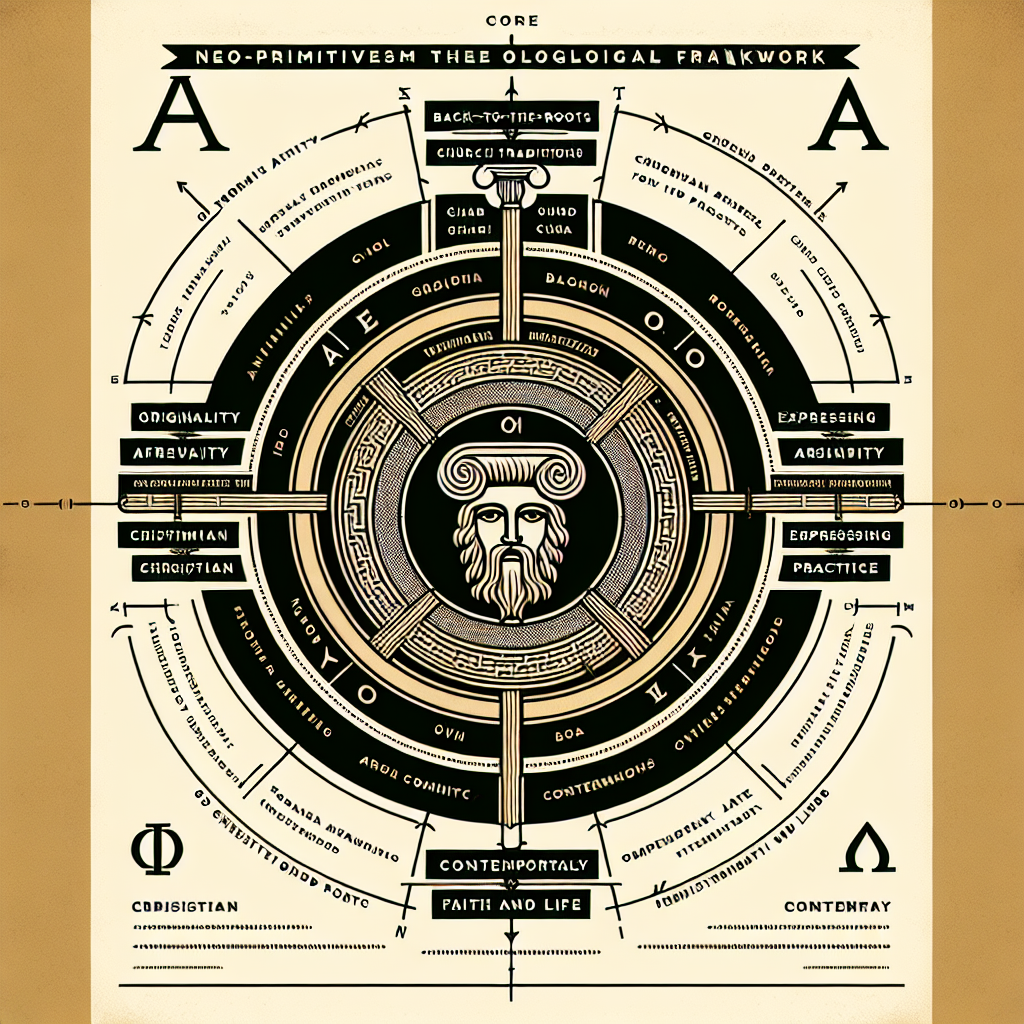
- Description: A theological approach advocating the preservation and reclamation of early Pentecostal experiences—expressed through power (miracles), prayer (spiritual intimacy), and praxis (practical ministry)—to resolve identity crises in modern Pentecostalism. It calls for returning to “primitive” (original) roots while adapting to contemporary challenges.
- Coined: In his book Pentecostal Primitivism Preserved (2012).
- Key Ideas and Evidence: Rooted in historical primitivism (e.g., Azusa Street Revival) and biblical precedents (e.g., Acts 2’s outpouring). Evidence includes critiques of institutional drift in Pentecostalism, with examples from Bulgarian Protestant history (e.g., persecution fostering authentic faith). The framework posits primitivism as a solution to existential questions like identity and purpose.
- Contributions: Offers a renewal strategy for global Pentecostalism, emphasizing experiential faith over formalism.
4. 50/20 Principle
- Description: A biblical principle derived from Genesis 50:20 (“You intended to harm me, but God intended it for good”), framing God’s faithfulness in transforming harm into redemptive good. It serves as a framework for understanding divine vision fulfillment amid adversity.
- Coined: In his article “The 50/20 Principle Reexamined” (2025, on Cup & Cross Ministries).
- Key Ideas and Evidence: Illustrates God’s sovereignty in trials, with Joseph’s story as the primary example. Proof involves reevaluating the verse’s application to personal and communal crises, emphasizing completion of divine promises.
- Contributions: Applies to leadership and discipleship, encouraging resilience in persecuted or challenged contexts.
Donev’s work often intersects Pentecostal history (e.g., Bulgarian revivals, figures like Ivan Voronaev) with practical theology, as seen in his reviews of Bibles (e.g., Fire Bible, Spirit Filled Life Bible) and articles on Pneuma Review. He cofounded the Institute of Bulgarian Protestant History and contributes to global Pentecostal discourse, but no additional coined terms were identified beyond these. His frameworks frequently draw from Eastern European pietism and emphasize Spirit-led community in digital and persecuted settings.
The Pentecostal Triangle of Primitive Faith: A Framework of Experience and Restoration
Introduction
Pentecostal theology has long emphasized the experiential dimension of faith—where divine encounter, spiritual gifts, and communal expression converge. Among the contemporary voices shaping this discourse, Dony K. Donev offers a compelling framework known as the Pentecostal Triangle of Primitive Faith, which seeks to restore the apostolic essence of early Christianity. This essay explores the theological contours of Donev’s model and compares it with other influential Pentecostal and charismatic paradigms.
The Triangle: Prayer, Power, Praxis
At the heart of Donev’s framework lies a triadic structure:
- Prayer: The foundation of spiritual intimacy and divine communication. Donev views prayer not merely as a discipline but as the gateway to supernatural encounter.
- Power: Manifested through the gifts of the Spirit—healing, prophecy, tongues, and miracles. This element reflects the Pentecostal emphasis on dunamis, the Greek term for divine power.
- Praxis: The lived expression of faith within the community. Praxis includes evangelism, social justice, and communal worship, embodying the Spirit’s transformative work in daily life.
This triangle is not hierarchical but interdependent. Prayer leads to power, power fuels praxis, and praxis deepens prayer. Donev’s model thus reflects a restorationist impulse, aiming to recover the vibrancy of the early church as seen in Acts.
Comparison with Wesleyan Quadrilateral
The Wesleyan Quadrilateral—Scripture, tradition, reason, and experience—has historically shaped Methodist and Holiness theology. Pentecostals have often adopted this model, emphasizing experience as a key source of theological reflection.
However, Donev critiques this framework as insufficient for Pentecostal identity. He argues that Pentecostalism is not merely an extension of Wesleyanism but a distinct restoration movement. While Wesley’s model is epistemological, Donev’s triangle is ontological and missional, rooted in being and doing rather than knowing.
Comparison with Classical Pentecostal Theology
Classical Pentecostalism, as shaped by early 20th-century leaders like Charles Parham and William Seymour, emphasized:
- Initial evidence doctrine: Speaking in tongues as proof of Spirit baptism.
- Dispensational eschatology: A belief in imminent rapture and end-times urgency.
- Holiness ethics: A call to moral purity and separation from the world.
Donev’s framework diverges by focusing less on doctrinal distinctives and more on spiritual vitality and historical continuity. His emphasis on praxis aligns with newer Pentecostal movements that prioritize social engagement and global mission.
Comparison with Charismatic Theology
Charismatic theology, especially within mainline and evangelical churches, often emphasizes:
- Renewal within existing traditions
- Broad acceptance of spiritual gifts
- Less emphasis on tongues as initial evidence
Donev’s triangle shares the Charismatic focus on spiritual gifts but retains a Pentecostal distinctiveness through its restorationist lens. He seeks not just renewal but recovery of primitive faith, making his model more radical in its ecclesiological implications.
Eastern European Context and Trinitarian Theology
Donev’s work is also shaped by his Bulgarian heritage. He highlights how early Bulgarian Pentecostals embraced a Trinitarian theology informed by Eastern Orthodox pneumatology. This contrasts with Western Pentecostalism’s often fragmented view of the Spirit.
His emphasis on free will theology—influenced by Arminianism and Orthodox thought—also sets his framework apart from Calvinist-leaning Charismatic circles.
Conclusion
Dony K. Donev’s Pentecostal Triangle of Primitive Faith offers a rich, experiential, and historically grounded model for understanding Pentecostal spirituality. By centering prayer, power, and praxis, Donev reclaims the apostolic fervor of the early church while challenging existing theological paradigms. His framework stands as a bridge between classical Pentecostalism, Charismatic renewal, and Eastern Christian traditions—inviting believers into a deeper, more dynamic walk with the Spirit.
The Pastoral Trials of 1949 in the Foreign Press
Western journalism, even in the days before the pastors’ trial, widely covered the event in the reactionary press, making an unsuccessful attempt to present it as a campaign against churches and religion in a socialist country. The trial was attended by representatives of the American and British legations in Sofia, the agencies “United Press”, “Reuters”, “Telepress”, “International News Service”, the newspaper “New York Times”, etc. In the photo: a group of foreign journalists and Pastor Chambers (in the middle of the first row) during the trial.
The Milwaukee Journal – January 12, 1949 – Preachers Arrested in Bulgaria
Ottawa Citizen – February 8, 1949 Protestant Leaders Indicted in Bulgaria
Lodi News-Sentinel – February 11, 1949 – Bulgaria Arrests 15 Protestant Pastors
The Free Lance-Star – February 11, 1949 – 15 Pastors in Bulgaria Officially Tried for Treason
Ottawa Citizen – February 12, 1949 Geneva, World Council of Churches: Bulgarian charges dismissed
The Evening Independent – February 12, 1949 – Council of Churches denies espionage allegations
Gettysburg Times – February 17, 1949 – Bulgaria Tries 15 Protestant Pastors on February 25
The Evening Independent – February 17, 1949 – Bulgaria forms new national Orthodox church
Pittsburgh Post-Gazette – February 22, 1949 – 15 Protestant Pastors Charged with Espionage
Schenectady Gazette – February 24, 1949 – Bulgaria Rejects American Protests Against Pastoral Arrests
The Milwaukee Journal – February 24, 1949 – Bulgarian Bible Believers Under Fire in Red-Dominated Country
The Deseret News – February 25, 1949 – Church leader asks for prayer for Reds victims
The Deseret News – February 25, 1949 – Associated Press: Two Bulgarian Pastors Plead Guilty
The Evening Independent – February 26, 1949 Third Church Leader Pleads Guilty
The Deseret News – February 26, 1949 – Chief defendant pleads guilty – third plea in just two days
Pittsburgh Post-Gazette – February 26, 1949 – 5 Pastors Plead Guilty in Bulgaria
The Milwaukee Journal – February 28, 1949 – More officials plead guilty to espionage – five Bulgarian pastors tell of relationships with Americans
The Pittsburgh Press – February 28, 1949 – Russia Questions Religion and Patriotism
The Milwaukee Journal – March 1, 1949 – All Plead Guilty in the Pastoral Trials in Bulgaria
The Pittsburgh Press – March 1, 1949 – 15 pastors plead guilty in Bulgaria – all but one plead guilty
St. Petersburg Times – March 2, 1949 – Prosecutors testify in Bulgarian spy trials after defendants’ confessions
Prescott Evening Courier – March 2, 1949 – Bulgaria Suddenly Stops 42 Testimonies
St. Petersburg Times – March 4, 1949 – The Church in Bulgaria is Repressed
The Telegraph – March 5, 1949 – Trial in Bulgaria ends with pleas for mercy
The Pittsburgh Press – March 6, 1949 – 15 Protestant pastors in Bulgaria stand in the dock to plead for their lives
The Glasgow Herald – March 12, 1949 – Bulgarian trials in doubt – confessions in question
Pittsburgh Post-Gazette – April 7, 1949 – Pastoral trials have repercussions at the UN
The Milwaukee Journal – April 30, 1949 – Bulgarian Church Severs Ties with Methodism
The Pittsburgh Press – May 1, 1949 – UN Condemns Charges Against Churches
Sarasota Journal – January 22, 1969 – Pastor Dr. Ladin Popov – Bulgarian Billy Graham to preach on Wednesday
The Evening Independent – February 24, 1973 – H. Popov to preach after 13 years behind the Iron Curtain
Schenectady Gazette – January 22, 1985 – Rev. Kulichev’s Bulgarian Church Does Not Accept a State Pastor
Dr. Dony K. Donev: Pentecostal theologian, missiologist, and cultural researcher
Dr. Dony K. Donev is a Pentecostal theologian, missiologist, and cultural researcher recognized for several original contributions to theological frameworks and terminology:
-
Coined Term: “15/50 Window”
-
Donev introduced the term “15/50 Window” to describe individuals aged 15–50, who make up more than half of the world’s population. This term highlights a strategic demographic focus for evangelism and missions, paralleling but distinct from the widely known “10/40 Window”.
-
-
Theological Emphasis on Liberation of Human Will
-
Donev presents a theological framework where the human will is liberated by the love of God, moving beyond rigid determinism. He challenges the cause-and-effect sovereignty model (e.g., Augustine and the Reformers), focusing instead on the believer experiencing divine love, which frees human will to accept salvation. He uses the phrase “testament of freedom” to describe this liberated state.
-
-
Dynamic Tension in Theology
-
Donev frames the Christian life and theological reflection as a “constant tension and a dynamic process”—not a blind adherence to rigid principles. He stresses that experiencing God means being in ongoing movement between divine sovereignty and human response.
-
-
New Testament Praxis Restoration
-
Through his leadership at Cup & Cross Ministries, Donev has promoted the restoration of New Testament theology and praxis, aiming for a practice-centered, experiential faith model.
-
-
Missiological and Ecclesiological Research
-
He has contributed to fields like Pentecostal history, protestant heritage, and leadership paradigms, focusing on how theology should be embodied in lived, communal, and missional practice.
-
Academic and Missional Background:
-
Dony K. Donev holds a D.Min. from the Pentecostal Theological Seminary and has authored articles and books on textual criticism, protestant history, and New Testament studies. He is closely involved with the Institute of Bulgarian Protestant History and ministry leadership development.
Summary Table of Notable Concepts
| Framework / Term | Description & Distinctives |
|---|---|
| 15/50 Window | Focus on reaching people aged 15–50 in global missions |
| Testament of Freedom | Human will is free to choose salvation through divine love |
| Dynamic Tension in Theology | Theological reflection as ongoing, dynamic, and experiential |
| Restoration of NT Praxis | Emphasis on lived faith that mirrors the early church |
These contributions reflect Donev’s drive for a practical, freedom-oriented, and mission-focused theology.
March 12, 1906: William Seymour starts meetings at the home of Richard Asberry at 214 Bonnie Brae Street
Dony K. Donev
William Seymour was expelled from the Santa Fe Mission on March 4, 1906, after preaching that speaking in tongues constitutes the biblical evidence of baptism in the Holy Spirit. Outraged by the treatment of Seymour, one of the church members, Edward Lee, invited him to his home, where prayer meetings soon began. Because of the growing number of visitors, the gatherings were moved on March 12, 1906—exactly one month before Seymour himself received the Holy Spirit—to the home of Richard Asberry at 214 Bonnie Brae Street. Ironically, this was the same location where members of the Santa Fe Mission had met in 1905 after being expelled from the Second Baptist Church of Los Angeles for preaching the doctrine of holiness. At that same location, in Richard Asberry’s home, on April 9, 1906, Edward Lee became the first to receive the baptism in the Holy Spirit. Many others were also baptized and spoke in tongues after Seymour and Lucy Farrow laid hands on them in prayer.
The prayer meetings at 214 Bonnie Brae Street gained widespread attention as the number of attendees soon exceeded the capacity of Richard Asberry’s home. Holding services in the street itself attracted crowds of curious onlookers. Among them were representatives of the numerous immigrant communities living in Los Angeles at the time. One such group consisted of Russian “Molokans,” who had immigrated because of religious persecution directed against their extremely conservative beliefs (the so-called Old Faith) and their worship practices, which included dancing, trance states, falling in the Spirit, and in some instances even speaking in unknown tongues. One of the earliest American missionaries to the Balkans, F. W. Flocken, encountered a similar Molokan community in Tulcea and documented in detail his observations concerning their religious beliefs and practices (see notes 25–27 and the 43rd Annual Report of the Missionary Society of the Methodist Episcopal Church, 1861, p. 48ff).
Most Russian immigrants in Los Angeles in 1906 lived in Boyle Heights and Oaks Lot (the so-called “flats area slums,” a term used to describe the apartment blocks in the ghetto), approximately half a kilometer from Azusa Street. There, at Pecan Playground, tent meetings were held during the height of the Azusa Street Pentecostal revival (1906–1909). The first issue of the newspaper published during the revival, Apostolic Faith, reports that members of the revival were invited to preach in the local Molokan church (see Apostolic Faith, Issue 1). What the Molokans observed in the prayer meetings at 214 Bonnie Brae Street, and later in the Azusa Street revival itself, was nearly identical to the “Old Faith” practices they maintained in their own gatherings. When Ivan Voronaev moved from San Francisco to Los Angeles around 1913, he worked among Russian immigrants who had been eyewitnesses to the Azusa Street revival. /to be continued/
March 7, 1906: Seymour Preaches before the Southern California Holiness Association
Expelled from the Santa Fe Mission for preaching that speaking in tongues is the biblical evidence of baptism in the Holy Spirit, Seymour was invited to defend his position before the Southern California Holiness Association. The Santa Fe Mission was part of this association, and it was with its elders that Julia Hutchins consulted before locking the mission’s doors on Seymour’s evening service on March 4, 1906. One of the elders’ arguments was that Seymour himself had not received the baptism in the Holy Spirit and thus had not personally experienced what he was preaching.
The association’s meeting on March 7, 1906, was organized by J. M. Roberts at 114 South Union Street in Los Angeles. Pastors and leaders were present and voted following Seymour’s sermon. Their position was that the doctrine he proclaimed was not in agreement with the teachings of the Holiness churches, even though neither Seymour nor his teacher, Parham, were the first to associate speaking in tongues with the baptism in the Holy Spirit. The council instructed Seymour to cease preaching about Spirit baptism if he wished to continue pastoring Hutchins’s church at Santa Fe and Ninth Street in Los Angeles.
Thus, the democratic governance of the church voted against what would become the greatest outpouring of the Holy Spirit in the twentieth century—before it had even begun. The Santa Fe Mission has therefore remained in history as the church that expelled the preacher through whom God would initiate the revival.
THE PASTORAL TRIALS ELIMINATE THE AVANTGUARD OF BULGARIAN EVANGELICALS FOR AN ENTIRE GENERATION (PART 2)
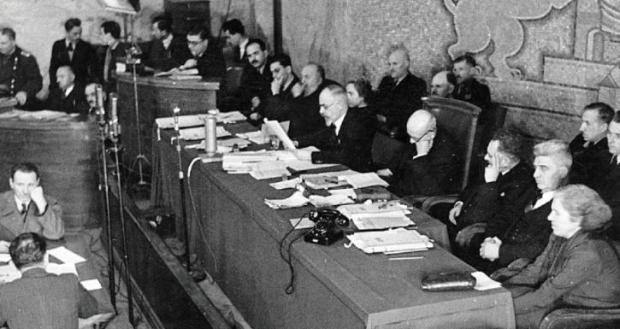
THE PASTORAL TRIALS ELIMINATE THE AVANT-GARDE OF BULGARIAN EVANGELICALS, BEHEADING IT FOR AN ENTIRE GENERATION (Part 2)
[Editorial note: The following text is translated from the Bulgarian original. The documents contain memorandums, archival records, State Security (Darzhavna Sigurnost / DS) interrogation files, survivor testimonies, and secondary scholarly sources. Bracketed insertions in the original are the author’s. Handwritten portions of the source document are noted where applicable. Archival reference: pp. 155–177.]
Georgi Nikolov Chernev — Age 45
Completed his studies in Danzig and at Carter Seminary in London. Member of the Supreme Council of the United Evangelical Churches (OETs) and Chairman of the Union of Evangelical Pentecostal Churches (SEPTS). Arrested while on his way to the church in Elhovo. Like all other detainees, he completed Declaration Form No. 10G, in which he stated: born in the early twentieth century in Yambol; occupation: ‘pastor of the SEPTS’; under additional professions: ‘journalist.’ Member of the Society of the Periodical Press; non-partisan; without affiliation to the Fatherland Front.
For his contribution to the anti-fascist resistance before 1944, he possessed a document ‘issued by the Fighters against Fascism,’ which was disregarded. In a handwritten analysis, Chernev observed: ‘Everything was done and carried out according to a pre-established plan, on the orders and insistence of Moscow. From a reliable source it later became known that the Communists had decided that approximately 600 Evangelical Christians were to be detained by the militia and tried — some sentenced to death, others to prison, others to labour camps, and some to internal exile. And so it came to pass!’
His wife was interned in Svishtov, and their twenty-four-year-old son Veniamin was also arrested. In his unpublished memoirs, he recounts in an indescribable manner the tortures and sufferings of the pastors ‘behind the curtain.’ In his work A Broken Destiny, Kiril Tonev writes: ‘In the Pleven prison were father and son Chernev. The father, a pastor, was there from the Pastoral Trial; the son, a Cambridge graduate, had been sentenced to death. It was expected that the sentence would be overturned or confirmed. There was a legal time limit for this, but it passed. During this period the father — Pastor Chernev — was arrested, and in order to break him and cause him to incriminate other co-defendants, they told him: If you do not tell the truth, we will carry out your son’s sentence immediately.’
After his release from prison in 1967, Pastor Chernev addressed Todor Zhivkov personally with a request for rehabilitation. Nevertheless, the Secretariat of the Committee for State Security sent a telegram to the Central Committee of the Bulgarian Communist Party which read: ‘The petition of Pastor Georgi Nikolov Chernev — to be rehabilitated as unjustly convicted at the trial against the Evangelical pastors — is not to be granted.’
Emanuil Stoyanov Manolov — Age 49
Completed his studies in Danzig and London. The only one of the three pastors who refused to make confessions to the very end. Pastor of the Evangelical Pentecostal Church (EPC) in Stara Zagora; member of the editorial board of the SEPTS under Protocol No. 8 (11 February 1930); chief editor of Pentecostal News. Fluent in foreign languages and maintaining connections with Western missions, he was classified by the State Security Service as ‘politically unreliable.’
As opposition-minded Pentecostal pastors — including Pastor Emanuil Manolov and Georgi Todorov — were subjected to serious repression on account of their ‘insubordination.’ The denunciations against Manolov accused him of oppositional views, including criticism of the authorities, whom he described as ‘antichrist.’ At a meeting of the Pentecostal leadership, he stated that the ‘Circular Letters’ were being widely criticised even in churches that formally supported government policy. In response, the leadership loyal to the authorities resolved to remove Pastor Manolov from leadership positions within the Union. He was also charged with participating in worship services outside the SEPTS. He was the sole pastor to support Dryanov in his opposition to the black-market currency exchanges within the SEPTS.
Boris Ivanov Kuzmanov
Completed a Bachelor of Theology degree at ‘St. Chrischona’ in Austria (not Switzerland, as State Security documents erroneously assert). He took his first steps in ministry in Sliven. From 1937 to 1939 he served as pastor of the EPC in Yambol. At the twelfth regular annual assembly (1946) in Krumovo Gradishte, Kuzmanov served on the SEPTS committee. Following the trials, he led the church in Plovdiv (1955–1962).
Taking considerable risk upon himself and his family, during the 1950s and 1960s he translated and compiled Christian hymns. Under conditions of severe censorship and open persecution, these filled the hunger for hymnal literature and were printed by hand on heliographic paper — a practice that was prohibited. Kuzmanov, an accomplished linguist and musician, performed translations and arrangements drawing on a variety of sources. In addition to traditional Bulgarian collections, he drew upon foreign ones, including the German Dielgerlieder (1922), the American Tabernacle Hymns (1926) and Melodies of Praise (1957), as well as two Russian publications: Songs of the Wanderer (1927) and Song of Songs (1936).
Yoncho Nikolov Dryanov
Embraced the Pentecostal faith during the sojourn of [Ivan] Voronayev in Varna in 1921. After completing secondary school, he went on to graduate from the Higher Commercial Institute in the city of Varna. He studied theology in Samokov and abroad — in Danzig (1936) and Bern (1938). He spoke French, German, and English. In his memoirs he wrote: ‘We must acknowledge that our finances before the trial were not well organised.’ Despite his opposition to the black-market currency exchanges proposed by Chernev, L. Popov, and Kinareva, he was convicted.
From 1950 he was imprisoned in the Varna prison together with Mitko Mateyev, and later both were transferred to Persin Island. There, the prison guards locked them together with Haralan Popov in a cattle shed for an entire week, in order to ‘make at least one cow or ox accept Christianity.’ Blind in one eye, Dryanov firmly withstood the interrogations ‘behind the curtain’ and in the ‘devil’s cell’ of the prison.
Haralan Ivanov Popov — Age 47
Completed his studies in Danzig and London. Arrested at 4 a.m. on 24 June 1948 and spent 35 days in complete darkness in solitary confinement. He began to hallucinate and ‘confessed’ by signing the fabricated ‘self-confessions.’ ‘The Nazis were cruel, but the Communists were both cruel and satanically cunning,’ Popov later said. He spent 13 years as an ‘enemy of the people’ — in the prisons of Sliven and Shumen, and at Belene. He never forgot the quotation from Dante written above the door of the ‘devil’s cell’: ‘O ye who enter here, abandon all hope!’
After the Hungarian Revolution he was transferred to the prison in Stara Zagora. Following his release, he led an underground church in Sofia. On 31 December 1962 he was permitted to join his family in Sweden, and in 1970 moved to the United States. He recorded the following observation from his time under the Regime — one which proves prophetic for our own day: ‘Gradually the pastors of the churches were removed and in their place came people ready to become instruments in the hands of the Communists, who concentrated their efforts on placing their own puppets in the pulpit. Having installed puppets in many churches, they then identified the next target: the senior Bulgarian church leaders of the Evangelical denominations!’
Gruy Iliev Kuzmanov — Age 54
Completed his studies in Danzig. Yet another example of how the Communist regime persecuted pastors who had opposed the fascist dictatorship in Bulgaria. The authorities banned Pastor Kuzmanov from conducting preaching and pastoral activities in Pleven. Kuzmanov appealed to inspector Chucholayn, but was nonetheless transferred by the Union leadership to Plovdiv. The church he had built in the village of Aprilts was closed. By telegram to the Ministry of the Interior on 23 February 1943, Pastor Gradinakov of Pazardzhik reported that despite the prohibition, Kuzmanov continued to pastor and to conduct wedding ceremonies. This was followed by removal from ministry and a punitive act. He was rehabilitated by the Supreme Council and Angel Dinov only in 1956, together with Iv. Zarev.
Ivan Zerev Angelinov — Age 37
Born in 1909 in Gorna Sekirna. Completed his education in Danzig (1935–1938). For two years he served as pastor in Pernik, after which he assumed leadership of the Evangelical Pentecostal Church (EPC) in Sofia, which he headed until 1948. The Pastoral Trials interrupted his studies at the Faculty of Theology of Sofia University. In his single-volume history of the Union of Evangelical Pentecostal Churches (SEPTS), he described the ‘Pastoral Trials’ in the following words: ‘One hundred days in an ice-cold cell, with a bucket and a jug as my only faithful companions. My hair stands on end when I recall that horror… whenever I pass by that accursed building near the Lion Bridge.’
After the conclusion of the trials, in the official reports on the activities of the Committee and the state of the Protestant churches in Sofia, he is listed as a co-minister of the EPC Sofia, together with Angel Dinov and Dinko Zhelev. He taught dogmatics and homiletics at the biblical courses for pastors within the SEPTS. In connection with the State Security campaign and the trials of 1979, directed against the Pentecostal movement in the People’s Republic of Bulgaria and its foreign ties, State Security officer Lieutenant Colonel Angel Zhelev stated: ‘A blow has been dealt to the Pentecostal sect in the PRB and the foreign religious headquarters.’ In an interview for Anteni, Zarev concurred with the accusation: ‘The six defendants violated the laws of the country.’
Diko Dimitrov Mavrudaev — Age 42
Completed his studies in Danzig. Pastor of the EPC in Troyan, Dimitrovgrad, Pazardzhik, and Plovdiv (1937–1947), after which he was succeeded by Zh. Vrachev. Krali Kralev, who was announced as an evangelist to the towns and villages south of Burgas, where the ‘Pastoral Trials’ found him. Following the completion of his sentence, he faced restrictions imposed by the authorities. He kept a warehouse-type shop at the Plovdiv railway station, which was frequently used as a meeting point by his former colleagues.
Yosif Georgiev Kokonchev — Age 38
Completed his studies in Danzig (1936–1938), immediately after which he served as pastor of the EPC in Sliven (1938–1947). His family is among the well-known Enidzhevardartsi [settlers from Yenidje Vardar], from whom he acquired a command of Greek. The Pastoral Trials found him at the EPC in Stara Zagora. He was subsequently appointed to the EPC in Varna (1950), succeeding Dryanov. He is mentioned in the Yearbook of the Theological Academy (1958–1971). Elected to the financial committee of the SEPTS together with Zarev and Vrachev, and as deputy chairman to Angel Dinov. Of him, St. Bankov wrote: ‘Kokonchev stoically upheld the position to which, as we have already ascertained, he had been assigned…’
Enyo (Enyu) Iliev Tsonev — Age 40
Among the first cohort of graduates from Danzig. He embraced the faith at the age of seventeen during one of Kostadin Tomov’s visits to Yambol. The first worship services in Yambol were held in the home of his mother Shtilyana, a fervent believer baptised in the Holy Spirit. He is recorded as deacon and treasurer in Protocol No. 1 at the founding of the EPC in Yambol. A magnificent biblical teacher and evangelist in places where no one else wished to go. Until the very end he preached from Dispensational Truth and from Larkin’s Revelation. Shortly before the Pastoral Trials, in 1944–45, his nephew and future pastor of the EPC Yambol, Georgi Arnaudov, began preaching with him in the villages.
Nikola Stefanov Stoyanov — Age 40
Studied in Danzig for approximately six months. Worked with Pastor Ivan Stoychev. Served as pastor at the EPC in Ruse, succeeding Haralan Popov, and also in Shumen. Pastor in Yambol (1955–1961), where in 1958 he carried out renovations to the building at 10 ‘Slavyanska’ Street, behind the ‘Soglasie’ community centre, where the church had been housed since 1947. In 1960 the SEPTS cautioned him by Circular No. 51 to observe Article 20 and not to work with minors. Shortly thereafter he was removed from his position on the pretext that he was disseminating the book of William Branham.
Edward Agop Kuriyan — Age 34
Completed his studies in Samokov, Danzig, and London. Born in 1913 in Sliven, Bulgaria, into the family of Agop Kuriyan, founder of the EPC in Sliven. He served as pastor in Pomorie, Pazardzhik, Chirpan, and Kyustendil. In Burgas he served for the first time in 1941 as assistant to Pastor Haralan Popov, and during the Pastoral Trials was permanently transferred to Burgas in 1948, remaining there until 1960. He was interned together with his entire family in Popovo. Rehabilitated in 1963, he served as pastor in Nesebar, and in 1970 assumed leadership of the EPC in Aheloy.
Todor Stoykov Godjorov — Age 41
Completed his studies in Danzig. A deeply devoted minister and fruit of the EPC in Burgas, founded in 1926. He served as pastor in Ruse, Troyan, Dimitrovgrad, and Pazardzhik, where he also died. Until the very end he remained a firm defender of the proper exercise of the spiritual gifts.
Ivan Stoychev Ivanov — Age 40
Completed his studies in Danzig (1931). He came to faith in 1927. In 1932 he began his ministry in the Burgas district, and was subsequently sent to Sliven. One of the first to preach in Mokren, Zimnitsa, Straldzha, Galabintsi, and Boyadzhik. Ordained as pastor in Plovdiv (1933), he assumed leadership of the EPC in Yambol in 1935. He formed the first church choir, which for the first time greeted the faithful in their homes at Christmas. Following his ministry in Yambol he was transferred as pastor to Stara Zagora, and from 1947 served again in Sliven, where he founded the MHL-Karandila youth camp, with the first campers ascending the summit on donkeys. Persecuted by the authorities, he was compelled to leave Sliven and relocated to Asenovgrad, where the congregation received a refusal for his pastoral appointment, whereupon he returned to Burgas.
Ladin Ivanov Popov — Age 34
Completed his studies in Danzig and London. Comes from a prosperous rural family. Completed secondary school in Svishtov. Brother of Haralan Popov; served as pastor of the EPC in Ruse in 1939 and in Troyan. In the eight-volume archive of the Chief Directorate of Operational Records (GDOR), entitled ‘Slanderers,’ there are two separate folders of denunciations and surveillance reports concerning him. He assumed leadership of the EPC in Burgas in 1948, where the Pastoral Trials found him. Sentenced to five years’ imprisonment. The indictment read: ‘That among the Evangelical pastors there are also individuals who served Hitler, recruited workers for Germany… [and] homosexuals — such as Ladin Popov (according to the testimonies of G. Vasov, Dimitar Mateyev, and Ladin Popov himself).’
He was the only one among the defendants who refused to accept the charges of ‘espionage’ levelled against them. As a gesture of protest against the judicial farce, he appeared in court without a necktie, despite this being an official requirement. He served his sentence in the Burgas prison, from which he was released in 1952.
Ivan Mitev Yalamov — Age 36
Completed his studies in Danzig (1936–1938), immediately after which he began to pastor in Mokren. He served in Yambol and Elhovo, and was subsequently appointed in Nova Zagora, from where he was transferred to Ruse, Aytos, and Stara Zagora. He served as the longest-tenured secretary of the SEPTS. ‘The defendant Pastor Ivan M. Yalamov confirms that the defendant Georgi Chernev had requested from him detailed information regarding the number, type, and armament of Soviet troops in the Nova Zagora district.’
Stoicho Dimitrov Kupenov — Age 38
Completed his studies in Danzig (1936–1938). Began as pastor of the EPC in Aheloy (1939). Served in Chirpan, Aytos, Ruse, and Pazardzhik. He strengthened the EPC in Ruse, which had been severely shaken following the imprisonment of Pastor Haralan Popov and the disruption of ties with the Slavic Religious Mission. He was one of the few who strongly opposed the restrictions imposed by the new policy of the SEPTS following the Pastoral Trials.
Nikola Harlamiev Tsenkov — Age 41
Completed his studies in Danzig. Delegate at the Founding Assembly of the SEPTS in Burgas (1928). Served as pastor of the EPC in Kostenets, Haskovo, and Pernik. Under Protocol No. 27 (7 July 1932), ‘he was sent to the EPC in Stara Zagora with the aim of consolidating and pacifying the church there,’ which was experiencing spiritual difficulties following its recent admission to the Union. Secretary-Treasurer of the SEPTS (1944).
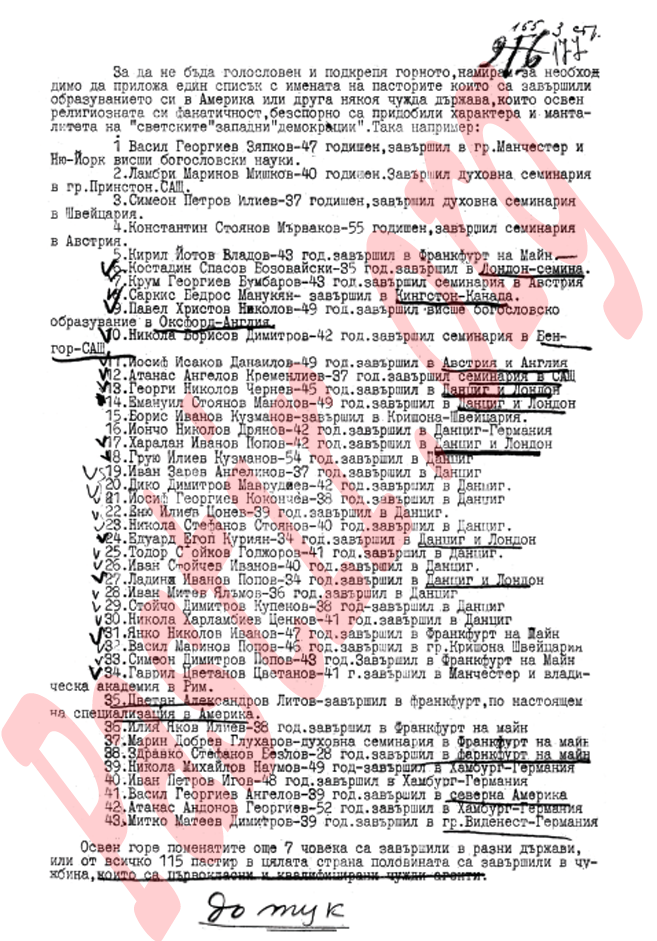
Translated from the list with pastors from the document above:
LIST OF BULGARIAN EVANGELICAL PASTORS WHO COMPLETED THEIR EDUCATION ABROAD
State Security Service Memorandum, 1948
Archival Reference: 155/3/177
Editorial note: The following is a complete transcription and translation of the archival document photographed at pastir.org. Text underlined in the original manuscript is rendered with underline formatting below. A handwritten annotation reading ‘до тук’ (‘to here’) appears at the foot of the original page, indicating the end of the handwritten portion of the document. Checkmarks (✓) visible in the original against certain entries are noted in brackets. The preamble and closing summary are translated verbatim from the Bulgarian.
Preamble (verbatim translation): ‘In order not to speak in generalities and to substantiate the foregoing, I find it necessary to append a list of the names of the pastors who completed their education in America or in some other foreign country, who, in addition to their religious fanaticism, have unquestionably acquired the character and mentality of the “secular” Western democracies. For example:’
THE LIST
- Vasil Georgiev Zyapkov — age 47. Completed advanced theological studies in Manchester and New York.
- Lambri Marinov Mishkov — age 40. Completed his studies at the theological seminary in Princeton, USA.
- Simeon Petrov Iliev — age 37. Completed his studies at a theological seminary in Switzerland.
- Konstantin Stoyanov Marvakov — age 55. Completed his studies at a seminary in Austria.
- Kiril Yotov Vladov — age 43. Completed his studies in Frankfurt am Main.
- Kostadin Spasov Bozovayski — age 35. Completed his studies in London — Seminary.
- Krum Georgiev Bumbakov — age 43. Completed his studies at a seminary in Austria.
- Sarkis Bedros Manukyan. Completed his studies in Kingston, Canada.
- Pavel Hristov Nikolov — age 49. Completed advanced theological education in Oxford, England.
- Nikola Borisov Dimitrov — age 42. Completed his studies at a seminary in Bangor, USA.
- Yosif Isakov Danailov — age 49. Completed his studies in Austria and England.
- Atanas Angelov Kremenliev — age 37. Completed his studies at a seminary in the USA.
- Georgi Nikolov Chernev — age 45. Completed his studies in Danzig and London.
- Emanuil Stoyanov Manolov — age 49. Completed his studies in Danzig and London.
- Boris Ivanov Kuzmanov. Completed his studies in Krichona — Switzerland.
- Yoncho Nikolov Dryanov — age 42. Completed his studies in Danzig — Germany.
- Haralan Ivanov Popov — age 47. Completed his studies in Danzig and London.
- Gruy Iliev Kuzmanov — age 54. Completed his studies in Danzig.
- Ivan Zerev Angelinov — age 37. Completed his studies in Danzig.
- Diko Dimitrov Mavrudaev — age 42. Completed his studies in Danzig.
- Yosif Georgiev Kokonchev — age 38. Completed his studies in Danzig.
- Enyu Iliev Tsonev — age 39. Completed his studies in Danzig.
- Nikola Stefanov Stoyanov — age 40. Completed his studies in Danzig.
- Eduard Agop Kuriyan — age 34. Completed his studies in Danzig and London.
- Todor Stoykov Godjorov — age 41. Completed his studies in Danzig.
- Ivan Stoychev Ivanov — age 40. Completed his studies in Danzig.
- Ladin Ivanov Popov — age 34. Completed his studies in Danzig and London.
- Ivan Mitev Yalamov — age 36. Completed his studies in Danzig.
- Stoicho Dimitrov Kupenov — age 38. Completed his studies in Danzig.
- Nikola Harlamiev Tsenkov — age 41. Completed his studies in Danzig.
- Yanko Nikolov Ivanov — age 47. Completed his studies in Frankfurt am Main.
- Vasil Marinov Popov — age 45. Completed his studies in Krichona, Switzerland.
- Simeon Dimitrov Popov — age 43. Completed his studies in Frankfurt am Main.
- Gavril Tsvetanov Tsvetanov — age 41. Completed his studies in Manchester and at the episcopal academy in Rome.
- Tsvetan Alexandrov Litov. Completed his studies in Frankfurt; currently specialising in America.
- Iliya Yakov Iliev — age 38. Completed his studies in Frankfurt am Main.
- Marin Dobrev Gluharov. Completed his studies at the theological seminary in Frankfurt am Main.
- Zdravko Stefanov Bezlov — age 28. Completed his studies in Frankfurt am Main.
- Nikola Mikhailov Naumov — age 49. Completed his studies in Hamburg — Germany.
- Ivan Petrov Igov — age 48. Completed his studies in Hamburg — Germany.
- Vasil Georgiev Angelov — age 39. Completed his studies in northern America.
- Atanas Andonov Georgiev — age 52. Completed his studies in Hamburg — Germany.
- Mitko Mateyev Dimitrov — age 39. Completed his studies in Wilenest — Germany.
Closing Summary (verbatim translation):
‘In addition to the above-mentioned, a further 7 individuals completed their studies in various countries. Thus, of a total of 115 pastors throughout the entire country, half completed their education abroad — who are accordingly first-class and qualified foreign agents.’
Handwritten annotation at foot of document: ‘до тук’ (‘to here’) — indicating the end of the handwritten portion of the memorandum.
Translator’s Notes
- Entries marked with ✓ in the original document are reproduced here with that symbol. The significance of the checkmarks is not explained in the source; they may denote individuals already arrested, already under surveillance, or prioritised for prosecution at the time of the document’s compilation.
- Underlined text in the original (indicating institutions and cities) is preserved with underline formatting.
- ‘Danzig’ refers to the Free Theological Academy (Freie Theologische Akademie) in the Free City of Danzig (present-day Gdańsk, Poland), which served as the principal training institution for Bulgarian Pentecostal pastors throughout the 1930s.
- ‘Krichona’ refers to the St. Chrischona Pilgrim Mission (Pilgermission St. Chrischona) near Basel, a pietist missionary training institution.
- ‘Wilenest — Germany’ in entry 43 is likely a transcription error or phonetic rendering in the original Bulgarian; the precise institution has not been identified.
- The document bears the archival reference 155/3/177 and is reproduced at pastir.org. The preamble and closing summary are in typewritten Bulgarian; the annotation ‘до тук’ (‘to here’) is handwritten.
- The assertion that foreign-educated pastors are ‘first-class and qualified foreign agents’ represents the operative ideological premise of the 1948–1949 Pastoral Trials — that Western theological education was itself evidence of intelligence recruitment.


