

30 years ago in Chicago

30 Years of the Bulgarian Church of God in Chicago
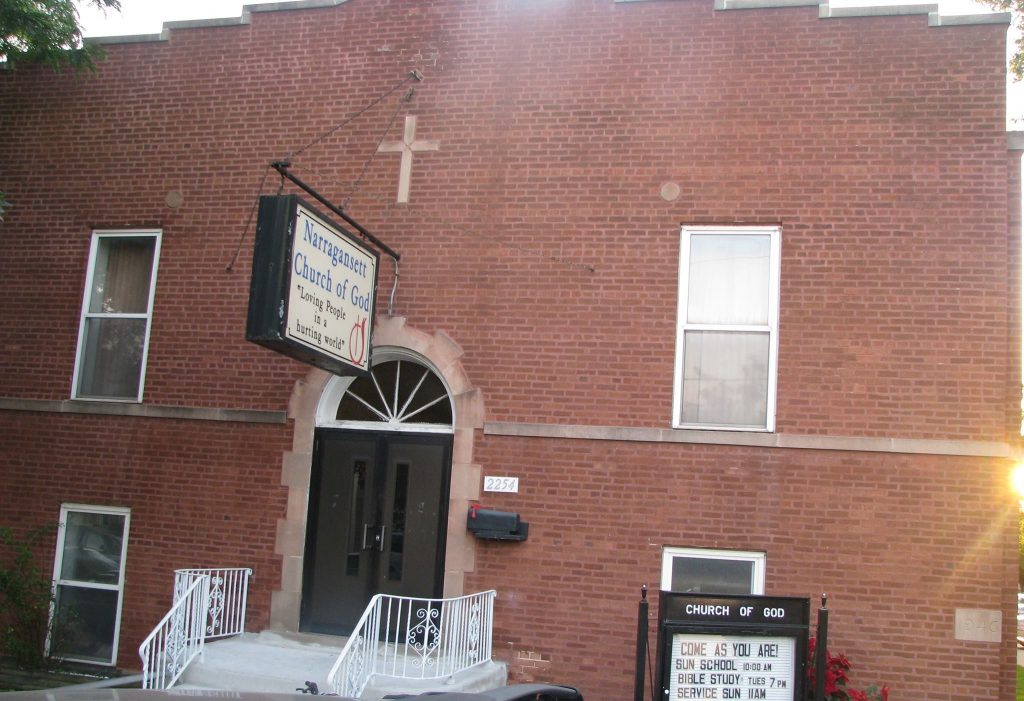
I left Chicago on this day 30 years ago (July 30, 1995). The Bulgarian church that day held service at 1 PM with 64 Bulgarians and many other internationals in attendance. Bulgarian students from the neighboring Indiana and Wisconsin attended as well. There was even a Bulgarian family from Alaska.
It was a Sunday. I left Chicago to preach in Beloit, WI that night and then left for Washington, D.C. the following morning. While driving north with quite the speed my Carolina blue Grand National began filling with white smoke. At first, I thought the air conditioner was on its last leg in the hot Chicago summer of 1995, but the air remained strong and cold. The cloud proceeded and it was so sensible that I had to slow down and basically stop on the side of the road. In my 35 years of ministry, I have only seen this one more time – in 2011 when the Glory of God descended over a youth camp we were preaching in the Bulgarian mountains. I did finally preach in Beloit and made it to D.C. the next day, but the vision of the cloud remained with me for the next 30 years.
Meanwhile, the word of mouth had spread and the Bulgarian church in Chicago was growing among the Bulgarian diaspora. On October 7, 1995, I was able to visit the church in Chicago again and present it to the National Overseer of the Bulgarian Church of God, Pastor Pavel Ignatov who visited the Bulgarian congregation in Chicago for the first time. By that time, it has become evident that the initial structuring for growth was giving more than expected results. The church became not only the first officially registered Bulgarian Pentecostal congregation in the United States, but also an important social and educational center able to minister to the 100,000 Bulgarians that live in the Great Lake region today.
Called to another mission, I left Chicago on July 30, 1995. The church bulletin upon my departure under Farewell and Appreciation read: “Today we are saying thank you to Dony for a job well done this past summer. He has served our church faithfully, and has been a tremendous blessing to Narragansett Ministries. Immediately following worship this morning, there is a dinner in Dony’s honor in the fellowship hall. And everyone is invited to attend.” Quiescently, while writing this next book for the 30th anniversary of the Bulgarian Church in Chicago, I was able to find this last bulletin in a box with several dozen letters I had sent weekly to my parents in Bulgaria. Surprising even to myself, those letters contain pictures, documents, dates, growth charts and progression predictions that are surprising even to me today. I remember spending countless nights in prayer, contemplating and strategizing over the new Bulgarian church plant, but I had forgotten all this was carefully documented as a case study.
The church congregation presented me with a plaque that represented my efforts and work in Chicago, which I have also kept until now. Because this plaque represents the prayers and the vision of many who are continuing the work today, establishing and leading Bulgarian churches around the world to providing pastoral care for many who have left the homeland in search for a better life. To these ministers goes my personal token of appreciation and thanks, “Well done thou good and faithful!” For me personally today a quarter of a century later, this plaque represents one very simply thing – I never betrayed my dreams. And in my book, this is well done…
Ministry Not for Sale
 My son, if sinners entice thee, consent thou not (Proverbs 1:10)
Several years ago, while employed with a certain organization, we faced the dilemma to choose between what was morally right and what was financially secure. Regardless of the jeopardy of this predicament, we were able to make the right decision, preserving our integrity and disallowing financial pressure to dictate our moral choices. Soon thereafter, we initiated a healing process which dealt with the internal wounds, restored the lost trust and attempted to recover the invested time and resources. Years past, we forgot the pain, but never forgot the lesson we learned …
Recently, while involved in a global ministry campaign, we were faced with a similar situation. This time, however, it did not involve business partners, but a multitude of Pentecostal ministers. The larger size of the context did not change the problem at hand, but rather intensified and multiplied its harmful effects. We regretfully witnessed how hundreds of men and women involved in ministry were manipulatively forced to face the same dilemma. They had to make a mandatory choice between the financial security of their families and their own moral integrity. The results were accordingly. Read more
Iran Sends Warning to Bulgaria
Iranian Foreign Ministry spokesman Esmail Baghaei said that any action enabling US strikes against Iran would amount to involvement in what he described as “aggression and war crimes.” He called on Bulgaria not to become “an accomplice to aggressors and violators of international law,” according to Iranian state media.
The warning comes after the Bulgarian government submitted a proposal to the National Assembly seeking approval for the deployment of up to eight US Boeing KC-135 Stratotanker aircraft, their crews, up to 250 American military personnel with personal weapons and ammunition, as well as related airport equipment.
The planned deployment is expected to take place at Bezmer airbase between July 24 and October 1, 2026. The request was forwarded to parliament after being approved by the Council of Ministers, while the Defense Committee backed the government proposal with 11 votes in favor, one against and two abstentions.
The issue is expected to be discussed in the plenary hall, with the current request differing from the previous deployment of US aircraft to Bulgaria. This time, the stated purpose is support for US operations in the Middle East, rather than NATO exercises, and the aircraft would be stationed at the military facility in Bezmer instead of Sofia’s civilian airport.
Tanker aircraft such as the KC-135 are primarily used to refuel other aircraft during flight, providing logistical support for military operations.
The Iranian warning comes amid renewed fighting between Washington and Tehran after a temporary ceasefire agreement collapsed. Both sides have intensified military actions in recent weeks, raising concerns over a possible return to a broader conflict.
Bulgarian diplomat Lyubomir Kyuchukov commented that the main difference between the current request and the previous one is that the purpose of the deployment has now been openly stated.
“This time the purpose has been declared openly, while the previous time it was concealed, and it is to provide logistics through the aircraft for strikes on Iran,” Kyuchukov said in an interview with NOVA NEWS.
According to him, the situation raises serious questions because the military actions between the United States and Iran are being carried out without a common position from the European Union and NATO.
“A very serious question arises, considering that practically no one even disputes that these military actions have nothing to do with international law,” Kyuchukov said, adding that EU member states have been left to make their own decisions regarding cooperation with Washington.
He noted that some countries with greater political and economic resources, such as Spain, refused similar requests, while others, including Italy and the United Kingdom, took more cautious positions.
Kyuchukov said Bulgaria must also consider its relations with the United States, but stressed that the key issue is the purpose of the aircraft’s presence.
“Because these tanker planes logistically support combat operations, and this is not in the agreement, and that is precisely why this entire issue needs to be addressed to the National Assembly,” he said.
The diplomat added that Bulgaria would not formally become a participant in the war through the deployment, but argued that the country would become involved in the broader conflict by taking a position.
“Bulgaria is not part of the war with this action, but it is part of the conflict, since it has taken a side in it,” Kyuchukov said.
He also argued that the confrontation between the United States and Iran had never fully ended despite previous attempts to establish a ceasefire.
Bulgarian Parliament Officially Approved U.S. Aircrafts
The Bulgarian Parliament Officially Approved U.S. Aircraft Deployment at Bezmer Base
The Bulgarian National Assembly approved the deployment of U.S. military tanker aircraft and personnel at Bezmer Air Base, authorizing support for American operations in the Middle East following a formal diplomatic request from Washington.
The resolution passed after nearly three hours of debate, with 135 lawmakers initially voting in favor, 13 against, and two abstaining. After “Revival” leader Kostadin Kostadinov requested a repeat vote, the proposal was approved again, receiving support from 124 deputies from Progressive Bulgaria and 15 from the Movement for Rights and Freedoms (DPS). One Progressive Bulgaria (PB) lawmaker voted against the measure, while two abstained. Twelve deputies from “Revival” opposed the resolution, while GERB, Democratic Bulgaria (DB), and We Continue the Change (PP) did not participate in the final vote.
The adopted resolution authorizes the temporary deployment of up to eight KC-135 aerial refueling aircraft, as many as 250 U.S. military personnel with personal weapons and ammunition, and the necessary airport equipment at Bezmer Air Base from July 24 through October 1, 2026.
Prime Minister Rumen Radev and Defense Minister Dimitar Stoyanov attended the parliamentary session at the request of the opposition. Before the vote, lawmakers also rejected a proposal to broadcast the debate live on national television and radio.
Stoyanov described the decision as difficult but necessary, saying the government had acted to protect Bulgaria‘s national interests while maintaining transparency. He stressed that the deployment would not undermine Bulgaria‘s sovereignty because Parliament retained the authority to approve the number of aircraft, personnel, and the duration of their stay.
“This is one of those decisions that is not easy to make, but it is necessary at this moment,” the defense minister said.
He emphasized that the aircraft are intended exclusively for aerial refueling and logistical support, not combat missions. “No offensive weapons systems of any kind will be deployed on Bulgarian territory. Their temporary presence does not make Bulgaria a party to the military conflict,” Stoyanov said, adding that the government had secured guarantees from its strategic partner to minimize security risks and had taken additional national and allied measures to protect the country.
According to Stoyanov, the American request is based on the bilateral Defense Cooperation Agreement signed in 2006 and made indefinite in 2016. He added that any deviation from the parameters approved by Parliament would require fresh authorization from the Bulgarian authorities.
During the debate, Prime Minister Radev rejected accusations that his government was pursuing contradictory policies. He argued that previous governments had misled the public by describing the earlier deployment of tanker aircraft at Sofia Airport as part of a military exercise.
“The note we received this time was the real note,” Radev said. “The law requires that Parliament approve a request of this nature, and we are not hiding behind anyone. We are proposing the deployment of up to eight aircraft at Bezmer, not 15 aircraft at Sofia Airport.”
Radev also criticized the previous decision to station tanker aircraft at Sofia’s civilian airport alongside commercial passenger traffic. He argued that large military aircraft carrying significant amounts of fuel should never have been based so close to the capital and its busy terminals.
The prime minister referred to remarks by U.S. Secretary of State Marco Rubio, who had publicly thanked Bulgaria for supporting U.S. operations in the Middle East. According to Radev, Rubio’s comments confirmed that the earlier deployment had not been linked solely to military exercises, as previously claimed.
Radev maintained that Bulgaria‘s broader foreign policy position had not changed. “I have been saying for years that the war in Ukraine has no military solution and that diplomacy and negotiations are the only path forward,” he told lawmakers. He insisted the government opposed expanding conflicts through additional weapons and funding while remaining committed to honoring Bulgaria‘s treaty obligations.
“If we want to be a reliable ally and an honest partner, we must honor the agreements we have signed. The United States is our main security ally. If we fail to meet our obligations, how can we expect them to meet theirs?” Radev said in his closing remarks.
The parliamentary debate exposed divisions across the political spectrum.
Former Foreign Minister Georg Georgiev of GERB criticized the government’s handling of the issue, arguing that Bulgaria should maintain a consistent foreign and defense policy. He accused the ruling majority of hypocrisy and political opportunism but said refusing support to an ally during a crisis would damage Bulgaria‘s credibility.
Viscountess Emily Anne Eliza Strangford
“I have looked upon nothing with such satisfaction as upon the six hospitals which I have built. Where there were most afflicted by the insurrection, old men, children, and mothers, nothing that was strange, because of typhus and dysentery. Sofia, one of my sisters, was only 18 years old – she died here, in the village of Radilovo, again from typhus, but before she died, she fed the hungry and treated the sick.” ~Lady Emily Strangford
Emily Ann Beaufort was born in 1826 as the youngest child in the family of the renowned geographer and oceanographer Admiral Sir Francis Beaufort, of French origin. The intellectual atmosphere of the Beaufort household actively encouraged her interests in travel, the natural sciences, and writing. From an early age, Emily accompanied her father on extensive journeys, which profoundly shaped her scientific curiosity and cosmopolitan outlook. Between 1843 and 1845, during travels along the coasts of the Orkney Islands in northern Scotland and Ireland, she collected marine algae and systematically preserved them in a two-volume herbarium.
Around the same time, Emily Ann Beaufort, now known as Lady Emily Strangford appeared in Bulgaria as the widow of the noble friend of the Bulgarian people and former president of the Royal Asiatic Society, Lord Strangford. As early as the beginning of the summer of 1876, Lady Strangford issued and circulated in England an appeal for the collection of relief funds for the victims of the April Uprising. Within the first weeks of the campaign alone, £29,000 were raised, a sum that continued to increase thereafter. The death of Lord Stranford in 1869 was a turning point in her life. The widow devoted herself to philanthropy and to voluntary work. After her curiosity for the exotic worlds, which was further developed under the influence of her husband into a stable interest and devotion, she changed her life and dedicated her efforts to help solve the issues of poverty, sufferings and social injustice.
On 15 August 1876, Viscountess Emily Anne Eliza Strangford publicly announced the establishment of the Bulgarian Peasant Relief Fund. Addressing the British public, she appealed for a total of £10,000 to assist Bulgarians left homeless and destitute in the aftermath of violence and devastation. At the same time, she volunteered her personal services, committing herself not merely as a donor but as an active organizer of relief on the ground. Upon her arrival in Bulgaria, Lady Strangford continued the work of the first hospital founded by the American missionary James Clarke, and soon expanded these efforts substantially. She organized and financed the construction of five additional hospitals in Karlovo, Panagyurishte, Perushtitsa, Petrich, and Radilovo. From Plovdiv, where she was primarily based, she personally supervised the organization, staffing, and operation of these institutions, either directly or through trusted collaborators. The Ottoman authorities permitted her voluntary activities and assigned a police officer in Plovdiv both to accompany her as a bodyguard and to monitor her work. Convinced of the transformative role of education, Lady Strangford deliberately located her shelter for homeless families in Plovdiv near a school, ensuring that children could attend classes regularly. Her vision of relief thus extended beyond immediate survival toward long-term social recovery. Drawing on reports by James Clarke, she structured her humanitarian activities across six rural districts identified as being in particularly deplorable condition. Material assistance was distributed on an unprecedented scale: clothing, bedding, cooking utensils, medicines, and other necessities reached tens of thousands of people. In addition, one hundred wooden huts were provided to homeless families. The total value of distributed aid reached £24,874, a sum remarkable both for its scale and for the speed with which it was deployed. From the very beginning of her stay, Lady Strangford provided extensive clothing assistance, including over 12,000 women’s traditional garments (sukmani), 10,000 pairs of men’s trousers (poturi), an equal number of men’s cloaks and coats, more than 5,000 rain cloaks (yamurluks), and nearly 1,500 blankets. In total, clothing was supplied to more than 20,000 individuals. Beyond emergency relief, she also funded the construction of dwellings, a mill, 110 distillation cauldrons for rose-oil production in Klisura and surrounding villages, five sawmills in the Rhodope Mountains, and large quantities of essential foodstuffs.
A public dining hall in Koprivshtitsa was likewise established, reinforcing local networks of support. Until that time, Bulgarian society under Ottoman rule had not witnessed a charitable initiative of comparable scope carried out within so brief a period. Lady Strangford’s philanthropy was distinctly personal and participatory. She worked in close contact with the local population, assisted by several young Bulgarian men who served as collaborators and translators. She entrusted reliable local figures with the direct management of relief activities. Nevertheless, the establishment of new institutions was not without difficulties. As a British woman operating independently, she was sometimes suspected of being a Protestant missionary or a foreign spy. In Karlovo, rumors circulated that the newly founded hospital might be a psychiatric institution or even a brothel, reflecting the climate of suspicion and uncertainty that accompanied her efforts. Several months after the establishment of these hospitals, Pastor Ivan Tondjorov founded another hospital in Plovdiv, which functioned for many years. During its early period, this institution provided medical care and refuge to members of Bulgarian revolutionary committees. Remarkably, the hospital continued to operate even after Tondjorov himself was arrested and imprisoned as a revolutionary in Yedi Kule in Thessaloniki, while other Bulgarian evangelicals were exiled to Diyarbakir for similar activities.
Before departing Bulgaria, Lady Strangford expressed her intention that the hospital buildings she had founded be converted into schools, thereby ensuring their continued service to Bulgarian society. She also facilitated the education of several young Bulgarian men who had worked with her, sending them to pursue studies at British universities. After her return to Great Britain, Lady Strangford remained energetically engaged in philanthropic and educational initiatives. She organized the Female Emigrant Society in Dorset Street, contributed to the establishment of a Medical School in Beirut, founded a geographical award in memory of her husband at Harrow School, and supported the creation of another hospital in Cairo, Egypt. When Emily Strangford died in 1887, she left behind extensive documentation, correspondence, and scholarly materials. In accordance with her will, she bequeathed a copy of a highly valuable Bible and her herbarium to her Bulgarian collaborator Valko Shopov, a gesture symbolizing the enduring personal and intellectual bonds she had formed during her humanitarian mission in Bulgaria.
 Dony K. Donev, D.Min., is a prominent researcher and author specializing in Bulgarian Protestant, Evangelical, and Pentecostal history, with over three decades of study. His work, including 19th Century History of Protestantism in Bulgaria and The Unforgotten: Historical and Theological Roots of Pentecostalism in Bulgaria, documents the development of these movements, their suppression under Communism, and the subsequent post-1989 revival. Key aspects of Donev’s research on Bulgarian Protestant history include:
Origins (19th Century): Protestant work began in the 1800s, with denominations like Congregationalists (1856), Methodists (1857), and Baptists (1865) establishing missions, culminating in the first Bulgarian Protestant Church in 1871. Donev also highlights the 1871 publication of the Protestant Bulgarian Bible translation. His research, often in collaboration with the Institute of Bulgarian Protestant History, has focused on preserving, digitizing, and recovering documents, including church diaries, photographs, and, in some cases, saving records from destruction during the communist era.
Aftermath of the April Uprising, 1876
Following the suppression of the April Uprising, horrific massacres were carried out in Batak, Perushtitsa, and other places in southern Bulgaria. In northern Bulgaria, the uprising in the Tarnovo district was also suppressed and its principal leaders executed. All of this adversely affected the evangelical work of both missions north and south of the Balkan range. Evangelical preachers were forced to limit their movements and make do with greatly reduced gatherings. Despite this, Bishop Andrews concluded his report to the Board in New York with the following recommendation:
“As soon as a more favorable opportunity presents itself for the Bulgarian mission, brethren from America must be sent in accordance with the purpose adopted when the work received its new impetus. This must be done because, in the event of death, transfer of missionaries to America, or proven incapacity on the part of the brethren now here, their number will not be sufficient.”
The Year 1877: A dark cloud hung over the mission. Yet the missionaries maintained unwavering faith in God. As often happens, light began to appear in the darkness. In Svishtov, Pastor Challis noticed encouraging signs early in the year. Church members, almost without exception, attended the prayer and class meetings. Two were received into full membership, and six on trial, in one of the villages within the Svishtov circuit. The Sunday school was well attended, and Pastor Challis translated into Bulgarian the questions for the Sunday lessons. Pastor Lounsbury likewise began his work in Tarnovo under encouraging conditions. Initially the meetings were well attended, but threats soon caused a significant decline in participation. Gavrail Iliev spent most of his time outside Ruse, in towns and villages where the massacres had occurred. Aid was distributed to 1,620 families. The Bulgarian preachers did everything they could in the afflicted areas of northern Bulgaria.
Lovech, 1877: Pastor and Eight Members Killed
During the Russo–Turkish War of 1877, when Russian forces captured Lovech and later withdrew temporarily, bashi-bazouk bands re-entered the town and slaughtered many people. According to some accounts, a massacre occurred at the place where the evangelicals gathered. Eight people were killed, including the preacher Nikola Voynov. It is unclear why this is omitted in the manuscripts of Pastor St. Tomov, though the event is confirmed.
Yordan Ikonomov then completing his theological course at the seminary in Drew, USA, was sent that same year to work in Bulgaria. The superintendent appointed him to teach the young men preparing for the ministry.
The Death of Mrs. Challis: In April 1877 Russia declared war on Turkey with the aim of liberating Bulgaria from Ottoman rule. Mrs. Flocken fell ill, and Mrs. Challis was holding a small child in her arms. Pastor Flocken believed it best to take the women to Germany and then return to Bulgaria. Just as he was preparing to carry out this plan, Pastor Challis contracted smallpox, and his devoted wife refused to leave him. The disease spread to the child, making separation impossible. Flocken departed with his wife, but upon arriving in Budapest, Mrs. Flocken was unable to continue the journey. He placed her in a Christian hospital, where the next day she gave birth to a daughter. Eager to return to Ruse, he soon learned the sorrowful news of the death of Mrs. Challis, who had died of smallpox.
Meanwhile Russian troops were advancing toward Svishtov, and the superintendent advised Pastor Challis to take his child to the United States, as he would be unable to care for it in Bulgaria. Following this counsel, Pastor Challis left for America accompanied by Miss Siika Dimitrova, daughter of Grandfather Dimitar – one of the first evangelicals in Svishtov – who agreed to care for the child. They arrived in New York in June 1877. Upon the advice of the mission secretaries and the bishop, he took up work in his Annual Conference until the end of the war in Bulgaria. Flocken received word from Budapest that his wife and newborn child were not expected to live long. He summoned Lounsbury to Ruse and left for Budapest. The child died, but by God’s mercy his wife survived.
The Russians crossed the Danube, and the missionaries were forced to withdraw. The mission was divided by the warring armies. Under these circumstances the Board advised Flocken and Lounsbury to return to the United States, and they departed. Pastor Flocken arrived in New York on 1 February 1878, and Lounsbury several weeks earlier.
Dony K. Donev, D.Min., is a prominent researcher and author specializing in Bulgarian Protestant, Evangelical, and Pentecostal history, with over three decades of study. His work, including 19th Century History of Protestantism in Bulgaria and The Unforgotten: Historical and Theological Roots of Pentecostalism in Bulgaria, documents the development of these movements, their suppression under Communism, and the subsequent post-1989 revival. Key aspects of Donev’s research on Bulgarian Protestant history include:
Origins (19th Century): Protestant work began in the 1800s, with denominations like Congregationalists (1856), Methodists (1857), and Baptists (1865) establishing missions, culminating in the first Bulgarian Protestant Church in 1871. Donev also highlights the 1871 publication of the Protestant Bulgarian Bible translation. His research, often in collaboration with the Institute of Bulgarian Protestant History, has focused on preserving, digitizing, and recovering documents, including church diaries, photographs, and, in some cases, saving records from destruction during the communist era.
VBS for Adults

For reasons obvious to most of our readers, I was able to attend no less than 10 (ten) VBS/Kids crusades this summer. Seven Baptist, several Pentecostals and a Methodist one.
The themes ranged from jungle journey and the Lion King to giddy up cowboys and cowgirls and world/planet/time travelling. All cool themes with lots of props and much careful preparation all in the name of bringing the Good News to the little ones. A noble cause truly worthy of any expense and labor for any church out there.
Time and length ranged from one whole day or one evening service to three nights and even several week long ones. For most of it, the ones held in most Baptist churches were designed by LifeWay and were well structured with kids constantly moving from station to station. The rest were somewhat free style, but still designed with the expectation of lots of children attending. In between each module there was candy, snacks or even a full blown supper.
The location of each VBS and the way it was designed for the crowd flow made the initial impression important. Signs welcoming and directing newcomers were grate, but the friendliness of the people made up for less signage and more human touch. Registration was a must and parents’ preferences were not taken lightly. The decorations of each room helped the children adjust to the new setting and work through the set curriculum. And yes, lots of kids made lots of mess so cleanness in class rooms, play areas and bathrooms were tended to. Some churches had a designated team that made sure the facilities were clean for the next group. And where cleanness was not intentional, it was observed that many parents did not return with their children.
Most VBS programs were designed around age groups. Some included even classes for toddlers and several had adult classes too. The ones that did not, included a family night toward the end of the week for parents to attend. A family night was a great feature for parents who did not attend but dropped their kids every night and picked them up afterwards. They were addressed with materials and opportunities for a spiritual renewal.
The thematic VBSs progressed with learning daily and build up on the previous day. The groups of children toggled between Bible lesson, crafts, games and lots of music. Kids were greatly encouraged to participate and learn the songs and dancing, recite Bible verses and answer questions from the covered material. Some parents participated too.
Prayer was made a central focal point for most of the VBSs observed. The Baptists ones, especially, had pledges of allegiance at the start of the service and assembly with prayer toward the end. A memorable experience for all children who enjoy social setting, making new friends and learn the Bible.
Here are several take ways to observe for a VBS in your church:
- Prepare for lots of children – if you have it they will come
- Train your workers. Form teams for each task. Assign measurable goals to ensure smooth moving through the program
- Self designed VBS programs work as good as the paid ones, as long as designed with the children and families in mind
- Chose the length of the event carefully with regard of your constitutions. For the most of it, less is really more.
- Do not underestimate friendliness, cleanness and the safety of the children.
- Don’t miss a family day. Everyone likes hot dogs and water slides on a hot summer day.
This goes without saying, but focus on God – it is easy to lose track and purposes in the larger design of such events.


