

Januarius MacGahan: Turkish Atrocities in Bulgaria (Part 2)
At the next house a man stopped us to show where a blinded little brother had been burned alive, and the spot where he had found his calcined bones, and the rough, hard-vizaged man sat down and sobbed like a child…. On the other side of the way were the skeletons of two children lying side by side, partly covered with stones, and with frightful, sabre cuts in their little skulls. The number of children killed in these massacres is something enormous. They were often spitted on bayonets, and we have several stories from eye-witnesses who saw the little babes carried about the streets, both here and at Olluk-Kui, on the points of bayonets. The reason is simple. When a Mohammedan has killed a certain number of infidels, he is sure of Paradise, no matter what his sins may be. Mahomet probably intended that only armed men should count, but the ordinary Mussulman takes the precept in its broader acceptation, and counts women and children as well. The advantage of killing children is that it can be done without danger, and that a child counts for as much as an armed man. Here in Batak the Bashi-Bazouks, in order to swell the count, ripped open pregnant women, and killed the unborn infants. As we approached the middle of the town, bones, skeletons, and skulls became more numerous. There was not a house beneath the ruins of which we did not perceive human remains, and the street besides was strewn with them.
Before many of the doorways women were walking up and down wailing their funeral chant. One of them caught me by the arm and led me inside of the walls, and there in one corner, half covered with stones and mortar, were the remains of another young girl, with her long hair flowing wildly about among the stones and dust. And the mother fairly shrieked with agony, and beat her head madly against the wall. I could only turn round and walk out sick at heart, leaving her alone with her skeleton. A few steps further on sat a woman on a doorstep, rocking herself to and fro, and uttering moans heartrending beyond anything I could have imagined. Her head was buried in her hands, while her fingers were unconsciously twisting and tearing her hair as she gazed into her lap, where lay three little skulls with the hair still clinging to them.…
And now we begin to approach the church and the schoolhouse. The ground is covered here with skeletons, to which are clinging articles of clothing and bits of putrid flesh; the air is heavy with a faint sickening odour, that grows stronger as we advance. It is beginning to be horrible.
The school is on one side of the road, the church on the other. The schoolhouse, to judge by the walls that are in part standing, was a fine large building, capable of accommodating two or three hundred children. Beneath the stones and rubbish that cover the floor to the height of several feet, are the bones and ashes of two hundred women and children burnt alive between those four walls. Just beside the school house is a broad shallow pit. Here were buried a hundred bodies two weeks after the massacre. But the dogs uncovered them in part.
The water flowed in, and now it lies there a horrid cesspool, with human remains floating about or lying half exposed in the mud. Nearby, on the bunks of the little stream that runs through the village, is a sawmill. The wheel-pit beneath is full of dead bodies floating in the water.
The banks of this stream were at one time literally covered with corpses of men and women, young girls and children, that lay there festering in the sun, and eaten by dogs. But the pitiful sky rained down a torrent upon them, and the little stream swelled and rose up and carried the bodies away, and strewed them far down its grassy banks, through its narrow gorges and dark defiles beneath the thick underbrush and the shady woods as far as Pestera, and even Tatar Buzardjik, forty miles distant.
We entered the churchyard, but the odour here became so bad that it was almost impossible to proceed. We take a handful of tobacco, and hold it to our noses while we continue our investigation. The church was not a very large one, and it was surrounded by a low stone wall, enclosing a small churchyard about fifty yards wide by seventy-five long. At first we perceive nothing in particular, and the stench was so great that we scarcely care to look about us, but we see that the place is heaped up with stones and rubbish to the height of five or six feet above the level of the street, and upon inspection we discover that what appeared to be a mass of stones and rubbish is in reality an immense heap of human bodies covered over with a thin layer of stones. The whole of the little churchyard is heaped up with them to the depth of three or four feet, and it is from here that the fearful odour comes….
We were told there were three thousand people lying here in this little churchyard alone, and we could well believe it. It was a fearful sight – a sight to haunt one through life. There were little curly heads there in that festering mass, crushed down by heavy stones; little feet not as long as your finger on which the flesh was dried hard, by the ardent heat before it had time to decompose; little baby hands stretched out as if for help; babes that had died wondering at the bright gleam of sabres and the red hands of the fierce-eyed men who wielded them; children who had died shrinking with fright and terror; young girls who had died weeping and sobbing and begging for mercy; mothers who died trying to shield their little ones with their own weak bodies, all lying there together, festering in one horrid mass. They are silent enough now. There are no tears nor cries, no weeping, no shrieks of terror, nor prayers for mercy. The harvests are rotting in the fields, and the reapers are rotting here in the churchyard.
We looked into the church which had been blackened by the burning of the woodwork, but not destroyed, nor even much injured. It was a low building with a low roof, supported by heavy irregular arches, that as we looked in seemed scarcely high enough for a tall man to stand under. What we saw there was too frightful for more than a hasty glance. An immense number of bodies had been partly burnt there and the charred and blackened remains, that seemed to fill it half way up to the low dark arches and make them lower and darker still, were lying in a state of putrefaction too frightful to look upon.
I had never imagined anything so horrible.
We all turned away sick and faint, and staggered out of the fearful pest house glad to get into the street again. We walked about the place and saw the same things repeated over and over a hundred times. Skeletons of men with the clothing and flesh still hanging to and rotting together; skulls of women, with the hair dragging in the dust, bones of children and of infants everywhere. Here they show us a house where twenty people were burned alive; there another where a dozen girls had taken refuge, and been slaughtered to the last one, as their bones amply testified. Everywhere horrors upon horrors.
….Some of those who have been able to identify the bones of friends have made weak attempts at burying them. But they have no spades to dig graves with, and they are weak and starving. Besides, many of the survivors are women, who have
made fruitless efforts to keep the bodies of loved ones covered with a little earth. We had ample proof that wherever bones could be identified, they were tenderly cared for. We saw many well-kept graves decorated with flowers. We saw others that had been uncovered by the rain or the dogs, leaving parts of the skeleton exposed, that were still decorated with flowers. We even saw skulls lying on the ground, within a doorway or a garden wall, with a bouquet of flowers lying upon them, as though some one was caring for them, and was yet loth to bury them away out of sight. I saw one half buried, with the face upward, and its hollow eyes gazing reproachfully up at the sunny sky, with a bouquet carefully placed in its mouth; but most of these skeletons and bones have nobody to look after them.
Of the eight or nine thousand people who made up the population of the place, there are only twelve or fifteen hundred left, and they have neither tools to dig graves with nor strength to use spades if they had them. But why have the Turkish authorities not buried them out of sight? The Turkish authorities will tell you they have buried them, and that there were very few to bury. Of all the cruel, brutal, ferocious things the Turks ever did, the massacre of Batak is among the worst! Of all the mad, foolish things they ever did, leaving these bodies to lie here rotting for three months un-buried is probably the maddest and most foolish! But this village was in an isolated, out-of-the way place, difficult of access, and they never thought Europeans would go poking their noses here, so they cynically said, “These Christians are not even worth burial, let the dogs eat them.”
We talked to many of the people, but we had not the heart to listen to many of their stories in detail, and we restricted ourselves to simply asking them the number lost in each family. No other method would probably give a better idea of the fearful character of the massacre, and the way in which whole families were swept out of existence. “How many ware in your family?” we would ask. “Ten,” the answer would be, perhaps. “How many remain?” “Two.” “How many in yours?” “Eight.” How many remain?” “Three.” “How many in yours?” “Fifteen.” “How many remain?” “Five.” And so on in families numbering from five to twenty, in which only remained from one to five persons.
One old woman came to us, wringing her hands, and crying in that hard tearless manner of which I have already spoken, and when we could get her sufficiently calmed to tell us her story, she said she had three tall handsome sons, Ghiorghy, Ivantehu, und Stoyan, and they were all married to good and dutiful wives, Reika, Stoyanka, and Anka, and they had between them twelve beautiful children, Anghel and Tragan and Ghiorghy and Ivantchu, Letko, Assen, Boydan, Stoyan, Tonka, Gingka, Marika, and Reika, so that the family counted all told nineteen persons living under the same roof. Of all this large flourishing family, the tall handsome sons, the dutiful wives, and the twelve beautiful children, there remained only this poor old grandmother. They were all brutally slaughtered to the last one. Of this nourishing family tree there remained only this lifeless withered trunk, and the poor old woman sat down and beat her head against the ground, and fairly screamed out her despair…. We were told that any number of children and young girls had been carried off; that it was known in what Turkish villages they were kept, and that the Turks simply refused to restore them to their parents. Mr. Schuyler afterwards obtained a list, with the names and ages of eighty-seven girls and boys that had been carried off, with the name of the village in which each was kept…. We asked about the skulls and bones we had seen up on the hill upon first arriving in the village where the dogs had barked at us. These we were told were the bones of about two hundred young girls, who had first been captured and particularly reserved for a worse fate than death. They had been kept till the last; they had been in the hands of their captors for several days – for the burning and the pillaging had not all been accomplished in a single day – and during this time they had suffered all it was possible that poor weak trembling girls could suffer at the hands of brutal savages. Then, when the town had been pillaged and burnt, when all their friends had been slaughtered, these poor young things, whose very wrongs should have insured them safety, whose very outrages should have insured them protection, were taken, in the broad light of day, beneath the smiling canopy of heaven, coolly beheaded, then thrown in a heap there, and left to rot.”
~ J. A. MacGahan (The Daily News, August 22, 1876)
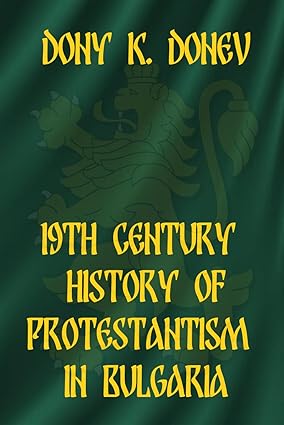 Dony K. Donev, D.Min., is a prominent researcher and author specializing in Bulgarian Protestant, Evangelical, and Pentecostal history, with over three decades of study. His work, including 19th Century History of Protestantism in Bulgaria and The Unforgotten: Historical and Theological Roots of Pentecostalism in Bulgaria, documents the development of these movements, their suppression under Communism, and the subsequent post-1989 revival. Key aspects of Donev’s research on Bulgarian Protestant history include:
Origins (19th Century): Protestant work began in the 1800s, with denominations like Congregationalists (1856), Methodists (1857), and Baptists (1865) establishing missions, culminating in the first Bulgarian Protestant Church in 1871. Donev also highlights the 1871 publication of the Protestant Bulgarian Bible translation. His research, often in collaboration with the Institute of Bulgarian Protestant History, has focused on preserving, digitizing, and recovering documents, including church diaries, photographs, and, in some cases, saving records from destruction during the communist era.
Januarius MacGahan: Turkish Atrocities in Bulgaria (Part 1)
“A pilgrim from the ends of earth I come
To kneel devoutly at your lowly tomb
To own our debt, we can never repay
To sigh with gratitude, thank God and pray
To bless your name and bless your name
For this I came.” ~Stoyan Vatralsky
“Since my letter of yesterday I have supped full of horrors. Nothing has as yet been said of the Turks that I do not now believe; nothing could be said of them that I should not think probable and likely. There is, it seems, a point in atrocity beyond which discrimination is impossible, when mere comparison, calculation, measurement are out of the question, and this point the Turks have already passed. You can follow them no further.…
But let me tell you what we saw in Batak: We had some difficulty in getting away from Pes[h]tera. The authorities were offended because Mr. Schuyler refused to take any Turkish official with him, and they ordered the inhabitants to tell us that there were no horses, for we had to leave our carriages and take to the saddle. But the people were so anxious that we should go that they furnished horses in spite of the prohibition, only bringing them at first without saddles, by way of showing how reluctantly they did it. We asked them if they could not bring us saddles, also, and this they did with much alacrity and some chuckling at the way in which the Mudir’s orders were walked over. Finally, we mounted and got off. We had been besieged all the morning by the same people who had blockaded us the night before, or who appeared to be the same, their stories were so much alike. We could do nothing but listen in pity to a few of them – it would have taken all day to hear each separate tale of misery and suffering – gave vague promises that we would do all in our power to relieve their misery upon our return to Constantinople. But diplomatic help is, alas! very slow. While ambassadors are exchanging notes and compliments inviting each other to dinner, discussing the matter over their coffee and cigars, making representations to the Porte, and obtaining promises which nobody believes in, these poor people are starving and dying. Many of them decided to seize this opportunity and accompany us to Batak, to visit their ruined homes, and others caught our bridle reins, determined to make us listen to their stories before we should start. One woman caught my horse, and held it until she could show me where a bullet had traversed her arm, completely disabling her from work, and this was only the least of her woes. Husband killed, and little children depending on that broken arm for bread; all of this told in a language so much like Russian that I could understand a great deal of it; so like Russian that I could easily have fancied myself amongst peasants of the Volga, or the denizens of the Gostinoidvor, Moscow. The resemblance is striking, and it is no wonder the Russians sympathise with these people….
Batak is situated about thirty miles south of Tatar Bazardjik as the crow flies, high up in a spur of the Balkans that here sweeps around to the south from the main range. The road was only a steep mountain path that in places might have tried the agility of a goat. There was a better one, as we learned upon our return, but with that perversity which distinguishes the Oriental mind, our guide took this one instead….
After three hours’ climbing by paths so steep that we were obliged to dismount and walk half the time without then seeming quite safe from rolling down into some abyss, mounting higher and higher until we seemed to have got among the clouds, we at last emerged from a thick wood into a delightful little valley that spread out a rich carpet of verdure before our eyes…. The mill-wheels are silent now. This little valley with its rich grassy slopes ought to have been covered with herds of sheep and cattle. Not one was to be seen. The pretty little place was as lonely as a graveyard, or as though no living thing had trod its rich greensward for years…. This was the village of Batak, which we were in search of.
…. We turned aside from the road, and passing over the debris of two or three walls and through several gardens, urged our horses up the ascent toward the dogs. They barked at us in an angry manner, and then ran off into the adjoining fields. I observed nothing peculiar as we mounted until my horse stumbled, when looking down I perceived he had stepped on a human skull partly hid among the grass. It was quite hard and dry, and might, to all appearances, have been there two or three years, so well had the dogs done their work. A few steps further there was another and part of a skeleton, likewise, white and dry. As we ascended, bones, skulls, and skeletons became more frequent, but here they had not been picked so clean, for there were fragments of half dry, half putrid flesh attached to them. At last, we came to a little plateau or shelf on the hillside, where the ground was nearly level, with the exception of a little indentation, where the head of a hollow broke through. We rode toward this with the intention of crossing it, but all suddenly drew reign with an exclamation of horror, for right before us, almost beneath our horses’ feet, was a sight that made us shudder. It was a heap of skulls, intermingled with bones from all parts of the human body, skeletons nearly entire and rotting, clothing, human hair and putrid flesh lying there in one foul heap, around which the grass was growing luxuriantly. It emitted a sickening odour, like that of a dead horse, and it was here that the dogs had been seeking a hasty repast when our untimely approach interrupted them.
In the midst of this heap, I could distinguish the slight skeleton form, still enclosed in a chemise, the skull wrapped about with a coloured handkerchief, and the bony ankles encased in the embroidered footless stockings worn by Bulgarian girls. We looked about us. The ground was strewed with bones in every direction, where the dogs had carried them off to gnaw them at their leisure.
At the distance of a hundred yards beneath us lay the town. As seen from our standpoint, it reminded one somewhat of the ruins of Herculaneum and Pompeii. There was not a roof left, not a whole wall standing; all was a mass of ruins, from which arose as we listened a low plaintive wail, like the “keening” of the Irish over their dead, that filled the little valley and gave it voice. We had the explanation of thin curious sound when we afterwards descended into the village. We looked again at the heap of skulls and skeletons before us, and we observed that they were all small and that the articles of clothing intermingled with them and lying about were all women’s apparel. These, then, were all women and girls. From my saddle I counted about a hundred skulls, not including those that were hidden beneath the others in the ghastly heap nor those that were scattered far and wide through the fields. The skulls were nearly all separated from the rest of the bones – the skeletons were nearly all headless. These women had all been beheaded.
We descended into the town. Within the shattered walls of the first house we came to was a woman sitting upon a heap of rubbish rocking herself to and fro, wailing a kind of monotonous chant, half sung, half sobbed, that was not without a wild discordant melody. In her lap she held a babe, and another child sat beside her patiently and silently, and looked at us as we passed with wondering eyes. She paid no attention to us, but we bent our ear to hear what she was saying, and our interpreter said it was as follows: “My home, my home, my poor home, my sweet home; my husband, my husband, my dear husband, my poor husband; my home, my sweet home,” and so on, repeating the same words over again a thousand times. In the next house were two engaged in a similar way; one old, the other young, repeating words nearly identical: “I had a home, now I have none; I had a husband, now I am a widow; I had a son, and now I have none; I had five children, and now I have one,” while rocking themselves to and fro, beating their heads and wringing their hands. These were women who had escaped from the massacre, and had only just returned for the first time, having taken advantage of our visit or that of Mr. Baring to do so. They might hare returned long ago, but their terror was so great that they had not dared without the presence and protection of a foreigner, and now they would go on for hours in this way, “keening” this kind of funeral dirge over their ruined homes. This was the explanation of the curious sound we had heard when up on the hill.
As we advanced there were more and more; some sitting on the heaps of stones that covered the floors of their houses; others walking up and down before their doors, wringing their hands and repeating the same despairing wail. There were few tears in this universal mourning. It was dry, hard, and despairing. The fountain of tears had been dried up weeks before, but the tide of sorrow and misery was as great as ever, and had to find vent without their aid. As we proceeded most of them fell into line behind us, and they finally formed a procession of four or five hundred people, mostly women and children, who followed us about wherever we went with their mournful cries. Such a sound as their united voices sent up to heaven I hope never to hear again.
….A little further on we came to an object that filled us with pity and horror. It was the skeleton of a young girl not more than fifteen lying by the roadside, and partly covered with the debris of a fallen wall. It was still clothed in a chemise; the ankles were enclosed in footless stockings, but the little feet, from which the shoes had been taken, were naked, and owing to the fact that the flesh had dried instead of decomposing were nearly perfect. There was a large gash in the skull, to which a mass of rich brown hair, nearly a yard long, still clung, trailing in the dust. It is to be remarked that all the skeletons found here were dressed in a chemise only, and this poor child had evidently been stripped to her chemise, partly in the search for money and jewels, partly out of mere brutality, and afterwards killed. We have tallied with many women who had passed through all parts of the ordeal but the last, and the procedure seems to have been, as follows: They would seize a woman, strip her carefully to her chemise, laying aside articles of clothing that wore valuable, with any ornaments and jewels she might have about her. Then as many of them as cared would violate her, and the last man would kill her or not as the humour took him.
Dony K. Donev, D.Min., is a prominent researcher and author specializing in Bulgarian Protestant, Evangelical, and Pentecostal history, with over three decades of study. His work, including 19th Century History of Protestantism in Bulgaria and The Unforgotten: Historical and Theological Roots of Pentecostalism in Bulgaria, documents the development of these movements, their suppression under Communism, and the subsequent post-1989 revival. Key aspects of Donev’s research on Bulgarian Protestant history include:
Origins (19th Century): Protestant work began in the 1800s, with denominations like Congregationalists (1856), Methodists (1857), and Baptists (1865) establishing missions, culminating in the first Bulgarian Protestant Church in 1871. Donev also highlights the 1871 publication of the Protestant Bulgarian Bible translation. His research, often in collaboration with the Institute of Bulgarian Protestant History, has focused on preserving, digitizing, and recovering documents, including church diaries, photographs, and, in some cases, saving records from destruction during the communist era.
Protestant Participation in the April Uprising (1876)
A considerable number of Protestants took part in the prematurely erupted April Uprising. Many of them were in the immediate circle of Benkovski, Vasil Volóv, and the other revolutionary apostles. Some Protestants joined during the uprising itself. According to Dimitar Strashimirov, about sixty men from the village of Tserovo, in the Pazardzhik region, joined Benkovski’s detachment under the leadership of Tsvyatko Brŭshkov. At that time Tserovo had 120 households, fifteen of which belonged to Bulgarian Protestants. Two roster protocols were compiled – one larger list for the Orthodox, and a smaller one for the Protestants. The leaders of the Protestant group were K. Teliyski and Nikola Kochov. From the same village came Ivan Cheshírov, one of the “tens-men” (leaders of groups of ten) in the Flying Column. Collective memory has preserved the names of two well-known Protestants from Panagyurishte as active participants in the uprising: Stefan Balabanov, who organized the sewing of clothing for the rebels, and Rad Minev, one of the most experienced arms-bearers of the insurgent town.
Protestants were also involved in the activities of nearly all revolutionary districts. Particularly dramatic was the fate of the evangelist Stoil Findzhikov, the master craftsman of the “cherry-wood cannons,” who became a symbol of the uprising. As a youth, Stoil had worked in a military workshop in Constantinople, where he learned details of firearms manufacture. On the eve of the uprising and during its course, prompted by Volov and Benkovski, he crafted and refined several of these primitive cannons. He fired his last “cherry-wood cannon” at the advancing Ottoman forces beneath Mount Kamenitsa. Under the pressure of the attacking bashi-bozouk irregulars, the defenders fled one by one, and some fell in battle.
The evangelist Petar Donchev from Panagyurishte also took an active part in the April Uprising. During the height of the revolt, he served as a trusted courier between the surrounding towns and villages, employed by both Benkovski and Volov. “Petraki,” as the insurgents called him, displayed remarkable resourcefulness, courage, and self-sacrifice. After the uprising he departed for the United States, where he studied theology, later returning to Bulgaria as pastor in Chirpan. Yet he remained throughout his life a passionate patriot and tireless public figure. He declined every offer of praise or reward after the Liberation with the simple words that “whatever he had done, he had done for God and for the Fatherland.”
In the early summer days of 1876, there existed a real danger that the bloody sacrifice of the Bulgarian people would be silenced. Had this occurred, the central idea of the revolutionary movement – and the sacrifice of tens of thousands – would have faded ingloriously into obscurity. At precisely this moment, Bulgarians from Pazardzhik and Plovdiv succeeded in secretly sending the first accurate and detailed descriptions of the events in the rebellious regions to the Protestant missionaries in Constantinople. A decisive man – Father Tilev of Pazardzhik – was the first to describe the massacres, the fires, the hangings, the mass slaughter of defenseless people, and the full horror experienced by the population in the affected districts. He entrusted the packet of writings to the Croat Ilitch, director of the Austrian post in Plovdiv, asking him to forward it to a friend in Constantinople who would deliver it personally to Dr. Albert Long. The first description was soon followed by a second and a third. Reports and accounts began to appear from other sources as well. Ivan Ev. Geshov of Plovdiv also sent a letter through Andrei Tsanov to Dr. Long, writing, among other things: “Many villages in the Pazardzhik region are in flames and the people are being exterminated. Is there no help or protection for them from somewhere?”
With the help of Andrei Tsanov, Dr. Long translated the letters into English and consulted Dr. George Washburn, director of Robert College. The two agreed that Dr. Long would systematize the shocking materials arriving in Constantinople, while Dr. Washburn would bring them to the attention of influential English and American figures in the Ottoman capital. Thus, the information reached Edwin Pears, an English barrister and correspondent for the Daily News, who sent the first alarming reports. The London editorial office initially refused to believe the atrocious descriptions and demanded telegraphic confirmation from Pears himself. Only then, on 23 June 1876, did the Daily News publish the first horrifying accounts of the tragedy of the Bulgarian people.
Dr. Long and Dr. Washburn presented the matter to the British ambassador Henry Elliot and the American minister Horace Maynard. Elliot stated that the matter had to be investigated and verified before being taken “seriously.” Undeterred, the two missionaries sent a second, even more detailed report to the Daily News, insisting that Britain intervene on behalf of the suffering Christian population. Gradually, the Disraeli–Beaconsfield government was cornered, and the prime minister attempted to deflect the issue by declaring in Parliament that “all this commotion is nothing but coffeehouse gossip.” This statement, however, marked the beginning of the crisis’ most intense phase.
More and more dispatches appeared in the Daily News and in a growing number of British and European newspapers. The Daily Mail sent the well-known American journalist Januarius MacGahan – then in London – to visit the sites of the atrocities and report his findings. Disraeli, for his part, ordered an “urgent inquiry” by the British Embassy in Constantinople. The ambassador entrusted the task to the youngest member of the mission, Walter Baring, along with his father-in-law, Fr. Gauracino, a Levantine, retired British consul, and significant debtor to the Ottoman state.
To the American missionaries it was clear that this move sought to obscure the truth about the massacre of an entire people. They immediately visited Minister Maynard again, insisting that the newly arrived first secretary and U.S. consul general in Constantinople, Eugene Schuyler, depart for the burned and blood-soaked regions of Bulgaria. This was also necessary because they feared that the Ottoman government would refuse permission for Baring to carry out his mission.
Minister Maynard expressed his profound sympathy for the Bulgarian people but explained that his duties in Constantinople did not include intervention in the political affairs of the empire, being limited exclusively to the promotion of “commercial relations.” In his view, only one Great Power – Britain – could exert real influence over Turkey. Dr. Washburn, exasperated, rose from his chair and firmly declared: “I am going directly to the telegraph office to inform the President of the United States that his representative in Turkey refuses to lift a finger to save an entire nation of suffering Christians. And I shall report the same to the American press.” The minister was compelled to ask Washburn to return to his office. With the assistance of Dr. Long, they devised a “skillful maneuver”: Eugene Schuyler would travel to Adrianople and the province “to identify and appoint a suitable correspondent for commercial matters.” Thus, the ground was prepared. Upon MacGahan’s arrival, the two Americans, both fluent in Russian, together with Petar Dimitrov, a graduate of Robert College and secretary of the newspaper Zornitsa, set out for the devastated regions of Bulgaria. They were later joined by the Russian consul in Adrianople, Prince Tsertelev.
Meanwhile, Dr. Jacob Clarke of Plovdiv was the first foreigner to visit Batak immediately after the massacre, accompanied by Pastor Nikola Boyadzhiev of Panagyurishte. Amid the ghastly scene and overwhelming stench, they placed in their suitcase several heads of children and women – still with their hair braided – and carried them back to Plovdiv. These were physical proofs intended to confront certain foreign skeptics, influenced by Ottoman officials, who claimed that the victims had been “rebels” whom the Turks were obliged to eliminate “to preserve order.” Dr. Clarke visited several consuls in Plovdiv and began taking out the severed heads one by one, asking: “Is this a rebel? And is this a rebel?” Britain, and soon all of Europe, recoiled in horror at the slaughter. One of the most renowned British war correspondents, Archibald Forbes, wrote:
“MacGahan accomplished brilliantly his mission of exposing the Turkish atrocities in Bulgaria in 1876. I know of nothing in journalism that surpasses, in language, pathos, and flaming indignation, writing that passed so spontaneously from heart to heart. His call stirred William Gladstone to a convulsive paroxysm of revulsion at the barbarities. It stirred England to the depths of her national soul. You could see people traveling on the railways reading those reports with burning faces and tears in their eyes.”
Throughout this entire dramatic period Dr. Albert Long, though remaining in Constantinople, continued – literally day and night – his efforts on behalf of the Bulgarian people. Even when, at the end of 1876 and the beginning of 1877, certain forces sabotaged the work of the Constantinople Conference of the Great Powers, which had agreed on autonomy for Bulgaria across its full ethnic territory, Dr. Long did not lose composure. He continued to seek solutions by every means available. Washburn wrote of him:
“It is a fundamental fact that, although Dr. Long kept modestly in the background, he was the center of everything that was done in Constantinople for Bulgaria during the massacres and the severe trials endured by the Bulgarians in their struggle for freedom.”
Finally, in early May 1876, just days after the outbreak of the April Uprising, a Bulgarian girl in Thessaloniki – Stefana Lanskova – was rescued from abduction intended to force her conversion to Islam. She was hidden in the home of the American consul in Thessaloniki, Hadzhi Lazarov (a Bulgarian Evangelical Christian from Voden who had taken American citizenship and service). This provoked violent unrest among fanatical Turks around Robert College in Constantinople. On May 6, 1876, Muslim extremists murdered the French and German consuls in Thessaloniki (Moulin and Abbott). The American consul, who was their primary target, survived. As unrest at Robert College intensified, ambassador Maynard appealed to President Grant for assistance who did not hesitate to dispatch an American naval squadron led by the USS Trenton to the Sea of Marmara to deter both the fanatical mobs threatening Robert College and the British naval squadron positioned at the Bosporus. It was in precisely this atmosphere that the large-scale efforts of American missionaries, journalists, and diplomats unfolded during the summer of 1876.
In s similar fashion Januarius MacGahan received assignments from the London Daily News and others to report from war zones, particularly the 1876 Bulgarian Uprising against the Ottoman Empire, where his vivid reports on atrocities. With special attention to the Batak Massacre that had shocked Europe and galvanized support for Bulgarian independence, leading to his posthumous title, “Liberator of Bulgaria.” His “orders” were to report the truth, which he did fearlessly, even following Russian armies without permission. His dispatches became crucial historical records of the conflict and Ottoman brutality over Bulgarian civilian population.
Dony K. Donev, D.Min., is a prominent researcher and author specializing in Bulgarian Protestant, Evangelical, and Pentecostal history, with over three decades of study. His work, including 19th Century History of Protestantism in Bulgaria and The Unforgotten: Historical and Theological Roots of Pentecostalism in Bulgaria, documents the development of these movements, their suppression under Communism, and the subsequent post-1989 revival. Key aspects of Donev’s research on Bulgarian Protestant history include:
Origins (19th Century): Protestant work began in the 1800s, with denominations like Congregationalists (1856), Methodists (1857), and Baptists (1865) establishing missions, culminating in the first Bulgarian Protestant Church in 1871. Donev also highlights the 1871 publication of the Protestant Bulgarian Bible translation. His research, often in collaboration with the Institute of Bulgarian Protestant History, has focused on preserving, digitizing, and recovering documents, including church diaries, photographs, and, in some cases, saving records from destruction during the communist era.
PENTECOST has COME
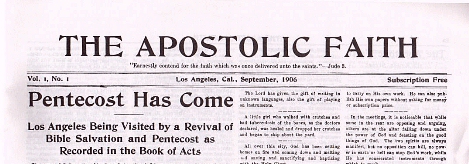
Zornitsa Newspaper and the Coverage of the April Uprising in 1876
In 1872, at the Second Annual Meeting of the Mission for European Turkey, the delegates entrusted Dr. Riggs with the task of supporting the further development of the newspaper. The printing of the Bulgarian Protestant translation of the Bible had been successfully completed, and Zornitsa now emerged as a primary objective in the missionaries’ publishing plans.
After the restoration of the publication in 1874, several changes were introduced – its format was enlarged from quarto to half-folio. The most significant change, however, was the transformation of the newspaper into a weekly. The weekly Zornitsa appeared for the first time in December 1875, while a monthly edition also continued to be issued, aimed specifically at younger readers. The editor-in-chief during this period was Theodore Byington, yet the recollections of contemporaries testify that Dr. Riggs played a key role – both in preparing many of the articles (Dr. Riggs is the author of numerous unsigned publications in Zornitsa) and in shaping editorial policy.
This shift in the publishing strategy of Zornitsa occurred immediately before one of the most dramatic events of the Bulgarian National Revival – the April Uprising. At the time of the uprising, Zornitsa was the most widely distributed Bulgarian newspaper, reaching virtually all territories inhabited by Bulgarians, and had gained considerable authority among the Bulgarian public. The stance of the newspaper during the tragic events of 1876 demonstrates that this was no coincidence; the people behind the publication had found an effective way both to proclaim the Gospel and to serve and support the Bulgarian nation.
Many objective researchers have unequivocally credited the Protestant missionaries and their publication with awakening international attention and public conscience regarding the Bulgarian question. On the one hand, the publishers of Zornitsa transmitted every piece of information they received about the atrocities committed during the suppression of the uprising directly to British and American governmental bodies and individuals, as well as to influential publications in those countries. On the other hand, the missionaries themselves traveled boldly and diligently throughout the devastated regions, serving as principal collaborators in the investigations initiated by British statesman Gladstone. Even more impressive is the courageous and empathetic reporting of the uprising in the newspaper’s own pages. Zornitsa became the sole written source of information for the Bulgarian people in many remote areas concerning the events in the rebel regions. Through Zornitsa, the Bulgarian nation shared in the horror and tragedy of the April Uprising – thus, although military operations were confined to limited territories, the entire Bulgarian people were informed about what was taking place. In this way, Zornitsa contributed significantly to transforming the events of April–June 1876 into a national drama and a collective experience for the whole Bulgarian nation.
From the earliest days of the uprising, Zornitsa reported the mobilization of Ottoman troops and their movement toward Plovdiv and Pazardzhik. In issue no. 18 of 30 April 1876, in an article entitled “Disturbances in Bulgaria,” readers received information about the rebellion in the Panagyurishte region. The following issue, dated 7 May, published a telegram from Hafiz Pasha concerning the destruction of Straltsa. The same issue contained a detailed account of the capture of Panagyurishte by Ottoman forces, as well as extensive reports on arrests in the Pazardzhik and Adrianople districts. Separate coverage was given to the arrest of Bulgarian priests, including a bishop from Plovdiv.
The issue of 14 May 1876 informed readers of Circassian raids in the Tryavna, Sofia, and Sevlievo regions. Extraordinary reporting covered the burning of 118 villages in the Plovdiv district. The publishers of Zornitsa suggested the tension within the Ottoman government by informing readers about the dispatch of official investigators. Zornitsa described the cherry-wood cannons of the rebels, standing against the “Krupp” artillery of the Ottoman army. In its 21 May issue, Zornitsa reported in detail on insurgent actions in the Turnovo region and on the harassment of Bulgarians in the Bitola region. The publishers showed remarkable knowledge by reporting on insurgent detachments in Zheravna and Medven, as well as on bashibozuk raids in the Samokov region. The authors grew increasingly bold, calling the actions of the bashibozuk in the Shumen region “terror.” Zornitsa encouraged Bulgarian readers by reporting the awakening of public opinion in the Western world. The first in a series of materials was published – the speech of Lord Stratford calling for a “radical reform in the Ottoman Empire.”
Zornitsa informed its readers about the arrival of Hristo Botev’s detachment, noting its 175 members and its landing on the Bulgarian shore from the steamer Radetzky. A notice about the death of rebel leader Georgi Benkovski was also published.
In its 11 June issue, Zornitsa printed the full text of the “Proclamation of the Bulgarian Insurgents to the Muslims,” clearly showing that the actions of the rebels were directed against the despotic Ottoman regime, while the Muslim population was collectively addressed as “brothers.” In this way, Zornitsa testified to the tolerance of the Bulgarian rebels and reinforced the moral character of their cause. The publishers were fully aware that, alongside the battles on the ground, a decisive struggle for world public opinion was taking place – and they did everything possible to support the Bulgarian cause on the international stage. At the same time, the newspaper encouraged Bulgarians by showing that their efforts and sacrifices were bearing fruit abroad: in July it published a reprint from the British Economist with the findings of Dr. Washburn’s investigation into the uprising and sharp criticism of Prime Minister Disraeli’s pro-Turkish policy. In issue no. 30, the British consul in Constantinople, F. Fransin, was called “a friend of the Bulgarians,” and his successful intervention leading to the release of 212 imprisoned Bulgarian rebels from the Adrianople jail was recounted. On 3 September, information was published about Gladstone’s newly issued pamphlet, The Bulgarian Horrors and the Question of the East. The following issue contained information about a subsequent appeal by Gladstone and Stratford to “the conscience of the English people.” Further reports were printed about the numerous relief committees established in English cities and about the donations of individuals such as Lady Strangford and Lord Mayor, who had turned their hearts toward the Bulgarian nation.
Meanwhile, the newspaper closely monitored events in the rebel regions – readers were informed about the arrests of committee activists in Macedonia and about the atrocities committed by the bashibozuk band led by Hadji Murad, who, together with fourteen members of his band, was later convicted by an Ottoman military court. Issue no. 39 printed Baring’s report on “the Turkish brutalities,” followed by the full texts of “The Bulgarian Memorandum to Lord Derby” and the petition of Balabanov and Tsankov to “the Queen of England.”
This brief survey of the coverage of the 1876 events in Zornitsa demonstrates the real benefit of the newspaper’s existence for the Bulgarian cause. It must be remembered that these publications appeared under strict censorship and even during the suspension of Bulgarian publications within the Ottoman Empire. Despite this, the Protestant missionaries succeeded in practically serving the people whose eternal salvation they sought, and in the dramatic months of 1876 they established a model of public behavior that remains exemplary even today. The preserved letters of the missionaries testify that their conduct was motivated by deep sincerity and genuine concern for the fate of the nation to which they felt called to minister.
Dony K. Donev, D.Min., is a prominent researcher and author specializing in Bulgarian Protestant, Evangelical, and Pentecostal history, with over three decades of study. His work, including 19th Century History of Protestantism in Bulgaria and The Unforgotten: Historical and Theological Roots of Pentecostalism in Bulgaria, documents the development of these movements, their suppression under Communism, and the subsequent post-1989 revival.
Key aspects of Donev’s research on Bulgarian Protestant history include:
Origins (19th Century): Protestant work began in the 1800s, with denominations like Congregationalists (1856), Methodists (1857), and Baptists (1865) establishing missions, culminating in the first Bulgarian Protestant Church in 1871. Donev also highlights the 1871 publication of the Protestant Bulgarian Bible translation. His research, often in collaboration with the Institute of Bulgarian Protestant History, has focused on preserving, digitizing, and recovering documents, including church diaries, photographs, and, in some cases, saving records from destruction during the communist era.
Pentecostalism and Growth: The Unforgotten documents the arrival of the Pentecostal movement in Bulgaria, particularly through the influence of the Azusa Street Revival, tracing the roots of early Bulgarian Pentecostal families.
Post-Communist Revival: Donev has documented the rapid growth of the Protestant movement after 1989, noting a significant increase in membership from approximately 13,000 to over 100,000. Dr. Donev has published his dissertation on on Bulgarian Churches in North America.
19th Century History of Protestantism in Bulgaria
Dony K. Donev, D.Min., is a prominent researcher and author specializing in Bulgarian Protestant, Evangelical, and Pentecostal history, with over three decades of study. His work, including 19th Century History of Protestantism in Bulgaria and The Unforgotten: Historical and Theological Roots of Pentecostalism in Bulgaria, documents the development of these movements, their suppression under Communism, and the subsequent post-1989 revival.
Key aspects of Donev’s research on Bulgarian Protestant history include:
Origins (19th Century): Protestant work began in the 1800s, with denominations like Congregationalists (1856), Methodists (1857), and Baptists (1865) establishing missions, culminating in the first Bulgarian Protestant Church in 1871. Donev also highlights the 1871 publication of the Protestant Bulgarian Bible translation. His research, often in collaboration with the Institute of Bulgarian Protestant History, has focused on preserving, digitizing, and recovering documents, including church diaries, photographs, and, in some cases, saving records from destruction during the communist era.
Pentecostalism and Growth: The Unforgotten documents the arrival of the Pentecostal movement in Bulgaria, particularly through the influence of the Azusa Street Revival, tracing the roots of early Bulgarian Pentecostal families.
Post-Communist Revival: Donev has documented the rapid growth of the Protestant movement after 1989, noting a significant increase in membership from approximately 13,000 to over 100,000. Dr. Donev has published his dissertation on on Bulgarian Churches in North America.
Let the Protestant say the prayer: Protestant Participation in Bulgaria’s Liberation
A considerable number of Protestants took part in the prematurely erupted April Uprising. Many of them were in the immediate circle of Benkovski, Vasil Volóv, and the other revolutionary apostles. Some Protestants joined during the uprising itself. According to Dimitar Strashimirov, about sixty men from the village of Tserovo, in the Pazardzhik region, joined Benkovski’s detachment under the leadership of Tsvyatko Brŭshkov. At that time Tserovo had 120 households, fifteen of which belonged to Bulgarian Protestants. Two roster protocols were compiled – one larger list for the Orthodox, and a smaller one for the Protestants. The leaders of the Protestant group were K. Teliyski and Nikola Kochov. From the same village came Ivan Cheshírov, one of the “tens-men” (leaders of groups of ten) in the Flying Column. Collective memory has preserved the names of two well-known Protestants from Panagyurishte as active participants in the uprising: Stefan Balabanov, who organized the sewing of clothing for the rebels, and Rad Minev, one of the most experienced arms-bearers of the insurgent town.
Protestants were also involved in the activities of nearly all revolutionary districts. Particularly dramatic was the fate of the evangelist Stoil Findzhikov, the master craftsman of the “cherry-wood cannons,” who became a symbol of the uprising. As a youth, Stoil had worked in a military workshop in Constantinople, where he learned details of firearms manufacture. On the eve of the uprising and during its course, prompted by Volov and Benkovski, he crafted and refined several of these primitive cannons. He fired his last “cherry-wood cannon” at the advancing Ottoman forces beneath Mount Kamenitsa. Under the pressure of the attacking bashi-bozouk irregulars, the defenders fled one by one, and some fell in battle.
The evangelist Petar Donchev from Panagyurishte also took an active part in the April Uprising. During the height of the revolt, he served as a trusted courier between the surrounding towns and villages, employed by both Benkovski and Volov. “Petraki,” as the insurgents called him, displayed remarkable resourcefulness, courage, and self-sacrifice. After the uprising he departed for the United States, where he studied theology, later returning to Bulgaria as pastor in Chirpan. Yet he remained throughout his life a passionate patriot and tireless public figure. He declined every offer of praise or reward after the Liberation with the simple words that “whatever he had done, he had done for God and for the Fatherland.”
The numerological slogan “1876 – Turkey will fall” was created by the Evangelical Christian Petar Vezhinov. Serving as couriers for the Internal Revolutionary Organization were Bulgarian Evangelical preachers: Veliko Petranov from Panagyurishte; N. Boyadzhiev and N. Kochev from the Pazardzhik region; Blago Sarandov and Petar Musevich from Macedonia. The pastor from Chirpan, Petar Doichev, was entrusted with important intelligence missions. Ivan Neykov served as the personal courier of Georgi Benkovski, while V. Karaivanov from Chirpan was suspected and arrested by the Ottoman authorities. Stefan Balabanov supplied a significant portion of the revolutionary uniforms, while Rad Manev, a gunsmith, manufactured weapons for the insurgents. The design for the “Chereshovoto Topche” (Cherry Cannon) was the work of the Evangelical Christian from Panagyurishte, master Stoil Findzhikov. At the decisive assembly in Oborishte, he was asked to deliver the prayer for the blessing of the cause for Bulgaria’s liberation.
When Georgi Benkovski gathered the insurgents in Oborishte before announcing the uprising, he declared: “Let the Protestant say the prayer.” The Protestant was Stoil Findzhikov, the historical figure who became the prototype for Ivan Vazov’s vivid character Borimechkata (The Bear Slayer). According to the recollections of Findzhikov’s daughter, Radka Kaloyanova, his prayer was: “Lord God, Who created heaven and earth, Who has helped many who have put their trust in You – help us as well, gathered here today, to succeed in our endeavor.” (Bulgarian Baptist Digest, Heralds of Truth)
BULGARIA after 2026 Elections: Putin’s Trojan Horse in EU…
Bulgaria’s President Rumen Radev, a military general and pilot, is now Bulgaria’s new Prime Minister. He has served two presidential terms, and in January 2026 he resigned from office and entered the early parliamentary elections. Radev’s decisive victory in the parliamentary elections is a guarantee of absolute Parliamentarian majority for the first time since 1997.
A former member of the Communist Party, he has often taken ambiguous positions regarding Russia, considering Crimea to be ‘Russian’ and criticizing the European sanctions imposed in response to the war.” Given Radev’s attitude toward Putin and Russia, there is a risk of a pro-Kremlin government at a critical moment — he would be Putin’s Trojan horse in Europe.
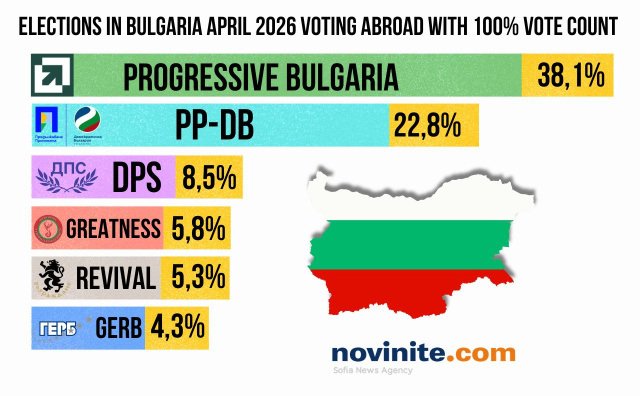
DW: ‘A Trojan Horse for Putin’: Foreign media on the elections in Bulgaria
France-Presse recalls that during his campaign, Radev called for “practical relations with Russia, based on mutual respect and equal treatment.”
POLITICO: Pro-Russian candidate Rumen Radev emerges as the winner of the elections in Bulgaria
CNN: Bulgaria’s Kremlin-friendly ex-president wins election in landslide
BBC: The election was called after the previous government tried to push through a controversial budget in December, prompting mass protests which Radev, as president, supported.
FoxNews: Tired of political turmoil, Bulgarians give ex-president a convincing mandate for change
ALIVE!
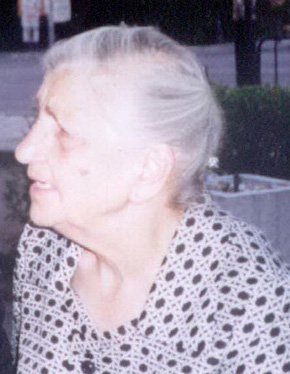 Rev. Dony K. Donev, D. Min.
“When I call to remembrance the unfeigned faith that is in thee, which dwelt first in thy grandmother Lois, and thy mother Eunice; and I am persuaded that in thee also.”
2 Timothy 1:5
My Grandma, Todorka Mindova, was one of the first Sunday school teachers in the Bulgarian Pentecostal Union. After successfully graduating from a training course in the city of Sliven led by Donka Kinareva and personally organized by Dr. Nicolas Nikolov, she was allowed to minister in the denomination. But for grandma, the faith was more than teaching or a sermon. It was life. Many Bulgarian Pentecostal ministers can testify to the effectiveness of her ministry. And for her constant fasting and thousands of answered prayers I could write a book.
But far more interesting for me as a child was the fact that being a Sunday school teacher, Grandma never tried to preach to me. In the hardest moments of life she would only confess these words, which I have remembered from my childhood: “We serve a living God.” More was not needed. For Grandma preached with her life. Read more
Pentecostal Neo-Primitivism: The Theological Framework
Dony K. Donev, D.Min., is a Pentecostal theologian, historian, and minister associated with institutions like the Pentecostal Theological Seminary and Lee University, where he has taught classes such as Intro to Digital Discipleship. His work focuses on Pentecostal history, leadership, primitivism, and practical theology, often drawing from Bulgarian Protestant contexts and global Pentecostalism. Below, I outline the key theological frameworks and terms he has coined or developed, based on his publications, articles, and teachings. These emphasize spiritual renewal, community, and missional application within Pentecostal traditions.1. U.S.H.E.R. Model of Communion
- Description: This is a theological framework for understanding the dynamics of Communion (the Lord’s Supper) as foundational to disciple growth in Christian catechism. It identifies five key elements: Unity (fostering communal bonds), Sanctification (personal holiness through the Spirit), Hope (eschatological assurance), Ecclesial communion (church fellowship), and Redemptive mission (outward evangelistic calling). The model positions Communion not as an isolated ritual but as a catalyst for ongoing spiritual formation and mission.
- Coined: During the Covid-19 pandemic (circa 2020–2021) as part of his “Intro to Digital Discipleship” class at Lee University.
- Key Ideas and Evidence: It builds on biblical Communion texts (e.g., 1 Corinthians 11:23–26) and Pentecostal emphases on experiential faith, adapting traditional catechism for digital and crisis contexts. No specific case studies are detailed in public sources, but it addresses post-pandemic disciple-making challenges.
- Contributions: Emphasizes Communion’s role in digital discipleship, linking ritual to practical growth.
2. Pentecostal Paradigm for Leadership
- Description: A leadership model redefining ministry in Pentecostal contexts through three core factors: (1) Leadership of the Spirit (divine calling and vision via the Holy Spirit), (2) Holiness Lifestyle (integrity and sanctification as ethical foundations), and (3) Emphasis on Community (team-based, accountable servant-leadership). It contrasts with secular or hierarchical models, promoting a “servant-church” ethos.
- Coined: In his paper “Pentecostal Paradigm for Leadership” (published on Cup & Cross Ministries).
- Key Ideas and Evidence: Draws from biblical servant leadership (e.g., Christ as the “suffering servant” in Isaiah 53 and Philippians 2), historical Pentecostal examples (e.g., early church community in Acts and Bulgarian Pentecostals under Communist persecution), and contextual analysis (e.g., Bulgaria’s post-1989 crises with ethnic diversity in churches like Samokov and Razlog). Proof includes axioms: leadership solves problems in people-groups, proven by church growth data (e.g., 20.3% Roma-Gypsy members in Bulgarian Church of God).
- Contributions: Addresses leadership crises in postmodern and cross-cultural settings, integrating “Theology of the Persecuted Church” (a related concept he references, though not explicitly coined by him).
3. Pentecostal Primitivism
- Description: A theological approach advocating the preservation and reclamation of early Pentecostal experiences—expressed through power (miracles), prayer (spiritual intimacy), and praxis (practical ministry)—to resolve identity crises in modern Pentecostalism. It calls for returning to “primitive” (original) roots while adapting to contemporary challenges.
- Coined: In his book Pentecostal Primitivism Preserved (2012).
- Key Ideas and Evidence: Rooted in historical primitivism (e.g., Azusa Street Revival) and biblical precedents (e.g., Acts 2’s outpouring). Evidence includes critiques of institutional drift in Pentecostalism, with examples from Bulgarian Protestant history (e.g., persecution fostering authentic faith). The framework posits primitivism as a solution to existential questions like identity and purpose.
- Contributions: Offers a renewal strategy for global Pentecostalism, emphasizing experiential faith over formalism.
4. 50/20 Principle
- Description: A biblical principle derived from Genesis 50:20 (“You intended to harm me, but God intended it for good”), framing God’s faithfulness in transforming harm into redemptive good. It serves as a framework for understanding divine vision fulfillment amid adversity.
- Coined: In his article “The 50/20 Principle Reexamined” (2025, on Cup & Cross Ministries).
- Key Ideas and Evidence: Illustrates God’s sovereignty in trials, with Joseph’s story as the primary example. Proof involves reevaluating the verse’s application to personal and communal crises, emphasizing completion of divine promises.
- Contributions: Applies to leadership and discipleship, encouraging resilience in persecuted or challenged contexts.
Donev’s work often intersects Pentecostal history (e.g., Bulgarian revivals, figures like Ivan Voronaev) with practical theology, as seen in his reviews of Bibles (e.g., Fire Bible, Spirit Filled Life Bible) and articles on Pneuma Review. He cofounded the Institute of Bulgarian Protestant History and contributes to global Pentecostal discourse, but no additional coined terms were identified beyond these. His frameworks frequently draw from Eastern European pietism and emphasize Spirit-led community in digital and persecuted settings.
The Pentecostal Triangle of Primitive Faith: A Framework of Experience and Restoration
Introduction
Pentecostal theology has long emphasized the experiential dimension of faith—where divine encounter, spiritual gifts, and communal expression converge. Among the contemporary voices shaping this discourse, Dony K. Donev offers a compelling framework known as the Pentecostal Triangle of Primitive Faith, which seeks to restore the apostolic essence of early Christianity. This essay explores the theological contours of Donev’s model and compares it with other influential Pentecostal and charismatic paradigms.
The Triangle: Prayer, Power, Praxis
At the heart of Donev’s framework lies a triadic structure:
- Prayer: The foundation of spiritual intimacy and divine communication. Donev views prayer not merely as a discipline but as the gateway to supernatural encounter.
- Power: Manifested through the gifts of the Spirit—healing, prophecy, tongues, and miracles. This element reflects the Pentecostal emphasis on dunamis, the Greek term for divine power.
- Praxis: The lived expression of faith within the community. Praxis includes evangelism, social justice, and communal worship, embodying the Spirit’s transformative work in daily life.
This triangle is not hierarchical but interdependent. Prayer leads to power, power fuels praxis, and praxis deepens prayer. Donev’s model thus reflects a restorationist impulse, aiming to recover the vibrancy of the early church as seen in Acts.
Comparison with Wesleyan Quadrilateral
The Wesleyan Quadrilateral—Scripture, tradition, reason, and experience—has historically shaped Methodist and Holiness theology. Pentecostals have often adopted this model, emphasizing experience as a key source of theological reflection.
However, Donev critiques this framework as insufficient for Pentecostal identity. He argues that Pentecostalism is not merely an extension of Wesleyanism but a distinct restoration movement. While Wesley’s model is epistemological, Donev’s triangle is ontological and missional, rooted in being and doing rather than knowing.
Comparison with Classical Pentecostal Theology
Classical Pentecostalism, as shaped by early 20th-century leaders like Charles Parham and William Seymour, emphasized:
- Initial evidence doctrine: Speaking in tongues as proof of Spirit baptism.
- Dispensational eschatology: A belief in imminent rapture and end-times urgency.
- Holiness ethics: A call to moral purity and separation from the world.
Donev’s framework diverges by focusing less on doctrinal distinctives and more on spiritual vitality and historical continuity. His emphasis on praxis aligns with newer Pentecostal movements that prioritize social engagement and global mission.
Comparison with Charismatic Theology
Charismatic theology, especially within mainline and evangelical churches, often emphasizes:
- Renewal within existing traditions
- Broad acceptance of spiritual gifts
- Less emphasis on tongues as initial evidence
Donev’s triangle shares the Charismatic focus on spiritual gifts but retains a Pentecostal distinctiveness through its restorationist lens. He seeks not just renewal but recovery of primitive faith, making his model more radical in its ecclesiological implications.
Eastern European Context and Trinitarian Theology
Donev’s work is also shaped by his Bulgarian heritage. He highlights how early Bulgarian Pentecostals embraced a Trinitarian theology informed by Eastern Orthodox pneumatology. This contrasts with Western Pentecostalism’s often fragmented view of the Spirit.
His emphasis on free will theology—influenced by Arminianism and Orthodox thought—also sets his framework apart from Calvinist-leaning Charismatic circles.
Conclusion
Dony K. Donev’s Pentecostal Triangle of Primitive Faith offers a rich, experiential, and historically grounded model for understanding Pentecostal spirituality. By centering prayer, power, and praxis, Donev reclaims the apostolic fervor of the early church while challenging existing theological paradigms. His framework stands as a bridge between classical Pentecostalism, Charismatic renewal, and Eastern Christian traditions—inviting believers into a deeper, more dynamic walk with the Spirit.


