

At North Greensboro Church of God
Write the Vision …
Some of the Projects Completed with the Bulgarian Church of God in 2005-10
 1. Chaplaincy: Bulgarian Chaplaincy Association and masters program in chaplaincy
2. Ethnic Minorities: annual Roma events and training seminars
3. Evangelism: 19 documented revivals, 24 evangelization meetings and 9 prayer rallies
4. Leadership Seminars for Church of God regional representatives
5. Media: COGBG.com and related websites
6. Mobile Bible School for pastoral teams and local churches
7. National Assembly for the Bulgarian Church of God
8. Served on the educational committees, evangelism board and church planting teams
9. Sunday School Program (2001-2002 and 2010 anniversary addition)
10. Youth Ministry: annual national events and camps
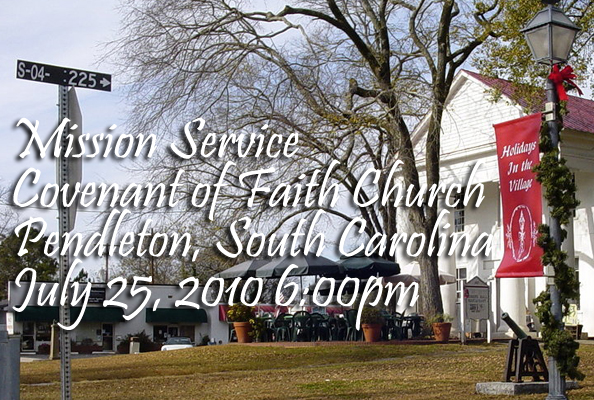
Mission Service at Covenant of Faith
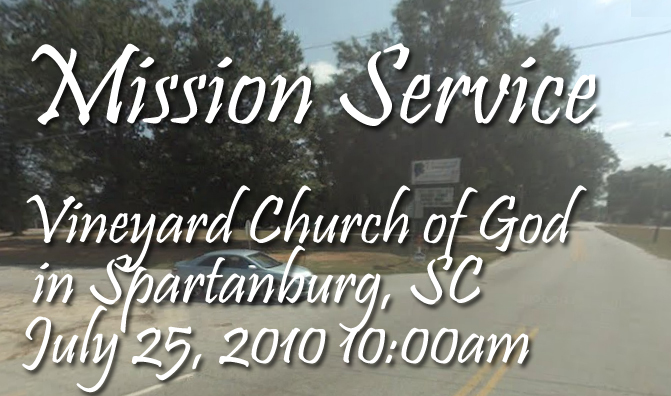
Mission Service at the Vineyard Church of God
M3: Missions for the Third Millennium – A Public Position
 by Rev. Dony K. Donev, D.Min.
The time of changes in the world of missions is at hand. The search for a new paradigm for doing missions in the beginning of the 21st century has begun. Much like in the world of the internet, it cannot be a closed-circuit reinstallation of the same old software, which changes the interface, but not the structure; or a copyrighted etalon designed to be used by a tender legal minority. It must be an open-source, people oriented, social networking, body-like organism of believers that practice the Bible providing the diakonia of missions to peoples and nations in a need of salvation.
This necessity for a fresh evaluation of the way we do missions in the Spirit is based on issues which older missional paradigms were unable to adequately address. Rethinking of world missions today, includes rethinking the global problems of economic crises, world terrorism, immigration and open border markets. Problems that point not to new frontiers in some unknown cosmic future, but back to the old countries upon which modern day civilization was built.
Churches and missionaries, then, cannot afford to simply follow any secular, political, social or economical wave, but must propose Biblical solutions, which surpass both the understanding and history of the natural world to the realm of the Kingdom of God – the sole solver, provider and proprietor of the restoration of God created humanity, social justice and every relationship within the universum for eternity.
It is there, in the very Kingdom identity, or the lacking of such thereof, that the problem of ministry in missions is found. And this problem is deep, penetrating the very soul and make of the church, changing it from a community of mission minded believers willing to dedicate their lives to missions, to an agency that sends half-prepared, half-sponsored, half-aware missionaries to a mission filed where cultural, leadership and financial dilemmas hit them as a hurricane and never seize to oppose their call to minister in a foreign land.
Several characteristics are apparent immediately. The ministry of missions in the 21st century must be:
1. More mission minded than agency structured
2. More missionary focused than leadership centralized
3. More operational than organizational
4. More result oriented than self and strategy containable
5. More praying than thinking while more feeling, than cognitive
6. More giving than fundraising oriented
7. More focused on the Dominion of the Kingdom, than the denomination.
A proposal of such caliber must begin simultaneously at three starting points. First, perhaps not by importance, but by legal requirement, a professional counsel is a must. Many mission agencies follow the secular practice of debriefing missionaries, who have been on the field for a long time as part of their reentry. It is expected that post-missional experiences are often defined as problems requiring a professional counselors. But there are so many more cultural, financial, leadership, church and purely structure related problems. For example, how can one ever imagine doing missions in the 21st century without assertive financial planning in difficult times and rapidly changing international currencies, or political and security advisory in times of ever-present global terrorism? If addressed properly by in-house professionals beforehand, most of them can and should be easily prevented in the ministry of the missionaries. Thus, released from the burden of solving problems they are not qualified to deal with, missionaries will be allowed to fully focus on their main goal: namely, the salvation of eternal human souls.
Second, but equally important, are some very practical implications concerning the church recognition of the ministry of the missionary. Unfortunately, even in the beginning of the 21st century, some of the leading Pentecostal denominations in the world do not have the ministry of missions present on their ministerial report forms, as if it simply does not fit there. Others are yet to include missions as a ministry occupation on their voting registrations for business meetings at assemblies.
And finally, a word about the Prophetic Utterance of Pentecostal Missions. Historically, we, the missionaries baptized with the Holy Ghost, seldom followed models and paradigms. Our guidance has been that prophetic Word, that utterance of the Spirit, that divine guidance and Heavenly call that are never wrong. We went without knowing. We prayed without ceasing. We prophesied without seeing in the physical or even purposefully refusing to reckon with it. We preached without a season, for preaching was the vibe of our ministry and the life of our churches. And this made us Pentecostal. Even more important, this made us powerfully Pentecostal and Pentecostally powerful.
And if indeed, it is true that this very power is being lost today, it means that the very identity of our movement has changed from power giving to power needing – from powerful to powerless. The main questions that must be raised then are these: “What is the prophetic word for Pentecostal missions in 21st century?” and “What does the Spirit wants us to do?” And their answers could be found in the restoration of Pentecostal preaching, prophecy and prayer, as the foundation of any paradigm or model on which we continue to build the Ministry of World Missions.
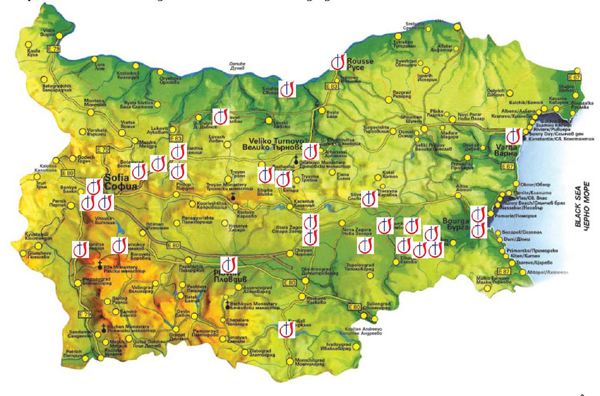
Map with Locations of Bulgarian Church of God Congregations Where We Have Ministered in 2005-2010
The (un)Forgotten: The Story of Rev. Ivan Voronaev’s Children
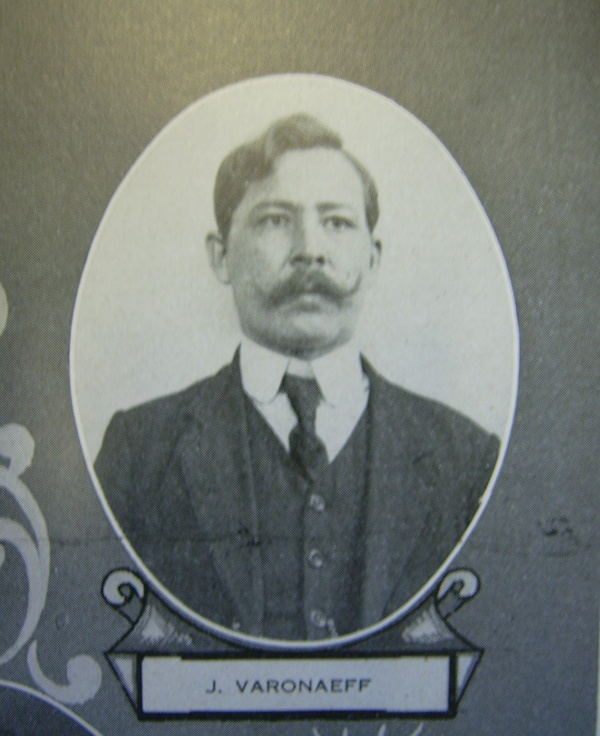 Our presentation at the 2010 SPS meeting in Minneapolis opened a door for discussion of early missionaries to Eastern Europe with a special focus on Rev. Ivan Voronaev. But the story and ministry of Rev. Ivan Voronaev cannot be separated from his main supporter and partner in the ministry – his wife and children.
During the time of original research, it became obvious that Ivan Voronaev was successful in the ministry both in the United States and Europe only through the obedience of his family. They followed his call for missions, leaving behind the comfort of life in America. The Voronaevs sacrificed the future of their children for the unknown reality of Russia’s greatest depression. The strive for survival followed the imprisonment of both parents along with the virtually impossible task to re-immigrate from Russia and reunite in the United States, and the constant struggle to save their parents from certain death in Stalin’s consecration camps even when all hope was lost.
The Voronaevs’ story presents an early historical case study on Pentecostal missionaries and their children, not only as second generation believers, but as second generation Pentecostal immigrants as well. This example is particularly interesting since it combines both mission and immigration, as integral parts of the Pentecostal identity at the dawn of the movement. To add to this there is the relationship between missionary families and the mission-sending agency, on this occasion being the Missions Department of the Assemblies of God and in part the Russian Evangelical Diaspora.
In this context, the research on the Voronaev family has three distinct parts: (1) life in Russia and the imprisonment of the parents, Ivan and Katherine Voronaev, (2) back to America under the care of Assemblies of God Missions’ Department and (3) and the after years, with a special focus on the life and ministry of the oldest of the Voronaev’s children, Paul.
The research will utilize the available archive information at the Assemblies of God archives in Springfield, MO, as well as some Russian library material from Moscow and Kiev, which have become available after the presentation of our 2010 Voronaev paper. Special attention will be given to Paul Voronaev’s personal correspondence after his return to the United States and subsequent papers, relative to the story of the Voronaev’s children, published by him in later years. As Rev. Ivan Voronaev’s personal end is yet unknown, it is our hope that story of the Voronaev children, will provide a much needed closure to the life and ministry of one of the earliest Eastern European missionaries in Pentecostal history.
Revival in North Dakota
We successfully returned from a mission trip to the Native American reservation in the Turtle Mountains of North Dakota. Our participation there was in partnership with long-time friends in the ministry from Matters of the Heart and upon the invitation of Rev. Daniel Bean, founder of Wind of the Spirit Ministries and pastor of the Dunseith Church of God.
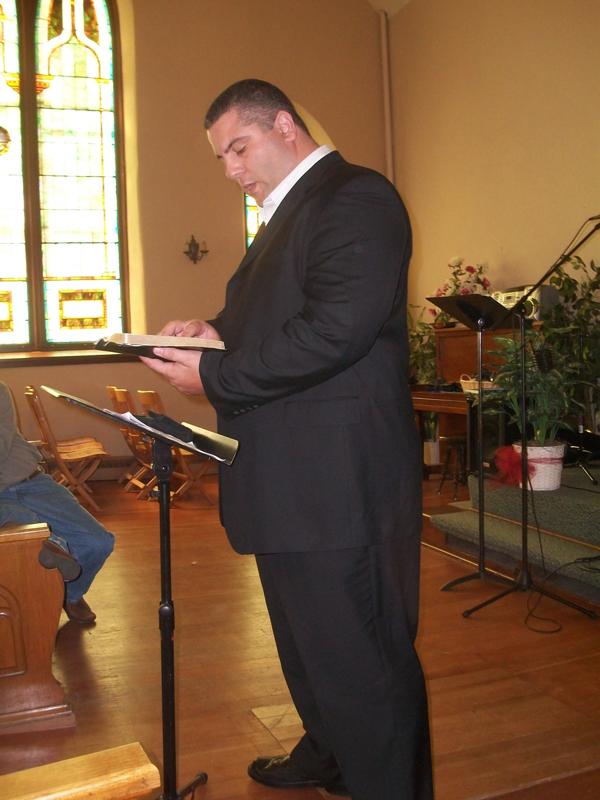
We held a three day revival, as at the same time participated and helped with the work on the reservation. For all revival services, we were blessed by Jeff Harrison from Matters of the Heart with his ministry in worship and special songs for each occasion. One of them was specifically dedicated to the ministry of Bro. Bean and his family, and Jeff was able to present them with the original hand written lyrics after his performance. We brought a brief sermon every night with a special message on Father’s Day Sunday.
Meeting new people and ministering to them was a true blessing. At the same, we were encouraged by the work of Pastor Bean, his family and his team. Their testimony and the ability to continue the ministry, even in hard times as the ones we live in, are commendable. For it is important that faithful Church of God people lead by the Spirit continue to build the local church as a ministry to our communities wherever they may be located. As we are preparing for the 73rd General Assembly of the Church of God, it is our prayer that such ministries are given further consideration and support by the general Body of Christ.


Revival in South Georgia
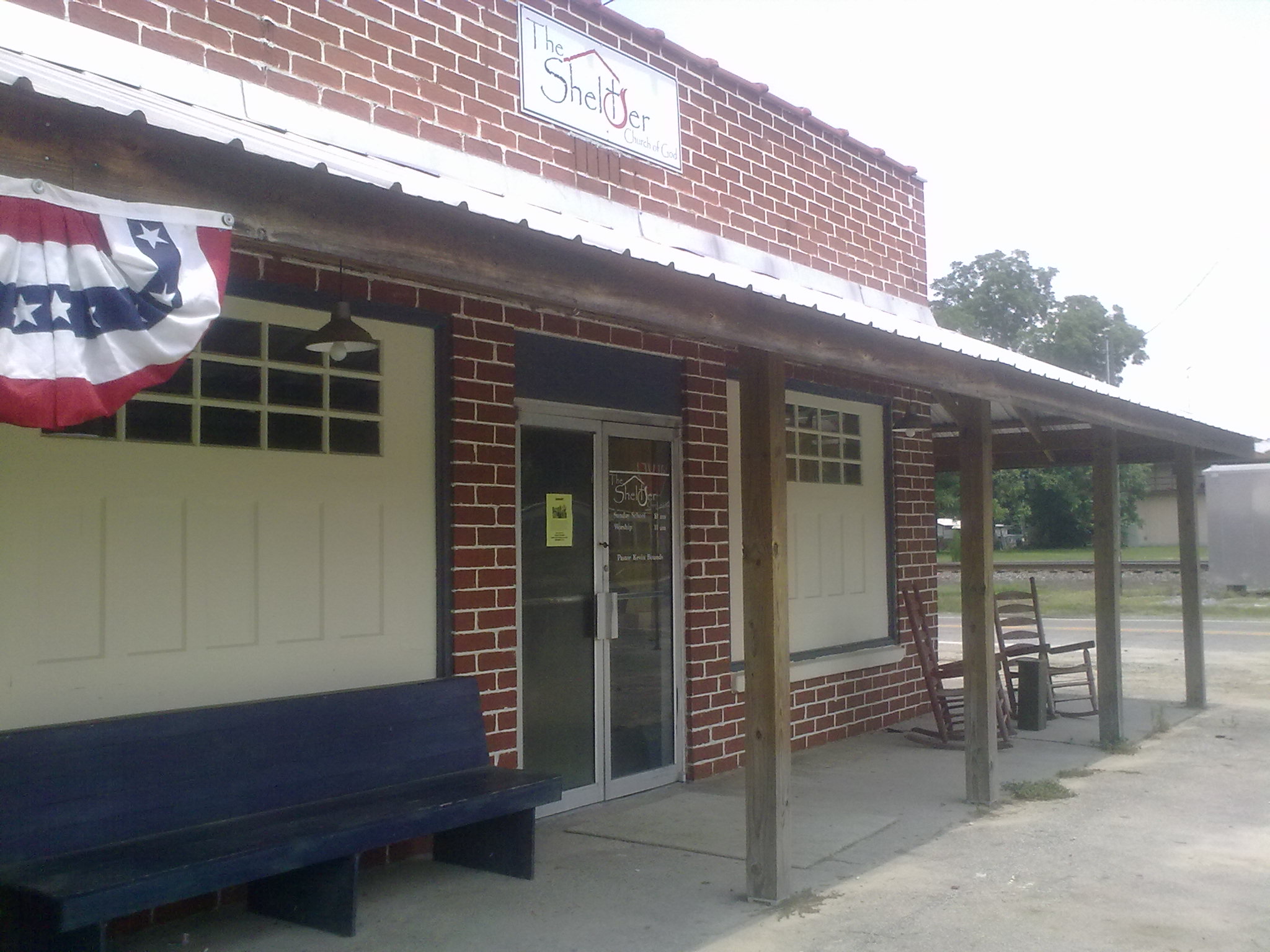 We just returned from a revival in the Shelter Church of God in Ambrose, GA – a new ministry started by pastor Kevin Bounds. The small, but growing congregation, which meets in a store front location in downtown Ambrose, already has a vision for establishing a strong ministry center in the area. We had three days of revival and enjoyed the wonderful fellowship of the pastoral family and the congregation.
But our connection with Pastor Kevin Bounds and the Shelter Church of God began long before Kevin was a pastor and the church ever existed. It began several years ago one cold winter morning in Bulgaria, while we were struggling with the dilemma of how to continue ministering there with a virtually exhausted annual budget.
Just as we prayed in our office in Yambol, Bulgaria asking the Lord for direction, we received an email from Pastor Kevin. We had never met before and there was no way he knew of our situation. But led by the Spirit after reading about us on the internet, he delivered a prophetic message over our ministry, which brought about a miracle which empowered us to continue to minister in Bulgaria in the years to come.
So needless to say, although we were meeting for the first time in this revival, we had been partners in the ministry for a very long time. In times of crises like the ones we live in, it is this prophetic move of the Spirit that the Church must follow. And it is this unity created by the leadership of the Spirit that empowers us all to continue in the ministry even when times are tough and keep building for the Kingdom.


