

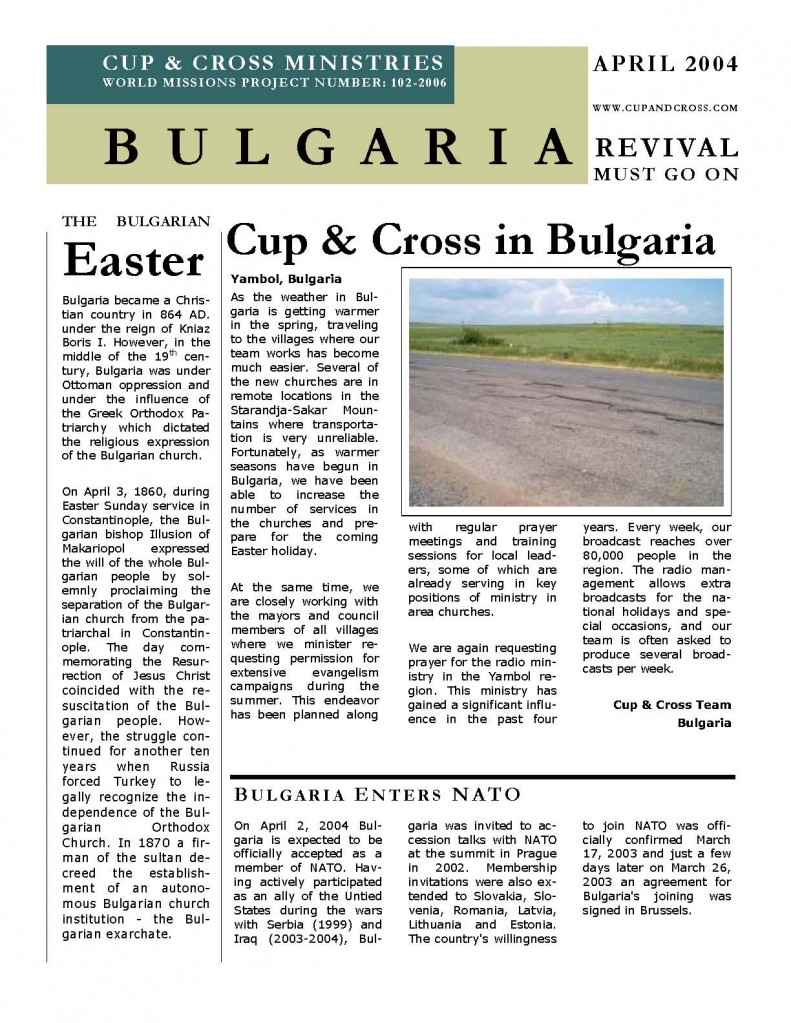
Cup & Cross in Bulgaria
Bulgaria: Report on Human Rights Practices – 2003
Country Reports on Human Rights Practices
Bureau of Democracy, Human Rights, and Labor
2003
February 25, 2004
Bulgaria is a parliamentary democracy ruled by a coalition government headed by Prime Minister Simeon Saxe-Coburg Gotha. The Government took office in 2001 following the victory of his National Movement Simeon II (NMS) party in parliamentary elections that were deemed generally free and fair despite some media irregularities. Following presidential elections in 2001, Georgi Purvanov, former leader of the Bulgarian Socialist Party (BSP), began his 5-year term in 2002. The Constitution provides for an independent judiciary; however, the judiciary suffered from corruption and wide-ranging systemic problems.
The Ministry of the Interior (MOI) is responsible for internal law enforcement. The National Investigative Service (NIS), which provides investigative support to prosecutors on serious criminal cases, is a judicial branch agency and therefore not under direct executive branch control. While civilian authorities generally maintained effective control of law enforcement officers, there were some instances in which law enforcement officers acted independently of government authority. Some law enforcement officers committed serious human rights abuses.
The country, with a population of approximately 7.9 million, had a market-based economy that was primarily service based. At year’s end, gross domestic product growth was estimated at 5 percent, and cumulative inflation was 5.6 percent. While official unemployment in December was 13.5 percent, down 3.96 percentage points from the beginning of the year, persistent unemployment continued to be a problem.
The Government generally respected the human rights of its citizens; however, there were problems in several areas. Law enforcement officers commonly beat suspects and inmates, and beat and mistreated minorities. Arbitrary arrest and detention were problems. Law enforcement officers harassed, physically abused, and arbitrarily arrested and detained Romani street children. Problems of accountability persisted and inhibited government attempts to address police abuses. Conditions in some prisons and detention facilities were harsh, and there were some instances of prolonged pretrial detention. The judiciary continued to struggle with wide-ranging systematic problems and suffered from serious corruption.
The Government restricted freedom of the press and limited freedom of association. The Government restricted freedom of religion for some non-Orthodox religious groups and societal discrimination and harassment of non-traditional religious minorities persisted, but were much less frequent than in previous years. Societal violence and discrimination against women was a problem. Conditions for children in state institutions were poor, and because of a lack of funds, the social service system did not assist homeless and other vulnerable children adequately, notably Roma and children with mental disabilities. There was some discrimination against persons with disabilities and a serious problem of discrimination against Roma. Child labor was a problem. Trafficking in persons was a serious problem, which the Government took some steps to address.
RESPECT FOR HUMAN RIGHTS
Section 1 Respect for the Integrity of the Person, Including Freedom From:
a. Arbitrary or Unlawful Deprivation of Life
There were no reports of the arbitrary or unlawful deprivation of life committed by the Government or its agents. However, forest guards killed two individuals during the year.
On March 26, a forest guard shot 28-year old Angel Simeonov while he was illegally cutting wood in a forest just outside of Samokov. Simeonov was taken to a hospital, but died after a couple of hours due to blood loss. The regional prosecutor investigated the incident and concluded that it was a justified use of force.
On August 7, an off duty forest guard shot and killed 25-year old Stoyan Lazarov near Kyustendil. The forest guard reportedly started shooting his gun indiscriminately for no apparent reason, and one of the bullets shot through the head of Lazarov, who had stopped in his truck nearby. The guard was charged with murder; the case remained pending at year?s end.
The Ministry of Interior Act permits law enforcement officers to use firearms to apprehend persons committing crimes or who have committed crimes, even if the crimes were minor.
The five defendants (three Bulgarians and two Ukrainians) in the trial of the 1996 murder of former Prime Minister Andrey Lukanov were sentenced to life imprisonment by the Sofia City Court on November 28; however, all of the defendants appealed the ruling to the Sofia Appellate Court. On March 7, Iliya Pavlov, reportedly head of Bulgaria’s largest organized crime organization, was shot and killed in Sofia a day after he testified about his professional relationship with Lukanov in the murder case. However, all indications from official and independent sources were that his death was linked to his reported organized criminal activities and not to his testimony.
There were no reported developments during the year in the investigation into the 2002 killing of Orthodox priest Stefan Kamberov.
b. Disappearance
There were no reports of politically motivated disappearances.
c. Torture and Other Cruel, Inhuman, or Degrading Treatment or Punishment
The Constitution prohibits such practices; however, police commonly beat criminal suspects, particularly during initial interrogations. Law enforcement officers also physically abused street children, the majority of whom were Roma (see Section 5).
Criminal suspects in police custody run a significant risk of being mistreated, most often during the initial interrogation. In February the Council of Europe reported that the Bulgarian Helsinki Committee (BHC) 2001 survey of incarcerated persons arrested after January 2000 found that 49 percent (compared with 51 percent in 1999) of interviewed prisoners reported that police officers used physical force against them during arrest; 44 percent (compared with 53 percent in 1999) reported one or more beatings at police stations. Romani prisoners reported being abused more frequently than did other prisoners. Very seldom were allegations of police abuse properly investigated, nor were the offending officers consistently punished. The Military Prosecutor’s Office in particular had not investigated incidents of alleged police abuse thoroughly or expeditiously.
Although some government officials stated that, under the country?s criminal code, any complaints about police beatings are required to be heard by judges, at times this law was not respected in practice. Human rights monitors reported that they received many complaints from persons who were too intimidated to lodge an official complaint with the authorities. Human rights observers charged that police often handled minor offenses by arresting suspects, beating them, and releasing them within a 24-hour period, so that no judicial involvement was required (see Section 1.d.)
Conditions in some prisons remained harsh and included overcrowding, inadequate lavatory facilities, and insufficient heating and ventilation. However, according to the BHC, prison overcrowding improved during the year with the opening of several new prison facilities. Nongovernmental organization (NGO) prison monitors reported that brutality committed by prison guards against inmates continued to be a problem, despite the MOI issuing instructions in August on detention procedures to reduce abuses. There were also reports of brutality among inmates. The process through which prisoners could complain of substandard conditions or of mistreatment did not function effectively. The Ministry of Justice (MOJ) reported that, at the end of the year, there were 788 charged persons in the country’s 65 detention centers and a total of 10,066 persons (of whom 325 were arraigned, 1536 were in trial phase, 8,205 were convicted) in the country?s 12 prisons.
Men and women were not held in the same prisons: 1 of the 12 prisons was reserved for women. In all prisons, convicted prisoners were held separately from pretrial detainees. The MOJ also reported that there were 79 minors in the country?s 2 labor correction hostels, which were used to hold persons under age 18 and were less restrictive than prisons.
The Government generally permitted requests by independent observers to monitor conditions in most prisons and detention facilities.
d. Arbitrary Arrest, Detention, or Exile
The Constitution prohibits arbitrary arrest and detention; however, there were some restrictions on these rights. Police often arbitrarily arrested and detained street children, the majority of whom were Roma (see Section 5).
The MOI is responsible for internal law enforcement including the National Police, the National Service for Combating Organized Crime (NSBOP), the National Security Service (civilian domestic intelligence), the National Gendarmerie Service (paramilitary police), and the Border Police. The media reported that the public order services, such as the National Intelligence Service and National Bodyguard Service, were not subject to adequate judicial, executive, or legislative oversight of their activities or budgets. Impunity remained a problem; problems of accountability inhibited government attempts to address police abuses.
According to data released by the Alpha Research Agency in October, corruption continued to be considered by many citizens to be one of the most significant social problems facing the country. The MOI reported that 107 complaints of corruption by police officers were filed with the Military Prosecutor’s Office during the year. According to the Prosecutor’s Office, during the year, there were 399 investigations into crimes reportedly committed by police officers; 71 were for bodily harm, 19 were for robbery, 7 were for burglary, 11 were bribery. The investigations resulted in indictments against three police officers on charges of rape, one police officer on charges of forced prostitution, and two police officers on charges of trafficking in persons. Customs officials were seen as being the most corrupt government officials, followed by magistrates (prosecutors, investigators, and judges) and police officers. However, the survey reported a decrease in corruption from customs officials and police officers and an increase in corruption from tax officials. One-quarter of those interviewed reported not approaching the judiciary, even when they had reason to do so, due to their widespread belief of magistrates? corruption.
The MOI reported that the curricula at the Police Academy and the Officers’ Schools were expanded to include human rights-related training in their mandatory courses. Training in combating human trafficking and assisting trafficking victims was also offered in September and December to active-duty police officers (see Section 6.f.).
Although warrants are not always required for arrest, police normally obtained a warrant from a prosecutor prior to apprehending an individual. If the person was released without being charged before the 24-hour period elapsed, there was no judicial involvement in the case. Human rights observers charged that police often handled minor offenses by arresting suspects, beating them, and releasing them within the 24-hour period (see Section 1.c.). Persons could be detained for no more than 24 hours at the request of an investigating magistrate or police officer; however, detention could last for up to 72 hours if ordered by a prosecuting magistrate.
The Constitution provides for access to legal counsel from the time of detention; however, in 2002 the BHC released the results of a survey of incarcerated persons arrested after January 2000, which found that more than 70 percent reported that they had had no legal representation during preliminary investigation of their cases. In April 2002, the MOI instituted a standard declaration process for detainees to indicate their need for access to legal counsel, medical attention, and family members; however, the BHC reported that there were no improvements in pretrial detention conditions.
The Constitution provides for bail, although it was not widely used.
While there were some continuing violations, NGOs reported that the Government generally observed the statutory limit of 1-year for pretrial detention or 2 years in the case of the most serious crimes. In the event of a conviction, the time spent in pretrial detention was credited toward the sentence.
Human rights observers reported that in many localities, children could be held for months in educational boarding schools on the basis of police referral before a local commission convened to make a decision on the case (see Sections 1.e. and 5).
The Constitution prohibits forced exile, and the Government did not employ it.
e. Denial of Fair Public Trial
The Constitution provides for an independent judiciary; however, problems in the judiciary remained, including a lack of transparent and neutral standards for assigning cases, poor coordination between magistrates (prosecutors, investigators, and judges), corruption, low salaries and understaffing, antiquated procedures, and a heavy backlog of cases. Human rights groups complained that magistrates sometimes failed to pursue most crimes committed against minorities.
Crime and corruption remained primary concerns of the Government. The inter-ministerial anti-corruption commission, established in 2002, coordinated the efforts of each government agency’s internal inspectorate in fighting public corruption and engaged in public awareness campaigns. In addition, constitutional amendments passed in September, narrowed the scope of immunity, irremovability, and life tenure for magistrates. Politicians and NGOs continued to criticize the Chief Prosecutor’s office for its failure to prosecute vigorously large numbers of serious criminal cases, leaving the impression that it lacked the will to crack down on organized crime and corruption. Local observers contended that organized crime influenced the prosecutor’s office. Few organized crime figures have been prosecuted to date and none have been convicted. According to the NSBOP, approximately 110 organized crime groups operated in the country.
Many observers believed that reforms were essential to establish a fair and impartial, as well as efficient, judicial system. As a result, in September the National Assembly passed amendments to the Constitution designed to limit magistrates’ immunity and increase their accountability. The amendments were expected to take effect in the beginning of 2004, and will require the adoption of supporting legislation.
Observers noted modest improvement in the efficiency of moving cases through the criminal system, although many serious systemic flaws remained. Long delays in trials were common and the police continued to struggle with a large backlog of outstanding investigations.
The court system consists of regional courts, district courts, military courts (on the regional and district levels), appellate courts, the Supreme Court of Cassation, and the Supreme Administrative Court. The Constitutional Court, which is separate from the rest of the court system, is empowered to rescind legislation that it considers unconstitutional, settle disputes over the conduct of general elections, and resolve conflicts over the division of powers between the various branches of government. Military courts handle cases involving military personnel (including police personnel) and some cases involving national security matters. As a part of the judiciary, military courts are independent from the military.
Judges are appointed by the 25-member Supreme Judicial Council (SJC) and, after serving for 3 years, cannot be removed except under limited, specified circumstances. The constitutional amendments provide for this probationary period to be extended to 5 years beginning in 2004. The difficulty and rarity of replacing judges, virtually regardless of performance, was often cited as a hindrance to effective law enforcement. The 12 justices on the Constitutional Court were chosen for 9-year terms as follows: One-third were selected by the National Assembly, one-third appointed by the President, and one-third selected by judicial authorities. The internal mechanisms that inhibit corruption in the judicial system were weak. Due to its composition and inadequate support staff, the SJC, which is responsible for the proper administration of justice and drafting the judiciary’s budget, was not able to effectively set the judiciary’s budget, ensure the effectiveness of judges, or protect the judiciary’s independence.
The Constitution stipulates that all courts shall conduct hearings in public unless the proceedings involve state security or national secrets, and authorities generally respected this provision. Defendants have the right to know the charges against them and are given ample time to prepare a defense. Defendants have the right to visits by family members, to examine evidence, and to know the charges against them. Charges may not be made public without the permission of the Chief Prosecutor. To enable a speedy trial, the law requires that investigations last no more than 2 months under normal circumstances, although the head regional prosecutor may extend this to 6 months, and the Chief Prosecutor may extend this to 9 months. Defendants in criminal proceedings have the right to confront witnesses and to have an attorney in serious cases, which could be provided and paid for by the Government in any instance where the defendant could not afford an attorney. In certain instances–when punishment of 10 years’ imprisonment or more could be imposed or when the defendant was a juvenile, a foreigner, mentally or physically disabled, or not present–participation of a defense attorney is mandatory, even when the defendant did not want an attorney, and could be provided and paid for by the Government. The right of appeal is provided for and was used widely.
The MOJ reported that there was a decrease in the number of civil cases filed in the second half of the year due to substantial increases in fees levied on claimants. The judiciary continued to suffer from a heavy backlog of cases, which resulted in long delays for trials. The practice of plea-bargaining, had not yet effectively lightened the caseload for prosecutors. In addition, plea-bargaining reportedly was perceived by many citizens as a way for the wealthy to buy their way out of charges.
Human rights observers considered educational boarding schools (formerly known as Labor Education Schools), to which problem children could be sent, as little different from penal institutions (see Section 5). Since the schools were not considered prisons under the law, the procedures by which children were confined in these schools were not subject to minimal due process requirements. Children sometimes appeared alone despite the requirement that parents must attend hearings; the law expressly prohibits the right to an attorney at the hearing. Decisions in these cases were not subject to judicial review, and children typically stayed in the educational boarding schools for 3 years or until they reached 18 years of age, whichever occurred first. The law provides for court review of sentencing to such schools, sets a limit of a 3-year stay, and addresses some other problems in these institutions; however, human rights activists dismissed this court review provision as a formality, since the child was not present to speak on his or her own behalf (nor was the defense lawyer or the child’s parents).
There were no reports of political prisoners.
f. Arbitrary Interference With Privacy, Family, Home, or Correspondence
The Constitution prohibits such actions, and the Government generally respected these provisions in practice; however, there were reports of mail, particularly foreign mail, being delayed and/or opened.
Seven members of the National Security Service were dismissed in January following a public scandal in December 2002 surrounding reports that the MOI had illegally wiretapped lawmakers, magistrates, and prominent journalists.
Section 2 Respect for Civil Liberties, Including:
a. Freedom of Speech and Press
The Constitution provides for freedom of speech and of the press; however, the Government exerted undue influence over the media. Although a variety of media outlets presented a broad spectrum of opinion, NGOs reported that significant numbers of journalists continued to feel constrained in their reporting because of media outlet management, government influence, and outside pressure. Prosecutors also were widely regarded as wielding an intimidating influence over journalists who were critical of the judicial process.
Several domestic and international organizations openly criticized the Government for its handling of media issues during the year. The Parliamentary Assembly of the Council of Europe issued a statement that was highly critical of the Government’s undue influence over public media outlets. The politically motivated dismissal of journalists was cited as one of the major problems, along with the draft of a new media law, which would give the majority party a significant amount of control over major media outlets.
A variety of newspapers were published freely by political parties and other organizations representing the full spectrum of public opinion.
There were no formal restrictions on programming and both television and radio provided a variety of news and public interest programming. Television and radio news programs on the state-owned media presented opposition views; however, media observers believed that the inadequacy of existing legislation left it vulnerable to government pressure.
The Bulgarian National Television (BNT) broadcast Turkish-language newscasts, and local affiliates of Bulgarian National Radio broadcast limited Turkish-language programming in regions with ethnic-Turkish populations. Foreign government radio programs had good access to commercial radio frequencies. A Romani-language radio and cable TV operation began broadcasting in Vidin but had difficulty in obtaining a broader broadcast license for the region.
There were two reported cases of violence against journalists. In February, unknown assailants severely beat a radio journalist from Vidin. In May, unidentified assailants severely beat the editor-in-chief of the Varna daily newspaper Chernomorie and owner of the DNES+ news website, Anton Lukov, in front of his city center home. Both of these cases were widely believed to have been connected to organized crime figures in their respective regions since there were a number of reports detailing the influence of local organized crime groups on investigative journalists and their publications.
Amendments passed in 2001 to the Radio and Television Act (RTA) authorized the Council for Electronic Media (CEM) to issue licenses for radio and television programming, a power previously held by the State Telecommunications Commission. The 2001 amendments require the CEM to consult with the Communications Regulation Commission (CRC), which allocates broadcast frequencies, before making decisions regarding programming licenses. However, amendments passed in 2002 to the RTA require the CEM to issue radio and television programming licenses only in accordance with the Strategy for Developing Radio and Television Activities, which was developed by the CEM and CRC jointly and submitted to the National Assembly; however, the National Assembly still had not approved the Strategy by year’s end. As a result, the CEM could not promulgate new licensing procedures, and it was not clear when the Government would resume licensing electronic media.
In July, the CRC issued a license for nation-wide broadcasting to New Television, making it the third nation-wide television broadcaster. The Supreme Administrative Court ruled that New Television could commence broadcasting without a license from the CEM as New Television won a tender to be the third national television broadcaster in 2001 before the amendments to the RTA establishing the CEM. While the CEM could not initiate new tenders for television and radio programming licenses, it was still able to transfer, amend, revoke, and terminate such licenses and regulate programming.
During the year, the CEM imposed 77 fines against television operators and 13 fines against radio operators for violations of the RTA. On November 6, the CEM revoked the license of Union Television, owner of the satellite channel Den, citing grave violations of the RTA and broadcasting a television show that impaired morals. Union Television appealed the decision to the Supreme Administrative Court; the case remained pending at year’s end.
Libel is punishable under the criminal code, but in most cases the courts defined libel and interpreted the law in a manner that favored journalistic expression. Fines for libel and defamation were approximately $9,375 (15,000 leva); these fines remained a heavy penalty in the context of the country’s economy. The provisions eliminated imprisonment as a penalty for libel. Journalists charged with libel or defamation also have reduced rights of appeal for libel sentences under the law. Under the law, libel remains a criminal offense and losing defendants are considered to be criminals. The number of criminal libel suits brought by the Government against journalists increased significantly over the past 2 years and an international NGO expressed concern that libel suits were essentially a tool that the ruling party used to silence its critics.
The Government did not restrict access to the Internet or academic freedom.
b. Freedom of Peaceful Assembly and Association
The Constitution provides for freedom of assembly, and the Government generally respected this right in practice. Authorities required permits for rallies and assemblies held outdoors, but most legally registered organizations routinely were granted permission to assemble. Political rallies and demonstrations were a common occurrence and generally took place without government interference.
The BHC reported that ethnic Macedonians were denied freedom of assembly; local authorities reportedly would only allow ethnic Macedonians to hold rallies or other meetings in private and outside of cities and other populated areas.
The Constitution provides for freedom of association; however, the Government prohibited groups that endanger national unity or promote and incite racial, national, ethnic or religious hatred, violate the rights of citizens, or seek to achieve their objectives through violent means. The Government undertook to respect the rights of individuals and groups to establish freely their own political parties or other political organizations; however, the Constitution prohibits the formation of political parties along religious, ethnic, or racial lines and prohibits citizens’ associations from engaging in political activity. Nonetheless, ethnic minority political parties operated during the year and won positions in government in the October local elections (see section 3).
c. Freedom of Religion
The Constitution provides for freedom of religion; however, the Government restricted this right in practice for some non-Orthodox religious groups. The Constitution designates Bulgarian Orthodox Christianity (BOC) as the “traditional” religion and the Government provided financial support to it, as well as to several other religious communities perceived as holding historic places in society, such as the Muslim, Roman Catholic, and Jewish faiths.
The Law on Religious Confessions took effect in 2002 to replace the universally unpopular Communist-created law of 1949. Religious and human rights groups have strongly criticized the law for the preferential treatment given to the BOC and for provisions that appear to take sides in what many see as an internal Church conflict. Under the new law, all religious groups, with the exception of the BOC, must register with the Sofia Municipal Court before they can practice their beliefs in public. The BHC also expressed concern at the requirement for groups to submit a statement of beliefs when applying for registration or re-registration, stating that this constituted an infringement on their freedom of religion. Even when they were registered nationally, some religious groups experienced problems with registering local branches, particularly Jehovah’s Witnesses in Burgas.
In some cases, local authorities used the lack of registration as a pretext for interference with some groups and harassed others. Some church groups circumvented the administrative obstacles created by a lack of registration by registering as NGOs. There were periodic reports of police using lack of local or national registration as a pretext to confiscate signboards and materials, detain or expel religious workers, and deny visas or residence permits to foreign-national missionaries.
In May, police reportedly prevented the International Baptist Church in Sofia from using a rented apartment for religious meetings.
A number of religious groups complained that foreign-national missionaries and religious leaders experienced difficulties in obtaining and renewing residence visas in the country due to an amendment to the Law on Foreign Persons. The law has no visa category explicitly applying to missionaries or religious workers, and rules for other categories of temporary residence visa (such as self-employed or business-owner) were tightened in ways that reportedly make it more difficult for religious workers to qualify.
The Muslim community, the Catholic Church, and some Protestant denominations claimed that a number of their properties confiscated under the Communist government were not returned. A central problem facing all claimants was the need to demonstrate that the organization seeking restitution was the same organization–or the legitimate successor of the organization–that owned the property prior to 1944. This was difficult because Communist hostility to religion led some groups to hide assets or ownership and because documents had been destroyed or lost over the years.
Relations between the major religious communities generally were amicable; however, discrimination, harassment, and general public intolerance of non-traditional religious groups remained an intermittent problem. Human rights groups reported that societal discrimination against non-traditional religious groups gradually lessened over the last few years.
For a more detailed discussion, see the 2003 International Religious Freedom Report.
d. Freedom of Movement Within the Country, Foreign Travel, Emigration, and Repatriation
The Constitution provides for these rights, and the Government generally respected them in practice. Every citizen has the right to return to the country, may not be forcibly expatriated, and may not be deprived of citizenship acquired by birth; there are no limits to these rights under the Constitution.
The Law on Refugees and Asylum provides for the granting of refugee status or asylum to persons who meet the definition in the 1951 U.N. Convention Relating to the Status of Refugees and its 1967 Protocol. In practice, the Government provided some protection against refoulement and granted refugee status and asylum (“humanitarian status”). However, NGOs, including the BHC, expressed concern over the Government’s handling of claims for refugee and humanitarian status and reported that there may have been cases in which bona fide refugees were turned away at the border. In September, police detained a group of Christian asylum-seekers from Iran. The Agency for Refugees did not get involved and the police turned them over to the Iranian Embassy in Sofia, which subsequently arranged for their return to Iran. The Government cooperated with the U.N. High Commission for Refugees (UNHCR) and other humanitarian organizations in assisting refugees and asylum seekers. The Government also provides temporary protection to persons who do not qualify as refugees or asylees.
Persons entering the country legally are required to immediately request and file applications for asylum or refugee status within 72 hours of entering the country, except in extraordinary situations. The law allows applicants for asylum or refugee status to be interviewed immediately and, within 3 days of the interview, applications are reviewed by a competent authority, who determines whether they merit further processing. The law also provides for the detention of foreigners who are deemed by the MOI to pose a threat to national security, or who have committed serious crimes.
The Agency for Refugees reported that it had received 12,803 applications for asylum since its inception in 1993. Of these, 4,454 persons were listed as having been granted refugee or humanitarian status. Domestic and international human rights organizations complained that the adjudication process was slow, but the UNHCR noted that the Agency for Refugees began a major restructuring project to reduce the adjudication time to a period of 3 months; the project was expected to take 4 years. The UNHCR, in cooperation with the International Organization for Migration (IOM), operated three transit centers near the Greek, Turkish, and Romanian borders and assisted the Government with a small reception center in Banya.
During the year, the Agency for Refugees received requests for refugee status from 1,549 persons. Refugee status was granted to 19 persons and humanitarian status given to 423, while 1,036 applications were denied. The leading countries from which applicants originated were Afghanistan, Iraq, Armenia, Algeria, Iran, and Nigeria.
Section 3 Respect for Political Rights: The Right of Citizens to Change Their Government
The Constitution provides citizens the right to change their government peacefully, and citizens exercised this right in practice through periodic, free, and fair elections held on the basis of universal suffrage; however, the constitution prohibits ethnically, racially, or religiously based parties.
In October, local elections were held nation-wide and the opposition Bulgarian Socialist Party (BSP) and Union of Democratic Forces (UDF) gained more electoral positions than the ruling NMS. Ethnic minority candidates, as well as the primarily ethnic-Turkish Movement for Rights and Freedom (MRF), also fared better than in previous local elections. The elections were deemed generally free and fair.
General elections held in 2001, were considered by international observers to be generally free and fair, and voting took place in a calm and orderly atmosphere; however, the Organization for Security and Cooperation in Europe (OSCE) reported that provisions in the election law regulating campaign coverage in the public media were overly restrictive.
There were no legal restrictions on the participation of women in government and politics. There were 63 women in the 240-seat National Assembly. A number of women held elective and appointive office at high levels in the Government, including one Deputy Prime Minister (who also was Minister of Economy) and four other ministers. Women also held key positions in the National Assembly, including one Deputy Speaker and the chairs of four committees. The largest opposition party in the National Assembly, the UDF, was led by a woman.
The primarily ethnic-Turkish MRF was represented in the National Assembly and in the Cabinet since 2001 and other major political parties generally accepted the MRF’s right to participate in the political process. In addition, a number of predominantly ethnic-Romani political parties achieved some success in the October local elections (see Section 2.b.).
There were no legal restrictions on the participation of minorities in politics; however, the Constitution prohibits ethnically, racially, or religiously based parties (see Section 2.b.). Despite the Constitutional ban, the primarily ethnic-Turkish MRF was part of the ruling coalition and represented the ethnic-Turkish minority, both at the national and local levels. There were 24 minority members of parliament (M.P.s) in the 240-seat National Assembly and 1 MRF minister in the Cabinet. The ethnic-Turkish community’s popularly elected representation of 20 ethnic-Turks in the National Assembly roughly corresponded to its size. There were also two Romani M.P.s and two ethnic-Armenian M.P.s in the National Assembly; however, minority groups were underrepresented in appointed government positions, particularly leadership positions.
In the October local elections, 3 percent of municipal councilors elected were Roma, and, according to Romani groups, a considerable number of Romani mayors also were elected. The National Association of Municipalities reported that Muslim candidates accounted for 12.5 percent of municipal mayors and 15.2 percent of municipal councilors elected in October.
Section 4 Governmental Attitude Regarding International and Nongovernmental Investigations of Alleged Violations of Human Rights
A number of domestic and international human rights groups generally operated without government restriction, investigating and publishing their findings on human rights cases. Human rights observers reported uneven levels of cooperation from various national and local government officials during the year. According to the NGO Access to Information Program, NGOs were denied access to information by the Government in approximately 90 cases throughout the year.
In general, human rights observers reported continued receptivity and dialogue on the part of the Government and law enforcement officers toward human rights concerns; however, law enforcement practices at the working level had not changed noticeably.
Section 5 Discrimination Based on Race, Sex, Disability, Language, or Social Status
The Constitution provides for individual rights, equality, and protection against discrimination; however, in practice, discrimination existed, particularly against women and Roma.
In September, the National Assembly passed the Protection Against Discrimination Act; the act is scheduled to take effect on January 1, 2004 and aims to prohibit discrimination on the grounds of race, sex, religion, disability, age, and sexual orientation. It shifts the burden of proof and provides for the establishment of a nine-member anti-discrimination commission with powers to receive and investigate complaints, issue rulings, and impose sanctions.
Women
Domestic violence against women was a serious problem. Although there were no official statistics on its occurrence, it was estimated by the NGO Animus Association Foundation (AAF) that one in five women suffered from spousal abuse. The law exempts from state prosecution certain types of assault if committed by a family member, and the Government generally did not assist in prosecuting domestic assault cases unless the woman was killed or injured permanently. Courts and prosecutors tended to view domestic abuse as a family matter rather than a criminal problem; as a result, police often were reluctant to intervene in cases of domestic abuse, even if a woman called them seeking protection or assistance.
The Government did not take steps to combat violence against women, and did not provide shelter or counseling for women. In Sofia, the NGO Nadya Center provided shelter to battered women, and the AAF operated a crisis center that provided short-term emergency shelter for female victims of violence. There were also 15 crisis centers around the country operated by local NGOs that provided assistance to female victims of violence. The AAF reported that it periodically received client referrals from the police. During the year, the IOM reported sheltering 90 women and girls and AAF sheltered 50 women.
The AAF operated a 24-hour hotline for women in crisis, including victims of trafficking, with trained volunteers as well as professional therapists to counsel victims. The hotline also provided volunteers to assist victims in obtaining other necessary services including medical exams and treatment, reissued identity documents, and information on housing and employment opportunities.
Spousal rape is a crime, but it rarely was prosecuted. The courts prosecuted rape, although it remained an under-reported crime because of the stigma which society attached to the victim. The maximum sentence for rape is 8 years; convicted offenders often received a lesser sentence or early parole. According to the Prosecutor’s Office, during the year, 168 persons were convicted on charges of rape and 298 persons (including 1 woman, 33 minors, 1 foreigner, and 3 police officers) were indicted on rape charges.
Prostitution is not prohibited by law; however, a variety of activities often associated with prostitution, such as pimping, are illegal (see Section 6.f.). Forced prostitution is illegal, but remained a serious problem. According to the Prosecutor’s Office, during the year, a total of 12 persons were convicted on charges of forced prostitution and 50 persons (including 9 women, 1 minor, 1 foreigner, and 1 police officer) were indicted on forced prostitution charges. Poor socio-economic conditions contributed to a disproportionate number of Romani women drawn into organized prostitution.
Trafficking in women was a serious problem (see Section 6.f.).
The law does not prohibit sexual harassment, and it was a widespread problem, particularly in the clothing assembly industry. A survey conducted by the Agency for Social Research (ASR) in 2002 found that approximately 40 percent of women had suffered sexual harassment in the workplace.
The Constitution prohibits privileges or restrictions of rights on the basis of gender, and women were not impeded from owning or managing businesses, land, or other real property and do not suffer from discrimination under inheritance laws; however, women faced discrimination both in terms of job recruitment and the likelihood of layoffs. The new anti-discrimination law, expected to take effect in 2004, aims to prohibit and punish gender-based discrimination.
The Government did not have programs to address economic discrimination or integrate women into the mainstream of society and the economy, although much NGO activity was focused on these areas. Of the women’s organizations that existed mainly to defend women’s interests, the two largest were the Women’s Democratic Union in Bulgaria and the Bulgarian Women’s Association.
Children
The Government generally was committed to protecting children’s welfare; however, government efforts in education and health were constrained by serious budgetary limitations and by outmoded social care structures. The Constitution provides for mandatory school attendance until the age of 16. Public education was free, but children were required to pay for books, which was a problem for poor families. Fewer girls than boys attended school, particularly among minority groups.
Romani children and ethnic-Bulgarian children generally attended separate schools, although several localities instituted integration programs. Credible allegations were made that Romani children received an inferior quality of education. Additionally, the Government was largely unsuccessful in attracting and keeping many Romani children in school; less than 8 percent of Romani children have completed secondary education, and less than 1 percent have graduated from higher education. Many Romani children arrived relatively unprepared for schooling; many were not proficient in the Bulgarian language.
The Government and NGOs undertook initiatives to address these problems. They included providing free lunches, subsidizing textbooks and tuition costs, using teacher’s assistants in schools with Roma and ethnic-Turkish students, and busing programs. Since 2002, a project in the Silistra region provided weekend classes for Romani children under the age of 15 who were not in school. Since 2000, the Government provided buses for Romani children to attend non-segregated schools in some cities.
Conditions for children in state institutions were poor. Social attitudes towards children with disabilities led families to institutionalize their children if they had disabilities. Another 2,900 children were considered at risk and were forced to seek care in institutions because their families could or would not support them. In 2002, there were 19,908 children in institutions; however, in September the Council of Ministers adopted a National Action Plan for Reducing the Number of Children in Institutions. Human rights monitors were sharply critical of the serious deficiencies in government-run institutions for children, including orphanages, educational boarding schools (reform schools), facilities for children with mental disabilities, and shelters for homeless children. These facilities were plagued by inadequate budgets, poorly trained and unqualified staff, and inadequate oversight. Access to medical care and proper hygiene was poor.
Violence against children was a problem.
There were few provisions for due process of law for Roma and other juveniles when they were detained in educational boarding schools run by the Ministry of Education (MOE)(see Section 1.e.). According to press reports and NGOs, living conditions at these reform schools were poor, offering few medical, educational, or social services. Generally, staff members at many such institutions lacked the proper qualifications and training to care for the children adequately. Degrading and severe punishment, such as the shaving of a child’s head, reduction in diet, severe beatings, and long periods of solitary confinement, were common at the schools. Children in these institutions also did not have adequate access to medical care.
As prostitution is not illegal, children involved in prostitution were not officially registered with the MOI’s unit for juvenile crime. However, they were viewed by the MOI as children at risk. In 2002, there were 585 child prostitutes on file with the MOI; during the year, the number decreased to 543. Child prostitution reportedly was particularly common among Romani youth.
Trafficking in children and child labor were problems (see Sections 6.d. and 6.f.).
Some Romani children were targets of arbitrary police detention; the homeless or abandoned were particularly vulnerable. Widespread poverty led many Romani children to turn to begging, prostitution, and petty crime on the streets.
The Council of Ministers adopted the National Strategy for the Children of the Street; however, the action plan for implementing the Strategy had not been approved by year’s end.
Persons with Disabilities
The law provides for a range of financial assistance for persons with disabilities, including free public transportation, reduced prices on modified automobiles, and free equipment such as wheelchairs; however, budgetary constraints limited the availability of assistance. A survey in 2002 by the Center for Independent Living (CIL) found that approximately 82 percent of public buildings were inaccessible to persons with disabilities. Societal discrimination against persons with disabilities persisted. Persons with disabilities had access to university training (students with disabilities were required to pay the university’s initial application fee but were exempt from tuition fees if accepted), to housing, and to employment; however, architectural barriers were a great hindrance in many older buildings, including schools and universities.
Conditions in institutions for persons with disabilities were poor. In May, the Deputy Minister of Labor and Social Policy announced that 29 social institutions were to be closed down by the end of the year due to their extremely poor physical condition. One social institution for children in the village of Fakia was completely closed and its 30 residents moved to other places. Another six social institutions were closed, renovated, and then reopened by year’s end. In March, there was a press report that a patient at the Bastoshevo social institution for adults with mental disabilities, near the city of Savlievo, was beaten to death. The MOI reported in early April that a patient at the Podgumer social institution for adults with disabilities, near Sofia, was strangled to death by another patient. The case was sent to the district prosecutor’s office.
Labor laws intended to protect the interests of persons with disabilities and create employment opportunities had a mixed effect. On the one hand, the law provides incentives for small firms to hire persons with disabilities and requires larger businesses to hire a set quota of persons with disabilities; however, enforcement of the law was low and other laws, such as shorter working hours for workers with disabilities, often led to discrimination against them in the hiring process. General unemployment and a poor economy also undermined initiatives aimed at advancing equal opportunity for persons with disabilities; the great majority of persons with disabilities were unemployed.
Persons with mental and physical disabilities, including very young children, were often separated from the rest of society. Some complained that the effective segregation of children with disabilities into special schools lowered the quality of their education. According to the Ministry of Labor and Social Policy (MLSP), over 2,500 children with disabilities did not attend school; however, according to the CIL, the number may have been twice as high, despite new by-laws adopted by the MOE to provide for the integrated education of children with disabilities in schools. Many children with disabilities were institutionalized.
The law requires improved structural access for persons with disabilities, and public works have taken this into account; however, enforcement of this law lagged in existing, unrenovated buildings.
National/Racial/Ethnic Minorities
According to a 2001 census, ethnic Bulgarians made up 86 percent and ethnic Turks 9 percent of the population. Ethnic-Roma were estimated officially to comprise 4.6 percent of the population; however, their actual share was likely between 6 and 7 percent. A Council of Europe report issued in 2002 estimated that there were 600,000 to 800,000 Roma in the country; official statistics estimated the number of Roma at 371,000. Ethnic-Bulgarian Muslims, often termed Pomaks, are a distinct group of Slavic descent whose ancestors converted from Orthodox Christianity to Islam; they constituted 2 to 3 percent of the population.
There were no reports of lethal police assaults on Roma; however, police harassed, physically abused, and arbitrarily arrested some Romani street children. Little progress was made in resolving cases of police violence against Roma.
Romani activists and NGOs continued to criticize the Government’s lack of progress in implementing the Program for Social Integration of Roma, which was unveiled in 1999; however, there were projects that sought to improve economic and educational opportunities for Roma, as well as to address the problem of ineffectual political leadership among the Roma. One program was the Ethnic Integration and Conflict Resolution project in Vidin, Kyustendil, and Lom, which provided limited funds to small enterprises that employed Roma, undertook activities to reduce Romani drop-out rates, provided tutoring for university enrollment exams, and created an Institute for Roma Leaders where young Roma could develop leadership and conciliation skills. The Government and the European Bank for Reconstruction and Development continued to fund the construction of new apartments in Sofia for Roma who were displaced in 2001, and additional construction was carried out in Plovdiv.
Severe unemployment and poverty among the Roma, combined with generally unfavorable attitudes toward Roma among ethnic Bulgarians and Turks, contributed to strained relations between the Roma and the rest of society.
As individuals and as an ethnic group, Roma continued to face high levels of discrimination. NGOs reported that Roma encountered difficulties applying for social benefits, and local officials discouraged rural Roma from claiming land to which they were entitled under the law disbanding agricultural collectives. Many Roma and other observers made credible allegations that the quality of education offered to Romani children was inferior to that afforded most other students. Workplace discrimination against minorities continued to be a problem, especially for Roma. Employers justified such discrimination on the basis that most Roma only had elementary training and little education. Roma continued to suffer from inadequate access to health care.
There were no places reserved for minority candidates at the Police Academy; however, there was a special Office for Romani Training Programs, and bilingual training manuals were published. Ethnic Turks and Roma held no senior law enforcement positions (see Section 1.d.).
There were no restrictions on speaking Turkish in public and the Government continued to fund voluntary Turkish-language classes in public schools in areas with significant Turkish-speaking populations.
Pomaks remained in an ambiguous position. In the town of Yakoruda local officials refused to recognize Pomak identity, and those calling themselves Pomaks or Bulgarian Muslims alleged discrimination by government officials.
There were no restrictions on the use of non-Slavic names; however, both ethnic Turks and Pomaks complained that the procedures for restoring their original names (after they had been forced to adopt Slavic names during the 1970s and 1980s) were excessively burdensome and difficult to accomplish.
Several thousand persons, mainly in the southwest, identified themselves as ethnic Macedonians, most for historical and geographic reasons. The Government did not recognize Macedonians as a distinct ethnic group, and the group was not enumerated in official government census statistics.
Section 6 Worker Rights
a. The Right of Association
The Constitution provides for the right of all workers to form or join trade unions of their choice, and workers exercised this right.
It was estimated that the unionized share of the workforce was approximately 18.2 percent; according to individual trade unions and the Democratic Trade Unions Association, the percentage of the workforce that was unionized continued to decrease. Trade unions were required to demonstrate their membership strength through a periodic census of their members; however, employer representative organizations were not similarly required to disclose whom they represented in the trilateral process.
Doctors and dentists were required by law to participate in government-imposed professional organizations, which many medical professionals viewed solely as government-mandated fee collection agencies that did not adequately represent their interests.
The Labor Code’s prohibits anti-union discrimination and includes a 6-month period for redress against dismissal as a form of retribution; however, there was no mechanism other than the courts for resolving complaints, and the burden of proof in such a case rested entirely on the employee. The backlog of cases in the legal system delayed further action, effectively postponing, perhaps indefinitely, redress of workers’ grievances.
The labor movement remained concerned about the widespread use of temporary contracts to evade provisions for worker protections for permanent staff. There were no restrictions limiting affiliation or contact with international labor organizations, and unions actively exercised this right.
b. The Right to Organize and Bargain Collectively
The Labor Code provides an adequate legal structure for collective bargaining, which was practiced nationally, regionally, and on the local level; however, labor unions alleged that many employers failed to bargain in good faith or to adhere to agreements that were concluded. Labor observers also viewed the Government’s enforcement of labor contracts as inadequate. The legal prohibition against striking for key public sector employees weakened their bargaining position; however, in the past, these groups were able to influence negotiations by staging protests and work slowdowns, and engaging in other pressure tactics without going on strike.
The Labor Code provides for the right to strike when other means of conflict resolution have been exhausted; however, political strikes were prohibited, and key public sector employees (primarily the military and the police) were subject to a blanket prohibition against striking. Such workers on occasion held effective strikes in which they stopped or slowed their activities for 1 or 2 hours. The Confederation of International Trade Unions in Bulgaria argued that the number of workers classified as essential, and thus ineligible to strike, was excessive and unfairly restricted the rights of many civil servants.
The obligation to bargain collectively and adhere to labor standards applies to the country’s six export processing zones, and unions can organize workers in these areas.
c. Prohibition of Forced or Bonded Labor
The Constitution prohibits forced and bonded labor, including by children; however, there were reports that such practices occurred (see Section 6.f.). Children were sometimes forced to work due to economic conditions, family members, or criminal organizations (see Section 6.d.).
d. Status of Child Labor Practices and Minimum Age for Employment
The Labor Code sets the minimum age for employment at 16 years and the minimum age for dangerous work at 18 years; employers and the MLSP were responsible for enforcing these provisions. Child labor laws generally were enforced well in the formal sector, but NGOs reported that children were exploited in certain industries (especially small family-owned shops, textile factories, restaurants, family farms, construction, and periodical sales) and by organized crime (notably for prostitution and distribution of narcotics). The National Assembly passed amendments to the Labor Code on February 12 and amendments to the Child Protection Act on April 4; nonetheless, the increasingly widespread practice of using child labor in family businesses and to support family budgets continued unabated, as a result of the poor economic conditions.
There were no official statistics on child labor. According to the International Labor Organization (ILO), children’s workdays often exceeded the 8-hour maximum set by the Labor Code, and sometimes children did not receive overtime pay for hours worked. Local NGOs reported that children worked on non-family-owned farms for meager monetary or in-kind wages (e.g., food), and that institutionalized children often hired themselves out for agricultural labor for a modest income during periods when they were allowed out of residential facilities.
“Worst forms” of child labor were infrequent, but continued to include hired heavy physical labor and health hazards on family tobacco farms, particularly among the Turkish minority.
e. Acceptable Conditions of Work
The national monthly minimum wage of approximately $68.75 (110 leva) did not provide a decent standard of living for workers and their family. The Constitution stipulates the right to social security and welfare aid assistance for the temporarily unemployed, although in practice such assistance often was late.
The Labor Code provides for a standard workweek of 40 hours with at least one 24-hour rest period per week. The MLSP was responsible for enforcing both the minimum wage and the standard workweek. Premium pay for hours worked over 40 per week were supposed to be negotiated between employers and employees. The Labor Code stipulates that premium pay for overtime could not be less than 150 percent during workdays, 175 percent during weekends, and 200 percent during official holidays. Enforcement generally was effective in the state sector (aside from dealing with wage arrears) but was weaker in the private sector.
There was a national labor safety program, with standards established by the Labor Code. The Constitution states that employees are entitled to healthy and non-hazardous working conditions, and the MLSP was responsible for enforcing these provisions. However, conditions in many cases continued to worsen due to budget constraints and the growth of a private sector that labor inspectors did not supervise effectively. Protective clothing often was absent from hazardous areas. The law requires joint employer and labor health and safety committees to monitor workplace conditions; however, implementation was slow and these committees remained in developmental stages at year’s end.
Under the Labor Code, employees have the right to remove themselves from work situations that present a serious or immediate danger to life or health without jeopardy to their continued employment. However, in practice, refusal to work in situations with relatively high accident rates or associated chronic health problems could result in the loss of employment for workers.
f. Trafficking in Persons
The law prohibits trafficking in persons; however, trafficking in persons was a serious problem, and the country remained a source, transit, and increasingly a destination country for trafficked persons. There was no evidence of a pattern of official complicity in trafficking, although a number of individual law enforcement officers and other government authorities were involved in trafficking.
In May, the National Assembly passed a Law on Combating Trafficking in Human Beings, which supplements the 2002 amendment to the penal code that made trafficking in persons a criminal offense; however, implementation was not expected to begin until 2004. The law aims to provide protection and assistance to trafficking victims, as well as to promote cooperation between the central government, municipal authorities, and NGOs for the development of programs to combat trafficking. The law requires the establishment of a National Commission, made up of a deputy prime minister, deputy ministers, representatives from the judiciary, and NGOs, to act as a coordination and policy-making body.
The punishment for trafficking in persons may include 1 to 8 years in prison and fines up to approximately $5,000 (8,000 leva). If aggravated circumstances exist–e.g., a minor or kidnapping was involved–penalties increase to 2 to 10 years in prison and fines of up to approximately $6,250 (10,000 leva). Penalties for trafficking persons across borders increase to 3 to 10 years’ imprisonment and fines of up to approximately $9,375 (15,000 leva). If the act of trafficking in persons was carried out in connection with organized crime or constituted a serious repeat offense, penalties increase to 5 to 15 years’ imprisonment and fines of up to approximately $12,500 (20,000 leva), and the court could confiscate the traffickers’ assets. A variety of additional laws could be used to prosecute persons for activities often associated with trafficking. Inducement to prostitution is punishable by up to 3 years’ imprisonment, and the penalty rises to 10 to 20 years if the crime was performed by or through an organized crime group, if the victim was a minor under age 18 or legally incompetent, if two or more persons were induced into prostitution, or if the offense was repeated. Law enforcement officers complained that because the minimum penalty was less than 5 five years’ imprisonment, they were not permitted to use special investigative techniques, such as wiretapping, to deal with traffickers.
The Government investigated cases of trafficking, and one suspected trafficker, the Bulgarian rapper known as Vanko 1, and two of his accomplices were brought to trial and convicted in November. However, no other suspected traffickers were brought to trial during the year. Some judges and prosecutors reported that they feared reprisals from organized crime figures. There were two police units, one within the National Border Police and the other within the NSBOP, that specifically addressed the problem of trafficking in persons.
Victims overwhelmingly were women and girls trafficked for the purposes of forced prostitution. Government authorities and NGO observers reported that there were approximately 275 confirmed victims of trafficking in 2002 that involved either internal trafficking or domestic victims trafficked internationally; however, the actual number of cases may be much higher. Government authorities also estimated that the number of prostitutes, both domestically and abroad, was between 2,500 and 5,000. Women working in the sex industry formed a high-risk group for trafficking, and it was not possible to determine the amount of prostitutes who were actually victims of trafficking. According to the IOM and AAF, there were also cases of male trafficking victims, specifically male children.
Girls and young women often were approached by persons who gained their trust, frequently other young women and acquaintances or persons introduced by mutual friends, who described glamorous work opportunities abroad. Some were sold into bondage to traffickers by relatives. Victims of trafficking ranged from those who were deceived into believing that they would have good and respectable employment to those who expected to work as prostitutes but were unprepared for the degree of violence and exploitation to which they would be subjected. Unaccompanied young women trying to cross the border into Macedonia, Romania, or Turkey reportedly could be at some risk of being abducted into trafficking. There were reports of women or girls who were denied access into Turkey for lack of a visa or means to pay for one being befriended by traffickers or abducted by taxi drivers at the border and sold to traffickers. Organized crime groups were responsible for human trafficking, although they could use various front companies to pose as employment agencies or tour operators.
According to AAF, the process of transforming girls into prostitutes generally took place before they left the country. The women typically were taken to a large town, isolated, beaten, and subjected to severe physical and psychological torture. Some trafficking victims from countries to the east were kept in the country for several weeks where they were subjected to psychological and physical abuse to make them more submissive before they were transported to their destination points. Once the women left the country, their identity documents were taken away, and they found themselves forced to work as prostitutes in cities across Europe. Victims routinely reported that traffickers took away their passports and visas and forced them to stay illegally in countries. The women were required to pay back heavy financial debts to the agency that helped them depart the country, leaving them in virtual indentured servitude. Traffickers punished women severely for acts of disobedience and threatened the women’s families and family reputations to ensure obedience.
It was widely believed that some law enforcement officers or other government authorities were complicit in human trafficking, including local authorities, border police officers, and customs officials. During the year, two police officers were indicted on charged of trafficking in persons. The bulk of involvement appeared to consist of accepting bribes to look the other way, although some officers could have been more involved. Those involved in facilitating trafficking overwhelmingly were low-level, low-paid officials in the provinces and border regions. While observers saw the enactment of the new law on trafficking as a positive step toward seriously combating trafficking and providing support for trafficking victims, in practice the Government used ineffective methods and a had weak record in investigating and prosecuting corruption and misconduct by police.
The Government does not have a witness protection program and witnesses often feared retaliation if they testified; however, the Government established an inter-ministerial working group to draft legislation for a witness protection program. The Government had a provision for victims to provide an anonymous sworn deposition to be used in court, but an anonymous deposition was required to be corroborated to obtain a conviction. Victims generally were not jailed, although they could be detained for brief periods for questioning until referred to an NGO for assistance and, if necessary, repatriation. The new law provides victims, not in legal immigration status, with the possibility of special residency status if they are willing to cooperate with law enforcement personnel.
The AAF operated a 24-hour hotline for women in crisis, including victims of trafficking which received 116 calls regarding trafficking of women and children during the year (see Section 5).
The Government did not operate any trafficking prevention programs; however, the National Police Academy offered 5-day training seminars for active-duty police officers on the legal provisions relating to trafficking in persons as well as the operational and psychological treatment for trafficking victims. These courses were developed and taught by the anti-trafficking unit of the NSBOP in cooperation with the Nadya Center and the AAF. The IOM continued its trafficking awareness campaign that began in 2000.
Bulgaria’s National Holiday: The Liberation of Bulgaria (1877-1878)
After being under Turkish yoke for over 500 years, Bulgaria was liberated in 1878. For the first time, March 3rd was celebrated in 1880 as the Day of the Ascension of Emperor Alexander II. Since 1888 it has been commemorated as the Day of Bulgaria’s Liberation from Ottoman rule.
During the 500 years of the Ottoman occupation, armed uprisings occurred recurrently in Bulgarian lands. Most of them were badly organized and brutally suppressed by superior Ottoman forces. It is from here that the great significance of the Bulgarian national liberation movement of the ’70s and its peak – the April Uprising – derives. The Bulgarian nation daringly appeared on the European political scene with the motto “Freedom or a heroic death,” challenging the rest of the world and putting to the test all adherents. The April Uprising of 1876 was quickly surprised by the Ottoman regular army through the killing of thousands of Bulgarian men, women and children and burning villages and towns to the ground. In this situation the governments of the Great Powers were in no position to overtly maintain the status quo as regards the Ottoman Empire. This created a congenial political situation and made it possible a more decisive intervention on the part of Russia. The Turkish atrocities that accompanied the April uprising illustrated to the whole world the true face of the Ottoman state and its barbarity. World public opinion raised its voice in defense of the Bulgarian people. British, American, Italian, French, German and Russian journalists and consuls made known to their governments and their peoples the truth about these monstrous crimes.
After preliminary talks with the European Great Powers on the possible outcome of hostilities, Russia declared war on Turkey on April 12, 1877. On the Balkans the Russian army had to overcome the Danube – a major water barrier, before coming anywhere near the Turkish troops. The Russians crossed the Danube in June, 1877. The war plan was based on the miscalculated presumption that Turkey was a colossus on clay stilts which should collapse at the first blow and envisaged the engagement of only a small Russian contingent 15,000-strong. Linder General Gurko’s command it was to rush through a narrow corridor to Constantinople and to prompt the terms of peace to the Turkish government. According to this same plan the 300,000-strong Ottoman troops in Bulgaria had to be counteracted by the Russian officers and soldiers about 250,000-strong in attacks outflanking the narrow passage.
The Bulgarian people met the news of the Russo-Turkish war with great enthusiasm and it too, rose against its centuries-long oppressor. A Bulgarian military detachment called ‘Bulgarian volunteers’, consisting of 12 battalions 12,500-strong, joined the Russian army. Hundreds of concomitant guerrilla detachments having from several dozens to several hundreds of soldiers were organized, too. These were particularly efficient in dealing with the communications and the small military groups of the enemy. Thousands of other Bulgarians directly joined the Russian army to help as reconnaissance officers, engineers of fortification facilities, medical orderlies, suppliers of fodder and food.
About the middle of July, the Russian leading detachment with Bulgarian volunteer forces reached the town of Stara Zagora in Southern Bulgarian, almost half-way through to Constantinople. The troops meant to protect the western flank of the Russian army in Bulgaria suffered a defeat in two assaults against the strategic fortress of Pleven, located only forty five miles from the Danube. At that time, the Turkish military forces concentrated on the eastern flanks of the corridor occupied by the Russians, also grew unimpeded. Soon their number was three times larger than the Russian troops withholding them. Turkish crack regiments four times as big as the Russian advance detachment were coming on from its opposite direction. Having no alternative but to succumb to the superior force, the Russians and the Bulgarians withdrew to position along the Balkan Mountain ridge in the region of the Shipka pass. Aware of its blunder, the Russian command immediately resorted to the translocation of major military formations from Russia to Bulgaria. Given traveling speed in those days the troops were expected to arrive at the front line not before the beginning of September. Everyone was clear that the war would be decided by the battle outcome at Shipka. If the Turkish army from southern Bulgaria succeeded in crossing over the Balkan Range and then joining one of the Turkish armies in northern Bulgaria, the Turkish command could be sure to obtain petrifying numerical superiority over the siege-imperiled Russians who should then leave Bulgaria. As fate has strangely willed it, the liberation of Bulgaria was entirely dependent upon the efficiency of the several thousand Bulgarian volunteers in keeping their positions on Shipka. Due to misjudgment of the direction of the Turkish main efforts, the command of the forces on Shipka had sent Russian operational reserve contingents to help in the defense of Hainboaz, another throat in the mountain. The Bulgarian volunteer detachment and only one Russian regiment remained on Shipka.
During the hot days of August 1877 epic battles took place on that mountain peak of Shipka, at the geographical intersection point of the Bulgarian lands. There the Bulgarians proved that they thoroughly deserved their freedom. Supported by few Russians, the Bulgarian volunteer detachment drove off dozens of frontal and flanking attacks by the stronger enemy with its manifold superior numbers of men and equipment, expected to easily vanquish volunteers, fighting with old rifle-trophies from the Franco-Prussian War. When the arms and ammunitions finished, the volunteers resorted to blank weapons to repulse the attacks. In fierce man-to-man fighting they showered boulders and other mass of rock, even their dead comrades’ bodies. Pertinacious and murderous was the Bulgarians’ effort that crushed the Turkish army and caused it to lose nearly half of its strength. The Bulgarian volunteers withstood their positions and thus, coped with a situation that spelled more and even greater danger. A quick change of scene and reversal of the war occurred after the arrival of fresh Russian reinforcements. They took Pleven and crossed the Balkan Mountain at the end of 1877. Following victorious battles at Sofia, Plovdiv and Sheinovo, the Ottoman military machinery was shattered, dilapidated and ruined. A preliminary peace treaty was signed in the small town of San Stefano near Constantinople on March 3, 1878. It made provision for an autonomous Bulgarian state extending to almost all Bulgarian lands in the geographical areas of Macedonia, Thrace and Moesia. The treaty of San Stefano obtained justice for the Bulgarian people. Its terms of peace included the restoration of Bulgaria’s state independence and the Bulgarians’ reunification within the boundaries of one state. It, provided the solution to the paramount historic task which had confronted the Bulgarian people over the last five centuries.
to the Turkish government. According to this same plan the 300,000-strong Ottoman troops in Bulgaria had to be counteracted by the Russian officers and soldiers about 250,000-strong in attacks outflanking the narrow passage.
The Bulgarian people met the news of the Russo-Turkish war with great enthusiasm and it too, rose against its centuries-long oppressor. A Bulgarian military detachment called ‘Bulgarian volunteers’, consisting of 12 battalions 12,500-strong, joined the Russian army. Hundreds of concomitant guerrilla detachments having from several dozens to several hundreds of soldiers were organized, too. These were particularly efficient in dealing with the communications and the small military groups of the enemy. Thousands of other Bulgarians directly joined the Russian army to help as reconnaissance officers, engineers of fortification facilities, medical orderlies, suppliers of fodder and food.
About the middle of July, the Russian leading detachment with Bulgarian volunteer forces reached the town of Stara Zagora in Southern Bulgarian, almost half-way through to Constantinople. The troops meant to protect the western flank of the Russian army in Bulgaria suffered a defeat in two assaults against the strategic fortress of Pleven, located only forty five miles from the Danube. At that time, the Turkish military forces concentrated on the eastern flanks of the corridor occupied by the Russians, also grew unimpeded. Soon their number was three times larger than the Russian troops withholding them. Turkish crack regiments four times as big as the Russian advance detachment were coming on from its opposite direction. Having no alternative but to succumb to the superior force, the Russians and the Bulgarians withdrew to position along the Balkan Mountain ridge in the region of the Shipka pass. Aware of its blunder, the Russian command immediately resorted to the translocation of major military formations from Russia to Bulgaria. Given traveling speed in those days the troops were expected to arrive at the front line not before the beginning of September. Everyone was clear that the war would be decided by the battle outcome at Shipka. If the Turkish army from southern Bulgaria succeeded in crossing over the Balkan Range and then joining one of the Turkish armies in northern Bulgaria, the Turkish command could be sure to obtain petrifying numerical superiority over the siege-imperiled Russians who should then leave Bulgaria. As fate has strangely willed it, the liberation of Bulgaria was entirely dependent upon the efficiency of the several thousand Bulgarian volunteers in keeping their positions on Shipka. Due to misjudgment of the direction of the Turkish main efforts, the command of the forces on Shipka had sent Russian operational reserve contingents to help in the defense of Hainboaz, another throat in the mountain. The Bulgarian volunteer detachment and only one Russian regiment remained on Shipka.
During the hot days of August 1877 epic battles took place on that mountain peak of Shipka, at the geographical intersection point of the Bulgarian lands. There the Bulgarians proved that they thoroughly deserved their freedom. Supported by few Russians, the Bulgarian volunteer detachment drove off dozens of frontal and flanking attacks by the stronger enemy with its manifold superior numbers of men and equipment, expected to easily vanquish volunteers, fighting with old rifle-trophies from the Franco-Prussian War. When the arms and ammunitions finished, the volunteers resorted to blank weapons to repulse the attacks. In fierce man-to-man fighting they showered boulders and other mass of rock, even their dead comrades’ bodies. Pertinacious and murderous was the Bulgarians’ effort that crushed the Turkish army and caused it to lose nearly half of its strength. The Bulgarian volunteers withstood their positions and thus, coped with a situation that spelled more and even greater danger. A quick change of scene and reversal of the war occurred after the arrival of fresh Russian reinforcements. They took Pleven and crossed the Balkan Mountain at the end of 1877. Following victorious battles at Sofia, Plovdiv and Sheinovo, the Ottoman military machinery was shattered, dilapidated and ruined. A preliminary peace treaty was signed in the small town of San Stefano near Constantinople on March 3, 1878. It made provision for an autonomous Bulgarian state extending to almost all Bulgarian lands in the geographical areas of Macedonia, Thrace and Moesia. The treaty of San Stefano obtained justice for the Bulgarian people. Its terms of peace included the restoration of Bulgaria’s state independence and the Bulgarians’ reunification within the boundaries of one state. It, provided the solution to the paramount historic task which had confronted the Bulgarian people over the last five centuries.
Cup & Cross in Bulgaria
Since September 1996, our work in Bulgaria has grown tremendously from two village churches to a Regional Pentecostal Fellowship of more than ten local congregations within the Church of God. As our team of eight ministers averages over 100 services per month, we are faithfully providing pastoral care for the following churches:
1. Alexandrovo Church 45 miles away from Yambol has 10 members. Cup & Cross Ministry Team has held 1 service per week there since May, 2001.
2. Bogorovo Church 38 miles away from Yambol has 30 members including the mayor. Cup & Cross Ministry Team has held 1 service per week there since October, 2000.
1. Dobrinovo Church 42 miles away from Yambol has 30 members. Cup & Cross Ministry Team has held 3 services per week there since March, 2003.
2. Iretchekovo Church 20 miles away from Yambol has 26 members. Cup & Cross Ministry Team has held 1 service per week there since January, 2003.
3. Kamenetz Church 32 miles away from Yambol has 50 members including the mayor. Cup & Cross Ministry Team has held 5 services per week there since February, 2000.
4. Kozarevo Church 7 miles way from Yambol has 58 members. Cup & Cross Ministry Team has held 1 service per week there since December, 2003.
5. Leyarovo Church 38 miles away from Yambol has 12 members including the mayor. Cup & Cross Ministry Team has held 2 services per week there since May, 2000.
6. Lulin Church 28 miles away from Yambol has 17 members including the mayor. Cup & Cross Ministry Team has held 2 services per week there since October, 2000.
7. Parvenetz Church 35 miles away from Yambol has 6 members. Cup & Cross Ministry Team has held 1 service per week there since March, 2003.
8. Polyana Church 52 miles away from Yambol has 60 members. Cup & Cross Ministry Team has held 2 services per week there since October, 1999.
9. Robovo Church 38 miles away from Yambol has 10 members. Cup & Cross Ministry Team has held 1 service per week there since May, 2000.
10. Tamarino Church 30 miles away from Yambol has 10 members. Cup & Cross Ministry Team has held 1 service per week there since December, 2002.
11. Tchukarovo Church 52 miles away from Yambol has 12 members including the mayor. Cup & Cross Ministry Team has held 2 services per week there since May, 2000.
12. Vodenitchane Church 26 miles away from Yambol has 16 members. Cup & Cross Ministry Team has held 2 services per week there since January, 2003.
20 Biblical Laws for the Spiritual Harvest in Bulgaria
1. The laws of sowing and harvesting are unchangeable (Gen. 8:22).
2. The laws of sowing and harvesting are based on seasons (Pr. 6:8; 26:1).
3. There is no spiritual harvest without a spiritual master (Mt. 9:38; Amos 4:7).
4. There is no spiritual harvest without a spiritual vision (Mt. 9:36).
5. There is no spiritual harvest without prayer (Mt. 9:38).
6. There is no spiritual harvest without spiritual workers (Mt. 9:37-38).
7. There is no spiritual harvest without spiritual sowing (2 Cor. 9:6; Gal. 6:7-9).
8. The abundance of the harvest is based on the abundance of sowing (2 Cor. 9:6).
9. There is no spiritual harvest without spiritual rain (James 5:7; Amos 4:7).
10. There is no spiritual harvest without self-sacrifice (1 Cor 15:36; Pr. 20:4).
11. There is no spiritual harvest without spiritual partnership (1Cor 3:9).
12. There is no spiritual harvest without spiritual care (1 Cor 3:6).
13. There is no spiritual growth without a spiritual base (1 Cor. 9-10).
14. There is no spiritual harvest without spiritual growth (Mk. 4:29; 1 Cor. 3:6-7).
15. There is no spiritual harvest without enemies (Mt. 13:25).
16. There is no spiritual harvest without weeds (Mt. 13:25).
17. There is no spiritual harvest without harvesting (Mt. 13:30; Mk. 4:29).
18. There is no spiritual harvest without reward (Jn. 4:36; 1 Cor. 3:8).
19. Wisdom is obeying the laws of the harvest (Pr. 10:5).
20. Fruitful harvest brings joy and motivation (Jn. 4:36; Is. 9:3).
Concise Plan for the Evangelization of Bulgaria (According to the Model of the Early Church)
Bulgaria is a post-communist country in Eastern Europe with a size slightly larger than the state of Pennsylvania and a population of eight million. Having converted to Christianity in AD 864, Bulgaria has remained predominantly Eastern Orthodox. Although, over 90% of the Bulgarians claim to be Eastern Orthodox in religious orientation, today a larger part of the nation remains largely pagan in praxis. The strong mission and revivalism movements at the turn of the 19th century widely introduced Protestant theology as an alternative for Bulgaria. One hundred years later, in the beginning of the 21st century the Bulgarian Protestant movement claims over 100, 000 newborn Christians. However, as Postmodernism approaches the Bulgarian church, more and more congregations find themselves in crises. The following excerpt is an outline of a larger study which purposes to propose a paradigm for Protestant development compatible with the current political, economical and social situation in Bulgaria.
1. Unity in the Spirit crossing interdenominational and cross-cultural differences, and building working relationships
2. Accent on the Bible with special attention to new translation and interpretations of the Biblical texts serving as means for personal and social formation
3. Life of holiness based on the New Testament as requirement for Christian life and testimony
4. National 24-hour fasting and prayer movement for blessings upon the Bulgarian nation, revival in the church and personal needs
5. Rediscovery and new commitment for Biblical style of ministry operating under the gifts of the Spirit
6. Expecting and receiving a spiritual vision from God
7. Creating ministry strategies and estimating ministry resources.
8. Geographical reorganization of restructuring Protestant activities in Bulgaria.
9. Strategic evangelization and revival movement
10. Establishment of a discipleship process
11. Integration of cell (home) groups
12. Purposeful training of leaders
13. Contemporary paradigm in organization of new congregations based on radical counter-reformation
14. Establishing of mission work in Bulgaria and internationally
15. Creating environment for Christian education
16. Participation in the social formation
17. Presentation of eschatological hope
18. Endurance in the faith
Christmas in Bulgaria
Although the Communist Regime outlawed the Christmas holiday for 45 years in Bulgaria, Christmas has always found a place in the hearts of the Bulgarian people. For centuries since the Bulgarian national conversion to Christianity in 864 AD Christmas has been a central Bulgarian holiday. As Orthodox Christianity is still the main religion in Bulgaria for many, Christmas has a Christian Orthodox accent including the Orthodox traditions and customs. Yet, the Bulgarian Protestant community has supported for the preservation of this Christian holiday especially during the time of the Communist persecution.
According to the Orthodox customs the Christmas holiday begins 40 days before the Christmas Eve. This time is called “Great Fasting” and is a time when no meat is eaten.
Christmas Eve is the end of the Great Fasting. On Christmas Eve the family has dinner together. The hostess prepares nine meals without meat. Some of them are: beans, vine or cabbage sarmi (vine or cabbage leaves stuffed with rice), stuffed peppers, pickles, walnuts, apples, honey, ushaf (a traditional Bulgarian meal prepared by boiling dried fruits), and round bread.
After the fast is over meat is served. Usually most of the Bulgarians eat pork chops, kebab and sausages. The kebab is prepared by cutting in small pieces the pork stewed with onions and pepper. The sausages are made of homemade minced pork.
Central for the Bulgarian Christmas dinner is the bantiza, which is a baked strudel like pastry filled with an egg and cheese mixture. A coin is put in it for luck. The oldest man in the family breaks the banitza and gives a piece everyone. The one who gets the piece with the coin in it is believed to be very wealthy in the New Year. The Christmas Eve table is not cleared until the following morning, a typical tradition to insure that there will be plenty of food in the coming year.
“Surovaknitza” is another typical Bulgarian Christmas tradition. The surovaknitza is made of a cornel stick/cudgel. It is pruned so that several branches remain on the two sides of it all along its length. Then the branches that are one against another (at the same level of the stick) are tied so that they form something like a round circle one half of which is at the left side and the other half is at the right side of the stick. Three or four such circles are formed on the length of the stick as the upper circles will be smaller and the lower circles will be wider. The circles and the stick are wrapped with woolen and cotton yarn (usually white and red). It is decorated with little balls made out of cotton, strings of popcorn, raisins, prunes, dried apple slices, dried peppers, etc.
The ready surovaknitza is used by the children to pat on the backs of their parents, grandparents, extended family, friends and any visitors in the house after the Christmas Eve. While patting, the kids say a wish for health, wealth, happiness and all the best to one patted. The patted person pays a dollar or five dollars to the child in order to receive a blessing in the New Year.
Around Christmas many Bulgarians celebrate their name days. It is almost like a birthday, except instead of a date the parson’s name is celebrated. This is usually done on the day of a particular saint after whom the person is named. For example:
December 4 – St. Barbara’s Day
December 6 – St. Nicholas’ Day (Nikoulden)
December 20 – St. Ignatius’ Day (Ignazhden)
January 1 – Vassil’s Day
January 6 – Epiphany – St. Jordan’s Day
January 7 – St. John’s Day (Ivanovden)
Another Christmas ritual is called Koleduvane. All the participants in it are men – bachelors, fiances and young men who have just married. This ritual group has its own name that differs from place to place and is connected with the region of the country – koledari, kolednitzi, koledare, etc. All the men choose their leader at St. Ignatius’ Day – he is called stanenik, usually an older man. The group has 10-15 persons. Each group includes younger boys (they are called cats), who walk around the houses and tell the hosts that the koledari are coming. The koledari wear old Bulgarian traditional clothing. They go round the houses in the village or in the town from midnight till dawn. On their way, in front of the gate and in the house they sing specific ritual songs. The songs differ from one another according to the place they are sung and the person they are dedicated to. As a whole, these songs are ritual wishes for happiness in the family and rich crop in the farm. The first song usually begins with this verse:
“Get up, get up dear host!
We are singing for you!
We have come to visit you,
We are good guests for you, koledari!”
The leader of the group carries in his hands the ring – shaped bun, which is a gift from the host. After the songs have been sung he tells a Christmas blessing:
“Let God grant you health;
We have brought in your house revelry! “
Besides the ring–shaped bun the hosts present the koledari with money, meat, flour, wine, beans and bacon. This ritual ends up with a common feast. Every family has a Christmas tree in their home; some are decorated with electric lights, some with candles. The tree is usually decorated with ornaments purchased in the store, cotton balls to imitate snow and a star on the top. Gifts are placed under the tree.
Christmas among the Bulgarian Protestants
Communism changed a lot in the Bulgarian mentality. For 45 years Christian holidays like Christmas and Easter were strictly forbidden. Christmas symbols and words were changed in an anti-Christian propaganda. For example, the traditional Bulgarian Christmas greeting Tchestito Rozdestvo Hristovo (Happy Birth of Christ) was replaced with Vesela Koleda (Joyfull Koleda – the word koleda derives from the Bulgarian word “kolia” which means to kill, to slay, and symbolizes the Bulgarian custom of slaying a pig in the preparation of the Christmas dinner). The name of Santa Claus was replaced with Grandpa Frost – again an old man with red clothing, long white beard and bag with presents; however, completely separated from the Christian meaning of the holiday. Even the traditional Orthodox Church was limited in their practice of Christmas.
Nevertheless, regardless of the persecution, secretly or openly, Christmas has always been present among the Bulgarian Protestants. Usually the church congregation would gather for a special Christmas service on Christmas Eve. In the Underground Church this event was one of the few occasions where the local congregation would come together and remain unnoticed by the secret police because of the celebration going on. Using the rare opportunity the church would not only use the time for fellowship but also for Communion and Baptism services. Since the churches did not own buildings, the baptismal would usually be performed in a river after the ice had been broken.
With the Fall of the Berlin Wall the situation changed dramatically. Through the largest spiritual revival Eastern Europe has ever known, in 10 years millions came to Christ. In the midst of the severe national economic crises, for protestants Christmas became not only a time of celebration, but also a time to reach to the ones in need. Thus the renewed Christmas became more powerful as it not only reflected on the Christian tradition but a real-life inspired practice of Christianity.
The Bulgarian Church of God is no stranger to these events. Every Christmas is seen as a ministry opportunity, as several activities take place. There are Christmas dinners for the needy which take place in the churches that sponsor social centers across the country. There is also a Christmas gift service for children from homes for children.
Christmas is a time when the church congregation comes together for reconciliation and recognition of the Birth of Christ. As the Christmas message is preached and Silent Night is sung, this holiday also becomes a celebration of the liberation of spirit and soul, provided by God through His Son. Thus for the church in a post-Communist context Christmas is the gift of liberty to come together and to worship. Remembering the Son of God who came to liberate us from sin and death we also wish you a Marry Christmas and a Happy New Year.
Bulgaria: Local Elections 2003
In October, Bulgaria held local government elections. The elections created severe tension in the political situation of the country as the current government is failing to provide the promised results in the first 800 days of the political program. The government is headed by Bulgaria’s former King Simeon, who ruled for three years until he was nine, when his family was exiled from Bulgaria after the Communist take-over in 1944. In 2001, he was named as Bulgaria’s prime minister becoming the first exiled East European monarch to return to power.
Four major political forces participated in the elections. Among them were the National Movement “Simeon II” (now in power), the Bulgarian Democratic Party (in power during 1997-2001), the Socialist Party (in power in during 1996-1997) and Liberty and Rights Movement (representing the minority Muslim population of Bulgaria). While final results of polls will become clear after the second round in a week, it is already clear that the ruling political party did not win the local elections.
As the government is getting close to their first 800 days the statistics are the least to say threatening. More than 65% of the Bulgarians live with less than 100 Euro a month, while large corporations close to the government are increasing in income and status. The medications are 40% more expensive than two years ago and the cost of electricity has doubled. One million Bulgarians have immigrated since 1990.
Bulgaria: Harvest Training Seminar
On October 25, 2003 Cup & Cross Ministries held another training seminar for the Yambol region. More than 80 local church leaders joined otgether in a conference hall on the Bakadjik mount outside Yambol. The date of the seminar was quite significant since it was held on the day before the Bulgarian local government elections.
The training seminar was organized with the participation of several church elders, mayors and sponsors. There were several training sessions
Along with the training sessions, there were media and drama presentations, and a special prayer for the Bulgarian government. The Kamenetz church choir led the meeting in praise and worship. There was also a special presentation on the Walls of Jerusalem that our team has worked on for the past six months. A husband and wife who have been marred for over 50 years recited Psalm 127 together as a testimony of God’s faithfulness in their lives.
The conference hall was built during the Communist Regime along with hotel quarters for meetings, which Communist Party representatives used to have there before 1989. After the Fall of the Berlin Wall the place was purchased and remodeled by the present owners. For the past three weeks the husband in the family has been in the ICU of the Yambol hospital, and our dealings were mainly with his wife. When she told him that a Pentecostal seminar will be held in their conference hall, the owner requested that they bring him in the seminar for prayer. The family was touched and were in tears during the time our team ministered. After the seminar they requested to host all of our future training events we hold in the Yambol region. For us, it was a reward that we were able to minister to these people and that our ministry was recognized in such a special way.
Nine Month Report from Bulgaria (January-September, 2003)
In October 1996 we partnered I ministry with the Mission for Christian Upbringing in Bulgaria, which today is operated by the Cup & Cross Ministers International team in Bulgaria.
During 1996-98 our ministry began two new churches in the region and provided pastoral care for 14 more. We held as many as four services every day. This work grew to what today is known as Mission Maranatha – a home mission department of Cup and Cross Ministries International which operates in Bulgaria.
Through this endeavor since 1999, Cup & Cross Ministries has began 11 Pentecostal churches in the Yambol region, providing Sunday School literatures, weekly radio program, organizing social care centers and numerous conferences, crusades and meetings. The team ministers to several hundred people, as the main ministry methodology includes ongoing prayer meetings and fasting organized among all the churches. The results have been magnificent as hundreds of people have been saved and many have received healing and miracles as the power of God is evident in every service.
Strategically located at the Bulgarian border with Turkey and Greece, this ministry has been able to reach Greek Orthodox and Muslim believers as well. Through the ministry of Shalom TV and the help of a local radio station, we have been able to provide weekly media outreaches which have served our vision as evangelistic tools.
As a result of this work today Cup & Cross Ministries provides pastoral care and ministry to 13 churches with 300 members. The following is an excerpt report of our ministry activities.
Churches: 13 (plus 2 project churches)
Traveling: Average of 2,500 miles per month
Services: Average of 100 a month
Team: 8 (plus 4 in raining)
Media: Shalom TV, Local Radio Broadcast
Training Seminars:
Kamenetz Church
Easter Regional Conference May 24, 2002
Christmas Regional Seminar December 27, 2002
Women of Godliness February 2, 2003
Forgiveness Conference March 15, 2003 (100 present)
Bogorovo Church
Women of Godliness May 3, 2003 (120 present)
Iretchekovo Church
Prayer for Jerusalem Seminar June 26, 2003 (250 present)
Please pray for our next regional training seminar in September, 2003. We are expecting over 300 to attend.
Water Baptism Services
May, 2001 Baptized 3 in the Yambol church
June, 2001 Baptized 3 in the Yambol church
June, 2003 Baptized 24 in the Black Sea


