Men & Women of Action in Bulgaria
New Bulgarian Translation of the Bible Released
Cup & Cross Ministries has released a new translation of the complete Johannine works (the Gospel, Epistles and Revelation) for the Bulgarian Easter on April 27, 2008.The final result of this project is a 90-page book including Bulgarian literal translation from the Greek originals NA 27/28, critical apparatus, textual commentary and translators notes. The book is successful in its purposes to provide a literal translation in the Bulgarian vernacular, exact preservation of the word order from the original text, translation of the Greek grammatical forms, as well as the Hebrew and Aramaic linguistic uniqueness of the text and a preservation of the original parts of speech and verb tenses. Read more
Annual Conference of Bulgarian Evangelical Churches in North America
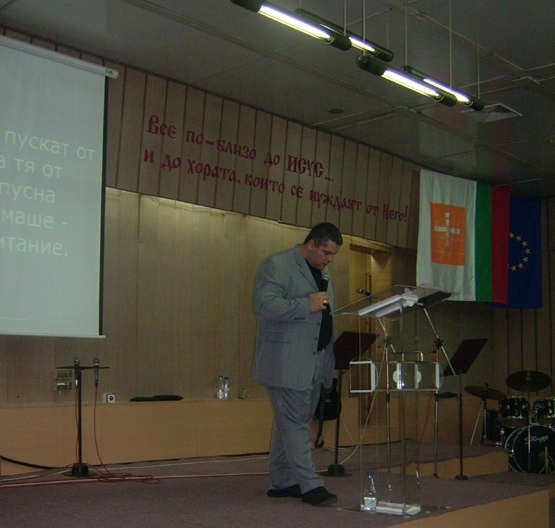
The seventh annual conference of Bulgarian Evangelical Churches in North America was held in Minneapolis May 24-26, 2008 under the theme “Fruitful in the Spirit.” The conference gathered Bulgarian evangelical believers from various parts of North America, but unfortunately the attendance was lower than previous years as the Bulgarian groups in Atlanta, GA; Nashville, TN; Ft. Lauderdale, FL and the Evangelical churches in Canada were without representatives.
Having worked with Bulgarian communities across the United States for some 15 years now while studying them for the purposes of our doctoral and postdoctoral research it is easily noticed, that the trends that led to the disappearance of Bulgarian Protestant communities in North America some 100 years ago are in the process of repeating themselves. This has been a personal concern of ours since we participated in the establishment of the first Bulgarian Church of God outside of Bulgaria in the city of Chicago. These issues can be summarized as follows.
Firstly, the problem in ministry remains unresolved through the continuous failure to provide the tri-dimensional dilemma of leadership, finances and culture. The resulting strife for preservation of the typical Bulgarian post communist mentality and “underground” style of ministry proves itself again and again incompatible with the American reality.
Secondly, the “regular” biannual division of congregations, which has become almost inevitable in the Bulgarian context, is hurting the churches preventing them from implementing a successful healing and growth process. These divisions evolve mainly from a misunderstood cell group model for “home-churching” which has proven ineffective in the Bulgarian cultural settings. The lack of an adequate split protection plan also contributes to this issue. At best, congregations spent all their resources managing to retain structure and prevent splits, while leaving no resources for further growth through reaching unchurched Bulgarian immigrants.
And thirdly, just like it happened some 100 years ago with the established Bulgarian protestant communities across North America, loosing the second generations of Bulgarian evangelical believers has become a counter priority. Perhaps because, Bulgarian congregations in the beginning of the 21st century are beginning to realize that it will inevitably mean the disappearance of Bulgarian Evangelical churches across North America as a whole. It is there, in winning the second generation of Bulgarian believers, where the key to survival of Bulgarian congregations lays.
It is encouraging, at the same time, to observer that one of the positive estimates provided by our doctoral project is also coming to reality. In 2002-2004, based on analyses provided by the New Religious Immigrants Project, our research suggested that the next Bulgarian Evangelical Church will be established in the last of the Seven American Gateway Cities which was still without a Bulgarian Church, namely the city of San Francisco. Our resent visit in the area of the Bay Area showed that this prediction is already progressing into a reality as the Bulgarian Diaspora there is already producing a Bible study group out of uniting Bulgarian college students from Barkley and young computer professionals in the area.
Resources for Further Study:
- Seven Churches of Revelation
- How to Start a Bulgarian Church in America from A-to-Z
- Bulgarian Churches in North America: Contextual Assessment
- Bulgarian Churches in North America: Statement of Problem
Seven Churches of Revelation
While Bulgarian Protestant churches and missions in Northern America have been present since the early twentieth century, networking between them is a rather new phenomenon that has occurred for less than a decade. Because of its recent existence, historical records and documented information on the subject is not yet available. However, the mission and vision of such a movement is not new to the Bible.
Cross-cultural church planting is seen repeatedly in the Scriptures. The Synagogue Movement during the times of Jewish slavery is a prime Old Testament example. The New Testament church and the spread of Christianity in the ancient East and the Roman Empire are other examples. In such cases, the mission and vision of religious formation presented in the Bible are applicable to the needs of a contemporary ethnic community of believers.
Of greater significance for this research is networking among religious communities in the Bible. The fact that such process exists is obvious from regular gatherings of New Testament church leaders in councils to make decisions and find solutions for problematic situations. The best example of church networking in a context of cross-cultural ministry is the description of the Seven Churches of Revelation.
This study will examine the text of Revelation chapters two and three in order to analyze similarities in problems and solutions in relation to the problem of ministry of the Bulgarian churches in America. The Scripture review will approach the Seven Churches from Revelation in a way very similar to the larger outline of the present doctoral project. Through establishing the general characteristics of the Seven Churches of Revelation, the cripture review will place the cultural, economic and leadership dilemmas within the churches’ context of ministry. It will then survey the churches and their relationships to the said dilemmas and will provide a statistical overview of the frequency of their occurrence. Finally, the Scripture review will analyze the results in light of the solutions proposed in the text of chapters two and three of the book of Revelation.
New Website for East Coast Bible College Alumni
Cup & Cross Ministries is pleased to inform you about our newly started website for East Coast Bible College alumni www.myECBC.com. The website is designed to serve as a community for students who can reconnect with old friends, exchange testimonies and ministry ideas and continue to partner together in the work of the Kingdom. Please forward this message to all East Coast Bible College alumni who you know. The address of the website is www.myECBC.com.
How to Start a Bulgarian Church in America from A-to-Z
Administration of Mission Three Year Plan
Rev. Dony K. Donev, D. Min.
Church of God Theological Seminary, 2003
Since 1990 Cup & Cross Ministries International has provided a dynamic Pentecostal style of leadership to the global scene of Christian ministry. With a major influence in Eastern Europe, our efforts have been focused on developing and coordinating ministry teams and supporting pastors and evangelists in the country of Bulgaria. This vision has been persistently reached through the means of Christian education, personal development, ministerial conferences, leadership seminars, media broadcasting, and a great number of other nontraditional styles of ministry. As a result, groups of churches within the Church of God and other denominations and whole regions such as the Yambol, Sofia, Sliven and Pravetz regions of Bulgaria have bought into the ministries’ vision and have followed the strategies designed to empower and enlarge their ministerial productivity.
Cup & Cross Ministries International has seized a great number of global harvest opportunities as well. It has been active in the church involvement with the European Union integration with Great Britain in 2001 and 2003, Finland in 1997, Israel in 2000 and Romania in 2001. By the use of modern technology, we have also been able to assist in ministry endeavors in Russia, the Ukraine, Macedonia, South Africa, India, the Philippines and France. Since 1994 the ministry has assisted churches across the United States and has strategically planned and developed a process which incorporates Bulgarian Evangelical Churches in North America. The first success of this endeavor was the establishment of the Bulgarian Evangelical Church of God in Chicago in 1995. Since then twelve more Bulgarian churches have been started in strategic immigration gateways across the United States and Canada. For the past four years our team have been involved in the process of starting a Bulgarian Evangelical Church in the city of Atlanta. Read complete paper (PDF)
Bulgarian Churches in North America: Contextual Assessment
After awaking in the morning of the 21st century, the world was rapidly introduced to a new postmodern movement called globalization. At a top political and economic level, globalization is the process of denationalization of markets, politics and legal systems purposing the implementation of a global economy. However, globalization is much more than an economic event as it affects social status and human rights of people worldwide. For the world community the process of globalization is a process of internationalization describing cross-border relations between countries, growth in international exchange and interdependence. It is also viewed as a liberalization process of removing government-imposed restrictions on movements between countries in order to create a borderless world. Globalization further implements spreading various objects and experiences to people at all corners of the earth creating universalization. In a cultural context, globalization is often seen as Westernization of the world. Finally, globalization carries the meaning of deterritorialization – reconfiguration of geography reforming any social place in new terms of independent territory, distance and borders.
Since the church is a global event, inevitably this process affects the community of believers. The “global believer” seeks to connect with people of similar nature independent of race, location and social status. Thus, church mission and church ministry reclaim its original Biblical global perspective. In this process, the church of postmodernity is liberated from its nationality and reaches toward internationalization establishing a new multicultural identity with a global perspective and mission. As a result multicultural churches gain a contextual new function serving as identity sources. Such is the case with the network of Bulgarian churches in North America.
Established to unite all Protestant Bulgarian churches in North America, it reaffirms the participation of Bulgarian immigrant communities in the global multicultural ministry. This present contextual assessment will explore the process of establishing a network of Bulgarian churches in Northern America. Read the complete paper (PDF)
Bulgarian Churches in North America: Statement of Problem
Since the fall of the Berlin Wall in 1989, the world has witnessed a miracle. In the corner of Europe, coming out from the severe Communist persecution and surrounded by the Balkan religious wars, one growing group of Christians is making a difference for the Kingdom of God. Placed on the crossroad of three world religions (Christianity, Islam and Judaism) and three continents (Europe, Africa and Asia), the country of Bulgaria has experienced an on-going spiritual revival in which hundreds of thousands of people have been touched by the power of God.
In the midst of extreme poverty due to prolonged economical crises, revival has become an answer for many. Yet, in the fifteen years of democratic post-Communism, more than one million Bulgarians have left their homeland in search of a better life and a better future. Receiving better economic opportunities, approximately 200,000 Bulgarians have established communities throughout the larger United States cities.
Having witnessed this remarkable act of God, some of them have brought the spirit of revival to their new land. Driven by the struggles of the immigration life, cultural adjustments and economic survival, these Bulgarians have been able to establish churches which serve not only as religious meetings, but also as communities of support.
Regardless of the vital integration and social functions for the Bulgarian communities, the resources of the Bulgarian Protestant churches in the United States remain unexplored. Their home churches are too far away and too poor to help, while the local cross-cultural ministries are either are occupied with much larger ethnic groups or lack the training and tools for effective ministry among Bulgarians. As a result, in the
midst of the present context of post-modernity and cultural re-imagination, the stories of these Christian pilgrims remain unheard. The reason for this is a threefold problem that focuses on the cultural, economical and organizational dilemmas with which the Bulgarian communities in North America struggle daily. Therefore, the problem involves finding a way to empower the network of Bulgarian Protestant churches in North America to overcome these cultural, economical and organizational dilemmas. This ambition postulates the enhancement of vision and quality of ministry among the Bulgarian immigrant communities. Read the complete paper (PDF)
Bulgarian Churches in North America
During Memorial Day weekend Cup & Cross Ministries will participated in the 7th Annual Conference of Bulgarian Churches in North America. The conference will take place on May 24-26, 2008 in Minneapolis and will be hosted by the local Bulgarian Evangelical Church. Over 200 delegates from Bulgarian communities of Dallas, Chicago, Los Angeles, Montreal and Atlanta are expected to attend the event. Cup & Cross has worked with Bulgarian immigrants for the past 15 years, and our team has actively and purposefully observed the Bulgarian Evangelical Churches in North America for almost seven years as a part of our ongoing research.
Bourgas Mayor Declares War on Churches
Several days before the Bulgarian Easter, the mayor’s office in the Black Sea city of Bourgas issued an order to all school principles to limit the access to students for all ministers and church members who identify themselves as Mormons, Jehovah’s Wit nesses or Pentecostals. We publish an English translation of letter without any further comments:
MUNICIPALITY OF BOURGAS
26 Alexandrovska Street, Bourgas 8000
Tel: 056/84 13 13, fax: 056/84 13 14, telex: 83 433
TO
HEADS OF SCHOOLS IN THE
MUNICIPALITY OF BOURGAS
DEAR HEADMISTRESS/HEADMASTER,
The Local Committee Against Anti-Social Behaviour Among Children and Young People (LCAABCYP) in the Municipality of Bourgas, jointly with the Police, is making inquiries regarding the activities of Christian churches non-traditional in our country, in connection with the forthcoming Easter holidays. The need to gather this material was dictated all the more by the increasing frequency of complaints by parents and suffering children, victims of a lack of information, and a lack of responsibility and control on the part of school and family.
To this end we are sending you an information sheet intended for all the pupils in the school under your charge. We leave it to you to select a suitable means, in or out of the classroom, to acquaint them with the information in the material. Whether in the form of a discussion or special lessons, you should explain the indications by which they can distinguish the sects from the Orthodox Faith traditional to our country.
We require feedback by you: in the form of your own inquiries, send information no later than 10 May 2008, addressed to Desislava Vasilieva, secretary of the Local Committee Against Anti-Social Behaviour Among Children and Young People (LCAABCYP) in the Municipality of Bourgas [stating]:
• The means by which the information was presented
• The response on the part of the pupils – actual examples of incidents they have experienced and their impressions; confirmed violations of human rights and freedoms on the part of the sects.
• Your attitude to the incidents shared by the pupils.
For further information and specific questions:
1. Desislava Vasilieva – secretary of the LCAABCYP – tel. 84 57 63 and 0899/82 88 44
2. Ivan Dimitrov – Police Inspector – Bourgas – 856 026 and 0898/78 42 68
Yours sincerely
YORDANKA ANANIEVA
Deputy Mayor and Chair of LCAABCYP
INFORMATION
In connection with the forthcoming Easter holidays there has been an activation of all the churches non-traditional in our country. It consists of a campaign to attract new members from all ages and social groups. To this end we consider it necessary to draw your attention to the most basic and dangerous sects which, despite their official registration with the Directorate of Churches at the Council of Ministers, are violating Bulgarian laws, civil rights and social order. For most people it is difficult to distinguish which missionary belongs to which religious sect. We will focus on some of the most popular non-traditional churches, who are using the forthcoming Christian holidays to agitate to their own advantage, attracting new members by manipulation. Initially they all present themselves as Orthodox Christians and later reveal that in fact this is to do with a different church, “better” and “truer”.
1. JEHOVAH’S WITNESSES
The church’s missionaries are well-dressed Bulgarian and foreign citizens. In the town at the moment there are representatives from Japan, Germany, Ukraine and Poland. In pairs they go around private homes, parks and schools, offering publications – “Watchtower”, “Awake!” and “What does the Bible really teach us?”. In most cases, according to the complaints that have reached us so far, the missionaries from the church of “Jehovah’s Witnesses” call for more modest dress, the repudiation by young people of all forms of entertainment, the repudiation of consultations with a doctor in the case of illness, and for cutting off from the natural family, on the pretext that love for Jehovah God comes before love for oneself and one’s own parents. The result of this suggestion, not uncommonly, is depression, mental disorders and suicides. A number of children have been offered money for food and clothes, as they were “helpfully” invited to attend their meetings in the so called “Kingdom Hall” situated next to “Konstantin Preslavsky” secondary school on the Slaveikov estate. Parallel with the refusal of medical assistance, the JWs also preach refusal of blood transfusions, even if it costs the life of the patient. According to schoolchildren, missionaries of this sect act by lying in wait for them outside the school gate and on the way home. There are confirmed cases of missionaries offering their sectarian literature to children and young people who were home alone, without parental supervision. When interest is shown or literature taken, the JWs return to the same address for renewed contact, in an insistent manner offering to give help and to expound texts from their booklets, with an invitation to attend their prayer house.
2. “CHURCH OF JESUS CHRIST AND [sic] THE LATTER DAY SAINTS – MORMONS”
The missionaries of this church are basically Americans – young people up to 35 years old, who stay in the territory of the town for not more than 2 to 3 months and on an exchange basis, after this period expires, they leave for another town to continue their mission. They are known by their traditionally immaculate dress of a white shirt, tie, and jacket with their name badge on the lapel. They generally go around in pairs, they are always smiling, they greet even strangers and, if interest is shown, they begin talking to explain from the Bible and the Book of Mormon who Jesus Christ is according to them. It is characteristic of them that they also visit private homes and, if no interest is shown, they don’t insist on immediately visiting you again. Their most widespread campaign is holding English language courses in their building at 29 Tsarigradska Street. They also invite schoolchildren, passers by and pensioners to their meetings, showing them films with a religious theme and discussing them afterwards. The Mormons speak good Bulgarian and in this way they win the sympathy of all citizens. They stay in Bulgaria on missionary service, cut off from their families, with the sole aim of publicising the work of their church around the world and attracting new members into its ranks, if possible from among young people. If you don’t wish to have contact with them it’s enough to show that you are not interested and that you don’t need their explanations. In the event of a violation of your personal rights and freedoms, you can make a complaint at the nearest police station or telephone direct on 166.
3. EVANGELICAL PENTECOSTAL CHRISTIANS IN BULGARIA
Under this heading can be included all the Protestant churches in the country, known to the general public as evangelical churches and people who are members of them as evangelicals. They can very easily be confused with the country’s traditional Orthodox Church. Their basic book is also the Bible, but they use a different translation and interpret the texts in a different way. They themselves also present themselves on initial contacts as Orthodox. Their differences with the Orthodox faith lie in the fact that they worship only the person of Jesus Christ. They do not acknowledge the divine attributes of the Holy Mother of God and all the other saints such as St George, St Ivan, St Dimitiri, St Nicholas and others that the Orthodox Church reveres. For this reason evangelicals do not celebrate name days and other feast days on the national calendar. For them celebrating a name day, Lazarus Day, Grandmother March [1st March] and other similar feast days is worship of something material and un-Christian, which the evangelical church treats as “sin”. These people lead a rather closed and restricted way of life, subject basically to Christian canons. Their place of worship can look like a very ordinary building, in which there are no icons, no candles are lit, and their priests are ordinary people who expound texts from the Bible to them. At these meetings they sing Christian songs with a popular sound, the louder the noise, the more Jesus is “praised”. Often in these meetings people present have fallen into unnatural states of trance, speaking incoherently, allegedly in ancient languages, and there is very likely a danger of mental aberrations and disorders after such a séance. They dupe their new members with free excursions in the country and abroad, with gifts of clothes, money and medicines, in this way becoming most popular among the weak strata of society. Two years ago a massive campaign of agitation on the part of the evangelical churches was carried out through free showings of the film “Jesus” before the Easter holidays. After the showings question cards were distributed to all who attended on which they filled in their impressions of the film, names, addresses and telephone numbers. In this way the evangelical churches are misusing personal data by disturbing, at their home addresses or by telephone, the persons who filled in the cards. All evangelical churches are financed by their partners abroad and in this way they gain quick and easy popularity. In the event they are misusing the known weakness of the Bulgarian nation – the worship of all things foreign.
It is typical of the sects listed above and other similar religious organisations that they disunite the Bulgarian nation and oppose it on religious principles. A feature often encountered is the disregard for national holidays and holy days, erroneously explained as unnecessary worship. In case of doubt you should in the first instance seek a consultation and personal conversation in the family with a parent; with a suitable trustworthy teacher or educational adviser; and not least with a police officer.