

March 12, 1906: William Seymour starts meetings at the home of Richard Asberry at 214 Bonnie Brae Street
Dony K. Donev
William Seymour was expelled from the Santa Fe Mission on March 4, 1906, after preaching that speaking in tongues constitutes the biblical evidence of baptism in the Holy Spirit. Outraged by the treatment of Seymour, one of the church members, Edward Lee, invited him to his home, where prayer meetings soon began. Because of the growing number of visitors, the gatherings were moved on March 12, 1906—exactly one month before Seymour himself received the Holy Spirit—to the home of Richard Asberry at 214 Bonnie Brae Street. Ironically, this was the same location where members of the Santa Fe Mission had met in 1905 after being expelled from the Second Baptist Church of Los Angeles for preaching the doctrine of holiness. At that same location, in Richard Asberry’s home, on April 9, 1906, Edward Lee became the first to receive the baptism in the Holy Spirit. Many others were also baptized and spoke in tongues after Seymour and Lucy Farrow laid hands on them in prayer.
The prayer meetings at 214 Bonnie Brae Street gained widespread attention as the number of attendees soon exceeded the capacity of Richard Asberry’s home. Holding services in the street itself attracted crowds of curious onlookers. Among them were representatives of the numerous immigrant communities living in Los Angeles at the time. One such group consisted of Russian “Molokans,” who had immigrated because of religious persecution directed against their extremely conservative beliefs (the so-called Old Faith) and their worship practices, which included dancing, trance states, falling in the Spirit, and in some instances even speaking in unknown tongues. One of the earliest American missionaries to the Balkans, F. W. Flocken, encountered a similar Molokan community in Tulcea and documented in detail his observations concerning their religious beliefs and practices (see notes 25–27 and the 43rd Annual Report of the Missionary Society of the Methodist Episcopal Church, 1861, p. 48ff).
Most Russian immigrants in Los Angeles in 1906 lived in Boyle Heights and Oaks Lot (the so-called “flats area slums,” a term used to describe the apartment blocks in the ghetto), approximately half a kilometer from Azusa Street. There, at Pecan Playground, tent meetings were held during the height of the Azusa Street Pentecostal revival (1906–1909). The first issue of the newspaper published during the revival, Apostolic Faith, reports that members of the revival were invited to preach in the local Molokan church (see Apostolic Faith, Issue 1). What the Molokans observed in the prayer meetings at 214 Bonnie Brae Street, and later in the Azusa Street revival itself, was nearly identical to the “Old Faith” practices they maintained in their own gatherings. When Ivan Voronaev moved from San Francisco to Los Angeles around 1913, he worked among Russian immigrants who had been eyewitnesses to the Azusa Street revival. /to be continued/
March 4, 1906: William Seymour is expelled from the Santa Fe Mission
March 5, 2026 by Cup&Cross
Filed under Featured, Missions, News, Publication
On March 4, 1906, Seymour preached during the morning service at the Santa Fe Mission that speaking in tongues is the biblical evidence of baptism in the Holy Spirit. When he returned for the evening service, he found the church doors locked by Julia Hutchins. After consulting the leadership of the Southern California Holiness Association, to which the Santa Fe Mission belonged, Hutchins informed Seymour that she did not accept speaking in tongues (glossolalia) as part of the doctrine of holiness. One of the elders’ arguments was that Seymour himself had not been baptized in the Holy Spirit and had not experienced what he preached.
However, Seymour was not the first to make the connection between speaking in tongues and baptism in the Holy Spirit. Even his teacher, Charles Parham, who systematized the theological link between biblical sanctification and Spirit baptism, was an heir to a rich tradition of preachers and churches that accepted speaking in tongues as the sign of the baptism in the Holy Spirit within the holiness doctrine.
1905 – Lucy Farrow, who introduced Seymour to Parham and later helped him receive the invitation to pastor the Santa Fe Mission in Los Angeles, was baptized in the Holy Spirit and spoke in tongues. She was the niece of Frederick Douglass and pastor of a Holiness church in Houston. Lucy Farrow received the baptism in the Holy Spirit while working in the home of Charles Parham. At a prayer meeting in Houston in early 1906, she prayed for 25 people, all of whom were baptized in the Holy Spirit and spoke in tongues simultaneously. Shortly afterward, she traveled to Los Angeles, and when Seymour was expelled, it was Lucy Farrow who prayed for the first believers to receive Spirit baptism during the home prayer meetings that began on Bonnie Brae Street in April 1906.
1896 – During the revival meetings known as the “Shearer Schoolhouse Revival,” more than 100 men, women, and children were baptized in the Holy Spirit. They were part of a mountain community in North Carolina called the “Christian Union,” from which the Church of God (Cleveland, Tennessee) would later emerge.
1887 – In the revival meetings of Maria Etter, under the power of the Holy Spirit, believers (mainly Quakers and Methodists) fell into trances and spoke in unknown tongues, leading the secular press to call her a “voodoo priestess.”
1880 – The “Pentecostal Holiness Church Movement” documented Holy Spirit baptisms among its members.
1889 – Jethro Walthall of Arkansas was baptized in the Holy Spirit along with many others during a prayer meeting.
1875 – E. B. Swan testified that the so-called “Gift People” in Rhode Island practiced speaking in tongues.
1874 – Similar testimonies came from healing meetings in New York State, where many were baptized in the Spirit and spoke in tongues.
1855 – William Dowie spoke in unknown tongues during meetings of Frank W. Sandford in Shiloh, Maine. Later, Dowie founded the “Gift People” movement, and Sandford started a Bible school called “The Holy Spirit and Us” as part of his church. Ambrose J. Tomlinson, who in 1907 would organize the Church of God, also visited Shiloh in October 1901. Even Charles Parham stayed at the school for six weeks during the summer of 1900 to listen to Sandford’s lectures. It was there that Parham first heard speaking in tongues among the students in the school’s old prayer towers.
In 1906, the participants in the Azusa Street Revival sought the same experience of speaking in tongues that had occurred in the early hours of January 1, 1901, at Charles Parham’s school in Topeka, Kansas. Interestingly, a publication from January 6, 1900, reported that at Sandford’s school in Shiloh, many had been baptized in the Holy Spirit and spoke in unknown tongues following a prayer meeting that began on New Year’s Eve and lasted about ten days.
1854 – W. P. Simons and Robert Boyd separately testified about speaking in unknown tongues during evangelistic meetings led by D. L. Moody, attended by followers of the Scottish preacher Edward Irving.
110 Years ago, William J. Seymour was baptized with the Holy Spirit
After starting a fast on April 6, 1906 in Los Angeles, the small group experienced what would become the first baptism with the Holy Spirit at the Azusa Street Revival. Several more followed shortly. William J. Seymour himself was baptized 110 years ago on April 12, 1906.
On the seventh, which was Good Friday, Seymour and his followers leased an abandoned church property at 312 Azusa Street and begin cleaning it up. Easter was on April 15, 1906 when they held their very first Pentecostal service at Azusa Street. The rest is history…
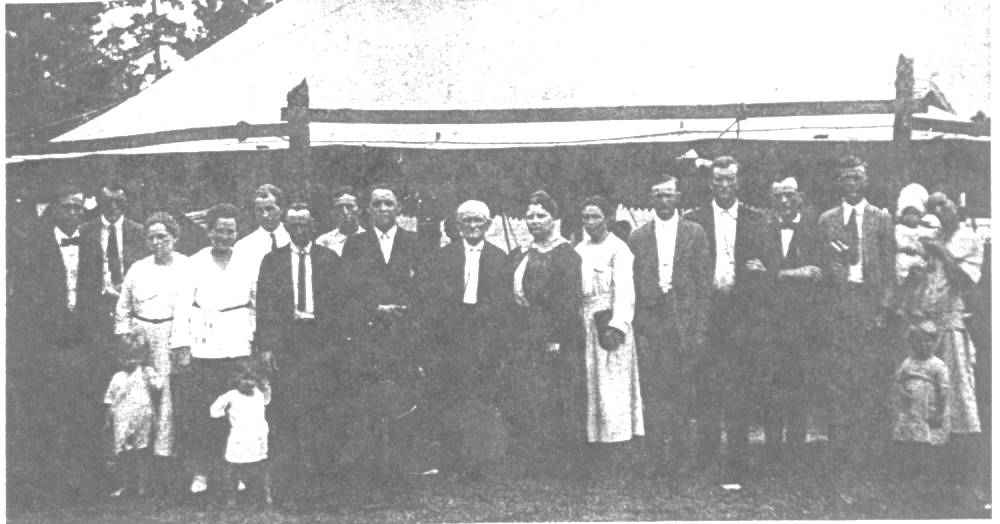
First person to speak in tongues in the Assemblies of God was William Jethro Walthall of the Holiness Baptist Churches of Southwestern Arkansas
 By Glenn Gohr
A/G Heritage, Fall 1992
Although the modern Pentecostal movement relates its beginnings to Charles Parham, who formulated classical Pentecostal theology at his Bible school in Topeka at the turn of the century, throughout history, from apostolic times to the present, there have been certain religious groups and isolated cases of individuals who have experienced tongues-speaking and spiritual gifts.
William Jethro Walthall, who founded the Holiness Baptist Churches of Southwestern Arkansas, a group which later merged with the Assemblies of God, is an important figure who received his baptism in the Spirit prior to Parham’s launching of Pentecostalism in 1901.
Walthall’s Spirit baptism, which occurred 113 years ago, is one of the earliest documented cases of speaking in tongues in North America. Earlier instances of tongues-speaking have been reported among the Shakers, the Holiness Movement, the “Gift People” or “Gift Adventists” in New England, and others. It is very possible that Walthall is the earliest person to have received the baptism in the Holy Spirit and who later joined the Assemblies of God.
William Jethro Walthall was born in Nevada County, Arkansas, March 9, 1858, the son of Charles Featherston Walthall and Mary Jemima Meador. His father died in 1863 at Rock Island, Illinois, as a prisoner in the Civil War, and his mother died 2 years later. Orphaned at age 7, he was reared by his widowed grandmother. However he had no Christian upbringing, so it was not until 1877 that he was confronted with the claims of the Gospel. That happened when he attended an old-time Methodist meeting and conviction gripped his heart, resulting in his conversion at age 19. Two years later, on August 3, 1879, he was married to his first wife, Melissa P. “Missy” Beavers, who bore him two children, Millard and Ibber Mae. After Melissa passed away, he married Hattie Vaughn on March 24, 1915.
While a young Christian, Walthall had a yearning for more of the workings of God in his life. He earnestly began to seek for a fullness of power to witness and better serve the Lord. This spiritual hunger led him to carefully study the Book of Acts and other scriptures. There he found recorded an enduement with power of the Holy Ghost which had accompanied the Early Church. He wanted this same experience in his life.
During a season of fervent prayer, he received a mighty infilling of the Spirit on September 3, 1879. Since he had never heard of the baptism of the Holy Spirit, he did not receive his Baptism through any prescribed theory or method.
Until that time all he knew about the Holy Spirit came from the teachings of the Methodists and Baptists. But this was something new. His experience came about in answer to prayer and through his own study of the Word of God. From the outset he understood that his experience corresponded with the records given in the Book of Acts.
In his testimony, Walthall describes his infilling by saying, “I was carried out of myself for the time being.” From the time of his Baptism, he testified that he often felt the strong anointing power of God. At times he would fall under the power of God when the Spirit came upon him. He also spoke in tongues as the Spirit directed.
For two years, during which time the Holy Ghost would often fall on me, I walked with God. Sometimes while in service and sometimes when alone in prayer I would fall prostrate under His mighty power. While under this power my tongue seemed to be tied in the center and loosed at both ends. I knew nothing of the Bible teaching on the Baptism or speaking with tongues, and thought nothing of what had happened in my experience.
Walthall was ordained by the Missionary Baptist Church on May 29, 1887, and served several congregations in Southwest Arkansas. He was active in various associational committees including foreign missions and temperance. In 1891 he was pastor of Piney Grove Church at Boughton, Arkansas, which was a part of the Red River Baptist Association of the Southern Baptist Convention. In fact, the annual associational meeting was held that year at Walthall’s church. The next year he was pastoring two churches at Bluff City and Prescott. From 1894-1895 he was pastoring at Stephens. The last Baptist church he pastored was at Buena Vista. Because of the prevalent view of the Holy Spirit held by Baptists, Methodists, and other mainline churches, Walthall had some reservations about his experience, as he shares in his testimony:
The ordinary Methodist and Baptist teaching was all that I knew, and, of course, that served to diminish my experience and to paralyze my faith rather than build me up. In the meantime, I began preaching a work to which I was called when the blessed Spirit filled me. I always felt that there was a lost chord in the Gospel ministry. My own ministry never measured up to my ideal, nor did the teaching of my church (Baptist) measure up to my experience.
Then in 1895 Walthall came into contact with the Holiness revival. Its emphasis on the work of the Holy Spirit impressed him. Its teachings approximated his ideal more nearly than anything else, but he never fully ascribed to the Holiness theology. He could not accept its theory of sanctification; nor could he accept its abridgement of the supernatural. Even so, the Holiness revival opened him up to a larger sphere of ministry, This in turn gave him the encouragement he needed to preach the full gospel message as he understood it from the Scriptures. As he began to preach a full gospel message, the Baptist leaders excluded him from his church and he was ostracized from the Baptist ministry in 1896. He continued preaching on his own.
After my new vision of the Word of truth, and my expulsion from the Baptist fellowship and ministry, I went alone with a new zeal in an independent, plodding ministry, with church and school houses closed against me. I was looked upon with suspicion, as unbalanced but was so animated by the divine presence that it seemed at times as if terrestrial bearing was almost lost. Baptist minister, J. C, Kelly, and other Baptists who became disfellowshipped because of their beliefs in entire sanctification and the work of the Holy Spirit.
He was soon followed by another Baptist minister, J. C. Kelly, and other Baptists who became disfellowshipped because of their beliefs in entire sanctification and the work of the Holy Spirit.


