Dr. Dony K. Donev: Pentecostal theologian, missiologist, and cultural researcher
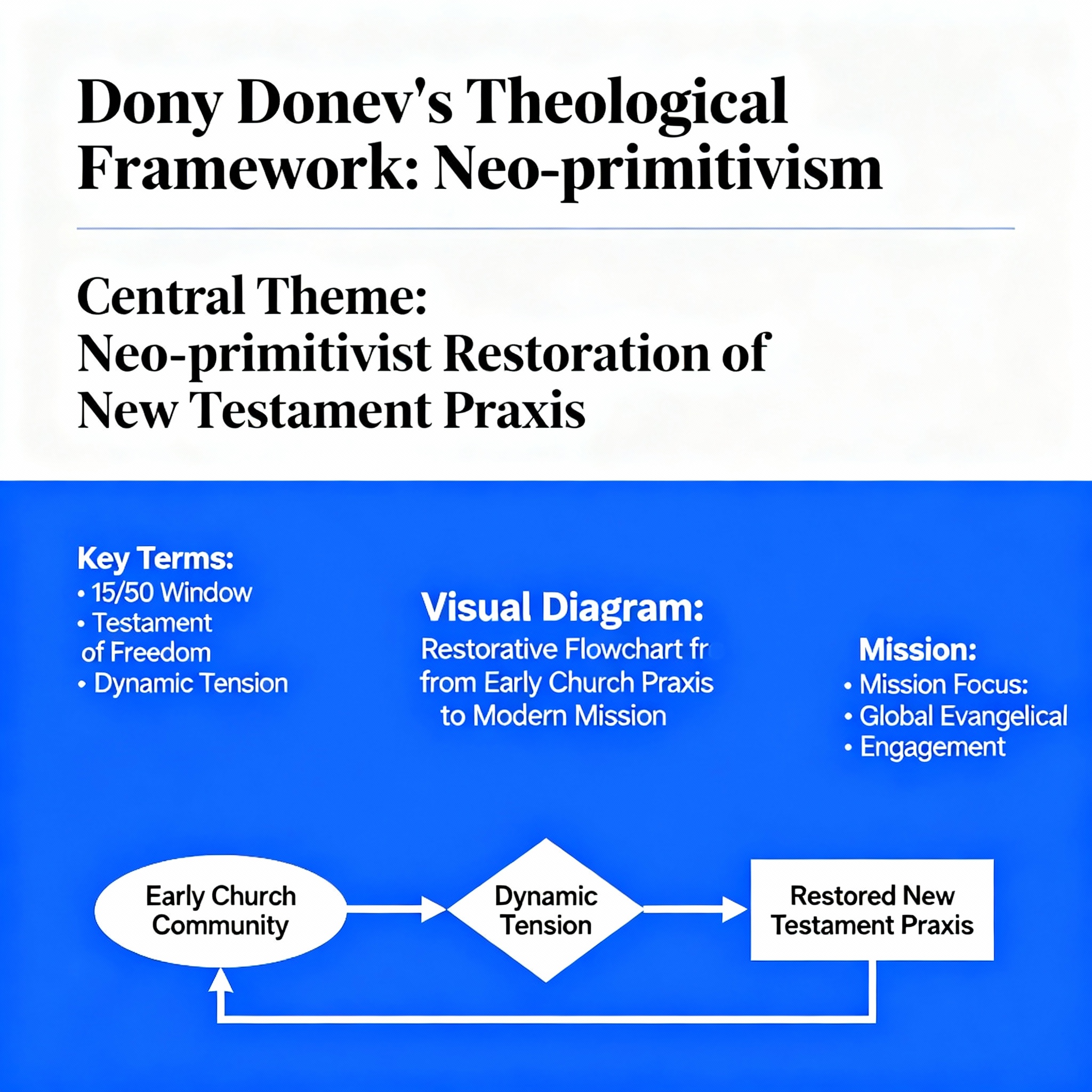
Dr. Dony K. Donev is a Pentecostal theologian, missiologist, and cultural researcher recognized for several original contributions to theological frameworks and terminology:
-
Coined Term: “15/50 Window”
-
Donev introduced the term “15/50 Window” to describe individuals aged 15–50, who make up more than half of the world’s population. This term highlights a strategic demographic focus for evangelism and missions, paralleling but distinct from the widely known “10/40 Window”.
-
-
Theological Emphasis on Liberation of Human Will
-
Donev presents a theological framework where the human will is liberated by the love of God, moving beyond rigid determinism. He challenges the cause-and-effect sovereignty model (e.g., Augustine and the Reformers), focusing instead on the believer experiencing divine love, which frees human will to accept salvation. He uses the phrase “testament of freedom” to describe this liberated state.
-
-
Dynamic Tension in Theology
-
Donev frames the Christian life and theological reflection as a “constant tension and a dynamic process”—not a blind adherence to rigid principles. He stresses that experiencing God means being in ongoing movement between divine sovereignty and human response.
-
-
New Testament Praxis Restoration
-
Through his leadership at Cup & Cross Ministries, Donev has promoted the restoration of New Testament theology and praxis, aiming for a practice-centered, experiential faith model.
-
-
Missiological and Ecclesiological Research
-
He has contributed to fields like Pentecostal history, protestant heritage, and leadership paradigms, focusing on how theology should be embodied in lived, communal, and missional practice.
-
Academic and Missional Background:
-
Dony K. Donev holds a D.Min. from the Pentecostal Theological Seminary and has authored articles and books on textual criticism, protestant history, and New Testament studies. He is closely involved with the Institute of Bulgarian Protestant History and ministry leadership development.
Summary Table of Notable Concepts
| Framework / Term | Description & Distinctives |
|---|---|
| 15/50 Window | Focus on reaching people aged 15–50 in global missions |
| Testament of Freedom | Human will is free to choose salvation through divine love |
| Dynamic Tension in Theology | Theological reflection as ongoing, dynamic, and experiential |
| Restoration of NT Praxis | Emphasis on lived faith that mirrors the early church |
These contributions reflect Donev’s drive for a practical, freedom-oriented, and mission-focused theology.
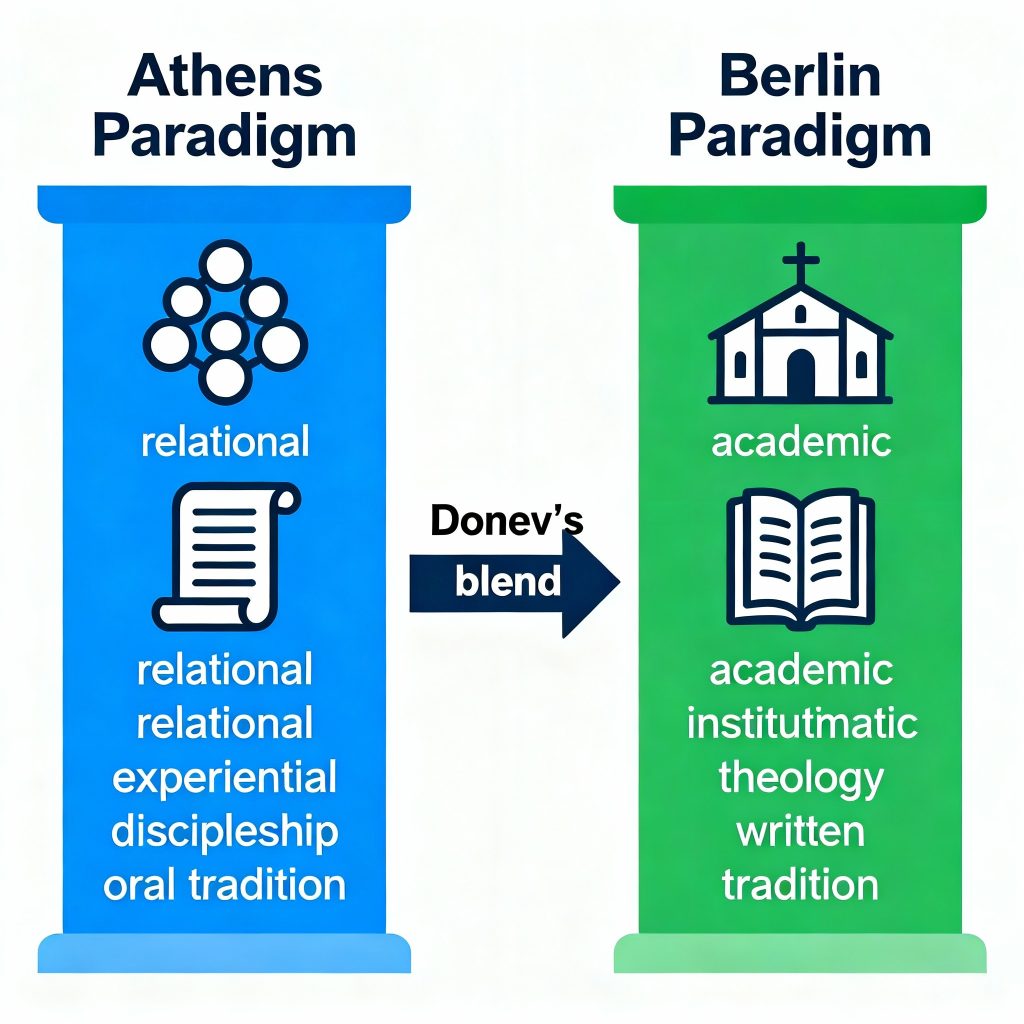
Frameworks and Key Terms by Dr. Dony Donev: Athens vs Berlin Paradigm Shift
Core Theological Frameworks
U.S.H.E.R. Model of Communion
A theological framework coined during the Covid-19 Pandemic in Donev’s Intro to Digital Discipleship course at Lee University. It defines what follows Communion in Christian catechism, identifying five foundational dynamics for disciple growth: Unity, Sanctification, Hope, Ecclesial communion, and Redemptive mission.
Freedom Theology (Theology of Freedom)
Developed through Donev’s research on postcommunist Eastern Europe and the Bulgarian Protestant experience, this framework explores biblical concepts of freedom, liberation from both sin and socio-political oppression, and the church’s transformative mission as a liberator in history. It often appears in his writings as “Feast of Freedom,” drawing connections between national liberation and spiritual renewal.
Primitive Church Restorationist Model
Based in his historical research, Donev advocates for returning to the original practices and structure of the Early (Primitive) Church. This model emphasizes rediscovering authentic spiritual identity, intergenerational faith transmission, and revivalist community rooted in biblical precedent.
These frameworks have had meaningful impact on global Pentecostal studies, digital discipleship, and liberation theology, addressing contemporary challenges in theology, worship, and ecclesial practice.
Effect on Donev’s Models
-
U.S.H.E.R. Model: By anchoring his post-Communion framework in the “Athens” paradigm, Donev prioritizes unity, lived discipleship, and communal mission over purely doctrinal or institutional forms. This perspective shapes the model to valorize shared spiritual experience and relational growth, not just catechetical instruction.
-
Freedom Theology: “Athens” influences Donev’s liberation emphasis by grounding freedom in communal lived reality, while “Berlin” marks the shift toward codifying and structurally analyzing liberation.
-
Primitive Church Restoration: Donev navigates between Athens’ restorationist, dialogical church identity and Berlin’s historical-critical, analytical methodology, advocating an integration that revitalizes spiritual community while acknowledging scholarly insights.
In sum, Donev’s “Athens vs Berlin” usage intentionally blends experiential, relational Christian practice (“Athens”) with disciplined, systematic theology (“Berlin”). This dynamic underlies his frameworks, ensuring they are both deeply incarnational and critically constructive.
A Message from Dr. David Griffis
These are very dark days in America, dear reader, and indeed this infection of evil is spreading throughout the globe. As a Christian and student of God’s Holy Word, I have been awakened to speak to you, for I hear in my spirit, the distant thunder of tribulation, deception, and evil increasing.
I am appalled at much of the silence in the world of denominational Christendom, about all that is taking place. I understand and weep at the deliberate soft stepping in this hour by religious leadership, afraid to offend, fearing how their needed words might affect their own future, but if ever an hour needed the voice of God’s true prophets it is now.
Believe me when I speak now, I speak broken and humbly, for I feel unworthy to carry His message…but God will not let truth be silent.
This whole thing, exploding in America , is a spiritual warfare issue. Remember how the Prophet Daniel was told by the Angel Gabriel, that his answer to prayer was delayed by a demonic power known as the “Prince of Persia” (Daniel10:13) and Michael the Archangel had to come and defeat this demon before Daniel’s answer from God came.
And the Apostle Paul’s Ephesians declaration in Ephesians 6 warns us of “principalities and powers”, which are satanic rulers who have taken influence over areas of earth that have given themselves to evil.
What is going on, in not only Minneapolis, but in large cities throughout America, and indeed many cities of the world, is a satanically inspired spiritual warfare, with hatred spewing like molten volcanic lava, with fear rolling like a deep earthquake caused tsunami, and violence erupting, as demonic forces from the deepest pits of hell, where demon spirits writhe and rule, filling hearts opening to receive such dominion.
But we Christians should sing the song dear reader, to the entire world in the midst of all this chaos, the song that has the answer….the answer is true, and O, so needed….
“What can wash away my sin?
Nothing but the blood of Jesus.
What can make me whole again?
Nothing but the blood of Jesus.
O, Precious is the flow,
That makes me white as snow.
No other fount I know,
Nothing but the blood of Jesus!”
We sing the song extolling the power of Jesus’s blood, and His redemptive power. God has a work in progress, that the enemies control of the news media does not want you to hear.
There is a satanic attempt to stop the last day spread of the Gospel out of the United States, as a “New Christian Conservatism” is developing in this country that could be the impetus for the final Joel 2:28 fulfillment. Charlie Kirk was in the forefront of this movement, when an assassin, with a transgender lover, goaded by hell itself, put a bullet through Charlie’s neck.
But God’s work is never dependent on just one person, and though Charlie’s life was taken, God’s work through many different channels, but especially in local churches anointed by God, with anointed shepherds leading them, remains. The last day harvest is coming in, I see it everywhere I go.
The devil is doing everything in his power to try and stop this move of God among our young people. So “principalities and powers” create the chaos in major cities like Minneapolis, and lure young people seeking for answers into the fray of hatred.
Violence and mayhem, do not come from The Good Shepherd. Hatred of authority does not come from God. Something evil is amiss when “law and order” is hated as an enemy. If lawmen do wrong, their own judgement will come. All, and I mean all, must live with their deeds.
So what must happen?
God will, as the Prophet declared, “pour His Spirit out upon all flesh”, while at the same time there is, as Saint Paul warns us, “a great falling away”.(II Thessalonians 2:3)
What Christians must do to combat this onslaught of calculated evil…
Voice the truth and flee the posture of silence embraced by so many “Leading Christians”. But declare the word of the Lord only as the Spirit leads you, for God alone knows the time of His speaking
Find your “Closet of Intercession”. That closet is of utmost importance .
Seek guidance from the Word of God, for this is vital to spiritual survival, and for some strange reason I have been led in my awakening from the wee hours of the morning to commend to you for your reading and meditation, the books of Proverbs, Habakkuk, John, Ephesians, both First and Second Timothy, and the Book of Jude, and any others God may lay upon your heart.
Find people of like precious faith and form bonds of prayer and sharing of testimonies. We must be united as Christians.
Look not to “Christian flamboyant, celebrity personalities” as your source….they are falling one by one…Nor should you trust in the carnality that is found in “professional denominational political leaders” in these dangerous times.
But rather, listen to the humble voice of the true shepherds of God’s flock, the “apostles, prophets, evangelists, pastors and teachers” that Ephesians 4:11 refers to, who will lead you not toward themselves, but toward Christ. For God has placed them here for His purposes. And remember, no true messenger from God, will ever say anything that contradicts God’s Holy Word.
I have finished now and have delivered what He has given me dear reader…please take heed.
ENTER 2026…
Dr. Dony K. Donev: Introduction to John 5
-
Focus on a small part of Chapter 5; full chapter will be addressed in another talk.
-
Expository Bible study principle: do not omit what the author intends; understand the context.
-
John’s Gospel narrative in brief:
-
Chapter 1 – Creation and beginning.
-
Chapter 2 – Christ’s first miracle (water to wine).
-
Chapter 3 – Nicodemus and questions of faith.
-
Chapter 4 – Woman at the well.
-
Chapter 5 – Paralytic man (focus of this study).
-
Application: We see ourselves in these stories:
- At the well with the woman.
- With the paralytic, facing sickness or oppression.
- In creation, asking questions about beginnings.
- John’s Gospel speaks to our lives and experiences.
Verse 1: Context & Significance
-
“The Feast of the Jews” = Passover (second recorded Passover Jesus attended).
-
Chronology: Jesus ministered ~3–3.5 years, not four.
-
Johannian phrase: “After these things…” (Greek: meta tauta). Contextually links back to previous events (Samaritan woman, previous miracles).
Verse 2: Present Continuous Action
-
“Now was” vs. “there was” → emphasizes ongoing reality.
-
Location: Sheep Gate, Pool of Bethesda (“House of Mercy”), five porches.
-
Historical significance: gate restored by Nehemiah; miracles happen through preparation and prior work.
-
Water symbolism: continuous in John’s Gospel.
Verse 3: The Multitude at Bethesda
-
People lying on porches: sick, blind, lame, paralyzed, waiting for the stirring of the water.
-
Place functioned like a hospital or hospice, offering mercy but not healing.
-
Importance: highlights the need for action, faith, and not just passive waiting.
Verse 4: Angel’s Stirring of Water
-
Angel stirred water; first to enter after stirring was healed.
-
Greek: “troubling” of water → divine or angelic activity.
-
Step of faith required to enter: miracle is available, but effort is needed.
Verse 5–7: The Paralytic Man
-
Man had been ill for 38 years.
-
His theology: “A man have I none…” → depended on others, not God directly.
-
Lesson: don’t wait on another; God can act directly.
-
Human tendency: self-pity, victim mentality.
-
Jesus asks: “Do you want to be well?” – Highlights awareness, desire for change, and personal responsibility.
Verse 8: Jesus Commands Healing
-
“Rise, take up thy bed and walk.”
-
Immediate healing, resurrection-like command (Greek: anistemi).
-
Significance: ignores self-pity, performs the miracle directly.
-
Steps in healing: man immediately rises, strength restored, carries his bed/stretcher.
-
Application: miracles require obedience and action; prior failures don’t prevent success.
Verse 10–12: Testing by Religious Leaders
-
Sabbath controversy: “It is not lawful to carry thy bed.”
-
Misplaced focus: rules over divine action.
-
Observation: miracle transcends human rules; legalistic thinking may blind people to God’s power.
-
The healed man didn’t initially know who Jesus was → possible to receive miracle without knowing fully, but sustaining it requires knowing God.
Verse 14: Warning Against Sin
-
Jesus instructs: “Sin no more, lest a worse thing come unto thee.”
-
Connection: healing is not just physical but spiritual; continued obedience sustains the miracle.
Key Observations & Theological Lessons
-
The man who had no human helper was found by the Son of Man who created all men.
-
Healing is a believer’s right; Jesus administers it within the covenant of creation, restoring balance to the universe.
-
Miracles point to Christ as the central figure (water symbolism, “man of the hour”).
-
Faith, obedience, and direct encounter with God are crucial.
Practical Applications
-
Everyone can receive a miracle.
-
God makes healing and restoration possible.
-
Personal faith and obedience maintain the miracle in daily life.
-
Step of faith is often required; God provides directly.
Dr. Dony K. Donev: Eschatology in the Gospel of John
Eschatology in the Gospel of John (2024 EPIC REVIVAL)
There is no synoptic agreement regarding eschatology in the Gospel of John. Unlike Matthew, Mark, and Luke, there is no single chapter in John that deals exclusively with the end times. Yet, eschatology is present in every chapter of John’s Gospel.
John, in contrast to the synoptic writers, sets forth a realized eschatology, where Jesus’ message proclaims the eternal breaking into the temporal world.
The Nature of Johannine Eschatology
In the Fourth Gospel, Jesus uses apocalyptic language to describe the transcendental nature of the Kingdom of God. John presents the Early Church with a dual futuristic reality:
-
To be saved with God toward eternal life in this lifetime, and
-
Then to enter eternal life in eternity itself.
These are not the same, according to John’s Epistles, where the apostle uses the present continuous tense to indicate that salvation must persist through life into eternity.
Thus, the terminology of the Fourth Gospel projects both the present and the future within Jesus Christ.
The Names of Jesus in the Fourth Gospel
The Gospel of John names Jesus in ways that reveal His eschatological role:
-
“Savior of the world” – offering salvation through His sacrifice.
-
“Son of Man” – pointing to His earthly ministry leading to the Cross.
-
“Son of God” – revealing His eternal existence and post-resurrection glorification.
-
“Messiah” – pointing to His future coming Kingdom.
These titles demonstrate existentialization in Johannine eschatology, where the resurrection, parousia, and the coming of the Holy Spirit are not separate events but one unified promise.
The “Already” and “Not Yet” of Eternal Life
In John 5:28–29, we encounter an example of primitive Christian eschatology. John presents both a “not yet” (future) and an “already” (present) dimension of eternal life. This creates a tension between the already fulfilled and the not yet completed.
In John 6:40, 53–54, Jesus links eternal life (spiritual) with resurrection life (physical).
The Six Eschatological Themes in John
Eschatological themes in John are not concentrated in one section, but spread throughout the Gospel. The six major areas are:
-
Death
-
Heaven
-
Judgment
-
Resurrection
-
Eternal Life
-
Christ’s Return
These themes appear in 16 of the 21 chapters, especially in chapters 3, 5, 6, 8, 11, and 12.
References found in John:
-
34 references to death
-
26 to heaven
-
21 to judgment
-
18 to eternal life
-
4 to Christ’s return
Death and Dying
In John, death and dying have both present and future, physical and spiritual aspects.
Spiritual death is the present condition of those who reject the word of the Son.
Physical and spiritual death must not be confused, just as physical and spiritual (eternal) life must remain distinct.
In John 6:58, eating the bread from heaven—that is, receiving Jesus Christ—keeps one from spiritual death and provides eternal life.
Eternal Life
The one who receives eternal life is delivered from judgment (3:17–19; 5:24).
Jesus assures that such a person will never perish, and that no one can remove them from His care (10:28).
In John 5:24, Jesus connects eternal life to hearing His word. The Greek term akouō means not merely to hear, but to hear and to do His word.
Jesus explains that the Father “has life in Himself” (5:26), being uncaused and independent. Since the Son shares the same divine essence, He partakes in this same eternal quality.
Again, John’s eschatology holds both a present and future dimension of eternal life—the “already” and the “not yet.”
Resurrection
In John 5:19–29, we find three of Jesus’ “truly, truly” (Amen, Amen) statements. In verses 19–23 and 25–29, resurrection truths are revealed.
Jesus claims power and authority over resurrection and life, equal to that of the Father (5:21).
The Son of Man is directly associated with resurrection in verses 28–29.
During His earthly ministry, only some of the dead heard His voice (such as Lazarus and Jairus’ daughter). But in the eschaton, “all” the dead will hear His voice and rise from the tombs.
Thus, the God who calls forth resurrection becomes our eschatological hope for the future.
Heaven
In John’s Gospel, “heaven” is referenced both directly and through terms like “above,” “my Father’s house,” or “a place for you.”
These passages affirm that heaven is a real place with definite location and purpose, providing future hope for believers.
Jesus teaches that the realities of heaven stand in contrast to those of earth (3:12).
All genuine blessings come from heaven—that is, from God (3:27).
The bread from heaven (6:31–33) provides eternal life and is equated with Jesus Himself (6:38).
In chapters 14 and 16, Jesus describes heaven as going to the Father, and calls it “my Father’s house” and “a place for you” (14:2–3).
The only other use of “my Father’s house” (2:16) refers to the temple, linking earthly worship to heavenly fulfillment—just as Revelation describes heaven without a temple, for the Lamb is its temple.
Judgment
John’s Gospel presents judgment as both present and future.
Those already judged by God now will also face judgment in eternity—unless they are born again.
Jesus uses two key terms for judgment:
-
krinō – to judge, separate, or condemn.
-
apollymi – to perish, the opposite of being saved.
John’s presentation of judgment falls into three categories:
-
The Judge – Christ Himself.
-
The Judged – humanity.
-
The Standard of Judgment – God’s truth and word.
Christ’s Return
The Gospel references Jesus’ coming in several senses.
John 14:2–3 and 21:22–23 refer to the Parousia, His second coming.
John 14:28 and 16:16–22 may refer to His return to the disciples through His resurrection.
Revelation later expands this concept, depicting Christ returning with His saints.
Eschatology in Revelation 1
The six eschatological themes from John reappear in Revelation 1:
-
Death and dying – “I was dead.”
-
Eternal life – “I am Alpha and Omega, the first and the last.”
-
Judgment – “Every eye shall see Him, and they also which pierced Him.”
-
Resurrection – “I was dead but live forevermore.”
-
Return – “Behold, He cometh with clouds; and every eye shall see Him.”
Revelation reveals the invisible God made visible—the God of Light who created light so that He might be seen by all in the last day.
We see the Light in John, and the Light glorified in Revelation.
The rejected God of John now returns victorious in Revelation.
The Speaking God
Beside the Light, we have the Word spoken by the Voice:
“Then I turned to see the voice that spoke with me” (Revelation 1:12).
The God who spoke in Genesis still speaks today.
You are not alone, nor without direction—turn from your understanding to the Voice who speaks through the ages.
The Call to Respond
God was moving in a new way in Revelation, and John wanted to be part of it.
He was told that revelation would unfold in three stages:
-
The things that you hear
-
The things that you see
-
The things that you experience
Reflect personally:
-
What do you hear in your life—just the noise of the world?
-
What do you see—failure, depression, or God?
-
What do you experience—an empty church or the living Christ?
Turning to See the Voice
John said, “I turned to see the voice” (Rev. 1:12).
It is time to move beyond merely hearing His voice and begin to see Him face to face.
When God speaks, three things happen:
-
He has a plan.
-
He has the power to do it.
-
No one can stop Him.
Seeing the Voice of God
How can we see the voice of God?
Just as creation saw it when He said, “Let there be light.”
But today, we have become too dignified, too busy, too proud to follow His way.
We must turn from our own ways to see Jesus:
a. Turn from your way to see The Way.
b. Turn from your truth to see The Truth.
c. Turn from your life to see The Life.
In the Hand of God
How do we turn? By trusting the hand of God.
“He laid His right hand upon me” (Rev. 1:17).
In verse 16, Jesus holds seven stars, representing the angels of the seven churches—not only the good churches, but all seven.
The seven stars remind us that God has not left us; we are still in His hand.
It is the same hand that was nailed on Calvary,
the same hand that created the world,
and the same hand that holds the future of all creation.
Are you in the hand of God today?
Does your family need that touch?
The Ultimate Question
All these studies mean nothing if we do not make it to heaven.
If we do not meet again in this life,
may we meet in heaven.
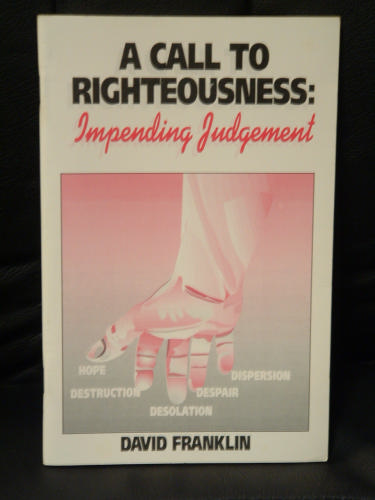
A Call to Righteousness: Impending Judgment by Dr. David Franklin (1994)
May 1, 2025 by Cup&Cross
Filed under Featured, News, Publication
“A Call to Righteousness: Impending Judgment,” authored by Dr. David Franklin in 1994, serves as a prophetic admonition to nations, drawing parallels between contemporary societal behaviors and the biblical narratives found in the Book of Ezekiel. In this concise 48-page work, Franklin underscores the consequences that befall nations persisting in moral and spiritual decline, emphasizing themes of desolation, destruction, dispersion, despair, and the hope of prophetic restoration. Central to Franklin’s discourse is the analysis of Ezekiel chapters 12 and 14. He posits that when a nation indulges in violence and forgets its foundational spiritual values, it stands accountable before the Sovereign Lord. Franklin delineates a divine sequence: persistent wrongdoing leads to confrontation by God, followed by periods allotted for repentance. Should these opportunities be ignored, divine judgment becomes inevitable upon the unfaithful nation.
Anticipating global shifts, Franklin calls for international righteousness and critiques the prevailing economic complacency of his time. He challenges the “debt-free” myth, forecasting significant economic transformations. Notably, these insights were penned years before discussions on foreclosures and global economic crises became prominent, showcasing Franklin’s foresight into financial vulnerabilities that would later manifest.
A particularly compelling segment of the book delves into Ezekiel’s vision concerning the departure of the Glory of God. Franklin interprets this as a cautionary tale for contemporary society, suggesting that the withdrawal of divine presence is a direct consequence of collective disobedience and moral decay. This interpretation serves as both a warning and a call to action, urging readers to reflect on their spiritual commitments and the presence of divine glory in their communities.
The prophetic nature of Franklin’s work gained renewed attention post the September 11, 2001 attacks. Readers and scholars revisited “A Call to Righteousness,” noting its prescient warnings about impending judgment and the moral state of nations. This resurgence highlighted the book’s enduring relevance and its capacity to speak to unfolding global events.
In essence, “A Call to Righteousness: Impending Judgment” is more than a historical or theological treatise; it is a timeless exhortation. Franklin challenges individuals and nations alike to introspect, repent, and realign with principles of righteousness. His work serves as a reminder that the trajectory of a nation is profoundly influenced by its collective moral and spiritual choices, and that heeding calls to righteousness is paramount to avert impending judgment.
In 1994, as a prophetic warning to the nation some seven years before the 9/11 attacks, Dr. David Franklin wrote “A Call to Righteousness: Impending Judgment.” Drawing conclusions from Ezekiel’s chapter 12 desolation, destruction, dispersion, despair and prophetic hope in chapter 14, he warns that:
(1) When a nation persists in violence, the Sovereign Lord confronts and holds responsible
(2) When a nation forgets God, He allows for times of repentance
(3) If repentance is ignored, God will expose and execute judgment on an unfaithful nation.
The book continues with a call for international righteousness (p. 10) and a critique of the debt-free myth proclaiming a time of economic shift (p. 11-12). Remember, this warning was written two decades before anyone in America had mentioned foreclosure, crises or global economic crises. But my favorite chapter still is the interpretation of Ezekiel’s vision of the departure of the Glory of God (p. 20-21).
 I read this book back in 1999 and frankly had forgotten about it until 2011 when, at a young ministers training camp in the mountains of Bulgaria, we experienced what we consider the most genuine appearance of the Glory of God in our whole ministry. We wrote about it then and presented our observation at the 2012 Missions Conference at the Good Shepherd Church of God inPahokee,FL. The four points of our observation carry a tremendous prophetic resemblance to what Dr. David Franklin had proclaimed in his book 18 years ago:
(1) Every time God renews His covenant with His people, He shows His presence.
(2) We know that God is present in the covenant, because He shows His glory. It happened to Moses and his generation. And it also happened to Solomon several hundred years later.
(3) When a generation looses the vision of the Glory of God, God begins renewing His covenant again with a new generation.
(4) God is not satisfied with a people who know the signs and the blessings of the covenant. He rests not until He is revealed as the God of the covenant.
Remembering Dr. Oliver McMahan (1954-2024)
On Tuesday, March 26, 2024, at the age of 69, Oliver “Dr. Mac” Lewis McMahan died peacefully at his home in Cleveland, Tennessee.
Oliver was born on November 15, 1954 in Honolulu, Hawaii. He was the son of Lewis Richard McMahan and Fiavaai “Fia” (Afalava) McMahan. He lived in Hawaii, where his parents were serving as missionaries, until he was ten years old. After leaving Hawaii, the family relocated to California to pastor churches in Salida and Modesto. Following high school, Oliver received a football scholarship to Cal Poly State University. During pre-season training for an upcoming All-Star game, he began to feel a heaviness of spirit and after much prayer, he decided to enroll in West Coast Bible College, instead, where he answered the call to ministry. It was here, also, he met the love of his life, Martha Hatcher. They were married in May of 1975.
Continuing his education, Oliver received his BA from West Coast Bible College in 1975. He then attended the Mennonite Seminary in Fresno for a year while pastoring the Traver Church of God. The following year he transferred to Brite Divinity School, Texas Christian University, where he earned his M.Div in 1978. In 1984, he received his D.Min also, from Brite Divinity School, TCU. In 1997, he received his Ph.D from Georgia State University.
Dr. McMahan held positions of Associate Professor of Bible and Dean of Students at Northwest Bible College in Minot, North Dakota and Dean and Professor at Jimmy Swaggert Seminary and Bible College in Baton Rouge, Louisiana.
Dr. McMahan was honored to serve on the Executive Council of the Church of God International from 1994-1996 and 2006-2010. He served his church in many capacities, with over 25 years as pastor, associate, evangelist and Bible Convention and Camp-meeting speaker. He was also a published author of multiple books; chapters in textbooks for clinicians; and articles in many research publications including the Journal of Psychology and Theology.
At the time of his death, Dr. McMahan was serving as Head Pastor of Cross Pointe Church of God in Cleveland, Tennessee and serving as the V.P. for Institutional Effectiveness and Accreditation at the Pentecostal Theological Seminary. He was also providing counseling at Health Management Services in Cleveland.
During these years of education and ministry, Oliver and Martha were blessed with three children. Their first born, Sarah Elizabeth, died at the age of six months. God gifted them with two more children, Jonathan and Holly, to complete their family and now, they have six grandchildren and three great grands (and two on the way). Oliver loved his family whole heartedly and always sought the best for them.
Dr. Mac, as he was affectionately known by many, was preceded in death by his parents, Lewis McMahan and Fia McMahan, his brother, Grady Garna McMahan and his daughter, Sarah Elizabeth McMahan.
He is survived by his wife of 48 years, Martha McMahan; son, Jonathan Eric McMahan; daughter, Holly Beth (Ben) Salicco and grandchildren Haley (Cory) Houk; Sarah (Lucien) Allison; Olivia McMahan; Sophia Salicco; Josiah Salicco; Emma McMahan; and three great grandchildren, Scarlett Houk, Charlee Houk and Ellijay Allison.
The family will receive friends on Friday, March 29th, 2024 from 4- 7pm at Poole Funeral Home & Cremation Services of Cleveland, 3000 Ralph Buckner Blvd NE Cleveland, TN 37311.
Dr. McMahan will lie in state at the Dixon Chapel from 10 am- until the service hour at 11:00 am with Dr. Michael Baker officiating. Interment will follow at Mt. Olive Cemetery 126 White Oak Rd Cleveland, TN 37312.
Condolences may be shared at pfhcleveland.com
Arrangements are entrusted to Poole Funeral Home & Cremation Services of Cleveland.
In Memoriam: Dr. Albert W. Wardin Jr.
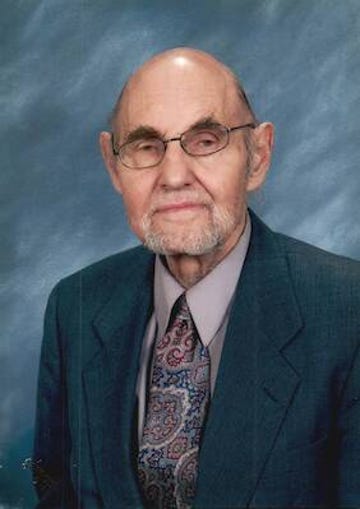 Albert W. Wardin, Jr., prominent Baptist historian, died on November 14, 2022, at the age of 94, in Nashville, Tennessee. Albert was preceded in death by his beloved wife of 38 years, Lucile Peak Wardin, for whom he was a devoted, compassionate caregiver for the last 8 years of her life. Albert was also preceded in death by his parents, Albert W. Wardin, Sr., and Anna Klemm Wardin, his brothers Ferdinand and John, his sister Ardis, and his nephew Brad. He is survived by his sister, Doris Wardin Lemley, and nieces and nephews, David, Stephen, Margaret, Debbie, John, Karen, Daniel, Chris, Matthew and Julie. Born in Portland, Oregon, on March 11, 1928, Albert made his first public appearance as a bare-bottomed infant on the promotional calendar of the Fulton Park Dairy, the family business. Albert graduated from Lincoln High School in Portland, then received his B.A. degree from Willamette University, his Master’s degree from Stanford University, and Bachelor of Divinity degree from Western Baptist Seminary. He began his lifelong career in religious education at Western Baptist Seminary in Portland, teaching church history, and taught Baptist History at Judson Baptist College, where he served as Head of Library. Albert came to Nashville in 1967, joining the faculty of Belmont College. Early in his tenure at Belmont, he served a vital role in the restoration of Belmont mansion. Albert was the first President of the Belmont Mansion Historical Society and its foundation, authoring a history of the mansion. Albert taught, wrote and ministered at Belmont until his retirement. Albert met Lucile at Belmont. While leading a bible study group for male students, Albert contacted female faculty to lead a similar group for coeds. The search led Albert to Belmont’s new Dean of Women, Lucile Peak, who said “yes” to Albert’s request for help with the bible study group and, more importantly, said “yes” again to Albert’s marriage proposal a year later. Albert and Lucile shared a heart for world missions and international students. Albert and his mother personally smuggled Bibles into Russia and Romania on travels abroad. They befriended students on their travels, forming lifetime bonds. A sabbatical year in Kenya led them to Harrison Waithaka, who they sponsored to attend Belmont. Baptist missions in Shanghai China led them to a lifelong relationship with their “son” Qin Bin Lin. A prolific author, Albert wrote 12 books and numerous articles centering on Baptist history, with a specialization in the Protestant church in Russia. He amassed an extensive collection of Baptist materials, especially on Russian Baptists. His most important works were Tennessee Baptists: A Comprehensive History and On the Edge: Baptists and Other Free Church Evangelicals in Tsarist Russia. The reference room of the Southern Baptist Historical Library and Archives is named in his honor. Albert supported missions and Baptist education and heritage locally, particularly the library of the American Baptist College, the Tennessee Baptist Historical Society and the Mill Creek Baptist Church graveyard, and globally as well. Albert made significant contributions to and was instrumental in the establishment of the Cambodia Baptist Union and Baptist Center in Bulgaria. A member of First Baptist Church-Nashville since 1967, Albert served as a Deacon, on the Missions Committee, and taught Sunday School and Training Union. He traveled each Sunday for years to teach Sunday School to inner-city youth at Carroll Street Chapel, now the Church of the Messiah. A child of God, a friend and citizen of the world, steward, preserver and chronicler of Baptist history and heritage, Albert leaves a lasting legacy. Visitation will be held Tuesday November 22 from 12 noon to 1 p.m., at First Baptist Church, Seventh and Broadway, Nashville, followed by a Celebration of Life worship service at the church beginning at 1 p.m., led by Tony Rankin. Entombment will follow at 2 p.m., at the mausoleum of Woodlawn-Roesch-Patton Funeral Home, 660 Thompson Lane, Nashville, led by Frank Lewis. In lieu of flowers, contributions may be made to the Albert and Lucile Wardin Endowment Fund at Belmont University.
Marked Man: The Rev. Dr. Stefan Bankov (1934-2021)
October 20, 2021 by Cup&Cross
Filed under Featured, News, Publication
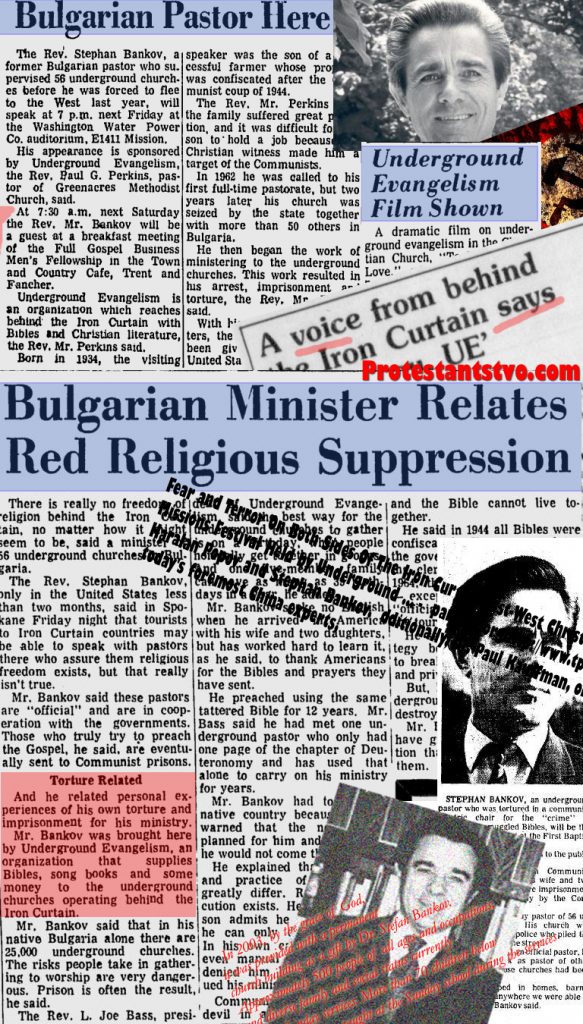
Marked Man
https://www.christianitytoday.com/ct/1978/november-3/new-firepower-for-fighting-war.html
The mysterious deaths in London last month of Bulgarian defectors Vladimir Simeonov and Georgi Markov didn’t surprise fellow defector Stefan Bankov. Bankov, a Christian who left Bulgaria with his family in 1969 to escape persecution, now preaches the gospel by radio to his countrymen. Working with Underground Evangelism in Glendale, California, he says that he and his family have been subjected to Communist harassment, threats, and assassination attempts.
While flying from London to Seattle in 1974, a man and woman spilled a liquid on Bankov’s shoulder that paralyzed his side and made him violently ill for several days. Two months ago, shots were fired at him outside his home. Bankov says that during his stay in the United States, there has been an attempt to kidnap his daughters. He reports that strangers have made attractive offers to his wife and daughters to get them to return to Bulgaria, and that his family has received hundreds of abusive telephone calls. A note taped recently to a window at the Bankov home warned: “You are marked. We follow you all the time.”
Bankov made these threats public only recently and after the deaths of Simeonov and Markov, who were among a group of five Bulgarian broadcasters who defected. Markov died after being stabbed by a poison-tipped umbrella. Simeonov died after falling down the stairs inside his London apartment (London authorities aren’t discounting the possibility that he was pushed), and Vladimir Kostov survived a poisoning attempt similar to that which killed Markov. A fifth broadcaster now working for Radio Free Europe hasn’t been attacked.
Currently under police protection, Bankov is cooperating with the FBI and Scotland Yard in an investigation of the deaths of the Bulgarian defectors—victims, he is sure, of foul play on the part of Bulgarian Communists. “I think their (the Communists’) main purpose is to scare every member of my family,” Bankov said of his own situation. “They want to keep us under constant psychological pressure.”
The Bulgarians apparently are upset by Bankov’s radio witness that is beamed to his homeland of nine million people. He recently received a letter from Bulgaria that warned him to leave Underground Evangelism, an organization with an evangelistic outreach to Communist countries, or “the troubles will never stop.”
Bankov attended a Bible college in Los Angeles for four years before starting his radio ministry. He works seven days a week preparing sermons and lectures in systematic theology for his Bible College of the Air. Broadcasts are aired once a day over Radio Trans Europe in Portugal and over Radio Malta.
The Bulgarian government frequently uses “ground wave jamming” to block Bankov’s broadcasts into major Bulgarian cities, according to Underground Evangelism president Joe Bass. Copies of a two-volume set of Bankov’s sermons and lectures, as well as cassette tapes of his broadcasts, are being smuggled into that Communist nation.
Bankov became a Christian in 1953, and he later pastored an independent church in Bulgaria until the government closed it in 1964. Bankov still owns the tattered New Testament, held together by a rubber band, that was his only resource during his ministry in Bulgaria.
The forty-five-year-old Bankov is accustomed to persecution. Before he escaped Bulgaria, Bankov says he was “constantly under pressure.” “It was a difficult time with the Bulgarian government.… They accused me of being mentally sick because I could not see the progress of the Communist party or of the Socialist society.”
Bankov, who creates most of his own teaching materials during twelve- and fourteen-hour working days, fears most for the safety of his family. As he intends to continue his radio ministry, he says, “My prayer every day is just, ‘Lord, help the kids and my wife to understand.’ ”
East-West Christian Solidarity, Inc.
Glendale, California 91225
Mission:
East-West Christian Solidarity was founded by Dr. Stefan Bankov, an internationally recognized Christian leader who survived Communism and the Cold War. Rev. Bankov was an underground pastor in Bulgaria from 1958 to 1969. He emerged from behind the Iron Curtain in 1969, after escaping a prison death sentence by the communist leaders in Bulgaria. He has survived communist torture, beatings, and attempted murder. After his escape, Pastor Bankov continued to preach to the Bulgarians by radio broadcasts from Trans World Radio and Radio Ibra. Dr. Bankov has spoken before members of Parliament in Australia, in churches of countless denominations, and his name has been featured in newspapers, magazines, and on television in several countries. Dr. Bankov has also authored many books–including the first Slavic Bible Concordance for the Eastern Bloc countries. After the fall of communism, Dr. Bankov returned to Bulgaria, his native homeland, to plant new churches, minister to the needs of people in this third world country, and contribute to the country’s long-term development. East-West Christian Solidarity offers preaching, teaching, literature, and humanitarian relief, in addition to planting, building and supporting churches even in the large Muslim population in remote areas of Bulgaria. Dr. Bankov has over 35 years of experience in providing underground evangelism, outreach and humanitarian relief in Bulgaria. For more information, please contact us.
Why Revival Came? by Dr. Charles Conn