

Prayer, Fasting and Spirituality
Nearly seven out of ten (69%) of the surveyed Bulgarians strongly affirm the expectation that the Bulgarian Church is a prayer center. In contrast, only 17% believe that prayer should be the primary function of the church.
Prayer
One out of two unchurched Bulgarians do not see a connection between prayer and spirituality.
One out of two church members affirm prayer and home groups as priority ministries for the church.
Every second church member prays twice or more daily
One out of four (25.53%) church members do not pray in the morning, noon nor evening, but do pray every day at another appointed time
Every fourth (25.5 %) church member has no set time for prayer.
Fasting
40% do not fast
24% fast sometimes
18% fast once or twice weekly
18% fast more than two days per week
Spirituality is defined by church members as:
Walking in the Spirit (40%)
Closeness to God (31%)
Operating under the gifts of the Spirit (11%)
Love toward neighbor (10%)
Works of faith (5%)
Care for widows and orphans (2%)
Humbleness (1%)
None of the surveyed, defines spirituality as resulting from prayer and fasting or standing under persecutions
Usage of the Bulgarian Bible
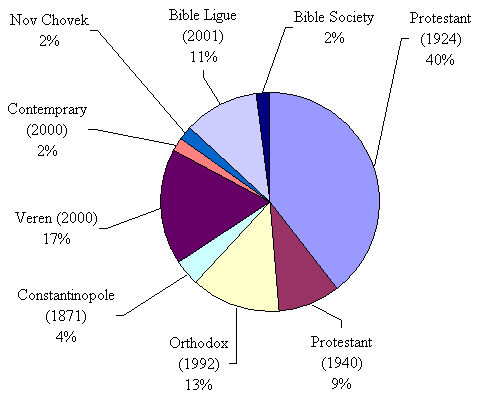
One out of three Bulgarians who read the Bible regularly read a version published after 1989.
One out of three reads less than one chapter from the Bible per day.
One out of ten (11%) read over ten chapters per day.
Nearly half (48%) read the Protestant versions of the Bulgarian Bible published in 1924 and 1940.
Other translations are also used as shown on the figure below.
Christian Enlightenment Center
Cup & Cross Ministries is working on adding a new department to the Shalom Group, a conglomerate for ministry which we started in 1996. Mission Maranatha and the Bulgarian Christian Television, Shalom TV were among the first successful projects of Shalom Group. The new department is called Christian Enlightenment Center and it will provide Christian media resources, solutions and training on the territory of Bulgaria through the following strategy:
Vision
To fulfill the Great Commission of Christ to the Church, “Go teach all nations …” (Matthew 28:19) as did the disciples of Christ beginning in Jerusalem and then “to the uttermost parts of the world” (Acts 1:8), preaching the Gospel of which were witnesses (Luke 1:2)
Methodology
1. Creating an atmosphere for spiritual upbringing based on the Biblical truths and Christian values of the individual.
2. Return to the Biblical principles which are valid and vital for the society, culture and person.
3. Implementation of the information technologies and communication methods in the presentation of the Bible and Christian resources for spiritual commitment which motivates the search for truth.
Strategy
1. Applying the Biblical principles for Christian living, along with fasting and prayer as a credo for work and ministry.
2. Development and maintaining of a library containing various translations of the Bible, reference literature (dictionaries, concordances), Christian books, newspapers, magazines and brochures.
3. Development and maintaining of an audio library with audio tapes, and CDs with the audio Bible, sermons, teachings and Christian music.
4. Development and maintaining of a library with video tapes, DVDs, and VCDs with Christian sermons, teachings, films and programs.
5. Development and maintaining of an information database with Christian resources and software.
6. Organizing and holding of seminars, conferences and training events to educate of the Biblical principles and Christian values, as well as contemporary computer and information technologies.
7. Supporting and working with local churches, Protestant denominations, missions, foundations and other para-church organizations with similar goals, methodology and Christian morale.
Annual Bulgarian Conference
During Memorial Day Weekend Cup & Cross Ministries participated in the Third Annual Conference of Bulgarian Churches in North America. The conference took place on May 29-31, 2004 in Minneapolis and was hosted by the local Bulgarian Evangelical Church. Over 130 delegates from Bulgarian communities of Dallas, Chicago, Los Angeles, Montreal and Atlanta attended the event. Among the Bulgarian ministers present, there were pastors who have been persecuted along with their families as a part of the underground church in Bulgarian during the Communist Regime.
The conference began on Saturday with an introduction of the ministries present and a concert in honor of May 24, the Bulgarian holiday which celebrates the Bulgarian alphabet and culture.
The Sunday morning service was accompanied with a picnic, followed by two sessions on the topic of the conference, “The Joy of the Lord is our Strength”. The first one was presented by the pastor of the Bulgarian Church in Los Angeles, and the second one by our ministry.
During the presentation we were able to inform of some of our findings of our research.
Cup & Cross has worked with Bulgarian immigrants for the past ten years, and our team has actively and purposefully observed the Bulgarian Evangelical Churches in North America for almost three years as a part of our research. We were able to present each minister, pastor and leader of a congregation with a special copy of the results of our research. The churches were also presented with a special Bible study software prepared by our internet ministry team of which administrates www.bibliata.com.
A new ambitious goal was set to review the results and analyses provided by the research and implement them in the ministry of the local congregations through a church-planting program for Bulgarian communities in North America.
Our research called for awareness of cross-cultural challenges, immigration dynamics and interchurch relationship as well as their affect on the churches identity and ministry. The conclusion included an altar call and dedication prayer for the future of the Bulgarian Evangelical Churches in North America and especially for the second generation of Bulgarian immigrants.
It was decided that the 2005 annual conference of Bulgarian Evangelical Churches in North America will take place in Los Angeles. The conference gave us an opportunity to network with Bulgarian congregations and communities nationwide. It is our prayer that their ministry is successful and blessed in the future.
Religious Awareness 101
For several years now, our team in Bulgaria has led an extensive Sunday School program using the Sunday School program that Cup & Cross developed in 2001 for the purposes of the Bulgarian Church of God. Although the program’s primary emphasis has been among adults in the area of Christian education and discipleship, its has proven very effective among children and teenagers.
Taking under consideration of the above, several of the churches we work with have opened a special Sunday School outreach for the children and young adults in the villages. Through this endeavor, the Sunday School program has flourished.
Three weeks ago a new implementation of the program was allowed by a local secular school in the village of Kamenetz. The faculty has extended an invitation to our team to hold a Religion Awareness class on Tuesdays. The class has been well attended since its start and will continue through the school year. This week, our team received a letter from the school principal expressing her appreciation of the efforts and the work.
Since Bulgaria is officially an Eastern Orthodox country, all offered religious classes in state schools have been Eastern Orthodox oriented. This is one of the first times that theology with a Protestant orientation is being taught in a Bulgarian state school. It is our prayer that as Bulgaria continues to develop its policy on religious tolerance, more classes like this are offered.
Gateway Cities for Bulgarian Evangelical Churches
Bulgarian Evangelical Churches are located in cities which have a high concentration of foreign-born immigrants. Such cities are called gateway cities, a large immigrant point-of-entry city to the United States. Immigrants typically enter the United States through one of these cities and settle there. Such cities contain over half of the foreign-born population in the United States. There are Bulgarian Evangelical Churches active in five of the seven gateway cities as follows:
Bulgarian Evangelical Churches in Gateway Cities
| Gateway City | Foreign Born | Percent of Foreign Born | Bulgarian Church |
| 1. New York, NY | 3,657,269 | 18.7% | Yes |
| 2. Los Angeles, CA | 3,944,828 | 27.1% | Yes |
| 3. Houston, TX | 460,380 | 12.3% | Yes |
| 4. Washington, DC | 578,786 | 8.6% | No |
| 5. Miami, FL | 1,072,843 | 33.6% | Yes |
| 6. Chicago, IL | 914,58 | 11.1% | Yes |
| 7. San Francisco, CA | 1,250,693 | 20.0% | No |
Geographical Location of Bulgarian American Churches and Gateway Cities.

Several facts are obvious from the above comparison. It is apparent that Bulgarian immigrants come to North America in ways similar to other immigrant groups, channeled through the listed gateway cities. Large cities which are gateways are more probable to become a settlement for Bulgarian immigrants due to the availability of jobs, lodging and other immigrants from the same ethnic group. The emerging Bulgarian immigrant communities share religious similarities and belongingness which are factors helping to form the communities. As a result of this process of formation of Bulgarian immigrant communities, the Bulgarian Evangelical Churches in North America emerge. It also seems natural to suggest that as this process continues, Bulgarian Evangelical Churches will be formed in the remaining two gateway cities (Washington, D.C. and San Francisco) and other large cities which meet the requirements to become a gateway city (for example, the city Atlanta). If this is true, it should be proposed that the Bulgarian Churches in North America follow a strategy for church planting and growth which targets this type of cities.
Mark 10 from a Critical Point
Date
The Jerome Bible Commentary states that the Gospel of Mark was written in AD 64, immediately after the death of Apostle Peter (Mally 22). Lane agrees with a date between AD 60-70, but definitely before the destruction of Jerusalem (21). Anderson uses the same time pointer in his conclusion that Mark was written approximately AD 65-70 (26).
Authorship
Lane writes that the Gospel is anonymous, but traditionally linked to Mark (21). This affiliation derives from the traditional view, which describes Mark as one of Peter’s associates. The Jerome Bible Commentary identifies the author as John Mark from Acts 12:12, 25 and Mark from 1 Pt. 5:13 (Mally 21).
The Interpreter’s Bible points out that the author is obviously not an expert of Judaism, and does not recognize the importance of the accurate description of the historical situation. For example, he calls Herod “a king,” while Herod is only “a governor” under the Roman rule (Grant 637).
Purpose
This characteristics of Mark’s account incorporate both his audience and his intent of writing. Anderson’s opinion is that Mark wrote to the Gentiles in the Roman Empire (29). On the other hand, The New Interpreter’s Bible states that both Syro-Palestinian and other ethnic groups of immigrants, forming minority communities in the Roman Empire, were among Mark’s audience (515).
Mark is also the earliest attempt to reduce the apostolic tradition to a written form. This makes his account the source for any further Gospel writing (Lane 1-4). Mercer Commentary of the Bible goes even further to suggest, that “before Mark there was no genre of literature known as Gospel” (Dowd 975). To further describe the life situation of the writing of the Gospel account, Anderson points out that Mark’s attempt to promote Christianity was done in a time when martyrdom was a reality (25).
Mercer Commentary of the Bible defines The Gospel of Mark as “a popular ancient biography, written from the presumption of the apocalyptic world-view” (Dowd 975-76). At the same time, Schweizer writes that the account is lacking biographical information (39). Anderson also agrees that Mark’s purpose was to present the person of Jesus, and not a biography or history (3).
Structure
Because of his traditional association with the apostle Peter (1 Pt. 5:13), it is suggested that the purpose of Mark was to introduce Peter’s preaching in written form. Lane presents an interesting comparison between the structure of the Gospel of Mark by chapters and the account of Peter’s sermon in Acts 10:36-41 (7-11).
The Jerome Bible Commentary points out that the structure of Mark can be divided both according to Geographical and Theological characteristics. The Geographical division is determined according to the travels of Jesus through the years of His ministry. On the other side, the Theological frame has two major divisions: the Ministry of Messiah and the Ministry of the Son of Man (Mally 22).
While Anderson disagrees with the existence of Q, Schweizer believes that Mark has used the Q-document as a source for his Gospel account (Anderson 4). Another proof that Mark is the first Gospel, is the fact that its structure has been closely followed by both Matthew and Luke (Anderson 2, 4). In the Gospel of Matthew, chapters three and four, Matthew follows the Markan narrative, but also attaches additional information from Q. Evidence for the use of information from Q is the obvious contrast between the length of the Gospel accounts (Schweizer 11).
Finally, the structure of Mark is compressed, but not chronological (Anderson 32, 34). The ending of the Gospel has been suggested to have a short and long version, excluding and including the passage of Mk. 16: 9-20. In both of the cases, it differentiates form the Markan style of writing and was probably edited later in the second century (Grant 645).
Criticism
The Interpreter’s Bible points out that the composition of the Gospel was based on oral tradition (Grant 634). Form Criticism characterizes the structure of Mark as episodic, where the different episodes in the plot of Mark are linked by words like, “immediately,” “again,” “and” (Anderson 7).
Opposing the possible application of Form Criticism, Anderson writes that:
1. Circumstantial details which were not of theological significance for the Early Church were preserved in the Markan account.
2. Eyewitnesses were present in the Early Church to check the accuracy and fullness of the written Gospel.
3. Transmission was not a free process, but rather a continuous transmission with specific set of rules without rules and limitations (Anderson 15).
Redaction Criticism, however, suggests that the style of writing is usual for Mark. Proof for this is the great number of various repetitions and stories, embedded within each other (Perkins 510-11).
Mercer Commentary on the Bible points out that the literary criticism structures of inclusion and chaism are among the main forms of repetition in the Markan Gospel account, where the inclusion is “a frame defined by the starting phrase,” and the chaism is “even more extensive repetition” (Dowd 975). The New Interpreter’s Bible states that the structure of the Gospel is such that individual narratives cannot be treated apart form their proper place in the story (Grant 512).
The following paragraphs are dedicated to highlight the most important aspects and annotations of Mark 10, combined with the view of different commentators on the application of different kinds of criticism on the Markan text.
§187 Marriage and Divorce (Mk. 10:1-12)
The mentioning of the house in this passage is not recorded by Matthew (Mt. 19:10-12) (Schweizer 383). Lane shows an interesting sequence that starts with the question of the Pharisees, continues through the Jewish tradition, provokes the Rabbinical interpretation of Moses and reaches to the heart of Creation narrative (356). The idea is that through His question Jesus challenges the legal system of the Jews.
While The Jerome Bible Commentary defines only v. 12 as a pronouncement, Lane argues that the whole passage is a pronouncement story (Mally 44, Lane 356). Mark 10:10-12, however, is definitely not a pronouncement story.
Anderson provides an interesting analogy between the teachings of Paul and the structure of Mark. He compares 1 Cor. 7:10-11 and Mk. 10:11-12 finding similarities between the doctrinal teachings of the Church on the marriage and divorce, presented in different contexts by both Paul in Mark (39).
According to Taylor, Mk. 10:1 is proto-Lukan, and vv. 2-9 is pronouncement story (Taylor 64). Bultmann describes Mk. 10:1-12 as a scholastic dialogue apophthegm (Bultmann 21).
There is a problem with Mark’s geographical note 10:1. It seems like Mark did not have accurate information about the place and the time of this story. Matthew updates the location mentioned by Mark from “Judea beyond Jordan,” “Gallilee” which Jesus left in order to go to Judea.
Also, in Matthew the crowd follows Jesus, while in Mark a new crowd gathers around Him. Jesus’ style of ministry is also different. While Mark states that He “taught” the crowds, Matthew accents the healing ministry of Jesus.
In Mark 10:2 there is a difference between the questions, which the Pharisees ask Jesus. Matthew adds “for any cause” to the words of Mark.
In Mark 10:3-9 there are no major differences among the Gospel writers. In v. 3 the Pharisees refer to Dt. 24:1, where Moses allowed them to giver a certificate of divorce. Mk. 12:6 is a quotation from Gen. 1:27; Mk. 12:7 from Gen. 2:24. Verse 9 may be the limit of the pronouncement story.
In 10:10, Mark records the words as a question asked by the disciples, while Matthew presents it as a saying of Jesus.
Mark 10:11 introduces few differences between the text and the record of Matthew. The Markan text condemns both men an women for divorce, while Matthew includes only men divorcing their wives. The Matthean text also allows divorce in a case of “unchastity.”
Matthew further includes an addition to the divorce case, which neither Luke nor Mark record. It refers to celibacy and has six facts about it:
1. Celibacy is better (Mt. 19:10).
2. Celibacy is not for everyone (Mt. 19:11).
3. Celibacy may be natural (Mt. 19:12).
4. Celibacy may be forced (Mt. 19:12).
5. Celibacy may be sacrificial (Mt. 19:12).
6. Celibacy may be commanded (Mt. 19:12).
§188 Jesus Blesses the Children (Mk. 10:13-16)
The blessing of the children seems like an appropriate continuation of the pronouncement on the divorce sanctity of marriage (Lane 359). The passage is recorded by all three of the Synoptic writers; however, the narrative is more objective in Mark than it is in Matthew’s description of the event (Schwitzer 384).
The original story in Mark 10:13 is the story of the children being brought to Jesus “to be touched” by Him. Matthew changes the verb to “laying of hands.” Obviously his perspective on the Doctrine of Laying of Hands was important at the time of writing. Luke, however, revises the little children to infants, making the range of their age wider, which was probably significant for him.
In 10:14 Mark describes Jesus as being “indignant.” Both Matthew and Luke, who obviously did not like this characteristic as a part of Jesus’ personality, omit this word.
While Luke agrees with Mark 10:15 on the “receiving” the kingdom of God, Matthew accents on the “changing” and “becoming,” which refers to the Doctrine of New Birth. Matthew also focuses on a particular phrase he likes to use, namely the “Kingdom of Heaven”. He uses this phrase as a replacement of the “Kingdom of God” used by both Mark and Luke, probably to escape any vain pronouncement of God’s name.
Mark 10:16 is in a correlation with 10:13 where Mark uses the word “touch.” The same phrase is used by Matthew, but omitted by Luke.
Taylor agrees that this is a pronouncement story, probably formed in the second period of Gospel Formation (Taylor 72, 148); however, vs. 15 may have been added in the last period (Taylor 106). Bultmann calls these passage a biographical apophthegm (Bultmann 32).
Verse 13-16 is often used by religious groups and denominations to defend the doctrine of infant baptism. The text, however, talks about Jesus blessing the children, and not baptizing them as some may propose.
§189 The Rich Young Man (Mk. 10:17-31)
The story of the rich young ruler has three major subdivisions:
1. Conversation between Jesus and the Ruler.
2. Saying of Jesus to the disciples on the entrance of rich men in the Kingdom.
3. Blessings for the disciples.
Mark 10:17-27 is a single unit expressing the essence of Jesus’ teaching on the entrance into the Kingdom (Lane 363). Mark 10:24b-27 is not a passage about riches, but about God’s freedom to give salvation to whomsoever He wills (Mally 46).
Taylor defines this passage as a pronouncement story (Taylor 64, 66). Bultmann, however, divides the passage. According to him, vs. 17-22 are scholastic dialogue “genuine apophthegm,” vs. 23,25 are logia sayings, and vs. 26 “serves as the introduction point of a new saying” (Bultmann 21, 75, 331).
In 10:17 only Mark mentions that Jesus was preparing for a journey. Mark uses the adjective “good,” which obviously, created a problem for Matthew who uses only the word “Teacher.” Luke, however, follows Mark’s structure.
All three Synoptic writers have different description of the man. While for Mark he is only a “certain man,” for Luke he is a ruler, and for Matthew he is someone who he later calls “a young man” (Mt. 19:20, 22).
In 10:18 there is no difference between Mark and Luke; Matthew omits good teacher as a natural continuation of the context created in the previous verse.
In 10:19 both Mark and Luke suggest certain that the man had certain knowledge of the law. Matthew, however, has doubts about his proficiency in it.
In the list of the commandments there are at least three differences between the lists of commandments from Ex. 20:12-16 and Dt. 5:16-20 that follow:
1. Luke changes the order of the first two, putting You shall not commit adultery before You shall not murder.
2. Mark lists You shall not defraud , which is not one of the Ten Commandments. Since this is an obvious error in the words of Jesus, both Matthew and Luke fix this in their lists.
3. Matthew adds You shall love your neighbor , which is not one of the Ten Commandments, but is a commandment in which Jesus incorporated some of them.
In 10:20-21 Mark and Luke agree on the phrase since my youth, while Matthew carefully omits it since it is in a contradiction with his following statements about the age of the man (Mt. 19:20, 22).
In 10:22, among the three Synoptic Gospels, Mark has the most vivid and descriptive reaction of the man. According to Mark, he is shocked from the radical words of Jesus and grieving because he is not willing to completely follow them. Matthew omits the shock. Luke reduces the emotional condition of the man to being sad.
The financial status of the man is the reason for his lack of spiritual success. According to Mark he possesses many possessions. Matthew carries the same idea. Luke simply describes him as being rich. Verse 22 ends the narrative and is followed by various sayings of Jesus related to the wealth and the kingdom.
Verse 10:23 contains the same contrast as in v. 15 appears. Matthew uses the phrase Kingdom of Heaven, while both Mark and Luke use the Kingdom of God.
In 10:24 Mark’s repetition of Jesus’ words is later omitted by both Matthew and Luke.
In 10:25-27 There is no major difference between the three Synoptic writers in this passage. It is interesting to notice that comparing to vv. 15, 23 even Matthew here uses the phrase the Kingdom of God in v. 25 in agreement with both Mark and Luke.
Mark 10:28 is defined by Bultmann as speech material also understood to be a transition (Bultmann 330). “We left everything” in Matthew and Mark is replaced by ”We left our homes” by Luke.
Mark 10:29-30 are according to Bultmann “a prophetic saying” (Bultmann 110). Briggs describes it as a promised reward for self-denial. This is one of Jesus’ sayings, which casts Him the role of a Prophet (Briggs 78). Both Matthew and Luke expand Jesus’ saying. Matthew adds the enthronement procession of Jesus and the apostles over the 12 tribes of Israel. Luke adds to all of the above the Kingdom.
Mark 10:31 is a “floating saying.” In 10:30-31 the list is pretty much the same, beside the changes in Luke, where he replaces fields with wife. Luke also replaces the phrase for my name’s sake with for the sake of the kingdom of God. He also changes the hundred fold from Mark and Matthew to very much more. Mark repeats the list pattern similar to v.24, where he uses repetition to stress the importance of the passage. All three of the Gospel accounts contain the same eschatological promise.
Mark 10:32-34 can be taken together with Mk. 8:32-33; 9:30-32 because of similarities in the structure of these passages (Taylor, 40, 149, 179). Bultmann describes it as “pure esoteric instruction” (Bultmann 331). It is also the third passion prediction with locale in vs. 32(Marxsen 73). The term amazed is used only three time in the New Testament, only by Mark (1:27; 10:24) (Stein 261).
Luke and Mark do not record The Parable of the Laborers in the Vineyard. It exists only in the account of Matthew, in progressive correlation with the eschatological promise from the previous verse.
§191 The Third Prediction of the Passion (Mk. 10:32-34)
Mercer Commentary of the Bible lists the three Passion Predictions as follows:
1. First Passion Prediction (Mk. 8:31-9:29)
2. Second Passion Prediction (Mk. 9:30-10:31)
3. Third Passion Prediction (Mk. 10:32-52) (Dowd 975).
Lane suggests a comparison between the three Passion Predictions and the Passion Narrative (375).
| Mk. 8:31 | Mk. 9:31 | Mk. 10:33-34 | Passion Narratives | |
| Delivered to the Chief Priest and Scribes | – | (X) | X | 14:53 |
| Sentenced to death | (X) | – | X | 14:64 |
| Delivered to the Romans | – | – | X | 15:1, 10 |
| Mocked, spit upon, scourged | – | – | X | 14:45; 15:15-20 |
| Executed | X | X | X | 15:20-39, 44 |
| Resurrected | X | X | X | 16:1-8 |
The above table shows a possibility that Mark’s description of the Passion was after the resurrection, since all the details of the passion are pointed as a part of the prophesy a Jesus.
The journey in 10:32 is the one that Jesus was preparing for in Mk.10:17. As it was earlier noted both Matthew and Luke omitted this preparation. At his point Matthew mentions the direction of the Journey, while Luke remains silent.
Mark 10:33-34 is the words of Jesus’ prophecy. Both Luke and Matthew record the event. Only Matthew refers to the killing of Jesus as a crucifixion. Luke adds to the story the misunderstanding of the disciples.
§192 Jesus and the Sons of Zebedee (Mk. 10:35-45)
The Enthronement Promise required from Jesus by the mother of the Sons of Zebedee is a new eschatological element (Schwetizer 385). Anderson writes that the cup can either be a symbol of joy (Ps. 16:5; 23:5; 116:13) or of suffering and punishment (Ps. 11:6; 75:8; Is. 51:17, 22) (255).
Mark 10:35-40 and 10:41-45 are two different pronouncement stories (Taylor 64, 66). In Bultmann’s view, the whole passage is a scholastic dialogue apophthegm; vs. 38, 39 are secondary element (Beare 198);
In 10:35 Mark records that the brothers themselves came to ask Jesus, while Matthew changes the story to their mother coming to Jesus and asking. Luke does not record this particular story.
In 10:36-40 The dialogue here remains unchanged; however, in both records Jesus’ answer is given to the brothers and not to the mother. Matthew omits the reference of Mark to Jesus’ baptism in vv. 38, 39.
In 10:41-44 Luke suggests a dispute between the disciples, which is not in a parallel with Mark’s segment. The dispute is most probably a reference to the record on the Sons of Zebedee in the previous passage. The comparison between the Gentile civil-authority structure and the disciples remains the same through all three Synoptic accounts.
Mark 10:45 contains another comparison between the disciples and the purpose of Jesus’ coming. It is omitted by Luke, who adds a rhetorical question as a conclusion to this passage.
§193 The Healing f Bartimaeus (Mk. 10:46-52)
According to The New Interpreter’s Bible, this passage is the final healing miracle (655). Lane also agrees on this point (Lane 386). The Jerome Bible Commentary states that this miracle, combined with the healing of the blind man in Mk. 8:22-26, forms the Dedaction Section of Mark (Mk. 8:27-10:45)(Mally 46).
Mark 10:46-52 is a miracle story (Taylor 120; Bultmann 213). Clearly, its purpose is to present Jesus as the Divine Healer. It served as a encouragement of the faith in the Early Church.
Mark 10:46 starts with two totally different chronological statements. Mark and Matthew claim that the time of the occurrence of the story was as they were leaving Jericho. Luke states that it was as they were approaching the city (Lk. 19:1-10). Furthermore, Mark names the blind man, while Luke does not record his name. Matthew records two blind men instead of one, which is an expression of Matthew’s tendency to emphasize the miracle works of Jesus. There is agreement in all three accounts of the place where the miracle occurred, as well as the crowds that were present.
In 10:47-48 Mark and Matthew omit the question of the blind man/men who is going by. The prayer of the blind man/men and his/their dialog with the crowd remains fairly the same through the Gospel accounts.
In 10:49-50 Matthew and Luke reduce Jesus’ response to the prayer of the blind man/men recorded by Mark in details.
In 10:51 the dialog between the blind man/men and Jesus remains the same, beside that Mark uses “My teacher,” while Luke and Matthew write Lord. The emphases of the word is that the blind man saw Jesus as Lord, while the disciples did not realize this fact.
Comparing to Mark 10:52 Matthew records the compassion of Jesus; however, he omits Jesus’ words which have a reference to the faith of the blind man/men.
It also seems like Mark does not mention one of the blind men in his early records. Matthew talks about both of them together. Luke places one of them at the entrance of Jericho, the other one in the city (Lk. 19:1-10). However, all three of the Synoptic writers agree on the immediate healing. Luke also adds the reaction of the crowd.
Conclusion
From the position of my literal interpretation and denominationally formed understanding of Mark’s account, I agree with the Markan authorship of the Gospel, the year and location of its writing, and the audience and purpose of the author. I am also convinced, that Form Criticism can most effectively follow the formation of the Markan text, and establish the basic original narratives for its development. It seems only appropriate to accept that because of its textual length, linguistic peculiarities, and doctrinal development the Markan account has a chronological and formative priority compared to Matthew and Luke. The use of Q-source is reasonable and essential in explaining the synoptic problem. Therefore, proper, scholastic Markan interpretation is intensively based on these theological grounds.
BIBLIOGRAPHY
Anderson, Hugh. The Gospel of Mark. Greenwood: The Attic Press, Inc., 1976.
Beare. F. W. The Earliest Records of Jesus. New York: Abingdon Press, 1962.
Briggs, R. C. Interpreting the Gospels. New York: Abingdon Press, 1969.
Dowd, Shayn E. “Mark.” Mercer Commentary of the Bible. Macon: Mercer University Press, 1995.
Grant, Frederick. “Introduction to Mark.” The Interpreter’s Bible. Vol. VII. New York:
Abingdon Press, 1951.
Lane, William L. The Gospel According to Mark. Grand Rapids: Eerdmans Publishing
Co., 1974.
Mally, Edward. “The Gospel According to Mark.” The Jerome Bible Commentary. Vol.
II. Englewood Cliff: Prentice-Hall Inc., 1968.
Marxsen, Willi. Mark the Evangelist. trans. James Boyce, etc. New York: Abingdon Press, 1969.
Perkins, Pheme. The New Interpreter’s Bible. Vol. VIII. Nashville,: Abingdon Press, 1995.
Schweizer, Eduard. The Good News According to Matthew. trans. David E. Green. Atlanta: John Knox Press,
1977.
Stein, Robert H. The Synoptic Problem. Grand Rapids: Baker Bookhouse, 1987.
Taylor, Vincent. The Formation of the Gospel Tradition. London: Macmillan, Co., 1953.
Notes on Mark 10
1. Matthew updates the location mentioned by Mark. Mark says it that Jesus is in Judea beyond Jordan, while Matthew states He adds that he left Galilee in order to go to Judea.
2. The crowd follows Jesus in Matthew, while in Mark a new crowd gathers around Jesus. In Mark the people gather with Jesus.
3. Jesus’ ministry is also different. While Mark states that He taught the crowds, Matthew accents the healing ministry of Jesus at this particular occasion.
10:2 There is a difference between the questions which the Pharisees ask Jesus. Matthew adds “for any cause” to the words of Mark, giving a universal usage to the meaning and application of divorce.
10:3-9 No major differences in this passage. In v. 3 The Pharisees refer to Dt. 24:1, where Moses allowed them to giver a certificate of divorce. Mk. 12:6 is a quotation from Gen. 1:27; Mk.
12:7 from Gen. 2:24.
10:10 Mark puts it as a question by the disciples, while Matthew presents it as a saying of Jesus.
10:11 [exceptional clause] Mark refers to both man and the woman committing adultery in a case of divorce, while Matthew reduces to only the man. Mathew has an addition to the divorce case, which neither Luke nor Mark record. It refers to celibacy and has six facts about it:
1. Celibacy is better (Mt. 19:10).
2. Celibacy is not for everyone (Mt. 19:11).
3. Celibacy may be natural (Mt. 19:12).
4. Celibacy may be forced (Mt. 19:12).
5. Celibacy may be sacrificial (Mt. 19:12).
6. Celibacy may be commanded (Mt. 19:12).
II. Jesus Blesses the Little Children
This passage is recorded by all three of the Synoptic writers.
10:13 The original story in Mark is the story of the children being brought to be touched by Jesus. Matthew changes the verb to laying of hands. Obviously his perspective on the Doctrine of Laying of Hands was important at the time of his writing. Luke, however, revises the little children to infants, making the range of their age wider, which was probably significant for him.
10:14 In this verse Mark describes Jesus as being indignant. Both Matthew and Luke, who obviously did not like this characteristic as a part of Jesus’ personality, omit this word.
10:15 While Luke agrees with Mark on the receiving the kingdom of God, Matthew accents on the changing and becoming, which refers to the Doctrine of New Birth.
Matthew also focuses on a particular phrase he likes to use, namely the Kingdom of Heaven. He uses this phrase a replacement of the Kingdom of God used by both Mark and Luke, probably to escape any vain pronouncement of God’s name.
10:16 This verse is in a correlation with 10:13 where Mark uses the word touch. Here he changes to laying of hands is used by Matthew, but omitted by Luke. [blessed]
Mk. 10:17-31 The story of the rich young ruler has three major subdivisions:
1. Conversation between Jesus and the Ruler.
2. Saying of Jesus to the disciples on the entrance of rich men in the Kingdom.
3. Blessings for the disciples.
10:17 Only Mark mentions that Jesus was preparing for a journey. Matthew omits the adjective good with the word Teacher.
The three Synoptic writers have different description of the man. While for Mark he is only a certain man, for Luke he is a ruler, and for Matthew he is someone who he later calls a young man (Mt. 19:20, 22).
10:18 No difference between Mark and Luke, while Matthew omits good teacher as a natural continuation of the context created in the previous verse.
10:19 While both Mark and Luke suggest certain that the man had certain knowledge of the law, Matthew obviously has doubts about his proficiency in it?
Also, there are at least three differences between the lists of commandments from Ex. 20:12-16 and Dt. 5:16-20 that follow:
1. Luke changes the order of the first two, putting You shall not commit adultery before You shall not murder.
2. Mark lists You shall not defraud , which is not one of the Ten Commandments. Since this is an obvious error in the words of Jesus, both Matthew and Luke fix this in their lists.
3. Matthew adds You shall love your neighbor , which is not one of the Ten Commandments, but is a commandment in which Jesus incorporated some of them.
10:20-21 Mark and Luke agree on the phrase since my youth, while Matthew carefully omits it since it is in a contradiction with his following statements about the age of the man (Mt. 19:20, 22).
10:22 Among the three Synoptic Gospels, Mark has the most vivid and descriptive reaction of the man. According to Mark, he is shocked from the radical words of Jesus and grieving because he is not willing to completely follow them. Matthew omits the shock. Luke reduces the emotional condition of the man to being sad.
The financial status of the man is the reason for his lack of spiritual success. According to Mark he possesses many possessions. Matthew carries the same idea. Luke simply describes him as being rich.
10:23 The same contrast as in v. 15 appears. Matthew uses the phrase Kingdom of Heaven, while both Mark and Luke use the Kingdom of God.
10:24 Mark’s repetition of Jesus’s words is later omitted by both Matthew and Luke.
10:25-27 There is no major difference between the three Synoptic writers in this passage. It is interesting to notice that comparing to vv. 15, 23 even Matthew here uses the phrase the Kingdom of God in v. 25 in agreement with both Mark and Luke.
10:28 We left everything in Matthew and Mark is replaced by We left our homes by Luke.
10:29 Jesus\rquote saying is expanded by both Matthew and Luke. Matthew adds the enthronement procession of Jesus and the apostles over the 12 tribes of Israel. Luke adds to all of the above the Kingdom.
10:30-31 The list is pretty much the same, beside the changes in Luke, where he replaces fields with wife. Luke also replaces the phrase for my name’s sake with for the sake of the kingdom of God. He also changes the hundred fold from Mark and Matthew to very much more.
Mark repeats the list pattern similar to v.24, where he uses repetition to stress the importance of the passage. All three of the Gospel accounts contain the same eschatological promise.
Both Luke and Mark omit The Parable of the Laborers in the Vineyard. It exists only in the account of Matthew, in progressive correlation with the eschatological promise from the previous verse.
10:32 This is the journey Jesus was preparing for in Mk.10:17. As we earlier noticed both Matthew and Luke omitted this preparation. At his point Matthew mentions the direction of the Journey, while Luke remains silent.
10:33-34 The only difference is that Luke only mentions the prophecy about Jesus as a reference, while both Mark and Matthew records it. Only Matthew refers to the killing of Jesus as a crucifixion. Luke adds the misunderstanding of the disciples.
Mk. 10:35-45 10:35 Mark records that the brothers themselves came to ask Jesus, while Matthew changes the story to their mother coming to Jesus and asking. Luke does not record this particular story.
10:36-40 The dialog here remains unchanged; however, in both records Jesus’ answer is given to the brothers and not to the mother. Matthew omits the reference of Mark to Jesus’ baptism in vv. 38, 39.
10:41-44 At this point Luke suggests a dispute between the disciples, which is not in a parallel with Mark’s segment. The dispute is in most probability referring to the record on the Sons of Zabedee in the previous passage. The comparison between the Gentile civil-authority structure and the disciples remains the same through all three Synoptic accounts.
10:45 Another comparison between the disciples and the purpose of Jesus’ coming. It is omitted by Luke, who adds a rhetorical question as a conclusion to this passage.
10:46-52 10:46 This passage starts with two totally different chronological statements. Mark and Matthew claim that the time of the occurrence of the story was as they were leaving Jericho. In order to secure his previous insert of the story about Zachaeus Luke states that it was as they were approaching the city (Lk. 19:1-10). Furthermore, Mark names the blind man, while Luke does not record his name. Matthew records two blind men instead of one. There is agreement in all three accounts of the place where the miracle occurred, as well as the crowds that were present.
10:47-48 Mark and Matthew omit the question of the blind man/men who is going by. The prayer of the blind man/men and his/their dialog with the crowd remains fairly the same through the Gospel accounts.
10:49-50 Matthew and Luke reduce Jesus’ response to the prayer of the blind man/men recorded by Mark in details.
10:51 The dialog between the blind man/men and Jesus remains the same, beside that Mark uses My teacher, while Luke and Matthew write Lord.
10:52 Matthew records the compassion of Jesus; however, he omits Jesus’ words which have a reference to the faith of the blind man/men.
It seems like Mark omits one of the blind men in his early records. Matthew talks about both of them together. Luke places one of them at the entrance of Jericho, the other one in the city (Lk. 19:1-10). However, all three of the Synoptic writers agree on the immediate healing. Luke also adds the reaction of the crowd.
Mark 2:26
” . . . {David} went into the house of God in the days of Abiathar the high priest and did eat the shewbread, which is not lawful to eat . . . ”
1 Samuel 21:1-6
“Then came David to Nob to Ahimelech the priest . . . so the priest gave him hallowed bread . . . ”
Problem: Mark quotes Jesus as saying that Abiathar was the high priest, but the account in Samuel to which James refers, says that Ahimelech was the high priest. Therefore, it is argued, that one, or both accounts, is in error.
Solution:
The apparent inaccuracy is resolved once it is realized that Abiathar and Ahimelech were names of both father and son. This can be seen by a comparison of the following passages:
1 Samuel 14:3 – “And Ahiah, {mg. called Ahimelech} the son of Ahitub . . . ”
1 Samuel 22:20 – “And one of the sons of Ahimelech the son of Ahitub, named Abiathar, escaped, and fled after David.”
2 Samuel 8:17 – “And Zadok the son of Ahitub, and Ahimelech the son of Abiathar, were the priests . . . ”
1 Chronicles 18:16; 24:6 – same as 2 Samuel 8:17.
The following diagram illustrates the point:
| Ahitub (1 Samuel 14:3) | Ahitub (2 Samuel 8:17) |
| father of Ahimelech (1 Samuel 14:3; 22:20) | father of Abiathar (2 Sam. 8:17; 1 Chron. 18:16) |
| father of Abiathar (1 Samuel 22:20) | father of Ahimelech (2 Sam. 8:17; 1 Chron. 18:16; 24:6) |
Jesus and the account in Samuel refer to Ahimelech (or Abiathar, his other name), the son of Ahitub. There is, therefore, no inaccuracy. Jesus uses one name, and the Samuel’s account uses the other name, for the same individual.
Accepting a Vision
Vision is a clear, challenging picture of the future of a ministry it can and must be. First, the vision must be a clear statement in order to be understood and acted upon. Secondly, vision is a challenging statement in order to bring a group of people to a next level. Then, the vision is a picture, a visual imagination rather than simply a sequence of words. Fourth, the vision must be related to the future and in this way to act as a prophetic guidance. Fifth, a vision can be. This means that a vision is able to exist and is able to empower others. Finally, a vision must be which means that a true vision brings urgency in itself.
Churches can exist in various status of vision among which are: multi-vision, wrong vision, no vision and single vision. A successful church operates under one, single, unified vision supernaturally given by God and based on the Great Commission which determines its pursuit of lost souls.
Your vision will inevitably determine the direction of your work. In order to serve as a ground work for what follows next in the church-planting process, the vision must provide purpose, mission and location. The purpose will determine what the future organization will do. The mission will establish the means of getting it done. The location will help establish a knowledge center where beilevers will assemble in order to obtain answers for certain needs. These can be determined by the purpose and mission of the church.
In all human efforts, a true church cannot be established without a vision from God. However, capturing vision is a very personal process which involves knowing yourself, knowing your ministry context and knowing God. A vision, then, can be obtained only through the Biblical means of prayer, fasting and solitude.
Since it is not a quick fix, a true vision emerges over a period of waiting on God. It has also been noted that the process of obtaining the vision is often longer than the realization of the vision itself. Such method clearly invests not only in the fulfillment of a project, but also in the personal growth of the individual and the community which undertakes it.
Get ready to share the vision you have accepted through:
1. Presenting the vision in a concise memorizeble form which clearly expresses its purpose and goals.
2. Make a continuous and constant presence of the vision in your methodology through preaching, teaching, discipleship, conference and other methods of communication.
3. Consider the vision as the basis of your ministry strategies.
4. Provide a more descriptive statement of the means through which the vision will be brought to realization.
The above process involves not only capturing, but also taking ownership of the vision. The great leader is a servant of the dream. The vision will never become a reality unless you can communicate it to others who can see your commitment to fulfill it. Thus, you personify the vision. Only then will the vision become a common vision and form the identity of your congregation.
(Excerpt from Analytical Overview and Church Planting Proposal for Bulgarian American Congregations Considering Cultural, Economical And Leadership Dimensions)


