Chaplaincy Education for Bulgaria
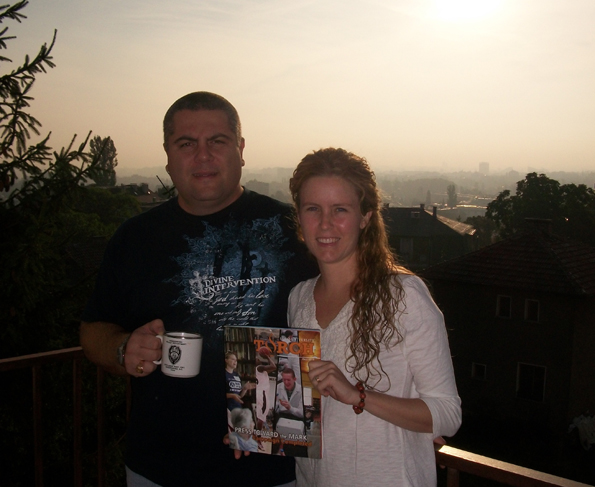 The completion of the first Master of Chaplaincy Ministry Program in Bulgaria and its official accreditation with New Bulgarian University in Sofia has raised interest about the educational strategy implemented in the task.
As early as 2001, Cup & Cross Ministries International in partnership with the Bulgarian Church of God invited the Church of God Chaplaincy Commission and implemented the first short-term chaplaincy training in the country since the Fall of the Berlin Wall. Even then it was clear that if chaplaincy was to remain a national focus, a clear educational strategy must be in place. As a result, with the establishment of the Bulgarian Chaplaincy Association in 2005-2006, our team set course toward a three-level national educational strategy on the subject of chaplaincy targeting:
(1) local churches and denominations,
(2) ministers with a calling for chaplain ministry, who are willing to dedicated time and effort in earning a masters degree in the filed,
(3) and last, but not least Bulgarian government agencies who in part would be instrumental in the reestablishment of chaplaincy in all relative areas.
The first of these three tasks was completed fairly easily as churches and evangelical denominations were open toward understanding and embracing chaplaincy, while many pastors and ministers within them had already experienced the need or had served in a similar context. The Bulgarian Chaplaincy Association and Cup & Cross Ministries partnered with the Military Ministry of Agape-Bulgaria, a regional wing of Campus Crusade, and for a bit longer than a year lectures, media materials and personal meeting were brought to several hundred local congregations, as well as national leaders of various denominations, among which the Assemblies of God and the Church of God. As a result virtually all evangelical denominations in Bulgaria were brought in position of supporting chaplaincy, a term which was once foreign, now well informed of its usage and strengths. It was time for step number two.
As early as 2006, students from various church backgrounds and active ministers were invited to participate in the first ever Master’s of Chaplaincy Ministry in the country. Four years later with the partnership of the United Theological Faculty of the Bulgarian Theological Institute in Sofia we were able to bring one of the few complete master’s program in chaplaincy in the world fully contextualized for the Bulgarian cultural and after much work and anticipation with a very timely and necessary international government accredited with the New Bulgarian University. Within the perimeter of the program are the follow modules:
(1) Module 1 was presented by the International Association of Evangelical Chaplains for the intro level module of chaplaincy ministry with special focus on military, police and prison work,
(2) Module 2 was presented by selected faculty members in the filed of Theological Studies from the Bulgarian Evangelical Theological Institute.
(3) While Module 3 in counseling, practicum and thesis completion was finalized by Cup & Cross Ministries International in cooperation with professors from New Bulgarian University.
Now the third level of education is at hand as chaplaincy is already being enforced by NATO and various EU agencies along with the realization on part of the Bulgarian government for the need of chaplaincy in various areas of administration even outside the armed forces, correctional institutions and the medical field. The role of our graduate students, who are now part of a well established and deeply rooted in the Bulgarian history and identity school of thought on how to do chaplaincy ministry, is imperative in this final task. To all that have taken it wholeheartedly, God speed and God bless.
Masters of Chaplaincy Reflections

It has taken exactly 10 years since the envisioning of the Masters of Chaplaincy Ministry in Bulgaria for its final realization in the Bulgarian national and cultural context. Through this time of struggle and anticipation, we encountered a number of difficulties as follows:
- Government difficulties on various levels within the Bulgarian administration and a direct repression from the Ministry of Justice, which was later included in the Religious Freedom report of the U.S. Department of State
- Administrative difficulties with approving the program as a legal educational process, while no legal background of chaplaincy has ever been provided in Bulgaria
- Economic difficulties with arranging location and time placement for the program, lecturers, the very much needed student scholarships and various other academic expenses
- Proper student selection through a special screening process to ensure only qualified candidates for placement within the Masters’ Program
- And of course, spiritual difficulties with the whole process of establishing chaplaincy in Bulgaria again being a definite spiritual warfare for all participants

Now that the Bulgarian Chaplaincy Program is an undeniable fact, we realize how our training was more than just a necessity for the implementation of such a great task. It was also well sufficient for a time as such.
I’m especially grateful for the role of my wife Kathryn, who was the main motivator behind the program and who stepped in at very crucial moments in the teaching process providing the complete structure of the program’s counseling module through her training from the Department of Psychology with Lee University and expertise from the Crises Counseling Center in Cleveland. My own experience as a chaplain during my CPE days at Erlanger and Siskin hospitals, as well as educational background from the Pentecostal Theological Seminary and experience with various churches and organizations as an ordained Church of God bishop, also served as tremendous support in various steps through the whole process of the program from its envisioning and foundation in 2001. We are thankful to all friends and partners in the ministry who contributed with their own expertise in the designing of the program and the educational process. And at last a final word of encouragement to all students and churches now set forth to do the ministry of chaplaincy in Bulgaria through the first Masters’ of Chaplaincy Ministry Program in the country.
Read more about chaplaincy in Bulgaria in the following HISTORY of EVENTS
Chaplaincy Counseling Module Completed
During the month of September 2011 the Counseling Module of the first Bulgarian Master of Chaplaincy Ministry Program in Bulgaria was successfully completed. This was the last of three modules, which further included two semesters’ long study of chaplaincy and theology taught at the United Theological Faculty of the Bulgarian Evangelical Theological Institute in Sofia, Bulgaria.
A total of fifteen students attended this final module. Ten of these students successfully finished their masters’ level studies and are now set forth for practicum in their respective areas of ministry and consecutive thesis defense prior to their graduation in the spring of 2012. Many of them are already ministering in hospital and prison settings, as well as among military and police personnel.
During the course of the program, we were able to finalize the long awaited negotiations with New Bulgarian University and signed an agreement with which every student chaplain will be able to graduate with a government accredited diploma from the Bulgarian Ministry of Education and New Bulgarian University.
This program in its entirety was only made possible through the personal efforts and tireless teaching of the following friends and partners in the ministry: Major General Clay Buckingham, USA (ret), Chaplain Colonel Rich Young of the IAEC, Dr. Jim Ellis from Union University, legal consultant on European Union religious issues, Dr. Hristo Berov from the Potsdam University in Germany, Dr. Roumen Bostandjiev from the Psychology Department of New Bulgarian University in Sofia, Bulgaria, Dr. Dona-Gene Mitchell from the Political Science Department of the University of Nebraska and professors from the United Theological Faculty under the supervision of Dr. Dony & Kathryn Donev from the Bulgarian Chaplaincy Association.
Read more about chaplaincy in Bulgaria in the following HISTORY of EVENTS
Where the Spirit of the Lord
The Apostolic Faith (May, 1908)
Ireland
Both Belfast and Bangor have been visited with Pentecost.
England
In the past year, news comes that probably 5OO people have received the Pentecost in England.
China
We hear from South China that about 1OO have received the baptism of the Holy Ghost and they now have a paper in the Chinese called “Pentecostal Truths,” which is being scattered in China and Japan. it Is a blessed paper and one can feel the power in it even though unable to read it.
West Africa
Brother E. McCauley from Long Beach, California, opened a mission in Monrovia, Liberia. God has been blessing the work. Other missionaries are helping. Sister Harmon writes: “It is marvelous at times to see the manifestations of the Spirit and to feel the power. They shake like a person with a hard chill; they are in such earnest-ness when they pray and God does so bless them, until you can hear them a block away,”
Jerusalem
One native minister of Beyroute, Syria, came to Jerusalem to spend the winter. God has baptized him with the Holy Ghost
and he speaks with tongues. Praise God! God started this movement in A. D. 32 in this dear old city, and the “latter rain” Is falling in 19O8. Glory to God! Miss Elizabeth Brown of the Christian and Missionary Alliance, received her baptism more than two weeks ago. She had the real old-fashioned manifestations like many had St Azusa street. — The secret of the matter was she was so given up to God. Praise His name! She came to my room and requested me to lay bands on her for her baptism. She felt waves of fire passing through her head and face and then began to speak in tongues. She sings the heavenly chant. It is precious to hear her.-Lucy M. Leatherman, Jerusalem, Palestine, care of American consulate.
Sweden
The Holy Ghost is falling on the humble in Gottenberg. In one prayer meeting. they saw fire, and four persons were filled with the Holy Ghost and spoke with tongues. They praised God until 5 o’clock in the morning. In a few days, more than twelve persons were baptized with the Holy Ghost and speaking in tongues.
Eight little children have been filled with the Spirit, speaking in tongues. Some of them stand on a chair testifying for Christ.
Many sick have been healed, sinners saved and backsliders coming to the Lord. One day in February. Twenty-three were baptized in water in the name of Jesus Christ. Nearly all of them had their Pentecostal experience. Many are seeking the power of God day and night.
One night the Lord sent a fisherman from an island near the city, using this dear brother in the healing of four sick people and two sisters gut their baptism of the Holy Ghost at the same time.
Many sinners have come to God in different parts of Sweden. There are Pentecostal companies here and there where the Lord is taking out a people for His name. A number of workers who received their baptism in Los Angeles are there being used of God. Address Brother Andrew G. Johnson, Backevick, 3 Hisingstad, Sweden.
India
In Panditla Ramabsi’s School at Mukti. Kedagon, India, God is working in power among the girls again. God is pouring out upon them such a spirit of prayer again. It is like the mighty roaring of the sea when they begin. The workers are looking for a great outpouring of His Spirit again upon Mukti. He has also been blessedly working among the Christian and Missionary Alliance people in Bombay.
Brother Max Wood Moorhead of Bombay, India, writes: “God is workiog mightily through the Bombay Presidency and there sre witnesses now at Bombay, Khamgaon, Okola, Amraoki, Dholka, Dharangson. Rhesqaon, Nasrapur, Pandharpur and Dhond. Praise God! Many natives are entering in, and how blessedly God uses these ignorant, lowly Indians as channels of blessing to their own people. A native boy of 19 was filled with the Holy Ghost in January and has been wonderfully healed of consumption and instrumental in winning souls to
Jesus. His heathen mother and a heathen lad, an old friend. He has also been a messenger or power to missionaries from the homeland. At Dolka, a station of the Christian and Missionary Alliance, where five missionaries have received Pentecost, six orphan lads are magnifying God in new tongues.”
PENTECOSTAL OUTPOURING IN SCOT-LAND
From “Confidence,” a free Pentecostal paper, to be obtained from the editors, 11 Park Lea Road, Sunderland, England.
Pentecost has fallen in Scotland at Edinburgh, Glasgow, Dumfermilne, Sterling, Clydebank, Falkirk, Tarbert, Toll Cross. Banton by Kilsyth, Kirkintillock, Coatbridge and other places.
Some incidents are reported from Kilsyth. a small Scottish town twelve miles from Glasgow, and other points.
A fireman at the colliery, as he was leaning on his shovel at work, began to speak in tongues.
A pitman at Motherwell broke out in the face of the coal-that is, while filling his wagon or tub. He was singing. “How I love that sweet story of old.” He said he felt something go down and then come up. Then for two hours he sat on his coal pile speaking in tongues as the Holy Spirit gave him utterance. The men near by working soon heard him, and one cried, “There’s Jock through in tongues and me no saved yet.”
A number have been converted just through hearing others speak in tongues. It was so with young H. He loved cycle racing. Etc., and kept away from the meetings; but when he heard his sister in the house “speaking mysteries” praising God in an unknown tongue. He was broken down. In the Mission Hall, from 3 one afternoon till 2 the next morning. he dealt with God and was saved. sanctified, and baptized with the Holy Ghost with the Scriptural evidences.
In a village in this part of Scotland. the little chapel got on fire and about twenty received their Pentecost with signs following and thirteen have been soundly converted. They were holding a “fellowship meeting” for those who had been fully anointed. Outsiders hearing the vehement cries of praise slid the speaking in tongues, gathered around. A sympathetic policeman kept the dour (his wife and daughter. who had received the blessing were inside). At last he cried. “Lads, I can stand it no longer. here goes.” And he flung open the door, and putting down his helmet, was soon pleading with God for the full baptism of the Holy Ghost. And he received it then and there and came through speaking in tongues.
It is touching to see the boys at Kilsyth (quite a number have got their Pentecost) all with their Bibles in the meeting, and little girls too, speaking in tongues and giving out solemn messages.
In other places children have had to suffer. We have heard of one whose father in the drink kicked his little girl because she went to the meetings, and she looking up at him, and through her tears said, “Glory to Jesus!”
An engine driver at Kilsyth was making his way to the house, and his legs gave way. The power of God fell on him, and they supported him to Brother Murdoch’s kitchen where many have received the baptism, and he was soon “through,” singing as the Spirit gave him utterance, and has been singing ever since.
Many ‘have already traveled to Kilsyth from the east and west, the north and south. Some critical investigators arrived one day by train. They agreed to test this thing by putting questions to the first Kilsyth man they met. It was the porter who opened the carriage door.
“Any meetings being held here?”
“Aye, sir, there are.”
“Have you been to any of them?”
“Yes, I’ve been.”
“Is it true that some folks are speaking in tongues?”
“it’s true enough.”
“Do you know anyone?”
“Yes, I’m one myself.”
Scottish people know their Bibles. They are no fools, not carried away easily. But they know that God has appeared in their midst, and they praise Him and exalt the ever precious Blood by which victory is assured.
PENTECOST IN AUSTRALIA
The Lord has visited Australia in great power and souls have been baptized with she Holy Ghost and signs following.
In a cottage meeting, in February 19O7, in Melbourne, a young brother received the baptism of the Holy Ghost and began to speak in tongues. Some fell under the power of God and a great awe came over the meeting. The brother spoke and sang, “giving messages in the unknown tongue and also interpreting.
A few Christians stopped at the house on the way to church one Saturday night but said they would have a little time of prayer first. The Lord came down in such power that they could not go, and some spoke in tongues and sang heavenly music.
A sister was washing up the breakfast things, when the Lord called her to prayer, she immediately obeyed Him, and the Spirit soon led her off in praise to Him in an unknown tongue. She says, “I was simply lost I in His love.”
A few were waiting upon God one Friday night when the Holy Spirit fell upon a lad 19. He sang beautifully for over an hour about Jesus’ coming. Next morning while work he sang praises to God in an unknown tongue.
These great blessings have come on the lowly and humble. Many have seen visions of Jesus and of heavenly fire, and the interpretations speak of the soon coming of Jesus.
A Policeman Receives Pentecost
A policeman, John Barclay, 161 Elgin street, Carlton, Melbourne, received his Pentecost. The following is a part of his testimony:
On Easter evening, 19O7, at a Holiness camp about twenty-seven miles from Melbourne, we all gathered for our usual praise and prayer meeting. A brother read 1 Cor., 12th chapter. Then we all knelt down but no one seemed able to pray aloud. The only words I could utter were these: “Lord, reveal Thyself tonight.”
Presently some mighty. marvelous unseen power took hold of me, and I was thrown downward on the floor. Everything around me disappeared. The other friends were as if they never existed. I saw the heavens opened and my precious Jesus sitting on the throne. Oh the joy and beauty and glory! It is unspeakable. Then Jesus came right down into the room and I saw Him smile all around. But He looked so sadly at me, and His look condemned me for refusing before to yield myself fully up to Him. His loving but sad look broke my heart and I burst into tears, and cried:
“Lord, I yield my all to You to do with me as Thou wilt!” I just cried from my heart that verse, “I’ll go where you want me to go, dear Lord” Then the Lord smiled again. During all this time I saw an innumerable host of angels in glory, and oh, such dazzling light and beauty. Whenever I cried, “I’ll go where you want me to go, dear Lord,” the dear Lord smiled on me and the angels waved pennons of white. It was simply celestial: no beauty on earth like it! No words on earth can describe what it was like. In visions He showed me that there is as much rejoicing in heaven over a fully surrendered soul as over a lost sinner returning from the wilds.
To come back to Easter Monday evening, I was for about an hour and a half conscious only of the Lord’s presence. When I returned to earth again and looked around, some were kneeling in silent prayer, others were lying prostrate on the floor. Presently a sister broke out in prayer entreating God to bless His children and save lost souls. Then she prayed in a strange tongue, which sounded like Chinese. Then she started singing in the same tongue. What heavenly music! It sounded very much like an angel’s voice coming rolling over the balconies of heaven. Of all the grand singers I have heard, I never heard anything so sweet. She gave messages from God to several Our meeting lasted till 4 o’clock In the morning.
On return in my work at home, I got so hungry to know more of the dear Lord that I began seeking in real deep earnest for the baptism of the Holy Ghost and fire. Satan had been giving me a very bad time by telling me that it was all false doctrine. I went into my bedroom and told the Lord to drive Satan away, that his assaults were more than I could bear. Then all once a beautiful cams and peace filled my soul. I was so happy that I could not even praise Him, but sat at His feet with my eyes closed looking into His dear face, when I saw a light shine from heaven far brighter than the noonday sun; It shone on my face brighter and brighter, until I had to cover my eyes with my hands.
That night I went to a meeting in a private house, and in this meeting Satan came to me with greater power, and I was of all men most miserable. About 1O:1O p. m., Satan did his best to get me to go home; but my Jesus kept me wailing on the Lord with others, some of whom were under the Spirit and speaking in tongues. About 1 o’clock a. m., a brother laid hands on me, and I received my baptism. My hands, arms, and whole body trembled greatly and I was thrown on the floor. All the others were praising the Lord. He is the same, yesterday, today, and forever. He baptizes with the Holy Ghost the same today as nineteen centuries ago. On that night week the Lord gave me the tongues, and since then I have spoken in four or five different languages. All glory to His Name!
People have told me that it is all of the devil; but the Jesus I serve and trust will not allow Satan to deceive me. It is now over six months since I received this baptism, and I know that Satan does not give the peace, joy, and happiness that I have got.
A burglar came to the altar at Azusa Mission, threw his skeleton keys under the bench (he had been plotting to rob a house). He got gloriously saved, soon he was sanctified. He was baptized down at the ocean, and shouted and jumped in the water and out of the water, he was so filled with the power of God. That afternoon he was baptized with the Holy Ghost and spake in tongues. He praises God and weeps as he tells of His wonderful love and mercy.
A sister finding there were some things hindering her from getting her baptism, shut herself in her room arid prayed practically all day and all night. She prayed through and got all her idols out of her heart and the power fell on her “like hail,” she says. She talked in tongues for a long time, though she said when she came to the mission that she did not want tongues. But God baptized her like all the rest.
A brother came from China to Los Angeles and received the baptism of the Holy Ghost and went on his way to England, and writes that it was the most wonderful experience of his life and he is rejoicing in the fullness of the Spirit.
The leading man among the colored Freemasons in Indianapolis and who was also cartoonist for two newspapers was sanctified and baptized with the Holy Ghost speaking in divers new tongues. He resigned and had prayer with his members in the lodge room, and they were much touched. Some of his brethren have since received their Pentecost also.
What hath God Wrought? In two precious years since the Lord poured out the Pentecost In Los Angeles in a little cottage on Bonnie Brae street, He has spread it around ‘the world. Hallelujah. Many are rejoicing with joy unspeakable for the great blessings that God is pouring out in this latter rain. Many saved, sanctified, healed of disease and baptized with the Holy Ghost and fire. Many happy families filled with the Spirit and working for Jesus. Soon after the Pentecost fell, the saints rented the lower room in the old building on Azusa Street, which has been much blest of God. To Him be all the glory and praise. When the place was about to he sold so that the Mission would have to move, the saints agreed to purchase it with three years’ time to pay the $15,OOO, expecting the Lord to send the money all in before that time, and He has done it and answered our prayers in a wonderful way. We humbly thank God. We love to think of the blessed old “Manger Home” where so many of us have received the baptism of the Holy Ghost. Many saints love the spot and will rejoice that God has given to us.
Christ’s character is our pattern and His word is our discipline. We want to he Just like Jesus in His suffering, His passion, His death. He is our ideal. Glory to God!
—page 1–
THE APOSTOLIC FAITH
For the next issues of this paper address
THE APOSTOLIC FAITH CAMPMEETING,
PORTLAND, ORE.
Subscription Free
THE APOSTOLIC FAITH MISSION
Stands for the restoration of the faith once delivered unto the saints-the old time religion of camp meetings, revivals, missions, street and prison work and Christian Unity everywhere,
Repentance-Mark 1:14, 15
Godly Sorrow for Sin, Example–Matt.9:13. 2 Cor. 7:9, 11. Acts 3:19, Acts 17: 30, 11.
Confession of Sin-Luke 15:21 and Luke 18:13,
Forsaking Sinful Ways-Isa. 55:7, Jonah 3:8. Prov. 28:11.
Restitution-Ezek. 33:15. Luke 19:8.
And Faith in Jesus Christ.
First Work-Justification is that act of God’s free grace by which we receive remission of sins. Acts 1O:42, 43. Rom, 3:25,
Second Work-Sanctification is the second work of grace and the last work of grace. Sanctification is that act of God’s free grace by which He makes us holy. John 17:15, 17.-“Sanctify them through Thy Truth; Thy work is truth.” 1 Thess. 4:3; 1 Thess. 5:21; Heb. 13:12; Heb. 2:11; Heb. 12:14.
Sanctification is cleansing to make holy. The disciples were sanctified before the Day of Pentecost. By a careful study of Scrip-tore you will find it is so now: “Ye are clean through the word which I have spoken unto you.” (John 15:3: 13:1O); and Jesus had breathed on them the Holy Ghost (John 2O:21, 22). You know, that they could not receive the Spirit if they were not clean. Jesus cleansed and got all doubt out of His church before He went back to glory.
The Baptism with the Holy Ghost is a gift of power upon the sanctified life; so when we get it we have the same evidence as the Disciples received on the Day of Pentecost (Acts 2:3, 4), in speaking in hew tongues. See also Acts 1O:45, 46; Acts 19:6; 1 Cur, 14:21. “For I will work a work, in your days which ye will not believe–though it be told you.”-Heb. 1:5.
Healing-We must believe that God is able to heal-Hz. 15:26:’ “1 am the Lord that healeth thee.” James 5:14; Psa. 1O3:3; 2 Kings 2O:5; Matt. 8:16,37; Mark 16; 16, 17, 18.
“Behold I am the Lord, the God of all flesh; is there anything too hard for Me?”-Jer. 22:27.
Too many have confused the grace of sanctification with the enduement of Power, or the baptism with the Holy Ghost; others have taken “the anointing that abideth” for the Baptism, and failed to reach the glory and power of a true Pentecost.
The Blood of Jesus will never blot out any sin between man and man they can make right; but If we can’t make wrongs right the Blood graciously covers. (Matt. 5:23, 24.)
We are not fighting men or churches, but seeking to displace dead forms and creeds and wild fanaticism with living, practical Christianity. “Love, Faith, Unity” are our watchwords, and “Victory through the Atoning Blood” our battle cry. God’s promises are true. He said: “Be thou faithful over a few things, and wilt make thee ruler over many.” From the little handful of Christians who stood by the cross when the testing and discouragement came, God has raised a mighty host.
Chinese Pentecostal Paper–The Lord laid it on my heart to get out a paper in the Chinese language. I put it before my Chinese brethren and they prayed over it and God put it at once on their hearts, and they began to translate pieces into Chinese. God has given us a Chinese brother who has received the baptism of the Holy Ghost and is a good printer. The paper is already being scattered among the millions of China. Offerings to help the dear Chinese brethren, who are poor in this world’s goods, get out their paper and circulate this Gospel may he sent to Brother Mok Lai Chi. 5 Laddes St., Hong Kong, China.–Bro. McIntosh.
Word comes that Bishop Homer of the Holiness movement of Canada has been baptized with the Holy Ghost as on the day of Pentecost. He had been claiming his baptism for twenty years and he says this is the greatest baptism he ever had.
Two Pentecostal papers in the Norwegian language are being published, the “Sandhedans Tolk,” published by Brother H. Langeland, Paulsbo, Wash., and “Byposten,” by Brother T. B. Barratt, Christiania, Norway.
The Lord had baptized a number in the little faith cottage back of the Mission. He has used our dear Sister Farrow whom He sent from Texas at the beginning of the outpuring of the Spirit in Los Angeles. In her room in the cottage, quite a number have received a greater filling of the Spirit and some have been healed and baptized with the Spirit since she returned from Africa.
ELECTRIC MESSAGES FROM THE FIELD
I can feel the breath of heaven, It’s coming. Perfect victory for our precious work.
This Gospel is sweeping like rain over the parched fields. Jesus is coming so soon, and the Lord is using those instruments that are given into His hands.
To think we have a part in this great Gospel, with persecutions. The blessed Christ is so near, even at our very door. O the rapture when He bursts the clouds and we hear the glad news, “Behold all things are ready, go ye out to meet Him.”
God is working and all hell cannot stop Him, so we need not fear but keep low at His feet and remember that He that is for Us is greater than they that he against us.
There is no one that can rob us of our power. We could easily sin and lose it, but we have learned the secret of abiding in His love, which is by keeping clean.
I praise God that He set me free. There are not men or devils enough to check this great river the Father for Jesus’ sake has put into my being. Bless His name. O let the Lord have His way with you, and be as free as heaven makes you.
Jesus brought the living, burning words of the Father into this old world, and bless His dear name, He has left them here for those that love Him and keep His commandments, and walk softly before Him. O to think He has given us this power and these words of the Father that bring instant healing, and rebuke demons and bring salvation to poor perishing souls.
We have been praying for the Apostolic power, and the Lord has been testing His Pentecostal people to see if we are pure gold, tried in the fire. He could not trust us without trying us first. The Lord wants soon to give the perfect gifts in the body, and He is going to give them to the true and tried ones only. He is getting us ready as fast as He can and as fast as we will let Him. Praise the name of our matchless Christ!
“Many are railed but few are chosen.” O I do want to be one of the few that shall walk Him in white. I feel if I can only sit in some corner of heaven and look on the stately form and face of my Christ who has done so much for it, it will be enough. My very soul is bowed down in humility as I even think of what He’s done for me. O may we keep at His lovely feet. May we see Jesus only. May we in this, last onslaught of Satan on the true children of God, in this last outpouring of the Spirit, stand as one man.
If we do faithfully the work God has called us to, in the face of all hell, we will see results. Many will preach a mere compromise but I will not do it. Can’t and be true to God. This old world has seen nothing but failure and weakness on the part of God’s people, and the time has cools to rise and shine, shake off the yoke. Bless His dear name! As soon as the saints get a little persecution for keeping things straight, they take to the background and say, May be I was too harsh.” But if we won’t be faithful in this age, the Lord will raise up those that will. We must have Peters and Pauls in this closing age as well as in the beginning of the church. If we can’t stand the evil report as well as the good. we need another dip in the Blood. My soul demands reality. We must be what we say we are. If we have the power of the Holy Ghost, we have something that can stand, and after doing all stand.-F. L. C.
Character and Work of the Holy Ghost. His character is love. If you find people that get a harsh spirit, and even talk in tongues in a harsh spirit, it is not the Holy Ghost talking. His utterances are in power and glory and with blessing and sweetness. The character of the Holy Ghost is precisely like Jesus the Word of truth, for the Holy Ghost is “the Spirit of truth.” He speaks always of the Word and makes everything like the Word. Jesus was the Son of God, the suffering Christ; and the Holy Ghost comes into the world to reveal this suffering Christ to us. He is a meek and humble Spirit–not a harsh Spirit. He is a Spirit of glory. When He comes into a believer, He comes to tell them all about Jesus’ salvation. He reveals Christ. He paints Him as the wonderful Son of God, the brightest gem the Father had in heaven –our only hope of salvation and reconciliation with the Father. How sweet it is to have the Holy Ghost come to you and show you Jesus through the Word. He witnesses and reveals through the Word, and never gets outside of the Word.
Every man born of the Spirit is born of Jesus Christ. The new birth puts you into the church and sin puts you out.
No wonder people get the missionary Spirit as soon as they get the baptism because they become partners with the Holy Spirit.
In the baptism of the Spirit, you are under the power of Spirit, and do not have to judge by what your eyes see and your ears hear but what the Spirit reveals.
SANCTIFIED ON THE CROSS
“I pray not that Thou shouldst take them out of the world, but that Thou shouldst keep them from the evil. They are not of the world even as I am not of the world. Sanctify them through Thy truth, Thy word is truth.” Jesus is still praying this prayer today for every believer to come and be sanctified. Glory to God! Sanctification makes us one with the Lord Jesus. (Heb. 2:11.) Sanctification makes us holy as Jesus is. Then the prayer of Jesus is answered, and we become one with Him, even as He is one with the Father. Bless His holy name.
He says again in I Thess. 4:3, For this is the will of God even your sanctification.” So it is His will fur every soul to be saved from all sin, actual and original. We get our actual sins cleansed away through the Blood of Jesus Christ at the cross; hut our original sin we get cleansed on the cross, It must be a real death to the old man. Rom. 6:6, “Knowing this that our old man is crucified with Him, that the body of sin, might be destroyed, that henceforth we should not serve sin: for he that Is dead is freed from sin.” So it takes the death of the old man in order that Christ might be sanctified in us. It is not sufficient to have the old man stunned or knocked down, for he will rise again.
God is calling His people to true holiness in these days. We thank God for the blessed light that He is giving us. He says in Ii Tim. 2:21: “Ifs man therefore purge himself from these. he shall be a vessel unto honor, sanctified and meet for the Master’s use.” He means for us to be purged from uncleanness and all kinds of sin. Then we shall be it vessel unto honor, sanctified and inset for the Master’s use, and prepared unto every good work. Sanctification makes us holy and destroys the breed of sin, the love of sin and carnality. It makes us pure and whiter than snow. Bless His holy name!
The Lord Jesus says, “Blessed are the pure in heart.” Sanctification makes us pure in heart. Any man that is saved and sanctified call feel the fire burning in his heart, when be calls on the name of Jesus. O may God help men and women ‘every-where to lead a holy life, free from sin, for the Holy Spirit seeks to lead you out of sin into the marvelous light of the Sun of God.
The Word says. “Follow peace with all men and holiness without which no man shall see the Lord.” So, beloved, when we get Jesus Christ our King of Peace in our hearts, we have the almighty Christ, the everlasting Father, the Prince of Peace. “Thou wilt keep him in perfect peace whose mind is stayed on Thee, because He trusteth in Thee.” We shall have wisdom, righteousness and power. For God is righteous In all His ways and holy in all His arts. This holiness means perfect love in our hearts, perfect love that casteth out fear.
Brother Paul says in order to become holy and live a holy life, we should abstain from all appearance of evil. Then the apostle adds, “And the very God of peace sanctify you wholly, and I pray God your whole spirit and soul and body he preserved blameless unto the coming of our Lord Jesus Christ.” (I These. 1: 22, 23.) “To the end He may establish your hearts unblameable in holiness before God, even our Father, at the coming of our Lord Jesus Christ with all His saints.” ii Thess. 3:13.) Bless His holy name. O beloved, after you have received the light, it is holiness or hell. God is calling fur men and women in these days that will live a holy life free from sin. We should remain before God until His all cleansing Blood makes us holy, body, soul and spirit.–W. J. S.
Pentecost means a continual revival among God’s people.
Gifts cannot save us. We see that by the life of Jesus. Many people are going to hell trusting in gifts. The Word tells us that without love we are nothing. The Blood of Jesus Christ is our only salvation.
The Word of God is the standard in this wonderful salvation. If you get on board the Word of God, the train will take you straight through to glory; but if you take some other way, you will have trouble at the gate. We preach a clean cut Gospel, for we will have to give an account at the judgment.
Adam was a lifeless man of clay when the Spirit of God breathed the breath of life into his nostrils, and he became a living soul. So when the Spirit of God comes into a church or an individual, He wakes it up and it becomes a live body. The Holy Ghost has no dead churches. He brings life wherever He Is.
Just as angels could not remain in the kingdom of God when they sinned, so people cannot live in the kingdom of God, His church, if they sin. The only way to remain in unity with Christ and His Spirit flowing in our souls Is to be obedient subjects. Obedience keeps us in the body of Christ and: His love flowing like an ocean.
When the Lord heals us or saves us, He tells us to “Sin no more, lest a worse thing come upon thee.” As long as we walk in obedience to God, His blessings will fail upon our souls; but if we turn back to sin and break our covenant with God, our last state will be worse than the first. Let us walk in the light of His precious Word.
God’s ministers are “a flame of fire.” He wants men and women all on fire. He wants us not only saved from sin but on fire. The Holy Ghost is dynamite and fire in your soul. He wants us to have not only the thunder but the lightning. The Holy Ghost is lightning. He strikes men down with conviction, slays and makes alive.
I put everything on the altar, all I hoped for and longed for I gave to the Lord, and when I prayed, the fire came down and God sanctified me and made me holy. Then I went home and said, I have got another religion. Well, it was not another religion but the old Ishmael was cast out, the carnal nature was destroyed, and God filled me with love and then closed the door and left me in that state. Nothing could come in but love.
This Pentecostal blessing is so sweet. When you lay down at night, how He comes and blesses your soul and sings through you and preaches through you, and the first thing in the morning It is Jesus. There is glory shining in your soul and He seems to light up the room and everything in your soul cries out, “Its Jesus only.” It is the power of the Holy Spirit through your soul. When He comes into your heart, He doss not bring any trash but He comes to reveal Jesus.
We must remember that tongues never bought this salvation, but it is the blood of Jesus Christ that purchased salvation. God wants men to have every gift but not to be led by gifts but by the Word of God, by the precious Blood of Jesus. Glory to God “This is My beloved son, hear ye Him.” We want to know God above all. When we have the Christ of God in our hearts. we can stand before the very gatling guns of hell and tell them that the Blood cleanseth.
The baptism of the Holy Spirit is power and understanding of the Word and the glory of God upon your life. Whenever the Lord wants to play His piano, He tunes up the harp and plays with His own fingers, speaking or singing in any language he wishes. The man that hears you speak a message right from the throne fails down and seeks God and gets up to report that God is in you of a truth. The baptism of the Holy Spirit makes you more humble and filled with divine love and the graces and fruits of the Spirit are manifest.
When you get the baptism with the Holy Ghost, you will surely go up into The mount with Christ. If you want to know what it is to praise God and have the joy of the Lord in your soul that flows like a mighty river ,tarry and get your personal Pentecost. He keeps the rivers flowing in your soul that you may be fit for irrigation wherever you go. Jesus said, “He that believeth on Me out of his belly shall flow rivers of living water. But this spake He of the Spirit which they that believe on Him should receive.” (John, 7:38, 39.)
Honor the Holy Ghost. Someone may say, ” If you can speak in tongues, let me hear you.” Don’t you ever try to do that. The Holy Ghost will never speak in that way. It is not ye that speak but the Holy Ghost, and he will speak when He chooses. Don’t you ever try to speak with tongues or say that the power belongs to you. It is by My Spirit, saith the Lord. When singing or speaking in tongues, your mind does not take any part in it. He wants you to pray for the interpretation, so that you can speak with the Spirit and with the understanding also. (I Cor,. 14:16)
—page 2—–
THE BAPTISM OF THE HOLY GHOST
The Azusa standard of the baptism with the Holy Ghost is according to the Bible in Acts 1:5,8; Acts, 2:4 and Luke, 24:49. Bless His holy name. Hallelujah to the Lamb for the baptism of the Holy Ghost and fire and speaking in tongues as the Spirit gives utterance.
Jesus gave the church at Pentecost a great lesson of how to carry on a revival, and it would be well for every church to follow Jesus’ standard of the ~ of the Holy Ghost and fire.
“And when the day of Pentecost was fully come, they were all with one accord in one place.” O beloved, there is where the secret is: one accord, one place, one heart, one soul, one mind, one prayer. If God can get a people anywhere in one accord and in one place, of one heart, mind, and soul, believing for this great power, It will fall and Pentecostal results will follow. Glory to God!
Apostolic Faith doctrine means one accord, one soul, one heart. May God help every child of His to live In Jesus’ prayer: “That they all may be one, as Thou, Father, art in Me and I In Thee; that they all may be one to us; that the world may believe that Thou hast sent Me.” Praise God! O how my heart cries out to God in these days that He would make every child of His see the necessity of living in the 17th chapter of John, that we may be one in the body of Christ, as Jesus has prayed.
When we are sanctified through the truth, then we are one in Christ, and we can get into one accord for the gift or power of the Holy Ghost, and God will come in like a rushing mighty wind and fill every heart with the power of the Holy Spirit. Glory to His holy name. Bless God! O how I praise Him for this wonderful salvation that is spreading over this great earth. The baptism of the Holy Ghost brings the glory of God In our hearts.
The Holy Ghost Is Power
There is a great difference between a sanctified person and one that is baptized with the Holy Ghost and fire. A sanctified person is cleansed and filled with divine love, but the one that is baptized with the Holy Ghost has the power of God on his soul and has power with God and men, power over all the kingdoms of Satan and over all his emissaries. God can take a worm and thresh a mountain. Glory to God. Hallelujah!
In all Jesus’ great revivals and miracles, the work was wrought by the power of the Holy Ghost flowing through His sanctified humanity. When the Holy Ghost comes and takes us as His instruments, this is the power that convicts men and women and causes them to see that there is a reality in serving Jesus Christ. O beloved, we ought to thank God that He has made us the tabernacles of the Holy Ghost. When you have the Holy Ghost, you have an empire, a power within yourself. Elijah was a power in himself through the Holy Ghost. He brought down fire from heaven. So when we get the power of the Holy Ghost, we will see the heavens open sod the Holy Ghost power falling on earth, power over sickness, diseases and death.
The Lord never revoked the commission He gave to His disciples: “Heal the sick, cleanse the lepers, raise the dead,” and He is going to perform these things if He can get a people in unity. The Holy Spirit is power with God and man. You have power with God as Elijah had. God put man over all His works; but we know that when Adam sinned, he lost a great deal of his power; but now through the Blood of Jesus, He says, “Behold, I give you power to tread on serpents and scorpions, and over all the powers of the enemy.” The Lord Jesus wants a church, when He comes back to earth, just like the one He started when He left the earth and organized it on the day of Pentecost.
Tarry in One Accord
O may every child of God seek his real personal Pentecost, stop quibbling and come to the standard that Jesus laid down for us in Acts 2: “And suddenly there came a sound from heaven as of a rushing mighty wind, and It filled all the house where they were sitting.” Glory to God! O beloved, if you wait on God for this baptism of the Holy Ghost just now, and can get two or three people together that are sanctified through the Blood of Christ, and all get into one accord, God will send the baptism of the Holy Ghost upon your souls as the rain falls from heaven. You may not have a preacher to come to you and preach the doctrine of the Holy Ghost and fire, but you can obey Jesus’ saying in the passage. “Where two or three are gathered together in My name, there am I in the midst of them.” This is Jesus’: and if two or three are gathered together in His name and pray for the baptism of the Holy Ghost, they can have it this day or this night, because it is the promise of the Father’s glory and you will find it a truth In your own life. God’s promises are true and sure.
The Baptism Falls on a Clean Heart
Jesus is our example. “And Jesus being full of the Holy Ghost, returned from Jordan, and was led by the Spirit.” We find in reading the Bible that the baptism with the Holy Ghost and fire falls on a clean, sanctified life, for we see according to the Scriptures that Jesus was “holy, harmless, undefiled,” sod filled with wisdom and favor with God and man, before God anointed Him with the Holy Ghost and power. For in Luke, 2:40 we read. “Jesus waxed strong in spirit, filled with wisdom, and the grace of God was upon Him”; and in Luke, 2:52, “And Jesus increased in wisdom and stature, and in favor with God and man.”
After Jesus was empowered with the Holy Ghost at Jordan, He returned in the power of the Spirit into Galilee, and there went out a fame of Him through all the region round about.” Glory to God! He was not any more holy or any more meek, but had greater authority. “And He taught in their synagogues, being glorified of all.”
Beloved, If Jesus who was God Himself, heeded the Holy Ghost to empower Him for His ministry and His miracles, how much more do we children need the Holy Ghost today. O that men and women would tarry for the baptism with the Holy Ghost and fire upon their souls, that the glory may be seen upon them just as It was upon the disciples on the day of Pentecost in the fiery emblem of tongues. The tongues of fire represented the great Shekina glory. So today the Shekina glory rests day and night upon those who are baptized with the Holy Ghost, while He abides in their souls. For His presence is with us. Glory to His name. I thank Him for this wonderful salvation. Let us ring His praises through all the world that all men may know that the Comforter has come. Bless His dear name!
Jesus’ First Sermon After His Baptism
“And He came to Nazareth where He was brought up: and as His custom was, He went into the synagogue on the Sabbath day and stood up for to read. And there was delivered unto Him the hook of the prophet Esaias. And when He had opened the book, He found the place where it is written: The Spirit of the Lord is upon Me because He hath anointed Me to preach the Gospel to the poor: He hath sent me to heal the broken-hearted, to preach deliverance to the captives, and recovering of sight to the blind, to set at liberty them that are blind, to preach the acceptable year of the Lord.” (Luke. 4:18, 19.) Hallelujah. Glory to God! This is Jesus’ sermon after His baptism with the Holy Ghost, preaching in the synagogue. He acknowledged that the Spirit of God was upon Him.
Jesus was the Son of God and born of the Holy Ghost and filled with the Holy Ghost from His mother’s womb: but the baptism of the Holy Ghost came upon His sanctified humanity at the Jordan. In His humanity, He needed the Third Person or the Trinity to do His work. And He could truly say that His fingers became instruments of the Holy Ghost to cast out devils.
The Holy Ghost Flows Through Pure Channels
If men and women today will consecrate themselves to God, and get their hands and feet and eyes and affections, body and soul, all sanctified, how the Holy Ghost will use such people. He will find pure channels to flow through sanctified avenues for His power. People will be saved, sanctified, healed and baptized with the Holy Ghost and fire.
The baptism of the Holy Ghost comes through our Lord and Savior Jesus Christ by faith in His word. In order to receive it, we must first he sanctified. Then we can become His witnesses unto the uttermost parts of the earth. You will never have an experience to measure with Acts. 2:4 and 16, 17, until you get your personal Pentecost or the baptism with the Holy Ghost and fire. (Matt., 13:11)
This is the latter rain that God is pouring out to His humble children in the last days. We are preaching a Gospel that measures with the great commission that Jesus gave His disciples on the day when He arose from’ the dead. (Matt. 28:19.2O-):
“Go ye therefore and teach all nations, baptizing them in the name of the Father, and of the Son, and of the Holy Ghost: teaching them to observe all things whatsoever I have commanded you: and to, I am with you always, even unto the end of the world. Amen!” They received the power to measure with this commission on the day of Pentecost. (Acts, 2:4.) Bless the lord. O how I bless God to see His mighty power manifested in these last days. God wants His people to receive the baptism with the Holy Ghost and fire.
A MOTHER’S EXPERIENCE OF PENTECOST
This is my first writing to the dear Apostolic Faith. I will say that I am all under the Blood, and I have victory, complete victory. I do praise Him for convicting and converting my soul and sanctifying me wholly and giving me the blessed baptism of the Holy Ghost. I received it when I sought in earnest, over a year ago.
I was fearful that it was hypnotism till I got right hungry for it; and I just went to the seekers’ board and knelt there. I had with me my two month’s old baby, and four older ones. They were sleepy, so I just got the baby down on the bench asleep, and asked God to take care of the children, and He did. My husband had been away from home at work, but I had been praying for God to give him work here at home Whittier. So he was there when I got my baptism. But I did not know he was in the room. I believe God sent him right back to the meeting where I was seeking.
I just said to Jesus, “Here I am before You.” it seemed I could almost see myself lying on the altar. I said, “Lord, have your way; I don’t want to be deceived about this matter. Lord, just keep hack the powers of darkness and have your way with me, and quicken the Spirit, for you know my chance of coming to the altar. I don’t know that I will ever get another chance all those children and no help with them so do the work right now.” And I did believe. Praise His holy name! He wonderfully came to my rescue right then, and I spake in three different languages, and still do, O praise His holy name! Sister John Woodruff. Whittier, Cal.
WORTH TARRYING NOR
I was wonderfully converted on Scriptural lines, Dec. 14, 1884, for years have been a believer and seeker for Bible Holiness, obtained the experience at a Holiness campmeeting in June. 19O3, and have had several anointings and refreshings since, hut have always felt a real lack of power for effectual service.
On the night of Dec. 9th., last, while we waited upon our face at home, asking God to soon fulfill His promise, and give me the longing desire of my heart, the baptism of the Holy Ghost. He answered back, “This is the night.” With great assurance, we stepped out into the storm and faithfully wounded our way to the little Mission, where we had given fourteen years of our life in service. Only one other hungry heart came out through the storm: but we two knelt before God and claimed the promise, and as our voices mingled together in intersession, suddenly I began to praise. And as I praised, prayer was left behind. All I could do was to praise Jesus, the Blessed Lamb of God. And as a great volume came welling out, it seemed to come from my very inmost being. All at once I felt a choking, gasping feeling in my throat and my vocal cords were manipulated in a peculiar way, and I knew the Holy Ghost had come to his temple within, which he had been preparing so long.
He now began to speak with the tongue yielded to Him, at first in a stammering way, finally flowing out in a clear, distinct language, which sounded like Chinese. He spoke twice in what seemed to be two languages. I rejoiced in the full Bible evidence. My soul was filled full of love as sweet as heaven. He shook and thrilled me over and over again. Oh, it was wonderful to me, a man of 60 years of age!
Now after thirty days have gone, the blessed love remains. The emotional part has cooled down, but the hunger has all gone and He satisfies me, and I find a new power for service. I am a new man with a new hook, and a new message, in a new tongue. It does satisfy my soul. It has been a help and inspiration to the few dear ones who are digging down deeper, that they may soon make the landing also.
Four days afterwards, eighteen miles from home, walking all alone in the snow, God gave me the gift of a tongue, what language I know not as yet, but I can use it at will. God has given me the interpretation of it, so I can glorify him as 1st Cor. 14:22, a sign to the unbelievers. It is worth tarrying fourteen months for, yea, for fourteen years. It is truly the fullness of the Holy Ghost coming in His full official character to empower for service as In Acts 1:8, and in Mark 16:17, 18.
I want to give just a little word to all honest seekers: look up, get hold upon God, do not be discouraged. He will come in His own way and surprise you when He does come (Hab. 2:3, last clause.) Be definite and personal in your prayers. Do not ramble all over and pray for others, but pray for yourself, and He will surely come to the joy of your hearts.–W. H. Standley, Watertown, N. Y.
Sanctification is a beautiful realm. You are saved from all Inherited sin, crucified with Christ: the resurrection life of Jesus Christ in your soul. You have faith for the healing of the sick and faith to get people saved and sanctified and the presence of the Lord is with you.
The Holy Ghost is the Teacher of teachers. He knows the word of God. You can talk with Him and ask Him for yourself. It is the sweetest thing to get alone with Him and let Him open the scripture to you. He is the interpreter of the word, the Spirit of truth to guide you into all truth.
PENTECOST AT A FUNERAL.
COCOANUT GROVE, Fla., Feb.19.
Last Monday afternoon I was called to preach the funeral sermon of a little child, the infant son of Mrs. Geo. Thompson of this place. The child was nearly three months old and the idol of its mother’s heart. The parents were both unsaved and their grief was almost unbearable. The mother especially was in a very critical condition, having cared for the little one in its sufferings and watched over it as only a loving mother can. With the father, she had watched it for days, as it seemed to hang between life and death.
I had talked with the father and he told me he could not ask God to spare it. Three times, he said, he had promised God if He would answer prayer and spare his loved ones, he would serve Him, and then had gone on in sin as before. “God Is not to he fooled with,” he said.
The heart-broken mother was unable to be in the service. Her strength was almost exhausted and she was prostrate on the bed. They brought her in to view the corpse for the last time, and it was a pitiful scene. It took three or four to get her back to the bed where she fainted away and was unconscious for some time during the burial service.
We went in to speak to her before leaving, and she called my wife to sing for her. They carried the little folding organ in by the bed, and she sang, “1 remember Calvary.” And the mother sprang up, knelt by the organ and cried, “Pray, Mrs. Eckert, I must get ready to meet my darling babe.” So after two prayers, she got back on the bed again and said, “Sing.” My wife sang three more songs, “Anchored in Jesus.” “Lean upon the arms of Jesus,” and “Mansion In Heaven,” and the mother joined in the last chorus, smiling and waving her hands. Then she raised up and they repeated the chorus again. Then, with the light of heaven in her face, she told us about those mansions in heaven and that she was going there to see Jesus and her darling babe.” She said, “Jesus Is here.” Then she began to sing, this time all alone; and as we listened to catch the words, we recognized the “voice divine,” and she was singing and speaking in a foreign language, just as they did on the day of Pentecost. (Acts, 2:4) Glory to God!
After singing and speaking for some time, she said. “Jesus is coming soon, He told me.” She also sang in English about the soon coming of our Lord then began telling us what God had done. She said. “How good God is, see how quick He done it! Why He just came down and washed me clean, took away all of my sorrow and pain, and then just came In Himself and filled me. Oh you don’t know how good He is!” Then she would sing and speak in tongues and praise God, and plead with her husband and other friends to pray.
We remained with them nearly two hours, and she spent all of that time shouting and praising God-Her strength was restored, and when we asked if she wanted nourishment, she said, “No, I am strong. I don’t need anything.” Several were present who had been very much opposed to the baptism with the Holy Ghost end the speaking in tongues, but they were convinced.
Last night she was at the cottage prayer meeting, and again we heard her tell her wonderful experience and sing and speak in tongues. We had prayed very earnestly for God to use the death of the child to save the parents; and before going to the funeral, I had gone off to my place of secret prayer and asked God to make it a Pentecostal funeral. And He answered In such a wonderful way that we were made to understand more fully what Paul meant in Eph., 3:20. Glory to God! What can be too hard for our Father?
We have a band of seventeen baptized saints here who speak in tongues as the Spirit gives utterance. Several hungry hearts are still seeking and people are being convinced of sin.–Clark Eckert. Pastor Holiness Church.
PROMISES TO THE OVERCOMER
In Revelations 2nd and 3rd chapters. Christ gives thirteen promises to the overcomer:
He shall eat of the tree of life. 2:7.
Shall have a crown of life. 2:10.
Shall not be hurt of the second death,2:11.
Shall eat of the hidden manna. 2:17.
Shall receive a while stone and a new name written therein. 2:17.
Shall have power over the nations. 2:26.
Shall have the Morning Star, which is Christ. 2:28.
Shall be clothed in white raiment. 3:5.
Shall not be blotted out of the Book of Life. 3:5.
Shall be confessed by Christ before God the Father. 3:5.
Shall be a pillar in the temple of God. 3:5.
Shall have written on him the name of God and the city of God. 3:12 .
Shall sit with Christ in His throne. 3:21 .
Paul was a full overcomer, for he said: “I have fought a good fight, I have finished my course, I have kept the faith. Henceforth there is laid up for me a crown of righteousness.” May we be faithful unto death. How are we to overcome? Only by the Blood of the Lamb and the word of our testimony. Full overcomers will have part with Jesus in the first resurrection.
———–Page 3———-
CHINESE FILLED WITH THE HOLY SPIRIT
Pentecost has come to the South China Alliance Mission. Some of the missionaries attended meetings In Macao and received their Pentecost and came hack to Wuchow wonderfully filled with the Spirit and speaking in tongues. Some of the Chinese Christians came back with the same experience. In a few days one of the missionaries in Wuchow received his Pentecost and also a number of the Chinese Christians. One missionary who bad been very poorly and had decided to return to the home land on that account received a wonderful baptism of power and was perfectly healed. Sister Ethel Landis at Kwei Peng, South China wrote: “A good many of the Chinese have received their Pentecost and are singing, praying, and praising in new tongues. The burden of it all is that Jesus is coming soon and we must prepare to meet Him, The best part is to see these dear Chinese Christians yielding fully to God and being filled with the blessed Holy Spirit.
THE LORD IS SENDING MISSIONARIES
Missionaries to Egypt-It is now almost a year and a half since I received my personal Pentecost. Since that time, I have been actively engaged in God’s mighty Pentecostal work. He has been graciously blessing. We expect to be in evangelistic work for a few months and then go to Egypt as missionaries. S G.S. Briesford, 110 N. Seventh Street. Colorado Springs, Co.
Los Angeles to Ceylon, India–Brother A. H. Post left Los Angeles Aug. 1, 19O7. The Lord graciously used him along the way. He writes: “I had the privilege in the will of God to visit Wales for over two weeks; and, praise be to our Lord, He is beginning a real Pentecost in that land, as also in many places in the British Isles, Scotland, Ireland and Wales, as well as England. In London, quite a number have received the baptism of the Holy Spirit.”
Later he writes from Kandy, Ceylon, India: “The Lord directed me to this inland city shout seventy-five miles from Colombo, There are a few here who are definitely tarrying for the baptism of the Holy Ghost. I feel sure the Lord will give victory and bring a Pentecostal revival to the island,”
Missionaries to Ireland–The last day we were at Spokane, Wash., we were staying with a couple of old ladies, and one of the ladies asked me to pray for her healing. When we prayed for her and anointed her and laid our hands on her for her healing, the power of God fell on her and she received her baptism and spoke in tongues a clear language. O glory to God! Victory through the precious Blood of Jesus. We expect to sail for Ireland about the middle of June.–Brother and Sister Thos. Griffin, Address 943 W. North Avenue, Chicago, IL. (The above is a short extract from letters received from our precious brother and sister from Los Angeles; The Lord is using them on the way to Ireland.)
Missionaries to Johannesburg, South Africa–Eleven Apostolic Faith missionaries from Indianapolis have lately sailed for South Africa. Brother and Sister H. M. Turney from Los Angeles who have been in Honolulu are also on the way and have written from England. God is making them a blessing on the way.
From Johannesburg, Africa, where the missionaries are going, we received this letter: “A few days ago. I was much blest in having a couple of pages, in a very much-dilapidated condition, of The Apostolic Faith put into my hands. Both these pages have pieces torn from them, nevertheless I do just feel that God has put them into my hands to revive my heart. The paper is now setting afire the hearts of a few other Christians, and we now, praise God, have also been led to pray for the baptism of the Holy Ghost with fire. Both in Cape Town and Johannesburg, a few earnest Christians are now meeting daily, and waiting upon God with one accord and are trusting and believing that God will baptize us with the Holy Ghost and fire.” May God send the “latter rain” in a deluge over that land. He is truly sending missionaries into a whitened field,
Missionaries to Palestine. Many souls in China have received the baptism of the Holy Ghost through the labors of Brother and Sister McIntosh at Macao and other places in China. The Lord told him to “go to Macaso” before he knew there was any such place but he looked It up on the map and found It. Of late he says the Lord told him to “go to Sharaaim, Palestine.” He did not know there was such a place till the Lord spoke to him. Now he is on his way there. Address him. Brother T. J. McIntosh. Jerusalem, Palestine, care of Thomas Cook & Son.
ITALIANS AND INDIANS RECEIVE THE HOLY GHOST
Bro. A. H. Argus, of 299 St. Johns Ave., Winnipeg, Canada, has just Returned From A Pentecostal Trip and Writes This Blessed Letter.
The first place I visited was Toronto, at which place I did enjoy the fellowship of the saints. Pentecost has fallen in at least five missions there. From there, I went to Ottawa and then to Athens, where we held meetings and some real remarkable cases of conversation, sanctification and of the Pentecostal baptism were manifest. God truly, was with us in power and we all did rejoice in the marvelous way in which He poured out of His Spirit in the place. After sixteen days there, the lord permitted me to return home by way of New York City.
In that city, while I was there, twenty-five received the baptism in one week. Five of the saints were fasting for ten day’ and, no doubt God was there in a special way. Pentecost has fallen in other missions in that city, also in adjoining cities-Philadelphia, Baltimore and Washington, D.C..
At the latter city I held two meetings for Sister Thomas, who has charge of the Pentecostal mission there. God truly is with a number of the saints in that place. I shall not soon forget the sweet fellowship we had together.
From there I went to Chicago, in which city Pentecost has fallen in thirteen or fourteen missions and hundreds have received this Pentecostal experience. Brother Durham has a strong work there. About a year ago, one or two Italians became convinced that this work was of God, and were saved, and pressed their way clean through to Pentecost: As a result, others followed and soon an Italian mission was opened, which is being run on Pentecostal lines. Many are being saved, sanctified and baptized two of their numbers have returned to their native country-Italy, they say to preach this Gospel. Truly these Italians appear to be under the anointing of the Spirit.
I also was at Zion City, where a number have received the baptism. On Sunday morning and evening, while I attended, there was a congregation of about 500 and seventy-five were at the altar. At St. Paul and Minneapolis, God is doing a great work.
Truly, the latter rain appears to be falling on every kindred, tongue and nation. While I was away, a number of Indians from the Reserve, about 2OO miles north heard of the work in Winnipeg and came in the city. Five of them received the baptism and others were saved and sanctified. Since they returned home, we have heard that other Indians have been saved. While the Indians were at the meetings in the city, two of the saints, under the power of the Spirit, spoke in other languages, which were understood by the Indians and one of the interpretations was, “Jesus Is coming soon.”
Truly, these are marvelous days. Reports are coming in from nearly every quarter of the globe of how the latter rain is failing In many places and, truly, It is encouraging to see that the God of Pentecost Is just the same today.
THE PENTECOSTAL REVIVAL
(From “Good Tidings,” published at 71O Wayne avenue, Dayton, OH.-Part of a letter by Miss E. Sisson.).
Esthonia, in Russia, brings us the story of a half-dozen or more little peasant girls upon whom came the mighty power of the Holy Ghost, and with it “the gift of tongues.” Several among them in a holy ecstasy speaking they understood not what; but to one among them was given “the gift of interpretation.” She said the burden of all they told was, “Jesus is coming soon. Prepare!” Take note, just here, beloved, that in all lands and all tongues, where God has thus spoken, this has been the first proclamation. “Jesus is coming soon. Make ready!”
“The Christians have seen their God.”
In one of the more recent accounts of revivals in Secunderabad, India, it is said the Holy Spirit came on them suddenly in the church prayer-meeting; the prayer of contrition was like the roar of a cataract. The heathen outside came running from every direction, looking in at every window, and watched the novel proceeding. As the Christians breaking through to God and coming out under the fiery baptism, lifted their rapt and ecstatic faces, the heathen went home to their villages, reporting with awe, “The Christians have seen their God!”
God Heals In India
From the second year of “The Revival” in Khassia Hills, India, a missionary writes it is spreading in such a wonderful way like a great prairie fire. Nothing is able to withstand it. It bursts out into a flame in the most unexpected places. Then follows account of the healing of a poor heathen woman of a most loathsome skin disease, because of which the heathen had thrust her from the village to die in the jungle. While on the roadside she stood listening to the preaching of the gospel and suddenly exclaimed, “God has given me medicine. He will heal me with this medicine,” and began rubbing her poor body with her hands when she exclaimed, “I am well!” It was so. The heathen around saw and were filled with awe.
This Gospel means a crucified life. We must take up our cross daily and follow Christ. The cause of so many losing the anointing of the Spirit is that they neglect to mortify and crucify self. He wants our eyes, our ears, and all our members kept unto Him, that we might live after the Spirit and not after the flesh. He is looking for people today that will die out to the flesh. How can our eyes revel to the things of this world and our ears listen to worldly music if they are consecrated to the, master’s use. People say this is fanaticism, but it is the teaching of the precious word of God. We must measure up to it. He wants us to have our ears closed to the world and open to heaven.
Cheng Ting Fu, Chih-ll, North China, is the address of Brother Bernstein, Brother and Sister Roy Hess, and ten other Pentecostal missionaries from Los Angeles and Chicago. The saints have been sending money to feed the starving there. Brother Hess says: “When I see the starving condition of this people and then look back where I came from and see them have so much. I feel like saying, O Christians, sell all your idols and hell! Send out missionaries.” Brother Bernstein writes: “We have our own regular meetings every night and the Holy Ghost is in our midst. Lately life has baptized my wife with the Holy Ghost and fire, and she spoke sod sang in other tongues. Glory to God In the highest! Our two boys, 11 and 8 years of age, were baptized some time ago, so we are a baptized company. God is working among the Chinese Christians here. There are some that are praying earnestly for the baptism of the Holy Ghost and fire. We have meeting with them every morning in our home, besides we have a meeting with the people on the streets every day and give the hungry a little food daily. The people here in general are very poor. They want to sell their children for a few dollars, because they have nothing to feed them. It is a great opportunity to tell them of the love of God. We have rented a store on the main street for about $1.50 a month. Had the first meeting Sunday, many people coming and going. We have a blind man taken out from the beggars and have clothed him and are feeding him and giving him the Gospel. I told him about Jesus’ Blood that cleanses from all sin. He did not understand it, and I explained that when we used water to wash his face, it got clean. He answered at once, ‘Tomorrow I want to come and wash my heart in Jesus’ blood’.”
HEAVENLY VISITATIONS IN INDIA
DHOLKA. Gujerat, India, Feb.17.
No pen can fully describe what God is doing here, and we are only In the midst of things, not at the end of this wave of power. Praise God! Yet I cannot longer keep from you the blessed tidings.
Last week the Lord sent Miss Gardner and me front Bombay to this place, having said to us in tongues before leaving. “Ask for great things.” “Ask in the heavens above or in the depth below.” We found the missionaries here a prepared people earnestly desiring the full baptism of the Holy Ghost. Some of them had definitely prayed long for it. Brother Schoonmaker was already fully in the baptism and has been greatly used of God.
The second day, all with one accord began to tarry before the Lord, the missionaries deciding by the will of God in them, to lay aside all the work that could be laid aside, and God has graciously enabled the busy workers to attend all the meetings since. We have tarried each day from 3p. m. till about midnight, with an intermission for dinner.
The first day, the lord worked mightily and baptized one sister, accompanying the baptism with a new tongue. She was filled with joy and praise and has gone on by leaps and bounds ever since.
Friday was a day of testing. The meeting seemed full of the love of God but the power seemed much less than the day before. The Lord sent Miss G. and me out into a field during the intermission to find out what was the matter. We humbled ourselves before God and begged Him to reveal the cause of failure. I began to speak in a tongue and she to interpret, and He said, “If ye have faith as a grain of mustard seed, ye shall unto this mountain, remove hence to yonder place, and it shall remove. O thou of little faith, wherefore didst thou doubt?” And other verses about faith. O the blessed faithful God! Let no one say tongues are of no use. We ‘accepted the reproof from our great Master and sought faith. It was given and the power came back.
On Saturday and Sunday, the mighty work went on. He baptized a sister and gave her a new tongue. Anointed another and gave several of us another new tongue and gave Miss G. the interpretation of all. O praise God with me. By this time, He had the Holy Spirit as oil on the whole waiting company, and all mouths were filled with praise and prayer.
Monday was the most marvelous and glorious day of my whole life so far. At the beginning of the meeting, Jesus talked with me like this: “What do you think I ant going to do?” “I don’t know. Lord.” “What do you believe for?” “I think you will baptize someone.” “Do you not believe I will do more?” “I hope so.” “Will you believe I will do greater things today than any day before?” “Yes, Lord, I will believe. He spoke also to Miss G. in the same way, telling her He would do mighty things before midnight.
I said, “Lord, let me see fire on all these heads, do let me. Lord.” Then I began to speak in a tongue. I soon became aware that I was praying for a brother. Then I saw a great shower of blood fall all over him. Then the prayer went to another brother, and a reservoir of oil was poured over him. Next it was for a sister, and as she lay on the floor, her body was covered in flaming fire. Another deluged in a flood of water from above, another stamped all over visibly with seals. Before another there appeared a great heart that kept enlarging, then a white door in the top of the heart, and both settled lightly down on her breast. Another seemed gradually enveloped in a cloud. The first brother to receive his baptism was eclipsed In glorious white light. Miss G. who was in a trance was covered over with soft white stuff, something like snow or feathers. On me the rain was falling. I asked Jesus was the white stuff was. He said, “It is dew only I made it look white to be visible.” All this impressed me that the Holy Spirit in all His aspects rested upon us and will be manifest to us. Oh glory to Jesus!
When Miss G. came out of the trance, she had seen a part in vision as I in the revelation.
A brother immediately said that God had been telling him for two days to ask two of us to lay hands on him for the baptism. We did so, each praying in English, then in tongues. The interpretation was given, “I indeed baptize with waster, but He shall baptize with the Holy Ghost and fire.” “Ye shall be baptized with the Holy Ghost not many days hence.” “Ye shall receive power after that the Holy Ghost is come upon you, and ye shall be my witnesses unto the ends of the earth.” Then there came much praise in the tongues. Then the Spirit said that hands should be laid upon another brother. We obeyed and await the manifestation of the baptism upon these two.
Then the power fell. There were times when we were all shouting, screaming and laughing together under the power of the Spirit. The Spirit has definitely given discernment of spirits during these days and rebuked one and another of us, and is teaching us many things. We are looking for still greater things. Think what it will be to this mission station, to this Bible school and this orphanage to have all the missionaries baptized with the Holy Ghost.
O beloved, let it speak to other mission stations and churches all over the world that God has come to fully equip us for His service. Let waiting ones not try to pray for others but for themselves. Let companies of those baptized who are praying with others waiting on God keep the one object before those in the room, not introducing other subjects of intercession. There must be one accord and one purpose in order that the Spirit may have a clear channel in the fellowship of Jesus, Kate Knight, Bombay, India.
THE HOLY GHOST AND THU BRIDE
We read in Rev., 22:17, “The Spirit and the bride say come.” O how sweet it is for us to have this blessed privilege of being a coworker with the Holy Ghost. He inspires us with faith in God’s word and endues us with power for service for the Master. Bless His dear name!
Every man and woman that receives the baptism of the Holy Ghost is the bride of Christ. They have a missionary spirit for saving souls. They have the spirit of Pentecost. Glory to God!
“And let him that heareth say, come: and let him that is athirst, come; and whosoever will, let him take the water of life freely.” O what a blessed text. The bride of Christ is calling the thirsty to come to Jesus because this is His work of the Holy Ghost in the believer. He intercedes for the lost: He groans for them.
The Spirit also calls the believer to come to Jesus and get sanctified. He points the sanctified to Jesus for his baptism with the Holy Ghost. When you are baptized with the Holy Ghost, you will have power to call sinners to Jesus, and they will be saved, and sanctified, and baptized with the Holy Ghost and fire. Amen!
Christ’s bride is pure and spotless. “Thou art all fair, my love, there is no spot in thee.” (Sol. Songs. 4:7.) Christ’s bride is clean, free front sin and all impurity. He gave Himself for her, that He might sanctify and cleanse the church with the washing of water by the word. That He might present it to Himself a glorious church, not having spot or wrinkle or any such thing, but that it should be holy and without blemish. (Eph., 5:25,27).
Christ’s bride has but one husband. (2 Cor., 11:2.) She is subject to Him. (Eph., 5:25.) The Bridegroom is the Son of God. (2 Cor., 11:2.)
We are married to Christ now in the Spirit,(Rom., 7:2,4.) Not only when He comes are we married to Christ but right now, if you are sanctified and baptized with the Holy Ghost and fire, you are married to Him already. God has a people to measure up to the Bible standard in this great salvation. Bless His holy name. Amen! W. J. S.
SPEAKING IN TONGUES
If you search the Scriptures carefully, you will find that when people get the baptism with the Holy Ghost and fire, they will speak in tongues and magnify God. (Acts 10:46.) We read in Acts 2:32,33: “This Jesus hath God raised up, whereof we all are witnesses. Therefore being by the right hand of God exalted, and having received of the Father the promise of the Holy Ghost. He bath shed forth this which ye now see and hear.”
So when you receive the baptism with the Holy Ghost and fire. His power will be seen and heard upon you. People will hear new songs and speaking in tongues. (Acts 2:4; Acts 2:16,17). We read also in Acts 2:11-13: “Cretes and Arabians, we do hear them speak in our tongues the wonderful works of God. And they were all amazed and were in doubt saying one to another, What meaneth this? Others mocking said, these men are full of new wine.” What was it that the people saw and heard? It was the Holy Ghost upon the disciples and the speaking in tongues.
This is the last Edition of the Azusa Street Mission Newspaper THE APOSTOLIC FAITH .
Water Baptism in the River
The Apostolic Faith (January, 1908)
Indianapolis, Ind.-Many souls have been baptized in Indianapolis, saved and sanctified.
Norwood, Ohio.-Our people are growing, fourteen baptized and interest increasing.-W.H. Cossum, 3952 Hazel avenue.
Colly, N.C.-The fire is still burning here in our midst and souls are being converted and sanctified and baptized with the Holy Ghost.-A.J. Bordeau.
Atlanta, Ga.-The meetings in the hall here have been blessed seasons of refreshing. For six months, every afternoon and night and all day on Sundays, the meetings have continued. Before this “latter rain” such revivals were unheard of. Souls are being saved, sanctified, and healed, and filled with the Holy Ghost. All glory to Jesus’ name! Let us follow on to know Him better. This is the beginning of great things.-“The Bridegroom’s Messenger,” 53 1/2 Auburn avenue.
Hill River, Minn.-I am thankful to God for what He has done for a small group of Christians here in the town of Hill River, where I live. Quite a few have received their Pentecost and others seeking it, and we are continuing to pray to God for His blessing in a greater degree.-Andrew Hausan, Fosston, Minn.
Utica, N.Y.-Blessed be the name of the Lord. Truly these days of the “latter rain” are days of Heaven upon the earth. We are a little band here but full of faith and pressing on. One by one, God is bringing our number into their Pentecost, and is opening other places where there are a few hungry believers longing for their inheritance.-Birdsell & Mason, 61 State street.
Concord Junction, Mass.-God is working in this place. Five of us have the baptism, speaking in tongues and others getting hungry. He came in to abide with me on Oct. 16th and spoke for Himself.-Everett E. Munroe, 397 Main street.
Strole, Va.-Pentecost has come here. Eight of us are speaking in tongues. We gamblers and drunkards have been saved. Praise the dear Lord. We are looking for dear Jesus every day and can hardly wait of see Him.-W.S. Woodworth, Caanan Faith Home and Full Gospel Mission.
Portsmouth and Richmond, Va.-Brother Seymour wrote from these places while he was visiting the missions in the East: “God is working in Portsmouth. Souls were baptized in Richmond and God is working in mighty power. The saints are just as sweet as can be. Glory to God for this Gospel. The saints are so simple here, that is the reason they receive the Pentecost so quickly. They are ready for the power.”
Philedelphia, Pa.-I have been helping in the Pentecostal work in one little meeting last Sunday and a number at the altar last Sunday and a number were slain under the mighty power of God. I had a letter from a sister in Danville, Va., a few days ago, and she says that God is blessing them there and that souls are being saved, sanctified, and baptized with the Holy Ghost. Hallelujah! hallelujah!-W.M. Scott, 906 Filbert street, Dec. 4.
Swanton, Ohio.-Praise the Lord. A few have been baptized near home here and a few have been wonderfully healed and a great many more are hungry for more of God. We have had a few wonderful conventions here in Ohio the past summer. One of the most wonderful meetings was at the Annual Christian Alliance Convention at Cleveland. Some evenings there were perhaps from three to four hundred down at the altar, some remaining all night; and a great many were saved. Praise the Lord. Jesus is certainly soon coming!-Gideon Ziegler.
Baltimore, Ohio.-There is a little mission here where the leader and about ten people had been seeking for their baptism for seven months, but none of them came through until last night, when the leader came through gloriously and others have been under the power and some sanctified. Praise God!-Mary A. Yaegge, 1022 N. Eutaw street. (This sister is on her way to Switzerland, where the Lord is calling her to preach the Gospel.)
Denver, Colo.-Our meetings are being blessed of God. Souls are being saved, sanctified, baptized with the Holy Ghost and healed, and the interest is still increasing. All glory be to God for His wonderful works that He is bestowing upon His children, as He is pouring our His Spirit upon all flesh in these latter days; for the coming of the Lord draweth nigh. The Lord has held us here and He has opened up an Apostolic Faith Mission on the corner of Lawrence and Twenty-fourth streets. The altar is filled with seekers.-E.S. Lee, 2305 Lawrence street.
Lynn, Mass.-We are now holding meetings in the mission at 260 Maple street. We commenced this work in a hall last February. One of our number, a girl born blind and blind for twenty-two years, healed and sanctified about eight years ago, received her personal Pentecost last March. She speaks, sings and preaches in different languages, has visions and prophecy. The Lord showed her this mission about two months before we had it. The Lord gave us the name of the mission, Apostolic Faith Mission. A number have been saved and sanctified, speak in new tongues and a number have been healed.-A.J. Rawson, Oct. 26th.
Dallas, Ore.-In the campmeeting here last summer about thirty were baptized with the Holy Spirit, with the evidence of speaking in tongues as the Spirit gave utterance. Many were saved and sanctified. Brother Earnest G. Hansen writes on Jan. 6th: “Since I last wrote, about eight backsliders have got back to the Lord, some have been sanctified, two have been baptized with the Holy Ghost. Meetings are grand.” They have a precious little paper there, clean and straight in doctrine, called “The Apostolic Witness.”
Portland, Ore.-At 224 Madison street, they have a blessed Apostolic Faith Mission. The saints are filled and overflowing with the Spirit and with love for souls, talking and singing in tongues. The hall is not nearly large enough. Altars are filled with seekers. We shall never forget the precious visit we had there. One secret of the power here is the prayer room where the workers drop in for silent prayer before the services-not to talk or visit. Souls were being saved, sanctified, and baptized. A bartender got wonderfully saved of God, and when he rose and tried to tell it, he broke down and fell on his knees and began to thank Jesus, and it filled everyone with joy. We have lately received some precious letters from Portland telling of God’s work there.
with * dear saints in New York. God is working there. Many are coming through. In one church,-a Baptist colored church of two thousand members,-God used us to give out these “latter rain” truths. The pastor who invited us became very hungry. He said he could not preach again till he was filled. Seven from his church received the promise of the Father, Acts 2:4. Hallelujah to Jesus! Went down to Norfolk, Va., and found quite a few baptized souls. God sent us up here to Baltimore and we found a little assembly here of baptized souls. We are out for God and wherever the Lamb goeth, we intend to follow.-Brother and Sister E.W. Vinton, 12 Leyden street, Medford, Mass.
Chicago, Ill.-God is wonderfully working here. Both the interest and power are increasing. we have stood by the simple Gospel from the very first, preaching only Jesus Christ and Him crucified. And as we have done this, the Holy Ghost has fallen on them that heard the Word, so that tongue can never tell what we have experienced. Praise the Lord!-Wm. H. Durham, 943 W. North avenue.
Sister Jennie E. Moore, who with two other precious sisters from Azusa Mission, Los Angeles, have been working in Chicago and other places, writes: “Truly, beloved, the mission at 943 W. North avenue is a blessed place-many Spirit-filled men and women and children. They have more children than at Azusa and they are filled. Beloved, I would you could see them.”
Winnipeg, Canada.-There was a great Pentecostal Convention in Winnipeg beginning November 15th. Preachers and workers from all parts of Canada were present. A band of workers who were in Portland at the time received a call from God to go to Winnipeg, and they were present at the convention: Sister Crawford and Mildred, Sister Neal, Brother Conlee and Brother Trotter. About twenty were baptized with the Holy Ghost and many were healed. The people brought handkerchiefs and aprons to be blessed as in Acts 19:12, and the Lord did wonderful signs through the simple faith of the dear ones that brought them. The Lord healed one young man of the tobacco habit, taking all the desire for the stuff away from him, through an anointed handkerchief, and he was saved in his own room. Demons were cast out of those bound by them. Our last published report from Winnipeg should have been signed, “The Apostolic Faith Mission, 501 Alexander Ave.”
Arcadia, Fla., and through the South.-Brother G.B. Cashwell and I are in the midst of a gracious revival in this town. The power is falling and saints are shouting. Bless God! Some have been saved, sanctified, and quite a number have received the Holy Ghost and speaking with other tongues as the Spirit gives utterance as in Acts 2:4. The altar is filled with seekers. God has kept me in Florida most all this year. Many saints have received the Holy Ghost in Florida with Bible evidence and many saved. A number of them have been baptized in water, buried in baptism, that is the Bible way.-F.M. Britton, Dec. 11.
Brother Cashwell writes from the South: “This truth in the South is spreading as never before and will keep spreading as Praise our God! Pray much and be true to Jesus. Many of us are now suffering much persecution, but our God is fighting our battles. Praise His dear name! Brother McIntosh writes me that seventy have received the Holy Ghost in thirty days after he arrived in Macao, China. O praise God for Pentecost. Salute all the saints for me in the love of Jesus!”-G.B. Cashwell, 53 1/2 Auburn avenue, Atlanta, Ga.
Stockton, Cal.-Five or six have been baptized with the Holy Ghost and several saved and several cases of healing.
Shenandoah, Iowa.-“Salvation has come. Hallelujah! God has come our way at last. Amen. Last Friday afternoon at Francis Jone’s a few of us were gathered pleading for the baptism of the Holy Spirit and He gave us the desire of our hearts at last. Glory, O glory. Two of us received our baptism, Sister Leyden and I. The rest are hard after Him. They were here at our house until after three this morning. There is quite a company of us Sister Leyden lay under the power for several hours and talked and sang in the Spirit and the Lord let me join in the song and sing too. Glory, glory, hallelujah! Blessed be the name of Jesus. The song was “Worthy is the Lamb,” and nearly the whole chapter. She interpreted it afterwards.”-Sister J.S. Jellison.
Minneapolis and St. Paul, Minn.-Wonderful outpouring of the Spirit here and at St. Paul. In five nights just passed in St. Paul alone, nine have received old time baptisms of the Holy Ghost and fire, speaking in many dialects and receiving wonderful visions from the Lord. Amen! Nine have been blessedly sanctified, some being for ******** woman dying with cancer-given up to die by three specialists, next morning after being prayed for arose and did her work, and has been doing it ever since-healed. I was in St. Paul last week and Brother Trotter was here, and in both places, the power was wonderful-yesterday especially, many being instantly healed and many saved. People were prostrated under the power of God at 11:30 last night. Many were heavily anointed for their baptism, and we expect a shower in the next few days. Glory is abiding in our hearts.-Florence Crawford, 1315 East 19th street, Minneapolis, Minn., Jan. 6.
A later report written Jan. 13th, says: “I wish to report victory in both St. Paul and Minneapolis. Yesterday was a great day. We had the ordinances of the Lord’s Supper and Foot-Washing Saturday night, and saints from St. Paul all came over and participated with us. Some fell under the power and lay for several hours. We had a blessed time. We then invited St. Paul saints to worship with us on Sunday afternoon. Sister Crawford gave the message in the afternoon. I gave it in the morning; and Brother Trotter in the evening. People fell under the power all day. And when I left the hall at 5 p.m., they were lying all over the hall under the power. The hall was an altar from the stand to the door. So many are getting saved, and many that have been claiming to be sanctified are finding that they were just saved, and are now getting really sanctified. Greetings to the church at Azusa street.” J.R. Conlee, 1003 25th avenue, N.E., Minneapolis.
——–
FROM AZUSA MISSION.
Many souls have been saved, sanctified, baptized with the Holy Ghost and sick bodies healed all over the land and in many lands since our last paper. Souls have been sanctified, baptized and saved at the old mission home at 312 Azusa street, Los Angeles.
When Christ was born, it was in a barn at Bethlehem; and when He began sending the “latter rain” about two years ago, the outpouring of the Spirit, it was in a barn in Los Angeles; for the old Mission is like a barn in its humility and plainness. Its old beams and whitewashed walls have been ringing with the praises and songs of the children of God ever since. Many from here have gone out into the foreign fields and the home fields, and they write back that they remember the blessed old times; and the Lord has been pouring out the same Spirit wherever He has sent them. The Spirit falls on humble hearts and in humble missions and churches.
Azusa Mission is still giving forth the same truth, and the Lord is pouring out His Spirit upon His sons and daughters, and they are witnessing in burning testimonies that Jesus’ Blood does cleanse from all sin and He does sanctify and baptize with the Holy Ghost and speak in tongues.
The holidays are special feast days at the Mission. The saints all gather-not to hear a program, for the Holy Ghost makes the program and the Father spreads the table with “the fatted calf” which represents Jesus, and we feed on Christ. Hallelujah! The Spirit sings the songs, some new and some old. Christmas was a blessed day at the Mission, also Watch Night and New Year’s Day. The meetings have been going on ever day since the work started and God’s word and the Holy Spirit are just as fresh and new as ever. The Lord provides for all the expenses. He has supplied all the needs of the workers, and when they come back they report that they have lacked nothing.
The devil is doing all he can to keep the saints from entering into the greater fullness of Christ; but we know God is raising up armies that will stand for the living God. Some went away from Azusa Mission because they thought the teaching on divorce was too straight; but God will not let us lower the standard. He wants a clean people and pure doctrine as a channel for this Pentecostal power. People everywhere are looking after this wonderful salvation that today is turning the world upside down, as it did in Paul’s time.
We look for a great outpouring of God’s Spirit in saving and healing power and power that fills with the Holy Ghost and fire in this year 1908. May all Christ’s people be stirred up over this salvation and sink down in deeper humility at the feet of Jesus.
“If we walk in the light as He is in the light, the Blood of Jesus Christ, His son, cleanseth us from all sin.” (I John 1, 7.) Bless His name forever and ever! It is the Blood that cleanseth, the precious Blood of Jesus. May we honor the Blood and keep under the Blood, and God will do mighty things for us. If the devil can get us on something outside of God, He will break our power. May we be watchful and ******keep under the Blood. The Lord wants the Blood preached as never before, and people will not have to wait so long to get the baptism. The Spirit follows the Blood. It is the Blood that saves us. We overcome by the Blood. Amen!
——–
FROM THE BIBLE SCHOOL IN MUKTI, INDIA.
It was noised one day, that some of the girls in the praying band were praying in different tongues. I had heard of the gift of tongues having been given to God’s children in other parts of the country, so was not surprised to hear our girls praying in new tongues. I did not go very near these girls, lest I should stumble them by taking too much notice of them, but quietly sat down and praised God.
One Sunday, as I was coming out of the church, after the morning service, I saw some girls standing near the door of a workers’ room. They seemed greatly excited and wondering, I soon found out the cause. A girl was praying aloud, and praising God in the English language. She did not know the language. Some of us gathered around her in the room, and joined her mentally in prayer. She was unconscious of what was going on, and was speaking to the Lord Jesus fluently in English. Before, I had heard her and some other girls uttering only a few syllables. Some repeated certain words over and over again. Some spoke one or more sentences, and some were simply groaning as if under a great agony of heart and mind, and carrying a great burden for souls.
“For with stammering lips and another tongue will He speak to this people.”
The gift of prophecy was also given to many of the praying girls, so that they could give God’s message in very clear language, taught by the Holy Spirit. The believers and unbelievers were moved alike by these messages, and a deep spiritual work began in our midst.
They who have received the gift of tongues are not using them for delivering messages from the Scriptures, except those who have received the gift of interpretation. They pray and praise God, and sometimes sing hymns in unknown tongues.-Mukti Prayer Bell.
——–
Multitudes in India and China are starving on account of the failure of crops. Any who want to help the famine sufferers can do so by sending money to the “Apostolic Faith,” and it will be sent direct to the missionaries in those countries to feed and care for the starving people, especially the orphans.
THE APOSTOLIC FAITH
312 Azusa Street
—————————————————————–
Published by
THE APOSTOLIC FAITH MISSION
Headquarters, Los Angeles
Subscription Free
_________________________________________________________________
—————————————————————–
This paper is free. We accept all donations toward it as free will offerings-not as subscription price.
——–
Notify us of any change in your address, so the papers will not be lost.
——–
Some have inquired how they could send money, as no name was given at the head of the paper. Money orders can be made payable to “The Apostolic Faith, 312 Azusa street, Los Angeles, Cal.”
——–
We are praising God for a free Gospel published free. All the work on the paper at the Mission is done freely and gladly by those who are baptized with the Holy Ghost, and who long to spread the glad tidings.
——–
We started this paper when we had not a dime in sight, and the means has always been freely donated. If not, we would not publish it. We expect the paper to stand just as it started.
——–
Many would like to get the paper oftener. Pray for the spread of the Gospel. If the saints unite in prayer, we believe God will greatly bless the publication on the Gospel this year. We hear of souls who have been baptized and saved through reading the paper.
——–
The cost of publishing and mailing this paper is much less when we print two papers at once, because they can be run off on the press and sent out for the same price as one paper. It cost about 1/2 cent for two papers, that is, when we print 40,000 at an issue. The postage is outside of that. So you can see that even a small offering will send quite a roll of papers, which may be read by many people, for they are often passed around and sometimes nearly worn out.
——–
The reason we put no name of editor at the head of this paper is because we want Christ exalted, that in all things He might have the pre-eminence.
——–
Some have asked for the addresses of workers and missionaries. If you address them at 312 Azusa street, Los Angeles, we will forward letters directly to them.
******** saint to himself and admonish him in love and in the meekness of our blessed Christ, and he shall gain him. May you not grieve the Spirit in your souls.
——–
Indiana Missionary Convention.-There will be a missionary convention at 32 S. Senate street, from Jan. 24th to Feb. 2. A band of workers from Indianapolis and vicinity expect to start for South Africa soon after the convention. For further information, address, “The Apostolic Faith Mission, 32 S. Senate street, Indianapolis, Ind.” May there be a mighty outpouring of the Spirit at the convention. Workers from all over the country are expected. The large Missionary Hall has a seating capacity for a thousand people.
——–
Correction.-We want to correct some errors that were in the last published report from Portland. The Christian Alliance did not come into the work or discontinue their meetings, as might have been understood. It was stated that one hundred were baptized at the campmeeting. The saints believe there were no so many. No record was kept. The insane persons that were brought for healing were not fully healed, or else through lack in our faith and through weakness lost their healing. The saints want the simple truth stated about the work. Amen! May no one from any place send in a report that is overstated but rather let it be understated.
——–
PRESS TOWARD THE MARK.
The outward Court contains a throng
Of worshipers, who tarry long,
Instead of pressing on.
Knowing their Lord was crucified,
And that it was for them He died;
They praise His name in song.
Beyond, there lies the Holy Place,
Which all may enter by His Grace,
And there be sanctified.
The Bread of Heaven each need supplies,
In God’s clear light, the old life dies,
With Jesus crucified.
The Holiest now we enter in,
Life out of death has banished sin,
His glory is revealed.
Cleansed with the water of the Word,
Baptized with fire by Christ the Lord,
By God the Father sealed.
This is God’s purpose, this God’s plan,
To send forth such to sinful man:
To witness of His Grace,
To let the Light and Glory shine,
To manifest His life divine,
His love to all our race.
M.J.D.
THE APOSTOLIC FAITH MISSION.
Stands for the restoration of the faith once delivered unto the saints- the old time religion, of camp meetings, revivals, missions, street and prison work and Christian Unity everywhere.
Teaching on Repentance-Mark 1:14, 15.
Godly Sorrow for Sin, Example-Matt., 9:13. 2 Cor. 7: 9, 11. Acts 3:19. Acts 17:30, 31.
Of Confession of Sin-Luke 15:21 and Luke 18:13.
Forsaking Sinful Ways-Isa. 55:7. Jonah 3:8. Prov. 28:13.
Restitution-Ezek. 33:15. Luke 19:8.
And faith in Jesus Christ.
First work.- Justification is that act of God’s free grace by which we receive remission of sins. Acts 10:42, 43. Rom. 3:25.
Second Work.-Sanctification is the second work of grace and the last work of grace. Sanctification is that act of God’s free grace by which He makes us holy. John 17:15, 17.-“Sanctify them through Thy Truth; Thy work is truth.” 1 Thess. 4:3; 1 Thess. 5:23; Heb. 13:12; Heb. 2:11; Heb. 12:14.
Sanctification is cleansing to make holy. The disciples were sanctified before the Day of Pentecost. By a careful study of Scripture you will find it is so now. “Ye are clean through the word which I have spoken unto you.” (John 15:3; 13:10); and Jesus had breathed on them the Holy Ghost (John 20:21, 22). You know that they could not receive the Spirit if they were not clean. Jesus cleansed and got all doubt out of His church before He went back to glory.
The Baptism with the Holy Ghost is a gift of power upon the sanctified life; so when we get it we have the same evidence as the Disciples received on the Day of Pentecost (Acts 2:3, 4), in speaking in new tongues. See also Acts 10:45, 46; Acts 19:6; 1 Cor. 14:21. “For I will work a work in your days which ye will not believe though it be told you.”-Heb. 1:5.
Seeking Healing-We must believe that God is able to heal.-Ex. 15:26; “I am the Lord that healeth thee.” James 5:14; Psa. 103:3, 2 Kings 20:5; Matt. 8:16, 17; Mark 16: 16, 17, 18. “Behold I am the Lord, the God of all flesh; is there any thing too hard for Me?”-Jer. 32:27.
Too many have confused the grace of sanctification with the enduement of Power, or the baptism with the Holy Ghost; others have taken “the anointing that abideth” for the Baptism, and failed to reach the glory and power of a true Pentecost.
The Blood of Jesus will never blot out any sin between man and man they can make right; but if we can’t make wrongs right the Blood graciously covers. (Matt. 5:23, 24.)
We are not fighting men or churches but seeking to displace dead forms and creeds ***********Blood” our battle cry. God’s promises are true. He said: “Be thou faithful over a few things, and will make thee ruler over many.” From the little handful of Christians who stood by the cross when the testings and discouragements came, God has raised a mighty host.
——–
FULL OVERCOMERS
Rev. 14.
“And I looked, and, lo, a Lamb stood on Mount Zion, and with Him a hundred forty and four thousand, having His Father’s name written in their foreheads.” -Rev. 14:1.
These 144,000 are the highest overcomers. Everyone that will reach the highest consecration in Jesus Christ can be a full overcomer and can go with Christ to the marriage supper of the Lamb. The rapture or catching away of the bride of Christ is liable to take place at any time; but we know that His revelation, or the coming of Jesus Christ when every eye shall see Him, cannot take place till the man of sin be revealed, that is the antichrist. II. Thess. 2:3.
The 12th of Revelations show where the overcomers are caught up to the throne of God. They are represented as the “man child” which was caught up unto God and to His throne. This child came from the church which is represented as a woman clothed with the sun, and the moon under her feet, and on her head a crown of twelve stars. We read that “Christ loved the church and gave Himself for it, that He might sanctify and cleanse it with the washing of water by the word, that He might present it unto Himself a glorious church without spot or wrinkle or any such thing; but that it should be holy and without blemish.”-Eph. 5:25, 27. Right out of this holy church is born the “man child.”
To have part in the rapture we must be sanctified and holy and live the life of a full overcomer. He that hath this hope in him purifieth himself even as Christ is pure. This is the blessed hope of the church, the coming of our Lord and Savior Jesus Christ who shall change our vile body that it may be like unto His glorious body. This is the first resurrection. “Blessed and holy is he that hath part in the first resurrection.” We all have the privilege to be full overcomers. We can be numbered in to take part with this great company on Mount Zion.
“These are they which were not defiled with women; for they are virgins. These are they which follow the Lamb whithersoever He goeth. These were redeemed from among men, being the first fruits unto God and the Lamb.”-Rev. 14, 4. “They are virgins,” this means sanctified souls, cleansed from spiritual fornication and physical fornication. “They follow the Lamb.” Let us go forth with Him. Let us get every thing we can in the word. In order to go with the Lord Jesus Christ, we must be filled with the blessed Holy Spirit.
“And in their mouth was found no guile; for they are without fault before the throne of God.”-Rev. 14:5. The Lord can get a people without fault in these days because He is able to save and keep us from falling and present us faultless before the throne. His prayer is still being heard in heaven today, “Sanctify them through Thy truth Thy word is truth.” He is praying for His church to be kept from evil. May God help us to claim every promise in His word.
“And I saw another angel fly in the midst of heaven, having the everlasting Gospel to preach unto them that dwell on the earth, and to every nation, and kindred, and tongue, and people.”-Rev. 14:6. It seems that after the rapture, or catching away of the bride, that the Gospel will still be preached on the earth to the people that will be left and were not ready to go in to the marriage supper. The angel proclaimed that, “The hour of His judgment is come.” We believe this is the great tribulation. The antichrist during this awful tribulation is going to compel men to serve him and bow down and call him god. But those who really know Jesus as the Christ and have the Blood in their hearts, are not going to bow down and accept the mark of the beast, but are going to prove faithful. Many of them are going to be martyrs and will be raised at the beginning of the millennium, but they will not be present at the marriage supper of the Lamb.
We read in Rev. 12,6 that the people that are left after the catching away of the “man child” will have a place prepared for them in the wilderness for them to flee to. The Lord will feed the church and protect her from the face of the serpent. “And the woman fled into the wilderness, where she hath a place prepared of God, that they should feed her there a thousand two hundred and three score days.” The Lord is faithful.
“And the third angel followed them, saying with a loud voice, if any man worship the beast and his image, and receive his mark in his forehead, or in his hand, the same shall drink of the wine of the wrath of God, which is poured out without mixture into the cup of His indignation; and he shall be tormented with fire and brimstone in the presence of the holy angels, and in the presence of the Lamb; and the smoke of their torment ascendeth up forever and ever.”-* 14:9, 11. The Lord Jesus teaches *** very strongly in Revelations. *** worship antichrist are going *** day and night
“Here is the patience of the saints’ here are they that keep the commandments of God and the faith of Jesus.” They did not forfeit their faith, their hope in Christ. They kept the faith in spite of tribulations, and they were faithful unto death. And the next verse says, “And I heard a voice from heaven saying unto me. “Write, Blessed are the dead that die in the Lord.” There will be many during the tribulation that will die rather than give up their faith.
May we be numbered with the 144,000 on Mount Zion who were full overcomers and were ready for the rapture. He is soon coming, and none will be ready but those that are washed in the Blood, made holy and sealed with the Holy Spirit of promise, ready when the trumpet sounds. Cor. 15:51, 52, and I Thess. 4:16. He does not come to the earth. He appears in the skies and we rise to meet Him. We shall be caught up together in the clouds “to meet the Lord in the air.” We shall be shut in with our God during the awful tribulation till the indignation be past. Isa. 26:20. Praise God. As the Lord shut Noah into the ark so He will shut us in. As the ark was borne up on the waters, so we will be lifted up with Him. And just as the ark came back and rested on the mount, so we come back with Him when His feet touch Mount Olivet.
The Lord Jesus is coming back with His bride on white horses from the marriage supper of the Lamb, to avenge His Blood on the antichrist and the false prophet.-Rev. 19:11, 14 and Jude 14, 15. The awful battle of Armageddon then takes place. Zechariah tells of this battle in the 14th chapter. Also we read in the last verse of this 14th chapter of Revelations, “And the winepress was trodden without the city, and blood came out of the winepress, even unto the horses’ bridles, by the space of a thousand and six hundred furlongs.” Just think of 200 miles of blood up to the horses’ bridles.
Then the great millennium is ushered in when Jesus shall sit on His throne and reign from shore to shore. This is when, “The wolf and the lamb shall feed together, and the lion shall eat straw like the bullock; and dust shall be the serpent’s meat. They shall not hurt nor destroy in all my holy mountain, saith the Lord.”-Isa. 65:25 and Isa. 11:6-9.
Then after we have reigned with Christ a thousand years, we shall sit on the judgment seat of Christ and judge men and angels. Then the justified and unrighteous will be raised to stand at the white throne judgment. The justified dead and those who lived during the millennium will be given everlasting life. That is the second resurrection.
Every full overcomer is going to be caught up when Jesus comes. O may God help His people that they all may meet Him in the skies. If you keep living this salvation moment by moment, you are going to be ready for the rapture, which is the coming of our Lord as a thief in the night to catch away His bride. Everyone that is not ready, like the foolish virgins, will be left to go through the awful tribulation that is coming on the earth.
——–
WHO MAY PROPHESY?
It is the privilege of all the members of the bride of Christ to prophesy, which means testify or preach. “And it shall come to pass in the last days, saith God, I will pour out of My Spirit upon all flesh; and your sons and your daughters shall prophesy, and your young men shall see visions, and your old men shall dream dreams; and on My servants and on My handmaidens I will pour out in those days of My Spirit; and they shall prophesy.” Acts 2:17, 18, and Acts 21:9.
Before Pentecost, the woman could only go into the “court of the women” and not into the inner court. The anointing oil was never poured on a womans head but only on the heads of kings, prophets and priests. But when our Lord poured out Pentecost, He brought all those faithful women with the other disciples into the upper room, and God baptized them all in the same room and made no difference. All the women received the anointed oil of the Holy Ghost and were able to preach the same as the men.
The woman is the weaker vessel and represents the tenderness of Christ, while the man represents the firmness of Christ. They both were co-workers in Eden and both fell into sin; so they both have to come together and work in the Gospel. (I. Cor. 11:8,9.) No woman that has the Spirit of Jesus wants to usurp authority over the man. The more God uses you in the Spirit, the more humbled and meek and tender you are and he more filled with the blessed Holy Spirit.
It is contrary to the Scriptures that woman should not have her part in the salvation work to which God has called her. We have no right to lay a straw in her way, but to be men of holiness, purity and virtue, to hold up the standard and encourage the woman in her work, and God will honor and bless us as never before. It is the same Holy Spirit in the woman as in the man.
——–
It was blood that saved the people from the awful destruction in Egypt, and it takes the Blood to save us today from sin. “And they overcame him by the Blood of the Lamb and by the word of their testimony.” It takes the Blood of the immaculate, incarnate Son of God to save from sin *******and when the Father looks upon those pierced hands and the wounded side of His Son, He has compassion upon the sinner. The blood of goats, calves, and lambs could not take away sin, it was only the answer of a good conscious. But O praise God, it is the precious Blood of Jesus Christ that saves from sin.
——–
We are justified through the Blood of Jesus. “Therefore being justified by faith, we have peace with God, through our Lord Jesus Christ.” Rom. 5:1. The second verse shows that through His Blood, we get standing grace in sanctification, and rejoice in the hope of the glory of God. Bless His holy name. It is the Blood of Jesus that saves and keeps from sin, and as long as we trust the cross of Christ and not ourselves or anything else, we can live this life free from sin. Glory to Jesus.
——–
We expect God to do great things this year. There were 60 cities in Canaan to be taken after they crossed over Jordan. Those that get the baptism with the Holy Ghost need to settle down in the Word, keep clean, and live the highest consecration before God. O beloved, we want to get all the stones and trash out of the way. We do not want to live on theological chips, shavings, husks, and wind, but upon the treasures of this blessed Holy Spirit in the Word.
——–
Jesus Christ was the spotless Lamb of God nailed to the altar, and God accepted the offering to save and sanctify every soul that will receive Him. If he had not been spotless, His death would have profited nothing, but being made perfect He became the author of eternal salvation, unto all them that obey Him.-Heb. 5:9.
——–
Let us in this 1908 never read our Bible carelessly but prayerfully. Let us sing under the anointing of the Spirit and not for fancy, and when we speak, speak in the Spirit, and God is going to pour out His Spirit as never before.
——–
It is so sweet to have the Blood of Jesus in our hearts. It gives us victory over sin and over every power of the enemy. Everyone that gets the Blood of our Lord Jesus Christ is entitled to the great power of the Holy Ghost.
——–
A sister in Minneapolis while getting her baptism sang in the Spirit and interpreted the song in English:
“I am coming soon;
Be faithful, children
A little longer;
I am coming soon.”
“TO THE MARRIED.”
I Cor. 7.
In these last days, so many deceptive spirits are in the world, that we have felt impressed by the blessed Holy Spirit to write a letter on the seventh chapter of First Corinthians, that blessed letter which Paul has sent to the church.
The Corinthian church was one of Paul’s most gifted churches, and just as it is today, where a church is very gifted, the only safeguard from deceptive spirits is by rightly dividing the Word of God, to keep out fanaticism. We may let down on some lines and rise on others, but God wants everything to be balanced by the Word of God. Paul writing to Timothy (II Tim. 1:13, 14) says, “Hold fast the form of sound words which thou has heard of me, in faith and love which is in Christ Jesus. That good thing which was committed unto thee keep by the Holy Ghost which dwelleth in us.” And again he says (II Tim. 3:14): “But continue thou in the things which thou hast learned and hast been assured of, knowing of whom thou hast learned them; and that from a child thou hast known the holy Scriptures, which are able to make thee wise unto salvation through faith which is in Christ Jesus. All Scripture is given by inspiration of God, and is profitable for doctrine, for reproof, for correction, for instruction in righteousness: that the man of God may be perfect, thoroughly furnished unto all good works.” So the Lord God wants us to search and compare scriptures with scriptures.
This Corinthian church had run into freeloveism, and a good many isms. Great division had arisen in it; it had split into several parts, and Paul had to settle them down into the Word of God. He writes this letter to them, for they had got into awful trouble.
Paul tells them in the first verse of this chapter to avoid immorality. He says, “Now concerning the things whereof ye wrote unto me, it is good for a man not to touch a woman.” (He does not mean a married man here, he means a man that is single, as verses 8 and 26 show.) He says in the 7th verse, “Every man hath his proper gift of God.” And to those that can receive this gift, Paul writes in verse 8, “I say therefore to the unmarried and widows, It is good for them if they abide even as I.” That is to say, by living a single life, they would have more power in the Spirit. He writes this to the church, to any who are saved, sanctified and filled with the Holy Spirit. Paul thought it was best, but he showed that everyone had his proper gift of God. So he did not put any bondage upon the people of Christ, because he had no scripture for it.
He says in the second and third verses, “Nevertheless, to avoid fornification, let every man have his own wife, and let every woman have her own husband. Let the husband render unto the wife due benevolence: and likewise also the wife unto the husband.” This of course means conjugal intercourse between man and wife. “The wife hath not power of her own body, but the husband: and likewise also the husband hath not power of his own body, but the wife.” That is to say, that the husband has no authority to live separated, without the consent of his wife; and the wife has no authority of herself to live separated without the husband. Then he says in the 5th verse, “Defraud ye not one another, except it be with consent for a time, that ye may give yourselves to fasting and prayer; and come together again, that Satan tempt you not for your incontenency.” That is to say that every wife and husband should abstain from impurity, and give themselves to fasting for a time. It should be by mutual agreement between the two to fast for power and blessing, and many times to avoid impurity. But he advised them to come again, “that Satan tempt you not for your incontenency.” Paul here does not make this a law, but as one that had the Holy Spirit, he gives them this advice. He adds in the 6th verse, “But I speak this by permission and not of commandment.” In Romans 1:26, 27, Paul shows there is a natural use for a wife, which is not lust. Speaking of the ungodly, he says, “For this cause God gave them up unto vile affections: for even their women did change the natural use into that which is against nature.” May God help us to be clear teachers of His Word.
“I would that all men were even as I myself. But every man hath his proper gift of God, one after this manner and another after that.” Paul is referring here to Matthew 19:12, where Jesus told the Pharisees that there were some men that were born eunuchs from their mother’s womb (that is to say, unable to have wives), some have been made eunuchs of men (for other advantages in life) and there were some eunuchs for the kingdom of Heaven’s sake. Men had prayed to God for this gift or blessing, just as Paul who said he wished all men were like him: he became no doubt a eunuch for the kingdom of Heaven’s sake. Jesus Himself said (Matt. 19:11), “All men cannot receive this saying, save they to whom it is given.” So Jesus did not put any bondage on men and women, but a man today that has received the power to become a eunuch for the kingdom of Heaven’s sake can live a single life with all holiness and purity. Praise our God!
We must rightly divide the Scriptures and compare scripture with scripture so that there be no confusion and no deceptive spirit or wrong teaching may creep in.
Paul says in verses 29 to 31, “But this I say brethren, the time is short: it remaineth that both they that have wives be as though they had none; and they that weep as though they wept not; and they that rejoice as though they rejoiced not; and they that buy as though they possessed not; and they that use the world as not abusing it: for the fashion of this world passeth away.” Bless the Lord! Now Paul in speaking this, did not put any bondage on mothers to fear that they would not be able to meet Jesus in His coming, because they were bringing forth children. Mothers and fathers that are saved and sanctified, to whom the Lord has given this gift of bringing forth children can live a pure and holy life before God and be of the bride of Christ, just as the bishop that teaches this holy Gospel can be the husband of one wife and raise his children in the fear of God.
Married couples who are mutually agreed, having received from the Lord power over both body, soul and spirit, God does not ask them to desire; but may they live as God has called them. Many times God gives this power to the husband before to the wife. Many times the wife has it; but in order to save the husband she has to submit to the husband. For God is not the author of confusion. This brings us back to the third verse of this same chapter. Also in Ephesians 5th chapter and 22nd verse, we read, “Wives, submit yourselves unto your husbands, as unto the Lord.” Please read on down to the 33rd verse. God does not make the husband the tyrant or cruel sovereign over the wife, neither does He make the wife to exercise tyranny over the husband, but He makes both one. God knows our hearts and our lives.
Someone may ask what Jesus meant in Matt. 24:19, “And woe unto them that are with child, and to them that give suck in those days.” Well, beloved, here Jesus’ heart was upon the people that would suffer in the awful tribulation that was coming to Jerusalem forty years after His ascension. He says to them, “But pray ye that your flight be not in the winter, neither on the Sabbath day.” Jesus was the Son of God but He was a man of prayer. He asked His disciples to pray with Him in the Garden of Gethsemane. He knew that in the destruction of Jerusalem, if they prayed to God, the Father would not permit it to come to pass in the winter, neither on the Sabbath day. He knew if it was on the Sabbath day, the Jews would be keeping the old Mosaic law (Col. 2:16) “Of new moons and of Sabbath days, which were a shadow of things to come, but the body of Christ.” (The greatest thing that people need in this day is Christ, and then all the days will come in their order and in their place.) Jesus knew if their flight occurred on the Sabbath day, all the gates of Jerusalem would be shut and the Christians could not get out, and the mothers could not escape; so His heart went out for the precious women. The Lord Jesus Christ knows all about our struggles. He knows all about our sufferings and our trials. He is touched with every infirmity and He remembers us. Bless His holy name.
May God help everyone that is getting saved to stay within the lids of God’s word and wait on God, and He will make all things right. Now we can give up anything that we see is really of self gratification. The Lord wants us to be temperate in all things. Bless His holy name. People that are desiring to get the victory over spirit, soul and body, can have it if they will trust God.
I have been asked so much on this question, and I can only give what God has revealed to me through His precious Word. Bless His holy name!
W.J.S.
——–
We read in I Cor. 14:20, “In the law it is written, With men of other tongues and other lips will I speak unto this people, and yet for all that, they will not hear me, saith the Lord. Wherefore tongues are for a sign, not to them that believe but to them that believe not.” Tongues are a sign, for Jesus said, “These signs shall follow them that believe; in My name shall they cast out devils; they shall speak with new tongues.” We believe because we have received God’s word into our hearts and the Holy Ghost also is a witness to us; therefore the sign of speaking in tongues follows. The sign is to them that believe not, that is, it convinces the unbelievers.
—
Dear loved ones, do not seek for tongues, but seek for the baptism with the Holy Ghost, and praise God and thank and bless Him, and He will manifest Himself. Everything we receive from God we receive by faith. When you have received the Word of God into your heart for the baptism of the Spirit, you must entertain the Holy Ghost by praising God and giving Him the glory for the Holy Spirit. Then He will manifest His power in the demonstration of speaking or singing in tongues, just as the Holy Ghost chooses. Hallelujah!
—
This Gospel means a crucified life. We must take up our cross daily and follow Christ. The cause of so many losing the anointing of the Spirit is that they neglect to mortify and crucify self. He wants our eyes, our ears, and all our members kept holy unto Him, that we might live after the Spirit and not after the flesh. He is looking for a people today that will die out to the flesh. How can our eyes revel in the things of the world and our ears listen to worldly music if they are consecrated to the Master’s use. People say this is fanaticism, but it is the teaching of the precious word of God. We must measure up to it. He wants us to have our ears closed to the world and open to heaven.
PRAYER
Prayer is the Spirit making intercession through you. Sometimes it is in groanings that cannot be uttered. He takes your whole being and commences prevailing through you.
* * *
God is listening when you are praying. He is right there to bless you. While you are making confession and supplication, Jesus comes down among us and breathes on us. O just think of the bright light that bursts on your face, when you are praying to your Almighty King.
* * *
You first have to repent before you can pray to God, because you must have the Word of God in your heart. God heareth not sinners. But when one has Godly sorrow and repents to God and prays, he is no more a sinner. We must have Christ in us before we can have power with God. We only have power with God through Jesus. He puts the Spirit in us that He might recognize Himself. All we get from God we get through Jesus. Through that wonderful sacrifice that He has made, He freely gives us all things.
* * *
Jesus is the door of salvation, and when we get into the Word, we have a chance to use the key of prayer. When Peter got into the Word, the Lord Jesus said, “Blessed art thou Simon, Son of Barjona, for flesh and blood hath not revealed it unto thee but My Father which is in heaven.” So Peter was converted and Jesus gave him the key of the kingdom of heaven. Matt. 16:19. He was the first one converted under the ministry of the Lord Jesus, and the Lord recognized it and gave him the keys. So the Lord gives you the keys of the kingdom of heaven when you are converted.
* * *
Many people get down and hollow to God and cry like the prophets of Baal and get nothing. It appears that they have a dead god. But those that have a living God, it does not take them long to get their petitions through, and He answers by fire.
* * *
If you pray in the Spirit, you will strike he spring of living water and it will bubble up in you and you never get tired praying. It is not your words. You have joy in your soul. But some of you pray and do not have any joy. You keep begging God and when you get almost through you remind Him to be faithful and be sure and do it. It seems you have a god you fear will not do you justice.
* * *
We ought not to stop till we pray through and get what we want from God. We should prevail with God till we get a witness. Elijah prayed for rain and sent his servant seven times till he got the witness, which was a cloud the size of a man’s hand. Then he arose and went to tell Ahab the rain was coming. Paul prayed thrice for a certain thing before God answered him. God heard the first time but he did not get the answer till he prayed three times. So we should press our claim before the throne till we get a witness by the power of the Holy Ghost. God will do just what He says He will.
* * *
Many people pray their own thoughts and do not stop and wait for the mind of God. Honor God for the spirit of prayer. You cannot pray yourself. Let the Holy Ghost give you the mind of God. It is the Spirit’s work altogether. It is not our work.
* * *
The Lord wants us to have more faith. When several are praying together for the same petition and one has prayed the prayer of faith, and the Holy Ghost has glorified Jesus by witnessing that the prayer is heard; then often someone will continue praying, just as they did for Peter after God had brought him out of the prison and he was knocking at the gate; and yet they would not believe that prayer could be answered so quickly. If you continue to pray, you grieve the Spirit by doubting, and show that you can hardly trust Him. The Lord wants us to know that He has heard us, and thank and praise Him, and it will help us a great deal in prayer. He does not want us to pray in doubt but in faith. “Believe that ye receive and ye shall have.”
* * *
The Lord wants us to claim His promises, everything we see in the atonement. Since we have Christ, we own everything that He owns, so we ought to claim it. We should have all the purchase of the atonement wrought out in our lives, justification, sanctification, the baptism with the Holy Ghost and healing of our bodies.
* * *
All prayer should be directed to the Father through Jesus. In casting out devils, it is through the name of our Lord and Savior Jesus Christ. In laying hands on the sick, it is in His name. All prayer must be in the name of Jesus.
* * *
O may God help us all this year to keep prayed up and read up and sung up. If there is too much reading the word without prayer, you get too argumentative, and if you pray too much without reading you get fanatical. One or two verses revive your heart. It is blessed to have God’s word. I could not live without the word.
CAME FROM CHINA TO AMERICA FOR PENTECOST.
As I am on my way back to China, I feel led to leave my testimony for the glory of God since he had manifested Himself. It is hard to express the wonderful way that He has led.
Five years ago a burden came on me for more of Him. I know I was sanctified years before but it did not satisfy me, and one night a brother came to my house. He did not say much, but I felt power in his words and that made me hungry to get something, and I called it the “melting power of the Holy Ghost,” and I kept pressing toward the mark. God wonderfully blessed me, and in 1904 I started for China. When I got there the burden became stronger yet, and I kept pressing on in prayer because I saw the need of God’s power to present His Gospel.
About December, 1906, I received the Apostolic Faith paper; and as I read it through in the spirit of prayer, I saw it was the thing that I had been looking for, and the first day of January I asked God as usual for a verse for that year, and He spoke plainly these words, “They shall be endued with power from on high.” That gave me such a wonderful faith!
After that I went to Shanghai with the intention of finding some one in the Centennial Missionary Conference that had the baptism of the Holy Ghost who could help me out. Instead of that I met opposition from every side, and one from Los Angeles that had attended the meetings denounced the whole thing as of the devil.
I went back to my station with a still stronger determination in my heart for the baptism. After I got home I received a letter from Chicago telling about the work going on in Chicago, and the writer herself had received her Pentecost. As my wife read the letter to me, this melting power that I had been praying for came upon me, and I fell down on the floor crying out “God’s wonderful mercy!”
From that time I felt the love of God in my soul stronger than ever before, but I was conscious that it was not the baptism. A desire came into my heart to go to America, but I did not dare to believe that it was God’s will that I should go. But as I prayed over it, that if it was His will He should open the way, He quickly did open the way, and I started and landed in Seattle, Wash., the 27th of August, just in time to meet a band of the Apostolic Faith people who were to go to Japan, Korea, India and China.
I went to their meetings and investigated the work carefully, and when I found out it wasn’t anything but Jesus that they exalted, I went right in among them to receive my baptism. As I got to the altar God’s blessing upon me was so great that I only shouted glory all the time. After the meeting was over I told the brethren that I could not understand how it was that I got so happy, because I thought I had something to do; but they said I could keep on praising Him, and that the Holy Ghost would come in that way.
As I told them the battles that I had had in China and that I had surrendered all, they satisfied me by saying that I was “prayed up” to date. I seemed too good for me to believe. I moved on to Oakland, Cal., and the same thing happened there, so I went to Los Angeles and the third day, on Sunday, Sept. 15th, He baptized me. I was under the power of God on the floor for more than two hours, and it seemed that every nerve in my body was charged and my jaws began to move, and I said to myself, “I could do that,” and I tried, but found out I could not do it mechanically, as it was done, and I was satisfied that it was on the Lord. Then my tongue began to move and a brother said to me, “Let the Holy Ghost have your voice.” I said to myself, “I am not going to obey man.” A short time after, the Holy Ghost said, “Give me your voice,” and I said, “I do not know what you mean.” Then such a power from within came forcing up, and I began to say a sentence, “Ya! ya!” I said, “This is my native language and I don’t want to fool the people, but it kept up for some time. So I began to praise God in English for the faithfulness of brothers and sisters around me, and they said, “Get your eyes on God.” I was fully convinced that it was all of God, and I shouted Glory! Then He began to speak through me in an unknown tongue, and I rose up under the power, going back and forth before the people preaching. I had no control of my body. I praise God for His manifestation and for the wonderful sweetness and joy that is growing stronger every day. I will advise anyone to get rid of all that you have and gain that “pearl of great price.” I pray God’s blessing upon all that are seeking God’s best and His mercy upon those who reject. Yours for lost souls in China. B. Berntsen. Tai-ming-fu, Chih-li, North China.
——–
If a man is in Jesus Christ, he will bring forth the fruits of the Spirit. Gal. 5:22. When we see people that are not bringing forth the fruits of the Spirit, it matters not how many tongues or how much power to move mountains they may have, the Lord says they are nothing.
——–
When men and women are saved and sanctified, they need the Blood just as much as they ever did. We should not trust ourselves a half a second, we need the Blood every moment.
TESTIMONIES.
“I praises God for His saving, sanctifying power, and for the Holy Ghost in His fullness, which I received a few days ago; since which I pray, sing and talk in other tongues as the Spirit gives utterance. Hallelujah to God!”-J.D. Melvin, Hector, Ark.
“God has reached out His dear hands away down south here, as I too have had this most glorious experience. Three of us were baptized, but one has gone out on the battlefield.”-Fannie Spurlock, Summit, Miss.
“He for whom I long have waited has come. Last night at 10 o’clock in our little mission, I moved out and He moved in, and gave His own evidence, speaking with my poor tongue in two distinct languages. O it is glorious. What a night it has been. Very little sleep. The glory has been so great. O how I praise Him.”-W.H. Standley, Watertown, N.Y.
“As soon as I began to read your paper, I began to shout and praise God, and began to shake so I could not read for some time. I will say I have been wonderfully filled with the Holy Ghost but have not received the speaking in tongues. Am still tarrying. I thought I would surely receive it yesterday while trying to read your paper. Every time I take it up, the thrills go through me, and I get so full to my throat. O it is of God. Bless His holy name. Glory!”-Mrs. J.E. Smith, Wolcott, N.Y.
“O how I praise my blessed Redeemer for all His goodness. He has saved me, baptized me with the Holy Ghost, and also four of my children. Glory to His name! He met with us on July 26th at our family altar and poured out His Spirit, baptizing my little girl, Millie, with the Holy Ghost, and she sang and praised God in tongues for nearly an hour. O how we rejoiced and praised God. My eldest son received his baptism in the meetings in Seattle, but my three daughters received their’s while praying with us at our family altar. O glory to Jesus forever.”-Mrs. E.A. Buckland, Silverdale, Wash.
“Last winter it was my happy lot to get one of your faith papers, where I learned about the blessed Pentecostal baptism. I praise God this morning I have the blessed Holy Ghost in my heart. Glory, glory to His precious name. He came in the 4th of March speaking in other tongues. Now I talk and sing as the Spirit gives utterance. Glory, glory to Jesus! He is my Savior, sanctifier, healer, my all in all. My two oldest daughters have received the Holy Ghost and talk and sing in other tongues.”-Jane L. Rousey, Dewey Rose, Ga.
“I have been quite sick since I wrote you all last. The Lofu has blessed me with a daughter and she is two weeks old tonight. I am praising God for His keeping power that keeps me through health and sickness. Even through my darkest hours, the room was filled with angels singing sweet songs to cheer and strengthen me in faith. Many nights when everybody else would be asleep, the Holy Ghost would come in mighty power and fill my heart so I could only say what good old David did in the 23rd Psalm. Praise the Lord! Dear saints, I am praising God for sending Sister Farrow through here in November. She held a few meetings here and the Lord wonderfully manifested His power in this place, and the fire is yet burning. Hallelujah! I am praising God for an Apostolic Mission in Littleton and we want you all to pray often for us that we may ever contend for the faith once delivered unto the saints.”-Mrs. Daisy A. Wilkins, Box 46, Littleton, N.C.
“I am here in Winnipeg and the glory of God is upon me. I can feel the Holy Ghost walking up and down in my innermost being and the cloven tongues of fire are burning from me head to the soles of my feet. I feel my nothingness and so unworthy to preach the Gospel, and my Heavenly Father so loving and kind to save such a wretched disgrace to humanity as I. God has His hand on poor me and has healed my body, opened up the way for service for me, got me into the harness, and I am getting fleshy and strong physically, and realizing I must sit at the feet of Jesus and be a channel for the Holy Ghost. God spoke to me a few days ago and asked me if I would be willing to sit at everyone’s feet and be nothing, that He might be glorified, so that is my prayer to get deeper down yet and stay at the feet of Christ-Brother Tom Anderson in Christ, Winnipeg, Man.
“The Lord graciously pardoned me of my sins. That was on Thursday evening at home. On Friday evening at the Azusa Street Mission, He wonderfully sanctified and anointed me, and I sang for about two hours. [We well remember this little girl’s singing in the upper room, it was the heavenly song that sounded like an angel.] Then about three hours after at a cottage meeting, the Lord baptized me with the Holy Ghost. When the campmeeting started, I neglected to read my Bible and to pray; so that caused me to lose the sweetness out of my soul. I kept losing out and losing out till I lost out altogether. But I did not know I was a backslider till one evening the Lord brought it out somehow that I was not saved. So that night I got back. While I was praying to get saved, I was blaming the Lord in my heart for not keeping me; but I had to get that out of my heart before I could get saved. The next morning I said to Mama, ‘Mama, I must be sanctified, because I don’t feel cross nor proud as I did before.’ But she said she did not think I was because she said justification gives you victory over those things, but sanctification takes them out. So after breakfast she and I went up on the hill to pray, and the dear Lord sanctified me, and He brought this scripture to my heart, ‘It is finished.’ And shout ten minutes after, He baptized me with the Holy Ghost. Praise His dear name!”-Kathleen Scott, Winnipeg, Man., Can.
“Just a line to say that I received my Pentecost on Christmas day at Sunderland. O glory, glory! Worthy is the Lamb that was slain.”-C.H. Hook, 23 Gairloch Rd., Camberwell, London, S.E., England.
“Blessed be the name of the Lord. He is the same yesterday, today and forever. He has baptized me with the Holy Ghost and fire and spoken through me in tongues. How sweet it is to be completely swallowed up in His love and let Him have His way. I feel that we are but in the beginning of this “latter rain” and greater things are before.”-C.E. Foster, 924 Kansas Ave., Topeka, Kans.
“While the Holy Ghost came into me with indescribable sweetness and power, I found myself absolutely alone and cut off from sect and society, friends and foes, and rested alone in His satisfying fullness. He seemed to settle down in my innermost being, adjusting Himself to His new home, and I soon began to speak in a low voice in a new tongue, then breaking out into singing while the melody rose in my heart as He gave utterance. This is an indescribable experience and must be passed through to appreciate it. The Comforter has come. The Holy Ghost in all His fullness now for the first time in my experience possesses my entire being, and satisfies and fills unto the uttermost. The work is done and Pentecost stands upon an incontrovertible Rock, of which experience alone I can testify upon the case.” -G.H. Lester, 24 Champion St., Carthage, N.Y.
“Hearing that the Holy Ghost had come to Tampa, I started at once. And while praising God for allowing me to suffer persecution, the Holy Ghost fell upon me and filled me. I have been continually praising Him ever since.”-Mary B. Simmons, Frostproof, Fla.
“Glory to be God forever! On the 17th of July, God wonderfully baptized me with the Holy Ghost. The Blessed Comforter came in and testified for Himself in another language. No tongue can express the glories I experienced then and am still enjoying. O how grand to do everything by the direct inspiration of the Holy Ghost! He gives me such direct messages from His Word and puts upon me special burdens of prayer in the Holy Ghost. I know He is going to lead me out to the foreign field.”-H. May Kelty, Tampa, Fla.
“At the time I wrote you requesting prayers for my brother, the doctors and nurse said he could live but a few days. I prayed the Lord to keep life in him till my letter could reach California. He was so low and so weak he could not speak above a whisper. I laid the anointed handkerchief you sent on his body in the name of the Lord, asking Jesus to raise him up for His own glory. He has been gaining ever since. He is now walking around in his room and sits at the table and eats heartily. I do praise the Lord for such a deliverance.”-Miss H.A. Peck, Cashmere, W. Va.
“Dear ones, it is sweet for me to think of you all and you kindness to me while I was with you. My soul is filled with the glory of the Lord. He is giving great victory wherever He sends us in His name, many being baptized with the Holy Ghost and speaking in tongues. Praise the Lord. The fight has been great. I was put out, because I believed that God did baptize me with the Holy Ghost among you all. Well, He did it and it just suits me. Glory in the Lord. Jesus is coming. Take the Bible way, it is right. The Lord is leading me out of all that men have fixed up for their glory. Be strong in Him. (Isa. 41:10, 20.) The Lord is casting out devils, healing the sick, and singing the sweetest songs. He has sung hundreds of songs. I do not have time to go back over one to practice it, for the next will be new. Praise His name. I sit under His shadow with great delight. His banner over me is love.”-C.H. Mason, Lexington, Miss., Nov.28.
“Some years ago, the Lord wonderfully saved my wife and I. Then eight years ago my wife was sanctified, and two years later I received the experience of entire sanctification. I knew there was a hungering and thirsting for more, and I knew that He promised to fill us to overflowing. I came into the light of the baptism of the Holy Ghost about three months ago. But it seemed that I could never die the death. My son was saved, sanctified and filled, my daughter came in next, and then my wife. It seemed I was doing all I could to get through. All the meetings closed around my home, so I and my family went to a Pentecostal campmeeting about sixty miles away. And on the 10th day of July, at 5 o’clock a.m., I went out to the tabernacle with the determination of going through that day. At about 11 o’clock, I just gave the baptism with wonderful manifestations of speaking in tongues. In the same meeting, there were sixty-two who came through to Pentecost.”-F.M. Woldron, Nocotee, Florida.
“The Lord saved me when a child fifteen years ago, sanctified me and called me to the rescue work, and gave me the baptism with the Holy Ghost, July 23. Thought I received Him when sanctified, but at times since, have prayed for the baptism of the Holy Ghost; but was never satisfied till one week ago when He testified in an unknown tongue and prayed for all nations and all people for an hour or more. Oh it is glory all the way. Ever since we heard of the wonderful outpouring of God’s Spirit and the mighty wonders wrought, we have been praying Him to give us the baptism of the Holy Ghost, and to give us a Holy Ghost revival. Some of us wished we might go to Los Angeles; but, O glory to God! He was so good as to send some of His children near us that had the experience-just fifteen miles from Tampa. One of our girls with my assistant first attended the meetings, and had not been at the altar 15 minutes at the first service till she received the baptism with the Holy Ghost, the Spirit testified through her in an unknown tongue. Since then, my assistant, two more of the girls and myself have received the Comforter and others are hungry. O praise the Lord. He has never been so precious and I have never been so sweetly kept and had such power. We have a mission in connection with the Home, where God is with us in power.”-Flora E. Bower, Hephzibah Rescue Home, Tampa, Fla.
“How I do thank God upon ever remembrance of the dear ones in and around Los Angeles, and how my heart grows tender and my eyes moisten when I think of the family gatherings we had twice a day at the old campground, as we gathered around Father’s table both for spiritual and temporal refreshment. How the sweet faces of the saints come up before me, as we gathered in the tabernacle or in the dining tent, or as we happened to meet going to and fro on the grounds, or up in the mountains to pray, or as we passed back and forth between there and the city, meeting some of our precious brothers and sisters and greeting them in Jesus’ name. My soul is flooded with joy when I recall those pleasant memories. At other times there is a longing takes possession of me to have a repetition of those happy days, which as I look back to them seem to have been a foretaste of the glad millennial day. Glory to our precious Christ. How I do remember you all before the throne, not only every time I bow my knees but also many, many times when I am going about my daily occupation. I can report victory in my soul, and have been joined by my precious wife on the upward march. Two of my little girls six and nine years are saved and getting on nicely. Glory to Jesus. There are many hungry souls here eager for the Gospel.” Joseph A. Grainger, Melfort, Sask., Canada.
——–
THE SALVATION OF JESUS
“The Son of Man is come to seek and to save that which was lost.” Luke 19:10.
Jesus still saves today. O sinner, give your heart to Jesus and be saved. He hung, bled and died on Calvary’s cross to redeem your soul from sin and hell. O , He loves you and He is calling you to come home. Come home, poor sinner, come home.
I once was a sinner. I do not know that I was such a hard sinner but I was a sinner. I used to love Christ’s people and love to go to church; but I did not know Jesus. I do not know how I could know Him. I though it was a feeling or imagination that came by loving the word of God so strongly. But all of those thoughts, when I came to sum them up, were nothing. There was something in my heart that told me there was a reality in the salvation of Jesus.
I used to love to go and hear God’s word preached, and I bought me a Bible and commenced reading it. But I used to hate to read in the Bible where death and hell were cast into the lake that burneth with fire and brimstone. Reb. 20:14. I used to say I would not like to go there. Then we read in Psalms 9:17, “The wicked shall be turned into hell and all the nations that forget God.” O sinner, where will you spend eternity? Will you spend it with the devil and his angels, or will you spend it with God and His angels?
If you read in the 55th of Isaiah, you will find these words, “Ho, everyone that thirsteth, come ye to the waters, and he that hath no money, come ye, buy and eat. Yea, come, buy wine and milk without money and without price.” Praise the Lord. O dear sinner, this is Jesus, this water. He is this milk and this honey. You can get Jesus Christ in your heart without paying for it. The blessed Holy Spirit calls you tonight and today to come and accept this water of life. O sinner, may you receive Him.
He says, “Wherefore do you send money for that which is not bread, and your labor for that which satisfieth not?” O dear sinner, dear precious backslider, Jesus can satisfy your heart. You may spend all your money in getting fine raiment, the latest style, you may go to all the theaters, all the card parties, you may have a good position, you may be a good moral man or woman; but O dear beloved, that is not going to satisfy you. Your heart is still empty. There is nothing can satisfy that longing heart and bring rest, peace, and joy only Jesus Christ the Son of God. O may you know Him. May you accept Him.
The prophet said, “And your labor for that which satisfieth not. Hearken diligently unto me, and eat ye that which is good.” Jesus Christ is the living bread that comes down from heaven, and if you eat of this Bread you will never hunger anymore. Your soul will be filled with joy and gladness. Jesus says, “He that drinketh of this water shall never thirst.” This is the water of life that runs through the ceaseless ages of eternity.
“Seek ye the Lord, while He may be found.” There is a time coming when men will seek God and will be too late. He says in Proverbs 1:26-28, “I also will laugh at your calamity; I will mock when your fear cometh; when your fear cometh as desolation, and your destruction cometh as a whirlwind; when distress and anguish cometh upon you. Then shall they call upon Me, but I will not answer; they shall seek Me early, but they shall not find Me.” O beloved, this is God’s word.
Then He says again, “Come unto Me, all ye that labor and are heavy laden, and I will give you rest. Take My yoke upon you and learn of Me, for I am meek and lowly in heart; and ye shall find rest unto your souls. For My yoke is easy and My burden is light.” Dear precious loved one, Christ’s yoke is easy, but the yoke of Satan is bondage, it is heavy. He makes you spend your money for the theaters, parties, and dances and for that which does not satisfy you, and he brings many aches to your heart. He keeps you going. Your soul is never satisfied. You are enslaved to keep up with the crowd. But, O beloved, Jesus frees you from this bondage. His yoke is easy, His burden is light. May God help you to give your heart to Jesus, that you might know His salvation. He saves you from telling stories, from gambling, playing cards, going to horse races, drinking whiskey or beer, cheating, and everything that is sinful or devilish. The Lord Jesus Christ will cleanse you and make you every wit whole. He will heal your body, and make you new.
He says, “Except a man be born again, he cannot see the kingdom of God. That which is born the flesh is flesh and that which is born of the Spirit is spirit.” The first birth makes us a creature, it is the physical birth; but the second birth is from above. It is the love of God shed abroad in our hearts by the Holy Ghost. It makes us a new creature in Christ Jesus. Old things are passed away and all things become new, so we become a new creature in Christ Jesus. God puts His love and joy into our hearts and we can sing Praise God. Glory to His name.
O if you are a converted child, may you give God your heart and let Him sanctify you through His cleansing Blood. Jesus is praying today for your sanctification. He is in heaven, but He says, “I pray not that Thou shouldst take them out of the world, but that Thou shouldst keep them from the evil. They are not *** even as I am not of the world. Sanctify them through Thy truth; Thy word is truth.” Glory to His name. His Blood flows and can cleanse from every stain. When God sanctifies you, you will love Him more than ever before, because there will be joy flowing like a river through your heart. Then after you get sanctified, you can get the baptism with the Holy Ghost, and God will grant the signs to follow in speaking in tongues, casting out devils, laying hands on the sick and they will recover. The Lord bless you. Amen.
——–
WE CANNOT AFFORD IT
We cannot afford to sell Satan even a small piece of ground in our hearts; because if we do, he will have right of way at the gate to get to it. The only way to keep him out is to live in the Word, a holy Spirit-filled life. Many people today have sold themselves for naught, they have sold a piece of their land which has been redeemed by the Blood of Christ. They have sold land to Satan to commit adultery, to steal, to beat or to cheat, but praise our God, He has sent us this blessed Gospel, the Word of God, to uncover men’s sins by the power of the Holy Ghost, that they may be loosed from these bondage spirits.
If the enemy finds there is a weak place in us, he is going to come in various ways to get us to sell him a piece of land, so he can sow his wild oats in it. We should be like Jesus; when the enemy tried to bargain with Him for the land of the world, telling Him what he would give Him, offering Him the whole world if He would fall down and worship him, Jesus would not bow. And we have His statement that when Satan had no power, he had no right of way. O may we not bow down or compromise at any terms with the world, the flesh or the devil.
——–
A sanctified body is one that is cleansed from all sickness and disease. The Lord gives you the power over sickness and disease, “that your whole spirit and soul and body be preserved blameless.” Some have a teaching that unless you have a sanctified body you cannot be holy. But though you have not yet attained to your inheritance in the atonement of Jesus and have a body that is sanctified from all sickness, yet your body is holy unto the Lord if you do not sin. Your body is the temple of the Holy Ghost if the Spirit of Christ is in you. And it is your privilege to go on and get a perfectly whole, strong body; that you may give Him glory for the salvation of spirit, soul, and body. That does not mean that you could not get sick any more. You must maintain the health and healing of your body just as for your soul, by faith and obedience.
The Apostolic Faith (October – January, 1908)
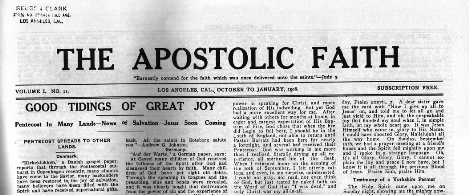
Denmark.
“Kirkeklokken,” a Danish gospel paper, reports that through the Pentecostal outburst in Copenhagen recently, many sinners have come to the Savior, many backsliders have been restored to the joy of salvation, many believers have been filled with the Spirit and have received supernatural gifts.
In Wales
“Praise God for another brother here who has also now received the Pentecost with tongues. He went home from here speaking in tongues all along the street. There are others to follow. Glory to Jesus. Tonight five or six brothers are coming here for their Pentecost. O, I do praise God that He sent me to Sunderland to get such a wonderful blessing. Praise His holy name.”–W. J. Tomlinson, Lynion House, Grove Place, Port Talbot.
Honolulu
Brother and Sister Turney, who have returned from Honolulu, now on their way to Africa report the work in Honolulu: “We had a glorious meeting Honolulu. The power came down and one young man a captain of the Salvation Army, who received his Pentecost, has now opened up an Apostolic Faith Mission in Santa Cruz, Cal. A lieutenant also received his Pentecost and went to carry the news to London, England. Charley Puck, who had a most wonderful experience, is preaching the Gospel on the Island of Hawaii in the city of Kanuela. They are having good meetings and good attendance. People are hungry for the truth.
London, England
I do thank God that there are a few whose eyes God has opened to see their lack and who have waited upon His in prayer for quite a year and a half ** Ackerman Rd., Brixton S.W., London. God has manifested His almighty power there in the baptism of dear Sister Price and one brother and myself, and I am so glad to send in my testimony to the glory of God and the encouragement of all His children. People are coming from far and near, and no one has been even invited. They just hear how God is working and come. This power was mightily present last Thursday, two sisters being shaken and nearly spoke in tongues. One night the very room was shaken as we read in the Word: “And when they had prayed the place was shaken.” Several have had blessed anointings, outpourings of the Spirit and revelations of Jesus Christ. Praise His Holy name.-Mary A. Martin, 319 Southampton St., Camberwell, London, England.
China.
Brother and Sister Garr are in Hong Kong, China, last report. God is using them blessedly. A glorious revival is breaking out. Several souls in Hong Kong have received their Pentecost.
In Macao and Canton, China, numbers have received the baptism with the Spirit. They are hungry for the Holy Ghost. Brother McIntosh wrote, “They come to our house at all times of the day and rap at our door at 11 and 12 o’clock at night, coming to seek for the Holy Ghost, and we stay up till one and two o’clock praying with them, and glory to God, the Pentecost falls and they speak in tongues.” Two sisters who received their Pentecost in Brother Cashwell’s work in the South have gone over to help Brother and Sister McIntosh. They are Sister A.E. Kirby and Sister Mabel Evans. Address Macao, China, care S.C. Todd.
Sweden.
Bramaregarden, Hisingstad, Goteborg, Nov. 19.-“I am very glad to hear from the old Azusa Mission, my home. I have victory through the dear, cleansing Blood of Christ. Glory to His great name! It is one year today since I came over to Sweden and this city Goteborg. God is still saving, sanctifying, and baptizing with the Holy Ghost, and people are getting healed of God. Last Sunday two got their Pentecostal blessing. We had a wonderful day, the Holy Ghost running the meetings, God’s children testifying, praising God, talking in unknown tongues. The fire has begun to fall on small islands near the city. Bless God! The work is still going on in many places in Sweden and God’s people are getting more hungry than ever. We trust God to send out more workers into the field. The fire is falling in ‘Norrland.’ Yet many, many have not heard this Gospel yet. This work will go on till Jesus our Lord comes back. All the saints in Goteborg salute you.”-Andrew G. Johnson.
Germany.
“Auf der Warte,” a German paper, says: At Cassel many children of God received the fullness of the Spirit after God had cleansed their hearts by faith. Many children of God have put right old debts. Through the speaking in tongues and the preaching, sins and bonds were revealed, and it was clearly taught that deliverance from the power of sin and the experience of heart cleansing are the conditions for receiving the Pentecostal baptism.
The manifestations of the Spirit when the souls were touched were different according to I Cor. 12. Some were knocked down to the floor, some were overflowed gently while sitting in their chairs. Some cried with loud voice, others shouted Hallelujah! clapped their hands, jumped or laughed with joy. Some saw the Lord not only in the meetings, but when silent in the houses, or in bed, or when walking on the road, god touched their souls.
All that was uttered in tongues as far as it concerned salvation was in perfect accord with Scripture. What the Lord gave to utter about His Cross, His Glory, and the Second Coming was refreshment and comfort for every believing soul. Through the speaking of tongues and prophecy those in the audience received conviction of their sins; which statement is proven by confessions made afterwards to the minister.
The fire is already burning at Grossalmerode. The Lord is doing great things. Many have received the Pentecostal baptism; and the Lord bestowed gifts upon many, especially the gift of tongues and interpretation.
——–
WITNESSES IN ENGLAND
(From reports printed at Sunderland, Eng.)
Children Receive Pentecost
I was present when the two girls, who were the first children to speak in tongues in England, Janie and May Boddy (the two daughters of the Rev. Alex A. Boddy, All Saints’ Vicarage, Sunderland), received their Pentecost. It was at the Vicarage.
The nine or ten persons present will never forget the scene. Janie received the interpretation for each sentence, and her childlike simplicity and joy, her beaming face, that I shall never forget, she turned message she received was: “Jesus is coming!” With a surprised look of joy on her face, that I shall never forget, she turned to her mother and kissed her, repeating the words: “Jesus is coming, mother!”
Then her fact became serious. She bowed her head a little and lifted her left hand to her cheek (she was kneeling all the time at the end of the table). Again a foreign language was heard. Then came the interpretation: “The Heavens are opened!” followed by the same jubilant glee.
One message was very solemn, spoken, too, with emphasis: “The first shall be last, and the last first.” Coming from such childlike lips, it made a great impression on us all.
Oh, what joy when she said: “Oh! mummie, Jesus has come, and come to stay; oh, good Jesus, good Jesus!” then peals of joybells of laughter.
As she related her experience the next day to a large crowd of children at the Parish Hall, she said, whilst inviting them to seek their Pentecost, “Oh, it is so wonderful, so wonderful!” It was wonderful, it was the Holy Spirit come to dwell within them.
May Boddy had a great revelation of God’s power. She prayed so earnestly that she might not “be left out.” It was touching, too, to see Janie, who had just received her Pentecost, as she laid her hand on her sister’s head and encouraged her; “It’s all through the Blood, May, all through the Blood! Jesus is come, He said, May too, May too.”
May spoke a long time. Some words were very clear. It seemed as if she was constantly claiming Jesus. His name was repeated time upon time. The words, “Aa, Ja, Jesus! Ja, ja, ja, Jesus!” were distinctly Norwegian, with the correct pronunciation (Oh, yes, Jesus! yes, yes, yes, Jesus!)
These two dear children have been kind and good girls before and loved Jesus dearly but now they love Him much more and are bold to tell others of His wonderful power to save-T.B. Barratt.
Testimony of a Vicar’s Wife
After a long time of silent waiting upon Him, God gave me a wonderful vision of Christ in the glory at the right hand of the Father, and from Him came a wonderful light on to me, causing me to laugh as I had never done before. I thought this was the Baptism, for this gave me more power in speaking for Christ, and more realization of His indwelling, but yet God had a more excellent way for me. After waiting with others for months at home, in eager and earnest expectation of His Baptism of Fire, God chose that when the fire did begin to fall here, I should be in the South of England, not able to return until Pastor Barratt had been here for nearly a fortnight, and several had received their Pentecost. God was working in me more than I realized, literally drying up all experience, all spiritual life of the flesh. When I returned home on the evening of the 10th of September, I felt utterly callous, and even, to my surprise, uninterested I could not pray, nor read, nor even think of God, but just rested by naked faith on the Word of God that “I was dead,” and only Christ was my all-in-all.
I went to the meeting the next evening, but could not sing nor pray, I just rested in God and asked Him to lead the Pastor to lay hands on me when He wished. Soon the Pastor was “filled with the Holy Ghost” and came to me. When he laid hands on me, I expected a great rush of feeling, such as I have often experienced, as the Life of Jesus thrilled through me body, but I felt nothing. The Spirit then flashed light on to the Word, “They laid hands on them and they received the Holy Ghost.” I should like to emphasize that it was at this point of really believing in my heart God’s Word, that I had received (Acts Viii., 17), that He began to manifest His presence (the empty cleansed vessel receiving the out-poured gift), and I just rested again in the fact that God the Holy Ghost had come and would do His own work. Suddenly the Lord fulled His Temple and I was in the glory. What followed I cannot describe, and it is too sacred to do so, but I knew God had come. Though never unconscious, I was quite oblivious to everyone around, just worshiping. Then my mouth began to quiver, my tongue began to move, and a few simple words were uttered, as I just yielded to the Holy Ghost. Much to my astonishment, I began to speak fluently in a foreign language-Chinese I think. The Spirit sang through me. The joy and rapture of this purely spiritual worship can never be described. If for no other purpose, I felt at last satisfied that “there was no difference between me and them as at the beginning,” Acts xi., 15. Then came a vision of the Blood. As the Spirit spoke that word I was conscious that ALL heaven oh glory! (myself included) was “worshiping the Lamb, as it had been slain.” Oh, the efficacy, the power of the Blood. In one moment, what I had believed in for years was illuminated as a reality. Nothing else can take its place, it is the Blood that cleanseth. Then came more words in ‘tongues’ with the interpretation. “Worthy is the Lamb; Jesus is coming.”
People say, “What is the difference now?” Just this, and this is all the difference. What one has held on to by faith in the Word, is a reality. I know, as never before, that Christ liveth in me. The Power to love and believe and witness is there, as never before; and last, though not least, after longing with a hungry heart for years to satisfy my God and Savior, that “He might see the travail of His soul and be satisfied,” I thank Him with all my heart that at last He has received from me pure spirit-worship-“mysteries,”-I Cor. 14, 2; John 3, 23. I recognize, as never before, that it is still a walk of faith and obedience, that I am nothing, and Christ is my all in all. I am launched out into the fathomless ocean of God’s love, joy and peace. It is “joy unspeakable and full of glory.” I thank god for the Pentecostal sign of ‘tongues.’ I did not ask for ‘tongues’ but for the Holy Ghost, and He “gave me utterance,” and the joy of praising God in the Spirit is truly wonderful.-Mrs. A.A. Body, Sunderland, Eng.
Testimony of a Sunday School Teacher
On Sunday, September 8th, I surrendered my whole being full to Jesus and accepted cleansing through His most precious Blood, and on Monday, September 9th, while reading a little booklet, I got a great blessing form these two verses:-
Nothing to settle? all has been paid,
Nothing of anger? peace has been made;
Jesus alone is the sinner’s resource,
Peace He has made by the Blood of His cross.
Nothing of guilt? no, not a stain,
How could the Blood let any remain,
My conscious is purged, my spirit is free,
Precious Blood is to God and to me.
And then I claimed my Pentecost through that precious Blood, and stood firm on the blessed promises in Luke xi., 13, and Luke xxiv., 49, and I praised Him for it until Friday, September 13th. Oh, that glorious night when Christ came into my heart in all His fullness. It was about twenty minutes to nine when I went into the meeting and they were singing “Rest in the Lord,” the message He gave me on Thursday, Psalm xxxvii., 7. A dear sister gave me the card with “Now I give up all to Jesus” on, and told me to let all go and just yield to Him, and oh, the unspeakable joy that flooded my soul when I, in simple faith, let my whole heart go. It was Jesus Himself who came in, glory to His Name. I could have shouted Glory, Hallelujah! all the way home. On Sunday, September 15th, we had a prayer meeting at a friend’s house and the Spirit fell mightily upon me and I spoke in a strange language. Oh, it’s all Glory, Glory, Glory, I cannot explain the joy and peace I now have, but I know it is all through the precious Blood of Jesus. Praise Him, praise Him.
Testimony of a Yorkshire Farmer
The Holy Spirit came upon me on Sunday night, showing me the mighty power in the blood of Jesus. The following night it was Jesus himself and the Holy Spirit entering in like a flood. I do thank the Lord that He enabled me to take Him in, or rather, He so melted me that I allowed Him to come in. I took Him in all His fullness, that the life of the head might be the life of the member of the body. How unnatural it would seem to see a person going about with life in the head and not the same life running through the body and the head no control over the body. I feel that I want to be like the bed of a river, perfectly still, but wide enough to admit a flood. When I got home on Tuesday night, I was sitting by myself occupied with the Lord, when I got the sign of tongues. Glory to the name of Jesus.
——–
PENTECOSTAL MISSIONARY REPORTS
Since the last paper, Spirit-filled missionaries have gone out from Los Angles to Monrovia, Liberia, Africa, two sisters to South China and a band of nine missionaries to North China. Also a band of fourteen missionaries went from Spokane, Wash., to Japan and China. They were able to talk to the Chinese and Japanese at the dock and on the ship in their native languages. The “Apostolic Light” is now published by Brother Ryan in Tokyo, Japan.
Our dear Brother A.H. Post who is on his way to South Africa from Los Angeles, writes from London, England, “Praise our god the ‘latter rain’ is falling in England. Glory to our God forever. I do greatly rejoice in Him for this blessed privilege of carrying this wonderful salvation to other nations. My heart leaps with joy and burns with His love for so great a privilege.” Address him at 14 Ackerman Road, Brixton, London, S.W., care Mrs. Price.
We never saw a more humble and Spirit-filled band of missionaries than the dear ones that left Los Angeles for North China, going by the way of Seattle where they were joined by others, making twelve in all, besides children. Brother Bernstein, Brother and Sister Hess and six workers from the Swedish Mission, made up the company from here. They went out trusting God alone for their support. Brother Bernsten says, “God has laid it on my heart to go to a new field and open up the work there. It is on the railroad line south of Peking, a big field, and to open our home for any independent worker filled with the Holy Ghost and fire, to come and stay with us until they are sure where God wants them. Pray for a dwelling place and a home convenient for Chinese orphans.” We are expecting God to wonderfully bless these consecrated and anointed ones. They are going into the famine district. Address B. Bernsten, Taiming fu, Chih-li, North China.
—
Our dear Sister Farrow, who was one of the first to bring Pentecost to Los Angeles, went to Africa and spent seven months at Johnsonville, 25 miles from Monrovia, Liberia, in that most deadly climate. She has now returned and has a wonderful story to tell. Twenty souls received their Pentecost, numbers were saved sanctified and healed. The Lord had given her the gift of the Kru language and she was permitted to preach two sermons to the people in their own tongue. The heathen some of them after receiving the Pentecost, spoke in English and some in other tongues. Praise God. The Lord showed her when she went, the time she was to return and sent her the fare in time, brought her home safely, and used her in Virginia and in the South along the way.
——–
There is no man at the head of this movement. God Himself is speaking in the earth. We are on the verge of the greatest miracle the world has ever seen, when the sons of God shall be manifested, the saints shall come singing from the dust (Isa. 26:19) and the full overcomers shall be caught up to meet the Lord in the air. The political world realizes that some great crisis is at hand, the scientific world, the religious world all feel it. The coming of the Lord draweth nigh, it is near, even at the doors.
THE APOSTOLIC FAITH
312 Azusa Street
—————————————————————–
Published by
THE APOSTOLIC FAITH MISSION
Headquarters, Los Angeles
Subscription Free
_________________________________________________________________
—————————————————————–
QUESTIONS ANSWERED
Should a person seek sanctification before the baptism with the Holy Ghost?
Yes. Sanctification makes us holy, but the baptism with the Holy Spirit empowers us for service after we are sanctified, and seals us unto the day of redemption. Sanctification destroys the body of sin, the old man Adam. Rom. 6:6, 7, “Knowing this, that our old man is crucified with Him, that the body of sin might be destroyed, that henceforth we should not serve sin.” When a man has been saved from actual sin, then he consecrates himself to God to be sanctified, and so his body of sin is destroyed or crucified. Then the resurrection life of Christ rises in his soul according to the Scriptures, Rom. 6:8, “Now if we be dead with Christ, we believe that we shall also live with Him.”
Is it necessary for a person to leave their home duties in order to wait at some place for the Holy Ghost?
No; you can wait right in the kitchen or in the parlor or in the barn. Some have received the baptism of the Spirit in their barns, some in the kitchen, some at family worship, some on their porch, some about their business.
Must people give up their property and have all things in common, in order to receive the Pentecost?
No; God has made us stewards over all that we have, and He lays on our hearts to give as He prospers us. At the beginning of Pentecost, there was a great awakening in Jerusalem, and many people were waiting for salvation. Numbers of them were poor and had no home, and were in need of food and raiment. And God laid it on the hearts of as many as were possessors of lands or houses that they sold their possessions and brought the price and laid the money at the apostles feet, to help supply the food and to spread the Word of God, that it might be preached over the world. But they did not do this in order to get salvation. God laid it on their hearts to do this for a special need. So those that were sent to preach the Gospel found favor with all the people and their needs were supplied, and they all were in one accord in the Spirit. But God does not mean that we should today, wherever the baptism is poured out, just sell our homes and come and wait for salvation, and expect to receive salvation simply because we have sold out our homes and our business and given up our talents. We can have positions that are decent and get salvation also, and can be called to a special business and can keep saved.
We read God’s word in I. Thess. 4:11, “And that ye study to be quiet and to do your own business and work with your own hands as we commanded you; that ye may walk honestly toward them that are without, and that ye may have lack of nothing.”
People that have large families have become so enthused over this wonderful salvation that they have sometimes sold out their homes, when God has not said so. We believe that people can have homes and still be in God’s order. We bless God for everyone to whom He has given homes and still be in God’s order. We bless God for everyone to whom He has given homes.. We tell them not to run ahead of the Spirit in selling their homes, except God has really laid it on their hearts to do so. We have seen many that did so and regretted it afterwards.
What is the real evidence that a man or woman has received the baptism with the Holy Ghost?
Divine love, which is charity. Charity is the Spirit of Jesus. They will have the fruits of the Spirit. Gal. 5:22. “The fruit of the Spirit is love, joy, peace, longsuffering, gentleness, goodness, meekness, faith, temperance; against such there is no law. And they that are Christ’s have crucified the flesh with the affections and lusts.” This is the real Bible evidence in their daily walk and conversation; and the outward manifestations; speaking in tongues and the signs following; casting out devils, laying hands on the sick and the sick being healed, and the love of God for souls increasing in their hearts.
Can a person lose the Pentecost and be restored?
Yes; if they have not sinned willfully. A willful sin means to deny the Blood of Jesus Christ and insult the Spirit of truth, which is the blessed Holy Ghost. Then there is no more remission of sin. But the person that has been snared by Satan and will confess their sin and turn to God will find saving power in the Blood to cleanse them. There is a great difference between denying the Blood of Jesus Christ or doing despite to the Spirit, and just simply falling into temptation and being overcome by Satan. If they repent and do the first works, and consecrate to receive sanctification, and wait for the baptism, they can get it again.
Do you teach that it is wrong to take medicine?
Yes, for saints to take medicine. Medicine is for unbelievers, but the remedy for the saints of God we will find in Jas. 5:14, “Is any sick among you, let him call for the elders of the church, and let them pray over him, anointing him with oil in the name of the Lord, and the prayer of faith shall save the sick, and the Lord shall raise him up; and if he have committed sins, they shall be forgiven him.”
Does the Lord Jesus provide healing for everybody?
Yes; for all those that have faith in Him. The sinner can receive healing.
Does a soul need the baptism with the Holy Ghost in order to live a pure and holy life?
No; sanctification makes us holy, Heb. 2:11, “For both He that sanctifieth and they who are sanctified are all of one, for which cause He is not ashamed to call them brethren.” The Holy Ghost does not cleanse anyone from sin. It is Jesus’ shed Blood on Calvary. The Holy Ghost never died for our sins. It was Jesus who died for our sins and it is His Blood that atones for our sins. The Scripture says, I. John 1:9, “If we confess our sins, He is faithful and just to forgive us our sins and to cleanse us from all unrighteousness. And as He is in the light, we have fellowship one with another, and the Blood of Jesus Christ His Son cleanseth us from all sin. It is the Blood that cleanses and makes holy, and through the Blood we receive the baptism of the Holy Spirit. The Holy Ghost always falls in answer to the Blood.
Do we need to study the Bible as much after receiving the Holy Ghost?
Yes; if not we become fanatical or many times will be led by deceptive spirits and begin to have revelations and dreams contrary to the word, and begin to prophesy and think ourselves some great one, bigger than some other Christians. But by reading the Bible prayerfully, waiting before God, we become just little humble children, and we never feel that we have got more than the least of God’s children.
Is it necessary to have hands laid on in order to receive the Holy Ghost?
No; you can receive Him in your private closet. The gift of the Holy Ghost comes by faith in the word of God. You may receive the Holy Ghost right now, that is if you are sanctified. Take your Bible, turn to the first chapter of Acts, 5th verse, “For John truly baptized with water, but ye shall be baptized with the Holy Ghost not many days hence.” Just read this verse of Scripture and cry out to the Father, “Lord Jesus, baptize me with the Holy Ghost,” and believe the Lord with all your heart and the power will fall.
The baptism of the Spirit is a gift of power on the sanctified life, and when people receive it, sooner or later they will speak in tongues as the Spirit gives utterance. A person may not speak in tongues for a week after the baptism, but as soon as he gets to praying or praising God in the liberty of the Spirit, the tongues will follow. Tongues are not salvation. It is a gift that God throws in with the baptism with the Holy Spirit. People do not have to travail and agonize for the baptism, for when our work ceases, then God comes. We cease form our own works, which is the very type of the millennium.
Is the speaking in tongues the standard of fellowship with the Pentecost people?
No; our fellowship does not come through gifts and outward demonstrations but through the Blood by the Spirit of Christ. There is nothing more loving than the Blood of Jesus Christ in our hearts. The Lord Jesus says, “If we walk in the light as He is in the light, we have fellowship one with another, and the Blood of Jesus Christ, His Son, cleanseth us from all sin.” If a man is saved and living according to the word of God, he is our brother, if he has not got the baptism with the Holy Spirit with tongues.
How are we to keep the anointing of the Spirit after receiving the Pentecost?
By living in the word of God with perfect obedience.
In meetings, should a number speak in tongues at the same time?
No; except as God sends a wave of the Spirit over the saints. Sometimes the Spirit will come as a shower or a rushing wind and everybody may speak that has the power. But it is not in order or Bible regulation for all to speak in tongues at once. I. Cor. 14:23, 24. Yet sometimes God works in ways that we do not just understand. But for the edification of all, there comes a time when we have to get back to the 14th chapter of First Corinthians from the 26th to the 40th verses. Paul says, “Let all things be done decently and in order.”
Is this movement a new sect or denomination?
No; it is undenominational and unsectarian. We believe in unity with Christ’s people everywhere, in the Word of God. It is the old-time apostolic assembly, the same old teaching of 1900 years ago. It is new to the world in these last days, but its teaching and doctrine is old as the New Testament.
Does any man control the missions of the Apostolic Faith?
No; every mission will have its own elders and teachers as the Holy Ghost shall appoint and teach the pure word of God. Every mission will be in harmony and work in unity. The Lord has deacons, elders, and teachers for the perfecting of the ministry in His saints, until we all become a perfect man in Christ Jesus.
What is the Bible way for a preacher to get his support and to raise the expenses of the church?
To pray to the Lord God and by free will offerings and donations, as God lays it on the hearts of the people that he is laboring with. God will graciously supply all needs, if you simply will trust Him and look to Him. He will pay off expenses.
Do you teach that divine love in the heart would make any familiarity between men and women safe and right?
No, every precious child that is getting the baptism of the Holy Spirit should be watchful and avoid all appearance of evil. Satan is transformed as an angel of light to deceive many precious souls that receive great spiritual blessings; and not understanding the cunning devices of the enemy, people have been led by Satan into freelovism. Some have taught that a baptism of love would make you so holy that you could overstep he bounds of propriety. May God help us to keep free from anything that is impure. If a person happens to get under the influence of these powers, they must denounce their doctrine and get these spirits cast off from them and get under the Blood. The doctrine of freeloveism is Satan’s counterfeit of genuine salvation through the Blood of Jesus.
On what grounds did the Lord Jesus teach that a man and wife could separate?
On the ground of fornication. These are the words of Jesus, “It hath been said, whosoever shall put away his wife, let him give her a writing of divorcement; but I say unto you that whosoever shall put away his wife, saving for the cause of fornication, causeth her to commit adultery; and whosoever shall marry her that is divorced committeth adultery.”-Matt. 5, 31, 32. Notice He says, “It hath been said, let him give her a writing of divorcement.” This used to be the teaching before the great Teacher came, but in Christ’s church there is no divorcement. Now a man has a right by the Scripture to put away his wife for fornication, but he has no right to marry another, according to the Scripture, while she lives. “For the woman which hath a husband is bound by the law to her husband, so long as he liveth; but if her husband be dead, she is loosed from the law of her husband; so then if while her husband liveth, she be married to another man, she shall be called an adulteress.”-Rom. 7:2, 3.
If a man puts away his wife, except for fornication, he exposes her to get another husband and send her soul to hell, so it will pay every man and every woman to live with their companion for the salvation of their soul, except for the cause of fornication. He has a right to put away but not a right to get another again.
Do you have preachers and evangelists of the Apostolic Faith that have two wives or two husbands?
No, we did allow it before we became settled down and searched the Scriptures and compared scripture with scripture. We allowed those that were divorced and remarried to preach the Gospel, thinking that everything was under the Blood, and if they did not have any more light it did not condemn them. But after searching the Scriptures, we found it was wrong; that the widow was to be the wife of one man and the bishop was to be the husband of one wife. We found no scripture where the preacher could be engaged in this blessed Gospel ministry with two living companions.
If people never had light on the divorce question and have the second companion, how shall they regulate their lives in harmony with the Scriptures?
“If any man come to Me, and hate not his father and mother and his wife and children and brethren and sisters, yea, and his own life also, he cannot be My disciple.”-Luke 14:26. That does mean to desert a lawful wife, but it means to let nothing stand between you and Christ. “And whosoever doth not bear his cross and come after Me, cannot be My disciple.”-Luke 15:27. “And if thy right eye offend thee, pluck it out and cast it from thee; for it is probable for thee that one of thy members should perish, and not that thy whole body should be cast into hell. And if thy right hand offend thee, cut it off, and cast it from thee; for it is profitable for thee that one of thy members should perish, and not that thy whole body should be cast into hell. It hath been said, whosoever shall put away his wife, let him give her a writing of divorcement but I say unto you, that whosoever shall put away his wife, saving for the cause of fornication, causeth her to commit adultery; and whosoever marrieth her that is divorced, committeth adultery.”-Matt. 5, 29, 32.
Can a child of God be possessed by evil spirits?
No; evil spirits cannot come under the Blood, any more than the Egyptians could pass through the Red Sea-the Red Sea represents the Blood of Jesus Christ. The Blood gives you power over all the power of the enemy. But we must have Christ within us. If the soul is left empty and no “strong man” within, then the evil spirit can just take the house. (Luke 11:21, 26.) Some say that when the soul is sanctified, the house is empty and clean, and if he does not get the Holy Ghost, a wicked spirit can come in. Don’t you ever believe that. That empty house represents a man that had a demon cast out (as we see plainly in the 24th verse); and he did not get Christ within. But a man that is sanctified has Christ ruling within. People that are living under the Blood live free from demons and satanic powers. They live pure and holy before the Lord. A man might be a Christian and oppressed by a demon, but that is altogether different from being possessed. Wicked spirits are driven out and repentance and faith wrought in the heart, when a man if justified. Then Christ comes in and keeps them out. A demon might be in the flesh as in the case of a cancer. The devil may oppress the body with sickness but that is very different from possessing the soul.
——–
A WONDERFUL BAPTISM IN ENGLAND
Two years ago, a special work of grace began. The Holy Spirit came upon me with manifestations, and the old natural life was in very deed and truth crucified with Christ. And from that time, I became a crucified follower of my crucified Lord. Anointings of the Holy Spirit were continually given me for service, as each need arose. It was indeed a walk in newness of life, proving the power of His resurrection.
On the last night of the old year, came the command to tarry, which was promptly carried out. The result being a further revelation of the exceeding sinfulness of sin and of His glorious holiness and love. At the end of eight days came a baptism of fire burning and consuming through my whole being as the very ashes of my old life were consumed and done away with. Love to God and man took possession of me, and I was filled to overflowing with the resurrection life of my Lord. Much time daily was spent in silent waiting before the Lord, receiving from His Holy Spirit such teaching, that what had formerly been light was translated into life for spirit, soul and body.
With two dear Pentecostal saints, I met for prayer and waiting. I saw in vision Christ on Calvary, bearing my sin. Each act of sin was laid separately upon Him and weighed Him down deeper and deeper, until beneath the awful weight of blackness and darkness of woe and of anguish, His heart was broken and mine seemed to break with His. How long this lasted, I do not know; but at length, consciousness returned. The glory broke and the Holy Spirit sang through me in English a hitherto unknown song of praise and thanksgiving for the precious, precious Blood, and of glory to the Lamb upon the throne.
On the evening of our next united gathering for prayer and waiting, revelation after revelation was given of the Lamb; the glory of the Lamb, the power of the Lamb, the victory of the Lamb, the marriage of the Lamb, and the reign of the Lamb with His glorified bride. I knew from that moment that Christ Jesus was on the throne of my heart as the Lamb slain from the foundation of the world, and that His purpose was to demonstrate the Lamb life through me.
The Holy Spirit descended in clouds of glory, wave after wave of glory broke upon me. Tidal waves of resurrection life and glory surged through every organ of my body, so that I was constrained to cry aloud for everything within me shouted “Glory” and could not be silenced.
I realized that this was that which was spoken by the prophet Joel, that God had made good His promise to me, and poured upon me His Holy Spirit. Glory to His name.
When I was once more alone, the Lord spoke to me and asked if I was disappointed that the gift of tongues had not been given. Disappointed Lord! I have You and You can speak in every tongue. It was You I wanted-You alone; and now You have taken full possession. He gave me to understand that tongues would soon be given. And a few days later when in prayer with two dear friends, He gave me the gift, and the Holy Spirit sang through me in a tongue utterly unknown before. The interpretation was given, and I knew it was all about the precious, precious Blood. Glory to the Triune God! Glory to the Lamb upon the throne.-Your English sister, M.J.D.
——–
“Jesus is coming soon,” is the message that the Holy Ghost is speaking today through nearly everyone that receives the baptism with the Holy Ghost. Many times they get the interpretation of the message spoken in an unknown language and many times others have understood the language spoken. Many receive visions of Jesus and He says, “I am coming soon.” Two saints recently in Minneapolis fell under the power were caught up to Heaven and saw the New Jerusalem, the table spread, and many of the saints there,-both seeing the same visions at the same time. They said Jesus was coming very soon and for us to work as we had little time.
—
Wherever this blessed Gospel goes, through Christ’s Spirit-filled servants, a fruitful field grows up right away. The birds all begin to sing, showing spring has come. The flowers all bud out in their souls, and they commence singing in tongues like the birds, showing us that the Holy Ghost brings spring to our hearts, and the blossoms and the fruit commence growing. Glory to God.
CHRIST’S MESSAGES TO THE CHURCH
The last message given to the church was by the Holy Ghost, from our Lord and Savior Jesus Christ through Brother John on the Isle of Patmos. Dear beloved, we read in Revelations 1:5-7, these words, “Unto Him that loved us and washed us from our sins in His own Blood.” Hallelujah to His name. “And hath made us kings and priests unto God and the Father; to Him be glory and dominion for ever and ever. Amen. Behold He cometh with clouds; and every eye shall see Him, and they also which pierced Him; and all kindreds of the earth shall wait because of Him. Even so, Amen.”
This is the beginning of this wonderful and blessed message given to our beloved Apostle John while he was suffering for the word of God and for the testimony of Jesus Christ. Jesus knew all about His servant, though He had been living in Heaven more than half a century after His ascension. And He came and visited that beloved apostle, the disciple who loved Jesus and leaned on His bosom. He now was old but had been faithful to the trust that Jesus had given him. He had passed through awful trials and tribulations for this precious Gospel, even being boiled in a caldron of oil, tradition tells us; but, blessed be God, they were not able to kill him. And when they got tired of this precious Holy Ghost Gospel messenger, preaching to them the faith of Jesus, they banished him to the Isle of Patmos. And while he was in the Spirit on the Lord’s day, our blessed Jesus Christ, the Son of the living God, our great Redeemer, came and gave him this wonderful revelation, and introduced Himself to John as, “I am Alpha and Omega, the beginning and the ending, said the Lord, which is, and which was, and which is to come, the Almighty.” Hallelujah.
O beloved, the Lord Jesus knows all about our trials and tribulations, because He was a man of sorrows and acquainted with grief. His whole life was a life of suffering. We read in Heb. 5:7, 8, “Though He were a son, yet learned He obedience by the things which He suffered. And being made perfect, He became the author of eternal salvation unto all them that obey.” O bless our God. Just to think that Jesus was God’s Son, and all things were made by Him and for Him; yet He was foreordained before the foundation of the world that He should die. He was slain before the foundation of the world. So the Word of God became flesh and dwelt among men and was handled by men, and lived in this world. And at the age of 33 years, He paid the debt on Calvary’s cross. O beloved, if we expect to reign with Him, we must suffer with Him-not that people must be sick or unhealthy or go with a long face, but we must bear all things and keep the faith of Jesus in our hearts. Our lives now are with the suffering Christ: and “it doth not yet appear what we shall be, but we know that when He shall appear, we shall be like Him; for we shall see Him as He is.” Glory to Jesus.
After Jesus introduced Himself, He gave John these blessed messages to the church. John was permitted to see from the beginning of the church age on down to the white throne judgment, the final winding up of the world. He was permitted to see the overcomers. He was permitted to see the millennial reign with Jesus in triumph over the kingdoms of Satan; to see this old world pass away, to see the new heavens and new earth, and the New Jerusalem coming down from God out of Heaven. John saw things past, things present, and things in the future. He had witnessed the glory and power of the apostolic church, and saw the falling away of the church, and God sent him to the church with this blessed message; that she should come back to her first love.
The Vision of Jesus in His Church
The most striking passage of Scripture in the first chapter is where John was permitted to see Jesus walking among the golden candlesticks, which represent the church. Christ is in His church today to fill men and women, to heal their bodies, save and sanctify their souls, and to put His finger upon every wrong and mean thing in the church. His rebuke is against it, for He hates sin today as much as He ever did when He walked by the Sea of Galilee. Glory to His name. Jesus hates impure doctrine just as much as when He rebuked the Pharisees for their impure doctrine.
John beheld Jesus in His glorified body. What a holy scene it was: the Son of God clothed with a garment down to the foot and girt about the paps with a golden girdle. “His head and His hairs were white like wool, as white as snow.” Hallelujah. There is nothing but purity and holiness in our Savior. And “His eyes were as a flame of fire.” Glory to Jesus. “And His feet like to fine brass, as if they burned in a furnace. And His voice as the sound of many waters,” which represents many people. Bless God.
“And He had in His right hand seven stars.” This represents His Holy Ghost ministers. Jesus has them in His hand, that is to say that He gave them the authority to preach the Gospel and power over devils. All of our authority and power comes from Jesus. It is so sweet when we know that we have authority from Jesus. Bless His holy name. O beloved, when we know Jesus Christ has His minister in His hand, we know that minister is a live preacher. Glory to Jesus. Hallelujah. A live minister represents one that is saved, sanctified and filled with the Holy Spirit. Then the same life, the same authority that Jesus promised we will find in his life.
“And out of His mouth went a sharp two-edged sword, and His countenance, was as the sun shineth through the blessed Christ. “And when I saw Him, I fell at His feet as one dead. And He laid His right hand upon me, saying unto me, Fear not; I am the first and the last.” Praise God, Jesus is alive and because He lives everyone that gets Christ is alive in the blessed Holy Spirit. The Blood of Jesus Christ does give life, power and fire, joy, peace, happiness and faith. Hallelujah to His name.
“I am He that liveth and was dead, and behold, I am alive for evermore.” Bless His holy name. He wanted John to know that He was the same One that hung and bled and died and shed His precious Blood on Calvary’s cross, went down into the grave, and rose again. This ought to make the whole body of Christ’s people everywhere happy to know that Jesus is alive for evermore. Hallelujah to His name.
Then He said, “And have the keys of hell and of death.” Bless God. No wonder Bro. David said, “Though I walk through the valley of the shadow of death, I will fear no evil, for Thou are with me.” When we get Jesus Christ in our hearts, we can use the word and it is a comfort to us to know that we have passed from death to life.
Then He told John particularly, “Write these things which thou hast seen, and the things which are, and the things which shall be hereafter.”
The Message to the Church of Ephasus
Then He gave him the messages to the seven churches. “And to the angel of the church at Ephesus write, “These things saith He that holdeth the seven stars in His right hand, who walketh in the midst of the seven golden candlesticks.” Hallelujah to His name. Ephesus was a city of Asia, quite a commercial city, a city of wealth, refinement, culture and great learning. It was where John preached and where Paul had labored. Many people there had been saved and baptized with the Spirit. Paul had witnessed a great scene in Ephesus where he had preached the Gospel of the Son of God and of the doctrine of the baptism with the Holy Spirit, and 12 men after hearing of this blessed doctrine, received water baptism, and when Paul laid his hands on them, they received the baptism with the Holy Ghost and spoke with tongues and prophesied. Acts. 19;6. So Ephesus was a favored place, but the message was sent to it and to all the churches of Asia. This is a true picture of the Lord Jesus’ eyes upon the church ever since its beginning, and; will be unto the end. We are living near the close of the Gentile age down in the Laodicean period, when the church has become as formal as the Laodiceans. This message was first to the church of Ephesus.
I Know Thy Works
The Lord Jesus said, “I know thy works.” God knows our works, He knows our hearts. “And thy labor and thy patience, and how thou canst not bear them which are evil; and thou has tried them which say they are apostles, and are not, and hast found them liars; and hast borne and hast patience, and for My name’s sake hast labored and hast not fainted.” Bless our God. That is more than many churches today could receive from the Master. Jesus commended them for what they had done. He commended them for their faithfulness. He is not like men. He knows our hearts, our trials, our conditions. But bless God, He does not make any allowance for sin. He hates sin today as much as He ever did. Yet He does not come to destroy us or condemn us, but to seek and to save us.
“Nevertheless I have somewhat against thee, because thou hast left thy first love.” The Lord does not want anything to get between us and Him. O may every precious child in these times that are getting the Holy Spirit not go into apostasy, but may they be a burning and a shining light for God, just as we were when we first received the baptism with the Holy Spirit. God wants us to keep the same anointing that we received and let nothing separate us from Christ.
Repentance
We find Jesus still preaches the same doctrine of repentance that He preached while on earth. In order to get right with God, He says , “Remember from whence thou art fallen and repent and do the first works, or else I will come unto thee quickly, and will remove thy candlestick out of his place, except thou repent.” Dear beloved, if there is anything wrong in your life and Jesus has His finger is truly in His church today. This is the Holy Ghost dispensation and He does convince men of sin, righteousness and the judgment, and if we will be honest, God will bless us.
To the Church Today
When a church or mission finds that the power of God begins to leave, they should come as a whole and confess, and let all get down before God and repent and pray to god until the old time fire and power and love come back again. Many times the Holy Spirit will leave an assembly, mission or church because the pastor grieves Him, and sometimes not only the pastor but the whole body commences backbiting, whispering, tattling, or prejudice and partiality creep in, until the whole becomes corrupted and Jesus is just ready to spew them out of His mouth. But, O beloved, let us then come to the 2nd chapter of Revelation and see what Jesus says to the assembly. He expects to find the church, when He comes back to earth again, just as full of fire and power and the signs following, as it was when He organized it on the day of Pentecost. Bless His holy name. May God help all His precious praying children to get back to the old Pentecostal power and fire and love. The church at that time was as terrible as an army with banners. She conquered every power of evil. Hypocrites were not able to remain in it any more than Annanias and Sapphira. God gave such wonderful love to His people.
Then He gave messengers to every church, showing that Jesus’ eyes are upon every church. His finger this day is upon every heart that does not measure to the fullness of holiness. God wants a holy church and all wrong cleansed away-fornication and adultery two wives, two husbands, not paying grocery bills, water bills, furniture bills, coal bills, gas bills, and all honest bills. God wants His people to be true and holy and He will work. Nothing can hinder. Bless His holy name.
I thank God for this wonderful message to the church, a message from heaven, given by Jesus to show that He is in the church, that He does walk among the golden candlesticks. He is in heaven, but through the power of the Holy Spirit, He walks in the church today. Nothing can be hidden from His pure eyes. He wants people to live the highest and deepest consecration to Him. He does not want their love for him divided. Their first love is to Him.
Impure Doctrine
We find many of Christ’s people tangled up in these days, committing spiritual fornication as well as physical fornication and adultery. They say, “Let us all come together; if we are not one in doctrine, we can be one in spirit.” But, dear ones, we cannot all be one, except through the word of God. He says, “But this thou hast that thou hatest the deeds of the Nicolaitanes, which I also hate.” I suppose that the apostolic church at Ephesus allowed people that were not teaching straight doctrine, not solid in the word of God, to remain in fellowship with them; and Jesus saw that a little heaven would leaven the whole, and His finger was right upon that impure doctrine. It had to be removed out of the church or He would remove the light and break the church up. When we find things wrong, contrary to Scripture, I care not how dear it is, it must be removed. We cannot bring Agag among the children of Israel, for God says he must die. Saul saved Agag, which represented saving himself, the carnal nature of old man; but Samuel said Agag must die, and he drew his sword and slew him. Christ’s precious word, which is the sword of Samuel, puts all carnality and sin to death. It means perfect obedience to walk with the Lord. There are many people in these last days that are not going to live a Bible salvation, they are going to take chances. But may God help everyone, if their right hand or right eye offend them to cast it from them. It is better to enter into life maimed than for soul and body to be cast into hell fire.
The Lord says, “He that hath an ear, let him hear what the Spirit saith unto the churches; To him that overcometh will I give to eat of the tree of life which is in the midst of the paradise of God.” O beloved, if we expect to reign with the Lord and Savior Jesus Christ, we must overcome the world, the flesh, and the devil. There will be many that will be saved but will not be full overcomers to reign on this earth with our Lord. He will give us power to overcome if we are willing. Bless His holy name.
W.J. Seymour.
——–
CHINA MISSIONARY RECEIVES PENTECOST.
On leaving China, October, 1906, I was asked to investigate the Apostolic Faith Movement in Los Angeles, where they claimed to have manifested the same gifts of the Holy Ghost as of old. (I Cor. 12: 8-10.) I heard such contradictory reports that I kept away for some time, but praise God, He had His hand upon me for this wonderful gift, and I had no rest until I went and heard and saw for myself.
It only took a short time after the beginning of the first meeting, to know it was of God. And when the altar call came, I went forward.
Before this I had asked God to turn His great searchlight upon my heart and was astonished to find so much worldliness, spiritual pride, vanity, insincerity, lack of love, selfishness, and other things. When I had left for the foreign field seven years before this, I thought I had died to everything; but when the Spirit began to deal with me in preparing me for the fullness of the Spirit, I found I was very much alive, in fact had scarcely begun to die to self. Although the Lord had given me wonderful victories in my life and what I thought was the baptism of the Spirit, yet when God began to search me as never before, I had to confess that I had never even been sanctified.
I had been taught the suppression theory, and now and again the “old man” would pop up in a greater or less degree; sometimes harsh words did not escape, but I would feel the boiling up inside. But God showed me that His word meant just what it said, that provision was made in the atonement-not only for our sins but for our sin, the old Adamic nature. (Rom. 6: 6, 18, 22.) How I did rejoice that at the last, the longing of my heart to be rid of that which had kept me from being entirely free from sin, was to be satisfied. I had sought my baptism of the Spirit three times, when the Lord told me that I must be sanctified before the Spirit could take full possession of my body. Just so were the disciples sanctified before Christ left them (John 17: 17, 19), that they might be ready for the baptism of the Spirit.
After some of the saints had prayed for me, one of them asked me if I had the witness of the Spirit to my sanctification according to Heb. 10: 14, 15. For some years back I had been taught of the Spirit to keep “short accounts” with the Lord, and there was nothing left to do in the way of restitution; and having laid all on the altar, I knew I had met the condition, and that god had fulfilled His promise; although there was no other feeling than the assurance that God had done the work because of His Word. I then began to praise God audibly, and in a few minutes I was flooded with billows of glory, and the Spirit sang through me praises unto God. Besides this witness of the Spirit, was the witness of the fruits; for under whatever provocation, there is no uprising, for there is nothing to rise up. Glory to Jesus.
When sanctified, I was filled with such glory that I felt sure it must be the baptism, which did not come for three weeks. In the meantime, the power was upon me almost continually, sometimes lying under the power for hours, while I consecrated myself to God as never before.
At last after a real dying out, as I never dreamed could be possible on earth, in the upper room at Azusa Mission, the promise of the Father was made real to me, and I was charged with the power of God and my soul flooded with glory. The Spirit sang praises unto God. Glory to Jesus. He gave me the Bible experiences, speaking through me in other tongues..
The Lord showed me that the cross was going to mean to me what it had never meant before. One morning the Spirit dealt with me, singing through me-
“Must Jesus bear the cross alone,
And all the world go free:
No, there’s a cross for every one,
And there is one for me.”
The last line He just seemed to burn into my soul by repeating it over and over again. Sometimes the Spirit would sing a line and then sob out a line. Although I wept and was in anguish of soul, it was all in the Spirit.
The life of Jesus passed before me, and He asked me if I was willing to follow Jesus in living absolutely for Him in ministering unto others. I thought I had known something of what this meant in China; but now to preach the everlasting Gospel in the power and demonstration of the Spirit and to truly go out on the faith line and to minister day and night, sometimes unto the hungry multitudes in the face of fierce opposition, meant far more than ever before. But He enabled me to say, “By Thy grace I will bear this cross.”
The Garden scene came up before me next, as the Spirit again sang, “Must Jesus bear the cross alone?” And He seemed to say, “Your friends will forsake you, your own family will misunderstand you, you will be called a fanatic, crazy; are you willing to bear this cross?” Again I answered, “By Thy grace, I will.”
The crucification scene then came before me and it seemed as if my heart would break with sorrow, and I could only wait in silence. Then I said, “Lord, if it was to be beheaded, I could; but-” I could go no further. Later in the day, the Lord spoke to me again as I was under the power. It seemed as if I would almost perish in soul anguish. I was unconscious of the workers all about me. It seemed as if Jesus Himself stood beside, looking down upon me. I could only say, “Jesus, Jesus, Jesus, I will, I will, I will.” His promises came to me as distinctly as if audibly said, “My grace is sufficient for you.” And in a flash, He gave me to understand the secret of the endurance of the martyrs who were burned at the stake with the glory of heaven upon their faces, and seemingly free from pain. And He enabled me to say, “Yes, Lord, your grace is sufficient.”
Then the Spirit began to sing in a joyful strain, repeating over and over again the last line until I could almost see the crown:
“The consecrated cross I’ll bear,
Till Christ has set me free;
And then go home a crown to wear,
For there’s a crown for me.”
To sum it up, the baptism of the Spirit means to me what I never dreamed it could this side of Heaven: victory, glory in my soul, perfect peace, rest, liberty, nearness to Christ, deadness to this old world, and power in witnessing. Glory to His name for ever and forever!-Antoinette Moomau, Eustice, Nebr.
——–
We ought to claim perfect health through the atonement of Jesus.
——–
The well of water that is within you that springs up into everlasting life is the Spirit, and its fruit is love. That love waters your own soul and everyone else that you come in contact with.
THE BAPTISM WITH THE HOLY GHOST.
There is no difference in quality between the baptism with the Holy Ghost and sanctification. They are both holiness. Sanctification is the Lord Jesus Christ crowned in your heart and the baptism with the Holy Spirit is His power upon you. It is all holiness. It makes you more like Jesus. It is Jesus in justification, Jesus in sanctification and Jesus in the baptism with the Holy Ghost. If we follow Jesus, we will never have any other spirit but the Spirit of holiness.
* * *
Everyone that gets sanctified and cleansed through the Blood has perfect union with the Lord Jesus Christ. The baptism with the Holy Ghost does not cleanse and free you from sin but it is the precious Blood of Jesus Christ. Then the Spirit falls in answer to the Blood.
* * *
Every man or woman that gets sanctified gets the witness of the Spirit. But when you enter into the Holy of Holies, you get the great Shekina glory upon you and cloven tongues of fire, and speak as the Spirit gives utterance, and the pillar of fire guides you every day of your life.
* * *
Everyone that gets this blessed Holy Spirit the signs will follow. Tongues are not an evidence of salvation, but one of the signs that follow every Spirit-filled man and woman. We find the people that abound in talking of Jesus today are people that are given power by the blessed Holy Spirit. The time is out for the work of the flesh.
* * *
When the Holy Ghost comes in, He fills you with love and joy and satisfaction. You have something when you have the baptism with the Holy Ghost. You have Him. People are hunting for blessings, but if you get the Blesser, you have Him all the time. You want not simply a blessing but the Holy Ghost. When He comes down, He will keep a fire in your heart. He is a person, He comes to lead and guide into all truth.
* * *
The baptism of the Spirit is the in-filling of the personal Holy Ghost, which is the earnest of the Spirit. Then God gives us the authority to do the same work that Jesus did. We find where men and women have received this baptism with the Spirit, there is a revival going on just as on the day of Pentecost. That is what the baptism with the Holy Spirit means-a continual revival.
* * *
When you get the baptism, you have a street in your soul called Thanksgiving Street, and you have an Amen Street and a Glory Street. Thanksgiving and the voice of melody is in your soul. When the Holy Ghost comes in, He comes singing, preaching and talking. It is because the church has brought forth the “man child.” Then we go on to perfection, forgetting the things which are behind and pressing forward to the things that are before.
* * *
The Lord God says He will make you witnesses unto the uttermost part of the earth. When He sent His disciples to the lost tribes of Israel. He sent them to those that spoke Greek and Hebrew. They did not need the languages of the nations. But when He sent them out after Pentecost, He gave them the commission, “Go ye into all the world and preach the Gospel to every creature.” And we find the first congregation they preached to after they received the baptism with the Holy Spirit, they had seventeen nationalities that heard the Gospel in their own tongue without confusion. (Acts 2, 9-11.) He is doing the same today, compelling men to believe that He is the same yesterday today, and forever. When God performed a miracle right before those people, of course they were convicted. So it is today where this Gospel is being preached in the power of the Spirit with signs following, men will fall out under the mighty power of God, and rise up and report that God is in you of a truth. This Gospel has power. Bless God.
* * *
The God of Pentecost has never lost any power. He stands to baptize man and women with the Holy Ghost today just as He did 1900 years ago. Every worker that is going out to stand for Christ ought to get the baptism with the Holy Ghost and fire. It is for you as soon as you get light upon it.
* * *
Keep your eyes on Jesus and not on the manifestations, not seeking to get some great thing more than somebody else. The Lord God wants you just as humble as a baby, looking for Him to fill you with more of God and power. If you get your eyes on manifestations and signs you are liable to get a counterfeit, but what you want to seek is more holiness, more of God.
* * *
The Holy Spirit has been in the world ever since God created it, for we find in Genesis 1: 2, “And the Spirit of God moved upon the face of the waters.” This precious Spirit was with Enoch, He was with Elijah, He was with Daniel, He was with God’s priests and prophets, and they spoke as they were moved by the Holy Ghost. The disciples of Jesus knew the Holy Spirit, because they had His presence when they were sent out on a mission, for Jesus empowered them Himself while on earth to cast out demons and heal the sick and raise the dead. The Spirit was upon them for a special work, but He was not in them, for Jesus said to them, “Even the Spirit of truth whom the world cannot receive, because it seeth Him not, neither knoweth Him, but ye know Him for He dwelleth with you and shall be in you.” (John 14, 17.) But when Jesus Christ took His place in heaven on the right hand of God, then He poured out His Spirit and gave us another Comforter that He should abide with us forever, to empower and to lead us into all truth.
* * *
The Holy Spirit talks with us like a companion, for He is a companion. Jesus was the Comforter of His disciples while He was here in the flesh; but He said when He went away, “I will pray the Father and He shall give you another Comforter, that He may abide with you forever. * * * It is expedient for you that I go away, for if I go not away, the Comforter will not come unto you, but if I depart, I will send Him unto you. When He the Spirit of truth is come, He will guide you into all truth.” The day came when He should make His home in the hearts of men and women, it was the day of Pentecost. He came to abide. He is the abiding Comforter. O praise God, He has come and taken His home in our hearts. Everyone can receive the personal Holy Ghost in their hearts, for He says, “I will pour out of My Spirit upon all flesh.”
* * *
The baptism of the Holy Ghost comes on the sanctified, cleansed life. After the vessel is cleansed and made holy, it is meet for the Master’s use. Bless His Holy name. “If a man therefore shall purge himself from these, he shall be a vessel unto honor, sanctified and meet for the Master’s use, prepared unto every good work.” (II Tim. 2, 21.) In seeking this baptism, if you realize that you are sanctified and cleansed by the Blood of Christ, and wait before Him for the out pouring of the Holy Spirit in thanksgiving and faith, He will come in and fill His temple from head to foot. This Holy Ghost is love, power, joy, blessing, wisdom and holiness. He will guide you and open the Scriptures to you.
* * *
The most wonderful thing a man or woman can receive after being sanctified is the outpouring of the Holy Ghost in their heart. He is fire and rivers of salvation in you inmost being. Isaiah prophesied, speaking of the Holy Ghost as floods of water: “I will pour water upon him that is thirsty, and floods upon the dry ground: I will pour My Spirit upon they seed, and My blessing upon thine offspring.” (Isaiah, 44, 3.) “Until the Spirit be poured upon us from on high, and the wilderness be a fruitful field, and the fruitful field be accounted for a forest.” (Isaiah, 32, 15.) Hallelujah! O it is so sweet and precious to receive this almighty baptism with the Holy Ghost in our souls. “He shall come down like rain upon the mown grass; as showers that water the earth. In His days shall the righteous flourish; and abundance of peace as long as the moon endureth.” (Ps. 7 1/2, 6, 7.)
——–
JESUS, O HOW SWEET THE NAME!
“Jesus, oh, how sweet the name!
Jesus, every day the same,
Jesus, let all saints proclaim
Its worthy praise forever-“
is the beautiful hymn the saints sang for three hours the night I received my baptism (June 15th, about 12 o’clock).
Oh, praise the name of Jesus! I sang it until the Precious Holy Ghost took my tongue and spoke for Himself. Oh, how wonderful, oh, how wonderful. Oh, praise God for His wonderful love! I wish I could describe to you what Jesus is to me. Oh, I thought I knew how to love Him before, I thought I knew Him, but never in such a way as I do now. Oh, it is so sweet to commune with God. I just wait before Him by the hour and let Him talk to me. I just cannot tell it. There are not words in the English language that can describe what Jesus is to me. I cannot begin to tell all, as my time is too limited, but will do the best I can.
I received my first anointing May 15th. By the anointing I mean the first I felt the Holy Ghost within. You will know when He begins to work. He just took control of my limbs and head. Oh, I cannot describe it. You must taste and see, you must have this blessed experience. Do not let anything interfere. Had another anointing a few days after that. Then felt the power within me almost every day until I received my baptism. About May 20th, I had such a wonderful anointing and I believe I would have received my baptism then, had I just known how to hold on to God by faith and rebuke the devil. Oh, he tried so hard to cheat me out of it. After that I got sort of discouraged for I felt I had done my part. Knew I was sanctified and ready for my baptism, and couldn’t understand why I did not get it. I thought the saints should pray more for me, but I had to die to the saints. I thought I ought to hurry and get it so you and the other dear ones would be encouraged, thought you would wonder why I did not get it sooner. But praise God He showed me that I must die to all opinions of people, so praise Him, I died to that.
Then He showed me the Word that, “After ye have done the whole will of God, ye have need of patience, that ye might obtain the promise.” I felt my need of that, for I was anxious. Oh, we just have to die to everything and everybody and see no one save Jesus. Praise His dear name! How blessed it is to reach the place where we see Him only.
Well, the Lord showed the Azusa street people that they were to have a camp-meeting, so they came out June 1st. Miss Johnson and I rented a tent and came also. during all this time I knew the Lord was with me, and I also knew the old devil was trying with all the forces of hell to cheat me out of the blessing. He presented everything imaginable to my mind, but, praise God! He brought me through more than conqueror. I just tell this for your encouragement. Remember, when the Lord works the devil works too, but when Satan presents anything to you, just tell him you are under the Blood. Just plead the blood, and he will flee.
July 11th, before going to the meeting, I had a blessed time talking to the Lord, and just felt sure I was going to get through. Went to the altar; the power of God was upon me, but I heard Miss Johnson say, “Hallelujah!” right at my side, and that was so unnatural for quiet Miss Johnson that I couldn’t help but think she must be getting through, so I looked at her. She was under the power and, bless God, she did get through. Had a wonderful experience. Both sang and spoke in tongues. Oh, I rejoiced that she got through. Now, just a word, remember when the power of God is upon you, even a thought will interfere with the workings of the Spirit. Oh, He is so easily grieved. So, when the Holy Ghost is working, keep your eyes centered upon Jesus, and when the devil presents a thought just rebuke him and plead the Blood.
The next night I was under the power, and almost spoke, but some one came into the room who did not feel right toward the sister that was praying for me, and the Spirit was so grieved within me that I just cried and cried. Not I, but the Spirit grieved. Oh, such grief, it was heart-rending. Oh, how careful people should be not to grieve the Holy Spirit. Before I go further I must tell you that when I went to the altar that night the Spirit began to shake my head, then my body, and gradually and gently laid me out of the floor. The Spirit did this three different times. At times it shook my whole body, and I was perfectly conscious all the time, but my thoughts were on Christ, I knew He was having His way in me.
The next morning (after the night just mentioned) I went to the eight o’clock prayer meeting and, while praying, the power came upon me, the Spirit laid me out on the floor again, and I was there from 8:45 until 4 o’clock that afternoon, right on my back, God having His way with me. Neale was dead and clear out of the way. It was the temple of the Holy Spirit, and He was having His way. This was in the large tabernacle. They had service at 10:30 and lasted until 12:30 or 1:00, and then service again from 2:30 until 5:00. Well, praise God! I was just covered with straw, but I never gave a thought, it was my baptism I was seeking. I was lost to the people, the straw and everything else. Well, may God bless and put a real hunger in your soul while you read this. Some one got up and sang a hymn (in the flesh), that means, of themselves, and it so grieved the Spirit in me I again gave vent to bitter tears. Oh, I have had sorrow in my life, but the deepest sorrow was when the Holy Ghost was grieved within me. To think of God Himself being within, having His way and then someone full of self getting up and talking and grieving the Spirit to such an extent that He leaves. Sad? Oh, I cannot find words to express it, but how it has taught me to walk carefully, to speak only as He gives me utterance. I would rather lose my life than grieve the Holy Spirit in anyone. But while I suffered from it, it just put such a contempt in me for this old life, this self life. Oh, what a terrible thing it is. How we have to walk and talk only as the Spirit leads, else we grieve the Spirit.
Well, it would take a long time to tell you how the devil tried to cheat me out of it. The Spirit was grieved again the next night but, praise God! on Friday night I got the victory and about 12 o’clock I received the baptism with the Holy Ghost and fire. The Spirit having been grieved so often, I felt very sad, and as I sat in the tabernacle that night, the Lord looked down upon me in pity, and He led a dear sister over to me (who was filled with the Holy Ghost) and she just threw her arm around me with such pity and tender mercy. It was not she but the Holy Ghost within that led. She was at the altar and our Father, praise His dear name, told her to go to me. Oh, how I love Him, how sweet to know how He loves us, how He pities us and how ready and willing He is to cheer us. As soon as she came, the old devil said, “You will not get there tonight.” I said, “Jesus, I am looking to Thee,” and as I looked to Him He brought this sweet and beautiful hymn to my mind, “Jesus, oh, how sweet the Name,” etc. I began to sing it and the saints that were there joined, and oh, praise His name! it was Jesus only I saw. This part is so holy, so sacred, that I know words will fail to convey it to your mind. I just kept singing until I seemed borne to a heavenly atmosphere. The beautiful strain seemed like a heavenly choir as I was borne upward, upward. Oh, how wonderful! It seemed as though I had become a little child and Jesus led me by the hand. As He led me on and on, I said, “Yes, I’ll go all the way with You.” He showed me the stake. I said “Yes.” I thought that would be easy, for He stood right by my side, and I felt-O! I just cannot tell you what sweet confidence I had in Him. He showed me the foreign field, He showed me home, etc., and it seemed I was so satisfied to do anything, for He had my hand all the time. Praise His precious name! I said, “Yes, Jesus, yes,” and I even said, “I want You to talk for me,” and that is when I spoke in another tongue. I feel that I fail when I try to write it. Words cannot express it. Wonderful! Wonderful! He spoke through me for some time. Remember, I was conscious all this time, but it was Jesus and I who were conversing. The world was shut out, self was shut out, and I was lost in God.
Oh, how wonderful to let God take every thought captive, and not only your thoughts but your body, too. Praise His holy name! My body shook most of the time and my hands went so fast. I sang just the chorus, “Jesus, oh, how sweet the Name!” and the saints sang it all the time, too; but I lost sight of the saints. I could hear the strain and it seemed like a heavenly host that was helping to bear me upward. Praise God! Praise God! This has been the most wonderful experience of my life. Oh, how could any one doubt God? That God shall give you your baptism soon is my prayer. Seek earnestly. Let no worldly care cheat you out of God’s wonderful gift.-(Letter written by Miss Martha Neale to a friend. This has been slightly altered for publication.)-Good Tidings.
——–
A CHEERING TESTIMONY.
“I never was so determined as now to stand in all the fullness of this great Gospel. O my life is in His hands to do just as He will with me. I can say from my heart, I count not my life dear unto myself; and there’s something down in my soul that says:
“Though earth and hell my way oppose,
Jehovah’s mightier than my foes.”
I bless and praise God that the Holy Ghost fell in dear Los Angeles. Oh, and it took me in. Oh, how hungry I was, and how the glory of heaven flooded my soul as I sat and listened to dear Brother Seymour expound the Word of God. “This is that” which the prophet Joel said should come. Glory to His holy name, it’s come! It’s in my innermost being and abiding there. Oh the glory of the anointing that abideth. It’s clean hands and pure hearts and a walk blameless before God, in holiness, in fear, meditating day and night in the law of God that keep this wonderful anointing. Few will pay the price to get that that Joel should come, and few will continue to pay the price to keep it; but by His grace and power, I mean to keep it if all hell should shake and conspire to make me fall or step for one moment aside. I’ve taken the narrow way. O I love it. I mean to go through with the despised few.
O how I love Jesus. I never loved Him as I do now. His word never was so sweet. It’s my meat and drink day and night. How can I ever praise Him enough or do enough or suffer enough for what He’s done for me! What a privilege to suffer a little with Jesus. This awful power and prince of the air is our worst enemy. We don’t fight against flesh and blood now. This is a greater fight-and with the greater fight comes far greater power. For every ninety-nine pounds of trial comes one hundred pounds of grace.
How it thrills my heart to think of the dear blessed saints that are standing true. As never before we are going to see the mighty signs follow the preaching of the Word; as we keep in line with the truth and in no way compromise, preach the word and let the Holy Ghost magnify Jesus. Glory, glory to His precious name. How my very soul does thrill with the thought of what God is going to do through a clean people. O I want to be spotless and have every thought brought into subjection. This Gospel is going like wildfire. It shall sweep everything before it, compromisers and all. The blessed Lord does let us see a little ahead to encourage our hearts while the fight is on. The blessed Jesus is so precious to me. Amid evil reports and great demands for help, He gives such assurance in my poor soul that all is well, and O the calm that’s coming after the storm.”-Florence Crawford.
——–
The Lord wants a people in these days that will make the very highest consecration to God. He wants us to step up to the heights of holiness. We are in a time when we ought to be looking for the greatest revival the world has ever had, because the time is drawing nigh when the Scripture says, “And He shall send Jesus Christ, which before was preached unto you; whom the heaven must receive until the times of restitution of all things, which God hath spoken by the mouth of all His holy prophets since the world began.” Now, beloved, if we come together in unity and love and look to God, He can send an earthquake to this old world, just as He did to the Philippine jail and loose the bands. He wants His people to have faith in God that He may do a mighty work.
——–
The principles of the doctrine of Christ are:
1. Repentance.
2. Faith in our Lord and Savior Jesus Christ.
3. Water baptism.
4. Sanctification.
5. The baptism with the Holy Spirit.
6. Second coming of our Lord Jesus Christ.
7. Final white throne judgment.
This is a word for word reprint.
FGBMFI Meetings in Ruse
 While ministering in Ruse, Bulgaria we received a special invitation to meet with the local chapter of the Full Gospel Business Men’s Fellowship International. They consist of a group of nearly 50 some Christian businessmen along with their families who have fellowship together sharing common struggles and offering practical advice for applying Biblical principles in the secular market. Many shared their concerns of the economic crises in Bulgaria and the devastating effects that credit lending has taken on the country as a whole.
We were very encouraged of their reception of our ministry, especially through our websites including www.bibliata.tv and evangelsko.info. It is a strange feeling to meet with people for the first time who have been following your ministry around the world online. We remain humbled and give God the glory for how He has allowed us to have such a great presence and influence in Bulgaria.
We were also able to give nearly a dozen copies of our new translation of the Gospels of John and Matthew, which were personally requested. This opened discussion for challenging ones thinking toward a new paradigm of applying the Bible translation in a more open church context.
During their main gathering, we were able to talk to them on the historical presence of Biblical business principle as brought by the puritans within the Bulgarian culture some two centuries ago. We also spoke of the role of the members of the local church in the process of forming Christian identity, providing applicable presence of spiritual fatherhood and reforming the society around us to the standards of God. While there, we were able to go to visit with several at their place of work and pray a special blessing over their businesses.
Church of God 125th Anniversary
 August 19th, 1886 eight people stepped forward and covenanted to “set together as the church of God.”
They committed to take the New Testament as their only rule of faith and practice.
They committed to “giving each other equal rights and privilege to read and interpret for yourselves as your conscience may dictate”
They expressed their desire to be “free from all man made creeds and traditions.”
Thus, there are four foundations in the Church of God: 1) Liberty 2) Biblical 3) Equality 4) Diversity
These eight people were: Richard Spurling, John Plemons, Polly Plemons, Barbara Spurling, Margaret Lauftus, Melinda Plemons, John Plemons Jr, and Adeline Lauftus