

20% Favor Socialist Leader
Socialist leader Sergey Stanishev enjoys the support of 20% of the Bulgarians for becoming the country’s next prime minister.Stanishev has been backed by 20% of the people, who participated in the Barometer Info survey. The data announced by Lyubomir Stoev also showed that the outgoing Prime Minister Simeon Saxe- Coburg has the support of 10% of the people.
The leader of the election surprise nationalist coalition Attack (Ataka) Volen Siderov has been favored for prime minister by 6%, whereas former prime minister and leader of Democrats for Strong Bulgaria Ivan Kostov garnered 5%.The majority of the participants, 45%, pointed other political leaders as most appropriate for the prime minister’s post. The survey was executed June 29 to July 1 and was participated by 510 Sofa citizens.
Government by Socialists
“The formula on the next Bulgarian government is already clear, a local news source said Saturday. The Cross website said that the Socialists Party and Turks-dominated Movement for Rights and Freedoms would claim state power. Cross, a source believed to be close to the socialists, said that Sergey Stanishev would certainly be prime minister. The agency cited “”sources close to the process of coalition talks.””
Members of the Simeon II National Movement will be included in the government. However, the former King’s party will not be part of the ruling coalition, the reports said. The agency did not specify whether its sources are members of the Socialist Party or not. Meanwhile, negotiations between the separate parties continued on Saturday, when the SP met right-wing coalition Bulgarian National Union (BNU). The two sides indicated that they were unlikely to coalesce.”
Early Elections by the Fall
The New Time political party is urging for early elections that should take place in the autumn. At a special press conference the party leader Emil Koshlukov pointed out that early elections would be necessary having in mind the situation in the country. Koshlukov also expressed hopes that Simeon Saxe-Coburg will keep up his promise and will not form a coalition with the socialist Coalition for Bulgaria. He said that the early elections will not affect Bulgaria’s EU entry.
The New Time political party will stay out of the 40th Bulgarian National Assembly as the “”hedgehogs”” of the Bulgarian politics couldn’t garner the needed support of at least 4% of the voters. The New Timers received some 3,4% of the votes, thus remaining out the next Parliament.”
Bulgarian Elections 2005: Bulgarian Socialists Claim Victory
SOFIA, Bulgaria (Reuters)
Bulgaria’s opposition Socialists claimed victory over the ruling centrists in Saturday’s elections, but exit polls suggested they may struggle to form a government. Any protracted coalition wrangling between parties could unsettle investors seeking quick economic and social reforms to secure EU entry in 2007 and increase impatience in a general population over poor living standards.
A Gallup exit poll for BTV television gave the ex-communists 32.2 percent of the vote versus 20.5 percent for ex-King Simeon Saxe-Coburg’s ruling National Movement for Simeon II (NMS). Earlier opinion polls had given the Socialists 40 percent, a vote that would have allowed them to form a government quickly. “We have won the elections,” said Socialist deputy leader Rumen Petkov. “But the results are not satisfactory.”
Three other local polling agencies put the Socialists, led by progressive Sergei Stanishev at 30.7-32.1 percent and the NMS at 19.5-21.1 percent. The next government must complete a mountain of difficult reforms under increased scrutiny from Brussels as skepticism over further EU expansion grows after recent French and Dutch rejections of the bloc’s constitution. Although investors have praised Saxe-Coburg’s government as the best since the fall of communism, public discontent over poverty and crime forced the only ex-monarch to second place.
Nationalists rise
Analysts say the surprise emergence of the nationalist Attack party, seen winning 7-7.9 percent and crossing the threshold to parliament, may have undermined them. “The result for Attack is a surpise and has eroded support for the Socialists,” said Kancho Stoichev, an analyst with Gallup. Analysts said the Socialists are expected to seek a coalition with the mostly ethnic-Turkish Movement for Rights and Freedoms (MRF) — Saxe-Coburg’s current ruling partner — and deputies from other parties.
“A left-center coalition is more likely,” MRF leader Ahmed Dogan said, apparently throwing his support behind the leftists. The Socialists have not ruled out seeking a grand coalition including the ruling centrists. Saxe-Coburg has made clear he will not join a grouping he does not lead but his party may find another role for him, such as the presidency, or some of his deputies may defect. The Socialists have been eager to show they have changed since they were ousted in 1997 after plunging the country into economic disaster. But despite vowing economic prudence and reforms crucial for EU accession — such as revamping a lumbering judiciary — the Socialists’ plans for more social spending are a bigger risk for the economy, analysts say.
Banished in 1947 at the age of nine by the communists, the former boy-king returned to win a landslide election victory in 2001. He led Bulgaria into NATO and to the threshold of the EU, boosted economic growth to 6 percent and cut unemployment. Despite his achievements, failure to deliver on brash 2001 pledges to make all Bulgarians wealthy in 800 days has angered voters. Bulgaria’s 2004 per capita GDP of 2,498 euros makes it second only to Turkey as the poorest EU member or candidate.
There are many Bulgarians still queuing outside the polling stations in the country despite the official end of the election day, Biser Troyanov, spokesman of the Central Elections Committee. He also pointed out that currently CEC is trying to connect all the regional Elections committees to explore the situation.
At 8 pm the preliminary results were announced with socialist Coalition for Bulgaria garnering 33,7% of the votes, followed by Simeon II National Movement (SIINM) with 21.1% and Movement for Rights and Freedoms (MRF) – 11.9%. This year’s surprise came from the nationalistic coalition Attack (Ataka), which gathered nearly 9% of the votes.
UDF Leader: We’ll Seek Right-Centre Coalition
We will seek a right-centre coalition in the cabinet to be formed, Nadezhda Mihaylova, leader of United Democratic Forces, said as early exit poll results were announced on the night of June 25.
The right-wing party is among the favorites for entering the 40th parliament of Bulgaria in a close-up margin with the Democrats for Strong Bulgaria of former Prime Minister Ivan Kostov. Nadezhda Mihaylova told Sofia News Agency that the Bulgarian Socialist Party will obviously be unable to form a government of its own and her party will focus on coalescing with other parties of the right and the centre political spectrum. In response to a question whether this desired coalition might involve the party of Ivan Kostov, she said that talks are just to come ahead. Mihaylova stressed also on the “positive fact” that the right-wing election racers have earned totally more votes that the party of Simeon II National Movement.
King’s Party Doesn’t Rule Out New Coalition
The king’s party Simeon II National Movement (SIINM) has not been defeated, Deputy Prime and Transport Minister Nikolay Vassilev said not ruling out the possibility of the forming of a new ruling coalition. The current government was formed by a coalition and if we sum up the percents of the three partners in the coalition the result will equal that of Coalition for Bulgaria, Vassilev pointed out. Vassilev, however, declined to comment on the future coalition members.
Nationalists Turn Fourth Biggest Parliamentary Power
The nationalist coalition Attack, the fist to gain seats in Bulgaria’s Parliament, ranks fourth among election racers, show results after fifty percent of the votes were processed. The Attack (Ataka) coalition, which has been described as a phenomenon and sprang the biggest surprise in the elections, collects 8.9% of the votes.”
Bulgaria Worries about EU Entry
By Nicholas Wood, International Herald Tribune
Bulgaria is to hold parliamentary elections Saturday, with its voters keenly aware that whatever government they elect, their chances of joining the European Union in the near future have become more remote. All of the mainstream political parties competing in the election are unified in their aim of achieving European Union membership by Jan. 1, 2007, as scheduled in negotiations. But comments made by leading European politicians suggesting that enlargement of the 25-member bloc should be slowed in the wake of French and Dutch votes rejecting the European constitution have sent shudders through the political elite.
Many now fear Bulgaria’s membership may be delayed by a year or more. Opinion polls predict that the country’s former communists, the Bulgarian Socialist Party, will win the largest number of seats and oust the former King of Bulgaria, Simeon Saxecoburggotski, who has led the government for the last four years.
The suggestion that enlargement could be delayed has intensified claims among parties that they are most capable of implementing the reforms needed to obtain membership on time. The EU enlargement commissioner, Olli Rehn, recently warned Bulgaria and Romania that unless they accelerated the pace of reforms they risked seeing their applications set back by a year.
Politicians here said there was a genuine commitment to completing reforms – in such areas as the judicial system and the prosecution of organized crime – but they also say that the EU has moved the goal posts. Senior politicians here appear bitter that, having asked Bulgaria and other East European states to implement difficult political and economic reforms, West European countries are not willing to do the same themselves – most notably in the area of farm subsidies – and are instead blaming enlargement for their problems.
“Every country should be judged according to its accomplishments,” said Sergei Stanishev, leader of the Bulgarian Socialist Party, who is tipped to be the country’s next prime minister. “It wouldn’t be fair for the Bulgaria to pay the price of the internal problems of the European Union,” he said in an interview at the party’s last election rally held Thursday night in Sofia.
Were membership to be delayed, the majority of politicians and analysts here say it would have a destabilizing effect in the country. Throughout the past 15 years, many Bulgarians have endured economic hardship as state run businesses have been closed down, people laid off, and price controls abolished in favor of an open market. While Bulgaria has seen strong economic growth (5.4 percent last year), and unemployment levels have dropped from to 13 percent from 18 percent during the last four years, many people appear frustrated about the pace of change, and concerned also that the country is not getting the best deal possible from the EU.
“It’s hard to make ends meet with the money we earn, but I’m not hoping for anything good when we join,” said Maria Nikolova, a 50-year-old stall holder in Sofia’s Zenski Pazar, or Ladies’ Market. Bulgarians earn, on average, 230 lev, or about $142, a month. Another stall holder, Constantin Nikolov, 51, said he believed the EU would at least curb corruption among Bulgarian politicians.
Hostility toward Europe, has emerged on the fringes of an otherwise overtly pro-European election campaign. Senior members of Stanishev’s party have called for the renegotiation of an agreement to shut down two nuclear reactors in a Soviet-built power station. Polls show that many Bulgarian believe the closure will lead to higher electricity prices, or to power cuts. “If Bulgaria’s membership is delayed this question will be put again,” said Rumen Ovcharov, a former energy minister and Socialist member of Parliament.
The rise of Ataka, an ultranationalist party formed just two months ago, is seen by diplomats and mainstream parties as one of greatest causes for concern in Bulgaria’s EU relations. Ataka, which has campaigned with the slogan “Bulgaria for the Bulgarians” and is predicted to win as much as 7 percent of the vote, is suggesting that Bulgaria should withdraw from NATO, and opposes EU membership. Its leader, Volen Siderov, blames the country’s Roma and Turkish minorities for crime and corruption in the country. By delaying membership, mainstream Bulgarian politicians and analysts argue that animosity toward the EU will grow and the momentum for reform would be undermined.
According to Ovcharov: “If the EU tells us you will now have to wait, people will ask why and what do we have to wait for.” “The reality,” said Antoaneta Primatarova, a former deputy foreign minister and the ex-Bulgarian ambassador to the EU, “is that the EU will have to reform.” And, she added, “it will be as painful as was for former communist states.”
Elections in Bulgaria
Bulgaria’s parliamentary elections are due in June 25, 2005. The basic power in the Parliamentary Republic is the legislative one, exercised by the Parliament (The National Assembly). It is unicameral and consists of 240 members, elected directly by the voters for a four-year term, on the basis of the proportional representation. For the parties and the pre-election coalitions to enter the National Assembly, they must collect at least 4% of the total number of votes at the elections.
Currently the ruling party Simeon II National Movement has the largest grouping in the assembly, followed by the Coalition for Bulgaria, led by the Bulgarian Socialist Party. The United Democratic Forces, comprising MPs who left the Union of Democratic Forces (UDF) early in 2004 to found Democrats for a Strong Bulgaria, comes third; the predominantly ethnic Turkish Movement for Rights and Freedoms follows next. These outnumber the UDF and the New Time group, the parliamentary group of the agrarian People’s Union and the Democratic Party, and the independent MPs.
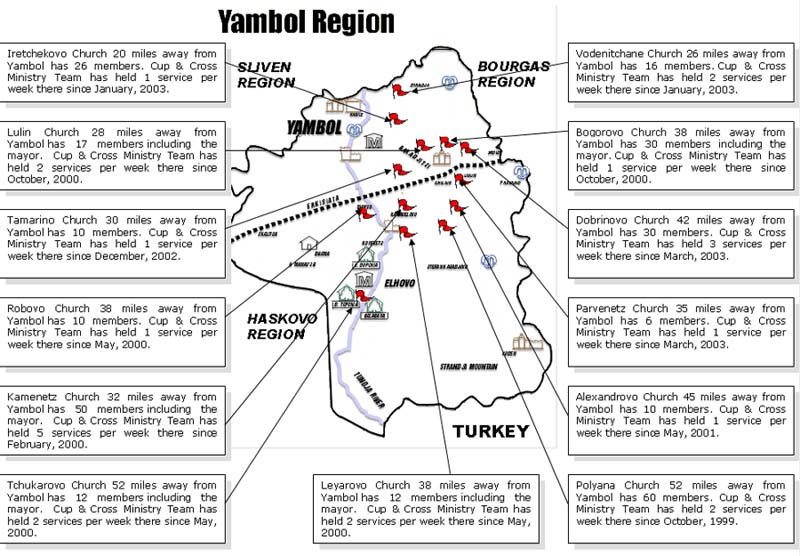
Our Ministry in the Yambol Region
Chaplaincy in Bulgaria
Since 1995, Cup and Cross Ministries International has worked toward a vision of the establishment of a Bulgarian Chaplaincy Association – an organization that incorporates pastoral care to prisons, military, police and hospitals. Our outreaches have been able to provide pastoral care and social services to the needy in a time of severe economic crises and political tensions. Our presence has been an answer for people in need for both physical and spiritual support. In the beginning of the 21st century, we are witnesses of a miracle as this vision comes into reality. Today, police and military officers participate in services led by the same ministers and pastors who once, during communism, they were ordered to arrest for the preaching of the Gospel.
History of Events
In September of 1944 the Communist revolution took over Bulgaria. All prior Protestant activates were outlawed. Pastors and ministers were imprisoned. Some were brutally executed. Any attempt for ministry in public was equal to a death sentence. The church went underground for 45 years until the Fall of the Berlin Wall in 1989 and a Holy Ghost revival swept through the country. In the summer of 2000 the Bulgarian Church of God organized a chaplaincy seminar in the Military School in Veliko Turnovo. This was done with the partnership of NATO’s head chaplain along with the representative of the Orthodox Church in Bulgaria, the director of the school under the patronage of the vice-president of Bulgaria Mr. Kavaldjiev. More than 250 officers, spiritual leaders and civil representatives participated. The goal of the seminar was to awaken the interest of the community and appeal for changes in the Bulgarian constitution, which would guarantee the freedom of military personnel to access the chaplain’s services and care.
The Bulgarian Chaplaincy Association
In February of 2002 a chaplaincy seminar, organized along with the Church of God Chaplains Commission, was held in the National Palace of Culture in Sofia. More than 60 pastors, chaplains, students and church workers from different denominations attended. These were people actively involved in military, hospital and prison ministries. The seminar was a stepping-stone for the development of the chaplaincy ministry in Bulgaria. It served as a beginning point of the structural development of the department of chaplaincy and caregivers in the Bulgarian Church of God and facilitated to the establishment of the Bulgarian Chaplaincy Association of which Cup & Cross Ministries became a charter member.
HEALTHCARE CHAPLAINCY IN BULGARIA
Bulgarian Pentecostals
 Fifteen years after the fall of the Berlin Wall, the Bulgarian Protestant movement claims over 100,000 members. This number is almost ten times higher than a 1975 German study which presented proof of approximately 13,000 “known” Protestants in Bulgaria. In the 1980s, this number had grown to 55,000, as this was the time when many Western missionaries were able to visit Bulgaria and gather information about the underground churches outlawed by the Communist Regime.
Although international reports confirmed the existence of over 100,000 Protestants in Bulgaria as early as 1994, the Bulgarian National Statistical Institute counted only 42,000 Protestant believers in Bulgaria for the 2002-2003 National Census. This number was detested recently by Dr. Stephen Penov, a professor at the Sofia University and a member of the Bulgarian Academy of Science, who has served as a Parliament expert on human rights and faith confessions. Dr. Penov stated that the members of classical Protestant denominations in Bulgarian exceeded 100,000 with over 60,000 identified as classical Protestants and a membership in the new Protestant denominations of approximately 50,000. During the past fifteen years, Bulgaria has experienced an ongoing Pentecostal revival. Therefore, it is not a surprise that over eighty percent of Bulgarian Protestants are Pentecostal or claim Pentecostal experience.
Protestant work on the Balkan Peninsula began in the 1800s when British and American missionaries were allowed to enter the Ottoman Empire. In the 1820s, the British Bible Society developed a Protestant translation of the Bulgarian Bible, which was completed and published in Constantinople in 1871. During this same period, various Protestant denominations began mission work in Bulgaria, among which were Congregationalists (1856), Methodist (1857), Baptists (1865) and Seven Day Adventists (1891). In 1871, the first Bulgarian Protestant Church was founded in the town of Bansko. By the time Bulgaria was liberated in 1878 and became an independent Balkan state, Protestantism was well established in the Bulgarian culture.
Pentecostalism was introduced in Bulgaria in 1920 as Ukrainian immigrants Zaplishny and Voronaev preached in the Congregational church at the Black Sea port city of Bourgas, where several were baptized with the Holy Spirit. This event marked the beginning of Bulgarian Pentecostalism.
In the next decade, the movement had spread throughout the country. The establishment of a consistent national structure occurred under the leadership of Nikolai Nikolov. The new denomination was formally recognized as the Union of the Evangelical Pentecostal Churches in Bulgaria, at a national assembly on 28-31 March, 1928. The organization, also known as the Pentecostal Union, was affiliated with the Assemblies of God denomination.
Legally, the newly formed organization was required to register with the Bulgarian government. This caused a great deal of controversy and division. A conservative Pentecostal group, with congregations located mainly in Northern Bulgaria, emerged from the split and adopted the name, Tinchevists, after the name of the leader Stoyan Tintchev. The Tinchevists, who are often called Northern Brothers due to the fact that most of their congregations were located in Northern Bulgaria, later became commonly known as the Bulgarian Church of God (lit. Bulgarian God’s Church).
The split between the Pentecostal Union and the Church of God was mainly due to leadership instability and internal organization disagreement. Unfortunately, due to the historical developments which followed, true attempts to reunite both Pentecostal wings did not take place even after the original leaders were replaced.
In 1944, the Communist Revolution took place in Bulgaria. In 1949, Communist authorities tried and convicted fifteen protestant leaders on false charges of treason and espionage. The division among Bulgarian Pentecostals continued during the Communist Regime. The Pentecostal Union pursued legal existence by registering with the Communist state. This action led to the government’s interference with church business and the implanting of secret agents within the denomination’s structure.
The Bulgarian Church of God, on the other hand, chose to remain underground and was severely persecuted by the authorities. Archives report that in 1974, the Bulgarian Church of God had only 600 members nationwide. This number grew to 2,000 members with congregations in 25 cities by 1981 and doubled by 1986 when the denomination was affiliated with the Church of God (Cleveland, TN).
At the same time, the Bulgarian Pentecostal Union had approximately 10,000 members and when the Berlin Wall fell, the denomination entered the Pentecostal revival that swept the country. In the decade that followed, the Pentecostal Union multiplied its congregation to 500 with over 50,000 members and adherents. A recent interview with Ivan Ivanov, the student pastor of the Pentecostal College in Sofia, indicated that the membership of the Pentecostal Union might have experienced a decline since 2002.
Meanwhile, the Bulgarian Church of God continued to grow reporting over 32,000 members with close to 400 congregations in 2001. Its work among the ethnic minorities in the country has resulted in the emergence of large Roma congregations like the ones in Samokov with 1,700 and in Razlog with 450 members.
It is reasonable to ask the question why is Pentecostalism so attractive to Bulgarian culture in the beginning of the 21st century? How is Pentecostalism responding so well to the need for faith within the postcommunist Bulgarian society? What is the reason Pentecostalism has spread so rapidly in the postcommunist age? Is Pentecostalism simply filling a spiritual gap or is it successfully responding to postmodern thinking?
The answers to the above questions are found in Pentecostal theology, which claims the “five-fold Gospel.” The results of a recent survey of one hundred randomly selected Bulgarian Protestants asking about the fundamentals of their faith is shown in the following table:
| Question | Yes | No |
| Does a person have free will? | 78% | 22% |
| Can a person choose to be saved or not? | 75% | 25% |
| Must a person accept Jesus Christ as a personal Savior in order to be saved? | 97% | 3% |
| Can a person lose his/her salvation? | 75% | 25% |
| Is the use of alcohol sin? | 60% | 40% |
| Can a person be saved without being baptized in the Holy Spirit? | 72% | 28% |
| Are you baptized with the Holy Spirit? | 63% | 37% |
| Have the spiritual gifts described in the Bible ceased? | 10% | 90% |
| Are there apostles today? | 64% | 36% |
| Do you go to church each week? | 73% | 27% |
| Do you pray daily? | 88% | 12% |
| Do you read the Bible daily? | 77% | 23% |
| Do you fast more than once a week? | 35% | 65% |
The last characteristic is prompted by the obvious fact, that where two or three Bulgarian Protestants agree, one disagrees with them. It is for future researchers to determine if this is a reflection of Bulgarian cultural mentality, suspicion remaining from the Communist Regime or simply Pentecostal experiential curiosity with existential need for opposition of social norms even within itself.
Fortunately, Bulgarians remain in almost complete agreement on issues such as the person and work of Jesus Christ in the salvific mission of God and the importance of the Holy Spirit in the mission of the church. Perhaps, these are the points of agreement which future Bulgarian Protestants should use to build unity and construct strategies for the future development of the movement. Because these also serve as the cornerstone of Pentecostal doctrine and practice, a movement toward unity within the Bulgarian Protestant movement should be initiated by Bulgarian Pentecostals. However, before such initiation can be realized, Pentecostals must reach a balance between their numerical advantage and their social action.


