

Services in Sofia
The Nazarene church in Sofia invited us to participate in their service last Sunday. We were able to respond to the invitation as part of our regular trips to the capital Sofia and ministered in the service Sunday afternoon. The church began only a few years back, as U.S. missionaries prepared the groundbreaking for its foundation. A close friend of ours from my hometown Yambol is now pastoring the church that is currently located in the Mladost suburb of Sofia.
Over 20 evangelical churches are located in the Mladost suburb of Sofia alone. The Nazarene church, for example, shares a building with the local Baptist church. Another large independent evangelical church is anticipating a building permit to build close by. The Church of God is also represented with a congregation and several cell groups. As the capital city is turning into a mega metropolis doubling its size to 2.5 million people, many of them seek residence in the suburbs where prices seem to be more affordable. This gives the church a unique opportunity to address a much larger congregation than anticipated when its original location was chosen. We are hoping to continue working with the church in the future helping them with reconstructing their strategy for a more openly expressed evangelistic approach toward ministry and growing of the membership.
Meeting the NATO Chaplain
After an endless number of protocol procedures, we were finally able to meet with the NATO chaplain in the Bezmer Airbase near Yambol. Chaplain (Maj.) David G. Waweru is a Kenyan national who serves in the United States mission to Bulgaria. He has spent the past two years stationed in Germany and has served in Iraq. This is his second trip to Bulgaria as part of a united training exercise between the United States’, Bulgarian and Romanian army forces and he is hoping to come back next year for a longer period of time.
Chaplain Waweru and his assistant met us at the gate of the Bezmer Airbase and we were able to spend time discussing a wide range of current issues such as: United States military presence in the country, army morale, integration of military models in the joint forces, the role of the chaplain, the Bulgarian attitude toward war, the NATO bases and chaplains in the Bulgarian Army. Some helpful points were reached on the expected visit of United States Chief Chaplain to Bulgaria. We also spoke about the Bulgarian Chaplaincy Association and the training course that it will offer through the Bulgarian Evangelical Theological Institute in the fall. We agreed to pass information through the chain of command and work toward future mutual projects.
More Services in Yambol
After so many years away from my hometown Yambol, I have been privileged to preach a number of services that are now turning into a series of evangelistic events. The last one was on July 19, 2006 as the pastor asked me to prepare a message on the concluding chapter of I Corinthians as a part of the church’s annual Bible book study. Our response was to present an in-depth study of the chapter focusing on giving, women in ministry, true apostleship and expectance of the Lord’s return. All of these issues have been and remain critical for the Bulgarian evangelical church. Therefore, the message used some elements of our common protestant heritage in Bulgaria to identify the issues with their theological and practical resolving not only in the local congregation, but in the movement as a whole.
St. Symeon the New Theologian
On the Mystical Life
Vol. 1 The Church and the Last Things (Crestwood: St. Vladimir’s Seminary Press, 1995)
Vol. 2 On Virtue and Christian Life (Crestwood: St. Vladimir’s Seminary Press, 1996)
Vol. 3 Life, Times and Theology (Crestwood: St. Vladimir’s Seminary Press, 1997)
I first heard of Symeon the New Theologian from one of my professors in seminary, Steven J. Land. Dr. Land defended a dissertation on Pentecostal Spirituality, which has now become a standard text for students of Pentecostal theology. One of the prime examples of proto-Pentecostal mysticism used in the text is Symeon the New Theologian, a 10th century mystic. Since my first encounter in seminary, I have desired to examine Symeon’s writings in person and being Slavic in background I have been partially able to do so because some are available through the Eastern Orthodox tradition. Therefore, I was thrilled when St. Vladimir’s Seminary published the trilogy in English. The point I would like get across is that if you are a Pentecostal scholar, reading Symeon’s writings is a must.
Do not be scared by the word mystical. Reading Symeon, one quickly finds out that the Pentecostalism experienced in any given holiness church is much more drastic, than any mystical example Symeon may have had.
Symeon’s writings do not fit a concrete type of literature. They explain theology in laymen’s terms, while taking the reader to the depth of the most intense theological discussions of the ages. Much like a Pentecostal testimony, the words have a way of bringing the experience of God close to the heart, while at the same time exalting His glory to the highest of all.
Therefore, a true Pentecostal commentary of the trilogy must begin with Symeon’s testimony of his experience. It is hardly an enigma to recognize that Symeon speaks abut the same experience, which we Pentecostals testify of – the experience of the Holy Spirit. He describes the event as “seeing the light” that is felt emotionally and physically and which transforms the soul with its divine power.
The first volume, entitled The Church and the Last Thing, begins with the Genesis stories of the Creation, Adam and Eve in the Garden, the first sin and God’s pan for salvation. For the Western reader, this approach resembles Augustine’s De Civitate Dei. For the Eastern Pentecostal reader it is similar to the sermons we were accustomed to under the Communist Regime, where the pastor would begin a message with Genesis and finish with Revelation. And for any Pentecostal, Symeon’s approach reveals God’s plan for man and His divine provision through the ages in the ultimate goal of history beginning with the first creation and finishing with the already-not-yet eschatological reality.
Eschatology for Symeon is not just the last things, but the first things now made perfect by God. It is both near and immanent, much like the Pentecostal expectation of the Lord’s return. It includes Israel, the Heavens and the Judgment Day. Interestingly, Symeon brings in the experience of a personal new beginning based on a free human will. He sees the end as closely connected to the personal choice for eternity. The terms “foreordained” and “called” are examined in the saying “Those Whom He Foreknew, the Same He Also Predestined.” The claim that some are elected and others rejected is refused by Symeon with the simple, but strong words: “Did he ever say to some: ‘Do not repent for I will not accept you?’ …. Of course not!”
The second volume, dedicated to the life of the Christian believer, comes as close to a Pentecostal experience as can be imagined. Symeon is quick to point out his own experience with God identifying it with the words of the apostle, “He appeared also to me” (1 Corinthians 15:8).
He speaks of the conscious possession of the Holy Spirit, claiming that one cannot “have” the Spirit and not know about it. For Symeon, the knowledge of the Spirit is the experience of the Sprit accompanied with feelings and emotions. For “only the dead feel nothing,” but when you possess the Spirit you know because you can feel. How close is this terminology to the Pentecostal, “I’ve got the Holy Ghost” and “I feel it. I feel it?” To the skeptic, Symeon further declares: “Do not say that it is impossible to receive the Spirit of God. …. On the contrary, it is entirely possible when one desires it.”
Symeon continues with the statement, that the believer is “called to see God in this life.” The conscious possession of the Holy Spirit is not only a personal experience with God, it is a present eschatological foreseeing and a prophetic anticipation of what is yet to come. According to Symeon, “Hearsay is not enough. The saints describe what they have seen” (emphasis mine); therefore, “through the Holy Spirit the saints become eyewitnesses of the world to come.”
In the last volume, Symeon speaks of the Christian sacraments clearly differentiating between the sacramental and personal experience of God. His theological overview articulates the incarnation, but refuses to explain the Trinity with human terms. Instead, Symeon calls the Church to “participate in the life of the Trinity,” again juxtaposing theological reasoning against personal experience of God. This particular practice is accompanied with an interesting note from the author about church politics. In a typical mystical manner, Symeon urges the believer to follow the mandate of the Spirit rather than the mandate of the Church.
The trilogy presents the New Theologian as new in name, but old in religion and original in the personal experience of God. This fact proves that through the ages, there have always been people searching for God with an open heart and experiencing His presence in a Pentecostal manner. It further defines the Pentecostal experience of the Spirit as the true restoration of the Early Church praxis. And finally, it proves Land’s thesis that Pentecostalism is more Orthodox than Catholic and more Eastern than Western.
When I became Pentecostal, I did not know this would become the “new fad” of 21st century spirituality. What I knew was that I experienced God personally and He personally saved my soul. Symeon’s testimony is not much different and can be summed up in one statement: one can make the reality of heaven the reality of this life by having a real experience with God.
New Services in Yambol
We returned to our home base of Yambol for another series of services as a part of our National Bible Tour. We began with a youth rally for all evangelical churches in the region. The rally was held at the First Assemblies of God Church in Yambol where youth gathered for another experience with God. After the Bibliata.com video presentation and talk about various products and services available on the web through our media consortium, we delivered a message dedicated on Pentecostal identity emerging from a life of holiness and Biblical standard. The message was challenging but well received by the youth and we had a great time ministering at the altar service.
We continued through the regular service on Sunday morning delivering a message on the Spirit of Pentecostal. The church building was packed as many also had to stand outside to doors. Several hundred people also came from close by churches and joined the congregation for the service. The alter service had a great impact not only on the people of Yambol, but on our team as well as most came to the altars for prayer.
After the service many shared their testimonies. An elderly lady came to us to tell us that in our service in Yambol last month, the sharp pain in her heart disappeared and she has not felt it for a month. Many more testified of miraculous healings and spoke of receiving a fresh touch from the Lord.
National Chaplaincy Meeting
Our regular monthly chaplaincy meeting with regional leaders involved in chaplaincy ministry around Bulgaria resulted in a decision toward the final legalization of the Bulgarian Chaplaincy Association. The date of the national meeting is now set, and we have begun announcing the event to key ministers and churches around Bulgaria. The said national meeting will finalize the foundations of the Association and will lay down its department structure, government involvement and principles of operation. Our action is strongly backed by military officials both locally and oversees, and we are confident that the future cooperation with government representatives will lead to expected results in the field of chaplain ministry in Bulgaria.
Services in Stara Zagora
Our week included eight church services, the last one being in the city Stara Zagora. We traveled to Pravetz where we held two services – one on Saturday and one on Sunday. Then on Sunday we had two more services in Etropole and Yablanitza, after which we traveled to the other side of Bulgaria where we held services in the city of Varna. Our week concluded with a youth rally in Stara Zagora.
While the Pravetz meetings were emotional and the Varna meetings were powerful, the meeting in Stara Zagora included both tears and Pentecostal power. Youth from all evangelical churches in town came with their youth pastors and friends to the Messiah Church to watch our Bibliata.com presentation and hear the message which initiated our National Bible Tour 2006.
I have preached many youth rallies and revivals both in the United States and in Bulgaria, but I must confess that I have never seen so many people in tears at the altar touched by the power of God and being transformed before our very eyes. We do not know yet what is to come in the city of Stara Zagora, but one thing remains for certain – God started something great in that city on July 1, 2006. The unquestionable proof of this statement was the lives touched during the services there and the testimonies which are continuing to come in.
Services in Varna
Immediately after returning from our trip to Pravetz, Etropole, Yablanitza and Sofia we departed to Varna for another ministry opportunity. It was there that we met with the local chaplaincy chapter and discussed with them some of the upcoming events in regard to the chaplaincy ministry in Bulgaria.
We were also able to meet with the founders of the New Wave youth movement to discuss some opportunities for the upcoming New Wave rally. Afterwards, we were given the opportunity to speak on their live radio show and respond to questions from the listeners.
On the following day, we ministered at the Varna Pentecostal Church, where we have minister before. We enjoyed our time there, as the Varna Church and its pastor have always been gracious hosts when we visit Varna and has become our long-term partner in the ministry of the Gospel and contributor to many of our ministry websites.
Pravetz 16 Years Later
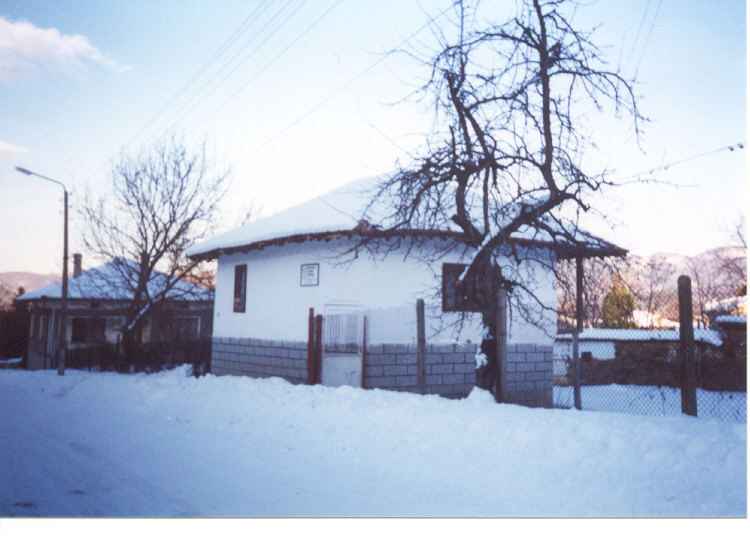
Thirteen years after graduating from high school I was able to return to Pravetz again for a reunion of the Church of God youth group there. As many of us traveled from various parts of the world to attend the meeting, it was only natural to recall what the Lord had done for us in this small mountain town.
The Church of God in Pravetz was founded as an outreach ministry of the close-by Etropole church. For many years, the Etropole Church of God was known as an underground evangelical congregation that served many in prayer and preaching regardless of limitations set by local and national authorities.
When the church in Pravetz began regular services in the early 1980s none of the secular observers suspected that it would have any influence on the town. Pravetz was the birthplace of the Bulgarian communist prime minister who ruled the nation for over 30 years. In the 1980s, Pravetz was known as a “privileged” city where the Communist Regime had build its own ideological stronghold. Yet, the Church of God in Pravetz survived the Regime and after much prayer and anticipation the church officially opened its’ doors after the fall of the Berlin Wall in 1989.
This was also the time of my affiliation with the church. Just having been saved in my hometown Yambol, I returned to Pravetz at the beginning of the school year in 1990 and begun attending the Church of God there. The church had a small group of young people who sought the Lord. In less than a year, their prayers were answered as a great multitude of young people begun attending the church. I remember one of the meetings where over 170 young people were present in the small military cafeteria adapted for church services. Having gathered at the recent meeting, we concluded again that for the period of 1990-1995, over 300 young people where saved in the city of Pravetz. Their stories remain forever recorded as part of the history of the Pravetz Church of God.
These were the events that we remembered at the gathering on June 24, 2006 in Pravetz. Many shared their stories since graduating from the school and beginning a carrier in various professional fields. Pastor Ivan Sabotinov, who has served in the church almost from its beginning, greeted the audience and reminded everyone of God’s love and grace that has remained the same through all these years. We were also given the opportunity to share from the Word and speak about the First Love. The message urged the remembrance of God’s miraculous power and assured those present that although we might have lost our first love, we are never lost from the first love of God. In addition, we were able to hold three more services on Sunday, June 25th at 8:00 a.m. in Pravetz, 10:00 a.m. in Etropole and 12:00 p.m. in Yablanitza.
Bulgarian Evangelical News
Cup & Cross Ministries just released a new website in service to the Bulgarian evangelicals around the world. The web address is www.evangelsko.info. This site incorporates leading web technologies to build an up-to-date press center for various religious news and events from and about Bulgaria. A dynamic personalized column is also implemented to present interviews with evangelical experts in various professional fields and to strategically build an image of the current profile of the average Bulgarian evangelical.The website is next in a long series of strategic website for Bulgarian evangelicals released in 2006 as follows:
January 16, 2006: PastorBG.com – a website dedicated to the work and ministry of the Bulgarian evangelical pastor
February 16, 2006: Protesntantstvo.com – a website dealing with Bulgarian protestant history
March 16, 2006: Kapelanstvo.com – a website presenting chaplaincy
April 16, 2006: Hvalenie.com – a website for Bulgarian praise and worship, with downloadable gospel music and the only Top 10 Bulgarian Gospel List
May 16, 2006: Propovedi.net – a dynamic web database with audio and video sermons by Bulgarian ministers


