

New Printed Revised Edition of the Constantinople Bible Published
Day of the Bible: December 7, 2008
180 Anniversary of the New Bulgarian Translation of Peter Sapunov
Year of the Bible in Bulgaria
Christian web mega portal Bibliata.com, with the partnership of Duh-i-istina.net and Bibles.org.uk websites, published a new printed revision of the first Bible in the new Bulgarian vernacular originally published in Constantinople in 1871. The complete text has been revised according to the modern Bulgarian alphabet in the period from 2004 to 2008. All words and their order have been preserved as in the original edition.
This first complete printed revision of the text was published on December 7, 2008 – Day of the Bible for the 180 Anniversary of the New Bulgarian Translation of Peter Sapunov. It is one of the 10 projects of Bibliata.com proposed for the Year of the Bible in Bulgaria. The others follow:
November 2008: Days of the Bible in schools of Kardzhali
September 2008: Bibliata.TV – Bulgarian Christian video portal
July 2008: Newly revised printed edition of the Bible of 1940 in partnership with Bibles.org.uk
June 2008: Children’s Bible 2.0 (audio, video and images for the little ones)
April 2008 (Easter): JOHN: Gospel, Epistles and the Apocalypse (New Bulgarian Translation) in partnership with the Eagle Publishing House
March 2008: New Bible Software CrossBgBible in partnership with Cross.Bibliata.com
December 2007 (Christmas): JOHN: New Bulgarian Translation (pilot edition) in partnership with the Eagle Publishing House
August 2007: Palm/PDA Bible 7.23 complete with three Bulgarian translations of the Bible Constantinople (1871), Revised Edition (1940) and WBTC (2000) in partnership with Bulgarian-American software company GMP Soft
March 2007: Revised digital edition of the Constantinople Bible of 1871 in partnership with Christian web portal Duh-i-Istina.net
Bulgarian Constantinople (Tsarigradska) Bible of 1871 can be ordered at: http://stores.lulu.com/Bibliata
Services at Dupnitsa: Building in the Times of Crises
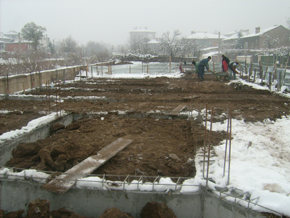 The snowstorm in Sofia slowed us down a bit, but it certainly could not stop us from holding yet another exciting ministry event in the town of Dupnitsa. In the past few years, the town has received much attention being a major point on the interstate connecting Greece and Macedonia with the Balkan Peninsula and the countries of the European Union. This has given the local Church of God a unique opportunity to minister to various ethnic groups and it was then that the need for a ministry building was recognized. The church has now finished the foundations of a very nice and solid church building project with a strategic location in the cities center by the river. The main work will be completed by the spring, which will empower the Dupnitsa Church of God for a new level of ministry. Our team was able to travel to the city with several fellow ministers and deliver a timely message to the people whom gathered in the cold winter eve. We enjoyed a warm spirit filled service which renewed and encouraged. After the service, we met with pastors who work with Bulgarian communities in Spain and England and discussed the possibilities for a short ministry trip to their churches in the near future.
Services at Samokov: Seeing through the Snowstorm
Comments Off on Services at Samokov: Seeing through the Snowstorm
We were blessed with a very long and warm fall season this year, which made our travels around the churches both possible and pleasant. Yet the first snowstorm inevitable hit and did so during the time when our team was scheduled to minister in the Samokov Church of God. The storm caught us while in Sofia preparing to host the biannual election meeting for the Bulgarian Chaplaincy Association. It was so severe that it left a larger part of the country without electricity. Regardless, we made our way through the curvy icy roads to the mountainous area of Samokov. As always, our travels were well worth it as we had one of the most anointed services in which the Lord led us to change what we were to deliver right after entering the church into His presence. Ministering along side of Church of God Overseer, Alexander Todorov, we prayed with the hundreds in attendance. After fellowship following the service our team left with a team from the Samokov church to minister in a near by Church of God for the evening service.
Thanksgiving in Kardjali, Bulgaria
During this Thanksgiving Holiday, our team received an invitation to organize and present a Day of the Bible event in six public schools in the city of Kardjali. Being the center of Bulgaria’s Muslim population, Kardjali and its surrounding region are often described as Bulgaria’s 10/40 window. The growing Muslim activities in the area are supported by over 150 new mosque builds in the past fifteen years alone. Naturally, Christian missions in the area are very limited and when a chance like this is presented, one does not hesitate to take it regardless of the cost.
After coordinating the event on the Day of the Bible with the local Church of God and the Assemblies of God pastors, we scheduled six presentations in the major public schools in town. Each presentation consisted of a brief lecture and a time for discussion. We were able to share with the students the story of the Bulgarian Bible, the translation and transition of the Bible text through the centuries and the role of the Bible in the postmodern technological stage through websites like our own Bibliata.com. Our team was also able to give out over 600 Bulgarian New Testaments and to donate Bibles and additional Christian literature to the schools’ libraries. This project was part of our Year of the Bible in Bulgaria and we give thanks for the God sent opportunity.
Bulgarian Chaplaincy Association Annual Meeting
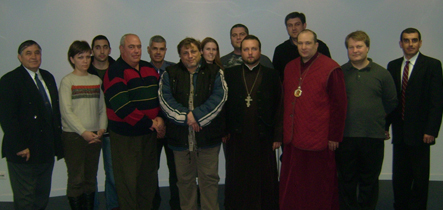
The third national annual meeting of the Bulgarian Chaplaincy Association was held in the capital Sofia on November 22, 2008. Founding members and delegates from the country and abroad joined together to thank God for His help with the chaplaincy work in Bulgaria, elect new government and receive the 2009 strategy. The Bulgarian Church of God, Eastern Orthodox Church, Baptist Conference and Assemblies of God, as well as many ecumenical and non-denominational churches were represented at the meeting. New members were voted in after the general election session and were welcomed by the President of the European Evangelical Alliance, Dr. Nick Nedelchev. The delegates discussed the opportunities and difficulties for chaplaincy work in Bulgaria and emerging alerts in government relationships within the NATO context. Important leadership decisions concerning the involvement of the Association in the Chaplaincy master’s program offered by the newly accredited Bulgarian Theological University in Sofia were put in motion. Fifteen proposed projects were brought for deliberation in the afternoon session as the 2009 Strategy was voted in and project officers were appointed. It was further resolved that the Bulgarian Chaplaincy Association will be hosting the Balkan Chaplaincy Conference in 2009 and the new advanced chaplaincy training program with extensions in Sofia, Yambol and Varna.
Bibliata.TV Officially Launched
It is said that a picture is worth a thousand words and this is very much true for our new web-ministry project www.bibliata.tv – a GodTube like web interface which gives the opportunity for churches, ministers and individual believers to publish their Christian videos of worship, preaching, evangelizing, prayer, drama, movies and much more.
We envisioned the project as a ministry opportunity back in 2006 when the YouTube syndrome swept the world. The planning for the website took some time, but it was its actual technological implementation that set us back of schedule a few months. We began preparing the server machine for the project in February 2008 and it took us six months to set it up for testing which began in the month of September 2008. Our team pre-released the website in beta testing version on September 15, 2008 which is the beginning of the school year in Bulgaria. Unfortunately, three consecutive government halting procedures delayed its official release until the month of November, when we were able to obtain a new server machine under a contract with a new hosting company abroad.
Since its official launching in November 2008 Bibliata.TV has been populated with over 1000 Christian videos by over 200 registered users. The newly released website is already serving as an online Christian community for Bulgarian believers around the globe.
Requests for new video materials, sermons, lectures, church services and music videos have been requested from Bulgarian communities across Bulgaria as well as in Belgium, France, Canada, United States, Spain and Germany. Using Bibliata.TV, we were able to provide live coverage for the Days of Open Doors event organized by the Bulgarian evangelical churches in celebration of the Day of Reformation in Bulgaria. But talk is cheap and a picture is indeed worth a thousand words, especially when you see it for yourself at www.bibliata.tv.
National Leadership Seminar for the Bulgarian Church of God of Prophesy in Rousse
November 9th through the 11th our team held the Bible Leadership Seminar for the National Assembly of the Church of God of Prophecy in Rousse. Monday afternoon we gathered in the upper room of the church where there were some 50 leaders from the country were present. The pastor opened the seminar with prayer and song and we followed with the introduction of the course and then taught on the 21 Laws of Leadership from a Biblical Perspective. After a small break we introduced the module on Problem Solving, which was received very well by the audience and continued with a brief discussion.
Ministering at the Rousse Church of God of Prophecy
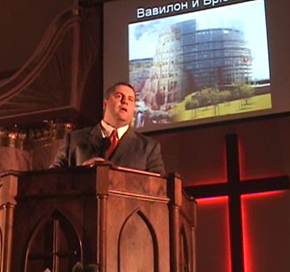 This past Sunday we were privileged with the opportunity, for the first time, to minister in the Rousse Church of God of Prophecy. Rousse is in the northeastern part of Bulgaria on the right bank of the Danube river just minutes away from Romania. It is a very unique town with a rich history of more than 5000 years and vast ancient architecture. Many buildings still remain as they were hundreds of years ago. The church building itself is actually one of those buildings. Yet, the church is even more unique due to it being a former synagogue. The pastor told us the story of how, after many obstacles, the church family witness the miracle of being able to purchase the building and how they invested their various talents to restore the building.
During the Sunday morning service we shared on the signs of the last days for it is our belief that we are not just living in the last days, but in the last minutes. An alter call followed the message in which the entire church came to the front where we, along with the pastor and his wife, were able to pray for the people and their various needs.
In the afternoon we were asked to speak to the 30 some youth of the church who had gathered for a time of fellowship. They came with open minds and questions concerning the Bible. We were also able to share with them of the variety of Biblical resources which can be found on our website consortium, Bibliata.com. It was however much to our surprise that many of them already knew of such and had been adamantly using the site. It is always encouraging to learn that the time invested by our team to make Bibliata.com a reality has been appreciated and in this case it was by ones that we had never even met. We are thankful for this and for the very warm and inviting spirit of the church family in Rousse, Bulgaria.
80 Years Bulgarian Pentecostal Union
The Bulgarian Pentecostal Union is celebrating 80 years from its conception in 1928 when Bulgarian born missionary Dr. Nickolas Nikoloff, trained and ordained by the Assemblies of God denomination, arrived in Bourgas with a mission to organize the Pentecostal communities across the country into one denomination. The Bulgarian Pentecostal movement had begun almost a decade earlier, when Ukrainian immigrants to the United States, Voronaeff, Zaplishny and Koltovitch returning as missionaries to their motherland, preached the new message of Pentecost in Bulgaria. At the same time, a more conservative group split from the newly founded Union establishing an underground network of Spirit-baptized holiness churches, which were able to survive the persecutions of the Communist Regime (1944-1989) and is today commonly known as the Church of God in Bulgaria.
Members from the whole country were present for the celebration of the 80th anniversary of the Bulgarian Pentecostal Union which took place in the capital Sofia. Our team was able to represent the Bulgarian Church of God at the meeting. We were also given the opportunity to speak at the New Wave Youth Rally which took place that same afternoon and were able to present to the some one thousand young people who filled the whole auditorium, our new project Bibliata.TV. In addition on Sunday, we ministered at the Fire Church of God in Sofia lead by the Church of God Regional Overseer for the Sofia region, Pastor Daniel Kirov and at the Salvation Church of God, where we finished two of the modules of the National Leadership Seminar for the Church of God.
National Leadership Seminar for the Church of God Continues in Sofia
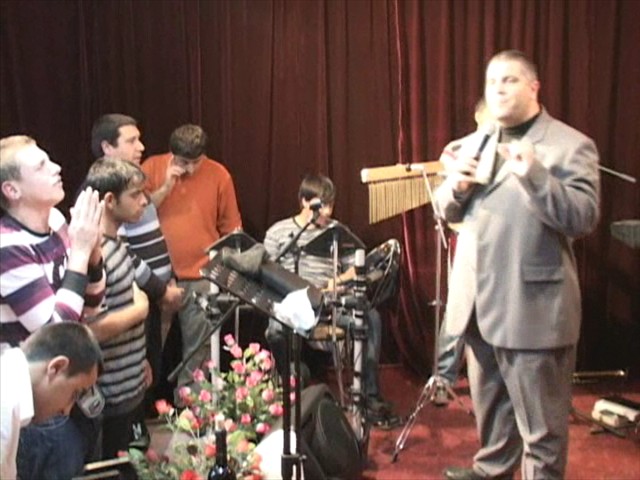 We were again privileged to teach the next two levels of the National Leadership Seminar for the Church of God in Sofia. This is the of tenth leadership event we have held for the Church of God in Bulgaria since August, 2008. The two levels presented were the “21 Laws of Leadership” and “52 Leadership Principles of Jesus.” As we taught the topics in the Salvation Church of God in Sofia, we were all amazed by the fact how relevant and applicable Biblical leadership is in the Bulgarian context. The particular team we were working with that night, is a multicultural group of people that ministers both in Bulgaria and to Bulgarian immigrants in Europe. They have an extensive ongoing work with Bulgarian communities in Spain and Portugal. Just recently, they returned from a missions trip to Greece which we were also invited to join, but were unable to do so due to our full preaching schedule in Bulgaria. The night of the leadership course, the team was leaving on a ministry trip to England and Germany that same night. Yet, they were eager to sit around the drawing board with us, learn new leadership principles and draft new strategies for ministry to implement in their trip. While many claim that the times of revival in Bulgaria re long gone, we were again amazed by the enthusiasm and motivation of the ministry teams in Sofia. And it seemed clear that true revival comes not from the crowds that it draws, but from the internal God-given motivation of people that are willing to dedicate their whole lives for bringing true spiritual revival to the land. For revival must go on …


