

THE PASTORAL TRIALS ELIMINATE THE AVANTGUARD OF BULGARIAN EVANGELICALS FOR AN ENTIRE GENERATION (PART 1)

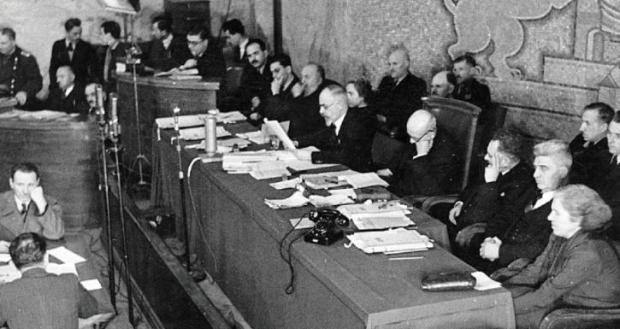
THE PASTORAL TRIALS ELIMINATE THE AVANT-GARDE OF BULGARIAN EVANGELICALS, BEHEADING IT FOR AN ENTIRE GENERATION (Part 1)
[Editorial note: The following text is translated from the Bulgarian original. The documents contain memorandums, archival records, State Security (Darzhavna Sigurnost / DS) interrogation files, survivor testimonies, and secondary scholarly sources. Bracketed insertions in the original are the author’s. Handwritten portions of the source document are noted where applicable. Archival reference: pp. 155–177.]
Archival Preamble
To Comrade [name illegible in manuscript]. Here! … (p. 1), 155–3pp–177
Comrade Director — in order not to speak in generalities [regarding the arrest warrants and the public punitive proceedings against them as enemies of the Party and the people] and to substantiate my claim, I shall append a list of the names of pastors who completed their education in America or in another foreign country. In addition to their religious fanaticism, they have unquestionably acquired the character and mentality of the ‘secular’ Western democracies. For example…
Vasil Georgiev Zyapkov — Age 47
Completed advanced theological studies in Manchester and New York. Interrogated by the State Security Service and driven nearly to madness before he ‘confessed’ to the creation of a spy network that had sabotaged the ‘people’s authority’ and harmed ‘fraternal relations with the Soviet Union,’ thereby becoming a ‘servant and assistant of the interests of England and the United States.’ According to the scenario written in Sofia and Moscow along the model of [Andrei] Vyshinsky, it was Zyapkov who was cast as the ‘sinister mastermind’ of the entire conspiracy (the so-called ‘espionage centre’). He was initially isolated and subjected to pressure to renounce his beliefs, subsequently blackmailed, and finally arrested in early November 1948. For nearly three months he was interrogated in the cells of the State Security Service together with the other pastors, all of whom were compelled to confess to everything imputed to them.
Zyapkov completed his studies in literature (not theology, as was erroneously believed) in Manchester. He maintained an extensive network of friends in England and America, including family ties, which the State Security Service deemed dangerous and potentially harmful to Bulgaria. At the insistence of Dimitar Furnadzhiev (1867–1944), he succeeded the latter as religious representative of the United Evangelical Churches (OETs). Zyapkov served as pastor of the central Methodist church ‘Dr. Long.’ He was sent by the Congregationalists to their Union Theological Seminary, where he most likely completed his master’s degree in 1932. His participation in the Bulgarian delegation to the Paris Peace Conference in the summer of 1946 was subsequently used as an argument at trial that he had established espionage contacts.
Zyapkov’s testimony (under the code name “ЧЕРВЕЙ” / “WORM”) reveals the interrogation techniques employed. Reading the document — written in 1951 and entitled My Confession Regarding the Trial, ostensibly submitted as a letter to the Prime Minister requesting a review of the case — one discovers numerous parallels with the memoirs of Haralan Popov (another of the convicted clergymen). The account of the tortures (more psychological than physical in nature) and the manner in which false confessions were ultimately extracted is replicated in both cases.
Zyapkov wrote that he was rarely beaten (‘only once was my head smashed against the concrete wall’), but that the most tormenting aspects were the ceaseless threats of a death sentence and the blackmailing carried out through his family (e.g., ‘your daughter will become a prostitute’). For weeks he was compelled to write confessions until 11:00 p.m., and was then woken shortly after midnight for lengthy nocturnal interrogations. He was threatened that the sentence would be carried out by execution in the cell. Towards the end of these exhausting interrogations, the prisoners began to experience hallucinations. A new narrative was fabricated in which Floyd Black, the director of the American College in Sofia, and his son Cyril Black were presented as the chief conspirators. The strategic intelligence that Zyapkov had allegedly gathered and transmitted to his purported handlers consisted of the numbers and names of Soviet ships docked in the port of Varna — information he had memorised in order not to compromise his confessions during the trial.
Note: Spas Ivanov Asenov, from the village of Malko Belovo, was sentenced to death in the trial of the ‘Free Warriors’ (anarchists). He shared a cell with Pastor Vasil Zyapkov and stated that he was a non-believer. However, when they led him out to be executed, he said: ‘Farewell! We shall meet above, before God’s gates!’
Together with Zyapkov, all of the more influential spiritual leaders were arrested. The agonising investigation was conducted by interrogators who had honed their inquisitorial cruelty through the interrogations of opposition figures. After months of physical and psychological torment, entirely innocent church workers were reduced to clay figures who, in the satanic tradition of the State Security Service, made their ‘confessions’ to having committed ‘espionage, slander against the people’s authority, and preparations for subversive activities.’ For a full three years after his sentencing, Zyapkov barely managed to return to normal behaviour.
Lambri Marinov Mishkov — Age 40
Completed his studies at the Princeton Theological Seminary. According to K. Grozev, he also studied chemistry at the University of Chicago and subsequently theology at Harvard, and worked towards a doctorate at Cambridge during the 1930s, at which point he was obliged to return to Bulgaria to be at his mother’s bedside in her final days. It is improbable, though not impossible, that the young Mishkov managed to complete so many disparate and numerous programmes of study within the span of approximately twenty years. It is equally possible that his name has been confused with that of his namesake Pavel Mishkov, who did indeed graduate from Chicago. The investigative file records only that he received his theological education at Princeton.
Despite being a clergyman, in 1946 he was invited to serve as an adjunct associate professor of philosophy at the newly founded University of Plovdiv. It was at this time that he published his book
Philosophy of Faith — one of the finest philosophical studies of the philosophy of religion ever written in the Bulgarian language.
- Grozev describes him as an ‘old uncle’ — a close friend of his grandfather. He spoke excellent English, would recount stories of Lincoln, and explained the meaning of the expression ‘monkey business,’ as well as one of the proposed etymologies of the well-known acronym ‘OK.’ Mishkov underwent the same interrogations and tortures as the others, but never confessed to having contacted the American Embassy or received money — an accusation that was ultimately dropped, resulting in a reduced sentence. Under duress, he ‘confessed’ to having transmitted information about the quantity of nails produced (in kilograms) at a factory in Plovdiv, as well as the road map from Plovdiv to Peshtera — a map that could in fact have been purchased at any bookshop. It was precisely this map, the subject of interrogations, that had allegedly been passed by Zyapkov to Cyrus Black, who was also considered part of the supposed spy network.
As with all those convicted, his children were barred from universities, forced to take low-paid manual work, and were permitted to visit their father only once every six months or even less frequently. The elder Grozev repeatedly took Mishkov’s children to prison visits when their mother was ill and the next permitted meeting was still months away.
Simeon Petrov Iliev — Age 37
Completed his studies at the American Scientific Theological School as well as a theological seminary in Switzerland. Following the departure of Kr. Stoyanov, at the initiative of the youth fellowship of the church, he was invited to assume the pastoral ministry in Asenovgrad (then known as Stanimaka). During his pastoral tenure, the church experienced a period of growth. He succeeded in uniting several other Evangelical fellowships, which led to a significant expansion of the church community. Despite the hardships of the post-war years, the new (modern) church building was constructed during this period. Furthermore, the headquarters of the Women’s Missionary Union of the Southern Evangelical Churches was established in Asenovgrad, further strengthening the organisational structure of the Protestant community in the region. Simeon Iliev served as pastor until 1949, when he was arrested and tried on charges of espionage.
Konstantin Stoyanov Marvakov — Age 55
Completed his studies at a theological seminary in Austria. Served as pastor of the church in Yakoruda. He was subjected to repression during the Communist campaign against religious communities in Bulgaria. Accused of espionage, the specific charges including the transmission of information concerning the annual harvest in the Chirpan region, as well as the production capacity of the oil-press in the village of Marichleri. These charges were formulated within the same framework as the case against Lambri Mishkov, with all alleged evidence reduced to a single page in the investigative file. This underscores the characteristic method of fabricating accusations in this period, whereby insignificant or publicly available information was interpreted as a threat to state security, in order to justify politically motivated repression.
Kiril Yotov Vladov — Age 43
Completed his studies in Frankfurt. Attended the men’s gymnasium in Pleven, and was subsequently recruited as an assistant pastor at the Sofia Methodist church ‘Dr. Long,’ where he worked and developed under the guidance of Pastor Vasil Zyapkov. He completed his theological education alongside future pastors Litov and Sivriev at the Methodist Seminary in Frankfurt, where he met his future wife, Maria Schmeissner, whom he married in 1931. In 1939 he was transferred to the Pleven Methodist church, replacing Pastor Yanko Ivanov.
As early as 10 September 1944, Soviet soldiers were quartered in the pastor’s residence. Two days later, a group of armed civilians burst into the house and conducted a search, their leader declaring: ‘You are under arrest! Take only the barest essentials — a little food and clothing — for we are taking you to Pleven prison.’ Pastor Yotov asked: ‘May we pray before you take us to prison?’ After the brief prayer, it was as though everything had changed. The leader of the arresting party began to calm those under arrest. The children were taken in by Miss Mara Gaytandzhieva and later sent to the village of Burkach to their grandmother. Before long, Maria returned, but completely changed — the time spent in prison remained with her for the rest of her life. Kiril Yotov spent eight months behind bars, enduring brutal torture and beatings.
In 1948 Kiril Yotov was arrested again in connection with the already-commenced Pastoral Trials. As a local prisoner, he was transferred from the Ministry of the Interior in Pazardzhik to Plovdiv, and ultimately to the investigative detention facility in Sofia. He was accused of supplying information concerning the annual harvest in Aprilsko and Tserov, the annual yield of winter crops, and the grape harvest. Beaten with leather belts and whips that tore entire strips of flesh from his back, in order to compel a confession — yet he did not lose his faith or his optimism. The Communists failed to break him and did not include him in the trial, as he was unpredictable and liable to disrupt their pre-arranged scenario. He was ultimately transferred to the ‘Bobov Dol’ labour camp and subsequently sent to Belene. His home was confiscated by the local authorities and his family was forced to relocate to Sofia. His wife Maria Yotova made extraordinary efforts to support the family, but the children were deemed politically unreliable and expelled from all youth organisations.
As no one could send him money from the outside, he acquired a razor, soap, and a rusty blade with which he shaved and cut the hair of his fellow camp inmates at Belene. In the summer of 1953, after five years in camps and prisons, Pastor Kiril Yotov was released. His family scarcely recognised him. At the time of his arrest he had been a healthy man weighing 85 kilograms; after five years he emerged emaciated, barely 48 kilograms — a frail body, but an unbroken spirit and a smile on his face. He recalled with pain the countless worthy individuals who had been oppressed, tortured, and humiliated.
Kostadin Spasov Bozovayski — Age 35
Theologian. Completed his seminary studies in Kassel and London, England. Born on 11 February 1912 in the village of Stob, Dupnitsa region. He served as pastor in Haskovo, following Vatralski, Furnadzhiev, and Gradinakov, and from 1956 served for three years as pastor in Asenovgrad. Until 1959 he was one of the few pastors not yet affected by the regime’s repression. When the Pastoral Trials commenced, Bozovayski was serving as treasurer at the ‘Pirin’ factories in Kardzhali whilst simultaneously serving as pastor of the Congregational church in the city. Upon his arrest, the charge was raised that he was a committed Germanophile, associating exclusively with reactionaries and the German specialists working in Kardzhali. He received various sums from different parts of Bulgaria, as well as numerous parcels from America, where his two brothers resided, with whom he maintained uninterrupted contact. In 1945 he attended the pastoral gathering of the United Evangelical Churches (OETs) in Burgas. He allegedly supplied ‘information regarding the annual production of the Pirin mine, the warehouses in Kardzhali, and tobacco production.’ The information was said to have been written on a typewriter.
Following the trials, already retired, Bozovayski served as chairman of the Congregational Church in Bulgaria and pastor of the mother church at 49 ‘V. Kolarov’ Street. He was repeatedly summoned before the [State] Committee, where Virchev, Totev, and Timotei Mikhailov were proposed to him as deputies. He refused, as they did not belong to the congregational churches, and Mikhailov was not even an ordained pastor. ‘You will ordain him,’ the director Tsvetkov ordered.
The authorities sought a financial audit with the aim of removing the Kulichev brothers on charges of hooliganism, including breaking down the church door with an axe. The Committee attempted to replace Pastor Bozovayski, but the congregation rejected the new appointment. ‘This question will be resolved definitively this year,’ the Party functionaries warned. ‘The leadership and ordinary membership is considerably aged… the church’s capacity for religious influence is rather weak,’ the Committee’s report noted.
Krum Georgiev Bumbanov — Age 43
Completed his studies at a seminary in Austria. Born in the village of Ognyanov (also known as Banya), he served as pastor of the church in Haskovo, following Vatralski, Furnadzhiev, Gradinakov, and Bozovayski. While serving in Yakoruda, he preached together with Angel Kremenliev in Bansko, Eleshnitsa, and Razlog. Brought as a defendant on the charge that he supplied information regarding the annual production of the dairies and the harvest in the Razlog region, as well as the summer crops in the area. His son, Danail Bumbanov, was arrested together with him in the course of the Pastoral Trials.
Sarkis Bedros Manukyan
Completed his studies in Kingston, Canada. His name appeared on the masthead of every issue of the Evangelical newspaper Zornitsa [Dawn].
Pavel Hristov Nikolov — Age 49
Completed advanced theological education at Oxford. Served as pastor of the church in Plovdiv before Zyapkov.
Nikola Borisov Dimitrov — Age 42
Completed his studies at a theological seminary in Bangor (USA — not the University of Bangor in England).
Yosif Isakov Danailov — Age 49
Completed his studies in Austria and England. A widely published Bulgarian man of letters. In 1952 he was the subject of a notice from the Presidium of the National Assembly: ‘Yosif Isakov Danailov, former resident of the city of Sofia, now of unknown address. I hereby notify you that under Enforcement Order No. 2132/1951, issued by the Sofia District Court, you have been sentenced to pay…’
Atanas Angelov Kremenliev — Age 37
Completed his studies at a seminary in the USA. Maintained close ties with Zyapkov and Pastor Isakov. He is mentioned in an explicit directive of the State Security Service: ‘Demonstrate that the defendants will be held accountable solely for their espionage [activities].’ Immediately following the exile of Pastor Trifon Ivanov, sentenced to eight years, Pastor Kremenliev was sent to the camp near Yakoruda with a rather unusual annotation regarding the conversion of Jews to Christianity.
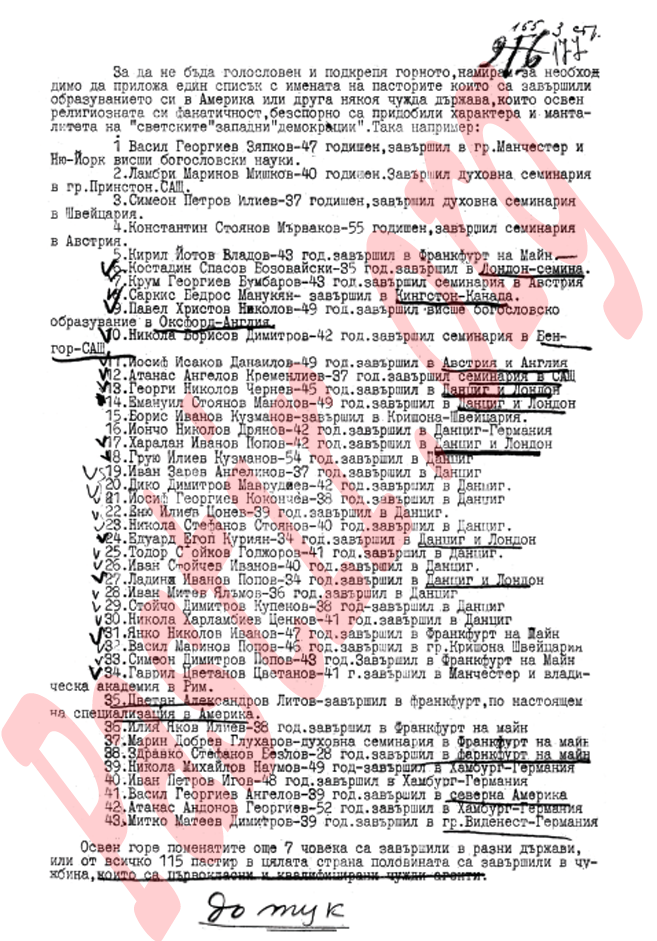
Translated from the list with pastors from the document above:
LIST OF BULGARIAN EVANGELICAL PASTORS WHO COMPLETED THEIR EDUCATION ABROAD
State Security Service Memorandum, 1948
Archival Reference: 155/3/177
Editorial note: The following is a complete transcription and translation of the archival document photographed at pastir.org. Text underlined in the original manuscript is rendered with underline formatting below. A handwritten annotation reading ‘до тук’ (‘to here’) appears at the foot of the original page, indicating the end of the handwritten portion of the document. Checkmarks (✓) visible in the original against certain entries are noted in brackets. The preamble and closing summary are translated verbatim from the Bulgarian.
Preamble (verbatim translation): ‘In order not to speak in generalities and to substantiate the foregoing, I find it necessary to append a list of the names of the pastors who completed their education in America or in some other foreign country, who, in addition to their religious fanaticism, have unquestionably acquired the character and mentality of the “secular” Western democracies. For example:’
THE LIST
- Vasil Georgiev Zyapkov — age 47. Completed advanced theological studies in Manchester and New York.
- Lambri Marinov Mishkov — age 40. Completed his studies at the theological seminary in Princeton, USA.
- Simeon Petrov Iliev — age 37. Completed his studies at a theological seminary in Switzerland.
- Konstantin Stoyanov Marvakov — age 55. Completed his studies at a seminary in Austria.
- Kiril Yotov Vladov — age 43. Completed his studies in Frankfurt am Main.
- Kostadin Spasov Bozovayski — age 35. Completed his studies in London — Seminary.
- Krum Georgiev Bumbakov — age 43. Completed his studies at a seminary in Austria.
- Sarkis Bedros Manukyan. Completed his studies in Kingston, Canada.
- Pavel Hristov Nikolov — age 49. Completed advanced theological education in Oxford, England.
- Nikola Borisov Dimitrov — age 42. Completed his studies at a seminary in Bangor, USA.
- Yosif Isakov Danailov — age 49. Completed his studies in Austria and England.
- Atanas Angelov Kremenliev — age 37. Completed his studies at a seminary in the USA.
- Georgi Nikolov Chernev — age 45. Completed his studies in Danzig and London.
- Emanuil Stoyanov Manolov — age 49. Completed his studies in Danzig and London.
- Boris Ivanov Kuzmanov. Completed his studies in Krichona — Switzerland.
- Yoncho Nikolov Dryanov — age 42. Completed his studies in Danzig — Germany.
- Haralan Ivanov Popov — age 47. Completed his studies in Danzig and London.
- Gruy Iliev Kuzmanov — age 54. Completed his studies in Danzig.
- Ivan Zerev Angelinov — age 37. Completed his studies in Danzig.
- Diko Dimitrov Mavrudaev — age 42. Completed his studies in Danzig.
- Yosif Georgiev Kokonchev — age 38. Completed his studies in Danzig.
- Enyu Iliev Tsonev — age 39. Completed his studies in Danzig.
- Nikola Stefanov Stoyanov — age 40. Completed his studies in Danzig.
- Eduard Agop Kuriyan — age 34. Completed his studies in Danzig and London.
- Todor Stoykov Godjorov — age 41. Completed his studies in Danzig.
- Ivan Stoychev Ivanov — age 40. Completed his studies in Danzig.
- Ladin Ivanov Popov — age 34. Completed his studies in Danzig and London.
- Ivan Mitev Yalamov — age 36. Completed his studies in Danzig.
- Stoicho Dimitrov Kupenov — age 38. Completed his studies in Danzig.
- Nikola Harlamiev Tsenkov — age 41. Completed his studies in Danzig.
- Yanko Nikolov Ivanov — age 47. Completed his studies in Frankfurt am Main.
- Vasil Marinov Popov — age 45. Completed his studies in Krichona, Switzerland.
- Simeon Dimitrov Popov — age 43. Completed his studies in Frankfurt am Main.
- Gavril Tsvetanov Tsvetanov — age 41. Completed his studies in Manchester and at the episcopal academy in Rome.
- Tsvetan Alexandrov Litov. Completed his studies in Frankfurt; currently specialising in America.
- Iliya Yakov Iliev — age 38. Completed his studies in Frankfurt am Main.
- Marin Dobrev Gluharov. Completed his studies at the theological seminary in Frankfurt am Main.
- Zdravko Stefanov Bezlov — age 28. Completed his studies in Frankfurt am Main.
- Nikola Mikhailov Naumov — age 49. Completed his studies in Hamburg — Germany.
- Ivan Petrov Igov — age 48. Completed his studies in Hamburg — Germany.
- Vasil Georgiev Angelov — age 39. Completed his studies in northern America.
- Atanas Andonov Georgiev — age 52. Completed his studies in Hamburg — Germany.
- Mitko Mateyev Dimitrov — age 39. Completed his studies in Wilenest — Germany.
Closing Summary (verbatim translation):
‘In addition to the above-mentioned, a further 7 individuals completed their studies in various countries. Thus, of a total of 115 pastors throughout the entire country, half completed their education abroad — who are accordingly first-class and qualified foreign agents.’
Handwritten annotation at foot of document: ‘до тук’ (‘to here’) — indicating the end of the handwritten portion of the memorandum.
Translator’s Notes
- Entries marked with ✓ in the original document are reproduced here with that symbol. The significance of the checkmarks is not explained in the source; they may denote individuals already arrested, already under surveillance, or prioritised for prosecution at the time of the document’s compilation.
- Underlined text in the original (indicating institutions and cities) is preserved with underline formatting.
- ‘Danzig’ refers to the Free Theological Academy (Freie Theologische Akademie) in the Free City of Danzig (present-day Gdańsk, Poland), which served as the principal training institution for Bulgarian Pentecostal pastors throughout the 1930s.
- ‘Krichona’ refers to the St. Chrischona Pilgrim Mission (Pilgermission St. Chrischona) near Basel, a pietist missionary training institution.
- ‘Wilenest — Germany’ in entry 43 is likely a transcription error or phonetic rendering in the original Bulgarian; the precise institution has not been identified.
- The document bears the archival reference 155/3/177 and is reproduced at pastir.org. The preamble and closing summary are in typewritten Bulgarian; the annotation ‘до тук’ (‘to here’) is handwritten.
- The assertion that foreign-educated pastors are ‘first-class and qualified foreign agents’ represents the operative ideological premise of the 1948–1949 Pastoral Trials — that Western theological education was itself evidence of intelligence recruitment.


Comments