

THE PASTORAL TRIALS ELIMINATE THE AVANTGUARD OF BULGARIAN EVANGELICALS FOR AN ENTIRE GENERATION (PART 3)

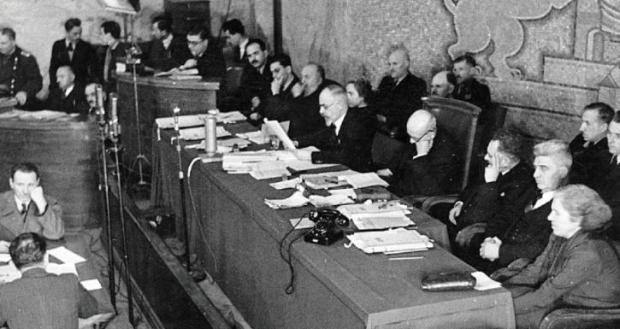
THE PASTORAL TRIALS ELIMINATE THE AVANT-GARDE OF BULGARIAN EVANGELICALS, BEHEADING IT FOR AN ENTIRE GENERATION (Part 3)
[Editorial note: The following text is translated from the Bulgarian original. The documents contain memorandums, archival records, State Security (Darzhavna Sigurnost / DS) interrogation files, survivor testimonies, and secondary scholarly sources. Bracketed insertions in the original are the author’s. Handwritten portions of the source document are noted where applicable. Archival reference: pp. 155–177.]
Yanko Nikolov Ivanov
Completed his studies in Frankfurt (1925). He had earlier withdrawn from the Faculty of Law at Sofia University and redirected his path towards commerce. He successfully completed the Commercial and Industrial Chamber in Ruse. His father, Nikola Ivanov, financed his studies and sent him to study theology at the Methodist Church seminary in Frankfurt. Immediately upon returning from Frankfurt, he was appointed to Gorna Mitropolia at the 28th Annual Conference in Sofia (1925). The following year Yanko Ivanov was elected assistant secretary of the Conference and appointed to the Evangelical Methodist Church (EMC) in Vidin for a period of four years. During this period he was elected secretary of the Annual Conference and treasurer of the Church Charitable Society. In 1930 he was sent to Lom for three years, where he subsequently served as pastor. During his stay in Lom the newly constructed Methodist church building was sold. From 1933 to 1940 he served in Pleven, and was then, with the approval of Alphonse Prache, transferred to the EPC Sofia as secretary of the Annual Methodist Conference. From 1944 he held the position of supreme superintendent of the EMC and deputy religious representative of the Evangelicals within the United Evangelical Churches (OETs), until the commencement of the Pastoral Trials.
From the State Security interrogation file: ‘His arrest for anti-people and espionage activities was met by him with arrogance. At the outset of the investigation he maintained an arrogant manner and with marked irony attempted to answer the questions. He relied on foreign intervention and on his high ecclesiastical rank. He denied everything without reservation… By this stance he greatly impeded the investigation. He displayed a strong will, a firm character, and steadfastness. He possesses a sound logical faculty.’
Despite being subjected to torture both ‘behind the curtain’ and in the ‘devil’s cell’ during pre-trial detention, he endeavoured to protect his colleagues from dangerous deviations in the political sphere. He attempted to warn the others that two of the accused pastors were assisting the investigation with their testimony, but his effort was thwarted. According to his testimony, at the OETs assembly of 1944, a hostile line towards the Fatherland Front was discussed, at which ‘Zyapkov reported that he had made contact with the American and British Legations in Sofia and received assurances of protection should the authorities take measures against them as a result of their conduct (according to the testimony of N. Mikhailov, Georgi Chernev, Yanko Ivanov, and others, in part)… That in 1945 Yanko Ivanov, in his capacity as deputy religious representative, met with a certain Tobias — who had entered the country under cover as a delegate of the British youth delegation and was an American intelligence operative — who came to Ivanov in strict secrecy and presented himself as an emissary of Methodist Bishop Garber, to whom Ivanov provided written information on the situation in the country and on the conditions under which the sects operated; which information he had gathered from all four sects in written form; and that he received directives for agitation and slander against the people’s authority from Tobias, which directives Ivanov subsequently transmitted at one of the sessions of the Supreme Council of the OETs (according to the testimonies of Ya. Ivanov, G. Chernev, and N. Mikhailov).’
In his own defence he stated: ‘I am proud to declare that the honourable Ministry of Foreign Affairs has never experienced any difficulties owing to violations committed by members or employees of the Methodist Church. In all circumstances, the Methodist Church as a community and I as its representative have acted straightforwardly, honestly, and loyally towards the authorities, as any good Bulgarian would. Never and under no circumstance have I sought the intervention of foreigners, not even that of our bishop Dr. Garber, in order to achieve a proper resolution of disputed matters with the authorities. In such cases I have always sought the assistance of the authorities and the laws of the country, but not the interference of any foreigners whatsoever.’
He was found guilty of participating in ‘a reconnaissance network in favour of a foreign intelligence service’ and transmitting ‘numerous items of information of a military, economic, and political character constituting state secrets’; receiving ‘remuneration from a foreign state and representatives of a foreign intelligence service’; disseminating ‘abroad false and grossly distorted accounts, substantially damaging the dignity of the Bulgarian people and state,’ as well as ‘false rumours, reports, and assertions,’ and ‘verbally within the country, offensive, defamatory, and false assertions’ with the aim of harming ‘our good relations with a friendly state or its authorities,’ diminishing ‘the prestige of such a state or its authorities,’ all of this serving ‘another state in a hostile act against the Bulgarian state.’ He was sentenced to life imprisonment with hard labour, a fine of one million leva in favour of the state, deprivation of pastoral rights, and confiscation of all his property. He was released after thirteen and a half years of imprisonment — only a few months before his death, which came on Christmas Day, 1962.
Note on his son: Nikolai Yankov Ivanov, residing at 86 ‘Rakovski’ Street, served as secretary of the Methodist Church youth section. He was expelled from the Shumen Aviation School on charges of fascist activity. He had made attempts to leave the country with no intention of returning. He had also escorted and arranged meetings with persons suspected of espionage for one Lord Shier, who arrived in Bulgaria in 1948.
Vasil Marinov Popov
Completed his studies in Brussels and theology in Cremona, Switzerland (1920). Detained and sent to a labour camp without sentence together with the Methodists Kiril Yotov, Marin Gluharov, and Nikola Pulev. The Pastoral Trials found him serving as pastor of the EMC in Varna. The investigation unearthed his earlier case from Lovech, where he had served as pastor (1940–1945) and had been acquitted. He maintained close ties with the American household at the boarding house in the city of Lovech, and demonstrated Germanophile tendencies, being a member of the Bulgarian-German Society in the city. He attended the OETs assembly held at the end of September and beginning of October 1945 in Burgas, at a special gathering of pastors convened at Zyapkov’s request; and also the conference of 1938 in Pleven, attended by Dr. John L. Newlson, Dr. Ralph Diffendorfer, and Alphonse Prache (according to the testimony of Yanko Ivanov and Mitko Mateyev).
Simeon Dimitrov Popov — Age 43
Completed his studies in Frankfurt; married to a Swiss national (Elza Walter Gisler). After completing secondary school in 1922, he was sent on a pastoral internship in Popovo, and the following year became assistant to Pastor Iv. Todorov in Veliko Tarnovo. At the Annual Conference in the autumn of 1924 he was sent to study theology at the seminary in Frankfurt am Main, Germany (1924–1927). After his return he served five years in Svishtov, and in 1932 was appointed senior pastor of the EMC in Lovech for a further five years. In 1937 he succeeded Vasil as pastor in the Czech village of Voyvodovo, remaining there until the moment of his arrest in 1949, when he was charged with espionage. He was sentenced to seven years and six months’ imprisonment, of which he served five years and four months in the prisons of Sofia, Varna, and Belene. He was released in 1955, and in 1958 assumed the pastorate of the EMC ‘Dr. Long’ in Sofia. His success was such that the authorities compelled him to relocate to Svoge, from where he commuted to services, until he was ultimately banned even from entering Sofia. In 1960 he assumed leadership of the EMC in Shumen, where he devoted himself to the meticulous collection and preservation of the Methodist archive.
In a letter from Zyapkov to the Methodist Church historian Samuil Vasilev, dated 25 March 1971, we read: ‘Is the bishop not interested in your work? Could Simeon Popov not help you in gathering materials? In my view he is the best worker in the Methodist Church today!’
Despite his advanced age, in Shumen Pastor Popov participated in a network for the clandestine distribution of Bibles. During one of the searches of his home, the State Security Service confiscated 4,000 Bibles, and he himself was arrested. During Johnnie Noer’s visit in 1989, Shumen was placed under blockade, and Pastor Simeon Popov — despite his advanced years — spent the day at the local militia headquarters in order to prevent the expulsion of the foreign visitors to Romania. Pastor Popov was known among the faithful of that era for his letter ministry, dispatching messages to over 1,200 believers throughout the country. Initially these were typed on a typewriter and later reproduced on a Roneograph. The Ministry of the Interior confiscated all the machines, but workers at the BCP party bookshop in Svoge secretly printed the messages at night. His book Why I Believe in God, begun in 1940, was printed in the Netherlands in 1982. In 1992 it received official approval and a recommendation from the Ministry of Education and Culture as a teaching aid for the optional study of religious instruction.
Gavril Tsvetanov Tsvetanov — Age 47
Completed his studies in Constantinople and at the episcopal seminary in Rome; residing in Sofia, 28 ‘Skobelev’ Street. His father, Pastor Tsvetan Tsvetanov, officiated at the wedding of Georgi Dimitrov and Lyuba Ivoshevich in Pleven on 20 October 1906. Gavril was born the same year in Sevlievo. He served as an associate professor at the Faculty of Economic and Social Sciences, and as secretary of the Supreme Council of the OETs and personal English-language correspondent of Yanko Ivanov. In 1920 he was sent on a scholarship to a theological school in Manchester. In 1923 he was sent to Italy to study theology, and contributed to the fascist newspaper Popolo d’Italia. In 1925 he was transferred again to study in Manchester. He attended the Methodist conference of 1938 in Pleven, together with Dr. John L. Newlson, chief secretary of the Board in America, Dr. Ralph Diffendorfer, and Alphonse Prache.
Before 9 September 1944, he was head of the ‘Cultural Section’ of the Bulgarian Workers’ Union (BRS). From August 1943 until 9 September 1944 he was mobilised at the Army Staff ‘Reconnaissance Company’ under Captain Armyanov. He organised a clandestine radio transmitter which, at Tsvetanov’s insistence, broadcast fascist content for a year and several months. He was a contributor to the newspaper Vecher, with records indicating that he served British intelligence. Detained for his fascist activities and sent to a corrective labour camp from 20 March to 20 October 1945. After 9 September he accompanied Yanko Ivanov to the American Mission, where Captain Andrénond received them, and served as interpreter for the conversation between the two. They also visited Strong, Reiminkel, and Cyril Black. During the visits of Bishop Dr. Paul Garber, Tsvetanov served as interpreter and transmitted informational data about Bulgaria, which were subsequently published in the foreign press, thereby exposing Bulgaria to the outside world. At the end of 1947 the chairman of the World Council of Churches, Cockburn, organised a conference with the pastors at the Hotel Bulgaria, with Gavril Tsvetanov serving as interpreter. For maintaining contacts with legionaries after 9 September, Tsvetanov was detained at the beginning of 1948 but released on 29 March 1948 owing to insufficient evidence. The foregoing is attested to by the testimonies of Yanko Ivanov and Haralan Popov, as well as by the data contained in file No. 155382.
Tsvetan Alexandrov Litov
Completed his studies in Frankfurt; currently specialising in America. He served as pastor of the ‘Dr. Long’ church in Sofia, which during his tenure numbered over 280 members. In 1934 he was one of only thirteen pastors in Bulgaria to receive a written certificate from the Ministry. As secretary of the OETs he participated in the Union of Youth Evangelical Organisations in Bulgaria. According to the confessions from the Pastoral Trials, he was among the first to whom Cyril Black’s petition was transmitted. He was then compelled to gather detailed information about the Sofia garrison and the Pernik–Voluyak railway line. The information was transmitted in 1945 in two tranches — to Black and to Melony Turner. He was the only one to escape conviction, being in the United States at the time and not returning to Bulgaria. Upon his departure he was replaced by Pastor Zdravko Bezlov.
Iliya Yakov Iliev — Age 38
Born in 1907 in Kalugerovo (near Pravets, above the Borovets fortress). He attended the ecclesiastical school of the Cherepish Monastery but could not sing. He completed secondary school in Botevgrad and established contact with the pastor of the EMC in Botevgrad, Spas Miloshev. He was appointed as a trainee pastor in 1929 under Pastor Alexander Georgiev in Pleven. The following year, at the Annual Conference of 1930, he was sent to the seminary in Frankfurt, where he studied alongside Popov, Iliev, Yotov, Litov, Kishishyan, Yanko Ivanov, and Georgi Sivriev. The rector, Dr. Mele, personally covered half of the tuition fee. He served with the Missionary Tent throughout Germany. At the 37th Annual Conference of the EMEC in Varna he was appointed by Bishop Nilsen to Hotantsa, where he worked for eleven years until the end of the Second World War.
His wife, Marta Müller — a German national — was to have been sent together with other Germans to a camp in the USSR, but the entire village interceded on her behalf, and the family relocated to the EMC in Lovech. At the end of August 1948 the American Girls’ School in Lovech was closed, and Pastor Iliev was charged and convicted at the second closed Pastoral Trial to three years’ imprisonment. He served his sentence in the Sofia Central Prison, while during the same period his son developed pulmonary complications. In August 1951 Pastor Iliev was released, but the church hall had been taken over as a warehouse by the Pharmaceutical Directorate — Lovech. From 1953 he conducted Sunday services simultaneously in the Methodist and Baptist churches in Ruse. Two years later the entire family settled in that riverside city, where he remained until his death in 1997.
Marin Dobrev Gluharov
Completed his studies at the theological seminary in Frankfurt. Born in Yablanitsa (1909). He graduated from the Theological Seminary in Sofia, and subsequently continued his studies in ‘Finance and Accounting’ at the Free University. In 1932 he received a scholarship for theological education in Germany. Upon his graduation in 1935 he assumed leadership of the Evangelical Methodist Church (EMC) in Vidin, and the following year was transferred to Sevlievo, where he served for four years. During the Second World War he fulfilled his pastoral duties in Ihtiman. During the Pastoral Trials he was sentenced to six years’ imprisonment, which he served in the labour camps at Belene and Bobov Dol. Because of his refusal to give testimony he could not be definitively convicted, but as a result of the inquisitions during interrogation and the brutal beatings inflicted upon him, he sustained severe physical injuries, including a fractured spine.
Stefan Bochev describes the condition of Pastor Gluharov, whom he encountered in the camp, in the following terms: ‘He could not stand upright. He dragged himself on his stomach, having fitted his palms with hand-clogs so as not to injure them. He would raise himself slightly on his hands in order to move forward. Yes, they had succeeded in reducing him to the condition of a reptile… crawling with his hand-clogs through the mud of Persin, yet with the gaze of a human being and a spirit worthy of the heights.’
Zdravko Stefanov Bezlov
At the age of twenty-eight, he graduated with distinction from Frankfurt (1943) and was awarded a scholarship for doctoral studies in the United States. Nevertheless, he returned to Bulgaria during the war and, after several months of work in Ruse, assumed leadership of the ‘Dr. Long’ church in Sofia. With the advent of the Communist regime, Pastor Bezlov was removed from the pulpit and began his path of martyrdom — passing through the cells of the State Security Service, labour camps, coal mines, and stone quarries. He was sentenced to fifteen years’ hard imprisonment, a fine of 250,000 leva, and deprivation of civil rights for fifteen years.
Despite all of this, he remained one of the few who refused to plead guilty — alongside Ivan Angelov, Hristo Neychev, Dimitar Hristov, and Zdravko Bezlov himself. He once confided: ‘I am in the camp, and do you know — when you fail to meet the quota, apart from being beaten with a cudgel, what it feels like to sleep in a pit full of mud.’ After thirteen and a half years Pastor Bezlov was released, but the authorities continued to persecute him as a former political prisoner. After 1989, already half-paralysed, he organised the restoration of the Methodist Church in Bulgaria and the ‘Dr. Long’ church. In 1992 the World Methodist Council awarded him its Peace Prize. The entire sum of the award he donated to the Organ Fund of the ‘Dr. Long’ church.
Nikola Mikhailov Naumov
Completed his studies in Hamburg, Germany. From 1922 a member of the editorial committee of the quarterly publication of the Evangelical Baptist Churches of Bulgaria (SEBC), together with Vidolov and Zashev. According to the confessions: ‘Mikhailov [i.e., the defendant Pastor Nikola M. Naumov — ed.] was also interested in the course of the war. I would communicate all information to him. Mikhailov would pass it on to the Americans… Mikhailov travelled throughout the provinces on church business.’
According to the indictment: ‘In 1938, the Baptist pastor Carl Filbrand — a long-standing major agent of American and German intelligence with several years’ experience in subversive work in the USSR, of German origin from Russia, residing in Vienna — convened a conference with Baptist pastors in Bulgaria at which he assigned them the very concrete task of propagating German influence in the country and gathering information of a political, economic, and military character. He organised an extensive agent network from all Baptist pastors, appointing as residents the pastors: Ivan Angelov, Georgi Vasov, and Nikola Mikhailov. This apparatus began to function immediately, with information being transmitted to Filbrand and Mikhailov (according to the testimony of N. Mikhailov, G. Chernev, and G. Vasov).’
Ivan Petrov Igov
Completed his studies in Hamburg, Germany. Born in Berkovitsa (1905); Baptist pastor residing in Sofia, 17 ’20 April’ Street. Sentenced and sent to Belene on account of his faith, where he spent six long years. His family was interned in Golintsi, without the right to return to Sofia. After his release, Igov served as pastor in Lom, and later in Varna and Plovdiv.
According to the indictment: ‘In 1925 he was recruited by Filbrand. He completed his studies at a theological seminary in Hamburg, Germany, a classmate of Georgi Vasov. In 1938 he participated in the re-recruitment of all Baptist pastors by Loishner, at which point he was designated as one of four individuals to establish the intelligence apparatus among pastors of the Baptist denomination. Until the war he received his support directly from America. In 1938 he returned to Sofia with Pavlov Schmidt, who was in Bulgaria at that time together with Filbrand. After 9 September, he attended all gatherings of the pastors, congresses, and so forth. He also attended the unofficial gatherings of the pastors, at which decisions were taken against the Fatherland Front authority. At the Baptist church congress of September 1947, Igov stood as a candidate for chairman of the Baptist Union. Mikhailov opposed him. Igov then rose and declared before everyone that he was leaving the Baptist Union congress and going to report Mikhailov to the authorities and reveal who Mikhailov was and what he was doing. Engineer Milan Kostov intervened and compelled them to reconcile. He received money from the illegally exchanged dollars. Igov was a collaborator of Georgi Vasov, to whom he transmitted his information. He was a travelling pastor among the Baptist churches. From 1931 to 1939 he visited Hungary, twice Germany, four times Switzerland, and Sweden (according to the testimony of Mikhailov, Zahari Raychev, Dimitar Mateyev, and G. Vasov).’
Vasil Georgiev Angelov
Completed his studies in America. Born in Stob (1909). On the recommendation of Pastor Pavel Mishkov, he completed his studies at Wheaton College in Chicago and the Theological Seminary in Dallas. He did not return to Bulgaria until 1938, where for a brief period he served as pastor in Yambol, Haskovo, and Samokov. From 1946 to 1948 he published the magazine Good News (Dobri Vesti).
According to the indictment: ‘[The pastors] gathered and transmitted to their foreign missions numerous items of information of a military, political, and economic character — such as the production of the military factories in Kazanlak and the aircraft factory and their output; the production of Koralovag; the production of the Mülhaupt factory in Ruse; the production of the Pirin mines; the mobilisation of conscripts; the movement of military units; traffic on the Danube and at Danubian ports; the mood of the popular masses; etc. (according to the testimony of N. Mikhailov, Georgi Vasov, Dimitar Mateyev, Zahari Raychev, Georgi Chernev, and Haralan Popov).’
Atanas Andonov Georgiev — Age 52
Completed his studies in Hamburg. Born in Sumitsa (1897); residing in Ruse, 35 ‘G. Dimitrov’ Street. Baptist pastor, recruited in 1925.
According to the indictment: ‘In 1937 re-recruited by Filbrand, and in 1938 recruited by Loishner. He supplied information of an economic, political, and military character to N. Mikhailov. After 9 September he continued his intelligence activities, again transmitting information to Mikhailov. According to the old and new construction of the intelligence apparatus, he was required to transmit his information to Nikola Mikhailov. From the information sent to us from Ruse regarding him, it is evident that he was hostile in his disposition towards the Fatherland Front authority. This is most clearly apparent from the sermons he delivered. He received from abroad for the year 1947 six parcels — 42 kg; for 1948 — one parcel of 8.5 kg; and for the period 1947–48 received from Mikhailov from the illegally exchanged dollars the sum of 324,000 leva.’
Mitko Mateyev Dimitrov — Age 39
Completed his studies in Germany.
According to the indictment: ‘Every Evangelical pastor who receives his support from abroad (and all of them do) was obliged to send reports to his foreign mission on his work and the conditions under which he operated — reports in which he was required to provide as extensive information as possible on the mood of the people among whom he worked, on economic life, on the political mood of the masses, etc. — reports constituting in essence intelligence despatches on the political and economic life of the country (according to the testimony of N. Mikhailov, Yanko Ivanov, Georgi Chernev, Georgi Vasov, Dimitar Mateyev, Haralan Popov, and others).’
Exiled to Varna, Persin, and Belene. After Belene he worked at Elhima. He was denounced by someone close to him for planning to emigrate. He was sentenced to a further seven years of hard imprisonment. He subsequently emigrated to Canada, where he published a book about the years spent in prison, entitled Upon Thy Word I Have Placed My Trust.
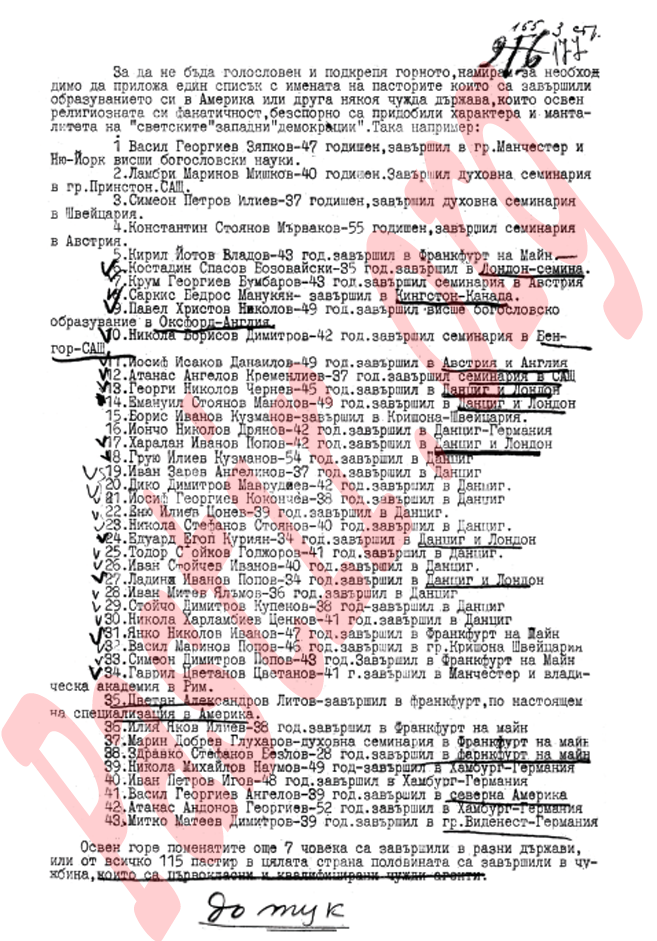
Translated from the list with pastors from the document above:
LIST OF BULGARIAN EVANGELICAL PASTORS WHO COMPLETED THEIR EDUCATION ABROAD
State Security Service Memorandum, 1948
Archival Reference: 155/3/177
Editorial note: The following is a complete transcription and translation of the archival document photographed at pastir.org. Text underlined in the original manuscript is rendered with underline formatting below. A handwritten annotation reading ‘до тук’ (‘to here’) appears at the foot of the original page, indicating the end of the handwritten portion of the document. Checkmarks (✓) visible in the original against certain entries are noted in brackets. The preamble and closing summary are translated verbatim from the Bulgarian.
Preamble (verbatim translation): ‘In order not to speak in generalities and to substantiate the foregoing, I find it necessary to append a list of the names of the pastors who completed their education in America or in some other foreign country, who, in addition to their religious fanaticism, have unquestionably acquired the character and mentality of the “secular” Western democracies. For example:’
THE LIST
- Vasil Georgiev Zyapkov — age 47. Completed advanced theological studies in Manchester and New York.
- Lambri Marinov Mishkov — age 40. Completed his studies at the theological seminary in Princeton, USA.
- Simeon Petrov Iliev — age 37. Completed his studies at a theological seminary in Switzerland.
- Konstantin Stoyanov Marvakov — age 55. Completed his studies at a seminary in Austria.
- Kiril Yotov Vladov — age 43. Completed his studies in Frankfurt am Main.
- Kostadin Spasov Bozovayski — age 35. Completed his studies in London — Seminary.
- Krum Georgiev Bumbakov — age 43. Completed his studies at a seminary in Austria.
- Sarkis Bedros Manukyan. Completed his studies in Kingston, Canada.
- Pavel Hristov Nikolov — age 49. Completed advanced theological education in Oxford, England.
- Nikola Borisov Dimitrov — age 42. Completed his studies at a seminary in Bangor, USA.
- Yosif Isakov Danailov — age 49. Completed his studies in Austria and England.
- Atanas Angelov Kremenliev — age 37. Completed his studies at a seminary in the USA.
- Georgi Nikolov Chernev — age 45. Completed his studies in Danzig and London.
- Emanuil Stoyanov Manolov — age 49. Completed his studies in Danzig and London.
- Boris Ivanov Kuzmanov. Completed his studies in Krichona — Switzerland.
- Yoncho Nikolov Dryanov — age 42. Completed his studies in Danzig — Germany.
- Haralan Ivanov Popov — age 47. Completed his studies in Danzig and London.
- Gruy Iliev Kuzmanov — age 54. Completed his studies in Danzig.
- Ivan Zerev Angelinov — age 37. Completed his studies in Danzig.
- Diko Dimitrov Mavrudaev — age 42. Completed his studies in Danzig.
- Yosif Georgiev Kokonchev — age 38. Completed his studies in Danzig.
- Enyu Iliev Tsonev — age 39. Completed his studies in Danzig.
- Nikola Stefanov Stoyanov — age 40. Completed his studies in Danzig.
- Eduard Agop Kuriyan — age 34. Completed his studies in Danzig and London.
- Todor Stoykov Godjorov — age 41. Completed his studies in Danzig.
- Ivan Stoychev Ivanov — age 40. Completed his studies in Danzig.
- Ladin Ivanov Popov — age 34. Completed his studies in Danzig and London.
- Ivan Mitev Yalamov — age 36. Completed his studies in Danzig.
- Stoicho Dimitrov Kupenov — age 38. Completed his studies in Danzig.
- Nikola Harlamiev Tsenkov — age 41. Completed his studies in Danzig.
- Yanko Nikolov Ivanov — age 47. Completed his studies in Frankfurt am Main.
- Vasil Marinov Popov — age 45. Completed his studies in Krichona, Switzerland.
- Simeon Dimitrov Popov — age 43. Completed his studies in Frankfurt am Main.
- Gavril Tsvetanov Tsvetanov — age 41. Completed his studies in Manchester and at the episcopal academy in Rome.
- Tsvetan Alexandrov Litov. Completed his studies in Frankfurt; currently specialising in America.
- Iliya Yakov Iliev — age 38. Completed his studies in Frankfurt am Main.
- Marin Dobrev Gluharov. Completed his studies at the theological seminary in Frankfurt am Main.
- Zdravko Stefanov Bezlov — age 28. Completed his studies in Frankfurt am Main.
- Nikola Mikhailov Naumov — age 49. Completed his studies in Hamburg — Germany.
- Ivan Petrov Igov — age 48. Completed his studies in Hamburg — Germany.
- Vasil Georgiev Angelov — age 39. Completed his studies in northern America.
- Atanas Andonov Georgiev — age 52. Completed his studies in Hamburg — Germany.
- Mitko Mateyev Dimitrov — age 39. Completed his studies in Wilenest — Germany.
Closing Summary (verbatim translation):
‘In addition to the above-mentioned, a further 7 individuals completed their studies in various countries. Thus, of a total of 115 pastors throughout the entire country, half completed their education abroad — who are accordingly first-class and qualified foreign agents.’
Handwritten annotation at foot of document: ‘до тук’ (‘to here’) — indicating the end of the handwritten portion of the memorandum.
Translator’s Notes
- Entries marked with ✓ in the original document are reproduced here with that symbol. The significance of the checkmarks is not explained in the source; they may denote individuals already arrested, already under surveillance, or prioritised for prosecution at the time of the document’s compilation.
- Underlined text in the original (indicating institutions and cities) is preserved with underline formatting.
- ‘Danzig’ refers to the Free Theological Academy (Freie Theologische Akademie) in the Free City of Danzig (present-day Gdańsk, Poland), which served as the principal training institution for Bulgarian Pentecostal pastors throughout the 1930s.
- ‘Krichona’ refers to the St. Chrischona Pilgrim Mission (Pilgermission St. Chrischona) near Basel, a pietist missionary training institution.
- ‘Wilenest — Germany’ in entry 43 is likely a transcription error or phonetic rendering in the original Bulgarian; the precise institution has not been identified.
- The document bears the archival reference 155/3/177 and is reproduced at pastir.org. The preamble and closing summary are in typewritten Bulgarian; the annotation ‘до тук’ (‘to here’) is handwritten.
- The assertion that foreign-educated pastors are ‘first-class and qualified foreign agents’ represents the operative ideological premise of the 1948–1949 Pastoral Trials — that Western theological education was itself evidence of intelligence recruitment.


Comments