

NY Times: Bulgaria’s Unholy Alliances
By MATTHEW BRUNWASSER
SOFIA — His enthronement as patriarch of Bulgaria, spiritual leader of millions of Orthodox believers here, was supposed to stir pride and moral togetherness in an impoverished country confronting a vacuum in political leadership and widespread economic pain. Instead, the installation of His Holiness Neofit last month, in a ceremony replete with byzantine splendor, served as one more reminder that Bulgaria had never really thrown off the inheritance of 40 years of rigid Communist rule and all the duplicitous dealings that went with it.
Bulgaria has suffered fresh turmoil since mid-February, when nationwide protests erupted over a rise in power prices. The national government resigned in what it said was a bid to avert more bloodshed. But this week, the country went into nationwide mourning over the death of one protester, Plamen Goranov, 36, who set himself on fire in front of a public building in his hometown, Varna.
The church has played no part in calming its troubled nation. Like 11 of the 14 metropolitan bishops who make up the ruling synod of the Bulgarian Orthodox Church, Neofit was revealed to have a file documenting or implying cooperation with the powerful secret police under Communism. Proof of collaboration — for which the church has never apologized — was expected, but the number of bishops implicated when a state commission opened the files on church leaders in January 2012 “was beyond all expectations,” noted Momchil Metodiev, a historian who has researched the church in the Communist era.
By comparison with the 30-volume record involving Simeon, the Bulgarian Church’s current metropolitan for Western Europe, Neofit’s 16-page file was slender. While the file contained only a proposal by the authorities to recruit him as an agent and a negative assessment of his suitability for State Security work, the revelations raised tantalizing questions about whether more incriminating documents had been removed. That such questions linger, more than 20 years after Communism, illustrates Bulgarians’ messy relationship to that past.
One day after the Berlin Wall fell in November 1989, the Communist dictator Todor Zhivkov, who had been in power since 1954, was deposed, not by popular uprising but in a palace coup. The politics behind the act remained murky, meaning that his removal is still a matter of dispute. Few Bulgarians can say the word “democracy” without irony or bitterness, because while they gained freedom and their country has now joined the North Atlantic Treaty Organization and the European Union, it has remained poor and underdeveloped, with the riches most dreamed of under capitalism reserved for the lucky, often criminally connected, few. And although State Security officially disbanded, its officials have retained a hold, contributing to the lack of clarity or debate about the past.
Many former agents went into private business and recruited wrestlers for muscle. Their networks, often criminal, gradually took over much of Bulgaria’s legitimate economy, helping to make Bulgaria notoriously corrupt, said Philip Gounev, a corruption expert at the Center for the Study of Democracy in Sofia. Similarly, the church has not faced up to its past. “Just as people say that our country is in ‘state capture’ by criminals and oligarchs who have taken control of the state, the church is in a state of ‘state capture’ by metropolitans associated with the state security police,” Mr. Gounev said.
The church counters that it is, for instance, planning to canonize martyrs from the Communist era over the next two years, making saints of those found to have died or been imprisoned for the faith among the thousands of believers who were persecuted. “We can expect to close the page of our Communist heritage by this very symbolic act,” said Desislava Panayotova, from the cultural department of the Holy Synod.
But it seems that it will take more than canonizations to restore the church’s position as a moral beacon in an increasingly secular society. After the state, the church is the second-largest landowner in the country, making it an attractive target for criminal groups. With its weak management and opaque institutions — the church does not, for instance, have a designated media spokesperson — observers say the church has remained aloof from any state efforts to clean up corruption. While many historic churches and monasteries crumble from neglect, the Bulgarian news media relay a stream of shocking stories about church officials’ luxury cars, expensive watches, shady land deals and ties to questionable businessmen.
The Stara Zagora metropolitan, Galaktion, a close rival to Neofit in the recent patriarchal election, bestowed an honorific church title on a wealthy sponsor, Slavi Binev, a former taekwando champion and owner of a security firm who is now also a member of the European Parliament. Mr. Binev was described in a 2005 WikiLeaks cable from the U.S. Embassy in Sofia as heading a group whose “criminal activities include prostitution, narcotics, and trafficking stolen automobiles.” In response, Mr. Binev told a Bulgarian newspaper that he was not perturbed to be on a list of people who were “the blossom” of Bulgarian business in the transition from Communism.
The metropolitan of Plovdiv, Nikolai, bestowed the same church title on Petar Mandzhukov, an international arms dealer, and later announced that he planned to sell his Rolex watch to pay the unpaid electricity bill for a church in his diocese, apparently hoping to quell public anger both at church riches and at the rising price of electricity that helped spark the recent protests. The church has also been accused of paying priests in cash to avoid social welfare payments and taxes.
One huge challenge is healing the post-Communist schism of 1992, when priests who said they had opposed Communism formed their own synod. Ugly disputes over church properties resulted, including physical fights. The police were called in during one particularly fierce battle over the church candle factory, a major source of income. Mr. Metodiev, the historian, who describes himself as “anti-Communist,” made a surprising discovery during research in the secret police files. “The leaders of the schismatic synod were in fact the closest allies of the Communist Party in the synod during the Communist period,” he said.
One bishop notorious for implementing State Security orders — Kalinik, the metropolitan of Vratsa — remains on the church synod today. Mr. Metodiev asserts that those with ties to State Security, particularly those recruited as young informers in the 1970s and 1980s, are now powerful, making the synod in fact more staffed by secret police than any other, including during Communism itself. “The very idea of meritocracy failed,” Mr. Metodiev said. “People are now accustomed to developing their careers due to connections. This is one of the most damaging long-term results of the power of the State Security.”
Bulgaria’s Orthodox Church Elects New Patriarch
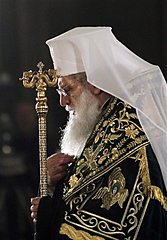 Metropolitan Neofit of Ruse was elected Sunday as the new spiritual leader of Bulgaria’s Orthodox Christians amid social unrest threatening to throw the Balkan country in a serious political crisis. The 67-year-old Neofit was picked among three candidates shortlisted in a secret ballot by the 14 bishops that make up the Holy Synod of the church.
The enthronement ceremony for Patriarch Neofit was held at Sofia with ongoing nationwide protests against high energy bills, poverty and corruption, and demands for radical political reforms, which forced the government to resign. Speaking at the ceremony, President Rosen Plevneliev voiced hope the new patriarch will contribute to Orthodox unity and the strengthening of the faith, and will preserve the integrity of the church.
The main challenges Neofit will face at home are addressing church unity, the church’s isolation from current public concerns, financial troubles and the dwindling number of priests and monks. Last year, a panel investigating communist-era secret services announced that 11 of the 15 metropolitans had ties to those services. Among those named was also Neofit. Over 20 Pentecostal and charismatic denominational leaders were also revealed to have been a part of a nationwide network of secret agents and handlers organized by the communist secret police. Yet, only two have resigned form their leadership positions. Alike many evangelical leaders in Bulgaria, the patriarch of the Orthodox church is elected for life.
Bulgaria’s ethnic party leader attacked by armed assailant
 BBC World News, Sofia – BULGARIA
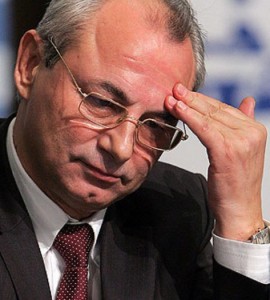
A man put a gun to the head of the leader of Bulgaria’s ethnic Turkish party during a televised conference.
Ahmed Dogan, leader of the Movement for Rights and Freedoms (MRF) was unharmed and the unidentified man was wrestled to the ground by security guards. The incident happened on Saturday at a party congress in the capital Sofia.
Interior Minister Tsvetan Tsvetanov said the attacker tried to fire two shots but “most likely the gun misfired”. He also said the assailant had a criminal record for drugs possession, robberies and hooliganism. Police arrested the attacker, a 25-year-old from the Black Sea town of Burgas, who was also carrying two knives.
The liberal MRF party represents ethnic Turks and other Muslims, who make up about 12% of Bulgaria’s population of about seven million. Mr Dogan, 58, has lead the party for almost 25 years. He returned to the party conference a few hours after the attack and was given a standing ovation.
President Rosen Plevneliev said in a statement: “Bulgarian society is traditionally known for its tolerance, mutual acceptance and respect between different ethnic groups and religions. “Such an act is unacceptable in a democratic state.” Attacks on politicians are rare in Bulgaria, but in 1996, former Prime Minister Andrei Lukanov was found shot dead near his home in Sofia
Bulgaria’s National Holiday: The Liberation of Bulgaria (1877-1878)
After being under Turkish yoke for over 500 years, Bulgaria was liberated in 1878. For the first time, March 3rd was celebrated in 1880 as the Day of the Ascension of Emperor Alexander II. Since 1888 it has been commemorated as the Day of Bulgaria’s Liberation from Ottoman rule.
During the 500 years of the Ottoman occupation, armed uprisings occurred recurrently in Bulgarian lands. Most of them were badly organized and brutally suppressed by superior Ottoman forces. It is from here that the great significance of the Bulgarian national liberation movement of the ’70s and its peak – the April Uprising – derives. The Bulgarian nation daringly appeared on the European political scene with the motto “Freedom or a heroic death,” challenging the rest of the world and putting to the test all adherents. The April Uprising of 1876 was quickly surprised by the Ottoman regular army through the killing of thousands of Bulgarian men, women and children and burning villages and towns to the ground. In this situation the governments of the Great Powers were in no position to overtly maintain the status quo as regards the Ottoman Empire. This created a congenial political situation and made it possible a more decisive intervention on the part of Russia. The Turkish atrocities that accompanied the April uprising illustrated to the whole world the true face of the Ottoman state and its barbarity. World public opinion raised its voice in defense of the Bulgarian people. British, American, Italian, French, German and Russian journalists and consuls made known to their governments and their peoples the truth about these monstrous crimes.
After preliminary talks with the European Great Powers on the possible outcome of hostilities, Russia declared war on Turkey on April 12, 1877. On the Balkans the Russian army had to overcome the Danube – a major water barrier, before coming anywhere near the Turkish troops. The Russians crossed the Danube in June, 1877. The war plan was based on the miscalculated presumption that Turkey was a colossus on clay stilts which should collapse at the first blow and envisaged the engagement of only a small Russian contingent 15,000-strong. Linder General Gurko’s command it was to rush through a narrow corridor to Constantinople and to prompt the terms of peace to the Turkish government. According to this same plan the 300,000-strong Ottoman troops in Bulgaria had to be counteracted by the Russian officers and soldiers about 250,000-strong in attacks outflanking the narrow passage.
The Bulgarian people met the news of the Russo-Turkish war with great enthusiasm and it too, rose against its centuries-long oppressor. A Bulgarian military detachment called ‘Bulgarian volunteers’, consisting of 12 battalions 12,500-strong, joined the Russian army. Hundreds of concomitant guerrilla detachments having from several dozens to several hundreds of soldiers were organized, too. These were particularly efficient in dealing with the communications and the small military groups of the enemy. Thousands of other Bulgarians directly joined the Russian army to help as reconnaissance officers, engineers of fortification facilities, medical orderlies, suppliers of fodder and food.
About the middle of July, the Russian leading detachment with Bulgarian volunteer forces reached the town of Stara Zagora in Southern Bulgarian, almost half-way through to Constantinople. The troops meant to protect the western flank of the Russian army in Bulgaria suffered a defeat in two assaults against the strategic fortress of Pleven, located only forty five miles from the Danube. At that time, the Turkish military forces concentrated on the eastern flanks of the corridor occupied by the Russians, also grew unimpeded. Soon their number was three times larger than the Russian troops withholding them. Turkish crack regiments four times as big as the Russian advance detachment were coming on from its opposite direction. Having no alternative but to succumb to the superior force, the Russians and the Bulgarians withdrew to position along the Balkan Mountain ridge in the region of the Shipka pass. Aware of its blunder, the Russian command immediately resorted to the translocation of major military formations from Russia to Bulgaria. Given traveling speed in those days the troops were expected to arrive at the front line not before the beginning of September. Everyone was clear that the war would be decided by the battle outcome at Shipka. If the Turkish army from southern Bulgaria succeeded in crossing over the Balkan Range and then joining one of the Turkish armies in northern Bulgaria, the Turkish command could be sure to obtain petrifying numerical superiority over the siege-imperiled Russians who should then leave Bulgaria. As fate has strangely willed it, the liberation of Bulgaria was entirely dependent upon the efficiency of the several thousand Bulgarian volunteers in keeping their positions on Shipka. Due to misjudgment of the direction of the Turkish main efforts, the command of the forces on Shipka had sent Russian operational reserve contingents to help in the defense of Hainboaz, another throat in the mountain. The Bulgarian volunteer detachment and only one Russian regiment remained on Shipka.
During the hot days of August 1877 epic battles took place on that mountain peak of Shipka, at the geographical intersection point of the Bulgarian lands. There the Bulgarians proved that they thoroughly deserved their freedom. Supported by few Russians, the Bulgarian volunteer detachment drove off dozens of frontal and flanking attacks by the stronger enemy with its manifold superior numbers of men and equipment, expected to easily vanquish volunteers, fighting with old rifle-trophies from the Franco-Prussian War. When the arms and ammunitions finished, the volunteers resorted to blank weapons to repulse the attacks. In fierce man-to-man fighting they showered boulders and other mass of rock, even their dead comrades’ bodies. Pertinacious and murderous was the Bulgarians’ effort that crushed the Turkish army and caused it to lose nearly half of its strength. The Bulgarian volunteers withstood their positions and thus, coped with a situation that spelled more and even greater danger. A quick change of scene and reversal of the war occurred after the arrival of fresh Russian reinforcements. They took Pleven and crossed the Balkan Mountain at the end of 1877. Following victorious battles at Sofia, Plovdiv and Sheinovo, the Ottoman military machinery was shattered, dilapidated and ruined. A preliminary peace treaty was signed in the small town of San Stefano near Constantinople on March 3, 1878. It made provision for an autonomous Bulgarian state extending to almost all Bulgarian lands in the geographical areas of Macedonia, Thrace and Moesia. The treaty of San Stefano obtained justice for the Bulgarian people. Its terms of peace included the restoration of Bulgaria’s state independence and the Bulgarians’ reunification within the boundaries of one state. It, provided the solution to the paramount historic task which had confronted the Bulgarian people over the last five centuries.
to the Turkish government. According to this same plan the 300,000-strong Ottoman troops in Bulgaria had to be counteracted by the Russian officers and soldiers about 250,000-strong in attacks outflanking the narrow passage.
The Bulgarian people met the news of the Russo-Turkish war with great enthusiasm and it too, rose against its centuries-long oppressor. A Bulgarian military detachment called ‘Bulgarian volunteers’, consisting of 12 battalions 12,500-strong, joined the Russian army. Hundreds of concomitant guerrilla detachments having from several dozens to several hundreds of soldiers were organized, too. These were particularly efficient in dealing with the communications and the small military groups of the enemy. Thousands of other Bulgarians directly joined the Russian army to help as reconnaissance officers, engineers of fortification facilities, medical orderlies, suppliers of fodder and food.
About the middle of July, the Russian leading detachment with Bulgarian volunteer forces reached the town of Stara Zagora in Southern Bulgarian, almost half-way through to Constantinople. The troops meant to protect the western flank of the Russian army in Bulgaria suffered a defeat in two assaults against the strategic fortress of Pleven, located only forty five miles from the Danube. At that time, the Turkish military forces concentrated on the eastern flanks of the corridor occupied by the Russians, also grew unimpeded. Soon their number was three times larger than the Russian troops withholding them. Turkish crack regiments four times as big as the Russian advance detachment were coming on from its opposite direction. Having no alternative but to succumb to the superior force, the Russians and the Bulgarians withdrew to position along the Balkan Mountain ridge in the region of the Shipka pass. Aware of its blunder, the Russian command immediately resorted to the translocation of major military formations from Russia to Bulgaria. Given traveling speed in those days the troops were expected to arrive at the front line not before the beginning of September. Everyone was clear that the war would be decided by the battle outcome at Shipka. If the Turkish army from southern Bulgaria succeeded in crossing over the Balkan Range and then joining one of the Turkish armies in northern Bulgaria, the Turkish command could be sure to obtain petrifying numerical superiority over the siege-imperiled Russians who should then leave Bulgaria. As fate has strangely willed it, the liberation of Bulgaria was entirely dependent upon the efficiency of the several thousand Bulgarian volunteers in keeping their positions on Shipka. Due to misjudgment of the direction of the Turkish main efforts, the command of the forces on Shipka had sent Russian operational reserve contingents to help in the defense of Hainboaz, another throat in the mountain. The Bulgarian volunteer detachment and only one Russian regiment remained on Shipka.
During the hot days of August 1877 epic battles took place on that mountain peak of Shipka, at the geographical intersection point of the Bulgarian lands. There the Bulgarians proved that they thoroughly deserved their freedom. Supported by few Russians, the Bulgarian volunteer detachment drove off dozens of frontal and flanking attacks by the stronger enemy with its manifold superior numbers of men and equipment, expected to easily vanquish volunteers, fighting with old rifle-trophies from the Franco-Prussian War. When the arms and ammunitions finished, the volunteers resorted to blank weapons to repulse the attacks. In fierce man-to-man fighting they showered boulders and other mass of rock, even their dead comrades’ bodies. Pertinacious and murderous was the Bulgarians’ effort that crushed the Turkish army and caused it to lose nearly half of its strength. The Bulgarian volunteers withstood their positions and thus, coped with a situation that spelled more and even greater danger. A quick change of scene and reversal of the war occurred after the arrival of fresh Russian reinforcements. They took Pleven and crossed the Balkan Mountain at the end of 1877. Following victorious battles at Sofia, Plovdiv and Sheinovo, the Ottoman military machinery was shattered, dilapidated and ruined. A preliminary peace treaty was signed in the small town of San Stefano near Constantinople on March 3, 1878. It made provision for an autonomous Bulgarian state extending to almost all Bulgarian lands in the geographical areas of Macedonia, Thrace and Moesia. The treaty of San Stefano obtained justice for the Bulgarian people. Its terms of peace included the restoration of Bulgaria’s state independence and the Bulgarians’ reunification within the boundaries of one state. It, provided the solution to the paramount historic task which had confronted the Bulgarian people over the last five centuries.


