

Ministering in Sofia: Three Services in a Day
At 10:00 a.m. our first service was at the Grace Church of God in Sofia where we delivered the message of Isaiah 3:10 “Tell ye to the Righteous that it shall be well with them.” The brief sermon was followed by an hour long alter service in which we prayed for people and anointed them for their needs. Through the prayer a number of people reported various healings. A father and son we prayed for were respectively baptized in the Holy Spirit and delivered from drugs.
At 5:00 p.m. we preached in the service of the Catholic Ecumenical Apostolic Church of Bulgaria where we encouraged the people and delivered to them the new translation of the Gospel of John printed by our ministry.
At 7:30 p.m. we arrived at the Gipsy ghetto of Phillipovtzyi, on the Westside of the capital Sofia, and had one of the greatest worship services we have ever experienced in the Upper Room church there. The service continued till late in the night as people kept on praying at the altars and receiving from God. Among many healings that happened, one miracle in particular stands out. A father of a little girl came into the service requesting to be anointed with oil and prayer from for his two month old daughter whom he left in hospital with double pneumonia. He returned the next day to report that he girl was healed after the prayer.
From the Heart of God to the Heart of Sofia
 Cup & Cross Ministries was instrumental in the envisioning, planning and promoting of a national ministry crusade which was brought to a close with a series of evangelization meetings at the National Palace of Culture in Sofia June 11-12, 2008. A number of Bulgarian and international five-fold ministries gathered together in the heart of Bulgaria, the Uzana area near Gabrovo, to pray and prepare for a new level of ministry. A great contribution to the organization of the seminar modules was given by Church of God Pastor Vassil Petrov of Gabrovo. The organization of the meetings in the capital was entrusted in the hands of pastor Stanislav Todorov. Special guest speakers were Apostle Scott Hunter from South Carolina and Nigerian prophet Emmanuel Babalola. The praise and worship was led by worship pastor maestro Ilia Panov, whose ministry is located in the poorest of all ghettos of Sofia, Philipovtsy. Evangelist Encho Enchev, who ministers among the Turkish minorities of Southern Bulgaria, was invited to share his heart and experiences with the people. The meetings were attended by Eastern Orthodox Bishop Hristo Pisarov and Father Michael Novak of the Catholic Apostolic Christian Church of Bulgaria, who shared their vision for a Bulgarian national unified ministry network. Read more
Camp Meeting 2008
This year, the Lord blessed us with the opportunity to participate in two camp meetings in Tennessee and South Carolina. On Thursday night, Rev. Floyd Lawhon delivered a very important and timely message on the priesthood in the church. This message related to the situation in Bulgaria so prophetically, that one can chart a map of the future developments within the Church of God based just on the words delivered in brother Lawhon’s sermon.
We were also able to travel to South Carolina and minister in the Newberry Church of God along with our good friends Pastor and Sister Michael Causey. Newberry is the first church which former Church of God overseer Paul Walker, took as his first pastorate. After the message was delivered, a gentleman approached us and told us of how he had not been in church for 7 years and came looking for a sign if he should return which he shared he found in the words of the message.
On Monday, Dr. Doug Small delivered a message on “Standing in the Middle” which prophetically related to the latest developments in Bulgaria and our ministry role, which we received through a revelation several years ago in our work with the Church of God in Bulgaria. During the altar call, he commanded in the Spirit to “go talk to the mayor.” Little he knew that our first stop in Bulgaria would be the mayor’s office of the city of Gabrovo to obtain a permit for the national Church of God assembly in the Heart of Bulgaria. We were also able to briefly present our ministry at the missions’ banquet.
New Research Trip to Nashville and Urbana
We were able to travel to two locations to obtain valuable materials concerning the Bulgarian Protestant history. The first location was the Southern Baptist Historical Library & Archives in Nashville, TN where a good number of Bulgarian Baptist periodical publications from the past 20 years are being preserved. Along with them, we were able to obtain several publications of the Ukrainian Baptist minister Ivan Ephraimovich Voronaeff (Voronaev), who after immigrating to the United States pastored a Baptist congregation in New York until receiving the baptism with the Holy Spirit. After his Pentecostal experience, Voronaeff founded a Russian Assembly in New York which he later left to travel to Turkey, Bulgaria, Ukraine and Russia to establish Pentecostal churches as an Assemblies of God missionary. Southern Baptist Historical Library & Archives in Nashville has preserved a number of issues from the Pentecostal publication “Evangelist,” which Voronaeff began publishing in the Ukraine in the late 1920s.
Also in Nashville, we were privileged to meet with Dr. Albert Wardin, a renowned Baptist historian who has written several pieces on Bulgarian Baptists after his first visit to Communist Bulgaria in the 1960s. We are expecting Dr. Wardin to visit us again in Bulgaria very soon in attempt to begin a round table discussion dealing with the history of Baptist presence and missionary endeavors on the Balkan Peninsula.
We departed from Nashville on our way to Urbana, IL to obtain a long-awaited copy of the Albert H. Lybyer Papers. Dr. Lybyer taught at Robert’s College in Constantinople in the beginning of the 20th century before serving as a member of the Board of Directors of the American College in Simeonovo (a suburb of the capital Sofia). His personal papers at archives of the University of Illinois in Urbana have preserved his correspondence with board members, college officials and representatives of the American Board, which are an invaluable reference to Bulgarian Protestant history. His correspondence as a board member contains unprecedented information of the history of the American College in Simeonovo, and more specifically its merge with the Samokov Missionary School. Dr. Lybyer’s papers contain his personal journals recorded during his early trips across the Balkan Peninsula, which presents the missionary context in early 20th century Bulgaria.
The Case of a NATO Chaplaincy Model within the Bulgarian Army
In April 2004, Bulgaria was officially accepted into the global structure of the North Atlantic Treaty Organization (NATO). The event followed a long series of historic developments that were accomplished despite the existence of highly antagonistic forces that opposed the very idea of Bulgaria’s membership in any Western alliance. Among these were internal and external political, economical and social factors that historically have forced the country to remain under the influence of the forces opposing the West.
Territorially, this tendency could be traced to the dramatic split of the Roman Empire even before the establishment of the first Bulgarian Kingdom on the Balkan Peninsula in 681AD. The consecutive military, cultural and economical influence of Byzantium over the Bulgarian nation claimed the newly established country to the side of the East from its birth. This propensity was sustained through the two Bulgarian Kingdoms (established respectfully in 681AD and 1188AD). It was renewed with even greater strength when the Ottoman Empire overtook the weakened country of Bulgaria in 1139AD and for the next five centuries, the Orient claimed control of European Bulgaria.
In 1878, Bulgaria was liberated from the Ottoman Yoke by Russia, but only to remain under its political and economical umbrella for the next 111 years until the fall of the Berlin Wall in 1989. This event reaffirmed Bulgaria’s belongingness to the East as the country joined the Central Powers throughout World War I and deliberately remained with the Axis Powers in World War II. Read more
10 Years of Military Ministry in Bulgaria
 Military Ministry in Bulgaria is celebrating 10 years. The special events will be held in the Black Sea town of Varna, Bulgaria. Chaplains from around the country, as well as international colleagues and friends, are invited for a time of reunion and inspiration. Special speakers of the event are Paul Pettyjohn and Chaplain Bernie Windmiller from the International Association of Evangelical Chaplains.
After serving the military in Bulgaria for a decade, the ministry is strategizing the legalization of chaplaincy and pastoral care in the Bulgarian professional army and police. Today, this difficult task seems closer than ever before, as ministers, pastors and caregivers are excited about the opening of such doors and the new opportunities which it will present for Bulgaria.
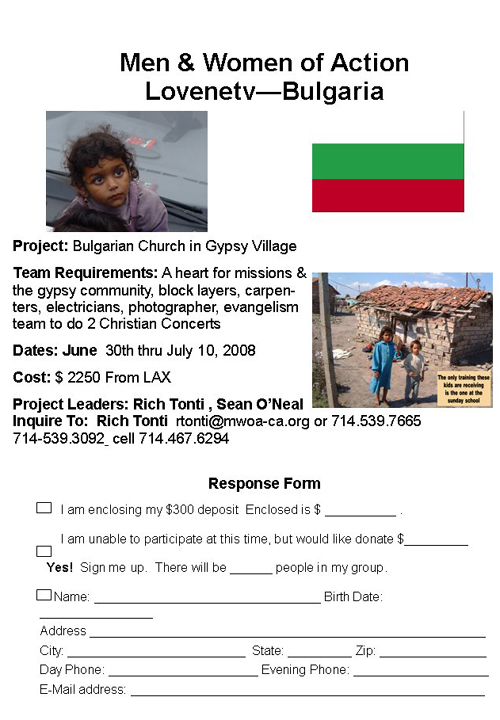
Men & Women of Action in Bulgaria
New Bulgarian Translation of the Bible Released
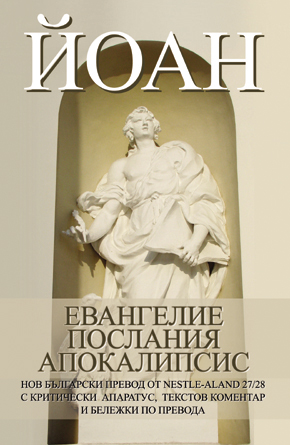 Cup & Cross Ministries has released a new translation of the complete Johannine works (the Gospel, Epistles and Revelation) for the Bulgarian Easter on April 27, 2008.The final result of this project is a 90-page book including Bulgarian literal translation from the Greek originals NA 27/28, critical apparatus, textual commentary and translators notes. The book is successful in its purposes to provide a literal translation in the Bulgarian vernacular, exact preservation of the word order from the original text, translation of the Greek grammatical forms, as well as the Hebrew and Aramaic linguistic uniqueness of the text and a preservation of the original parts of speech and verb tenses. Read more
Annual Conference of Bulgarian Evangelical Churches in North America
The seventh annual conference of Bulgarian Evangelical Churches in North America was held in Minneapolis May 24-26, 2008 under the theme “Fruitful in the Spirit.” The conference gathered Bulgarian evangelical believers from various parts of North America, but unfortunately the attendance was lower than previous years as the Bulgarian groups in Atlanta, GA; Nashville, TN; Ft. Lauderdale, FL and the Evangelical churches in Canada were without representatives.
Having worked with Bulgarian communities across the United States for some 15 years now while studying them for the purposes of our doctoral and postdoctoral research it is easily noticed, that the trends that led to the disappearance of Bulgarian Protestant communities in North America some 100 years ago are in the process of repeating themselves. This has been a personal concern of ours since we participated in the establishment of the first Bulgarian Church of God outside of Bulgaria in the city of Chicago. These issues can be summarized as follows.
Firstly, the problem in ministry remains unresolved through the continuous failure to provide the tri-dimensional dilemma of leadership, finances and culture. The resulting strife for preservation of the typical Bulgarian post communist mentality and “underground” style of ministry proves itself again and again incompatible with the American reality.
Secondly, the “regular” biannual division of congregations, which has become almost inevitable in the Bulgarian context, is hurting the churches preventing them from implementing a successful healing and growth process. These divisions evolve mainly from a misunderstood cell group model for “home-churching” which has proven ineffective in the Bulgarian cultural settings. The lack of an adequate split protection plan also contributes to this issue. At best, congregations spent all their resources managing to retain structure and prevent splits, while leaving no resources for further growth through reaching unchurched Bulgarian immigrants.
And thirdly, just like it happened some 100 years ago with the established Bulgarian protestant communities across North America, loosing the second generations of Bulgarian evangelical believers has become a counter priority. Perhaps because, Bulgarian congregations in the beginning of the 21st century are beginning to realize that it will inevitably mean the disappearance of Bulgarian Evangelical churches across North America as a whole. It is there, in winning the second generation of Bulgarian believers, where the key to survival of Bulgarian congregations lays.
It is encouraging, at the same time, to observer that one of the positive estimates provided by our doctoral project is also coming to reality. In 2002-2004, based on analyses provided by the New Religious Immigrants Project, our research suggested that the next Bulgarian Evangelical Church will be established in the last of the Seven American Gateway Cities which was still without a Bulgarian Church, namely the city of San Francisco. Our resent visit in the area of the Bay Area showed that this prediction is already progressing into a reality as the Bulgarian Diaspora there is already producing a Bible study group out of uniting Bulgarian college students from Barkley and young computer professionals in the area.
Resources for Further Study:
- Seven Churches of Revelation
- How to Start a Bulgarian Church in America from A-to-Z
- Bulgarian Churches in North America: Contextual Assessment
- Bulgarian Churches in North America: Statement of Problem
Seven Churches of Revelation
While Bulgarian Protestant churches and missions in Northern America have been present since the early twentieth century, networking between them is a rather new phenomenon that has occurred for less than a decade. Because of its recent existence, historical records and documented information on the subject is not yet available. However, the mission and vision of such a movement is not new to the Bible.
Cross-cultural church planting is seen repeatedly in the Scriptures. The Synagogue Movement during the times of Jewish slavery is a prime Old Testament example. The New Testament church and the spread of Christianity in the ancient East and the Roman Empire are other examples. In such cases, the mission and vision of religious formation presented in the Bible are applicable to the needs of a contemporary ethnic community of believers.
Of greater significance for this research is networking among religious communities in the Bible. The fact that such process exists is obvious from regular gatherings of New Testament church leaders in councils to make decisions and find solutions for problematic situations. The best example of church networking in a context of cross-cultural ministry is the description of the Seven Churches of Revelation.
This study will examine the text of Revelation chapters two and three in order to analyze similarities in problems and solutions in relation to the problem of ministry of the Bulgarian churches in America. The Scripture review will approach the Seven Churches from Revelation in a way very similar to the larger outline of the present doctoral project. Through establishing the general characteristics of the Seven Churches of Revelation, the cripture review will place the cultural, economic and leadership dilemmas within the churches’ context of ministry. It will then survey the churches and their relationships to the said dilemmas and will provide a statistical overview of the frequency of their occurrence. Finally, the Scripture review will analyze the results in light of the solutions proposed in the text of chapters two and three of the book of Revelation.


